MCQ
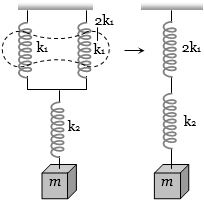
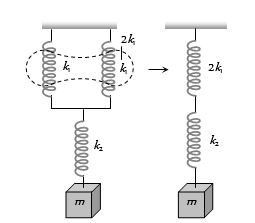
What will be the force constant of the spring system shown in the figure
  • A
    $\frac{{{K_1}}}{2} + {K_2}$
  • ${\left[ {\frac{1}{{2{K_1}}} + \frac{1}{{{K_2}}}} \right]^{ - 1}}$
  • C
    $\frac{1}{{2{K_1}}} + \frac{1}{{{K_2}}}$
  • D
    ${\left[ {\frac{2}{{{K_1}}} + \frac{1}{{{K_1}}}} \right]^{ - 1}}$
Answer

Correct option: B.
${\left[ {\frac{1}{{2{K_1}}} + \frac{1}{{{K_2}}}} \right]^{ - 1}}$
b
(b)In series combination
$\frac{1}{{{k_S}}} = \frac{1}{{2{k_1}}} + \frac{1}{{{k_2}}}$
==> ${k_S} = {\left[ {\frac{1}{{2{k_1}}} + \frac{1}{{{k_2}}}} \right]^{ - 1}}$

Need a full question paper?

Generate a complete, print-ready paper with questions like this in minutes — across 16+ boards, with answer keys.

Start Generating Free

Similar questions

Which of the following parameters is the same for molecules of all gases at a given temperature?
Two coaxial discs, having moments of inertia $I_1$ and $\frac{I_1}{2}$ are a rotating with respectively angular velocities $\omega_1$ and $\frac{\omega_1}{2}$, about their common axes. They are brought in contact with each other and thereafter they rotate with a common angular velocity. If $E_f$ and $E_i$ are the final and initial total energies, then $(E_f -E_i)$ is
A car is moving on a circular level road of curvature $300\,metres.$ If the coefficient of friction is $0.3$ and acceleration due to gravity is $10\,m/s^2,$ the maximum speed the car can have is ........ $km/hr$ 
Three blocks are initially placed as shown in the figure. Block $A$ has mass $m$ and initial velocity $v$ to the right. Block $B$ with mass $m$ and block $C$ with mass $4m$ are both initially at rest. Neglect friction. All collisions are elastic. The final velocity of block $A$ is
A police car with a siren of frequency $8$ $kHz$ is moving with uniform velocity $36$ $km/hr$ towards a tall building which reflects the sound waves. The speed of sound in air is $320$ $m/s$. The frequency of the siren heard by the car driver is .... $kHz$
The rebound coefficient between a tennis ball and a racket is defined as $g = v_2/ v_1$, where $v_1$ is the incoming speed of the ball and $v_2$ is the speed of the ball after rebound while the racket is at rest. A tennis ball falls from height $H$ to a racket at rest and bounces back to $0.8\  H. A$ tennis player is using the racket to hit an incoming tennis ball traveling at $150\ km/hr$ and the racket is moving at $100\ km/hr$. What is the speed of the ball after being hit? (Assume the mass of the racket >> that of the ball)..........$km/hr$
A sound source is moving on a circular path of radius $R$ with constant angular speed $\omega $ in anticlockwise direction and emits a frequency $n$ . An observer performs simple harmonic along the path $QPR$ with time period $T = \frac {2\pi }{\omega }$ as shown in the figure. If at $t = 0$ source is at $A$ and observer is at $Q$ and assume $OP$ is very large as compare to radius $R$ and $QP$ , then 
An inclined plane makes an angle of $30^{\circ}$ with the horizontal. A solid sphere rolling down this inclined plane from rest without slipping has a linear acceleration equal to ........
A projectile is thrown at an angle $\theta$ with the horizontal and its range is $R_1$. It is then thrown at an angle $\theta$ with vertical and the range is $R_2$, then
Pressure gradient has the same dimension as that of