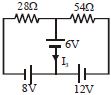
When a current of $2\,A$ flows in a battery from negative to positive terminal, the potential difference across it is $12\,V$. If a current of $3\,A$ flows in the opposite direction potential difference across the terminals of the battery is $15\,V$, the emf of the battery is ............... $\mathrm{V}$
Medium



Download our appand get started for free
Experience the future of education. Simply download our apps or reach out to us for more information. Let's shape the future of learning together!No signup needed.*
Similar Questions
- 1View SolutionWhich of the following is not equal to watt
- 2Two bulbs consume same power when operated at $200\, V$ and $300\, V$ respectively. When these bulbs are connected in series across a $D.C$. source of $500\, V$, thenView Solution
- 3Two wires of same length and thickness having specific resistances $6\, \Omega \,cm$ and $3 \,\Omega\, cm$ respectively are connected in parallel. The effective resistivity is $\rho\, \Omega \,cm$. The value of $\rho$ to the nearest integer, is ..... .View Solution
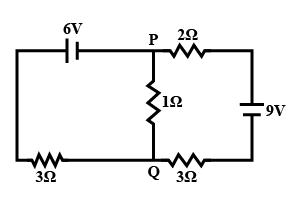
- 4In the circuit shown, the current in the $1\,\Omega$ resistor isView Solution
- 5View SolutionIf an electric current is passed through a nerve of a man, then man
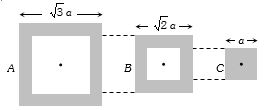
- 6Following figure shows cross-sections through three long conductors of the same length and material, with square cross-section of edge lengths as shown. Conductor $B$ will fit snugly within conductor $A$, and conductor $C$ will fit snugly within conductor $B$. Relationship between their end to end resistance isView Solution
- 7Two bulbs are in parallel and they together consume $48\, W$ from a battery of $6\, V$. The resistance of each bulb is ............ $\Omega$View Solution
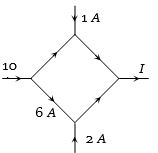
- 8The figure shows a network of currents. The magnitude of currents is shown here. The current $I$ will be ........... $A$View Solution
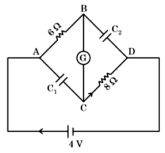
- 9In this figure the resistance of the coil of galvanometer $G$ is $2\,\Omega$. The emf of the cell is $4\,V$. The ratio of potential difference across $C_1$ and $C_2$ is:View Solution
- 10Consider the circuit shown in the figure. The current $I_3$ is equal toView Solution