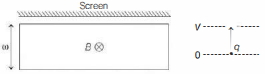
Which of the following particle will describe the smallest circle when projected with the same velocity perpendicular to the magnetic field ?
Easy
Download our app for free and get started
In this case path of charged particle is circular and magnetic force provides the necessary centripetal force, i.e., $\mathrm{Bqv}=\frac{\mathrm{mv}^{2}}{\mathrm{r}}$
or radius of path, $\mathrm{r}=\frac{\mathrm{mv}}{\mathrm{Bq}}$
since, $v$ and $B$ will remain same $r \propto \frac{m}{q}$. The ratio is least for electron. Therefore, it will describe the smallest circle.

Download our appand get started for free
Experience the future of education. Simply download our apps or reach out to us for more information. Let's shape the future of learning together!No signup needed.*
Similar Questions
- 1View SolutionIf the direction of the initial velocity of the charged particle is neither along nor perpendicular to that of the magnetic field, then the orbit will be
- 2View SolutionIn order to increase the sensitivity of a moving coil galvanometer, one should decrease
- 3A particle of mass $M$ and charge $Q$ moving with velocity $\mathop v\limits^ \to $ describes a circular path of radius $R$ when subjected to a uniform transverse magnetic field of induction $B$. The work done by the field when the particle completes one full circle isView Solution
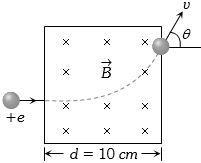
- 4A proton accelerated by a potential difference $500\;KV$ moves though a transverse magnetic field of $0.51\;T$ as shown in figure. The angle $\theta $through which the proton deviates from the initial direction of its motion is......$^o$View Solution
- 5A current of $I$ $ampere$ is passed through a straight wire of length $2.0$ $metres$. The magnetic field at a point in air at a distance of $3$ $metres$ from either end of wire and lying on the axis of wire will beView Solution
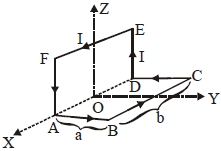
- 6A wire carrying current $I$ is bent in the shape $A\,B\,C\,D\,E\,F\,A$ as shown, where rectangle $A\,B\,C\,D\,A$ and $A\,D\,E\,F\,A$ are perpendicular to each other. If the sides of the rectangles are of lengths $a$ and $b,$ then the magnitude and direction of magnetic moment of the loop $A\,B\,C\,D\,E\,F\,A\,$ isView Solution
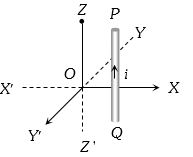
- 7A vertical wire kept in $Z-X$ plane carries a current from $Q$ to $P$ (see figure). The magnetic field due to current will have the direction at the origin $O$ alongView Solution
- 8A closely wound solenoid of $2000$ $turns$ and area of cross-section $1.5 \times 10^{-4}\ m^2$ carries a current of $2.0\, A.$ It is suspended through its centre and perpendicular to its length, allowing it to turn in a horizontal plane in a uniform magnetic field $5 \times 10^{- 2}$ $tesla$ making an angle of $30^o $ with the axis of the solenoid. The torque on the solenoid will beView Solution
- 9In the figure shown a coil of single turn is wound on a sphere of radius $R$ and mass $m.$ The plane of the coil is parallel to the plane and lies in the equatorial plane of the sphere. Current in the coil is $i$. The value of $B$ if the sphere is in equilibrium isView Solution
- 10A rectangular region of dimensions ( $\omega \times l(\omega) \ll l$ ) has a constant magnetic field into the plane of the paper as shown in the figure below. On one side, the region is bounded by a screen. On the other side, positive ions of mass $m$ and charge $q$ are accelerated from rest and towards the screen by a parallel plate capacitor at constant potential difference $V < 0$ and come out through a small hole in the upper plate. Which one of the following statements is correct regarding the charge on the ions that hit the screen?View Solution