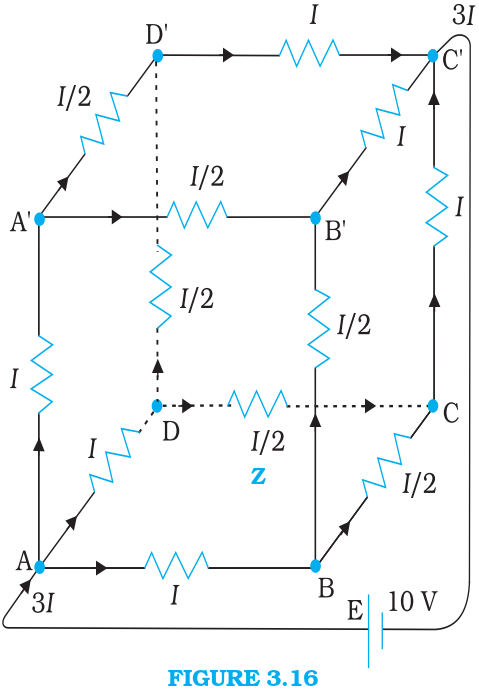
A battery of $10 V$ and negligible internal resistance is connected across the diagonally opposite corners of a cubical network consisting of 12 resistors each of resistance $1 \Omega$ (Fig. 3.16). Determine the equivalent resistance of the network and the current along each edge of the cube.
Example-(3.5)
Download our app for free and get started
The network is not reducible to a simple series and parallel combinations of resistors. There is, however, a clear symmetry in the problem which we can exploit to obtain the equivalent resistance of the network.
The paths $AA ^{\prime}, AD$ and $AB$ are obviously symmetrically placed in the network. Thus, the current in each must be the same, say, $I$. Further, at the corners $A ^{\prime}, B$ and $D$, the incoming current $I$ must split equally into the two outgoing branches. In this manner, the current in all the 12 edges of the cube are easily written down in terms of $I$, using Kirchhoff's first rule and the symmetry in the problem.
Next take a closed loop, say, ABCC'EA, and apply Kirchhoff's second rule:
$
-I R-(1 / 2) I R-I R+\varepsilon=0
$
where $R$ is the resistance of each edge and $\varepsilon$ the emf of battery. Thus,
$
\varepsilon=\frac{5}{2} I R
$
The equivalent resistance $R_{e q}$ of the network is
$
R_{e q}=\frac{\varepsilon}{3 I}=\frac{5}{6} R
$
For $R=1 \Omega, R_{e q}=(5 / 6) \Omega$ and for $\varepsilon=10 V$, the total current ( $=3 I$ ) in the network is
$
3 I=10 V /(5 / 6) \Omega=12 \text { A, i.e., } I=4 A
$
The current flowing in each edge can now be read off from the Fig. 3.16.
The paths $AA ^{\prime}, AD$ and $AB$ are obviously symmetrically placed in the network. Thus, the current in each must be the same, say, $I$. Further, at the corners $A ^{\prime}, B$ and $D$, the incoming current $I$ must split equally into the two outgoing branches. In this manner, the current in all the 12 edges of the cube are easily written down in terms of $I$, using Kirchhoff's first rule and the symmetry in the problem.
Next take a closed loop, say, ABCC'EA, and apply Kirchhoff's second rule:
$
-I R-(1 / 2) I R-I R+\varepsilon=0
$
where $R$ is the resistance of each edge and $\varepsilon$ the emf of battery. Thus,
$
\varepsilon=\frac{5}{2} I R
$
The equivalent resistance $R_{e q}$ of the network is
$
R_{e q}=\frac{\varepsilon}{3 I}=\frac{5}{6} R
$
For $R=1 \Omega, R_{e q}=(5 / 6) \Omega$ and for $\varepsilon=10 V$, the total current ( $=3 I$ ) in the network is
$
3 I=10 V /(5 / 6) \Omega=12 \text { A, i.e., } I=4 A
$
The current flowing in each edge can now be read off from the Fig. 3.16.

Download our appand get started for free
Experience the future of education. Simply download our apps or reach out to us for more information. Let's shape the future of learning together!No signup needed.*
Similar Questions
- 1Two heating elements of resistances $R_{1}$ and $R_{2}$ when operated at a constant supply of voltage, $V$, Consume power $P_1$ and $P_2$ respectively. Deduce the expressions for the power of their combination when they are, in turn, connected in $(i)$ series and $(ii)$ parallel across the same voltage supply.View Solution
- 2A capacitor of capacitance $10\mu\text{F}$ is connected across a battery of emf 6.0V through a resistance of $20\text{k}\Omega$ for 4.0s. The battery is then replaced by a thick wire. What will be the charge on the capacitor 4.0s after the battery is disconnected?View Solution
- 3View SolutionProve that the current density of a metallic conductor is directly proportional to the drift speed of electrons.
- 4View SolutionTwo heated wires of the same dimensions are first connected in series and then in parallel to a source of supply. What will be the ratio of heat produced in the two cases?
- 5View SolutionHow many time constants will elapse before the current in a charging RC circuit drops to half of its initial value? Answer the same question for a discharging RC circuit.
- 6A cell of emf 'E' and internal resistance 'r' is connected across a variable load resistor R. Draw the plots of the terminal voltage V versus (i) R and (ii) the current I.View Solution
It is found that when R = 4$\Omega$, the current is 1 A and when R is increased to 9$\Omega$, the current reduces to 0.5 A. Find the values of the emf E and internal resistance r. - 7A coil of resistance $100\Omega$ is connected across a battery of emf $6.0V.$ Assume that the heat developed in the coil is used to raise its temperature. If the heat capacity of the coil is $4.0J/K,$ how long will it take to raise the temperature of the coil by $15^\circ C$?View Solution
- 8View Solution
- In a metre bridge [Fig. 3.27], the balance point is found to be at 39.5 cm from the end A, when the resistor Y is of $12.5\ \Omega.$ Determine the resistance of X. Why are the connections between resistors in a Wheatstone or meter bridge made of thick copper strips?
- Determine the balance point of the bridge above if X and Y are interchanged.
- What happens if the galvanometer and cell are interchanged at the balance point of the bridge? Would the galvanometer show any current?
- 9Calculate the temperature at which the resistance of a conductor becomes 20% more than its resistance at 27°C. The value of the temperature coefficient of resistance of the conductor is $2.0 \times 10\frac{-4}{\text{K}}.$View Solution
- 10View SolutionDefine the terms (i) drift velocity, (ii) relaxation time.
A conductor of length L is connected to a dc source of emf ε. If this conductor is replaced by another conductor of same material and same area of cross-section but of length 3L, how will the drift velocity change?