Why the dam of water reservoir is thick at the bottom
Easy


Download our appand get started for free
Experience the future of education. Simply download our apps or reach out to us for more information. Let's shape the future of learning together!No signup needed.*
Similar Questions
- 1According to Bernoulli's equation $\frac{P}{{\rho g}} + h + \frac{1}{2}\,\frac{{{v^2}}}{g} = {\rm{constant}}$ The terms $A, B$ and $ C$ are generally called respectively:View Solution
- 2A uniform cylinder of length $L$ and mass $M$ having crosssectional area $A$ is suspended, with its length vertical, from a fixed point by a massless spring such that it is half submerged in a liquid of density $\sigma$ at equilibrium position. The extension $x_0$ of the spring when it is in equilibrium isView Solution
- 3A wooden block of volume $1000\, cm^3$ is suspended from a spring balance. It weighs $12$ $N$ in air. It is suspended in water such that half of the block is below the surface of water. The reading of the spring balance is ...... $N$View Solution
- 4The terminal velocity of a small sphere of radius $a$ in a viscous liquid is proportional toView Solution
- 5A triangular lamina of area $A$ and height h is immersed in a liquid of density $\rho $ in a vertical plane with its base on the surface of the liquid. The thrust on the lamina isView Solution
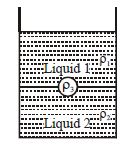
- 6Diagram shows a jar filled with two non mixing liquids $1$ and $2$ having densities ${\rho _1}$ and ${\rho _2}$ respectively. A solid ball, made of a material of density ${\rho _3}$ , is dropped in the jar. It comes to equilibrium in the position shown in the figure. Which of the following is true for ${\rho _1}$ , ${\rho _2}$ and ${\rho _3}$ ?View Solution
- 7Blood velocity: The flow of blood in a large artery of an anesthetised dog is diverted through a Venturi meter. The wider part of the meter has a crosssectional area equal to that of the artery. $A = 8\; mm^2$. The narrower part has an area $a = 4 \;mm^2$. The pressure drop in the artery is $24\; Pa$. What is the speed (in $m/s$) of the blood in the artery?View Solution
- 8A long cylindrical vessel is half filled with a liquid. When the vessel is rotated about its own vertical axis, the liquid rises up near the wall. If the radius of vessel is $5\,cm$ and its rotational speed is $2$ rotations per second, then the difference in the heights between the centre and the sides, in $cm,$ will beView Solution
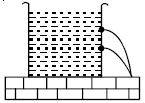
- 9In a cylindrical vessel containing liquid of density $\rho $, there are two holes in the side walls at heights of $ h_1$ and $h_2$ respectively such that the range of efflux at the bottom of the vessel is same. The height of a hole, for which the range of efflux would be maximum, will beView Solution
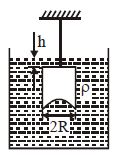
- 10A hemispherical portion of radius $R$ is removed from the bottom of a cylinder of radius $R$. The volume of the remaining cylinder is $V$ and mass $M$. It is suspended by a string in a liquid of density $\rho$, where it stays vertical. The upper surface of cylinder is at a depth $h$ below the liquid surface. The force on the bottom of the cylinder by the liquid isView Solution