Four bodies have been arranged at the corners of a rectangle shown in figure. Find the centre of mass of the system.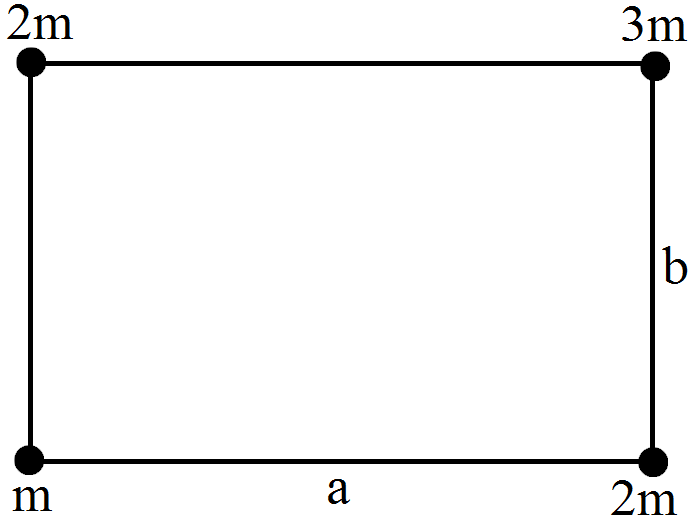
Download our app for free and get started
Let $m_1 = m, m_2 = 2m, m_3 = 3m, m_4= 2m$
Let mass m, be at origin.
$\therefore\text{ For }\text{m}_1;\text{x}_1=0,\text{y}_1=0$
$\text{For }\text{m}_2;\text{x}_2=\text{a}\hat{\text{i}}$
$\text{y}_2=0$
$\text{For }\text{m}_4;\text{x}_4=0,\text{y}-4=\text{b}\hat{\text{j}}$
Coordinates of COM of the system are
$\text{x}=\frac{\text{m}_1\text{x}_1+\text{m}_2\text{x}_2+\text{m}_3\text{x}_3+\text{m}_4\text{x}_4}{\text{m}_1+\text{m}_2+\text{m}_3+\text{m}_4}$
$=\frac{\text{m}\times02\text{m}\times\text{a}\hat{\text{i}}+3\text{m}\times\text{a}\hat{\text{i}}+2\text{m}\times0}{\text{m}+2\text{m}+\text{3m}+2\text{m}}$
$\text{x}=\frac{5\text{ma}\hat{\text{i}}}{8\text{m}}=\frac{5\text{a}\hat{\text{i}}}{8}$
$\text{y}=\frac{\text{m}_1\text{y}_1+\text{m}_2\text{y}_2+\text{m}_3\text{y}_3+\text{m}_4\text{y}_4}{\text{m}_+\text{m}_2+\text{m}_3+\text{m}_4}$
$=\frac{\text{m}\times0+2\text{m}\times0+3\text{m}\times\text{b}\hat{\text{j}}+2\text{m}\times\text{b}\hat{\text{j}}}{\text{m}+2\text{m}+3\text{m}+\text{2m}}$
$=\frac{5\text{mb}\hat{\text{j}}}{8\text{m}}=\frac{5}{8}\text{b}\hat{\text{j}}$
$\therefore$ Centre of mass of system is $\frac{5}{8}(\text{a}\hat{\text{i}}+\text{b}\hat{\text{j}})$
Let mass m, be at origin.
$\therefore\text{ For }\text{m}_1;\text{x}_1=0,\text{y}_1=0$
$\text{For }\text{m}_2;\text{x}_2=\text{a}\hat{\text{i}}$
$\text{y}_2=0$
$\text{For }\text{m}_4;\text{x}_4=0,\text{y}-4=\text{b}\hat{\text{j}}$
Coordinates of COM of the system are
$\text{x}=\frac{\text{m}_1\text{x}_1+\text{m}_2\text{x}_2+\text{m}_3\text{x}_3+\text{m}_4\text{x}_4}{\text{m}_1+\text{m}_2+\text{m}_3+\text{m}_4}$
$=\frac{\text{m}\times02\text{m}\times\text{a}\hat{\text{i}}+3\text{m}\times\text{a}\hat{\text{i}}+2\text{m}\times0}{\text{m}+2\text{m}+\text{3m}+2\text{m}}$
$\text{x}=\frac{5\text{ma}\hat{\text{i}}}{8\text{m}}=\frac{5\text{a}\hat{\text{i}}}{8}$
$\text{y}=\frac{\text{m}_1\text{y}_1+\text{m}_2\text{y}_2+\text{m}_3\text{y}_3+\text{m}_4\text{y}_4}{\text{m}_+\text{m}_2+\text{m}_3+\text{m}_4}$
$=\frac{\text{m}\times0+2\text{m}\times0+3\text{m}\times\text{b}\hat{\text{j}}+2\text{m}\times\text{b}\hat{\text{j}}}{\text{m}+2\text{m}+3\text{m}+\text{2m}}$
$=\frac{5\text{mb}\hat{\text{j}}}{8\text{m}}=\frac{5}{8}\text{b}\hat{\text{j}}$
$\therefore$ Centre of mass of system is $\frac{5}{8}(\text{a}\hat{\text{i}}+\text{b}\hat{\text{j}})$

Download our appand get started for free
Experience the future of education. Simply download our apps or reach out to us for more information. Let's shape the future of learning together!No signup needed.*
Similar Questions
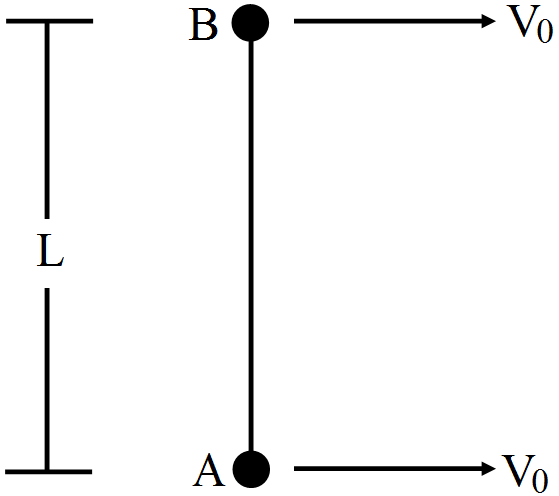
- 1View SolutionTwo small balls A and B, each of mass m, are joined rigidly to the ends of a light rod of lengh L (figure). The system translates on a frictionless horizontal surface with a velocity vo in a direction perpendicular to the rod. A particle P of mass m kept at rest on the surface sticks to the ball A as the ball collides with it. Find:
- The linear speeds of the balls A and B after the collision.
- The velocity of the centre of mass C of the system A + B + P.
- The angular speed of the system about C after the collision.
- 2View SolutionExplain why friction is necessary to make the disc in roll in the direction indicated.
- Give the direction of frictional force at B, and the sense of frictional torque, before perfect rolling begins.
- What is the force of friction after perfect rolling begins?
- 3View SolutionA uniform rod of length L lies on a smooth horizontal table. A particle moving on the table strikes the rod perpendicularly at an end and stops. Find the distance travelled by the centre of the rod by the time it turns through a right angle. Show that if the mass of the rod is four times that of the particle, the collision is elastic.
- 4View SolutionTwo discs of same mass and thickness are made of materials having different densities. Which one of them will have larger M.I.?
- 5View SolutionTorques of equal magnitude are applied to a hollow cylinder and a solid sphere, both having the same mass and radius. The cylinder is free to rotate about its standard axis of symmetry, and the sphere is free to rotate about an axis passing through its centre. Which of the two will acquire a greater angular speed after a given time.
- 6A solid disc and a ring, both of radius $10cm$ are placed on a horizontal table simultaneously, with initial angular speed equal to 10 π rad $s^{-1}$. Which of the two will start to roll earlier? The co-efficient of kinetic friction is $\mu_\text{k}=0.2$View Solution
- 7View SolutionHow much fraction of the kinetic energy of rolling is purely:
- Translational.
- Rotational.
- 8A cylinder of mass $5kg$ and radius $30cm$ and free to rotate about its axis, receives an angular impulse of $3kgm^2 s^{-1}$ followed by a similar impulse after every $4$ seconds. What is the angular speed of the cylinder $30s$ after the initial impulse? The cylinder is at rest initially.View Solution
- 9View SolutionDefine radius of gyration and give the physical significance of moment of inertia.
- 10Point masses $m_1$ and $m_2$ are placed at the opposite ends of a rigid rod of length L, and negligible mass. The rod is to be set in rotation about an axis perpendicular to it. Find the position on this rod through which the axis should pass in order that the work required to set the rod in rotation with angular velocity $\omega_0$ should be minimum.View Solution