Question
Write the significance/applications of dipole moment.
Answer

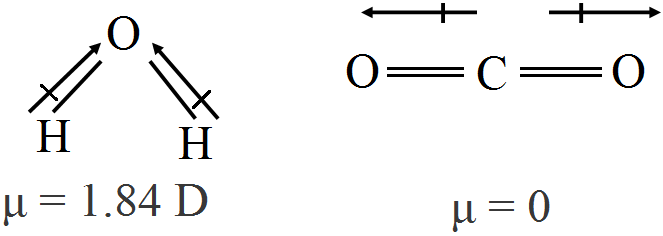
In heteronuclear molecules, polarization arises due to a difference in the electronegativities of the constituents of atoms. As a result, one end of the molecule acquires a positive charge while the other end becomes negative. Hence, a molecule is said to possess a dipole.
The product of the magnitude of the charge and the distance between the centres of positive-negative charges is called the dipole moment $(\mu)$ of the molecule. It is a vector quantity and is represented by an arrow with its tail at the positive centre and head pointing towards a negative centre.
Dipole moment $(\mu)=$ charge $(\mathrm{Q}) \times$ distance of separation $(r)$
The SI unit of a dipole moment is 'esu'.
1 esu $=3.335 \times 10^{-30} \mathrm{Cm}$
Dipole moment is the measure of the polarity of a bond. It is used to differentiate between polar and non-polar bonds since all non-polar molecules (e.g. $\mathrm{H}_2, \mathrm{O}_2$ ) have zero dipole moments. It is also helpful in calculating the percentage ionic character of a molecule.

Need a full question paper?

Generate a complete, print-ready paper with questions like this in minutes — across 16+ boards, with answer keys.

Start Generating Free

Similar questions

Calculate the wavenumber for the longest wavelength transition in the Balmer series of atomic hydrogen.
Draw the structures of $\mathrm{BCl}_3$. $\mathrm{NH}_3$ and $\mathrm{AlCl}_3$ (dimer).
  1. What is the increasing order of the acidity of the compounds, $H_2O, H_2S$ and $H$, Se? Give reason for your answer.
  2. Complete and balance the following chemical equations:
    1. $\text{Na}+\text{D}_2\text{O}\xrightarrow{\ \ \ \ \ \ \ \ \ \ }$
    2. $\text{SO}_3+\text{D}_2\text{O}\xrightarrow{\ \ \ \ \ \ \ \ \ \ \ }$
    3. $\text{Na}_2\text{O}+\text{D}_2\text{O}\xrightarrow{\ \ \ \ \ \ \ \ \ \ }$
Match the species in Column I with the type of hybrid orbitals in Column II.
 
Column I
 
Column II
i.
$SF_4$
a.
$sp^3d^2$
ii.
$IF_5$
b.
$d^2sp$
iii.
$\text{NO}^{+}_{2}$
c.
$sp^3d$
iv.
$\text{NH}^{+}_{4}$
d.
$sp^3$
 
 
e.
$Sp$
What are biodegradable and non-biodegradable pollutants?
Describe the bulk preparation of dihydrogen by electrolytic method. What is the role of an electrolyte in this process?
Predict the products of electrolysis in the following:
An aqueous solution of $CuCl_2$ with platinum electrodes.
Give three points of differences between inductive effect and resonance effect.
  1. Balance and complete the following reactions:
  1. $\text{Fe(s)}+\text{H}_2\text{O}\xrightarrow{\ \ \ \ \ \ \ \ }$
  2. $\text{Zn(s)}+\text{NaOH}(\text{aq})\xrightarrow{\ \ \ \ \ \ \ \ \ \ }$
  3. $\text{Mg(s)}+\text{HNO}_3(\text{aq})\xrightarrow{\ \ \ \ \ \ \ \ \ }$
(b) Write chemical equations for the following:
(1) $H_2O_2$, as an oxidising agent in acidic medium.
(ii) $H_2O_2$ as an reducing agent in basic medium.
(iii) $H_2O_2$ as an reducing agent in basic medium.
(iv) $H_2O_2$ as an reducing agent in acidic medium.
Explain the deactivating and metadirecting effect of nitro group (-NO2) in nitrobenzene.