Question
Write the two processes that take place in the formation of a p-n junction. Explain with the help of a diagram, the formation of depletion region and barrier potential in a p-n junction.

Answer


Due to the diffusion of electrons and holes across the junction a region of (immobile) positive charge is created on the n-side and a region of (immobile) negative charge is created on the p-side, near the junction; this is called depletion region.
Barrier potential is formed due to loss of electrons from n-region and gain of electrons by p-region. Its polarity is such that it opposes the movement of charge carriers across the junction.

Need a full question paper?

Generate a complete, print-ready paper with questions like this in minutes — across 16+ boards, with answer keys.
Start Generating Free

Similar questions

Define the current sensitivity of a galvanometer. Write its S.I. unit.
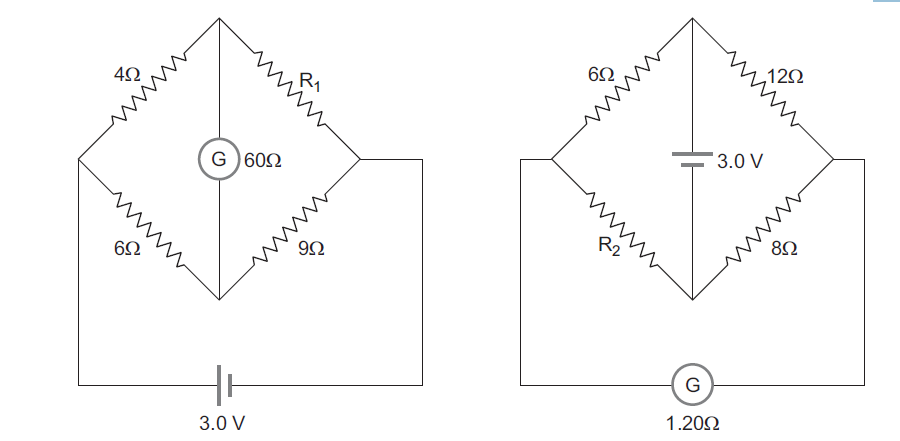
Figure shows two circuits each having a galvanometer and a battery of 3 V. When the galvanometers in each arrangement do not show any deflection, obtain the ratio R/ R2.

A solid sphere rolling on a rough horizontal surface with a linear speed v collides elastically with a fixed, smooth, vertical wall. Find the speed of the sphere after it has started pure rolling in the backward direction.
A capacitor and a resistor are joined in series with an ac source. If voltage across the ends of $C$ and $R$ be 120 V and 90 V respectively and root mean square value of current is 3 A , then calculate (i) impedance (ii) power factor of the circuit.
A long, straight wire of radius r carries a current i and is placed horizontally in a uniform magnetic field B pointing vertically upward. The current is uniformly distributed over its cross-section.
  1. At what points will the resultant magnetic field have maximum magnitude? What will be the maximum magnitude?
  2. What will be the minimum magnitude of the resultant magnetic field?
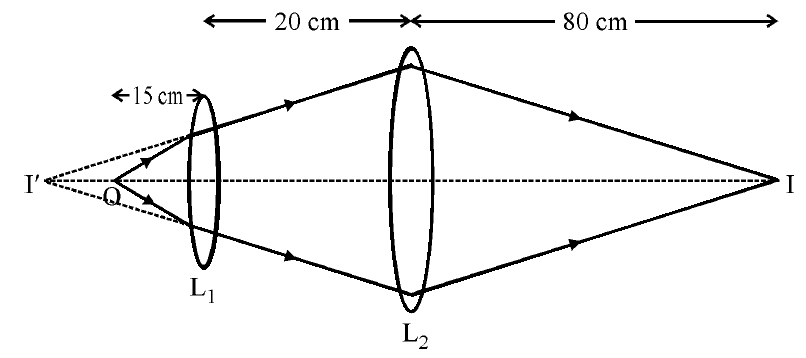
In the following diagram, an object ‘O’ is placed 15 cm in front of a convex lens L1 of focal length 20 cm and the final image is formed at ‘I’ at a distance of 80 cm from the second lens L2. Find the focal length of the lens L2.

Derive the formula for the force acting on current carrying rod placed in a magnetic field.
A pendulum having a bob of mass m is hanging in a ship sailing along the equator from east to west. When the ship is stationary with respect to water the tension in the string is T0.
  1. Find the speed of the ship due to rotation of the earth about its axis.
  2. Find the difference between T0 and the earth's attraction on the bob.
  3. If the ship sails at speed v, what is the tension in the string? Angular speed of earth's rotation is $\omega$ and radius of the earth is R.
If one of the two electrons of a H2 molecule is removed, we get a hydrogen molecular ion $\text{H}^+_2​.$ In the ground state of an $\text{H}^+_2​,$ the two protons are separated by roughly 1.5 Å, and the electron is roughly 1 Å from each proton. Determine the potential energy of the system. Specify your choice of the zero of potential energy.
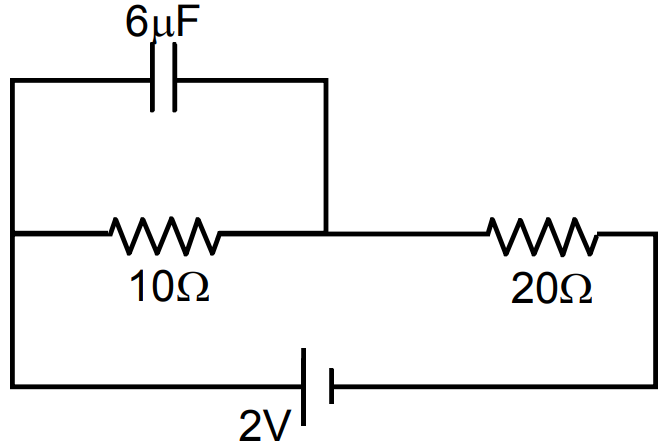
Find the charge on the capacitor shown in figure.