Question
Write two applications of electrochemical series.

Answer

I. Predicting the Liberation of Hydrogen Gas from Acids by Metals : All metals having negative electrode potentials (negative $E _{\text {red }}^0$ ) show greater tendency of losing electrons as compared to hydrogen. So, when such a metal is placed in an acid solution, the metal gets oxidised, and $H ^{+}$ions get reduced to form hydrogen gas. Thus the metals having negative $E _{ red }^0$ values liberate hydrogen from acid solution.
$M \longrightarrow M _{(a q)+n e^{-}}^{n+}$
Metal having negative $E _{\text {red }}^{\circ}$ value
Thus, $\quad n H _{(a q)}^{+}+n e^{-} \longrightarrow n / 2 H _{2(g)}$
$M +n H _{(a q)}^{+} \longrightarrow M _{(a q)}^{n+}+\frac{n}{2} H _{2(g)}$
In other words, we can say that metals which are placed above hydrogen in electro-chemical series liberate hydrogen from acids while the metals which are below hydrogen in the electro-chemical series (like $Cu , Hg , Au$, Pt etc.) do not evolve hydrogen from acids, as they have positive value of electrode reduction potential.
II. Predicting the Displacement of Metals : A metal higher in the series will displace the metal from its solution which is lower in the series i.e., the metal having low standard reduction potential will displace the metal from its salt solution which has higher value of standard reduction potential. This is due to the fact that the metal having more negative value of $E _{\text {red }}^0$ have a higher tendency to lose electrons. Thus, having a greater tendency to dissolve in solution as cations. The ions of another metal having higher $E _{\text {red }}^0$ value show a greater tendency towards reduction.
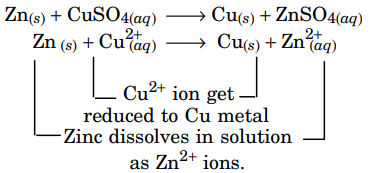
Example : Zinc displaces copper from $CuSO _4$
Solution
$Zn _{(s)}+ CuSO _{4(a q)} \longrightarrow Cu _{(s)}+ ZnSO _{4(a q)}$
or
Image
The $E _{ red }^0$ of $Zn =-0.76 V$ and for $Cu =+0.34 V$.
Zn has lower $E ^0$ value as compared to $Cu . Zn$ has greater tendency towards oxidation and $Cu ^{2+}$ ions get reduced to Cu metal.
$Zn \longrightarrow Zn ^{2+}+2 e^{-}$ $\quad$(Oxidation)
$Cu ^{2+}+2 e^{-} \longrightarrow Cu$$\quad$(Reduction)
Thus, Low displaces or reduces high
Similarly, copper displaces silver from $AgNO _3$ solution or iron can displace copper from $CuSO _4$ but silver does not displace copper.

Need a full question paper?

Generate a complete, print-ready paper with questions like this in minutes — across 16+ boards, with answer keys.
Start Generating Free

Similar questions

What is crystal field splitting energy? How does the magnitude of $\Delta_0$ decide the actual configuration of d-orbitals in a coordination entity?
(a) Differentiate between
a. Nucleotide and Nucleoside
b. Amylose and Amylopectin
(b) Write a reaction which shows that all the carbon atoms in glucose are linked in a straight chain.
(c) Write two differences between DNA and RNA.
(d) Amino acids can be classified as $\alpha-, \beta-, \gamma-, \delta-$ and so on depending upon the relative position of the amino group with respect to the carboxyl group. Which type of amino acids forms a polypeptide chain in proteins?
(e) What are any two good sources of vitamin A?
(f) What is anomeric carbon?
(g) What is the difference between a glycosidic linkage and a peptide linkage?
Answer the following question:
How will you convert phenol to benzoic acid?
A colorless substance ' $A$ ' $\left( C _6 H _7 N\right)$ is sparingly soluble in water and gives a water-soluble compound ' B ' on treating with a mineral acid. On reacting with CHCl 3 and alcoholic potash ' A ' produces an obnoxious smell due to the formation of compound ' C '. The reaction of ' A ' with benzene sulphonyl chloride gives compound ' D ' which is soluble in alkali. With $NaNO _2$ and HCl , ' A ' forms compound ' E ' which reacts with phenol in alkaline medium to give an orange dye ' $F$ '. Identify compounds ' $A$ ' to ' $F$ '.
Write equations of the following reactions :
(i) Friedel Crafts reaction-alkylation of anisole.
(ii) Nitration of anisole.
(iii) Bromination of anisole in ethanoic acid medium.
(iv) Friedel Crafts acetylation of anisole.
Explain the cyclic structure of glucose.
Explain the different methods of preparing haloakanes from alcohols.
i. Tert$-$Butylamine cannot be prepared by the action of $NH_3$ on tert$-$butyl bromic. Explain why?
ii. Suggest a convenient method for the preparation of tert$-$butylamine.
Explain the structure and classification of animes.
A first order reaction takes 30 min for 50% completion, what would be time for its 90% completion.