Question
Explain the structure and classification of animes.

Answer

SELF

Need a full question paper?

Generate a complete, print-ready paper with questions like this in minutes — across 16+ boards, with answer keys.
Start Generating Free

Similar questions

Complete the following reactions :
(i) $C _6 H _5 NH _2+ CHCl _3+$ alc. $KOH \longrightarrow$
(ii) $C _6 H _5 N_2 Cl + H _3 PO _2+ H _2 O \longrightarrow$
(iii) $C _6 H _5 NH _2+ H _2 SO _4$ (conc.) ⟶
(iv) $C _6 H _5 N_2 Cl + C _2 H _5 OH \longrightarrow$
(v) $C _6 H _5 NH _2+ Br _2(a q) \longrightarrow$
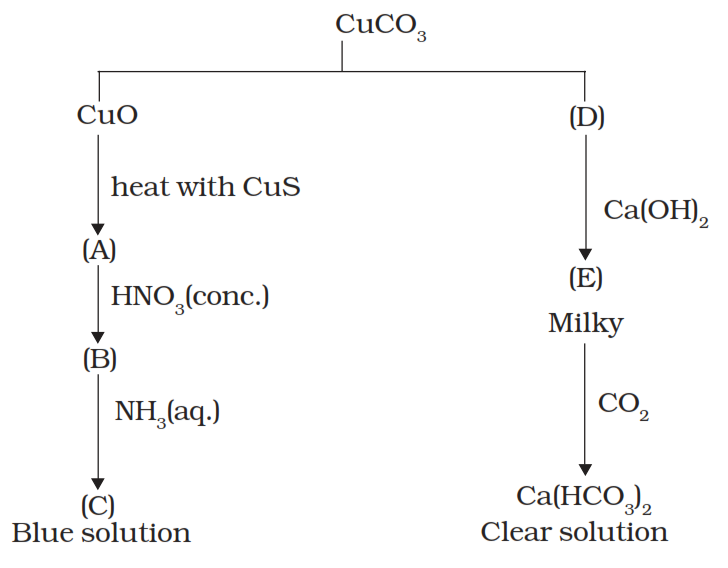
Identify $A$ to $E$ and also explain the reactions involved.
Explain Kohlrausch's law of independent migration of ions. Mention the application of Kohlrausch's law.
  1. What type of deviation is shown by a mixture of ethanol and acetone? Give reason.
  2. A solution of glucose $($molar mass $= 180\ g\ mol^{–1})$ in water is labelled as $10\% ($by mass$).$ What would be the molality and molarity of the solution?
$($Density of solution $= 1.2\ g\ mL^{–1}).$
List various types of isomerism possible for coordination compounds, giving an example of each.
$FeSO_4$ solution mixed with $\left( NH _4\right)_2 SO _4$ solution in $1:1$ molar ratio gives the test of $Fe ^{2+}$ ion but $CuSO _4$ solution mixed with aqueous ammonia in $1: 4$ molar ratio does not give the test of $Cu ^{2+}$ ion. Explain why?
Write two applications of electrochemical series.
What is polymerisation? Define the terms 'addition polymerisation' and Give one example.
State the reactions and reaction conditions for the following conversions:
i. Benzene diazonium chloride to nitrobenzene.
ii. Aniline to benzene diazonium chloride.
iii. Ethylamine to methylamine.
How does colour appear in coordination compounds? Its explanation is based on crystal field theory.