MCQ
Young's experiment establishes that
  • Light consists of waves
  • B
    Light consists of particles
  • C
    Light consists of neither particles nor waves
  • D
    Light consists of both particles and waves

Answer

Correct option: A.
Light consists of waves
a
(a)

Need a full question paper?

Generate a complete, print-ready paper with questions like this in minutes — across 16+ boards, with answer keys.
Start Generating Free

Similar questions

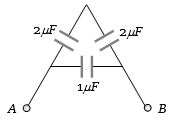
What is the effective capacitance between $A$ and $B$ in the following figure........$\mu \,F$
What happens to fringe width in Young’s double slit experiment if it is performed in glycerine instead of air
In an industrial process $10\, kg$ of water per hour is to be heated from $20°C$ to $80°C$. To do this steam at $150°C$ is passed from a boiler into a copper coil immersed in water. The steam condenses in the coil and is returned to the boiler as water at $90°C.$ how many $kg$ of steam is required per hour. $($Specific heat of steam $= 1$ $calorie \,per\, gm°C,$ Latent heat of vaporisation $= 540 \,cal/gm)$
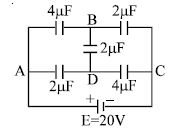
The figure shows a diagonal symmetric arrangement of capacitors and a battery. The potential of the point $B$ and $D$ are
In a Wheatstone's bridge, three resistances $P, Q$ and $R$ connected in the three arms and the fourth arm is formed by two resistances $S_1$ and $S_2$ connected in parallel. The condition for the bridge to be balanced will be
A presbyopic patient has near point as $30 \,cm$ and far point as $40 \,cm$. The dioptric power for the corrective lens for seeing distant objects is
The relation between $\lambda $ and $({T_{1/2}})$ is (${T_{1/2}}=$ half life, $\lambda=$ decay constant)
At time $t=0$, a container has $N_{0}$ radioactive atoms with a decay constant $\lambda$. In addition, $c$ numbers of atoms of the same type are being added to the container per unit time. How many atoms of this type are there at $t=T$ ?
A count rate meter shows a count of $240$ per minute from a given radioactive source. One hour later the meter shows a count rate of $30$ per minute. The half-life of the source is ..........$min$
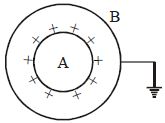
$A$ and $B$ are two concentric spheres. If $A$ is given a charge $Q$ while $B$ is earthed as shown