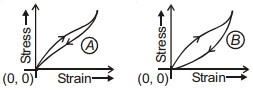
Young's modulus of rubber is ${10^4}\,N/{m^2}$ and area of cross-section is $2\,c{m^2}$. If force of $2 \times {10^5}$ dynes is applied along its length, then its initial length $l$ becomes
Medium
Download our app for free and get started
(c) $Y = {10^4}N/{m^2},A = 2 \times {10^{ - 4}}{m^2},F = 2 \times {10^5}dyne = 2N$
$l = \frac{{FL}}{{AY}} = \frac{{2 \times L}}{{2 \times {{10}^{ - 4}} \times {{10}^4}}} = L$
Final length $=$ initial length $+$ increment $= 2L$

Download our appand get started for free
Experience the future of education. Simply download our apps or reach out to us for more information. Let's shape the future of learning together!No signup needed.*
Similar Questions
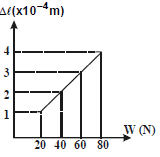
- 1The adjacent graph shows the extension $(\Delta l)$ of a wire of length $1\, m$ suspended from the top of a roof at one end and with a load $W$ connected to the other end. If the cross-sectional area of the wire is $10^{-6}\, m^2$, calculate the Young’s modulus of the material of the wire.View Solution
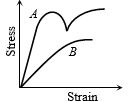
- 2The diagram shows stress v/s strain curve for the materials $A$ and $B$. From the curves we infer thatView Solution
- 3The bulk modulus of a spherical object is '$B$'. If it is subjected to uniform pressure '$P$', the fractional decrease in radius isView Solution
- 4A wire is suspended by one end. At the other end a weight equivalent to $20\, N$ force is applied. If the increase in length is $1.0\, mm$, the increase in energy of the wire will be ....... $joule$View Solution
- 5An aluminum rod (Young's modulus $ = 7 \times {10^9}\,N/{m^2})$ has a breaking strain of $0.2\%$. The minimum cross-sectional area of the rod in order to support a load of ${10^4}$Newton's isView Solution
- 6$Assertion :$ Solids are least compressible and gases are most compressible.View Solution
$Reason :$ solids have definite shape and volume but gases do not have either definite shape or definite volume. - 7A wire is suspended by one end. At the other end a weight equivalent to $20\, N$ force is applied. If the increase in length is $1.0\, mm$, the increase in energy of the wire will be ....... $joule$View Solution
- 8One end of a horizontal thick copper wire of length $2 L$ and radius $2 R$ is welded to an end of another horizontal thin copper wire of length $L$ and radius $R$. When the arrangement is stretched by a applying forces at two ends, the ratio of the elongation in the thin wire to that in the thick wire is :View Solution
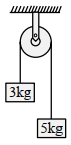
- 9Two blocks of masses $3 \,{kg}$ and $5\, {kg}$ are connected by a metal wire going over a smooth pulley. The breaking stress of the metal is $\frac{24}{\pi} \times 10^{2}\, {Nm}^{-2}$. What is the minimum radius of the wire? (Take $\left.g=10\, {ms}^{-2}\right)$ (in $cm$)View Solution
- 10View SolutionTwo different types of rubber are found to have the stress-strain curves as shown. Then