Questions · Page 3 of 6

M.C.Q [1M]

MCQ 1011 Mark
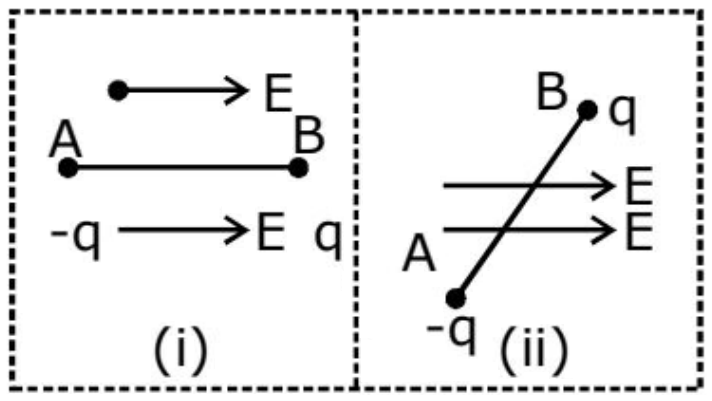
An electric dipole is placed in a uniform electric field. The net electric force on the dipole.
  • A
    Is always zero.
  • B
    Depends on the orientation of the dipole.
  • C
    Can never be zero.
  • D
    Depends on the strength of the dipole.
Answer
  1. Is always zero.

Explanation:

Net Electric force = FA + FB

= -qE + qE

= 0
View full question & answer
MCQ 1021 Mark
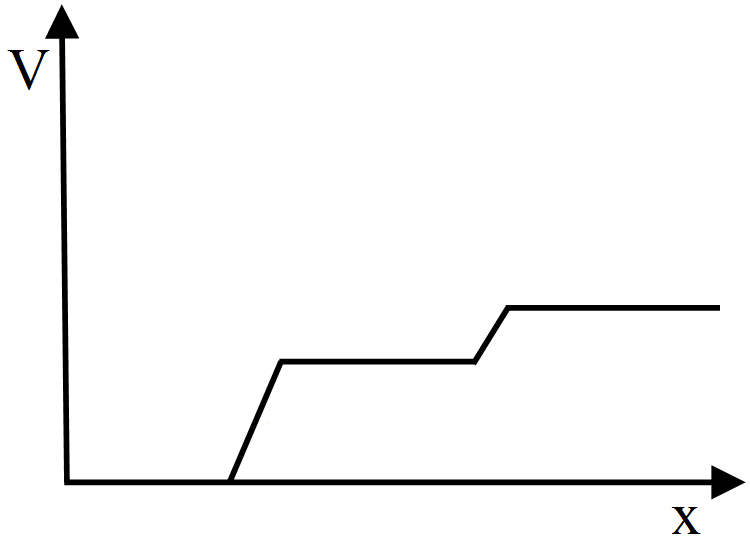
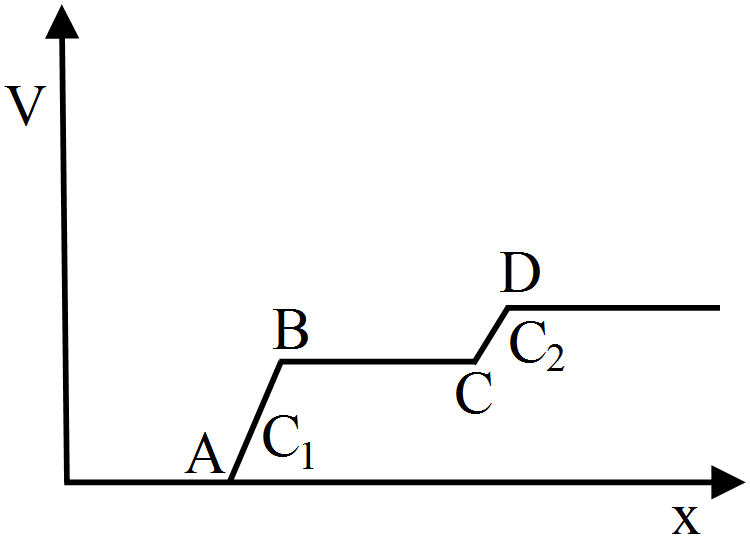
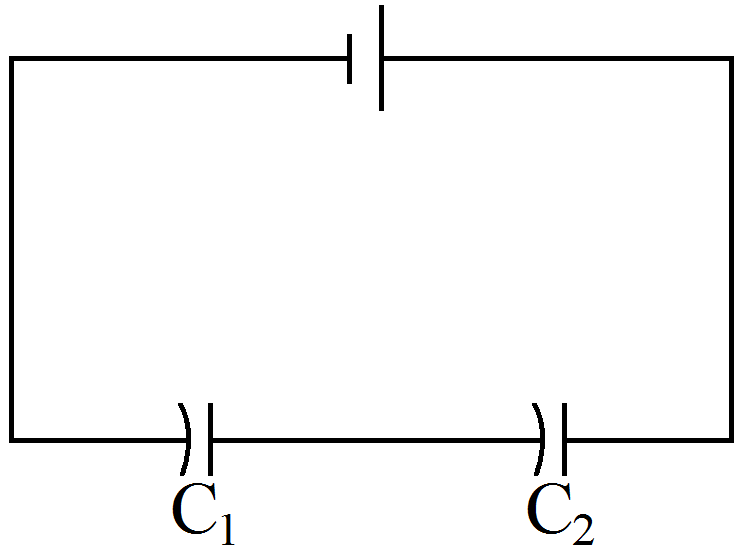
Figure shows two capacitors connected in series and joined to a battery. The graph shows the variation in potential as one moves from left to right on the branch containing the capacitors:


  • A
    C1 > C2
  • B
    C1 = C2
  • C
    C1 < C2
  • D
    The information is not sufficient to decide the relation between C1 and C2.
Answer
  1. C1 < C2

Explanation:

Region AB shows the potential difference across capacitor C​1 and region CD shows the potential difference across capacitor C2. Now, we can see from the graph that region AB is greater than region CD. Therefore, the potential difference across capacitor C1 is greater than that across capacitor C2

$\because$ Capacitance, $\text{C}=\frac{\text{Q}}{\text{V}}$

$\therefore\text{C}_1<\text{C}_2$ (Q remains the same in series connection).

View full question & answer
MCQ 1031 Mark
If a positive charge is shifted from a low-potential region to a high-potential region, the electric potential energy.
  • A
    Increases.
  • B
    Decreases.
  • C
    Remains the same.
  • D
    May increase or decrease.
Answer
  1. Increases.

Explanation:

Electric Potential Energy $=\text{q}\text{Dv}$

$=\text{q}(\text{v}_\text{f}-\text{v}_\text{i})$

If positive charge is shifted from a Low potential region to a High-Potential region, then electric Potential Energy increases.

View full question & answer
MCQ 1051 Mark
When moving electron comes closer to other stationary electron, then its kinetic energy and potential energy respectively _____ and _____.
  • A
    Increases, increases
  • B
    Increases, decreases
  • C
    Decreases, increases
  • D
    Decreases, decreases
Answer
  1. Decreases, increases

Explanation:

When electron comes closer to the other stationary electron, its kinetic energy decreases because of repulsion between them. As per conservation of energy, the potential energy increases.

View full question & answer
MCQ 1061 Mark
Mark the correct options:
  • A
    A diode valve can be used as a rectifier.
  • B
    A triode valve can be used as a rectifier.
  • C
    A diode valve can be used as an amplifier.
  • D
    A triode valve can be used as an amplifier.
Answer
  1. A diode valve can be used as a rectifier.

  2. A triode valve can be used as a rectifier.

  1. A triode valve can be used as an amplifier.

Explanation:

A diode valve and a triode valve allow current to flow only in one direction. Since a rectifier is a device that converts alternating current (bi-directional) into direct current (uni-directional), a diode valve and a triode valve can be used as rectifiers. A triode valve can control its output in proportion to the input signal. That is, it can act as an amplifier, whereas a diode valve cannot control its output in proportion to the input signal. So, it cannot be use as an amplifier.

View full question & answer
MCQ 1071 Mark
The electrostatic potential due to an electric dipole is inversely proportional to:
  • A
    $\frac{1}{\text{r}}$
  • B
    $\frac{1}{\text{r}^2}$
  • C
    $\text{r}$
  • D
    $\text{r}^2$
Answer
  1. $\text{r}^2$
View full question & answer
MCQ 1081 Mark
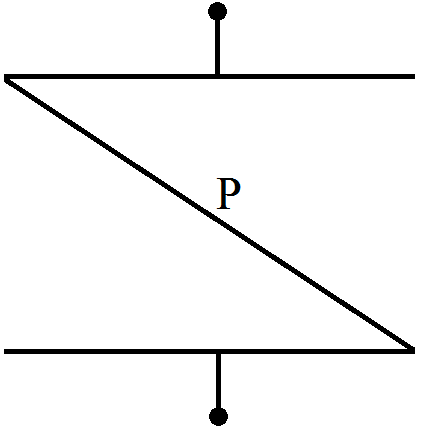
A thin metal plate P is inserted between the plates of a parallel-plate capacitor of capacitance C in such a way that its edges touch the two plates (figure). The capacitance now becomes:

  • A
    $\frac{\text{C}}{2}$
  • B
    2C
  • C
    0
  • D
    Indeterminate.
Answer
  1. Indeterminate.

Explanation:

The thin metal plate inserted between the plates of a parallel-plate capacitor of capacitance C connects the two plates of the capacitor; hence, the distance d between the plates of the capacitor reduces to zero. It can be observed that the charges on the plates begin to overlap each other via the metallic plate and hence begin to conduct continuously.

Mathematically,

$\text{C}=\frac{\in_0\text{A}}{\text{d}}$

In this case, d = 0.

$\therefore\text{C}=\infty$

View full question & answer
MCQ 1091 Mark
What happens to the capacitance when a dielectric material is inserted between the plates of a parallel plate capacitor?
  • A
    Capacitance decreases.
  • B
    Capacitance remains same.
  • C
    Capacitance increases.
  • D
    Depends upon the material of the dielectric.
Answer
  1. Capacitance increases.

Explanation:

When a dielectric material is inserted between the plates of the parallel plate capacitor, the capacitance of the capacitor increases with a factor of K. That is C = KC0.

View full question & answer
MCQ 1101 Mark
The capacitance of a capacitor does not depend on:
  • A
    The shape of the plates.
  • B
    The size of the plates.
  • C
    The charges on the plates.
  • D
    The separation between the plates.
Answer
  1. The charges on the plates.

Explanation:

The capacitance of a capacitor is given by:

$\text{C}=\frac{\in_0\text{A}}{\text{d}}$

Here, A is the area of the plates of the capacitor and d is the distance between the plates.

So, we can clearly see that the capacitance of a capacitor does depend on the size and shape of the plates and the separation between the plates; it does not depend on the charges on the plates.

View full question & answer
MCQ 1111 Mark
From a supply of identical capacitors rated 8 μF, 250 V, the minimum number of capacitors required to form a composite 16 μF, 1000 V capacitor is:
  • A
    2
  • B
    4
  • C
    16
  • D
    32
Answer
  1. 32

Explanation:

The required voltage is 1000v and the capacitors are parallel as 250v.

So number of capacitors required will be 4  i.e250 × 4 = 1000 in series.

Now example of four capacitor in series will be equal 2μf (micro farade) but the equivalent capacitance required is given as 16μf so there must be 8 series of parallel arrange capacitors each of capacitor 2 micro farad hence total number of capacitor = 4 × 8 = 32

View full question & answer
MCQ 1121 Mark
The plate current in a diode is zero. It is possible that:
  • A
    The plate voltage is zero.
  • B
    The plate voltage is slightly negative.
  • C
    The plate voltage is slightly positive.
  • D
    The temperature of the filament is low.
Answer
  1. The plate voltage is zero.
  2. The plate voltage is slightly negative.
  3. The plate voltage is slightly positive.
  4. The temperature of the filament is low.

Explanation:

The plate current varies directly with the plate voltage. Therefore, if the plate voltage is zero, the plate current is also zero. Due to the same reason, if the plate voltage is negative, the plate current will be zero. Now, if the plate is slightly positive, then it may be the reason that the plate voltage is not able to reduce the effect of space charge. Hence, the current may be zero. Now, as the temperature of the filament is low, it will not be able to emit electrons and the resulting plate current will be zero. Hence, all the options are possible.

View full question & answer
MCQ 1131 Mark
Name the unit of electrical potential:
  • A
    Coulomb
  • B
    Watt
  • C
    Joule
  • D
    Volt
Answer
  1. Volt

Explanation:

Electrical potential is a type of potential energy, and refers to the energy that could be released if electric current is allowed to flow.

View full question & answer
MCQ 1141 Mark
Which of the following statement is not true?
  • A
    Electrostatic force is a conservative force.
  • B
    Potential at a point is the work done per unit charge in bringing a charge from infinity to that point in an electric field.
  • C
    Electrostatic force is non-conservative.
  • D
    Potential is the ratio of work to charge.
Answer
  1. Electrostatic force is non-conservative.

Explanation:

Work done by the electrostatic force is independent of the path followed by it, and it depends only on the initial and final positions. For example, work done in moving a unit positive charge in a closed loop of an electric field is zero. So,electrostatic force is a conservative force.

View full question & answer
MCQ 1151 Mark
The amount of energy that a unitary point electric charge would have, if located at any point in space, is defined its:
  • A
    Electric potential energy.
  • B
    Electric potential.
  • C
    Electric potential difference.
  • D
    Electric field.
Answer
  1. Electric potential.

Explanation:

The electric potential is the electric potential energy per unit charge.

View full question & answer
MCQ 1161 Mark
The process in which a region is made free from any electric field is known as _____________.
  • A
    Electrostatic forcing
  • B
    Electrostatic binding
  • C
    Electrostatic shielding
  • D
    None of the options
Answer
  1. Electrostatic shielding

Explanation:

Electrostatic shielding is a phenomenon seen when a Faraday cage is used to block the effects of an electric field.

View full question & answer
MCQ 1171 Mark
The work done in placing a charge of 8 × 10-18 coulomb on a condenser of capacity 100 micro-farad is:
  • A
    3.1 × 10⁻²⁶ joule.
  • B
    4 × 10⁻¹⁰ joule.
  • C
    32 × 10-32 joule.
  • D
    16 × 10-232 joule.
Answer
  1. 32 × 10-32 joule.
View full question & answer
MCQ 1181 Mark
If the plates of a parallel plate charged capacitor are not parallel, the interface charge density is:
  • A
    is higher at the closer end.
  • B
    is non-uniform.
  • C
    Is higher at inclined plate.
  • D
    Is uniform.
Answer
  1. is non-uniform.
View full question & answer
MCQ 1191 Mark
An equipotential surface is that surface:
  • A
    On which each and every point has the same potential.
  • B
    Which has negative potential.
  • C
    Which has positive potential.
  • D
    Which has zero potential.
Answer
  1. On which each and every point has the same potential.
View full question & answer
MCQ 1201 Mark
Electrostatic is the branch of physics which deals with the:
  • A
    Forces between charges in motion.
  • B
    Forces between charges in rest.
  • C
    Both a and b.
  • D
    None.
Answer
  1. Forces between charges in rest.
View full question & answer
MCQ 1211 Mark
A hollow metal sphere of radius 5cm is charged such that the potential on its surface is 10V. The potential at a distance of 2cm from the centre of the sphere is:
  • A
    Zero.
  • B
    10V.
  • C
    4V.
  • D
    10/ 3V.
Answer
  1. 10V.
View full question & answer
MCQ 1221 Mark
On moving a charge of Q coulomb by X cm, W J of work is done, then the potential difference between the points is:
  • A
    W/Q *V.
  • B
    QW V.
  • C
    Q/W V.
  • D
    Q2 /W V.
Answer
  1. W/Q *V.
View full question & answer
MCQ 1231 Mark
The electric potential at a point on the equatorial line of an electric dipole is:
  • A
    Directly proportional to distance.
  • B
    Inversely proportional to distance.
  • C
    Inversely proportional to square of the distance.
  • D
    None of these.
Answer
  1. None of these.
View full question & answer
MCQ 1241 Mark
In parallel combination of capacitors, the effective capacitance:
  • A
    Decreases.
  • B
    Increases.
  • C
    Remains same.
  • D
    None.
Answer
  1. Increases.
View full question & answer
MCQ 1251 Mark
A parallel-plate capacitor has plates of unequal area. The larger plate is connected to the positive terminal of the battery and the smaller plate to its negative terminal. Let Q+ and Q- be the charges appearing on the positive and negative plates respectively:
  • A
    Q+ > Q-
  • B
    Q= Q-
  • C
    Q+ < Q-
  • D
    The information is not sufficient to decide the relation between Q+ and Q-.
Answer
  1. Q= Q-

Explanation:

The charge induced on the plates of a capacitor is independent of the area of the plates.

$\therefore$ Q= Q-

View full question & answer
MCQ 1261 Mark
Non polar molecules has:
  • A
    Permanent dipole moment.
  • B
    No permanent dipole moment.
  • C
    Both a and b.
  • D
    None.
Answer
  1. No permanent dipole moment.
View full question & answer
MCQ 1271 Mark
In a region, the potential is represented by V(x, y, z) = 6x - 8xy - 8y + 6yz, where V is in volts and x, y, z are in metres. The electric force experienced by a charge of 2 coulomb situated at point (1, 1, 1) is:
  • A
    $6\sqrt{5}\text{ N}$
  • B
    $30\text{N}$
  • C
    $24\text{N}$
  • D
    $4\sqrt{35}\text{ N}$
Answer
  1. $4\sqrt{35}\text{ N}$
View full question & answer
MCQ 1281 Mark
To obtain $3\ \mu\text{F}$ capacity from three capacitors of $2\ \mu\text{F}$ each, they will be arranged.
  • A
    All the three in series.
  • B
    All the three in parallel.
  • C
    Two capacitors in series and the third in parallel with the combinatioin of first two.
  • D
    Two capacitors in parallel and the third in series with the combinatioin of first two.
Answer
  1. Two capacitors in series and the third in parallel with the combinatioin of first two.
View full question & answer
MCQ 1291 Mark
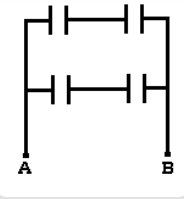
Each capacitor in the circuit shown is a 1F capacitor. What would be the equivalent capacitance between A and B?

  • A
    0.5F
  • B
    F
  • C
    2F
  • D
    4F
Answer
  1. F

Explanation:

Equivalent capacitance of each pair of capacitance in series$=\frac{1\times1}{1+1}\text{F}=0.5\text{F}$

The two series combination are connected in parallel. Hence the net capacitance becomes 0.5F + 0.5F = 1F

View full question & answer
MCQ 1301 Mark
Which one of the following gives the resultant capacitor when capacitors are joined in series?
  • A
    The sum of the individual capacitors.
  • B
    The reciprocal of the sum of the reciprocals of the individual capacitors.
  • C
    The reciprocal of the sum of the capacitors.
  • D
    The sum of the reciprocals of the individual capacitors.
Answer
  1. The reciprocal of the sum of the reciprocals of the individual capacitors.

Explanation:

The resultant capacitor when capacitors are joined in series is the reciprocal of the sum of the reciprocals of the indivisual capacitors.

View full question & answer
MCQ 1311 Mark
In which type of molecule positive and negative charges does not coincide with each other?
  • A
    Isentropic
  • B
    Equipotential
  • C
    Polar
  • D
    Non-polar
Answer
  1. Polar

Explanation:

A molecule in which the centre of mass of positive and negative charges does not collide with each other is called a polar molecule. They have a permanent dipole moment. They have unsymmetrical shapes.

View full question & answer
MCQ 1321 Mark
A positively charged particle is released from rest in an uniform electric field. The electric potential energy of the charge:
  • A
    Remains a constant because the electric field is uniform.
  • B
    Increases because the charge moves along the electric field.
  • C
    Decreases because the charge moves along the electric field.
  • D
    Decreases because the charge moves opposite to the electric field.
Answer
  1. Decreases because the charge moves along the electric field.

The positive charge will experience an electrostatic force whose direction will be along the direction of electric field.

In other words, positive charge will move from high electrostatic potential to low electrostatic potential.

Work will be done by electric filed on the charge and the electric potential energy of the charge will decrease.

View full question & answer
MCQ 1331 Mark
What will be the nature of equipotential surfaces due to a point charge, situated at infinity?
  • A
    Plane surface
  • B
    Spherical
  • C
    Elliptical
  • D
    Cylindrical
Answer
  1. Plane surface

Explanation:

If a point charge is situated at infinity, the electric field lines coming out of it will be in the form of parallel straight lines. As we know that field lines cut the equipotential surfaces orthogonally, therefore the equipotential surfaces must be plane surfaces. They can be considered the surface of a sphere of infinite radius.

View full question & answer
MCQ 1341 Mark
One Volt is equal to:
  • A
    1 Joule
  • B
    1 Newton/ Coulomb
  • C
    1 Joule/ Coulomb
  • D
    1 Coulomb/ Newton
Answer
  1. 1 Joule/ Coulomb

Explanation:

The volt is a measure of electric potential. One volt is defined as the difference in electric potential between two points of a conducting wire when an electric current of one ampere dissipates one watt of power between those points. It is also equal to the potential difference between two parallel, infinite planes spaced 1 meter apart that create an electric field of 1 newton per coulomb. Additionally, it is the potential difference between two points that will impart one joule of energy per coulomb of charge that passes through it. It can be expressed in terms of SI base units (m, kg, s, and A)

$1\text{volte}=\frac{1\text{joule}}{\text{Coulomb}}$

View full question & answer
MCQ 1351 Mark
A dielectric slab is inserted between the plates of an isolated charged capacitor. Which of the following quantities will remain the same?
  • A
    The electric field in the capacitor.
  • B
    The charge on the capacitor.
  • C
    The potential difference between the plates.
  • D
    The stored energy in the capacitor.
Answer
  1. The charge on the capacitor.

Explanation:

When we insert a dielectric between the plates of a capacitor, induced charges of opposite polarity appear on the face of the dielectric. They build an electric field inside the dielectric, directed opposite to the original field of the capacitor.

Thus, the net effect is a reduced electric field.

Also, as the potential is proportional to the field, the potential decreases and so does the stored energy U, which is given by

$\text{U}=\frac{\text{qV}}{2}$

Thus, only the charge on the capacitor remains unchanged, as the charge is conserved in an isolated system.

View full question & answer
MCQ 1361 Mark
Two metal plates having charges Q, -Q face each other at some separation and are dipped into an oil tank. If the oil is pumped out, the electric field between the plates will:
  • A
    Increase.
  • B
    Decrease.
  • C
    Remain the same.
  • D
    Become zero.
Answer
  1. Increase.

Explanation:

Oil between the plates of the capacitor acts as a dielectric. We know that the electric field decreases by a factor of $\frac{1}{\text{K}}$ of the original field when we insert a dielectric between the plates of a capacitor (K is the dielectric constant of the dielectric). So, if the oil is pumped out, the electric field between the plates will increase, as the dielectric has been removed.

View full question & answer
MCQ 1371 Mark
A dielectric slab is inserted between the plates of a capacitor. The charge on the capacitor is Q and the magnitude of the induced charge on each surface of the dielectric is Q':
  • A
    Q' may be larger than Q.
  • B
    Q' must be larger than Q.
  • C
    Q' must be equal to Q.
  • D
    Q' must be smaller than Q.
Answer
  1. Q' must be smaller than Q.

Explanation:

The relation between the induced charge Q' and the charge on the capacitor Q is given by:

$\text{Q}'=\text{Q}\Big(1-\frac{1}{\text{K}}\Big)$

Here, K is the dielectric constant that is always greater than or equal to 1.

So, we can see that for K > 1, Q' will always be less than Q.

View full question & answer
MCQ 1381 Mark
Which of the following about potential at a point due to a given point charge is true?
The potential at a point P due to a given point charge.
  • A
    Is a function of distance from the point charge.
  • B
    Varies inversely as the square of distance from the point charge.
  • C
    Is a vector quantity.
  • D
    Is directly proportional to the square of distance from the point charge.
Answer
  1. Is a function of distance from the point charge.
View full question & answer
MCQ 1391 Mark
What is the maximum energy that can be stored in a capacitor?
  • A
    Depends on the maximum area of the capacitor.
  • B
    Depends on the maximum resistance offered.
  • C
    Depends on the maximum electric field.
  • D
    Depends on the maximum current passing through the capacitor.
Answer
  1. Depends on the maximum electric field.

Explanation:

The maximum energy that can be desirably stored in a capacitor is depends on the maximum electric field that the dielectric can withstand without breaking down. Therefore, capacitors of the same type have about the same maximum energy density, i.e. joules of energy per cubic meter.

View full question & answer
MCQ 1401 Mark
An arrangement which consists of two conductors separated by a dielectric medium is called:
  • A
    Resistor.
  • B
    Inductor.
  • C
    Rectifier.
  • D
    Capacitor.
Answer
  1. Capacitor.
View full question & answer
MCQ 1411 Mark
The interior of a conductor can have no excess ____ in the static situation.
  • A
    Electric field.
  • B
    Electric potential.
  • C
    Electric energy.
  • D
    Charge.
Answer
  1. Charge.
View full question & answer
MCQ 1421 Mark
How does the potential difference change with the effect of the dielectric when the battery remains connected across the capacitor?
  • A
    Increases
  • B
    Decreases
  • C
    Remains constant
  • D
    Becomes zero
Answer
  1. Remains constant

Explanation:

As the battery remains connected across the capacitor, so the potential difference remains constant at V0 even after the introduction of the dielectric slab. In this way, dielectric has an effect on potential difference.

View full question & answer
MCQ 1431 Mark
An example of an equipotential surface in earth is:
  • A
    A line passing through the centre of the earth connecting two points along the diameter.
  • B
    A plane that passes through the circular section of the hemisphere of the earth.
  • C
    A spherical surface at a distance of 1km from the surface of the earth with its centre at centre of earth.
  • D
    A plane on the surface of the earth, which is a tangent to the earth.
Answer
  1. A spherical surface at a distance of 1km from the surface of the earth with its centre at centre of earth.

Explanation:

The potential is seen to be a constant on a sphere at all points.

View full question & answer
MCQ 1441 Mark
What type of surface is the surface of a conductor?
  • A
    Equipotential
  • B
    Unipolar
  • C
    Unipotential
  • D
    Bipolar
Answer
  1. Equipotential

Explanation:

Electric field at any point is equal to the negative of the potential gradient. But inside a conductor, the electric field is zero. Hence, the electric potential is constant throughout the volume of a conductor and has the same value on its surface. Thus the surface of a conductor is equipotential.

View full question & answer
MCQ 1451 Mark
Consider the following statements and select the correct option:
  1. In an external electric field, the positive and negative charges of a non–polar molecule are displaced in opposite directions.
  2. In non –polar molecules displacement stops when the external force on the constituent charges of the molecule is balanced by the restoring force.
  3. The non–polar molecule develops an induced dipole moment.
    • A
      I and II.
    • B
      II and III.
    • C
      I and III.
    • D
      I, II and III.
    Answer
    1. I, II and III.
    View full question & answer
    MCQ 1461 Mark
    How does the potential difference change with the effect of the dielectric when the battery is kept disconnected from the capacitor?
    • A
      Increases
    • B
      Decreases
    • C
      Remains constant
    • D
      Becomes zero
    Answer
    1. Decreases

    Explanation:

    When the dielectric slab is introduced between the plates, the induced surface charge on the dielectric reduces the electric field.

    The reduction in the electric field results in a decrease in potential difference.

    $\text{V}=\text{Ed}=\frac{\text{E}_0\text{d}}{\text{k}}=\frac{\text{V}_0}{\text{k}}$

    View full question & answer
    MCQ 1471 Mark
    In case of a Van de Graaff generator, the breakdown field of air is:
    • A
      2 × 10⁸V m–1
    • B
      3 × 10⁶V m–1
    • C
      2 × 10⁸V m–1
    • D
      3 × 10⁴V m–1
    Answer
    1. 3 × 10⁶V m–1
    View full question & answer
    MCQ 1481 Mark
    Some charge is being given to a conductor. Then its potential:
    • A
      is maximum somewhere between surface and centre.
    • B
      is maximum at surface.
    • C
      is maximum at centre.
    • D
      remains same throughout the conductor.
    Answer
    1. remains same throughout the conductor.

    Explanation:

    Given that some charge is given to a conductor then the whole charge is distributed over its surface only. Inside of conductor, electric field is zero whereas potential is same as on the surface. Hence, throughout the conductor, potential is same i.e, the whole conductor is equipotential.

    View full question & answer
    MCQ 1491 Mark
    Equipotential surfaces of a single point charge are _____ surfaces centred at the charge.
    • A
      Concentric cylindrical.
    • B
      Concentric circular.
    • C
      Concentric spherical.
    • D
      None.
    Answer
    1. Concentric spherical.
    View full question & answer
    MCQ 1501 Mark
    The net charge on a condenser is:
    • A
      infinity
    • B
      q/ 2
    • C
      2q
    • D
      zero
    Answer
    1. zero

    Explanation:

    Every condenser is made with two plates. The charge on one plate is +Q and other is −Q.

    Thus total charge of condenser is Qt​ = +Q - Q = 0

    View full question & answer
    M.C.Q [1M] - Page 3 - Physics STD 12 Science Questions - Vidyadip