Questions · Page 2 of 6

M.C.Q [1M]

MCQ 511 Mark
What is the nature of equipotential surfaces in case of a positive point charge?
  • A
    Circular
  • B
    Spherical
  • C
    Cubical
  • D
    Cylindrical
Answer
  1. Spherical

Explanation:

We know that electric field lines cross the equipotential surfaces perpendicularly. Electric field lines are generated radially from a positive point charge. Therefore, for holding both the conditions, the equipotential surfaces must be spherical.
View full question & answer
MCQ 521 Mark
What is the amount of work done to bring a charge of 4 × 10-3C charge from infinity to a point whose electric potential is 2 × 102V?
  • A
    0.8J
  • B
    -0.8J
  • C
    1.6J
  • D
    -0.4J
Answer
  1. 0.8J

Explanation:

Work done = potential × charge by definition. We know that the potential of a point is the amount of work done to bring a unit charge from infinity to a certain point. Therefore, work done W = q × V = 4 × 10-3 × 200J = 0.8J. The work done is positive in this case.


View full question & answer
MCQ 531 Mark
Which of the following is an example of a molecule whose centre of mass of positive and negative charges coincide each other?
  • A
    CO2
  • B
    CO
  • C
    CH3OH
  • D
    NH3
Answer
  1. CO2

Explanation:

CO2 is a molecule in which the centre of mass of positive and negative charges collide with each other and is called a non-polar molecule. They normally have zero dipole moment. They have symmetrical shapes.

View full question & answer
MCQ 541 Mark
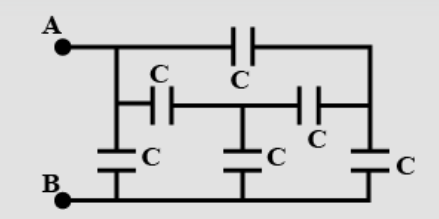
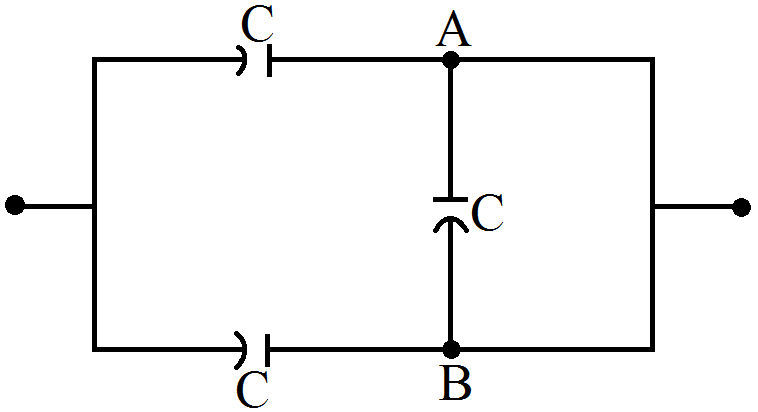
The equivalent capacitance of the combination shown in figure is:

  • A
    C
  • B
    2C
  • C
    $\frac{\text{C}}{2}$
  • D
    None of these.
Answer
  1. 2C

Explanation:

Since the potential at point A is equal to the potential at point B, no current will flow along arm AB. Hence, the capacitor on arm AB will not contribute to the circuit. Also, because the remaining two capacitors are connected in parallel, the net capacitance of the circuit is given by

Ceq = C + C = 2C

View full question & answer
MCQ 551 Mark
When a thin mica sheet is placed between the plates of a condenser then the amount of charge, so compared to its previous value, on its plates will become:
  • A
    unchanged
  • B
    zero
  • C
    less
  • D
    more
Answer
  1. unchanged

Explanation:

As no cell is connected to the capacitor, the charge will remain constant.

View full question & answer
MCQ 571 Mark
For any charge configuration, equipotential surface through a point is _____ to electric field at that point.
  • A
    Perpendicular.
  • B
    Normal.
  • C
    Parallel.
  • D
    Both a and b.
Answer
  1. Both a and b.
View full question & answer
MCQ 581 Mark
Work done in moving an object through an equipotential surface is:
  • A
    Positive
  • B
    Negative
  • C
    Zero
  • D
    Depends on the field direction
Answer
  1. Zero

Explanation:

Work done is given difference in potentials. In an equipotential surface, all points will have same potential. Thus work done is zero

View full question & answer
MCQ 591 Mark
Consider the following statements regarding series grouping of capacitors and select the correct statements.
  1. Charge on each capacitor remains same and equals to the main charge supplied by the battery.
  2. Potential difference and energy distributes in the reverse ratio of capacitance.
  3. Effective capacitance is even less than the least of teh individual capacitances.
  • A
    I and II.
  • B
    I and III.
  • C
    II and III.
  • D
    I, II and III.
Answer
  1. I, II and III.
View full question & answer
MCQ 601 Mark
The molecules in which centres of positive and negative charges are separated are called as:
  • A
    Non polar molecules.
  • B
    Polar molecules.
  • C
    Both a and b.
  • D
    None.
Answer
  1. Polar molecules.
View full question & answer
MCQ 611 Mark
An electric dipole is kept in non-uniform elecric field. it experiences?
  • A
    A force and a torque.
  • B
    A force but not a torque.
  • C
    A torque but not a force.
  • D
    Neither a force nor a torque.
Answer
  1. A force and a torque.
View full question & answer
MCQ 621 Mark
Van de Graaff generator is used to:
  • A
    Store electrical energy.
  • B
    Build up high voltage of few million volts.
  • C
    Decelerate charged particle like electrons.
  • D
    Both (a) and (b).
Answer
  1. Build up high voltage of few million volts.
View full question & answer
MCQ 631 Mark
When air in a capacitor is replaced by a medium of dielectric constant K, the capacity:
  • A
    Decreases K times.
  • B
    Increases K times.
  • C
    Increases K2 times.
  • D
    Remains constant.
Answer
  1. Increases K times.
View full question & answer
MCQ 641 Mark
A capacitor is a system of two conductors separated by _____.
  • A
    Conductors.
  • B
    Dielectrics.
  • C
    An insulators.
  • D
    None.
Answer
  1. An insulators.
View full question & answer
MCQ 651 Mark
Dielectric constant is the:
  • A
    Vector quantity.
  • B
    Scalar quantity.
  • C
    Dimensions less quantity.
  • D
    None.
Answer
  1. Dimensions less quantity.
View full question & answer
MCQ 661 Mark
A dielectric slab is inserted between the plates of an isolated capacitor. The force between the plates will:
  • A
    Increase.
  • B
    Decrease.
  • C
    Remain unchanged.
  • D
    Become zero.
Answer
  1. Remain unchanged.

Explanation:

The force between the plates is given by

$\text{F}=\frac{\text{q}^2}{2\in_0\text{A}}$

Since the capacitor is isolated, the charge on the plates remains constant.
We know that the charge is conserved in an isolated system.

Thus, the force acting between the plates remains unchanged.

View full question & answer
MCQ 671 Mark
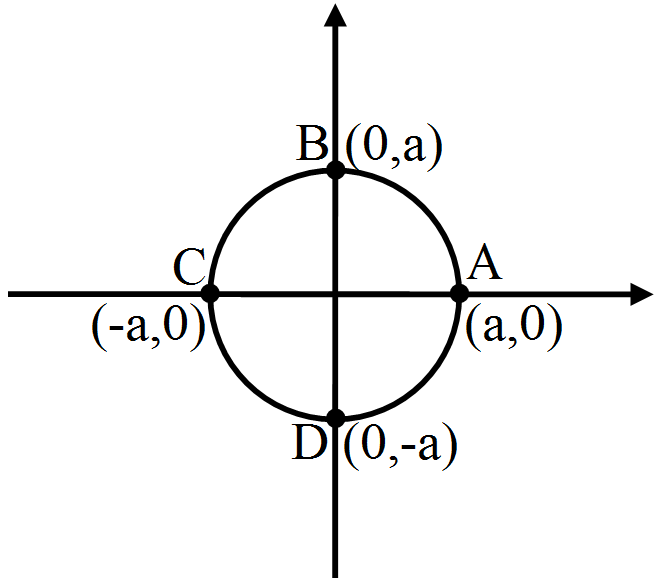
The electric field at the origin is along the positive x-axis. A small circle is drawn with the centre at the origin cutting the axes at points A, B, C and D having coordinates (a, 0), (0, a), (-a, 0), (0, -a) respectively. Out of the points on the periphery of the circle, the potential is minimum at.
  • A
    A
  • B
    B
  • C
    C
  • D
    D
Answer
  1. A

Explanation:

$\text{E}=\text{E}_0\hat{\text{i}}$ (Given)

(Potential at A):-

$\text{V}_\text{A}=\big(\text{E}_0\hat{\text{i}}\times\text{a}\hat{\text{i}}\big)=\text{E}_09$

(Potential atB):-

$\text{V}_\text{B}=\big(\text{E}_0\hat{\text{i}}\times\text{a}\hat{\text{i}}\big)=0$

(Potential at C):-

$\text{V}_\text{C}=\big(\text{E}_0\hat{\text{i}}\times(-\text{a})\text{i}\big)=\text{E}_0\text{a}$

(Potential atD):-

$\text{V}_\text{D}=(\text{E}_0\hat{\text{i}}\times(-\text{a})\hat{\text{j}})=0$

View full question & answer
MCQ 681 Mark
The dipole moment per unit volume is called as:
  • A
    Dielectrics.
  • B
    Polarisation.
  • C
    Electric field.
  • D
    Electric dipole moment.
Answer
  1. Polarisation.
View full question & answer
MCQ 691 Mark
What is the net electric field in the outer regions above the upper plate and below the lower plate in a parallel plate capacitor?
  • A
    Maximum
  • B
    Uniform
  • C
    Zero
  • D
    Minimum
Answer
  1. Zero

Explanation:

In the outer regions above the upper plate and below the lower plate, the electric fields due to the two charged plates cancel out. Hence, the net electric field in the outer regions above the plate and below the lower plate is zero.

View full question & answer
MCQ 701 Mark
‘X’ is the phenomenon of making a region free from any electric field. Identify X.
  • A
    Faraday’s cage
  • B
    Electrostatic shielding
  • C
    Gauss theorem
  • D
    Corona discharge
Answer
  1. Electrostatic shielding

Explanation:

The phenomenon of making a region free from any electric field is called electrostatic shielding. It is based on the fact that the electric field vanishes inside the cavity of a hollow conductor.

View full question & answer
MCQ 711 Mark
Which of the following is an example of a molecule whose centre of mass of positive and negative charges does not coincide each other?
  • A
    NH3
  • B
    H2
  • C
    CH4
  • D
    CO2
Answer
  1. NH3

Explanation:

NH3 is a molecule in which the centre of mass of positive and negative charges does not collide with each other and is called a polar molecule. They have a permanent dipole moment. They have unsymmetrical shapes.

View full question & answer
MCQ 721 Mark
If a charged body is moved in an electric field against the Coulomb force, then ________?
  • A
    Work is done on the body by an external agent.
  • B
    Work is done by the electric field.
  • C
    Electric field intensity decreases.
  • D
    The total energy of the system decreases.
Answer
  1. Work is done on the body by an external agent.

Explanation:

To move a body against some force, work is to be done on the body. In this case, an external force is to be applied on the body to move it i.e. an external work is to be done. As we are moving the body against the Coulomb’s force, hence no work is done on the body by the electric field.

View full question & answer
MCQ 731 Mark
Point A is at a lower electrical potential than point B. An electron between them on the line joining them will:
  • A
    Move towards A
  • B
    Move towards B
  • C
    Move at right angles to the line joining A and B
  • D
    Remain at rest
Answer
  1. Move towards B

Explanation:

Given that point A is at lower electric potential than point B. The electron between them on line joining will move.

We have to find where this electron moves.

Since we know that electric currents move from a higher potential or a lower potential. Also, electrons move in the direction opposite to electric current. So the electron on the line joining two points A and B will move from lower to higher potential i.e, it will move towards B.

View full question & answer
MCQ 741 Mark
If a conductor has a potential V ≠ 0 and there are no charges anywhere else outside, then:
  • A
    There must be charges on the surface or inside itself.
  • B
    There cannot be any charge in the body of the conducor.
  • C
    there must be charges only on the surface.
  • D
    there must be charges inside the Surface.
Answer
  1. There must be charges on the surface or inside itself.
  2. There cannot be any charge in the body of the conducor.

The potential of a body is due to charge of the body and due to the charge of surrounding. If there are no charges anywhere else outside, then the potential of the body will be due to its own charge. If there is a cavity inside a conducting body, then charge can be placed inside the body. Hence there must be charges on its surface or inside itself.

Hence option (a) is correct. The charge resides on the outer surface of a closed charged conductor. Hence there cannot be any charge in the body of the conductor.

Hence option (b) is correct.

View full question & answer
MCQ 751 Mark
What is the S.I. unit of electric potential? 
  • A
    Ampere
  • B
    Volt
  • C
    Volt.m
  • D
    Coulomb
Answer
  1. Volt

Explanation:

An electric potential (also called the electric field potential or the electrostatic potential) is the amount of electric potential energy that a unitary point electric charge would have if located at any point of space, and is equal to the work done by an electric field in carrying a unit positive charge from infinity to that point.

This value can be calculated in either a static (time-invariant) or a dynamic (varying with time) electric field at a specific time in units of joules per coulomb, or volts (V). The electric potential at infinity is assumed to be zero.

View full question & answer
MCQ 761 Mark
The anode of a thermionic diode is connected to the negative terminal of a battery and the cathode to its positive terminal:
  • A
    No appreciable current will pass through the diode.
  • B
    A large current will pass through the diode from the anode to the cathode.
  • C
    A large current will pass through the diode from the cathode to the anode.
  • D
    The diode will be damaged.
Answer
  1. No appreciable current will pass through the diode.

Explanation:

If the anode is given a negative potential relative to the cathode, the electrons are pushed back to the cathode. Hence, no current will flow through the diode.

View full question & answer
MCQ 771 Mark
Statement(A): Negative charges always move from a higher potential to lower potential point
Statement (B): Electric potential is vector.
  • A
    A is true but B is false.
  • B
    B is true but A is false.
  • C
    Both A and B false.
  • D
    Both A and R are true.
Answer
  1. Both A and B false.

Explanation:

Positive charges move from higher to lower potential whereas negative charges move from lower to higher potential. Hence, A is false. Electric potential does not have direction and is a scalar quantity.

View full question & answer
MCQ 781 Mark
A sheet of aluminium foil of negligible thickness is introduced between the plates of a capacitor. The capacitance of the capacitor:
  • A
    Decreases.
  • B
    Remains unchanged.
  • C
    Becomes infinite.
  • D
    Increases.
Answer
  1. Remains unchanged.
View full question & answer
MCQ 791 Mark
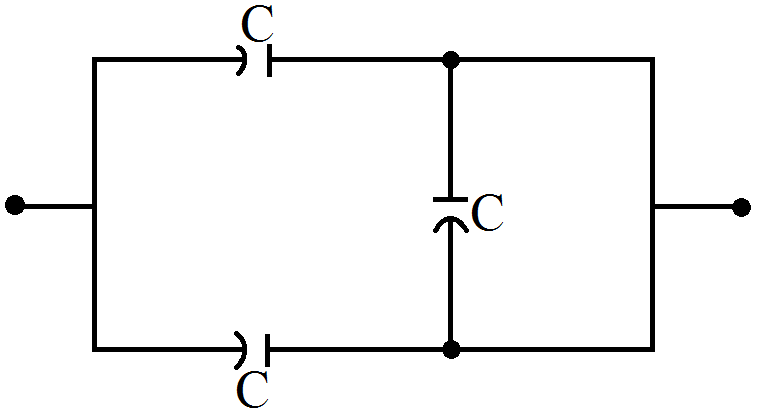
The equivalent capacitance between A and B is:

  • A
    6C
  • B
    4C
  • C
    2C
  • D
    None of the above
Answer
  1. 2C

Explanation:

For IMAGE 01 AND 02:

[Loops AXBY forms wheat stone bridge ]

So, effective capacitance will be for the bridge C

In IMAGE 03 the parallel combination 

C′ = C + C = 2C

View full question & answer
MCQ 801 Mark
In order to increase the capacity of a parallel plate condenser, one should introduce a sheet of between the plates (assume that the space is completely filled).
  • A
    Mica
  • B
    Tin
  • C
    Copper
  • D
    Stainless Steel
Answer
  1. Mica

Explanation:

Dielectric constant is the factor by which the capacitance increases from its value in air when a dielectric is introduced between the plates.

Mica, among the materials mentioned above, is a dielectric material and hence to be used to increase the capacity.

View full question & answer
MCQ 811 Mark
Which of the following statement is true about the relation between electric field and potential?
  • A
    Electric field in the direction in which the potential decreases steepest.
  • B
    Magnitude of electric field is given by the change in the magnitude of potential per unit displacement normal to the equipotential surface at that point.
  • C
    In the region of strong electric field, equipotential surfaces are far apart.
  • D
    Both the statements (a) and (b) are correct.
Answer
  1. Both the statements (a) and (b) are correct.

Explanation:

The magnitude of electric field is given as the change in magnitude of potential per unit displacement as

View full question & answer
MCQ 821 Mark
What is the total work done on moving a test charge on an equipotential surface?
  • A
    Maximum
  • B
    Minimum
  • C
    Constant
  • D
    Zero
Answer
  1. Zero

Explanation:

The potential difference between any two points on an equipotential surface is zero.
Work done = Test charge x potential difference(0)

View full question & answer
MCQ 831 Mark
Among identical spheres A and B having charges −15C and −16C:
  • A
    −15C is at higher potential.
  • B
    −16C is at higher potential.
  • C
    both are at equal potential.
  • D
    no such comparison can be made.
Answer
  1. −15C is at higher potential.

Explanation:

Potential at surface of a sphere of radius r is V = kQ/ r

As identical sphere so r is same for both, Thus V will depend on charge Q.

So when Q is more, potential will be more.

Since −15 C is more than −16 C, so −15 C sphere will have higher potential.

View full question & answer
MCQ 841 Mark
When is the effective capacitance of a capacitor increased?
  • A
    When the capacitors are connected in series.
  • B
    When the capacitors are randomly connected.
  • C
    When the capacitors are connected in parallel.
  • D
    When the capacitors are connected in series and parallel simultaneously.
Answer
  1. When the capacitors are connected in parallel.

Explanation:

The effective capacitance of a capacitor is increased when the capacitors are connected in parallel. When the capacitors are connected in parallel, the equivalent capacitance is given by:

Cp = C1 + C2 + C3 +…….

When the capacitors are connected in parallel, the potential difference across each capacitor is the same.

View full question & answer
MCQ 851 Mark
Which of the following statements is correct?
  • A
    An electric field is a scalar quantity.
  • B
    Electric field lines are at 45 degrees to the equipotential surfaces.
  • C
    The surface of a charged conductor is equipotential.
  • D
    Field lines due to a point charge are circular.
Answer
  1. The surface of a charged conductor is equipotential.

Explanation:

In conductors, charges are equally distributed over the surface of the conductor. Therefore the potential throughout the surface is the same, i.e. equipotential. The electric field is a vector quantity and the field lines cut the equipotential surfaces at 90 degrees. The field lines due to a point charge are radial.

View full question & answer
MCQ 861 Mark
A cube of a metal is given a positive charge Question: For this system, which of the following statements is true?
  • A
    Electric potential at the surface of the cube is zero.
  • B
    Electric potential within the cube is zero.
  • C
    Electric field is normal to the surface of the cube.
  • D
    Electric field varies within the cube.
Answer
  1. Electric field varies within the cube.
View full question & answer
MCQ 871 Mark
What is the net electrostatic field in the interior of a conductor?
  • A
    Positive
  • B
    Negative
  • C
    Zero
  • D
    Depends on the nature of the conductor
Answer
  1. Zero

Explanation:

Net electrostatic field is zero in the interior of a conductor. When a conductor is placed in an electric field, its free electrons begin to move in the opposite direction. Negative charges are induced on the left end and positive charges on the right end of the conductor. The process continues until the electric field set up by induced charges becomes equal and opposite the external field.

View full question & answer
MCQ 881 Mark
The electrostatic force between the metal plates of an isolated parallel plate capacitor C having a charge Q and area A, is:
  • A
    Independent of the distance between the plates.
  • B
    Linearly proportional to the distance between the plates.
  • C
    Inversely proportional to the distance between theplates.
  • D
    Proportional to the square root of the distance betweenthe plates.
Answer
  1. Independent of the distance between the plates.
View full question & answer
MCQ 891 Mark
A parallel plate capacitor is charged to a certain voltage. Now, if the dielectric material (with dielectric constant k) is removed then the
  • A
    Capacitance increases by a factor of k
  • B
    Electric field reduces by a factor k
  • C
    Voltage across the capacitor decreases by a factor k
  • D
    None of these
Answer
  1. None of these

Explanation:

As the capacitor is charged by using cell so potential as well as filed between the plates become constant.

For removing dielectric the capacitance becomes C/ k. Thus capacitance decreases by a factor of k.

View full question & answer
MCQ 901 Mark
What is not true of equipotential surface?
  • A
    The PD between any two points on the surface is zero.
  • B
    The electric field is always perpendicular to the surface.
  • C
    Equipotential surfaces are always spherical.
  • D
    No work is done in moving a charge along the surface.
Answer
  1. Equipotential surfaces are always spherical.

Explanation:

Equipotential surface

→ P.D difference between two points on the surface is zero always since potential is same everywhere in equipotential surface.

→ The EF is always perpendicular to the surface because there is no potential gradient along any direction parallel to the surface P so no EF parallel to the surface

→ Equipotential surface can have any shape not just sphere.

→ No work is done in moving a charge along the surface, because potential difference is zero.

View full question & answer
MCQ 911 Mark
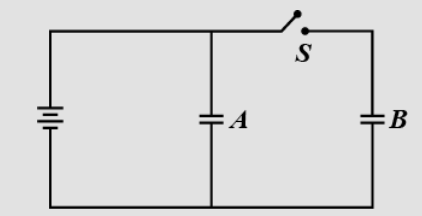
Two identical air filled parallel plate capacitors are charged to the same potential in the manner shown by closing the switch S. If now the switch S is opened and the space between the plates is filled with a dielectric of relative permittivity εr​, then:

  • A
    The potential difference as well as charge on each capacitor goes up by a factor εr​.
  • B
    The potential difference as well as charge on each capacitor goes down by a factor εr.
  • C
    The potential difference across A remains constant and the charge on B remains unchanged.
  • D
    The potential difference across B remains constant while the charge on A remains unchanged.
Answer
  1. The potential difference across A remains constant and the charge on B remains unchanged.

Explanation:

After switch S is opened, as the Capacitor A is connected across the battery, its potential difference is fixed at steady state (i.e., when capacitor is fully charged).

Capacitor B is isolated, so its charge gets fixed. But as we insert the dielectric, its capacitance changes, thus its potential difference also changes.

View full question & answer
MCQ 921 Mark
A pendulum ( positively charged and hinged at some length above the plate) is swinging above a parallel plate (infinitely large and having negative charge), now consider the following statements, (consider gravity):
  • A
    Angular momentum about the hinge point of the ball will be max at lowest point.
  • B
    Electric potential energy will be max at highest point.
  • C
    Gravitational potential energy will be lowest at highest point.
  • D
    None of the above.
Answer
  1. Angular momentum about the hinge point of the ball will be max at lowest point.

Explanation:

Angular momentum about the hinge point of the ball will be max at point. mV will be max at closer point because law of conservation says that the swinging energy will be gathered when it will be at lowest point. The potential energy is maximum.

View full question & answer
MCQ 931 Mark
An electric dipole is placed at the centre of a sphere, choose the correct options:
  • A
    Electric field is zero at every point on the surface.
  • B
    Flux is zero across the surface.
  • C
    No circle is present in the sphere which is equipotential.
  • D
    None of the above.
Answer
  1. Flux is zero across the surface.

Explanation:

A dipole contains two equal and opposite charge. So total charge inside the sphere will be zero.

By Gauss's law, the flux across a surface is depends on the charge inside the surface. As total charge is zero inside the sphere so the flux through the sphere will be zero.

As the electric field is resultant effect due to all charges so there will be field exists on the surface.

As the sphere contains two equal and opposite charges so there may be exists equipotential surface in the sphere.

View full question & answer
MCQ 941 Mark
Equipotential surfaces:
  • A
    Are closer in regions of large electric fields compared to regions of lower electric fields.
  • B
    Will be more crowded near sharp edges of a conductor.
  • C
    Will be more crowded near regions of large charge densities.
  • D
    Will always be equally spaced.
Answer
  1. Are closer in regions of large electric fields compared to regions of lower electric fields.
  2. Will be more crowded near sharp edges of a conductor.
  3. Will be more crowded near regions of large charge densities.

Equipotential surfaces are closer in regions of large electric fields because electric field intensity is inversely proportional to the separation between equipotential surfaces. 

As the electric field intensities is large near sharp edges of a charged conductor or near the regions of large charge densities. Therefore, numbers of equipotential surfaces are closer to such places or in other words they are more crowded.

View full question & answer
MCQ 951 Mark
1 electron volt = __________ J.
  • A
    1.6 × 10-19
  • B
    4.8 × 10-19
  • C
    1.6 × 10-10
  • D
    10
Answer
  1. 1.6 × 10-19

Explanation:

1 electron volt is the amount of work done if an electron is passed through a potential difference of 1V. Therefore the work done = 1V × charge of an electron = 1.602 × 10⁻¹⁹ J. But it is a small quantity and hence we use kilo electron volt and mega electron volt in practical.

View full question & answer
MCQ 961 Mark
If the capacitors in the previous question are joined in parallel, the capacitance and the breakdown voltage of the combination will be:
  • A
    2C and 2V
  • B
    C and 2V
  • C
    2C and V
  • D
    C and V
Answer
  1. 2C and V

Explanation:

In a parallel combination of capacitors, the potential difference across the capacitors remain the same, as the right-hand-side plates and the left-hand-side plates of both the capacitors are connected to the same terminals of the battery. Therefore, the potential remains the same, that is, V.

For the parallel combination of capacitors, the capacitance is given by

Ceq = C1 + C2

Here,

C1 = C2 = C

$\therefore$ Ceq = 2C

View full question & answer
MCQ 971 Mark
The factor by which the capacitance increases from its vacuum value when the dielectric is inserted fully between the plates of a capacitor, is called as:
  • A
    Dielectric.
  • B
    Dielectric constant of the substance.
  • C
    Permittivity.
  • D
    Permiability.
Answer
  1. Dielectric constant of the substance.
View full question & answer
MCQ 981 Mark
A point charge q is rotated along a circle in the electric field generated by another point charge Q. The work done by the electric field on the rotating charge in one complete revolution is_______?
  • A
    zero
  • B
    positive
  • C
    negative
  • D
    zero if the charge Q is at the center and nonzero otherwise.
Answer
  1. zero

Explanation:

The net displacement round one complete circle is 0.

View full question & answer
MCQ 991 Mark
The work done by the external force in bringing the charge q from infinity to a point is called as:
  • A
    Electric field due to charge q at that point.
  • B
    Potential energy due to charge q at that point.
  • C
    Both a and b.
  • D
    None.
Answer
  1. Potential energy due to charge q at that point.
View full question & answer
MCQ 1001 Mark
The forces in which sum of kinetic energy and potential energy is conserved are called as:
  • A
    Electrostatic forces.
  • B
    Nuclear forces.
  • C
    Conservative forces.
  • D
    Both a and c.
Answer
  1. Conservative forces.
View full question & answer
M.C.Q [1M] - Page 2 - Physics STD 12 Science Questions - Vidyadip