Questions · Page 5 of 5

M.C.Q [1M]

MCQ 2011 Mark
The energy needed to break a nucleus into its individual nucleons in a nuclear reaction is called:
  • A
    Nuclear binding energy
  • B
    Ionization energy
  • C
    Free energy
  • D
    Fission energy
Answer
  1. Nuclear binding energy

Explanation:

The protons and the neutrons exist together inside the nucleus due to attractive nuclear forces, thus some energy is required to break the nuclear forces.

Hence the binding energy is defined as the energy needed to break the nucleus into its individual nucleons in a nuclear reaction.
View full question & answer
MCQ 2021 Mark
Suppose we consider a large number of containers each containing initially 10000 atoms of a radioactive material with a half life of 1 year. After 1 year:
  • A
    All the containers will have 5000 atoms of the material.
  • B
    All the containers will contain the same number of atoms of the material but that number will only be approximately 5000.
  • C
    The containers will in general have different numbers of the atoms of the material but their average will be close to 5000.
  • D
    None of the containers can have more than 5000 atoms.
Answer
  1. The containers will in general have different numbers of the atoms of the material but their average will be close to 5000.

Solution:

Key concept:

Half life ( T1/2): Radioactivity is a process due to which a radioactive material spontaneously decays. Time interval in which the mass of a radioactive substance or the number of its atom reduces to half of its initial value is called the half life of the substance.

i.e., if $\text{N}=\frac{\text{N}_0}{2}$

Then $\text{t}=\text{T}_\frac{1}{2}$

Hence from $\text{N}=\text{N}_0\text{e}^{-\lambda\text{t}}$

$\frac{\text{N}_0}{2}=\text{N}_0\text{e}^{-\lambda\Big(\text{T}_\frac{1}{2}\Big)}\Rightarrow\ \text{T}_\frac{1}{2}=\frac{\log_\text{e}2}{\lambda}=\frac{0.693}{\lambda}$

In half-life (t = 1yr) of the material on the average half the number of atoms will decay. Therefore, the containers will in general have different number of atoms of the material, but their average will be approx 5000.

View full question & answer
MCQ 2031 Mark
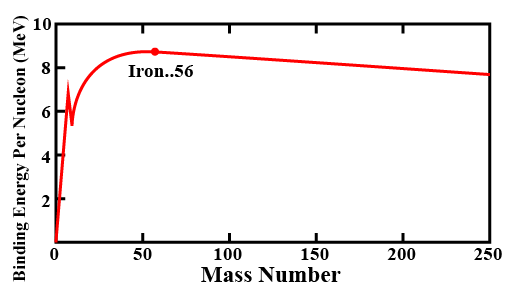
For the nuclie with mass number > 100:
  • A
    Binding energy of the nucleus decreases on an average as A increases.
  • B
    Binding energy of the nucleus increases on an average as A increases.
  • C
    The two nuclei fuse to form a bigger nuclide releasing energy.
  • D
    The nucleus essentially breaks up into two nuclides of equal mass releasing energy.
Answer
  1. Binding energy of the nucleus decreases on an average as A increases.

Explanation:

From the above figure it is clearly visible that the binding energy of the nucleus decreases on an average as A increases

View full question & answer
MCQ 2041 Mark
Q value for neutron decay is:
  • A
    0.782 MeV
  • B
    0.782 eV
  • C
    78.2 MeV
  • D
    0
Answer
  1. 0.782 MeV

Explanation:

For neutron decay, some mass disappears as neutrons convert to a proton, electron and antineutrino.

Q = (mn​−mp​−mνˉ​−me​)c= 0.782MeV

View full question & answer
MCQ 2051 Mark
Which of the following is the radio-isotope? 
$^{39}_{19}{\text{K}}$​, $^{40}_{19}{\text{K}}$
  • A
    $^{39}_{19}{\text{K}}$
  • B
    $^{40}_{19}{\text{K}}$
  • C
    $^{39}_{19}{\text{K}}$​, $^{40}_{19}{\text{K}}$
  • D
    none of them
Answer
  1. $^{40}_{19}{\text{K}}$

Explanation:

$^{40}_{19}{\text{K}}$ is the radioactive isotope of Potassium element.

As it has more number of neutrons than number of protons.

View full question & answer
MCQ 2061 Mark
The nuclear fusion reaction between deuterium and tritium takes place:
  • A
    At ordinary temperature and pressure.
  • B
    At low temperature and low pressure.
  • C
    At very high temperature and very high pressure.
  • D
    When the temperature is near absolute zero.
Answer
  1. At very high temperature and very high pressure.

Explanation:

Nuclear fusion occurs at very high temperature and very high pressure. It is the primary phenomenon for the generation of heat energy in the sun.

View full question & answer
MCQ 2071 Mark
In a radioactive decay, neither the atomic number nor the mass number changes. Which of the following particles is emitted in the decay?
  • A
    Proton.
  • B
    Neutron.
  • C
    Electron.
  • D
    Photon.
Answer
  1. Photon.

Explanation:

The atomic number and mass number of a nucleus is defined as the number of protons and the sum of the number of protons and neutrons present in the nucleus, respectively. Since in the decay, neither the atomic number nor the mass number change, it cannot be a beta-decay (release of electron, proton or neutron). Hence, the particle emitted can only be a photon.

View full question & answer
MCQ 2081 Mark
The Sun's mean density is:
  • A
    1.4×kg/m3
  • B
    1.4×10³kg/m3
  • C
    1.4×10³kg/cc
  • D
    1.4×kg/cc
Answer
  1. 1.4×10³kg/m3

Explanation:

Density of water is = 1000 kg/m3

Density of sun = 1.4×1000

= 1.4×10³ms−3

View full question & answer
MCQ 2091 Mark
The radiant energy of the sun results from:
  • A
    Nuclear fusion
  • B
    Nuclear fission
  • C
    Combustion
  • D
    Explosion
Answer
  1. Nuclear fusion

Explanation:

The radient energgy of is result of nuclear fusion. The energy from both heat and light originates from a nuclear fusion.

View full question & answer
MCQ 2101 Mark
When a hydrogen bomb explodes, which of the following is used?
  • A
    Fission
  • B
    Fussion
  • C
    Both
  • D
    None of these
Answer
  1. Fussion

Explanation:

Hydrogen bomb is based on nuclear fusion and hence hydrogen atoms combine to form Helium atoms.

View full question & answer
MCQ 2111 Mark
When two deuterium nuclei fuse together to form a tritium nucleus, we get a:
  • A
    Neutron
  • B
    Deuteron
  • C
    Alpha particle
  • D
    Proton
Answer
  1. Proton

Explanation:

Here the nuclear reaction: $2^2_1$H(deutron)→$_1^3​$H(tritium)

For balancing the reaction: $2^2_1$​H→$_1^3​$H+$_1^1$​H(proton)

Thus, we will get a proton in this reaction.

View full question & answer
MCQ 2121 Mark
A nucleus of element X is represented as $^{56}_{26}\text{X}$
Which is an isotope of element X?
  • A
    $^{26}_{56}\text{X}$
  • B
    $^{54}_{26}\text{X}$
  • C
    $^{56}_{24}\text{X}$
  • D
    $^{54}_{28}\text{X}$
Answer
  1. $^{54}_{26}\text{X}$

Explanation:

Isotopes are variants of a particular chemical element which differ in neutron number, and consequently in nucleon number. All isotopes of a given element have the same number of protons but different numbers of neutrons in each atom.

Since, the isotopes has same number of proton.

View full question & answer
MCQ 2131 Mark
Binding energy per nucleon for C12 is 7.68 MeV and for C13 is 7.74MeV. The energy required to remove a neutron from C13 is:
  • A
    5.49MeV
  • B
    8.46MeV
  • C
    9.45MeV
  • D
    15.49MeV
Answer
  1. 8.46MeV

Explanation:

C13 + energy → C12 + n

Energy required to remove one neutron = Difference in total binding energy

= 13 × 7.74 − 12 × 7.68MeV

= 8.46MeV

View full question & answer
MCQ 2141 Mark
Fusion reaction is also known as ..........:
  • A
    Chemical reaction
  • B
    Elastic reaction
  • C
    Thermonuclear reaction
  • D
    Photonuclear reaction
Answer
  1. Thermonuclear reaction

Explanation:

In nuclear physics,nuclear fusion is a nuclear reaction in which two or more atomic nuclei collide at very high speed and join to form a new type of atomic nucleus. During this process matter is not conserved because some of the matter of fusing nuclei is converted to photons also known as thermonuclear reaction.

View full question & answer
MCQ 2151 Mark
During a nuclear fission reaction:
  • A
    A heavy nucleus breaks into two fragments by itself a light nucleus bombarded by thermal neutrons breaks up.
  • B
    A light nucleus bombarded by thermal neutrons breaks up.
  • C
    A heavy nucleus bombarded by thermal neutrons breaks up.
  • D
    Two light nuclei combine to give a heavier nucleus and possible other products.
Answer
  1. A heavy nucleus bombarded by thermal neutrons breaks up.

Explanation:

In a nuclear reactor, a large fissile atomic nucleus like uranium-235 absorbs a thermal neutron and undergoes a nuclear fission reaction. The heavy nucleus splits into two or more lighter nuclei releasing gamma radiation and free neutrons.

View full question & answer
MCQ 2161 Mark
A nuclear reaction with positive Q value is:
  • A
    Endothermic
  • B
    Exothermic
  • C
    Either endothermic or exothermic
  • D
    Neither endothermic nor exothermic
Answer
  1. Exothermic

Explanation:

An exothermic reaction is that in which heat is released.

An exothermic reaction is that in which heat is absorbed.

In a nuclear reaction, if the mass of the product nucleus and outgoing particle is less than the mass of the target nucleus and bombarding particle, then energy is released (exothermic reaction), and Q-value is +ve.

View full question & answer
MCQ 2171 Mark
What parameter is used to measure the stability of a nucleus?
  • A
    Average binding energy
  • B
    No. of protons
  • C
    No. of neutrons
  • D
    No. of electrons
Answer
  1. Average binding energy

Explanation:

Stability of nucleus is based on average binding energy i.e. binding energy per nucleon. This much energy will be needed for nucleon to break free.

View full question & answer
MCQ 2181 Mark
A nuclei having same number of neutron but different number of protons/ atomic number are called:
  • A
    Isobars.
  • B
    Isomers.
  • C
    Isotones.
  • D
    Isotopes.
Answer
  1. Isotones.
View full question & answer
MCQ 2191 Mark
One curie is equal to:
  • A
    3.7 × 10¹⁰ Disintegration/ sec.
  • B
    3.2 × 10⁸ Disintegration/ sec.
  • C
    2.8 × 10¹⁰ Disintegration/ sec.
  • D
    None of these.
Answer
  1. 3.7 × 10¹⁰ Disintegration/ sec.
View full question & answer
MCQ 2201 Mark
The fusion of light elements take place at about the temperatures of about:
  • A
    30°C 
  • B
    100°C 
  • C
    10,000°C 
  • D
    2×10°C
Answer
  1. 2×10°C

Explanation:

Thermonuclear reaction, fusion of two light atomic nuclei into a single heavier nucleus by a collision of the two interacting particles at extremely high temperatures, with the consequent release of a relatively large amount of energy.

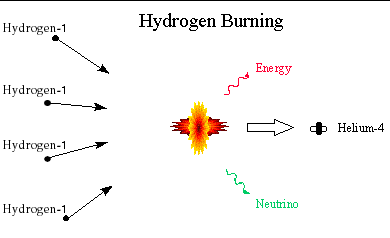
The Sun is a main-sequence star, and thus generates its energy by nuclear fusion of hydrogen nuclei into helium. In its core, the Sun fuses 620 million metric tons of hydrogen each second.

as shown in the figure that hydrogen atom are fusses to helium atom.

View full question & answer
MCQ 2211 Mark
Which of the following is not a mode of radioactive decay?
  • A
    Positron emission.
  • B
    Electron capture.
  • C
    Fusion.
  • D
    Alpha decay.
Answer
  1. Fusion.
View full question & answer
MCQ 2221 Mark
On an average, the number of neutrons and the energy of a neutron released per fission of a uranium atom are respectively?
  • A
    2.5 And 2 keV.
  • B
    3 And l keV.
  • C
    2.5 And 2 meV.
  • D
    2 And 2 keV.
Answer
  1. 2.5 And 2 meV.
View full question & answer
MCQ 2231 Mark
Which of the following of a radioactive material is a measure of its instability?
  • A
    Full life.
  • B
    Mean life.
  • C
    Half life.
  • D
    None of these.
Answer
  1. Half life.
View full question & answer
MCQ 2241 Mark
Mass number is denoted by:
  • A
    D
  • B
    S
  • C
    A
  • D
    Z
Answer
  1. A

Explanation:

The mass number (A) is the number of nucleons, which is the total number of protons and neutrons in the nucleus of an atom.

View full question & answer
MCQ 2261 Mark
Mass of atom expressed in atomic mass unit is:
  • A
    Atomic mass
  • B
    Molecular mass
  • C
    Atomic number 
  • D
    None of the above
Answer
  1. Atomic mass

Explanation:

The mass of an atom expressed in amu is known as atomic mass. atomic mass unit defined as a unit of mass used to express atomic and molecular weights, equal to one-twelfth of the mass of an atom of carbon-12.

View full question & answer
MCQ 2281 Mark
Chadwick was awarded the 1935 nobel prize in physics for his discovery of the:
  • A
    Electron.
  • B
    Proton.
  • C
    Neutron.
  • D
    Positron.
Answer
  1. Neutron.
View full question & answer