Questions

4 Marks Question

Take a timed test

35 questions · self-marked practice — reveal the answer and mark yourself.

Question 14 Marks
What are the advantages and disadvantages of tabular presentation of data?
Answer
The advantages of tabular presentation are:
  1. This method is the simplest form of data presentation. Data is easily understood, if tables are systematically prepared.
  2. This method facilitates comparison of data by presenting the data properly in rows and columns.
  3. This method highlights important characteristics of data. Accordingly, it becomes easy to draw inferences from it.
  4. Arranging the data in rows and columns helps the investigator to detect various errors and omissions in the data collected.
The disadvantages of tabular presentation are:
  1. Preparing tables require proper understanding of data, otherwise they will be misleading.
  2. Tables are not very attractive as compared to diagrams.
View full question & answer
Question 24 Marks
Differentiate between graphs and diagrams.
Answer
Difference between graphs and diagrams is as follows:
  1. In the construction of a graph generally graph paper is used which helps us to study the mathematical relationship between two variables. Diagrams are constructed on a plain paper and are used for comparison only and not for studying.
  2. Diagrams furnish only approximate information. It is not useful for further mathematical and statistical analysis.
  3. Diagrams are useful in depicting categorical and geographical data but they fail to present data realting to time series and frequency distribution.
View full question & answer
Question 34 Marks
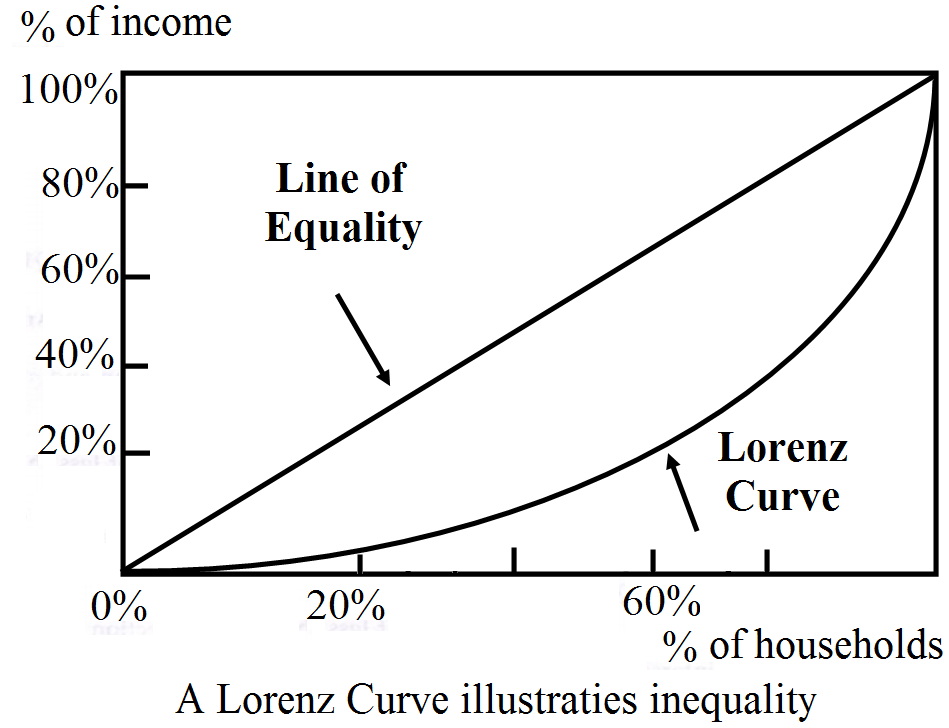
What is a Lorenz curve? What does it show?
Answer
This is a modification of the Ogive when the variables and the cumulative frequencies are expressed as percentages. It serves to measure the evenness of the distribution and is useful in picturing the distribution and dispersion of wealth, sales and profits etc. If we get a line which is a diagonal of the square, it implies that variable is evenly distributed amongst population. Farther is the line from this diagonal, higher is the inequality and vice versa.
View full question & answer
Question 44 Marks
Suppose you want to emphasise the increase in the share of urban non-workers and lower level of urbanisation in India as shown in Example 4.2. How would you do it in the tabular form?
Answer
To showcase the increase in the share of urban non-workers and lower level of urbanisation in India, the data given in the example 4.2 (Case 2, page no.41) can be tabulated as follows:
 
Urban areas
Rural areas
Total
Worker population
9
31
40
Non-workers population
19
43
62
Total
28
74
102
From the above table we can see that out of total population of 102 crore, 74 crore people are residing in rural India and only 28 crore people are living in urban areas. This clearly indicates the low levels of urbanisation in the country. Higher share of urban non-workers can be indicated from the fact that 19 crores people out of total 28 crore population in urban areas are non-working (i.e. 67.85% urban population is non-working), as compared to rural India where 43 crore out of 74 crore people are non-working (i.e. 58.1% of rural population is non-working).
View full question & answer
Question 54 Marks
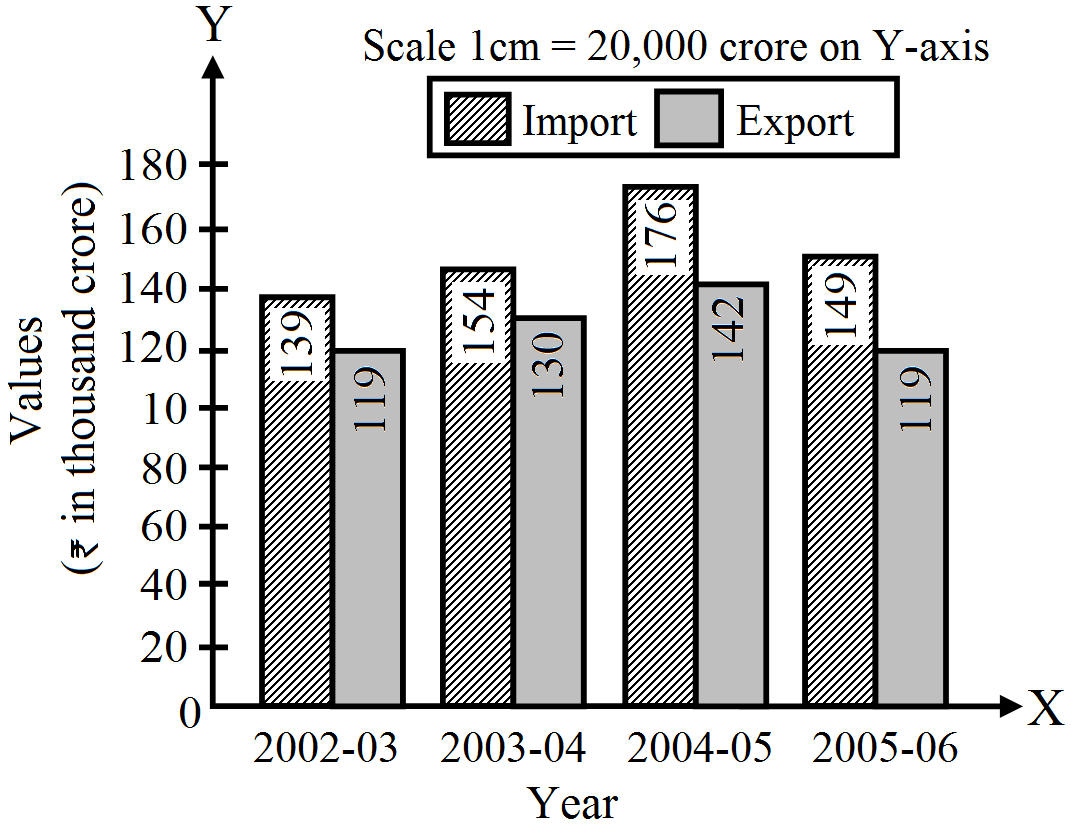
Represent the following data by an appropriate bar diagram.
Import and Export of India
Year
Impoet in Current Price (₹ in thousand crore)
Export in Current Price (₹ in thousand crore)
2002-03
139
119
2003-04
154
130
2004-05
176
142
2005-06
149
119
Answer
The above table shows data related to two variables, therefore it is represented with the help of multiple bar diagram. The bar diagram showing import and export of India is given below:
View full question & answer
Question 64 Marks
The following table shows the estimated sectoral real growth rates (percentage change over the previous year) in GDP at factor cost.
Year
Agriculture and allied sectors
Industry
Services
1994-95
5.0
9.2
7.0
1995-96
-0.9
11.8
10.3
1996-97
9.6
6.0
7.1
1997-98
-1.9
5.9
9.0
1998-99
7.2
4.0
8.3
1999-2000
0.8
6.9
8.2
Represent the data as multiple time series graphs.
View full question & answer
Question 74 Marks
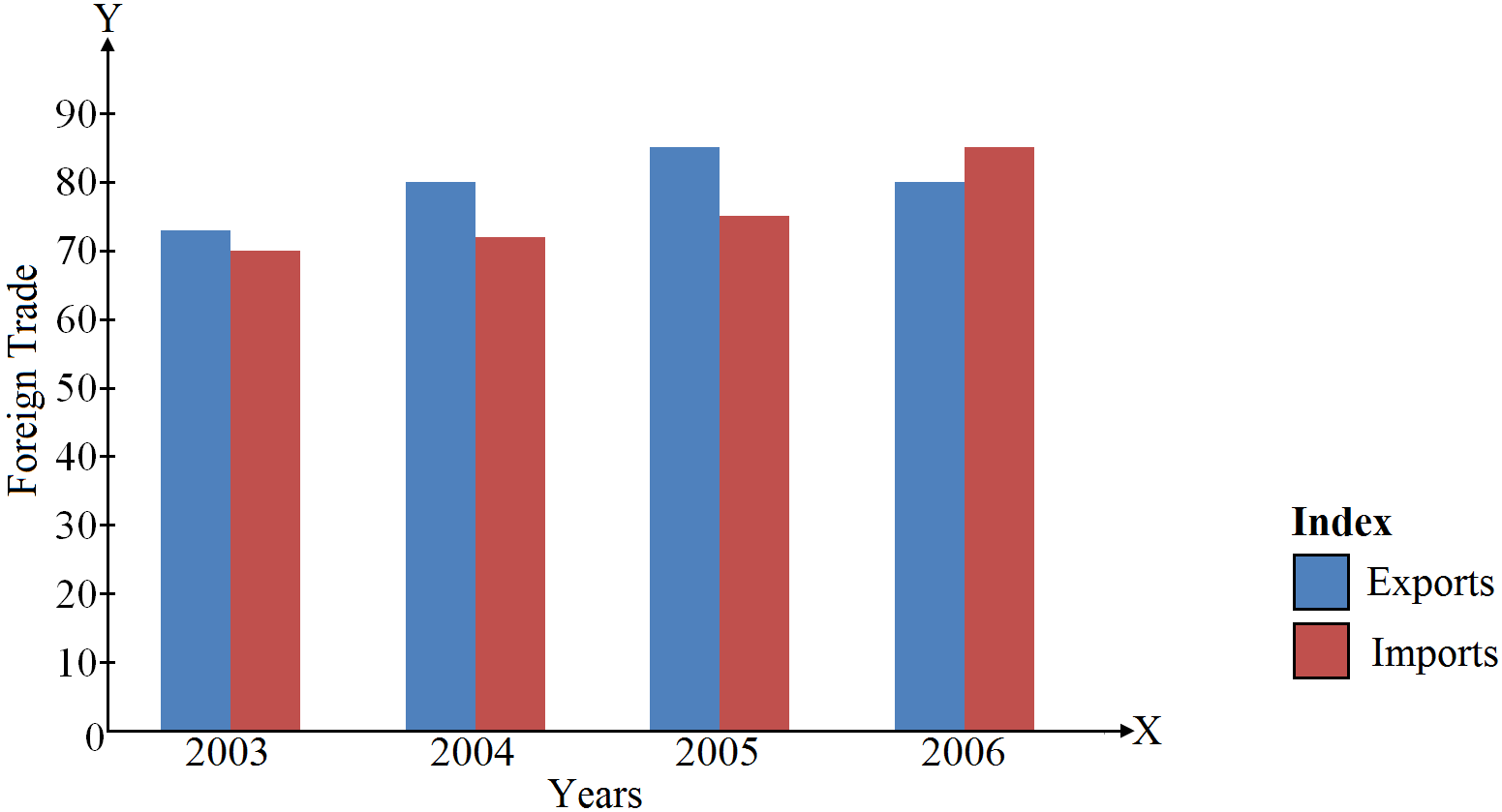
Represent the following data with the help of multiple bar diagram.
Year
2003
2004
2005
2006
Exports (crore in ₹)
73
80
85
80
Imports (crore in ₹)
70
72
75
85
Answer
Multipte Bar Diagram.
View full question & answer
Question 84 Marks
What are the general rules of tabulation?
Answer
General rules of a table are as follows:
  1. A table should be simple and attractive. There should be no need of further explanations (details).
  2. Proper and clear headings for columns and rows should be need.
  3. Suitable approximation may be adopted and figures may be rounded off.
  4. The unit of measurement should be well defined.
  5. If the observations are large in number they can be broken into two or three tables.
  6. Thick lines should be used to separate the data under big classes and thin lines to separate the sub classes of data.
View full question & answer
Question 94 Marks
Distinguish between a bar diagram and a histogram.
Answer
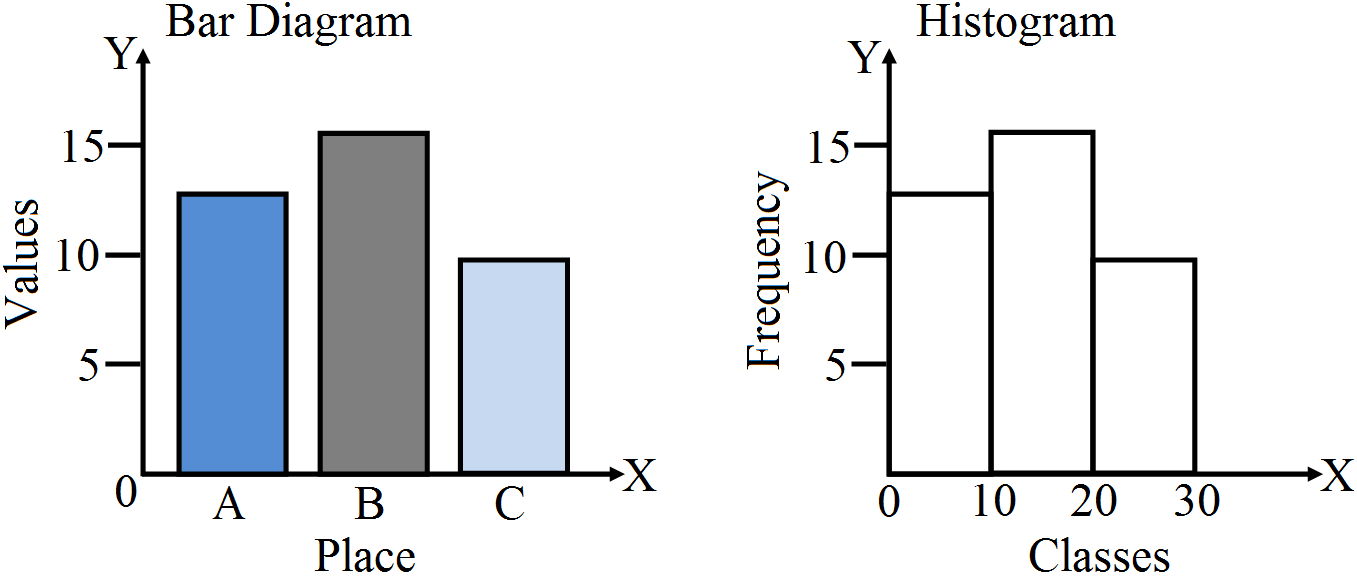
Bar diagram is different from a histogram in two ways:
  1. In a bar diagram, we are concerned with the length of the bar. They are one-dimensional form of presentation. But, a histogram is a two-dimensional form of presentation where length and width both are taken into account.
  2. In a bar diagram, there is a gap between different bars whereas in a histogram, there is no gap in between the different rectangles.
The following figures illustrate the idea:
View full question & answer
Question 104 Marks
Differentiate between frequency polygon and frequency curve.
Answer
The differences between frequency polygon and frequency curve are given below:
S. No.
Basis
Frequency Polygon
Frequency Curve
1.
Meaning
Frequency polygon is a graphical representation of a frequency distribution in which frequencies are first plotted and then joined by straight lines with the help of a ruler.
Frequency curve is a graphical representation of a frequency distribution in which frequencies are first plotted and then joined by free hand.
2.
Based on
A frequencies polygon for a continuous distribution can be made with the help of histogram.
frequency curve is made with the help of frequency polygon.
View full question & answer
Question 114 Marks
How do we get class intervals when mid points are given?
Answer
Following steps are taken:
  1. Add mid values of two successive classes.
  2. Divide it by 2.
  3. It is upper limit of preceding class and lower limit of successive class.
  4. Find the difference between mid values of two successive classes.
  5. Deduct it from the upper limit obtained to get lower limits of the preceding class.
  6. Repeat it for all classes if classes are unequal (if difference between different mid values is different) and if classes are equal (if difference between different mid values is equal) simply keep on adding the difference between two successive mid values to find the upper limits of different classes.
View full question & answer
Question 124 Marks
Draw a frequency polygon for the data given below:
Daily pocket money (in ₹)
20-25
25-30
30-35
35-40
40-45
No. od students
4
9
13
9
5
View full question & answer
Question 134 Marks
What is an ogive? What is the significance of the point where it intersects?
Answer
A frequency distribution gives the number of observations that lie in any class interval whereas the cumulative frequency distribution gives the number of frequencies that lie below any mark or above any given mark. When derived from a frequency distribution, the cumulative frequency distribution of one kind gives the number of observations less than the lower boundaries of the successive class and the cumulative frequency distribution of the second kind gives the number of observations that exceed the lower boundaries of the class which are respectively known as the less than and greater than the cumulative frequency distribution.
If we draw frequency polygon to the above iwo distribution we get cumulative frequency polygon (less than & greater than). If we draw a frequency curve to the above two distribution in the same graph, we get cumulative frequency curve or Ogive.
The x co-ordinate of the point of e intersection of less than and greater than cumulative frequency curve is the median.
View full question & answer
Question 144 Marks
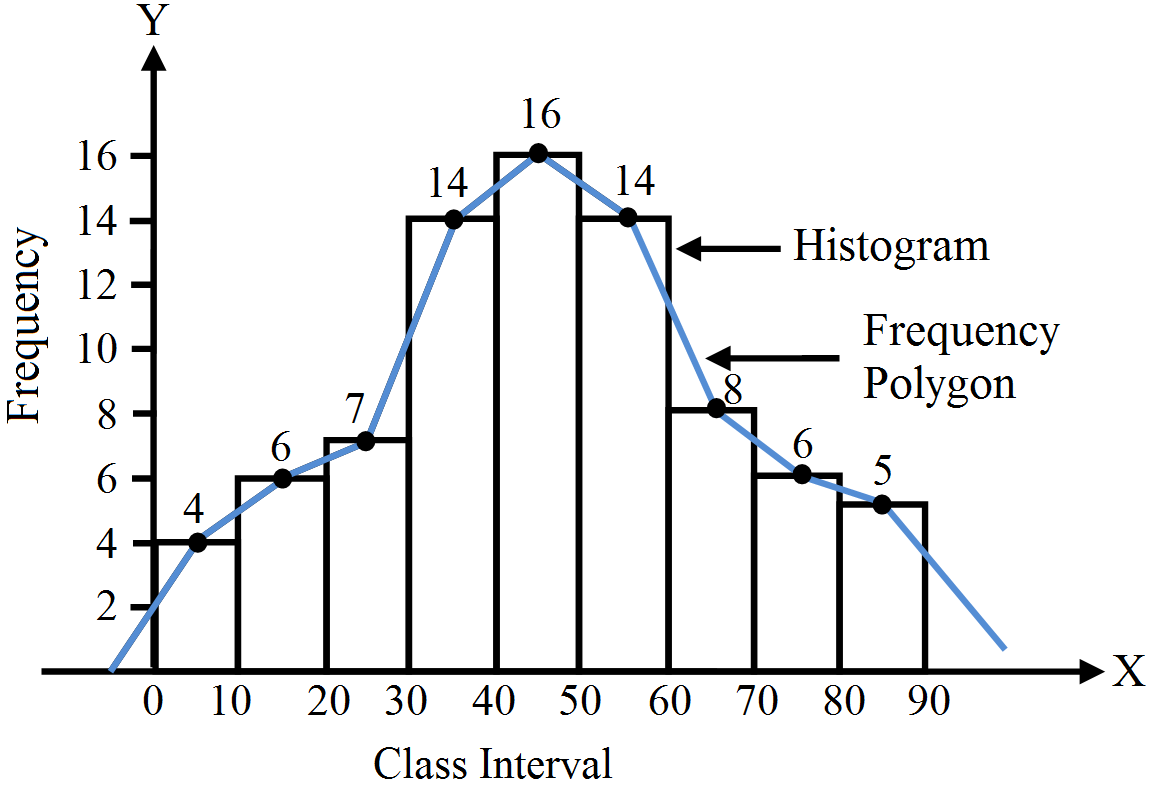
Construct a frequency polygon with histogram for the following data.
Class Inrercal
Frequency
0-10
4
10-20
6
20-30
7
30-40
14
40-50
16
50-60
14
60-70
8
70-80
6
80-90
5
Answer
A frequency polygon with histogram using the given data is shown below:
View full question & answer
Question 154 Marks
What are the general rules to construct a Time Series graph?
Answer
General rules to construct a Time Series graph:
  1. Since time can never be in negative values, II and III quadrant are not used in making of time series graphs.
  2. Time period (week, Month, Year) is taken on X- Axis. And Variable under study is taken on Y-Axis
  3. We start Y axis with Zero and decide the scales for both the axis.
  4. Different values are plotted on the graph.
  5. By joining these points, we get a time series graph.
Time series graph can be of three types:
  1. One Variable Graph.
  2. Two or more than two variable Graph.
  3. When False Base Line is used.
  4. Graphs of Different Units.
View full question & answer
Question 164 Marks
Distinguish between classification and tabulation of data.
Answer
Differences between classification and tabulation of data are:
S. No.
Basis
Classification
Tabulation
1.
Meaning
Classification of data means that the data is arranged in different classes according to the presence or absence of certain attributes.
Tabulation of data means that the classified data is arranged in rows and columns, under suitable heads and sub-heads.
2.
Sequence
Classification precedes the process of tabulation.
Data can be tabulated only after it has been classified.
3.
Method or Process
Classification is a method which facilitates statistical analysis.
Tabulation is a process which facilitates the presentation of data by preparing table.
4.
Tool
It is a tool which helps to organise data.
It is a tool which helps in the presentation of data.
View full question & answer
Question 174 Marks
Write three merits of tabular presentation of data.
OR
State the merits of tabular presentation.
Answer
The three merits of tabular presentation of data are:
  1. It plays an important role in simplifying presentation of data.
  2. It makes voluminous data collected usable and easily comprehendible.
  3. It facilitates further analysis.
  4. Tables are good sources of reference for further studies.
  5. Tables facilitate comparison.
View full question & answer
Question 184 Marks
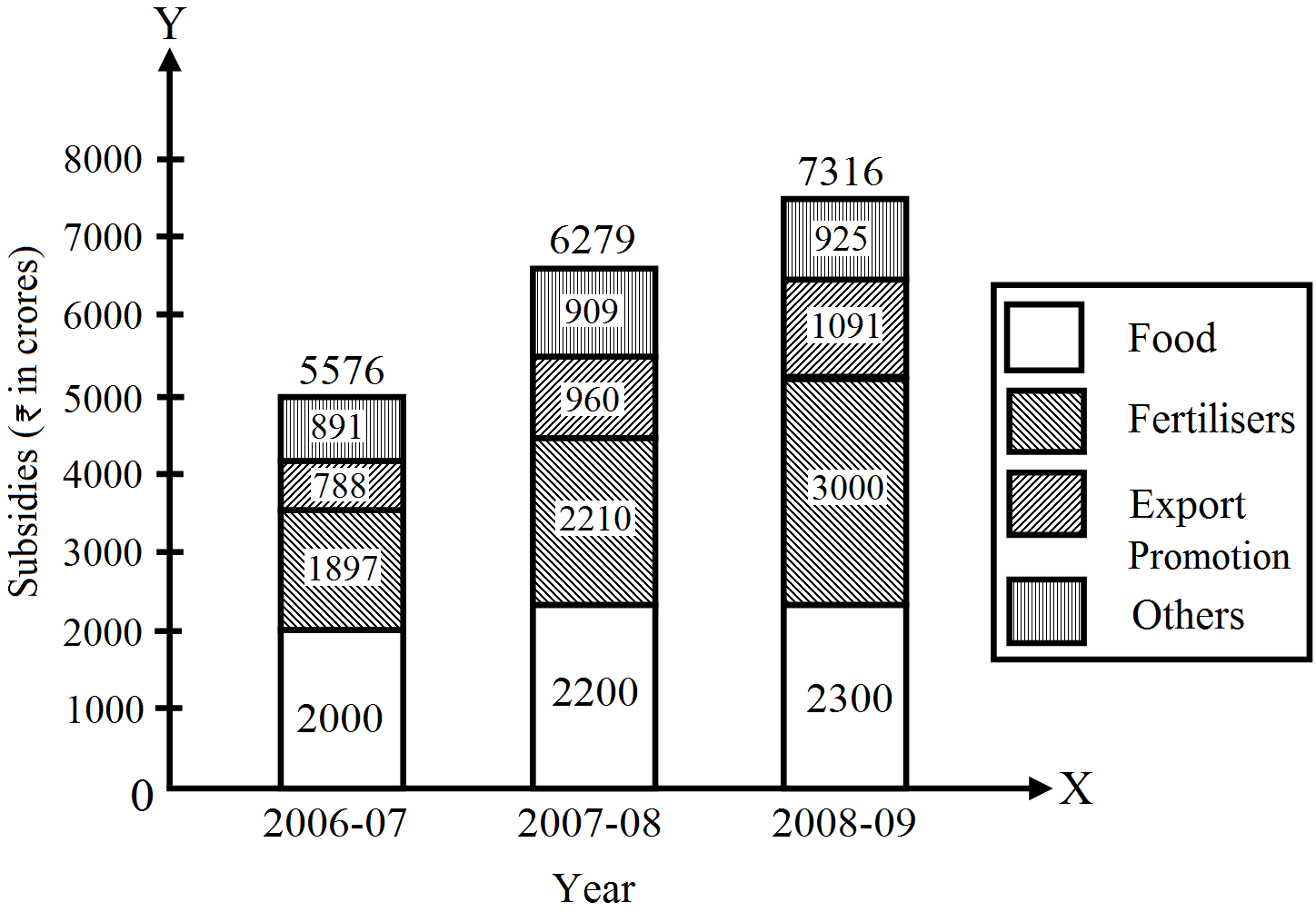
Subsidies on food, fertilisers, export promotion and others given by the government are shown in the table below (in crores). Represent the data diagrammatically.
Year
Food
Fertilsers
Export Promotion
Others
Total
2006-07
2000
1897
788
891
5576
2007-08
2200
2210
960
909
6279
2008-09
2300
3000
1091
925
7316
Answer
Sol. The data shows the sub-division of subsidy in different components. Therefore, it is represented through a sub-divided bar diagram. The diagrammatic representation of the given data is shown below:
View full question & answer
Question 194 Marks
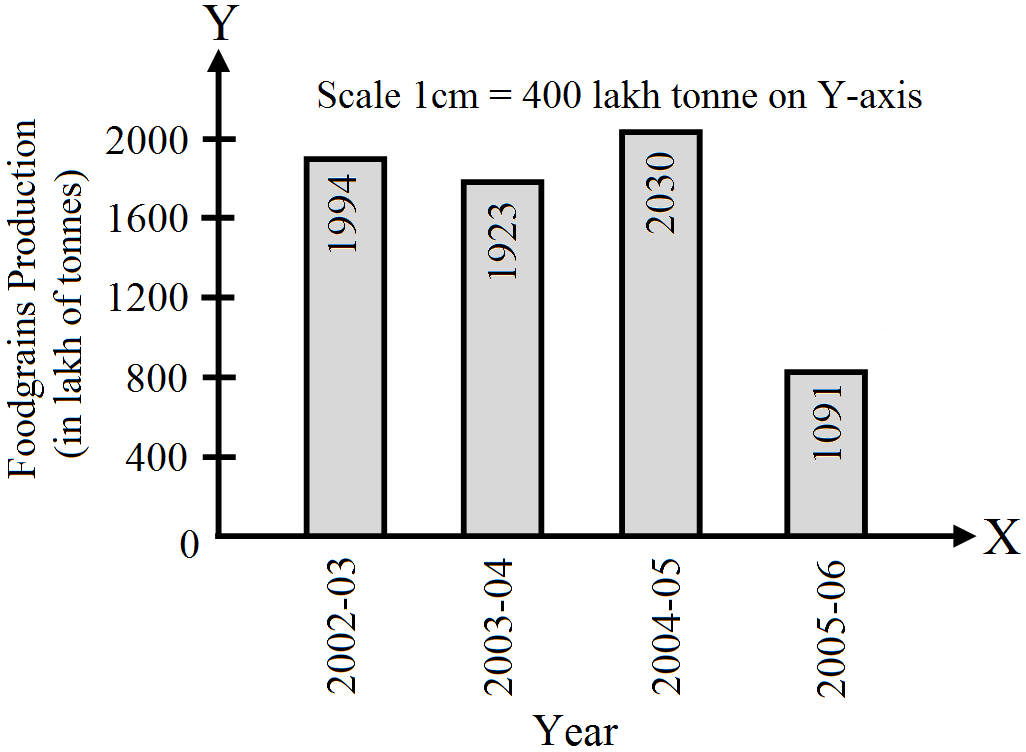
The following table gives absolute values (in lakh of tonne) of foodgrains production in India.
Year
Foodgrains production (in lakh of tonnes)
2002-03
1994
2003-04
1923
2004-05
2030
2005-06
1091
Represent the data by an appropriate bar diagram.
Answer
The bar diagram of given data is shown below:
View full question & answer
Question 204 Marks
Explain the advantages and disadvantages of textual presentation of data.
Answer
The advantages of textual presentation of data are:
  1. The reporter can draw attention of the reader to highlight particular points which he considers to be of special importance.
  2. This mode of presentation of data is easy to understand as well as appealing to literate people.
  3. Detailed information can be provided to the reader regarding any problem.
The disadvantages of textual presentation of data are:
  1. In most cases, the textual presentation of statistical information is monotonous and boring.
  2. It is not appropriate for presenting a large volume of statistical information.
  3. If it becomes necessary to make large number of comparisons, this method may not work.
View full question & answer
Question 214 Marks
Describe the procedure of drawing a histogram when class intervals are:
  1. Equal.
  2. Unequal.
Answer
  1. Steps of drawing a histogram in case of equal Class Intervals:
  1. We take the class intervals on the x-axis.
  2. The frequencies are taken on the y-axis.
  3. We construct rectangles on all class intervals such that the area of each rectangle is proportional to the frequency in the corresponding class.
  1. Steps of drawing a histogram in case of unequal Class Intervals:
  1. Take the class on the x-axis.
  2. Adjust the given frequencies according to the size of the class interval. Adjusted frequencies are obtained by using the formula:
Adjusted Frequency $=\frac{\text{Lowest class size}}{\text{Size of the class}}\times\text{given frequency}$
  1. Take the adjusted frequency on the y-axis.
  2. Construct rectangles on all class intervals.
The only difference between the two procedures is that in case of equal class intervals, histogram is made on the basis of the frequencies given originally whereas, in case of unequal class intervals, histogram is made on the basis of adjusted frequencies.
View full question & answer
Question 224 Marks
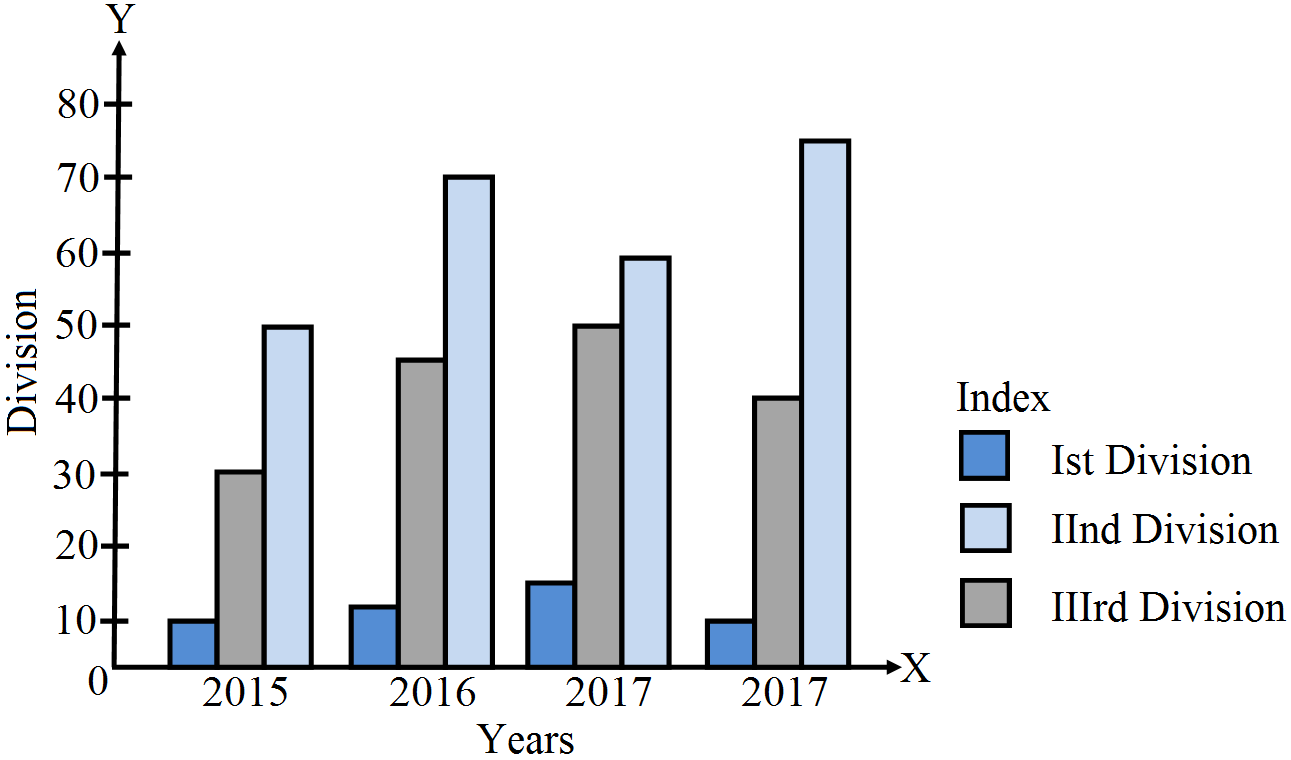
The result of X class students is given as follows:
Years
Ist Division
IInd Division
IIIrd Division
2015
10
30
50
2016
12
45
70
2017
14
50
60
2018
11
40
75
Draw a multiple bar diagram.
Answer
Multiple Bar Diagram.
View full question & answer
Question 234 Marks
Distinguish between classification and tabulation.
Answer
S. No.
Classification
Tabulation
1.
Since data is classified before tabulation, so classification is the basis of tabulation.
Tabulation is a step after classification. Only classified data can be presented in a tabular form.
2.
Under classification method, collected data is classified according to their characteristics.
In the process of tabulation, organised data is divided into different columns and rows.
3.
Classification is a method of statistical analysis.
Tabulation is a method of presentation of data.
4.
In classification, data is classified into different groups and sub-groups.
In tabulation, data is presented in title, caption, stub, body etc.
5.
In the process of classification, original data is used.
In tabulation, both types of data (original and derived) are used.
View full question & answer
Question 244 Marks
What is a false base line? How is it different from a kinked line?
Answer
Usually, when we draw any graph, thescale on which the graph is measured starts from zero on the y-axis. However, under the situations when the data to be plotted on graph starts from a value which is far above zero, results in the problem of shortage of space on graph. To overcome this problem of shortage of space, a false base line is plotted. False base line is a line which is drawn to grasp the attention of the reader on the fluctuations which usually remains unnoticed.
A kinked line is used on x axis for the same purpose for which false base line is used for y axis. It means when variable starts from a higher value, we use kinked line and when frequency starts with a first higher number followed by smaller gaps, we use false base line.
View full question & answer
Question 254 Marks
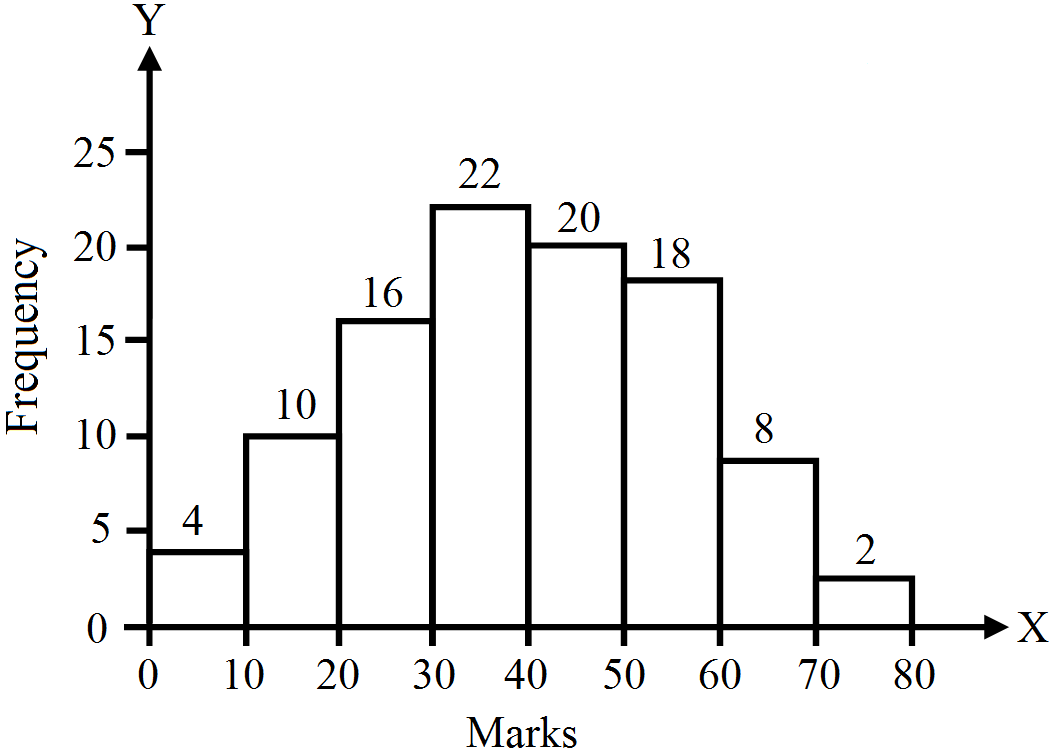
Present the data given in the table below with the help of a histogram.
Marks
Frequency
0-10
4
10-20
10
20-30
14
30-40
22
40-50
20
50-60
18
60-70
8
70-80
2
Answer
A histogram showing given data is given below:
View full question & answer
Question 264 Marks
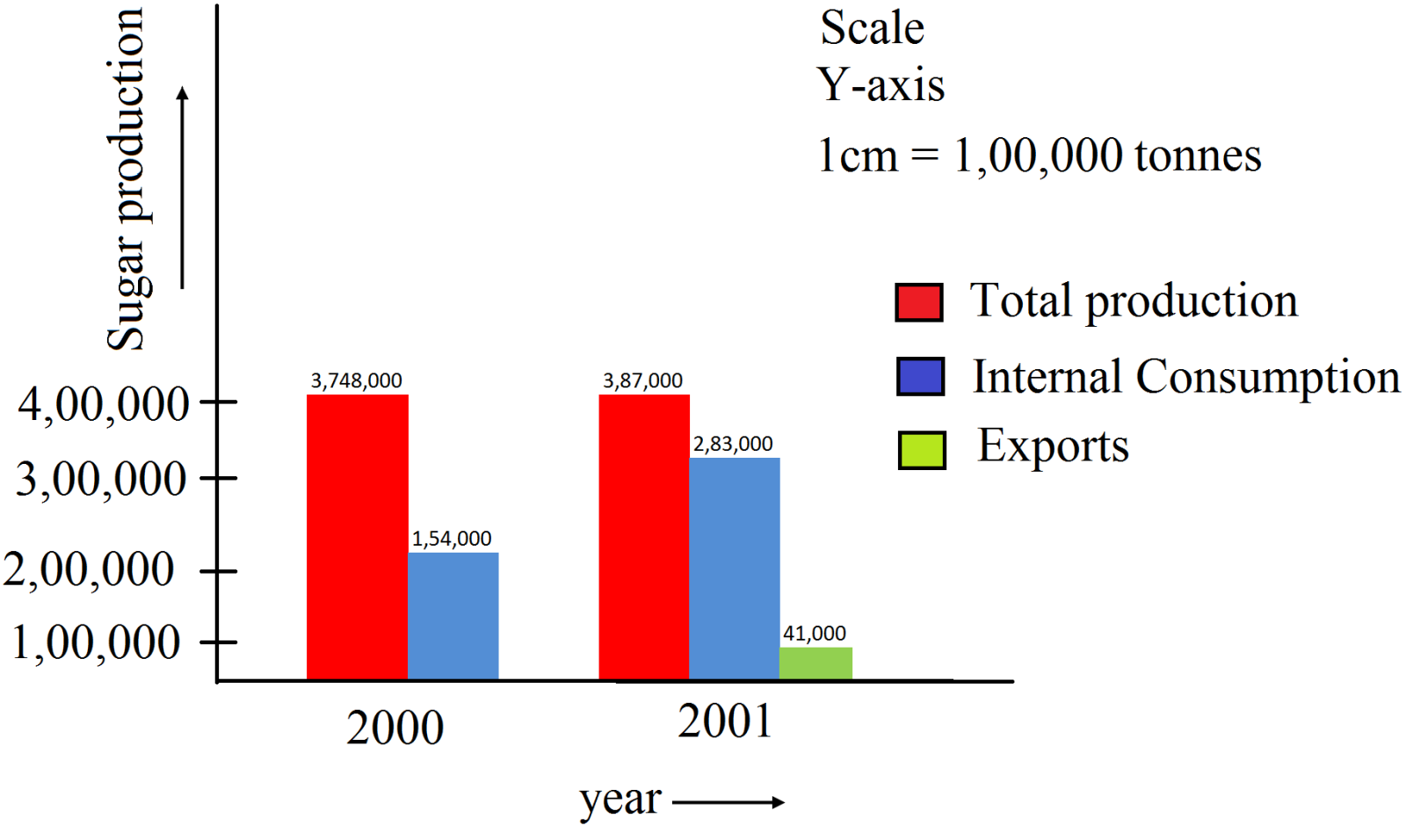
The Indian Sugar Mills Association reported that, ‘Sugar production during the first fortnight of December 2001 was about 3,87,000 tonnes, as against 3,78,000 tonnes during the same fortnight last year (2000). The off-take of sugar from factories during the first fortnight of December 2001 was 2,83,000 tonnes for internal consumption and 41,000 tonnes for exports as against 1,54,000 tonnes for internal consumption and nil for exports during the same fortnight last season.’
  1. Present the data in tabular form.
  2. Suppose you were to present these data in diagrammatic form which of the diagrams would you use and why?
  3. Present these data diagrammatically.
Answer
  1.  
Sugar Production in India
Date
Total Production (tonnes)
Internal Consumption (tonnes)
Export of sugar (tonnes)
December, 2000
3,78,000
1,54,000
-
December, 2000
3,27,000
2,83,000
41,000
  1. To present these data in diagrammatic form we can use multiple bar diagram because these are effective in comparing two or more sets of data.
  2.  
View full question & answer
Question 274 Marks
What do you mean by pie diagram? Write the steps involved in constructing it.
Answer
A pie diagram is a circle diagram whose area is proportionally divided among the components it represents.
The following steps are involved in constructing it:
  1. Construct a circle of an appropriate size with a compass.
  2. Pie diagrams are usually not drawn with absolute values of a category. The values of each category are first expressed as percentage of the total value of all the categories.
  3. Each percentage figure of every component is multiplied by 3.6 to find out its respective angle.
$\Big(\frac{360^\circ}{100}=3.6^\circ\Big)$
  1. Represent various components by different shades, designs or colours for proper identification.
View full question & answer
Question 284 Marks
Explain the utility of diagrammatic presentation by giving any four points.
Answer
The utility of diagrammatic presentation of data will be clearly understood by the following points:
  1. The impression created by diagrams, lasts much longer than those presented in a tabular form.
  2. Diagrammatic presentation of data saves much time and labour in comparison to other techniques of presentation of data.
  3. Diagrams are attractive and have great memorising effect.
  4. With the help of diagrams, the most complex data becomes simple and understandable.
View full question & answer
Question 294 Marks
What is a false base line? Under what conditions would its use be desirable?
Answer
A fundamental rule while constructing graphs is that Y-axis should originate from zero. If the lowest value to be plotted on Y-axis is relatively high, and the consecutive values differ by small value, then presenting such a data poses a problem. This is because if a small scale is taken on the Y-axis, then this would unnecessarily enlarge the presentation and would result in poor visual communication. On the other hand, if a large scale is taken, then the presentation will be cluttered. Therefore, a false base line is drawn over and above the origin, representing the lowest value of the data, and then subsequent values differ by a suitable scale. Preparing a false base line is desirable under the given conditions.
  1. When the lowest value of the series is relatively high.
  2. When subsequent values differ by a small value.
View full question & answer
Question 304 Marks
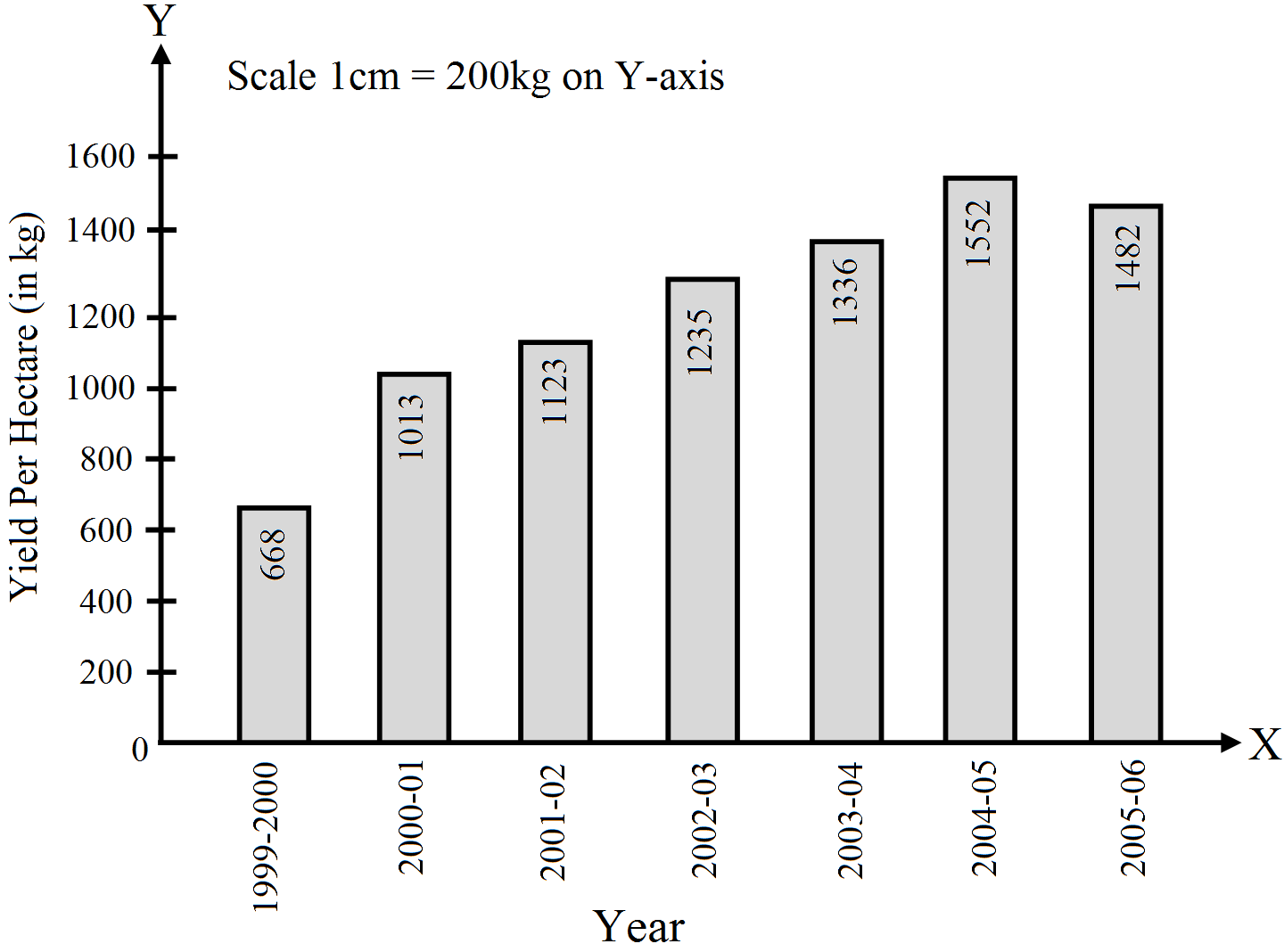
Rice yield per hectare is given below. Show the data diagrammatically.
Year
Yield per hectare (in kg)
1999-2000
668
2000-2001
1013
2001-2002
1123
2002-2003
1235
2003-2004
1336
2004-2005
1552
2005-2006
1482
Answer
The above data can be presented with the help of a simple bar diagram, since only one variable is to be presented.The figure is drawn below:
View full question & answer
Question 314 Marks
What are the main objectives of tabulation?
Answer
Following are the main objects of the tabulation or tabular presentation of statistical data:
  1. It simplifies the complex data.
  2. It facilitates comparison.
  3. It helps to give better identity to the data.
  4. It provides a good means of arrangement.
View full question & answer
Question 324 Marks
Give the differences between diagrams and graphs.
Answer
Differences between diagrams and graphs are:
S. No.
Diagrams
Graphs
1.
A diagram is generally constructed on plain paper.
A graph is generally constructed on graph paper for greater accuracy.
2.
A diagram is used for making comparisons.
A graph represents mathematical relationship between two variables.
3.
The determination of values of median, mode are impossible through diagrams
Graphs are used to obtain the values of median, mode, etc.
4.
Diagrams cannot be used to present data related to frequency distribution and time series.
Data related to frequency distribution and time series can be presented through graphs.
View full question & answer
Question 334 Marks
What are the functions of a graph?
Answer
According to King, "One of the chief aims of statistical science is to render the meaning of masses of figures clear and comprehensible at a glance". This is often best accomplished by presenting the data in a pictorial (or graphical) form.
The shape of the graph gives an exact idea of the variations of the distribution trends. Graphic presentation, therefore, serves as an easy technique for quick and effective comparison between two or more frequency distributions. When the graph of one frequency distribution is superimposed on the other, the points of contrast regarding the type of distribution and the pattern of variation become quite obvious. All these advantages necessitate a clear understanding of the various forms of graphic representation of a frequency distribution.
View full question & answer
Question 344 Marks
Discuss some of the uses of diagrams.
Answer
Some uses of the diagrams are as follows:
  1. Attractive and Impressive: Diagrams are attractive and impressive.
  2. Simple and easily understandable: Diagrams are easy and simple to understand. Knowledge of mathematics is not required to understand diagrams.
  3. Useful in Comparison: Diagrams prove very useful in comparing data from one year to another or otherwise.
  4. Helps in forecasting: It helps us to predict future values on the basis of past statistics.
  5. Save time effort and energy: By simplifying data, diagrams save time, energy and effort.
  6. Diagrams are useful in all fields: From sports to education to medical and engineering, in all fields we make use of diagrams. They are specifically useful for policy formulation and decision making.
View full question & answer
Question 354 Marks
What is procedure of drawing histogram.
Answer
The following steps are to be followed to construct a histogram:
  1. Step 1: Mark class intervals on X-axis and frequencies on Y-axis.
  2. Step 2: The scales for both the axes need not be the same.
  3. Step 3: Class intervals must he exclusive. If the intervals are in inclusive form, convert them to the exclusive form.
  4. Step 4: Draw rectangles with class intervals as bases and the corresponding si frequencies as heights.
  5. Step 5: The class limits are marked on the horizontal axis and the frequency is marked on the vertical axis. Thus, a rectangle is constructed on each class interval.
  6. Step 6: If the intervals are equal, then the height of each rectangle is proportional to the corresponding class frequency.
  7. Step 7: If the intervals are unequal, then the area of each rectangle is proportional to the corresponding class frequency.
View full question & answer