Questions

3 Marks Question

Take a timed test

16 questions · self-marked practice — reveal the answer and mark yourself.

Question 13 Marks
Explain the nucleophilic substitution reaction of aldehydes and ketones with Grignard reagent (R'-Mg-X) with chemical equations ### Write only chemical reactions to obtain 1º, 2º and 3º alcohols from aldehyde andketone compounds.
Answer
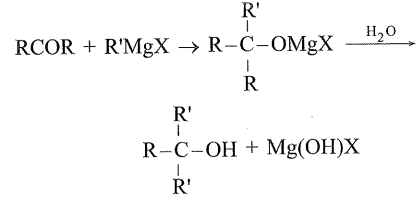
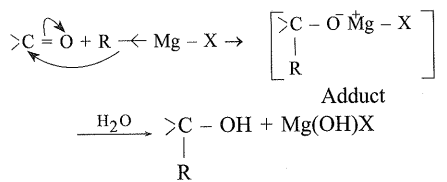
→ Alcohols are produced by the reaction of Grignard reagents with aldehydes and ketones.
→ The first step of the reaction is the nucleophilic addition of Grignard reagent to the carbonyl group to form an adduct. Hydrolysis of the adduct yields an alcohol.
Image
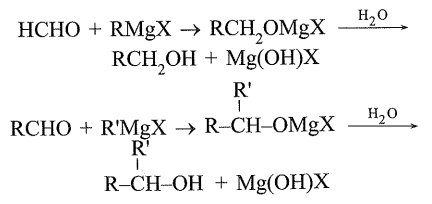
→ The overall reactions using different aldehydes and ketones are as follows:
Image
Image
→ You will notice that the reaction produces a primary alcohol with methanal, a secondary alcohol with other aldehydes and tertiary alcohol with ketones.
View full question & answer
Question 23 Marks
Explain the preparation of ethers with mech$-$anism by dehydration of alcohols.
Answer
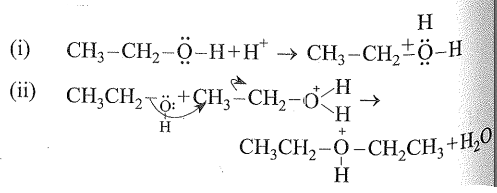
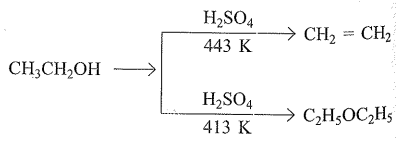
$\rightarrow$ Alcohols undergo dehydration in the presence of protic acids $(H_2SO_4, H_3PO_4).$ The formation of the reaction product, alkene or ether depends on the reaction conditions. For example, ethanol is dehydrated to ethene in the presence of sul$-$ phuric acid at $443 K.$ At $413 K,$ ethoxyethane is the main product.
Image
$\rightarrow$ The formation of ether is a nucleophilic bimolecular reaction $(S_N2)$ involving the attack of alcohol molecule on a protonated alcohol, as indicated below:
Image
$(ii)$
Image
$\rightarrow$ Acidic dehydration of alcohols, to give an alkene is also associated with substitution reaction to give an ether.
View full question & answer
Question 33 Marks
State the preparation, properties and uses of methanol.
Answer
$\rightarrow$ Methanol, $CH_3OH,$ also known as 'wood spirit', was produced by destructive distillation of wood. Today, most of the methanol is produced by catalytic hydrogenation of carbon monoxide at high pressure and temperature and in the presence of $ZnO - Cr_2O_3$ catalyst.
$CO +2 H _2 \xrightarrow[\substack{200-300\ atm \ 573-673 k }]{ ZnO - Cr _2 O _3} CH _3 OH$
$\rightarrow$ Methanol is a colourless liquid and boils at $337 K.$ It is highly poisonous in nature. Ingestion of even small quantities of methanol can cause blindness and large quantities causes even death. Methanol is used as a solvent in paints, varnishes and chiefly for making formaldehyde.
View full question & answer
Question 43 Marks
Write a note on halogenation of phenol.
Answer
$\rightarrow$ Halogenation: On treating phenol with bromine, different reaction products are formed under different experimental conditions.
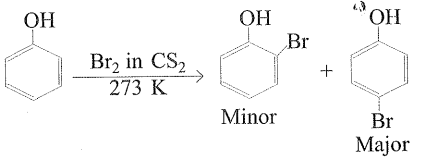
$(a)$ When the reaction is carried out in solvents of low polarity such as $CHCl_3$ or $CS_2$ and at low temperature, monobromophenols are formed.
Image
$\rightarrow$ The usual halogenation of benzene takes place in the presence of a Lewis acid, such as $FeBr^3, $ which polarises the halogen molecule. In case of phenol, the polarization of bromine molecule takes place even in the absence of Lewis acid. It is due to the highly activating effect of $-OH$ group attached to the benzene ring.
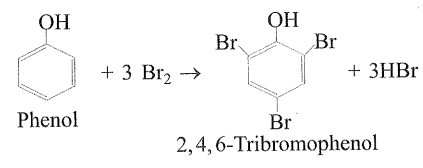
$(b)$ When phenol is treated with bromine water, $2, 4, 6-$tribromophenol is formed as white precipitate.
Image
View full question & answer
Question 53 Marks
Explain nitration of phenol in detail.
Answer
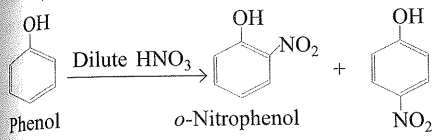
→ Nitration: With dilute nitric acid at low temperature (298 K), phenol yields a mixture of ortho and para nitrophenols.
Image
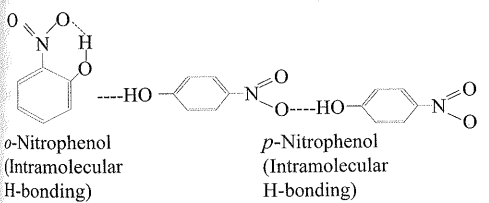
→ The ortho and para isomers can be separated by steam distillation. o-Nitrophenol is steam volatile due to intramolecular hydrogen bonding while p-nitrophenol is less volatile due to intermolecular hydrogen bonding which causes the association of molecules.
Image
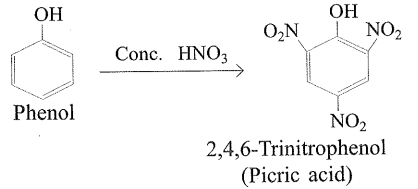
→ With concentrated nitric acid, phenol is converted to 2,4,6-trinitrophenol. The product is commonly known as picric acid. The yield of the reaction product is poor.
Image
→ Nowadays picric acid is prepared by treating phenol first with concentrated sulphuric acid which converts into phenol-2,4-disulphonic acid, and then with concentrated nitric acid to get 2,4,6-trinitrophenol.
View full question & answer
Question 63 Marks
Write a note on oxidation reaction of alcohols. $\#\#\#$ Explain oxidation of alcohols with chemical reactions.
Answer
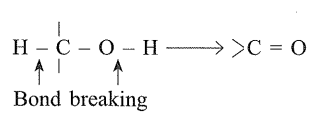
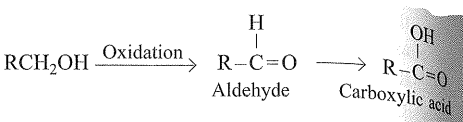
$\rightarrow$ Oxidation: Oxidation of alcohols involves the formation of a carbon oxygen double bond with cleavage of an $O-H$ and $C-H$ bonds.
Image
$\rightarrow$ Such a cleavage and formation of bonds occur in oxidation reactions. These are also known as dehydrogenation reactions as these involve loss of dihydrogen from an alcohol molecule Depending on the oxidising agent used, a primary alcohol is oxidised to an aldehyde which in turn is oxidised to a carboxylic acid
Image
$\rightarrow$ Strong oxidising agents such as acidified potassium permanganate are used for getting carboxylic acids from alcohols directly. $Cro_3$ in anhydrous medium is used as the oxidising agent for the isolation of aldehydes.
$RCH _2 OH \xrightarrow{ CrO _3} RCHO$
$\rightarrow$ A better reagent for oxidation of primary alcohols to aldehydes in good yield is pyridinium chlorochromate
$ \text{(PCC)},$ a complex of chromium trioxide with pyridine and $ \text{HCl.}$
$CH _3- CH = CH - CH _2 OH \xrightarrow{ PCC }$$CH _3- CH = CH - CHO$
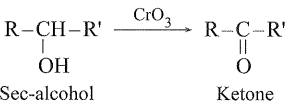
$\rightarrow$ Secondary alcohols are oxidised to ketones by chromic anhyride $(CrO3).$
Image
$\rightarrow$ Tertiary alcohols do not undergo oxidation reaction. Under strong reaction condition such as strong oxidizing agents $(KMnO_4)$ and elevated temperature, cleavage of various $C-C$ bonds place and mixture of carboxylic acid containing Activate $W$ lesser number of carbon atoms is formed.
View full question & answer
Question 73 Marks
Explain dehydration of alcohols with chemical equations. And also give the order for relative ease of dehydration of alcohols.
Answer
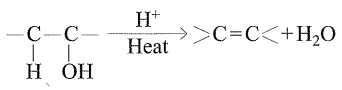
$\rightarrow$ Dehydration: Alcohols undergo dehydration $($removal of a molecule of water$)$ to form alkenes on treating with a protic acid e.g., concentrated $H_2SO_4$ or $H_3PO_4,$ or catalysts such as anhydrous zinc chloride or alumina.
Image
$\rightarrow$ Ethanol undergoes dehydration by heating it with concentrated $H_2SO_4$ at $443 K.$
$C _2 H _5 OH \xrightarrow[443 K]{ H _2 SO _4} CH _2= CH _2+ H _2 O$
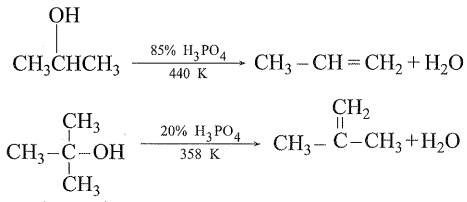
$\rightarrow$ Secondary and tertiary alcohols are dehydrated under milder conditions. For example
Image
$\rightarrow$ Thus, the relative ease of dehydration of alcohols follows the following order :
Tertiary $>$ Secondary $>$ Primary
View full question & answer
Question 83 Marks
Write a note on esterification of alcohols and phenols.
Answer
$\rightarrow$ Alcohols and phenols react with carboxylic acids, acid chlorides and acid anhydrides to form esters.
$Ar / RO - H + R ^{\prime}- COOH \stackrel{ H ^{+}}{\rightleftharpoons} Ar / ROCOR ^{\prime}+ H _2 O$
$Ar / R - OH +\left( R ^{\prime} CO \right)_2 O \stackrel{ H ^{+}}{\rightleftharpoons} Ar / ROCOR '+ R ^{\prime} COOH$
$R / ArOH + R ^{\prime} COCl \xrightarrow{\text { Pyridine }} R / ArOCOR ' + HCl$
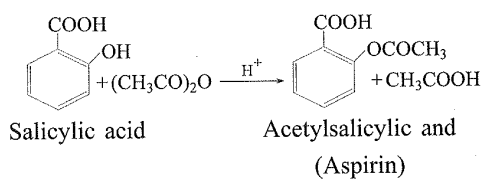
$\rightarrow$ The reaction with carboxylic acid and acid anhydride is carried out in the presence of a small amount of concentrated sulphuric acid. The reaction is reversible, and therefore, water is removed as soon as it is formed. The reaction with acid chloride is carried out in the presence of a base $($pyridine$)$ so as to neutralise $ \text{HCl}$ which is formed during the reaction. It shifts the equilibrium to the right hand side. The introduction of acetyl $(CH_3CO)$ group in alcohols or phenols is known as acetylation. Acetylation of salicylic acid produces aspirin.
Image
View full question & answer
Question 93 Marks
Why a compound in which hydroxyl group attached to an aromatic ring is more acidic than the one in which hydroxyl group attached to an alkyl group?
Answer
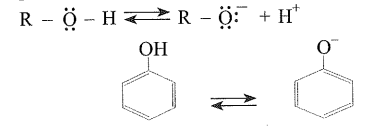
$\rightarrow$ The ionization of an alcohol and a phenol takes place as follows:
Image
$\rightarrow$ Due to the higher electronegativity of $sp^2$ hybridised carbon of phenol to which $-OH$ is attached, electron density decreases on oxygen. This increases the polarity of $O-H$ bond and results in an increase in ionization of phenols than that of alcohols.
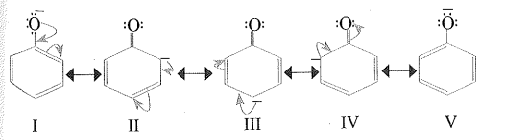
$\rightarrow$ Now let us examine the stabilities of alkoxide and phenoxide ions. In alkoxide ion, the negative charge is localised on oxygen while in phenoxide ion, the charge is delocalised.
$\rightarrow$ The delocalisation of negative charge $($structures $I-V)$ makes phenoxide ion more stable and favours the ionization of phenol.
$\rightarrow$ Although there is also charge delocalisation in phenol, its resonance structures have charge separation due to which the phenol molecule is less stable than phenoxide ion.
Image
View full question & answer
Question 103 Marks
Write a note on acidity of alcohols.
Answer
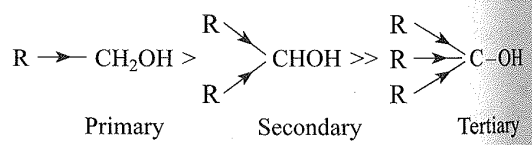
$\rightarrow$ Acidity of alcohols: The acidic character of alcohols is due to the polar nature of $O-H$ bond. An electron$-$releasing group $(-CH_3, C_2H_5) \ 2$ increases electron density on oxygen tending to decrease the polarity of $O-H$ bond. This decreases the acid strength. For this reason, the acid strength of alcohols decreases in the following order :
Image
$\rightarrow$ Alcohols are, however, weaker acids than water. This can be illustrated by the reaction of water with an alkoxide.
Image
$\rightarrow$ This reaction shows that water is a better proton donor $($i.e., stronger acid$)$ than alcohol. Also, in the above reaction, we note that an alkoxide ion is a better proton acceptor than hydroxide ion, which suggests that alkoxides are stronger bases $($sodium ethoxide is a stronger base than sodium hydroxide$).$
$\rightarrow$ Alcohols can act as both bronsted bases as well as acids. It is due to the presence of unshared electron pairs on oxygen. which makes them proton acceptors.
View full question & answer
Question 113 Marks
Explain the acidic nature of alcohols and phenols by their reaction with metals. $\#\#\# \ '$ Alcohols and phenols are acidic in nature' verify the truth of this statement by a reaction with metals.
Answer
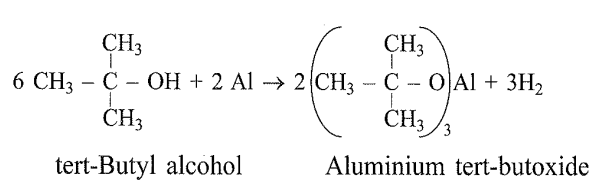
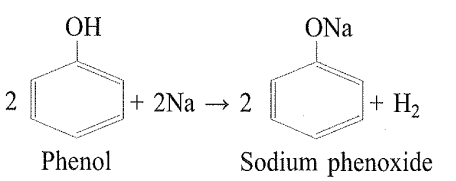
$\rightarrow$ Reaction with metals: Alcohols and phenols react with active metals such as sodium, potassium and aluminium to yield corresponding alkoxides/phenoxides and hydrogen.
$\ce{2 R - O - H +2 Na} \rightarrow \underset{\text{ Sodium alkoxide }}{\ce{2 R - O - Na + H _2}}$
Image
Image
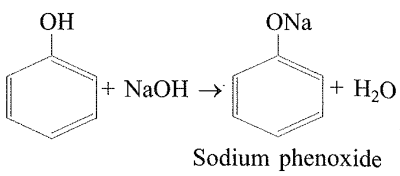
$\rightarrow$ In addition to this, phenols react with aqueous sodium hydroxide to form sodium phenoxides
Image
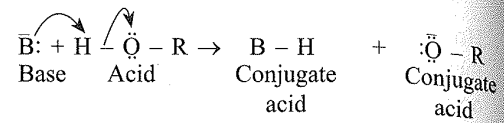
$\rightarrow$ The above reactions show that alcohols and phenols are acidic in nature. In fact, alcohols and phenols are bronsted acids i.e., they can
donate a proton to a stronger base $(B)$.
Image
View full question & answer
Question 123 Marks
Explain the effect of hydrogen bond on boiling point of alcohol and phenol.
Answer
→ The boiling points of alcohols and phenols increase with increase in the number of carbon atoms (increase in van der Waals forces). In alcohols, the boiling points decrease with increase of branching in carbon chain (because of decrease in van der Waals forces with decrease in surface area).
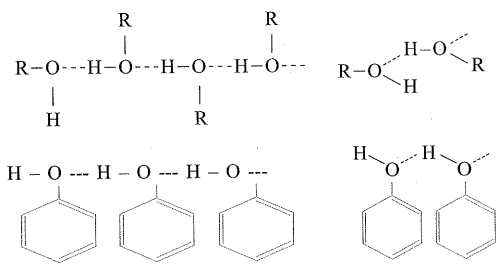
→ The -OH group in alcohols and phenols involved in intermolecular hydrogen bonding is as shown below:
Image
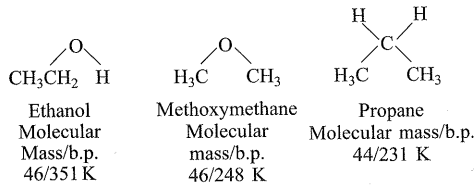
→ It is interesting to note that boiling points of alcohols and phenols are higher in comparison to other classes of compounds, namely hydrocarbons, ethers, haloalkanes and haloarenes of comparable molecular masses. For example, ethanol and propane have comparable molecular masses but their boiling points differ widely. The boiling point of methoxymethane is intermediate of the two boiling points.
Image
→ The high boiling points of alcohols are mainly due to the presence of intermolecular hydrogen bonding in them which is lacking in ethers and hydrocarbons.
View full question & answer
Question 133 Marks
Give information about $C-O-H$ bond angle in alcohol, phenol and ether with suitable example.
Answer
$\rightarrow$ In alcohols, the oxygen of $-OH$ group is attached to carbon by a sigma $(\sigma)$ bond formed by the overlap of an $sp^3$ hybridised orbital of carbon with $sp^3$ hybridised orbital of oxygen.
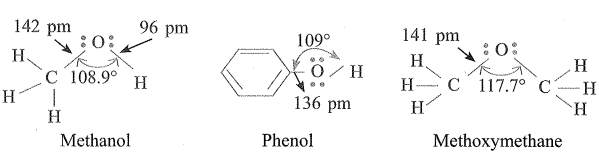
$\rightarrow$ Figure depicts structural aspects of methanol, phenol and methoxymethane.
Image
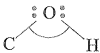
$\rightarrow$ The bond angle Imagein alcohols is slightly less than the tetrahedral angle $(109^\circ -28 \ ').$
$\rightarrow$ It is due to the repulsion between the unshared electron pairs of oxygen.
$\rightarrow$ In phenols, the $OH$ group is attached to $sp^2$ hybridised carbon of an aromatic ring.
$\rightarrow$ The carbon$-$oxygen bond length $(136 \ pm)$ in phenol is slightly less than that in methanol.
$\rightarrow$ This is due to $(i)$ partial double bond character on account of the conjugation of unshared electron pair of oxygen with the aromatic ring and $(ii) \ sp^2$ hybridised state of carbon to which oxygen is attached.
$\rightarrow$ In ethers, the four electron pairs, i.e., the two bond pairs and two lone pairs of electron on oxygen are arranged approximately in a tetrahedral arrangement.
$\rightarrow$ The bond angle is slightly greater than the tetrahedral angle due to the repulsive interaction between the two bulky $(-R)$ groups.
$\rightarrow$ The $C-O$ bond length $(141\ pm)$ is almost the same as in alcohols.
View full question & answer
Question 143 Marks
Explain the nomenclature of phenols by giving examples.
Answer
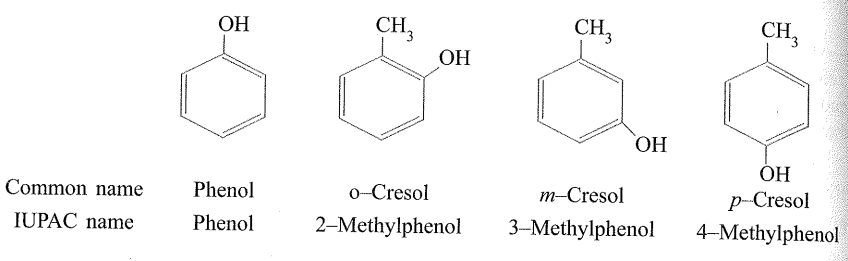
→ The simplest hydroxyl derivative of benzene is phenol. It is its common name and also an accepted IUPAC name. As structure of phenol involves a benzene ring, in its substituted compounds the term ortho (1,2- disubstituted), meta (1,3- disubstituted) and para (1,4- disubstituted) are often used in the common names.
Example:
Image
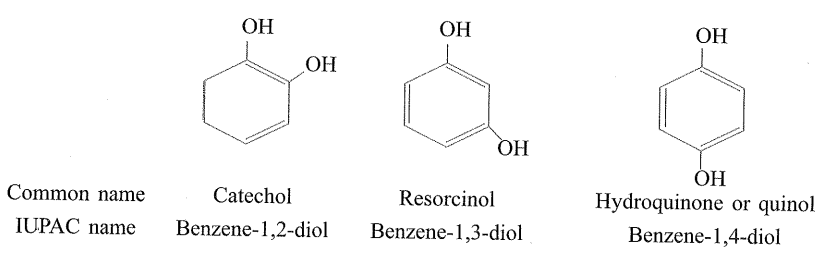
→ Dihydroxy derivatives of benzene are known as 1, 2, 1, 3- and 1, 4-benzenediol.
Image
View full question & answer
Question 153 Marks
Discuss the classification of monohydric alcohols containing $C_{sp}^3-OH$ bond.
Answer
$\rightarrow$ $C_{sp}^3 - OH$ bond: In this class of alcohols. the $-OH$ group is attached to an $sp^3$ hybridised $3$ carbon atom of an alkyl group. They are further classified as follows:
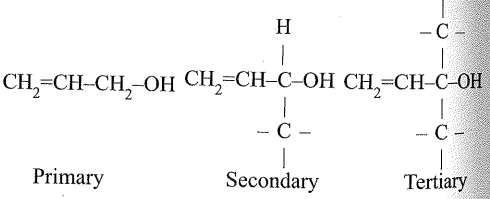
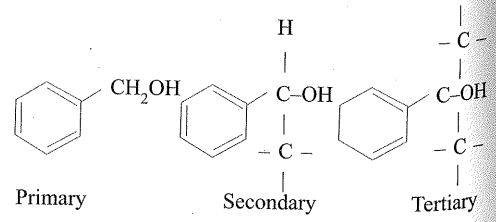
$\rightarrow$ Primary, secondary and tertiary alcohols: In these three types of alcohols, the $-OH$ group is attached to primary, secondary and tertiary carbon atom, respectively as depicted below :
Image
$\rightarrow$ Allylic alcohols : In these alcohols, the $-OH$ group is attached to an $sp^3$ hybridised carbon next the carbon$-$carbon double bond, that is to an allylic carbon. For example,
Image
$\rightarrow$ Benzylic alcohols : In these alcohols, the $-OH$ group is attached to an $sp^{3-}$ hybridised carbon atom next to an aromatic ring. For example,
Image
$\rightarrow$ Allylic and benzylic alcohols may be primary, secondary or tertiary.
View full question & answer
Question 163 Marks
What are alcohol, phenol and ether compounds ?
Answer
$\rightarrow$ Alcohol compounds: An alcohol contains one or more hydroxyl $(OH)$ group $(s)$ directly attached to carbon atom $(s),$ of an aliphatic system. For example, $CH_3OH.$
$\rightarrow$ Phenol compounds: A phenol contains one or more hydroxyl $(OH)$ group $(s)$ directly attached to carbon atom $(s),$ of an aromatic system. For example, $C_6H_5OH$
$\rightarrow$ Alcohol compounds: The substitution of a hydrogen atom in a hydrocarbon by an alkoxy or aryloxy group $(R-O/Ar-O)$ yields another class of compounds known as 'ethers', for example, dimethyl ether $(CH_3OCH_3).$
$\rightarrow$ In short, ether is a compound which is formed by substituting the hydrogen atom of hydroxyl group of an alcohol or phenol by an alkyl or aryl group.
View full question & answer