MCQ 1011 Mark
A source of sound of frequency $n$ is moving towards a stationary observer with a speed $S$. If the speed of sound in air is $V$ and the frequency heard by the observer is $n_1$, the value of $n_1 / n$ is
- A
$(V+S) / V$
- B
$V /(V+S)$
- C
$(V-S) / V$
- ✓
$V /(V-S)$
AnswerCorrect option: D. $V /(V-S)$
(d) By using $n^{\prime}=n \frac{v}{v-v_S} \Rightarrow \frac{n_1}{n}=\left(\frac{V}{V-S}\right)$
View full question & answer→MCQ 1021 Mark
Two tuning forks, $A$ and $B$, give 4 beats per second when sounded together. The frequency of $A$ is $320 \mathrm{~Hz}$. When some wax is added to $B$ and it is sounded with $A, 4$ beats per second are again heard. The frequency of $B$ is
- A
$312 \mathrm{~Hz}$
- B
$316 \mathrm{~Hz}$
- ✓
$324 \mathrm{~Hz}$
- D
$328 \mathrm{~Hz}$
AnswerCorrect option: C. $324 \mathrm{~Hz}$
(c)$n-n \downarrow=x \text { (same) } $
$n \downarrow n=x \text{(same}\Rightarrow n=n+x)$
$=320+4=324 \mathrm{~Hz} .$
View full question & answer→MCQ 1031 Mark
In stationary waves, antinodes are the points where there is
- A
Minimum displacement and minimum pressure change
- B
Minimum displacement and maximum pressure change
- C
Maximum displacement and maximum pressure change
- ✓
Maximum displacement and minimum pressure change
AnswerCorrect option: D. Maximum displacement and minimum pressure change
View full question & answer→MCQ 1041 Mark
The driver of a car travelling with speed 30 metres per second towards a hill sounds a horn of frequency $600 \mathrm{~Hz}$. If the velocity of sound in air is 330 metres per second, the frequency of the reflected sound as heard by the driver is
- ✓
$720 \mathrm{~Hz}$
- B
$555.5 \mathrm{~Hz}$
- C
$550 \mathrm{~Hz}$
- D
$500 \mathrm{~Hz}$
AnswerCorrect option: A. $720 \mathrm{~Hz}$
(a) From the figure, it is clear that Frequency of reflected sound heard by the driver.$\begin{aligned}n^{\prime} & =n\left[\frac{v-\left(v_o\right{vv_s\right]=n\left[\frac{v+v_o}{v-v_s}\right]=n\left[\frac{v+v_{c a r}}{v-v_{c a r}}\right] \\& =600\left[\frac{330+30}{330-30}\right]=720 \mathrm{~Hz} .\end{aligned}$
View full question & answer→MCQ 1051 Mark
The equation $y=0.15 \sin 5 x \cos 300 t$, describes a stationary wave. The wavelength of the stationary wave is
- A
- ✓
$1.256$ metres
- C
$2.512$ metres
- D
$0.628$ metre
AnswerCorrect option: B. $1.256$ metres
On comparing the given equation with standard equation $\frac{2 \pi}{\lambda}=5\Rightarrow \lambda=\frac{6.28}{5}=1.256 \mathrm{~m}$
View full question & answer→MCQ 1061 Mark
A boy is walking away from a wall towards an observer at a speed of $1$ metre/sec and blows a whistle whose frequency is $680 \mathrm{~Hz}$. The number of beats heard by the observer per second is (Velocity of sound in air $=340$ metres $/ \mathrm{sec}$
AnswerObserver hears two frequencies(i) $n_1$ which is coming from the source directly(ii) $n_2$ which is coming from the reflection image of sourceso, $n_1=680\left(\frac{340}{340-1}\right)$ and $n_2=680\left(\frac{340}{340+1}\right)$$\Rightarrow n_1-n_2=4 \text {beats}$
View full question & answer→MCQ 1071 Mark
A source and listener are both moving towards each other with speed $v / 10$, where $v$ is the speed of sound. If the frequency of the note emitted by the source is $f$, the frequency heard by the listener would be nearly
- A
$1.11 f$
- ✓
$1.22 f$
- C
$f$
- D
$1.27 f$
AnswerCorrect option: B. $1.22 f$
View full question & answer→MCQ 1081 Mark
A transverse progressive wave on a stretched string has a velocity of $10 \mathrm{~ms}^{-1}$ and a frequency of $100 \mathrm{~Hz}$. The phase difference between two particles of the string which are $2.5 \mathrm{~cm}$ apart will be
- A
$\frac{\pi}{8}$
- B
$\frac{\pi}{4}$
- C
$\frac{3 \pi}{8}$
- ✓
$\frac{\pi}{2}$
AnswerCorrect option: D. $\frac{\pi}{2}$
$(d) \ v=n \lambda $
$\Rightarrow \lambda=10 \mathrm{~cm}$
Phase difference $\frac{2\pi}{\lambda} \times$ Path difference $\frac{2 \pi}{10} \times 2.5=\frac{\pi}{2}$
View full question & answer→MCQ 1091 Mark
The path difference between the two waves $y_1=a_1 \sin \left(\omega t-\frac{2 \pi x}{\lambda}\right)$ and $y_2=a_2 \cos \left(\omega t-\frac{2 \pi x}{\lambda}+\phi\right)$ is
- A
$\frac{\lambda}{2 \pi} \phi$
- ✓
$\frac{\lambda}{2 \pi}\left(\phi+\frac{\pi}{2}\right)$
- C
$\frac{2 \pi}{\lambda}\left(\phi-\frac{\pi}{2}\right)$
- D
$\frac{2 \pi}{\lambda} \phi$
AnswerCorrect option: B. $\frac{\lambda}{2 \pi}\left(\phi+\frac{\pi}{2}\right)$
$y_1=a_1 \sin \left(\omega t-\frac{2 \pi x}{\lambda}\right)$ and$y_2=a_2\cos\left(\omega t-\frac{2 \pi x}{\lambda}+\phi\right)=a_2 \sin \left(\omega t-\frac{2 \pi x}{\lambda}+\phi+\frac{\pi}{2}\right)$
So phase difference $=\phi+\frac{\pi}{2}$ and $\Delta=\frac{\lambda}{2 \pi}\left(\phi+\frac{\pi}{2}\right)$
View full question & answer→MCQ 1101 Mark
A plane wave is described by the equation $y=3 \cos \left(\frac{x}{4}-10 t-\frac{\pi}{2}\right)$. The maximum velocity of the particles of the medium due to this wave is
- ✓
$30$
- B
$\frac{3 \pi}{2}$
- C
$3 / 4$
- D
$40$
Answer$v_{\max }=a \omega=3 \times 10=30$
View full question & answer→MCQ 1111 Mark
In a stationary wave, all particles are
- ✓
At rest at the same time twice in every period of oscillation
- B
At rest at the same time only once in every period of oscillation
- C
Never at rest at the same time
- D
AnswerCorrect option: A. At rest at the same time twice in every period of oscillation
View full question & answer→MCQ 1121 Mark
When a tuning fork $A$ of unknown frequency is sounded with another tuning fork $B$ of frequency $256 \mathrm{~Hz}$, then $3$ beats per second are observed. After that $A$ is loaded with wax and sounded, the again $3$ beats per second are observed. The frequency of the tuning fork $A$ is
- A
$250 \mathrm{~Hz}$
- B
$253 \mathrm{~Hz}$
- ✓
$259 \mathrm{~Hz}$
- D
$262 \mathrm{~Hz}$
AnswerCorrect option: C. $259 \mathrm{~Hz}$
It is given that$n=$ Unknown frequency $=$ ?$n_{\text {}}=$ Known frequency $=256 \mathrm{~Hz}$
$x=3$ bps, which remains same after loadingUnknown tuning fork $A$ is loaded so $n\downarrow$
Hence $(n)\downarrow n_s=x(nn)\downarrow=x(\Rightarrow n_1=n_1+x=256+3=259 \mathrm{~Hz}$.
View full question & answer→MCQ 1131 Mark
Two waves are given by $y_1=a \sin (\omega t-k x)$ and $y_2=a \cos (\omega t-k x)$ The phase difference between the two waves is
- A
$\frac{\pi}{4}$
- B
$\pi$
- C
$\frac{\pi}{8}$
- ✓
$\frac{\pi}{2}$
AnswerCorrect option: D. $\frac{\pi}{2}$
(d) $y_1=a \sin (\omega t-k x)$$\text { and } y_2=a \cos (\omega t-k x)=a \sin\left(\omega t-k x+\frac{\pi}{2}\right)$Hence phase difference between these two is $\frac{\pi}{2}$.
View full question & answer→MCQ 1141 Mark
Doppler shift in frequency does not depend upon
- A
The frequency of the wave produced
- B
The velocity of the source
- C
The velocity of the observer
- ✓
Distance from the source to the listener
AnswerCorrect option: D. Distance from the source to the listener
View full question & answer→MCQ 1151 Mark
The musical interval between two tones of frequencies $320 \mathrm{~Hz}$ and $240 \mathrm{~Hz}$ is
AnswerCorrect option: B. $\left(\frac{4}{3}\right)$
(b) Musical interval is the ratio of frequencies $=\frac{320}{240}=\frac{4}{3}$
View full question & answer→MCQ 1161 Mark
Learned Indian classical vocalists do not like the accompaniment of a harmonium because
- A
Intensity of the notes of the harmonium is too large
- B
Notes of the harmonium are too shrill
- C
Diatonic scale is used in the harmonium
- ✓
Tempered scale is used in the harmonium
AnswerCorrect option: D. Tempered scale is used in the harmonium
(d) Indian classical vocalists don't like harmoniuim because it uses tempered scale.
View full question & answer→MCQ 1171 Mark
The relation between time and displacement for two particles is given by
$y_1=0.06 \sin 2 \pi\left(0.04 t+\phi_1\right), y_2=0.03 \sin 2 \pi\left(1.04 t+\phi_2\right)$
The ratio of the intensity of the waves produced by the vibrations of the two particles will be
- A
$2: 1$
- B
$1: 2$
- ✓
$4: 1$
- D
$1: 4$
AnswerCorrect option: C. $4: 1$
(c) $\frac{I_1}{I_2}=\frac{a_1^2}{a_2^2}=\left(\frac{0.06}{0.03}\right)^2=\frac{4}{1}$
View full question & answer→MCQ 1181 Mark
With what velocity an observer should move relative to a stationary source so that he hears a sound of double the frequency of source
- ✓
Velocity of sound towards the source
- B
Velocity of sound away from the source
- C
Half the velocity of sound towards the source
- D
Double the velocity of sound towards the source
AnswerCorrect option: A. Velocity of sound towards the source
View full question & answer→MCQ 1191 Mark
Two passenger trains moving with a speed of $108 \mathrm{~km} / \mathrm{hour}$ cross each other. One of them blows a whistle whose frequency is $750 \mathrm{~Hz}$. If sound speed is $330 \mathrm{~m} / \mathrm{s}$, then passengers sitting in the other train, after trains cross each other will hear sound whose frequency will be
- A
$900 \mathrm{~Hz}$
- ✓
$625 \mathrm{~Hz}$
- C
$750 \mathrm{~Hz}$
- D
$800 \mathrm{~Hz}$
AnswerCorrect option: B. $625 \mathrm{~Hz}$
View full question & answer→MCQ 1201 Mark
Two tuning forks $A$ and $B$ vibrating simultaneously produce 5 beats. Frequency of $B$ is 512 . It is seen that if one arm of $A$ is filed, then the number of beats increases. Frequency of $A$ will be
Answer(c) After filling frequency increases, so $n_A$ decreases $(\downarrow)$.
Also it isgiven that beat frequency increases (i.e., $x \uparrow$ )
Hence $n \downarrow-n_{-}=x \uparrow$ $n-n \uparrow=x \uparrow$
correct $n_{-}-n_x=x \uparrow $
$\Rightarrow n_{+}=n_c+x=512+5=517 \mathrm{~Hz} .$
View full question & answer→MCQ 1211 Mark
A wave is reflected from a rigid support. The change in phase on reflection will be
- A
$\pi / 4$
- B
$\pi / 2$
- ✓
$\pi$
- D
$2 \pi$
Answer(c) After reflection from rigid support, a wave suffers a phase change of $\pi$.
View full question & answer→MCQ 1221 Mark
Ten tuning forks are arranged in increasing order of frequency in such a way that any two nearest tuning forks produce 4 beats/sec. The highest frequency is twice of the lowest. Possible highest and the lowest frequencies are
- A
$80$ and $40$
- B
$100$ and $50$
- C
$44$ and $22$
- ✓
$72$ and $36$
AnswerCorrect option: D. $72$ and $36$
View full question & answer→MCQ 1231 Mark
A source of sound emitting a note of frequency $200 \mathrm{~Hz}$ moves towards an observer with a velocity $v$ equal to the velocity of sound. If the observer also moves away from the source with the same velocity $v$, the apparent frequency heard by the observer is
- A
$50 \mathrm{~Hz}$
- B
$100 \mathrm{~Hz}$
- C
$150 \mathrm{~Hz}$
- ✓
$200 \mathrm{~Hz}$
AnswerCorrect option: D. $200 \mathrm{~Hz}$
Since there is no relative motion between observer and source, therefore there is no apparent change in frequency.
View full question & answer→MCQ 1241 Mark
Consider ten identical sources of sound all giving the same frequency but having phase angles which are random. If the average intensity of each source is $I_0$, the average of resultant intensity $l$ due to all these ten sources will be
- A
$I=100 I_0$
- ✓
$I=10 I_0$
- C
$ I=I_0$
- D
$I=\sqrt{10} I_0$
AnswerCorrect option: B. $I=10 I_0$
In case of interference of two waves resultant intensity $I=I_1+I_2+2 \sqrt{I_1 I_2}\cos\phi$
If $\phi$ varies randomly with time, so $(\cos \phi)_{a v}=0$ $\Rightarrow I=I_1+I_2$
For $n$ identical waves, $I=I_0+I_0+\ldots \ldots =n I_0$ here $I=10I_0$.
View full question & answer→MCQ 1251 Mark
A tuning fork and a sonometer wire were sounded together and produce $4$ beats per second. When the length of sonometer wire is $95 \mathrm{~cm}$ or $100 \mathrm{~cm}$, the frequency of the tuning fork is
- ✓
$156 \mathrm{~Hz}$
- B
$152 \mathrm{~Hz}$
- C
$148 \mathrm{~Hz}$
- D
$160 \mathrm{~Hz}$
AnswerCorrect option: A. $156 \mathrm{~Hz}$
(a) Probable frequencies of tuning fork be $n+4$ or $n-4$Frequency of sonometer wire $n \propto \frac{1}{l}$
$\therefore \frac{n+4}{n-4}=\frac{100}{95} \text {or} 95(n+4)=100(n-4)$or $95 n+380=100 (n-400)$ or $5 n=780$ or $n=156$
View full question & answer→MCQ 1261 Mark
When two sound waves with a phase difference of $\pi / 2$, and each having amplitude $A$ and frequency $\omega$, are superimposed on each other, then the maximum amplitude and frequency of resultant wave is
- A
$\frac{A}{\sqrt{2}}: \frac{\omega}{2}$
- B
$\frac{A}{\sqrt{2}}: \omega$
- C
$\sqrt{2} A: \frac{\omega}{2}$
- ✓
$\sqrt{2} A: \omega$
AnswerCorrect option: D. $\sqrt{2} A: \omega$
(d) $A_{\max }=\sqrt{A^2+A^2}=A \sqrt{2}$, frequency will remain same i.e. $\omega$
View full question & answer→MCQ 1271 Mark
The source producing sound and an observer both are moving along the direction of propagation of sound waves. If the respective velocities of sound, source and an observer are $v, v_s$ and $v_o$, then the apparent frequency heard by the observer will be ( $n=$ frequency of sound)
- A
$\frac{n\left(v+v_o\right)}{v-v_o}$
- ✓
$\frac{n\left(v-v_o\right)}{v-v_s}$
- C
$\frac{n\left(v-v_o\right)}{v+v_s}$
- D
$\frac{n\left(v+v_o\right)}{v+v_s}$
AnswerCorrect option: B. $\frac{n\left(v-v_o\right)}{v-v_s}$
View full question & answer→MCQ 1281 Mark
The sound carried by air from a sitar to a listener is a wave of the following type
Answer(d) Observer receives sound waves (music) which are longitudinal progressive waves.
View full question & answer→MCQ 1291 Mark
For the stationary wave $y=4 \sin \left(\frac{\pi x}{15}\right) \cos (96 \pi t)$, the distance between a node and the next antinode is
AnswerComparing given equation with standard equation $y=2 a \sin \frac{2 \pi x}{\lambda} \cos \frac{2 \pi v t}{\lambda}$ gives us $\frac{2\pi}{\lambda}=\frac{\pi}{15}\Rightarrow\lambda=30$
Distance between nearest node and antinodes = $\frac{\lambda}{4}=\frac{30}{4}=7.5$
View full question & answer→MCQ 1301 Mark
Which of the property makes difference between progressive and stationary waves
Answer(c) Progressive wave propagate energy while no propagation of energy takes place instationary waves.
View full question & answer→MCQ 1311 Mark
The equation of a wave is $y=2 \sin \pi(0.5 x-200 t)$, where $x$ and $y$ are expressed in $\mathrm{cm}$ and $t$ in sec. The wave velocity is
- A
$100 \mathrm{~cm} / \mathrm{sec}$
- B
$200 \mathrm{~cm} / \mathrm{sec}$
- C
$300 \mathrm{~cm} / \mathrm{sec}$
- ✓
$400 \mathrm{~cm} / \mathrm{sec}$
AnswerCorrect option: D. $400 \mathrm{~cm} / \mathrm{sec}$
(d) Comparing given equation with standard equation of progressive wave. The velocity of wave$v=\frac{\omega(\text { Co }- \text { efficient of } t)}{k(\text { Co }- \text{efficient of } x)}=\frac{200 \pi}{0.5 \pi}=400 \mathrm{~cm} / \mathrm{s}$
View full question & answer→MCQ 1321 Mark
If amplitude of waves at distance $r$ from a point source is $A$, the amplitude at a distance $2 r$ will be
- A
$2 A$
- B
$A$
- ✓
$A / 2$
- D
$A / 4$
AnswerCorrect option: C. $A / 2$
$A / 2$
View full question & answer→MCQ 1331 Mark
A tuning fork gives $5$ beats with another tuning fork of frequency $100 \mathrm{~Hz}$. When the first tuning fork is loaded with wax, then the number of beats remains unchanged, then what will be the frequency of the first tuning fork
- A
$95 \mathrm{~Hz}$
- B
$100 \mathrm{~Hz}$
- ✓
$105 \mathrm{~Hz}$
- D
$110 \mathrm{~Hz}$
AnswerCorrect option: C. $105 \mathrm{~Hz}$
Suppose $n_{+}=$known frequency $=100 \mathrm{~Hz}, n_{+}=$? $x=5$ bps, which remains unchanged after loading Unknown tuning fork is loaded so $n \downarrow$
Hence $n-n \downarrow=x$$n \downarrow-n=x$
From equation (i), it is clear that as $n$. decreases, beat frequency. (i.e. $n-(n))$ can never be $x$ again.
From equation(ii),as $(n) \downarrow$, beat frequency (i.e. $(n)-n$ ) decreases as long as $(n)$ remains greater than $n$, if $(n)$ become lesser than $n$ the beat frequency will increase again and will be$(x)$.
Hence this is correct.So, $n=n+x=100+5=105 \mathrm{~Hz}$.
View full question & answer→MCQ 1341 Mark
Two tuning forks of frequencies 256 and 258 vibrations/sec are sounded together, then time interval between consecutive maxima heard by the observer is
- A
$2 \mathrm{sec}$
- ✓
$0.5 \mathrm{sec}$
- C
$250 \mathrm{sec}$
- D
$252 \mathrm{sec}$
AnswerCorrect option: B. $0.5 \mathrm{sec}$
(b) $T=\frac{1}{258-256}=0.5 \mathrm{sec}$
View full question & answer→MCQ 1351 Mark
The equation of the propagating wave is $y=25 \sin (20 t+5 x)$, where $y$ is displacement. Which of the following statement is not true
- A
The amplitude of the wave is $25$ units
- ✓
The wave is propagating in positive $x$-direction
- C
The velocity of the wave is $4$ units
- D
The maximum velocity of the particles is $500$ units
AnswerCorrect option: B. The wave is propagating in positive $x$-direction
(b) Positive sign in the argument of sin indicating that wave is travelling in negative $(x)$-direction.
View full question & answer→MCQ 1361 Mark
A source and an observer are moving towards each other with a speed equal to $\frac{v}{2}$ where $v$ is the speed of sound. The source is emitting sound of frequency $n$. The frequency heard by the observer will be
- A
- B
$n$
- C
$\frac{n}{3}$
- ✓
$3 n$
Answer(d)$n^{\prime}=n\left(\frac{v+v_0}{v-v_s}\right)=n\left(\frac{v+v / 2}{v-v / 2}\right)=3 n$
View full question & answer→MCQ 1371 Mark
Two wires are in unison. If the tension in one of the wires is increased by $2 \%, 5$ beats are produced per second. The initial frequency of each wire is
- A
$200 \mathrm{~Hz}$
- B
$400 \mathrm{~Hz}$
- ✓
$500 \mathrm{~Hz}$
- D
$1000 \mathrm{~Hz}$
AnswerCorrect option: C. $500 \mathrm{~Hz}$
$n \propto \frac{1}{2 \ell} \sqrt{\frac{T}{m}}$
$\therefore n \propto T $
$\frac{n_2}{n_1}=\sqrt{\frac{T_2}{T_1}}=\frac{\sqrt{1.02 T_1}}{T_1}=\sqrt{1.02}=1.01$
Also $n_2-n_1=5$
$\therefore 1.01 n_1-n_1=5 $
$\therefore 0.01 n _1=5$
$\therefore n_1=\frac{5}{0.01}=500\ Hz$
View full question & answer→MCQ 1381 Mark
The phase difference between the two particles situated on both the sides of a node is
- A
$0^{\circ}$
- B
$90^{\circ}$
- ✓
$180^{\circ}$
- D
$360^{\circ}$
AnswerCorrect option: C. $180^{\circ}$
View full question & answer→MCQ 1391 Mark
A car sounding a horn of frequency $1000 \mathrm{~Hz}$ passes an observer. The ratio of frequencies of the horn noted by the observer before and after passing of the car is $11: 9$. If the speed of sound is $v$, the speed of the car is
- ✓
$\frac{1}{10} v$
- B
$\frac{1}{2} v$
- C
$\frac{1}{5} v$
- D
$v$
AnswerCorrect option: A. $\frac{1}{10} v$
View full question & answer→MCQ 1401 Mark
A source of sound of frequency $500 \mathrm{~Hz}$ is moving towards an observer with velocity $30 \mathrm{~m} / \mathrm{s}$. The speed of sound is $330 \mathrm{~m} / \mathrm{s}$. the frequency heard by the observer will be
- ✓
$550 \mathrm{~Hz}$
- B
$458.3 \mathrm{~Hz}$
- C
$530 \mathrm{~Hz}$
- D
$545.5 \mathrm{~Hz}$
AnswerCorrect option: A. $550 \mathrm{~Hz}$
(a)$n^{\prime}=n\left(\frac{v}{v-v_S}\right) \Rightarrow n^{\prime}=500\left(\frac{330}{330-30}\right)=550 \mathrm{~Hz}$
View full question & answer→MCQ 1411 Mark
Two sound waves of slightly different frequencies propagating in the same direction produce beats due to
MCQ 1421 Mark
A man is watching two trains, one leaving and the other coming in with equal speeds of $4 \mathrm{~m} / \mathrm{sec}$. If they sound their whistles, each of frequency $240 \mathrm{~Hz}$, the number of beats heard by the man (velocity of sound in air $=320 \mathrm{~m} / \mathrm{sec}$ ) will be equal to
Answer
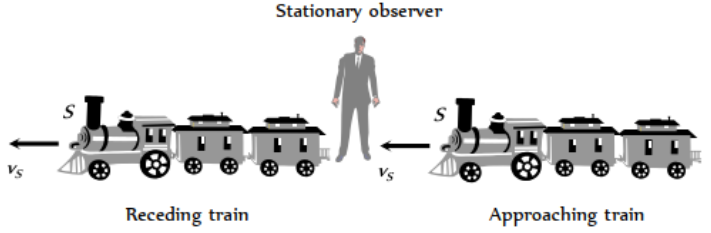
Frequency of sound heard by the man from approaching train
$n_a=n\left(\frac{v}{v-v_s}\right)=240\left(\frac{320}{320-4}\right)=243 \ Hz$
Frequency of sound heard by the man from receding train
$n_r=n\left(\frac{v}{v+v_s}\right)=240\left(\frac{320}{320+4}\right)=237 \ Hz$
Hence, number of beats heard by man per sec
$=n_a-n_r=243-237=6$
Short trick : Number of beats heard per sec
$=\frac{2 n v v_S}{v^2-v_S^2}=\frac{2 n v v_S}{\left(v-v_S\right)\left(v+v_S\right)}=\frac{2 \times 240 \times 320 \times 4}{(320-4)(320+4)}=6$
View full question & answer→MCQ 1431 Mark
The equation of a transverse wave travelling on a rope is given by $y=10 \sin \pi(0.01 x-2.00 t)$ where $y$ and $x$ are in $\mathrm{cm}$ and $t$ in seconds. The maximum transverse speed of a particle in the rope is about
- ✓
$63 \mathrm{~cm} / \mathrm{s}$
- B
$75 \mathrm{~cm} / \mathrm{s}$
- C
$100 \mathrm{~cm} / \mathrm{s}$
- D
$121 \mathrm{~cm} / \mathrm{s}$
AnswerCorrect option: A. $63 \mathrm{~cm} / \mathrm{s}$
The given equation is $y=10 \sin (0.01 \pi x-2 \pi t)$
Hence $\omega=$ coefficient of $t=2 \pi$
$\Rightarrow$ Maximum speed of the particle $v_{\max }=a \omega=10 \times 2 \pi$$=10 \times 2 \times 3.14=62.8 \approx 63 \mathrm{~cm} / \mathrm{s}$
View full question & answer→MCQ 1441 Mark
$41$ forks are so arranged that each produces $5$ beats per sec when sounded with its near fork. If the frequency of last fork is double the frequency of first fork, then the frequencies of the first and last fork are respectively
- ✓
$200,400$
- B
$205,410$
- C
$195,390$
- D
$100,200$
AnswerCorrect option: A. $200,400$
(a) Similar to previous question
$n_{\infty}=n_{-}+(N-1) x $
$2 n=n \quad+(41-1) \times 5 $
$\Rightarrow n_{\infty}=200 \mathrm{~Hz} \text { and } n_{-}=400 \mathrm{~Hz}$
View full question & answer→MCQ 1451 Mark
A motor car blowing a horn of frequency $124 \mathrm{vib} / \mathrm{sec}$ moves with a velocity $72 \mathrm{~km} / \mathrm{hr}$ towards a tall wall. The frequency of the reflected sound heard by the driver will be (velocity of sound in air is 330 $\mathrm{m} / \mathrm{s})$
- A
$109 \mathrm{vib} / \mathrm{sec}$
- B
$132 \mathrm{vib} / \mathrm{sec}$
- ✓
$140 \mathrm{vib} / \mathrm{sec}$
- D
$248 \mathrm{vib} / \mathrm{sec}$
AnswerCorrect option: C. $140 \mathrm{vib} / \mathrm{sec}$
View full question & answer→MCQ 1461 Mark
A wave is represented by the equation $y=7 \sin \left(7 \pi t-0.04 x \pi+\frac{\pi}{3}\right)$ $x$ is in metres and $t$ is in seconds. The speed of the wave is
- ✓
$175 \mathrm{~m} / \mathrm{sec}$
- B
$49 \pi \mathrm{m} / \mathrm{sec}$
- C
$49 \pi \mathrm{m} / \mathrm{sec}$
- D
$0.28 \mathrm{\pi m} / \mathrm{sec}$
AnswerCorrect option: A. $175 \mathrm{~m} / \mathrm{sec}$
(a) $\quad v=\frac{\text { Co - efficient of } t}{\text { Co - efficient of } x}=\frac{7 \pi}{0.04}=175 \mathrm{~m} / \mathrm{s}$.
View full question & answer→MCQ 1471 Mark
When two sound waves are superimposed, beats are produced when they have
- A
Different amplitudes and phases
- B
- C
- ✓
Answer(d) For producing beats, their must be small difference in frequency.
View full question & answer→MCQ 1481 Mark
The length of two open organ pipes are $l$ and $(l+\Delta l)$ respectively. Neglecting end correction, the frequency of beats between them will be approximately (Here $v$ is the speed of sound)
AnswerCorrect option: C. $\frac{v \Delta l}{2 l^2}$
(c)$\lambda_1=2 l, \lambda_2=2 l+2 \Delta l$
$ \Rightarrow n_1=\frac{v}{2l}\text { and } n_2=\frac{v}{2 l+2 \Delta l} $
$\Rightarrow \text { No. of beats }=n_1-n_2=\frac{v}{2}\left(\frac{1}{l}-\frac{1}{l+\Delta l}\right)=\frac{v \Delta l}{2 l^2}$
View full question & answer→MCQ 1491 Mark
The equation of a stationary wave is $y=0.8 \cos \left(\frac{\pi x}{20}\right) \sin 200 \pi t$, where $x$ is in $\mathrm{cm}$ and $t$ is in sec. The separation between consecutive nodes will be
- ✓
$20 \mathrm{~cm}$
- B
$10 \mathrm{~cm}$
- C
$40 \mathrm{~cm}$
- D
$30 \mathrm{~cm}$
AnswerCorrect option: A. $20 \mathrm{~cm}$
(a) On comparing the given equation with standard equation. $\left[y=2 a \sin \frac{2 \pi x}{\lambda} \cos \frac{2 \pi v t}{\lambda}\right]$
We get $\frac{2 \pi}{\lambda}=\frac{\pi}{20} \Rightarrow \lambda=40$
Separation between two consecutive nodes = $\frac{\lambda}{2}=\frac{40}{2}=20 \mathrm{~cm}$
View full question & answer→MCQ 1501 Mark
A source of sound is moving with constant velocity of $20 \mathrm{~m} / \mathrm{s}$ emitting a note of frequency $1000 \mathrm{~Hz}$. The ratio of frequencies observed by a stationary observer while the source is approaching him and after it crosses him will be(Speed of sound $v=340 \mathrm{~m} / \mathrm{s}$ )
- ✓
$9: 8$
- B
$8: 9$
- C
$1: 1$
- D
$9: 10$
AnswerCorrect option: A. $9: 8$
(a) When source is approaching the observer, the frequency heard
$n_a=\left(\frac{v}{v-v_S}\right) \times n=\left(\frac{340}{340-20}\right) \times 1000=1063 \mathrm{~Hz}$
When source is receding, the frequency heard
$n_r=\left(\frac{v}{v+v_S}\right) \times n=\frac{340}{340+20} \times 1000=944 $
$\Rightarrow n_a: n_r=9: 8$
Short tricks : $\frac{n_a}{n_r}=\frac{v+v_S}{v-v_S}=\frac{340+20}{340-20}=\frac{9}{8}$.
View full question & answer→