MCQ 1511 Mark
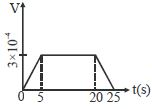
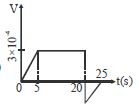
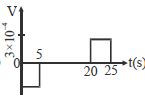
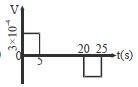
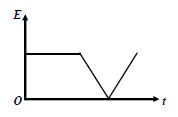
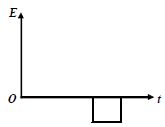
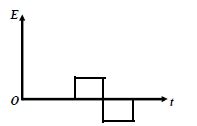
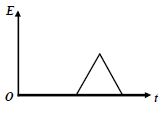
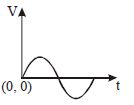
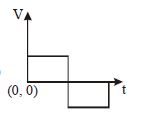
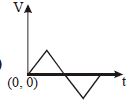
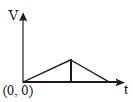
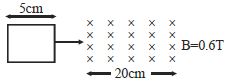
A square loop of side $5\, cm$ enters a magnetic field with $1\, cms^{-1}$. The front edge enters the magnetic field at $t = 0$ then which graph best depicts $emf$
View full question & answer→MCQ 1521 Mark
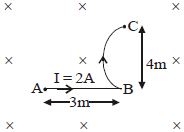
In the given figure force on wire $ABC$ will be $(B = 2T)$
- A
$4(3+2\pi ) N$
- ✓
$20\,N$
- C
$10\,N$
- D
$40\,N$
AnswerCorrect option: B. $20\,N$
b
Force an $\mathrm{AB}=\mathrm{BI} \ell=12 \mathrm{\,N}$ (upward)
Force on $\mathrm{BC}=16 \mathrm{\,N}$ (left)
so force on $\mathrm{ABC}=\sqrt{(12)^{2}+(16)^{2}}=20 \mathrm{\,N}$
View full question & answer→MCQ 1531 Mark
A conducting loop is placed in a uniform magnetic field with its plane perpendicular to the field. An $emf$ is induced in the loop if
$(a)$ It is translated (inside the field)
$(b)$ It is rotated about its axis
$(c)$ It is rotated about a diameter
$(d)$ It is deformed
- A
$a,\,b$
- B
$b,\,c$
- ✓
$c,\,d$
- D
$a,\,c,\,d$
AnswerCorrect option: C. $c,\,d$
c
The $EMF$ induced in a loop is given as $E M F=-\frac{d \phi}{d t}$
Hence a change in flux through the loop is necessary for emf induction, which
happens only in case of options $C$ and $D.$
Hence correct answers are options $\mathrm{C}$ and $\mathrm{D}$.
View full question & answer→MCQ 1541 Mark
A square loop of wire, side length $10\, cm$ is placed at an angle of $45^o$ with a magnetic field that changes uniformly from $0.1\, T$ to zero in $0.7\, seconds$. The induced current in the loop (its resistance is $1\,\Omega $) is.....$ mA$
Answera
Area of a square loop,
$A =10 \mathrm{cm} \times 10 \mathrm{\,cm} $
$=100 \mathrm{\,cm}^{2}=10^{-2} \mathrm{\,m}^{2}$
Initial magnetic flux linked with the loop
$\phi_{1} =\mathrm{B}_{1} \mathrm{A} \cos \phi $
$=0.1 \times 10^{-2} \times \cos 45^{\circ}$
$=\frac{0.1 \times 10^{-2} \times 1}{\sqrt{2}}=\frac{10^{-3}}{\sqrt{2}} \mathrm{\,Wb}$
Final magnetic flux linked with loop
$\phi_{2}=0 \mathrm{Wb} \quad\left(\because B_{2}=0\right)$
The induced emf in the loop is
$\mathrm{e}=-\frac{\mathrm{d} \phi}{\mathrm{dt}}=-\frac{\left(\phi_{2}-\phi_{1}\right)}{\mathrm{t}}$
$=-\frac{\left(0-\frac{10^{-3}}{\sqrt{2}}\right)}{0.7}=\frac{10^{-3}}{0.7 \times \sqrt{2}}=10^{-3} \mathrm{\,volt}$
The induced current in the loop is
$I=\frac{e}{R}=\frac{10^{-3} V}{1 \Omega}=10^{-3} A=1.0 \mathrm{\,mA}.$
View full question & answer→MCQ 1551 Mark
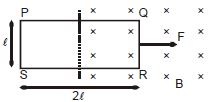
A rectangular loop $PQRS$ is being pulled with a constant speed into a uniform transverse magnetic field by a force $F$ (as shown). $E.m.f.$ induced in side $PS$ and potential difference between points $P$ and $S$ respectively are (Resistance of the loop $= r$)
- A
Zero, $\frac{{Fr}}{{Bl}}$
- B
- ✓
Zero, $\frac{{Fr}}{{Bl}}$
- D
$\frac{{Fr}}{{6Bl}}$,$\frac{{Fr}}{{6Bl}}$
AnswerCorrect option: C. Zero, $\frac{{Fr}}{{Bl}}$
c
$Emf$ induced $=B \ell v=0 \quad\left\{B_{P S}=0\right\}$
${{\rm{V}}_{{\rm{PS}}}} = {\rm{ir}} = \frac{{{\rm{B}}\ell {\rm{v}}}}{{\rm{r}}} \cdot \frac{{\rm{r}}}{6} = \frac{{{\rm{Fr}}}}{{6{\rm{B}}\ell }}\left\{ {{\rm{v}} = \frac{{{\rm{Fr}}}}{{{{\rm{B}}^2}{\ell ^2}}}} \right\}$
View full question & answer→MCQ 1561 Mark
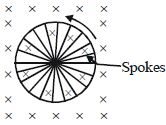
A bicycle wheel of radius $0.4\, m$ has $20$ spokes. It is rotating at the rate of $180$ revolution per minute, perpendicular to the horizontal component of earth's magnetic field of $0.4 \times 10^{-4}\, T$ . The $emf$ induced between the rim and the centre of the wheel will be
- A
$6 \times 10^{-3} \,V$
- B
$6 \times 10^{-4} \,V$
- ✓
$6 \times 10^{-5} \,V$
- D
$6 \times 10^{-6} \,V$
AnswerCorrect option: C. $6 \times 10^{-5} \,V$
c
Refer to the promblem no. $5,$ induced emf across the ends of each spoke is
$e = \frac{1}{2}B{l^2}\omega $
where $l$ is the length of each spoke i.e., the radius of the
wheel $l = 0.4\,{\rm{m}}$
All the induced cells are connected in parallel as shown in the adjoining figure. Therefore induced emf between the rim and the centre of the wheel is
$e = \frac{1}{2}B{l^2}\omega $
$=\frac{1}{2} \times 0.4 \times 10^{-4} \times(0.4)^{2} \times \frac{2 \pi \times 180}{60}$
$=6 \times 10^{-5} \mathrm{V}$
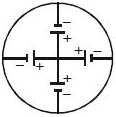
View full question & answer→MCQ 1571 Mark
A metal rod of length $1\,m$ is rotated about one of its ends in a plane right angles to a field of inductance $2.5 \times 10^{-3}\,Wb / m ^2$. If it makes $1800 $ revolutions $min$. Calculate induced e.m.f. between its ends$..........V$
- A
$2.471$
- B
$3.171$
- ✓
$0.471$
- D
$1.771$
AnswerCorrect option: C. $0.471$
c
(c)
Given $: \ell=1\,m , B =5 \times 10^{-3}\,Wb / m ^2$
$f =\frac{1800}{60}=30 \text { rotations } / sec$
in one rotation, the moving rod of the metal races a circle of radius $r=\ell$
$\therefore$ Area swept in one rotation $=\pi r ^2$
$\frac{ d \phi}{ dt }=\frac{ d }{ dt }( BA )= B \cdot \frac{ dA }{ dt }=\frac{ B \pi r ^2}{ T }$
$= B f \pi r ^2=\left(5 \times 10^{-3}\right) \times 3.14 \times 30 \times 1=0.471 \,V$
View full question & answer→MCQ 1581 Mark
The back $e.m.f$. induced in a coil, when current changes from $1$ ampere to zero in one milli second, is $4$ volts, the self inductance of the coil is
- A
$1 H$
- B
$4 H$
- C
${10^{ - 3}} H$
- ✓
$4 \times {10^{ - 3}} H$
AnswerCorrect option: D. $4 \times {10^{ - 3}} H$
d
(d) $e = - L\frac{{di}}{{dt}}$ but $e =\,4\,V$ and $\frac{{di}}{{dt}} = \frac{{0 - 1}}{{{{10}^{ - 3}}}} = - 1/{10^{ - 3}}$
$\therefore \;\frac{{ - 1}}{{{{10}^{ - 3}}}}( - L) = 4 \Rightarrow L = 4 \times {10^{ - 3}}henry$
View full question & answer→MCQ 1591 Mark
A coil of wire of a certain radius has $600$ turns and a self inductance of $108\, mH$. The self inductance of a 2nd similar coil of $500$ turns will be.........$mH$
Answerb
(b) $\frac{{{L_B}}}{{{L_A}}} = {\left( {\frac{{{n_B}}}{{{n_A}}}} \right)^2} \Rightarrow {L_B} = {\left( {\frac{{500}}{{600}}} \right)^2} \times 108 = 75\;mH$
View full question & answer→MCQ 1601 Mark
The average $e.m.f$ induced in a coil in which the current changes from $2$ $ampere$ to $4$ $ampere$ in $0.05$ $second$ is $8$ $volt.$ What is the self inductance of the coil ?......$H$
- A
$0.1$
- ✓
$0.2$
- C
$0.4$
- D
$0.8 $
Answerb
(b) $e = - L\frac{{di}}{{dt}} \Rightarrow 8 = L\frac{{(4 - 2)}}{{0.05}} \Rightarrow L = 0.2\;H$
View full question & answer→MCQ 1611 Mark
A closely wound coil of $100$ turns and area of cross-section $1\;c{m^2}$ has a coefficient of self-induction $1 \,mH$. The magnetic induction in the centre of the core of the coil when a current of $2A$ flows in it, will be......$Wb{m^{ - 2}}$
AnswerCorrect option: A. $0.022$
a
(a) $B = \frac{{{\mu _0}Ni}}{{2r}} = \frac{{4\pi \times {{10}^{ - 7}} \times 100 \times 2 \times \sqrt \pi }}{{2 \times {{10}^{ - 2}}}}$ $ = 0.022\;wb/{m^2}$
View full question & answer→MCQ 1621 Mark
An ideal coil of $10\, henry$ is joined in series with a resistance of $5 \,ohm$ and a battery of $5 \,volt$. $2$ second after joining, the current flowing in ampere in the circuit will be
- A
${e^{ - 1}}$
- ✓
$(1 - {e^{ - 1}})$
- C
$(1 - e)$
- D
$e$
AnswerCorrect option: B. $(1 - {e^{ - 1}})$
b
(b) From $i = {i_0}[1 - {e^{ - Rt/L}}]$, where ${i_0} = \frac{5}{5} = 1\;amp$
$\therefore \;i = 1\left( {1 - {e^{\frac{{ - 5 \times 2}}{{10}}}}} \right) = (1 - {e^{ - 1}})amp$
View full question & answer→MCQ 1631 Mark
A circular coil of radius $5\, cm$ has $500$ turns of a wire. The approximate value of the coefficient of self induction of the coil will be
- ✓
$25$ millihenry
- B
$25 \times {10^{ - 3}}$ millihenry
- C
$50 \times {10^{ - 3}}$ millihenry
- D
$50 \times {10^{ - 3}}$ henry
AnswerCorrect option: A. $25$ millihenry
a
(a)$\phi = Li \Rightarrow NBA = Li$
Since magnetic field at the centre of circular coil carrying current is given by $B = \frac{{{\mu _0}}}{{4\pi }}.\frac{{2\pi Ni}}{r}$
$\therefore \;N.\frac{{{\mu _0}}}{{4\pi }}.\frac{{2\pi Ni}}{r}.\pi {r^2} = Li \Rightarrow L = \frac{{{\mu _0}{N^2}\pi r}}{2}$
Hence self inductance of a coil
$ = \frac{{4\pi \times {{10}^{ - 7}} \times 500 \times 500 \times \pi \times 0.05}}{2} = 25\;mH$
View full question & answer→MCQ 1641 Mark
If in a coil rate of change of area is $5$ m$^2$/milli second and current become $1 \,amp$ from $2\, amp$ in $2 \times {10^{ - 3}}\,sec.$ If magnitude of field is $1$ tesla then self inductance of the coil is....$H$
Answerd
(d)$N\phi = Li \Rightarrow \frac{{Nd\phi }}{{dt}} = \frac{{Ldi}}{{dt}}$
$\Rightarrow NB\frac{{dA}}{{dt}} = \frac{{Ldi}}{{dt}}$
$ \Rightarrow \frac{{1 \times 1 \times 5}}{{{{10}^{ - 3}}}} = L \times \left( {\frac{{2 - 1}}{{2 \times {{10}^{ - 3}}}}} \right) $
$\Rightarrow L = 10H$
View full question & answer→MCQ 1651 Mark
In a circular conducting coil, when current increases from $2 \,A$ to $18 \,A$ in $0.05 \,sec$., the induced $e.m.f$. is $20\, V$. The self inductance of the coil is.....$mH$
AnswerCorrect option: A. $62.5$
a
(a) $|e|\, = L\frac{{di}}{{dt}}$
$\Rightarrow 20 = L \times \frac{{(18 - 2)}}{{0.05}}$
$ \Rightarrow L = 62.5\;mH$
View full question & answer→MCQ 1661 Mark
The current in a coil of inductance $5\, H$ decreases at the rate of $2$ A/s. The induced $e.m.f$. is....$V$
Answerc
(c) $e = - L\frac{{di}}{{dt}}$,
since current decreases so $\frac{{di}}{{dt}}$
is negative, hence $e = - 5 \times \left( { - 2} \right) = + 10\,V$
View full question & answer→MCQ 1671 Mark
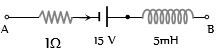
The network shown in the figure is a part of a complete circuit. If at a certain instant the current $i$ is $5\, A$ and is decreasing at the rate of ${10^3}A/s$ then ${V_A} - {V_B}$ is......$ V$
Answerc
(c) By using Kirchoff’s voltage law
${V_A} - i\;R + E - L\frac{{di}}{{dt}} = {V_B} \Rightarrow {V_B} - {V_A} = 15\;volt.$
View full question & answer→MCQ 1681 Mark
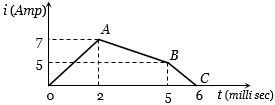
The current through a $4.6\, H$ inductor is shown in the following graph. The induced emf during the time interval $t = 5\, milli-sec$ to $6\,milli-sec$ will be
- A
$10^3\,V$
- B
$2.3\times 10^3 \,V$
- ✓
$23 \times 10^3\, V$
- D
AnswerCorrect option: C. $23 \times 10^3\, V$
c
(c) Rate of decay of current between $t = 5\, ms$ to $6\, ms$ $ = \frac{{di}}{{dt}} = - \,{\rm{(Slope of the line }}BC)$
$ = - \,\left( {\frac{5}{{1 \times {{10}^{ - 3}}}}} \right) = - \,5 \times {10^3}A/s.$ Hence induced emf $e = - \,L\frac{{di}}{{dt}} = - \,4.6 \times ( - \,5 \times {10^3}) = 23 \times {10^3}V.$
View full question & answer→MCQ 1691 Mark
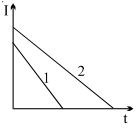
Two identical inductance carry currents that vary with time according to linear laws (as shown in figure). In which of two inductance is the self induction $emf$ greater?
- ✓
$1$
- B
$2$
- C
- D
data are insufficient to decide
Answera
$e=-L\frac{d i}{d t} \Rightarrow\left(-\frac{d i}{d t}\right)_{1 }> \left(-\frac{d i}{d t}\right)_{2} \Rightarrow e_{1} > e_{2}$
View full question & answer→MCQ 1701 Mark
$A$ long solenoid of $N$ turns has a self inductance $L$ and area of cross section $A$. When a current $i$ flows through the solenoid, the magnetic field inside it has magnitude $B$. The current $i$ is equal to:
- ✓
$BAN/L$
- B
$BANL$
- C
$BN/AL$
- D
$B/ANL$
AnswerCorrect option: A. $BAN/L$
a
$\phi=L i \Rightarrow N B A=L I \Rightarrow I=\frac{N B A}{L}$
View full question & answer→MCQ 1711 Mark
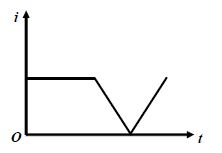
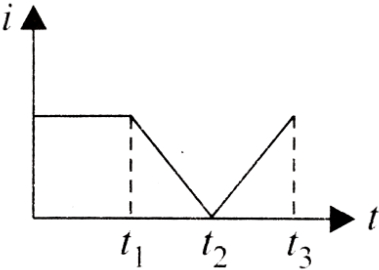
The current $i$ in an induction coil varies with time $t$ according to the graph shown in figure. Which of the following graphs shows the induced $emf \,(e)$ in the coil with time ?
Answerc
Indyced emf in the coil is given by $E=-\frac{L d i}{d t}$
From the graph it is clear that for time $t_{1},$ current does not change with time, i.e. $\frac{d i}{d t}=0 .$ so, induced emf is zero. Hence graph $(a)$ and $(b)$ are wrong.
from time interval $\left(t_{1}\right) \rightarrow\left(t_{2}\right),(d i / d t)$ is negative and constant. Hence, choise $(C)$ is correct.
Choice$(D)$ is wrong because in the graph the induced emf is never negative and is not constant.
View full question & answer→MCQ 1721 Mark
The current through an inductor is given by $i = (10 + 20t) \,amp.$ where $t$ is in $sec.$ The induced $emf$ in the inductor is $4\, V.$ The total flux linked with the inductor at $t = 2s$ is ......$Wb$
Answera
$\mathrm{e}=\frac{-\mathrm{Ldi}}{\mathrm{dt}} \Rightarrow \mathrm{L}=\frac{-\mathrm{e}}{\mathrm{d} i / \mathrm{dt}}=0.2 \mathrm{\,H}$
Now $ \mathrm{L}=\frac{\mathrm{N} \phi}{\mathrm{i}}$
$\mathrm{N} \phi=\mathrm{Li}=(2.0)(50)=10 \mathrm{\,Wb}$
View full question & answer→MCQ 1731 Mark
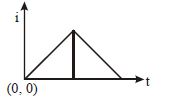
The current $'i'$ in an inductance coil varies with time $'t'$ according to following graph which of the following plots shows the variation of voltage in the coil
Answerb
$\mathrm{emf}=L \frac{d i}{d t}$
Rate of change of current is constant for one period at a positive value and is constant at negative value for the second time period.
Therefore emf is a constant positive value for first half and constant negative value for second half. Option $B$ is correct.
View full question & answer→MCQ 1741 Mark
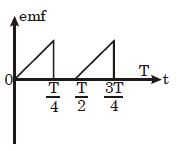
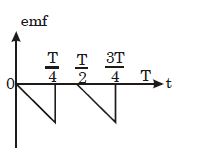
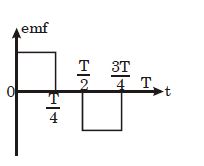
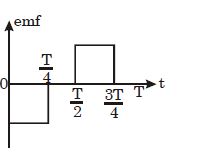
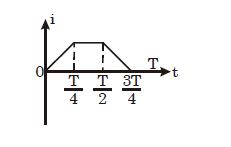
The current $i$ in a coil varies with times as shown in the figure. The variation of induced $emf$ with time would be
Answerd
$\varepsilon=-\frac{\mathrm{LdI}}{\mathrm{dt}} \rightarrow \varepsilon=-\mathrm{L} \frac{\mathrm{d} \mathrm{I}}{\mathrm{dt}}$
bigger loop and $\mathrm{cw}$
$0<\mathrm{t}<\mathrm{T} / 4 \rightarrow \frac{\mathrm{d} \mathrm{I}}{\mathrm{dt}} \rightarrow+\mathrm{ve} $ and constant
$\mathrm{T} / 4<\mathrm{t}<\mathrm{T} / 2 \rightarrow \frac{\mathrm{d} \mathrm{I}}{\mathrm{dt}}=0$
$\frac{\mathrm{T}}{2}<\mathrm{t}<3 \frac{\mathrm{T}}{4} \rightarrow \frac{\mathrm{dI}}{\mathrm{dt}} \rightarrow-\mathrm{ve} $ and constant
View full question & answer→MCQ 1751 Mark
Self inductance of solenoid is $'L'$ which is made by a wire of length $'l_w'$ then length of solenoid is
- A
$\frac{{{\mu _0}l_w^2}}{{4{\pi ^2}L}}$
- B
$\sqrt {\frac{{4\pi L{l_w}}}{{{\mu _0}}}} $
- C
$\pi \sqrt {\frac{{4L{l_w}}}{{{\mu _0}}}} $
- ✓
$\frac{{{\mu _0}l_w^2}}{{4\pi L}}$
AnswerCorrect option: D. $\frac{{{\mu _0}l_w^2}}{{4\pi L}}$
d
$\ell_{\omega}=2 \pi \mathrm{r} \times \mathrm{N}$
$\mathrm{L}=\frac{\mu_{0} \mathrm{N}^{2} \pi \mathrm{r}^{2}}{\ell}$
${\rm{L}} = \frac{{{\mu _0}{{\rm{N}}^2}4{\pi ^2}{{\rm{r}}^2}}}{{4\pi \ell }} = \frac{{{\mu _0}\ell _\omega ^2}}{{4\pi \ell }}$
View full question & answer→MCQ 1761 Mark
Two solenoids have identical geometrical construction and same number of truns but one is made of thick wire and other of thin wire. Which of the following quantities are different for two solenoids :-
$(a)$ Self inductance.
$(b)$ Rate of joule heating if the same current goes through them.
$(c)$ Magnetic potential energy if the same current goes through them .
$(d)$ Time constant.
AnswerCorrect option: A. $b, d$
a
$\mathrm{P}_{\mathrm{in}}=\mathrm{V}_{\mathrm{P}} \mathrm{I}_{\mathrm{P}}$
$\mathrm{V}_{\mathrm{P}}=\frac{\mathrm{P}_{\mathrm{in}}}{\mathrm{I}_{\mathrm{P}}}=\frac{1000}{8}=125$
$\frac{V_{S}}{V_{P}}=\frac{N_{S}}{N_{P}}$
$\Rightarrow \mathrm{N}_{\mathrm{S}}=\frac{\mathrm{V}_{\mathrm{S}}}{\mathrm{V}_{\mathrm{P}}} \times \mathrm{N}_{\mathrm{P}}=\frac{500}{125} \times 100=400$
View full question & answer→MCQ 1771 Mark
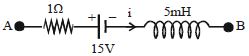
The network shown in figure is a part of a complete circuit. If at a certain instant the current $'i'$ is $5\, A$ and is decreasing at the rate of $10^3 \,A/sec$. then $V_A -V_B$ is.......$ V$
Answerc
incluced $\mathrm{emf}$ $=\mathrm{L} \frac{\mathrm{d} \mathrm{I}}{\mathrm{dt}}=5 \mathrm{\,V}$
$\mathrm{V}_{\mathrm{A}}-5-15+5=\mathrm{V}_{\mathrm{B}}$
$\mathrm{V}_{\mathrm{A}}-\mathrm{V}_{\mathrm{B}}=15$ $\mathrm{volt}$

View full question & answer→MCQ 1781 Mark
A constant current $I$ maintained in a solenoid. Which of the following quantities will increase if an iron rod is inserted in the solenoid along its axis:-
$(a)$ Magnetic field at the centre
$(b)$ Magnetic flux linked with the solenoid
$(c)$ Self inductance of the solenoid
$(d)$ Rate of Joule heating
- ✓
$a, b, c$
- B
$c, d$
- C
$a, b$
- D
Only $b$
AnswerCorrect option: A. $a, b, c$
a
When ferro mag. material is inserted
$B \uparrow $ so ${\phi _B} \uparrow $ and $L \propto {\mu _r}$.
View full question & answer→MCQ 1791 Mark
Two coils have of self inductance $L_1 = 4\, mH$ and $L_2 = 1\, mH$ respectively. The currents in the two coils are increased at the same rate. At a certain instant of time both coils are given the same power. If $I_1$ and $I_2$ are the currents in the two coils at that instant of time respectively, then the value of $\frac{{{I_1}}}{{{I_2}}}$ is
- A
$1$
- B
$\frac{1}{2}$
- ✓
$\frac{1}{4}$
- D
$\frac{1}{8}$
AnswerCorrect option: C. $\frac{1}{4}$
c
$\mathrm{e}=\mathrm{L} \frac{\mathrm{di}}{\mathrm{dt}} $ (numerically)
${\mathrm{L}=\frac{\mathrm{e}}{\mathrm{di} / \mathrm{dt}}}$
$P=e \times i$
or $\quad \mathrm{e}=\frac{\mathrm{P}}{\mathrm{i}}$
$\therefore \mathrm{L}=\frac{\mathrm{P}}{\mathrm{i}(\mathrm{di} / \mathrm{dt})}$ ($\because $ Power and curect rate is same )
or $\mathrm{L} \propto \frac{1}{\mathrm{i}}$
$\therefore \frac{i_{1}}{i_{2}}=\frac{L_{2}}{L_{1}}=\frac{1}{4}$
View full question & answer→MCQ 1801 Mark
Current in a circuit falls from $5.0\, A$ to $0.0\, A$ in $0.1\, s$. If an average $emf$ of $200\, V$ induced, give an estimate of the self-inductance of the circuit....$H$
Answerb
Initial current, $I_{1}=5.0 \mathrm{A}$
Final current, $I_{2}=0 A$
Change in current, $d l=I_{1}-I_{2}=5 A$
Time taken for the charge, $t=0.1 s$
Average emf, $e=200 \mathrm{V}$
For self inductance $(L)$ of the coil, we have the relation for average emf as$:$
$e=L \frac{d i}{d t}$
$L=\frac{e}{\frac{d i}{d t}}$
$=\frac{200}{\frac{5}{0.1}}=4 H$
Hence the self inductance of the coil is $4 H$
View full question & answer→MCQ 1811 Mark
If $N$ is the number of turns in a coil, the value of self-inductance varies as
- A
$N^o$
- B
$N$
- ✓
$N^2$
- D
$N^{-2}$
Answerc
self-inductance $ = \frac{{{\mu _0}{N^2}A}}{l}$
View full question & answer→MCQ 1821 Mark
In a coil current falls from $5\, A$ to $0\, A$ in $0.2\, s$. If an average $emf$ of $150\, V$ is induced, then the self inductance of the coil is.....$H$
Answerd
Here, $\frac{\mathrm{dl}}{\mathrm{dt}}=\frac{0-5}{0.2}=-25 \mathrm{\,A\,s}^{-1},$
$ \varepsilon =150 \mathrm{\,V} $
As $|\varepsilon| =\mathrm{L}\left|\frac{\mathrm{d} |}{\mathrm{dt}}\right|$
$\therefore L = \frac{{|\varepsilon |}}{{\left| {d/dt} \right|}} = \frac{{150}}{{25}} = 6\,{\rm{H}}$
View full question & answer→MCQ 1831 Mark
A $10\, V$ battery connected to $5\,\Omega $ resistance coil having inductance $10\, H$ through a switch drives a constant current in the circuit. The switch is suddenly opened and the time taken to open it is $2\, ms$. The average $emf$ induced across the coil is
- A
$4\times10^4\, V$
- B
$2\times10^4\, V$
- C
$2\times10^2\, V$
- ✓
$1\times10^4\, V$
AnswerCorrect option: D. $1\times10^4\, V$
d
Here, current $\mathrm{I}=\frac{\mathrm{V}}{\mathrm{R}}=\frac{10}{5}=2 \mathrm{\,A}$
Final current, when the switch is opened is zero.
$\therefore \frac{{{\rm{dI}}}}{{{\rm{dt}}}} = \frac{{0 - 2}}{{2 \times {{10}^{ - 3}}}} = - 1 \times {10^3}{\mkern 1mu} {\rm{A}}{{\rm{s}}^{ - 1}}$
As $\varepsilon=-L \frac{\mathrm{d} I}{\mathrm{dt}}$
$=-10\left(-1 \times 10^{3}\right)=10^{4} \mathrm{\,V}$
View full question & answer→MCQ 1841 Mark
In $SI$, Henry is the unit of
Answerc
Henry s the unit of inductance. It is same for the self inductance and mutual inductance.
View full question & answer→MCQ 1851 Mark
The area of its cross-section is $1.2 \times {10^{ - 3}}{m^2}$. Around its central section, a coil of $300$ turns is wound. If an initial current of $2A$ in the solenoid is reversed in $0.25\, sec$, then the $e.m.f$. induced in the coil is
- A
$6 \times {10^{ - 4}}\,V$
- B
$4.8 \times {10^{ - 3}}\,V$
- C
$6 \times {10^{ - 2}}\,V$
- ✓
$48 \,mV$
AnswerCorrect option: D. $48 \,mV$
d
(d) Induced emf $e = M\frac{{di}}{{dt}} = \frac{{{\mu _0}{N_1}{N_2}A}}{l}.\frac{{di}}{{dt}}$
$ = \frac{{4\pi \times {{10}^{ - 7}} \times 2000 \times 300 \times 1.2 \times {{10}^{ - 3}}}}{{0.30}} \times \frac{{|2 - ( - 2)|}}{{0.25}}$
$ = 48.2 \times {10^{ - 3}}V = 48\;mV$
View full question & answer→MCQ 1861 Mark
The number of turns of primary and secondary coils of a transformer are $5$ and $10$ respectively and the mutual inductance of the transformer is $25\,henry$. Now the number of turns in the primary and secondary of the transformer are made $10$ and $5$ respectively. The mutual inductance of the transformer in henry will be
Answerc
(c) $M = \frac{{{\mu _0}{N_1}{N_2}A}}{l}$
View full question & answer→MCQ 1871 Mark
The mutual inductance between a primary and secondary circuits is $0.5 \,H$. The resistances of the primary and the secondary circuits are $20\,\Omega$ and $5\,\Omega $ respectively. To generate a current of $0.4 \,A$ in the secondary, current in the primary must be changed at the rate of.....$A/s$
Answera
(a) ${e_2} = M\frac{{d{i_1}}}{{dt}} \Rightarrow {i_2}{R_2} = M\frac{{d{i_1}}}{{dt}} \Rightarrow 0.4 \times 5 = 0.5 \times \frac{{d{i_1}}}{{dt}}$
$ \Rightarrow \frac{{d{i_1}}}{{dt}} = 4\;A/\sec .$
View full question & answer→MCQ 1881 Mark
Two coils $A$ and $B$ having turns $300$ and $600$ respectively are placed near each other, on passing a current of $3.0$ ampere in $A$, the flux linked with A is $1.2 \times {10^{ - 4}}\,weber$ and with $B$ it is $9.0 \times {10^{ - 5}}\,weber$. The mutual inductance of the system is
- A
$2 ×10^{-5}\, henry$
- ✓
$3 ×10^{-5} \,henry$
- C
$4 ×10^{-5}\, henry$
- D
$6 ×10^{-5}\,henry$
AnswerCorrect option: B. $3 ×10^{-5} \,henry$
b
(b) ${N_2}{\phi _2} = M{i_1}$
$\Rightarrow 9 \times {10^{ - 5}} = M \times 3$
$ \Rightarrow M = 3 \times {10^{ - 5}}H$
View full question & answer→MCQ 1891 Mark
Two conducting circular loops of radii ${R_1}$ and ${R_2}$ are placed in the same plane with their centres coinciding. If ${R_1} > > {R_2}$, the mutual inductance $M$ between them will be directly proportional to
- A
${R_1}/{R_2}$
- B
${R_2}/{R_1}$
- C
$R_1^2/{R_2}$
- ✓
$R_2^2/{R_1}$
AnswerCorrect option: D. $R_2^2/{R_1}$
d
(d) Mutual inductance between two coil in the same plane with their centers coinciding is given by
$M = \frac{{{\mu _0}}}{{4\pi }}\left( {\frac{{2{\pi ^2}R_2^2{N_1}{N_2}}}{{{R_1}}}} \right)$ henry.
View full question & answer→MCQ 1901 Mark
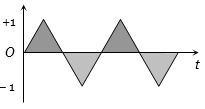
An alternating current of frequency $200\,rad/sec$ and peak value $1\,A$ as shown in the figure, is applied to the primary of a transformer. If the coefficient of mutual induction between the primary and the secondary is $1.5\, H$, the voltage induced in the secondary will be.....$V$
- A
$300 $
- ✓
$191$
- C
$220 $
- D
$4471 $
Answerb
(b) $e = - M\frac{{di}}{{dt}} = - 1.5\frac{{(1 - 0)}}{{(T/4)}} = - \frac{6}{T}$, $T = \frac{{2\pi }}{\omega } = \frac{{2\pi }}{{200}} = \frac{\pi }{{100}}$
==>$\,|e|\, = \frac{{600}}{\pi } = 190.9\,V\tilde --\,191V$
View full question & answer→MCQ 1911 Mark
$A$ small coil of radius $r$ is placed at the centre of $a$ large coil of radius $R,$ where $R > > r$. The coils are coplanar. The coefficient of mutual inductance between the coils is
- A
$\frac{{{\mu _0}\pi r}}{{2R}}$
- ✓
$\frac{{{\mu _0}\pi {r^2}}}{{2R}}$
- C
$\frac{{{\mu _0}\pi {r^2}}}{{2{R^2}}}$
- D
$\frac{{{\mu _0}\pi r}}{{2{R^2}}}$
AnswerCorrect option: B. $\frac{{{\mu _0}\pi {r^2}}}{{2R}}$
b
current coil having the radius $\mathrm{R} B_{1}=\frac{\mu_{0} I_{1}}{2 R}$
magnetic flux of the secondary coil
$I_{2}=B_{1} A_{2}=\frac{\mu_{0} I_{1} \pi r^{2}}{2 R}$
mutual inductance
$\frac{\mu_{0} \pi r^{2}}{2 R}$
View full question & answer→MCQ 1921 Mark
Two coil $A$ and $B$ have coefficient of mutual inductance $M = 2H$. The magnetic flux passing through coil $A$ changes by $4$ Weber in $10$ seconds due to the change in current in $B$. Then
- A
change in current in $B$ in this time interval is $0.5A$
- ✓
the change in current in $B$ in this time interval is $2A$
- C
the change in current in $B$ in this time interval is $8A$
- D
a change in current of $1A$ in coil $A$ will produce a change in flux passing through $B$ by $4$ Weber.
AnswerCorrect option: B. the change in current in $B$ in this time interval is $2A$
b
$\phi=M I \Rightarrow \Delta \phi=M \Delta I$
$4=2 \times \Delta I \Rightarrow \Delta I=2 A m p$
View full question & answer→MCQ 1931 Mark
There are $10$ turns in coil $M$ and $15$ turns in coil $N$ . If a current of $2\ A$ is passed through coil $M$ then the flux linked with coil $N$ is $1.8 × 10^{-3}\ Wb$ . If a current of $3\ A$ is passed through coil $N$ then flux linked with coil $M$ is
- A
$1.2 × 10^{-3} \ Wb$
- ✓
$2.7 × 10^{-3} \ Wb$
- C
$1.8 × 10^{-3} \ Wb$
- D
$4.05× 10^{-3} \ Wb$
AnswerCorrect option: B. $2.7 × 10^{-3} \ Wb$
b
Mutual inductance $\mathrm{M}=\frac{\phi_{\mathrm{N}}}{\mathrm{I}_{\mathrm{M}}}=\frac{\phi_{\mathrm{M}}}{\mathrm{I}_{\mathrm{N}}}$
$\Rightarrow \phi_{\mathrm{M}}=\left(\frac{\mathrm{I}_{\mathrm{N}}}{\mathrm{I}_{\mathrm{M}}}\right) \phi_{\mathrm{N}}=\frac{3}{2} \times 1.8 \times 10^{-3}$
$=2.7 \times 10^{-3} \mathrm{\,Wb}$
View full question & answer→MCQ 1941 Mark
Two coils have a mutual inductance $0.005\,H$ . The current changes in the first coil The current changes in the first coil according to the equation $I = I_0 sin\,\omega t$ , where $I_0 = 10\,A$ and $\omega = 100\pi \,rad/s$ . The maximum value of $emf$ in the second coil will be
- ✓
$5\pi $
- B
$10\pi $
- C
$2.5\pi $
- D
$15\pi $
AnswerCorrect option: A. $5\pi $
a
As, $|\varepsilon|=M \frac{d I}{d t}$
$=M \frac{d}{d t}\left(I_{0} \sin \omega t\right)=M I_{0} \omega \cos \omega t$
$\therefore \quad \varepsilon_{\max }=0.005 \times 10 \times 100 \pi \times 1=5 \pi$
View full question & answer→MCQ 1951 Mark
Two conducting circular loops of radii $R_1$ and $R_2$ are placed in the same plane with their centre coinciding. If $R_1 >> R_2$ the mutual inductance $M$ between them will be directly proportional to
- A
$\frac{{{R_1}}}{{{R_2}}}$
- B
$\frac{{{R_2}}}{{{R_1}}}$
- C
$\frac{{{R_1^2}}}{{{R_2}}}$
- ✓
$\frac{{{R_2^2}}}{{{R_1}}}$
AnswerCorrect option: D. $\frac{{{R_2^2}}}{{{R_1}}}$
d
Magnetic field at the centre of primary coil $\mathrm{B}=\frac{\mu_{0} \mathrm{i}_{1}}{2 \mathrm{R}_{1}}$
Considering it to be uniform, magnetic flux passing through secondary coil is
$\phi_{2}=\mathrm{BA}$
$=\frac{\mu_{0} i_{1}}{2 R_{1}}\left(\pi R^{2}\right)$
$M=\frac{\phi_{2}}{i_{1}}$
$M=\frac{\mu_{0} \pi R_{2}^{2}}{2 R_{1}}$
$M \propto \frac{R_{2}^{2}}{R_{1}}$
View full question & answer→MCQ 1961 Mark
Two coils of self inductances $2\, mH$ and $8\, mH$ Hare placed so close together that the effective flux in one coil is completely linked with the other. The mutual inductance between these coils is......$mH$
Answerc
Mutual inductance between coils is
$M=K \sqrt{L_{1} L_{2}}$
or, $\quad M=1 \sqrt{2 \times 10^{-3} \times 8 \times 10^{-3}} \quad(\because K=1)$
$=4 \times 10^{-3}=4 \mathrm{mH}$
View full question & answer→MCQ 1971 Mark
A coil of radius $1\, cm$ and of turns $100$ is placed in the middle of a long solenoid of radius $5\, cm$. and having $5\, turns/cm$. parallel to the axis of solenoid The mutual inductance in millihenery will be
- A
$0.0316$
- B
$0.063$
- C
$0.105$
- ✓
$0$
View full question & answer→MCQ 1981 Mark
An $e.m.f.$ of $100\,millivolts$ is induced in a coil when the current in another nearby coil becomes $10\, ampere$ from zero in $0.1\,second$ . The coefficient of mutual induction between the two coils will be.....$millihenry$
Answera
$\text { induced emf } e=100 \mathrm{mV}$
$\qquad=100 \times 10^{-3} \mathrm{V}=0.1 \mathrm{V}$
$e=m \frac{\Delta i}{\Delta t}$
$e=m \cdot\left(\frac{i_{2}-i_{1}}{t_{2}-t_{1}}\right)$
$0.1=m\left(\frac{10-0}{0.1-0}\right)$
$m=\frac{0.1}{100}=10^{-3} H$
$m=1 m H$
View full question & answer→MCQ 1991 Mark
Two coils $X$ and $Y$ are placed in a circuit such that when a current changes $2A$ in coil $X,$ the magnetic flux changes by $0.4\,weber$ in $Y$. The value of mutual inductance of the coils....$H$
Answera
$\phi = MI \Rightarrow d\phi = M\,dI$
View full question & answer→MCQ 2001 Mark
If the coefficient of mutual induction of the primary and secondary coils of an induction coil is $5\, H$ and a current of $10\, A$ is cut off in $5\times10^{-4}\, s$, the $emf$ inducted (in $volt$) in the secondary coil is
- A
$5\times10^4$
- ✓
$1\times10^5$
- C
$25\times10^5$
- D
$5\times10^6$
AnswerCorrect option: B. $1\times10^5$
b
The induced $\mathrm{emf}$ $\mathrm{e}$ in the secondary coil is given by :
${\mathrm{e}=-\frac{\mathrm{d} \phi}{\mathrm{dt}}=-\mathrm{M} \frac{\mathrm{d} \mathrm{I}}{\mathrm{dt}}} $
or $\left| {\rm{e}} \right| = {\rm{M}}\frac{{{\rm{dI}}}}{{{\rm{dt}}}}$
$\therefore $ $|\mathrm{e}|=5 \times \frac{10}{5 \times 10^{-4}}=1 \times 10^{5} \mathrm{\,V}$
View full question & answer→