MCQ 1011 Mark
$D, E, F$ are the mid-point of the sides $BC, CA$ and $AB$ respectively of $\triangle\text{ABC}.$ Then $\triangle\text{DEF}$ is congruent to triangle.
- ✓
$AFE, FBD, EDC$
- B
$ABC$
- C
$BFD, DCE$
- D
$AEF$
AnswerCorrect option: A. $AFE, FBD, EDC$
$DEF$ is the median triangle and it divides the given triangle into $4$ identical triangles including median triangle.
View full question & answer→MCQ 1021 Mark
In the adjoining figure, the rule by which $\triangle\text{ABC}\cong\triangle\text{ADC}\ ?$
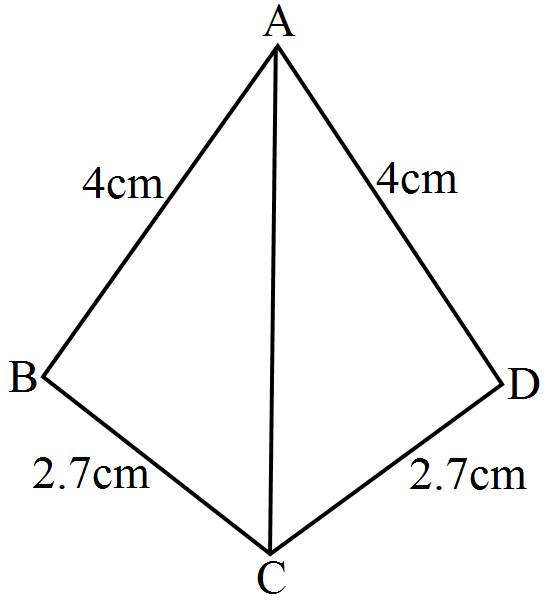
AnswerIn $\triangle\text{ABC}$ and $\triangle\text{ADC}$ we have,
$AB = AD (4\ cm)$
$BC= DC (2.7\ cm)$
$AC = AC$ (commom in both)
Hence, $\triangle\text{ABC}\cong\triangle\text{ADC},$ by $SSS$ criterion.
View full question & answer→MCQ 1031 Mark
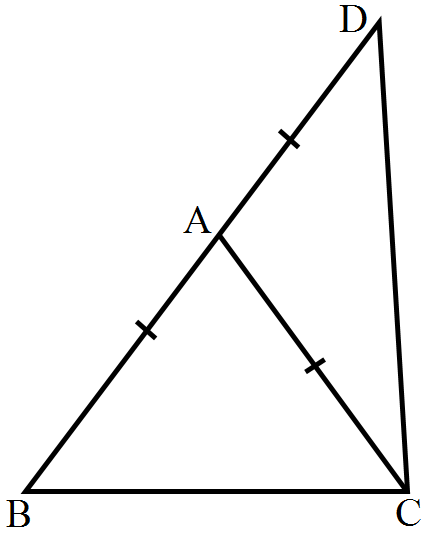
In an isosceles, $\triangle\text{ABC},$ $AB = AC$ and side $BA$ is produced to $D$ such that $AB = AD$. Then the measure of $\angle\text{BCD}$ is:
- A
$70^\circ $
- ✓
$90^\circ$
- C
$100^\circ$
- D
$60^\circ$
AnswerCorrect option: B. $90^\circ$
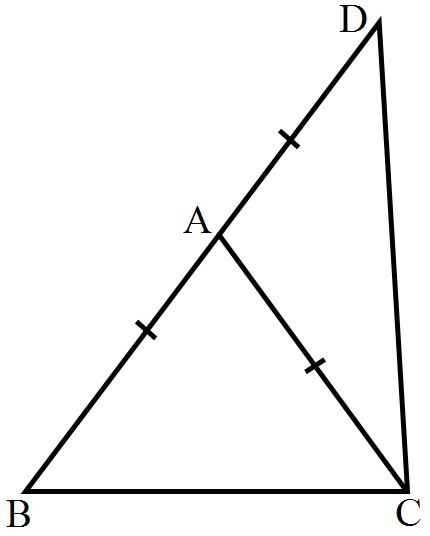
Given in $\triangle\text{ABC}, AB = AC$
$\Rightarrow\angle\text{ABC}=\angle\text{ACB}$ (Since angles opposite to equal sides are equal)
Also given that $AD = AB$
$\Rightarrow\angle\text{ADC}=\angle\text{ACD}$ (Since angles opposite to equal sides are equal)
$\therefore\ \angle\text{ABC} = \angle\text{ACB} = \angle\text{ADC} = \angle\text{ACD} = \text{x}(\text{AB = AC = AD})$
Also, $\angle\text{BCD} = \angle\text{A}\text{CB} + \angle\text{A}\text{C}+\angle\text{A}\text{D} = \text{x} + \text{x} = 2\text{x}$
In $\triangle\text{BCD},\ \angle\text{CBD} + \angle\text{BCD} + \angle\text{BDC} = 180^\circ$
$\text{x} + 2\text{x} + \text{x} = 180^\circ$
$4\text{x} = 180^\circ$
$\text{x}=45^\circ$
$\triangle\text{BCD} = 2\text{x}$
$= 90^\circ$ View full question & answer→MCQ 1041 Mark
In a $\triangle\text{ABC},$ if $\text{AB}=\text{AC}$ and BC is produced to D such that $\angle\text{ACD}=100^\circ$ then $\angle\text{A}=$
- ✓
$20^\circ$
- B
$40^\circ$
- C
$60^\circ$
- D
$80^\circ$
AnswerCorrect option: A. $20^\circ$
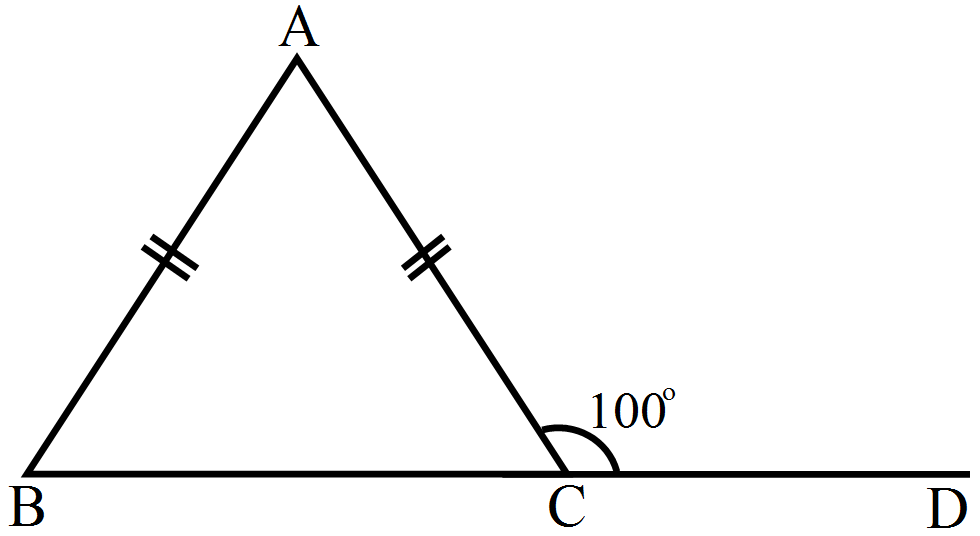
$\text{AB}=\text{AC}$
$\Rightarrow\angle\text{ABC}=\angle\text{ACB}$ (Isoscles $\triangle$ Property)
$\angle\text{ACB}=180^\circ-100^\circ=80^\circ$
$\Rightarrow\angle\text{ABC}-=\angle\text{ACB}=80^\circ$
$\angle\text{A}=180^\circ-\angle\text{ACB}-\angle\text{ABC}=180^\circ-80^\circ-80^\circ=20^\circ$
Hence, correct option is $(a).$ View full question & answer→MCQ 1051 Mark
If $\triangle\text{ABC}\cong\triangle\text{PQR}$ and $\triangle\text{ABC}$ is not congruent to $\triangle\text{RPQ},$ then which of the following is not true:
- ✓
$BC = PQ$
- B
$AC = PR$
- C
$AB = PQ$
- D
$RQ = BC$
AnswerCorrect option: A. $BC = PQ$
$\triangle\text{ABC}\cong\triangle\text{PQR}$$\Rightarrow\text{AB}=\text{PR},\text{AC}=\text{PR},\text{BC}=\text{QR}$
$\triangle\text{ABC}\not\cong\triangle\text{RQP}$
$\Rightarrow\text{AB}\not=\text{QR},\text{AC}\not=\text{RP},\text{BC}\not=\text{PQ}$
Hence, correct option $(a).$
View full question & answer→MCQ 1061 Mark
In the adjoining figure, $BC = AC$. If $\angle\text{ACD} = 115^\circ,$ the $\angle\text{A}$ is: 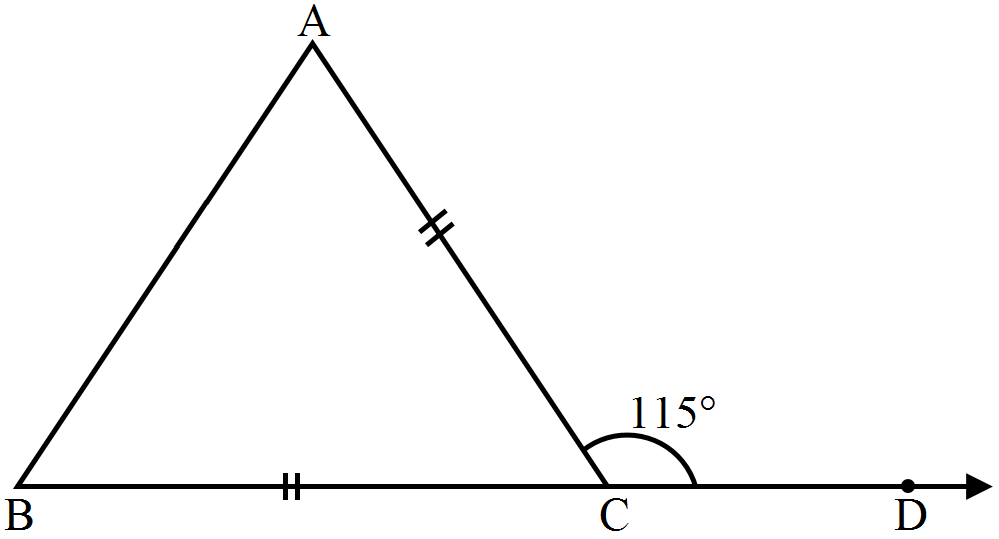
- A
$70^\circ$
- B
$50^\circ$
- ✓
$57.5^\circ$
- D
$65^\circ$
AnswerCorrect option: C. $57.5^\circ$
As $BC = AC$, therefore triangle $ABC$ is an isoscelestriangle.
Given $\angle\text{ACD} = 115^\circ,\ \angle\text{ACB} = 180-115=65^\circ$ (Linear Pair)
As $AC = BC$, therefore $\angle\text{A} =\angle\text{B}$
As sum of all the three angles of atriangle is $180^\circ $
Therefore, $\angle\text{A} + \angle\text{B} + \angle\text{ACB} = 180^\circ$
$\angle\text{A} = \angle\text{B} = 57.5$
View full question & answer→MCQ 1071 Mark
In $\triangle\text{ABC, AB = AC}$ and $\angle\text{B} = 50^\circ.$ Then $\angle\text{C}$ is equal to:
- ✓
$50^\circ$
- B
$130^\circ$
- C
$40^\circ$
- D
$80^\circ$
AnswerCorrect option: A. $50^\circ$
Given: $\triangle\text{ABC, AB = AC}$ and $\angle\text{B} = 50^\circ.$
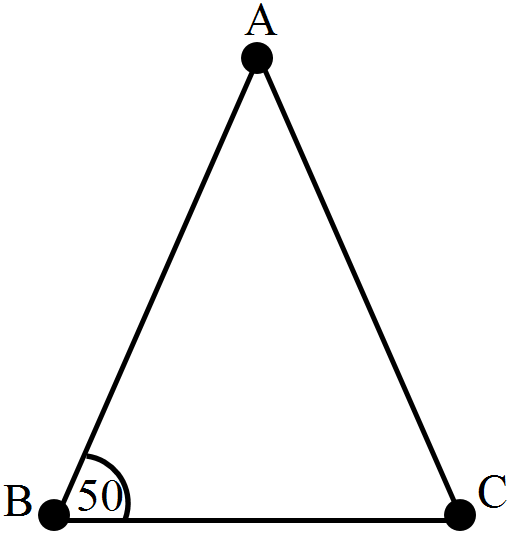
As, $AB = AC$
So, it is an isosceles triangle.
So $\angle\text{B} = \angle\text{C}$
$\angle\text{B} = 50^\circ$ (given)
$⇒\angle\text{C} = 50^\circ$ View full question & answer→MCQ 1081 Mark
In a $\triangle\text{ABC},\angle\text{A}=50^\circ$ and $BC$ is produced to a point $D$. If the bisectors of $\angle\text{ABC}$ and $\angle\text{ACD}$ meet at E, then $\angle\text{E}=$
- ✓
$25^\circ$
- B
$50^\circ$
- C
$100^\circ$
- D
$75^\circ$
AnswerCorrect option: A. $25^\circ$
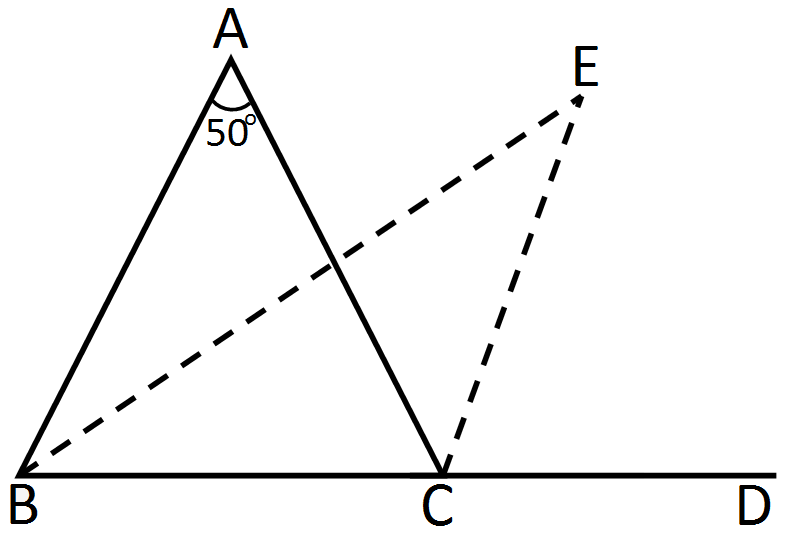
$BE$ and $CE$ are bisectors of $\angle\text{B}$ and $\angle\text{ACD}.$
In $\triangle\text{ABC},$
$\angle\text{A}+\angle\text{B}+\angle\text{C}=180^\circ$
$\Rightarrow\angle\text{B}+\angle\text{C}=180^\circ-50^\circ=130^\circ\dots(1)$
Now, in $\triangle\text{BEC}$
$\angle\text{CBE}+\angle\text{BEC}+\angle\text{ECB}=180^\circ\dots(2)$
$\angle\text{CBE}=\frac{\angle\text{B}}{2},\angle\text{BEC}=\angle\text{E},\angle\text{ECB}=\angle\text{C}+\angle\text{ACE}$
Now, $\angle\text{ACD}=180^\circ-\angle\text{C}$
$\angle\text{ACE}=\frac{\angle\text{ACD}}{2}=\frac{180^\circ-\angle\text{C}}{2}=90^\circ-\frac{\angle\text{C}}{2}$
So, $\angle\text{ECB}=\angle\text{C}+90^\circ-\frac{\angle\text{C}}{2}$
$\Rightarrow\angle\text{ECB}=90^\circ+\frac{\angle\text{C}}{2}$
Now putting all value in eq $(2)$
$\frac{\angle\text{B}}{2}+\angle\text{E}+90^\circ+\frac{\angle\text{C}}{2}=180^\circ$
$\Rightarrow\angle\text{E}=180^\circ-90^\circ-\Big(\frac{\angle\text{B}+\angle\text{C}}{2}\Big)$
$=90^\circ-\Big(\frac{\angle\text{B}+\angle\text{C}}{2}\Big)$
$=90^\circ-\frac{130^\circ}{2}$[From eq $(1)]$
$\Rightarrow\angle\text{E}=25^\circ$ View full question & answer→MCQ 1091 Mark
In the adjoining figure, $AB = FC, EF = BD$ and $\angle\text{AFE} = \angle\text{CBD}.$ Then the rule by which $\triangle\text{AFE}\cong\triangle\text{CBD}.$
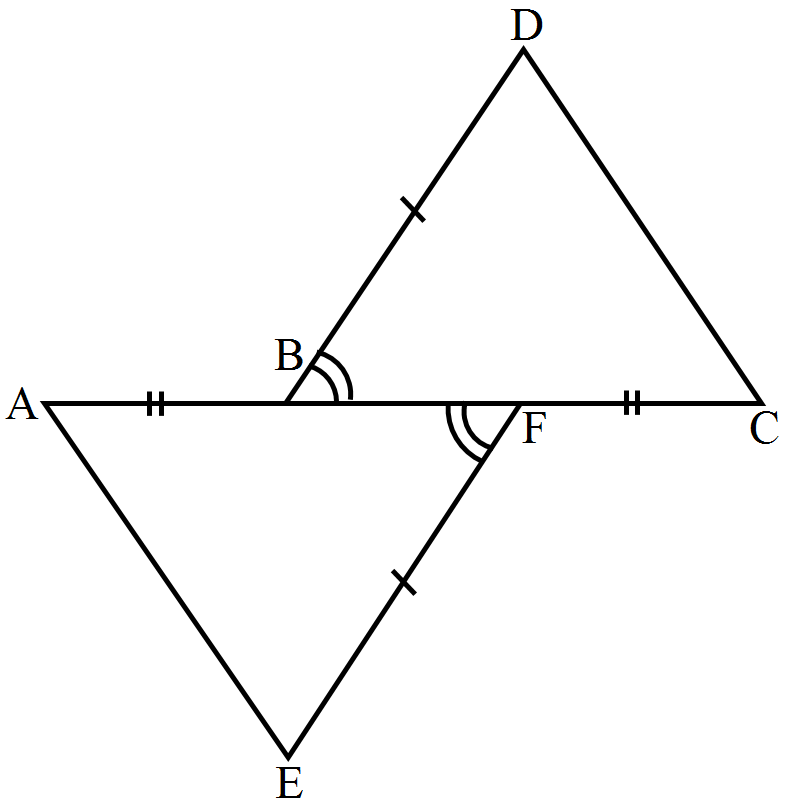
Answer$ASA$
In $\triangle\text{DBC}$ and $\triangle\text{AEF},$ we have
$AB = FC$ (given) by adding BF on both sides
$AF = CB$
$\triangle\text{AEF}=\ \triangle\text{CBD}$ (given)
$EF = BD$ (given)
Hence, $\triangle\text{AFE}\cong\triangle\text{CBD}$ by $SAS$ as the corresponding sides and their included angles are equal.
View full question & answer→MCQ 1101 Mark
In a $\triangle\text{ABC},$ If $\angle\text{A}= 45^\circ$ and $\angle\text{B}= 70^\circ.$ Determine the shortest sides of the triangles.
Answer$\angle\text{A}+\angle\text{B}+\angle\text{C}=180^\circ$
$\angle\text{A}=45^\circ$
$\angle\text{B}=70^\circ$
$\angle\text{C}+45^\circ+70^\circ=180^\circ$
$\angle\text{C}+115^\circ=180^\circ$
$\angle\text{C}=180^\circ-115^\circ$
$\angle\text{C}=65^\circ$
$\angle\text{A}$ is shortest angle and the side opp to shortest angle is shortest.
So, $BC$ is the shotest side.
View full question & answer→MCQ 1111 Mark
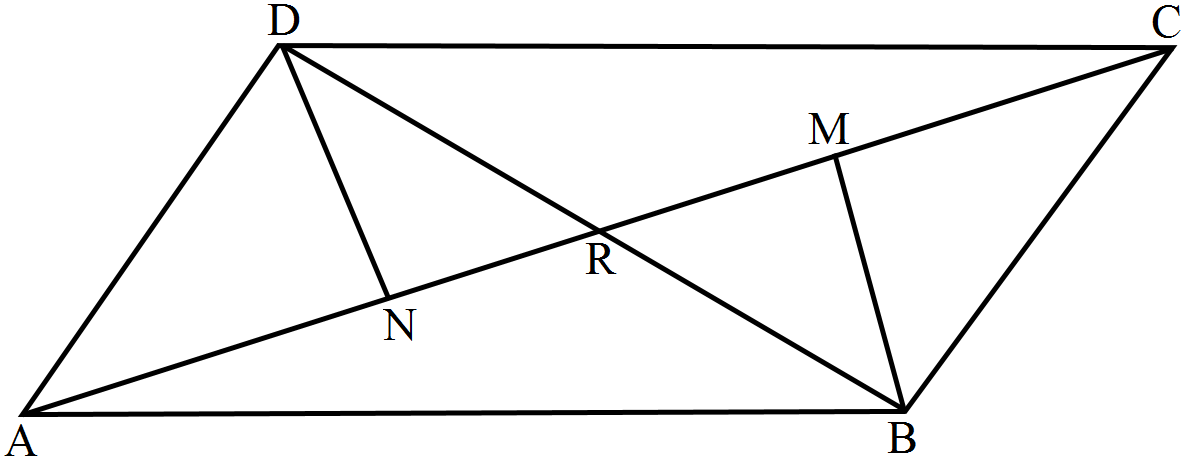
In quadrilateral $ABCD, BM$ and $DN$ are drawn perpendiculars to $AC$ such that $BM = DN$. If $BR = 8\ cm$. then $BD$ is:
- A
$12\ cm$
- B
$2\ cm$
- ✓
$16\ cm$
- D
AnswerCorrect option: C. $16\ cm$
In triangles $\triangle\text{DNR}$ and $\triangle\text{BMR},$
$\angle\text{N} = \angle\text{M} = 90^\circ$
$\angle\text{NRD} = \angle\text{MRB}$ (vertically opposite angles)
$BM = DN$ (Given)
Therefore, $\triangle\text{DNR}$ and $\triangle\text{MRB},$ are congruent
Therefore, $BR = DR = 8\ cm$
$BD = 16\ cm$
View full question & answer→MCQ 1121 Mark
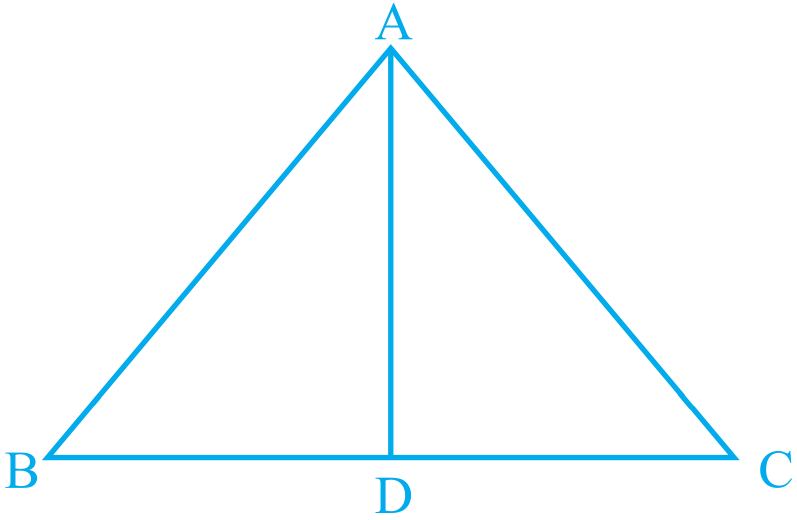
$AD$ is the median of the triangle. Which of the following is true?
- A
$AC + CD < AB$
- ✓
$AB + BC + AC > 2AD$
- C
$AB + BD < AC$
- D
$AB + BC + AC > AD$
AnswerCorrect option: B. $AB + BC + AC > 2AD$
In triangle $ADB$
$AB + BD > AD$
In triangle $ADC$
$AC + DC > AD$
Adding both
$AB + AC + BD + DC > 2AD$
Now $BD + DC = BC$
So, $AB + AC + BC > 2AD$
View full question & answer→MCQ 1131 Mark
An exterior angle of the triangle is $110^{\circ}$, One of the opposite interior angle is $50^{\circ}$. What are the other two angles?
AnswerCorrect option: B. $60^{\circ} and 70^{\circ}$
Let the other opposite interior angle be x and the remaining angle of the triangle be $z.$
Sum of the opposite two interior angle = Exterior angle
$50^{\circ} + x = 110^{\circ}$
$\Rightarrow x = 60^{\circ}$
Now,$ 60^{\circ} + 50^{\circ} + z = 180^{\circ}$ (Angle sum property)
$\Rightarrow z = 70^{\circ}$
Therefore, the other two angles of the triangle $= 60^{\circ}$ and $70^{\circ}$
View full question & answer→MCQ 1141 Mark
In triangles $ABC$ and $PQR$ three equality relations between some parts are as follows: $AB = QP,$ $\angle\text{B} = \angle\text{P}, BC = PR$. State which of the congruence conditions applies:
AnswerTwo sides and included angle are equal and is $SAS$ axiom.
View full question & answer→MCQ 1151 Mark
In a triangle, an exterior angle at a vertex is $95^\circ $ and its one of the interior opposite angle is $55^\circ $, then the measure of the other interior angle is:
- A
$85^\circ $
- ✓
$40^\circ$
- C
$90^\circ$
- D
$55^\circ$
AnswerCorrect option: B. $40^\circ$
Let the other interior opposite angle be $x^\circ .$
Then, we have $x^\circ + 55^\circ = 95^\circ $
$\Rightarrow x^\circ = 95^\circ - 55^\circ = 40^\circ $
View full question & answer→MCQ 1161 Mark
In $\triangle\text{ABC}$ and $\triangle\text{DEF}$ its is given that $\angle\text{B}=\angle\text{E}$ and $\angle\text{C}=\angle\text{F}$ in order that $\triangle\text{ABC}≅\triangle\text{DEF}$ we must have,
AnswerCorrect option: B. $BC = EF$
In $\triangle\text{ABC}$ and $\triangle\text{DEF}$
$\angle\text{B}=\angle\text{E}$ and $\angle\text{C}=\angle\text{F}$
For congruence, $BC = EF$
Therefore by $AAS$ axiom
$\triangle\text{ABC}≅\triangle\text{DEF}$
View full question & answer→MCQ 1171 Mark
If the sides of a triangle are produced in order, then the sum of the three exterior angles so formed is:
- A
$90^\circ$
- B
$180^\circ$
- C
$270^\circ$
- ✓
$360^\circ$
AnswerCorrect option: D. $360^\circ$
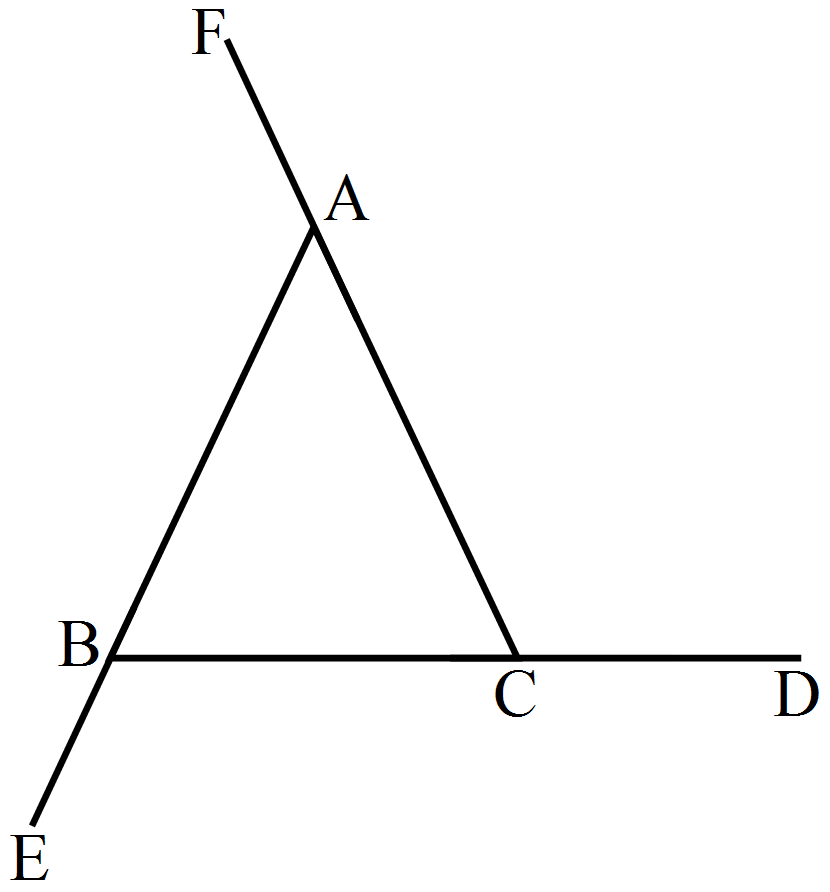
In $\triangle\text{ABC},$
$\angle\text{A}+\angle\text{B}+\angle\text{C}=180^\circ$
Now, $\angle\text{FAB}=180^\circ-\angle\text{A}\dots(1)$
$\angle\text{DCA}=180^\circ-\angle\text{C}\dots(2)$
$\angle\text{EBC}=180^\circ-\angle\text{B}\dots(3)$
Adding equation $(1), (2)$ and $(3) \angle\text{FAB}+\angle\text{DCA}+\angle\text{EBC}=180^\circ-\angle\text{A}+180^\circ-\angle\text{C}+180^\circ-\angle\text{B}$
$=540^\circ-(\angle\text{A}+\angle\text{B}+\angle\text{C})$
$=540^\circ-180^\circ$
$\Rightarrow $ Sum of all exterior angles $= 360^\circ$ View full question & answer→MCQ 1181 Mark
In the following, write the correct answer.Two sides of a triangle are of lengths $5\ cm$ and $1.5\ cm$. The length of the third side of the triangle cannot be:
- A
$3.6\ cm$
- B
$4.1\ cm$
- C
$3.8\ cm$
- ✓
$3.4\ cm$
AnswerCorrect option: D. $3.4\ cm$
Since sum of any two sides of triangle is always greater than thrid side, so that side of the triangle cannot be $3.4\ cm$ becouse then,
$1.5\ cm + 3.4\ cm = 4.9\ cm.$
View full question & answer→MCQ 1191 Mark
In the adjoining figure, $BC = AD$, $\text{CA}\bot\text{AB}$ and $\text{BD}\bot\text{AB}.$ The rule by which $\triangle\text{ABC}\cong\triangle\text{BAD}$ is:
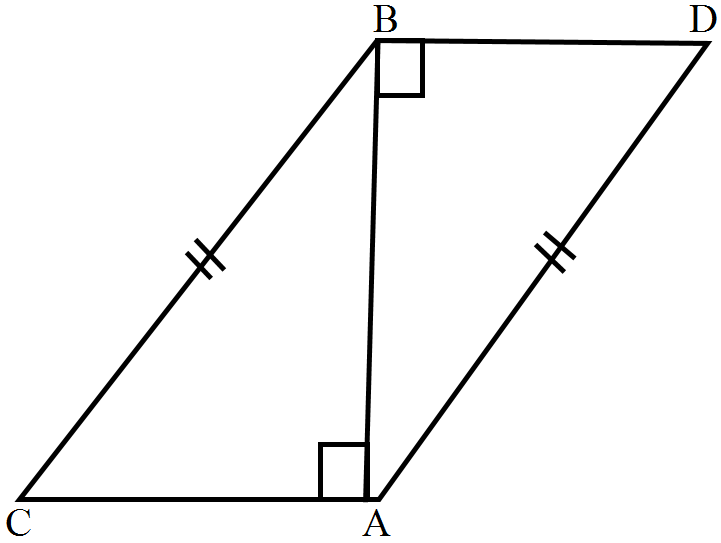
AnswerIn $\triangle\text{ABC}$ and $\angle\text{BAC}=\angle\text{ABD}$
$BAD$, we have (Right angles)
$BC = AD $(Hypotentuses and Given)
$AB = AB$ (common in both)
Hence, $\triangle\text{ABC}\cong\triangle\text{BAD}$ by $RHS$ criterion.
View full question & answer→MCQ 1201 Mark
In Figure, if $\text{l}_1|| \text{l}_2,$ the value of $x$ is:
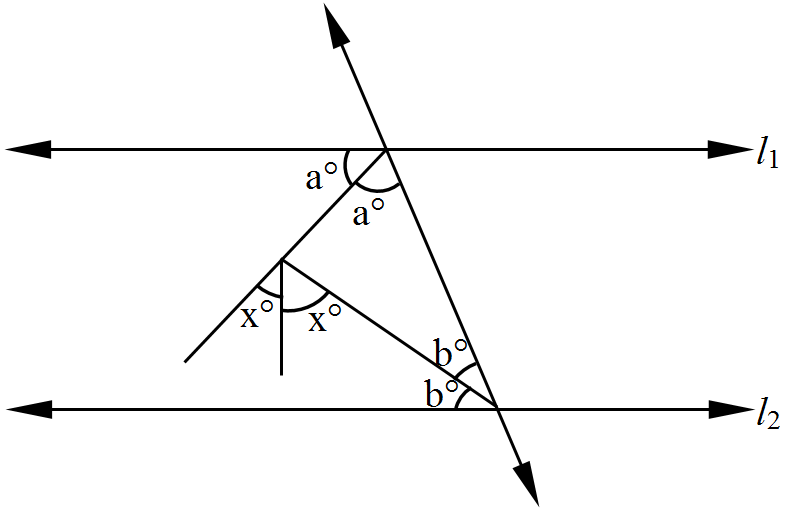
- A
$60$
- B
$22\frac{1}{2}$
- ✓
$45$
- D
$30$
Answer
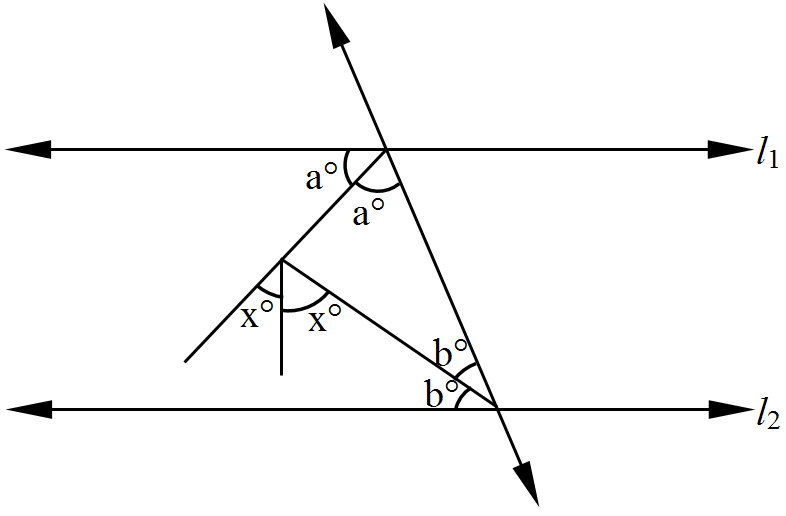
$\text{ACS} = 180^\circ−2\text{b}^\circ$
Also $\angle\text{ACS} = \angle\text{PAC} = 2\text{a}^\circ$ (alternate angles)
$\Rightarrow 2a^\circ = 180^\circ − 2b^\circ $
$\Rightarrow a^\circ + b^\circ = 90^\circ $
Now, in $\triangle\text{ABC}$
$\text{a}^\circ+\text{b}^\circ + \angle\text{ABC} = 180^\circ$
$\angle\text{ABC} = 180^\circ - 2\text{x}^\circ$
$\Rightarrow a^\circ + b^\circ + 180^\circ − 2x^\circ = 180^\circ $
$\Rightarrow 2x^\circ = a^\circ + b^\circ = 90^\circ $
$\Rightarrow x^\circ = 45^\circ $
View full question & answer→MCQ 1211 Mark
In a $\triangle\text{ABC},$ if $\angle\text{B} = \angle\text{C} = 45^\circ,$ which is the longest side?
AnswerWe know that sum of all angles of a triangle is $180^\circ \angle\text{A} + \angle\text{B} + \angle\text{C} = 180^\circ$
$\angle\text{B} = \angle\text{C} = 45^\circ$
$\angle\text{A} + 45^\circ + 45^\circ = 180^\circ$
$\angle\text{A} + 90^\circ = 180^\circ$
$\angle\text{A} = 180^\circ - 90^\circ$
$\angle\text{A} = 90^\circ$
So, angle A is the largest and the side opposite to the greatest angle is the longest so, side $BC$ is the longest.
View full question & answer→MCQ 1221 Mark
In $\triangle\text{ABC}$ and $\triangle\text{DEF,}$ it is given that $AB = DE$ and $BC = EF$. In order that $\triangle\text{ABC}\cong\triangle\text{DEF},$ we must have:
- A
$\angle\text{A}=\angle\text{D}$
- ✓
$\angle\text{B}=\angle\text{E}$
- C
$\angle\text{C}=\angle\text{F}$
- D
AnswerCorrect option: B. $\angle\text{B}=\angle\text{E}$
In $\triangle\text{ABC}$ and $\triangle\text{DEF},$
$AB = DE$ and $BC = EF$
SO, the induded angles should be equal for the triangle to be congurent by the $SAS$ congruence criterion.
Thus, we must have $\angle\text{B}=\angle\text{E}.$
View full question & answer→MCQ 1231 Mark
In the adjoining Figure, $AB = AC$ and $BD = CD$. The ratio $\angle\text{ABD} : \angle\text{ACD}$ is: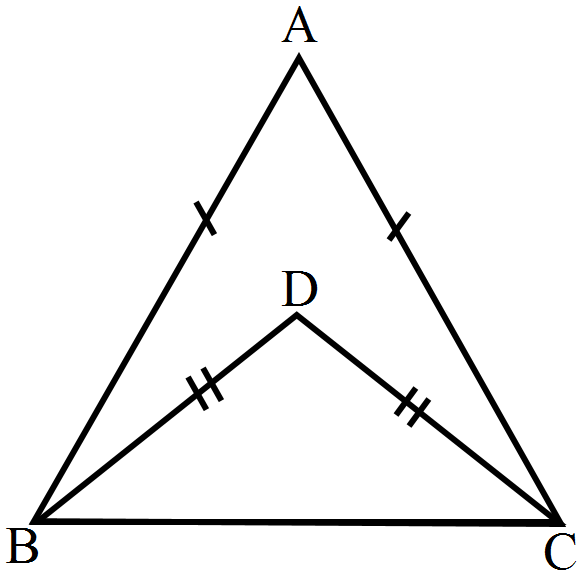
- A
$2 : 3$
- B
$2 : 1$
- C
$1 : 2$
- ✓
$1 : 1$
AnswerCorrect option: D. $1 : 1$
In $\triangle\text{ABC}$
$AB = AC$
$\therefore\ \angle\text{ABC} = \angle\text{ACB}$ (angles opposite to equal sides of a triangle are equal)$ ...(1)$
In $\triangle\text{DBC}$
$DB = DC,$
$\therefore\ \angle\text{DBC} = \angle\text{DCB}$ (angles opposite to equal sides of a triangle are equal)$ ...(2)$
Subtract $2$ from $1$
$\angle\text{ABC} - \angle\text{DBC} = \angle\text{ACB} - \angle\text{DCB}$ (equals subtracted from equals gives equal)
$= \angle\text{ABD} = \angle\text{ACD}$
Divide both the sides by $\angle\text{ACD}$
$\Rightarrow \frac{\angle\text{ABD}}{\angle\text{ACD}} = 1$
$\therefore\ \angle\text{ABD} : \angle\text{ACD}=1:1$
View full question & answer→MCQ 1241 Mark
In $\triangle\text{ABC, }\angle\text{C}=\angle\text{A},$ $BC = 4\ cm$ and $AC = 5\ cm$. then, $AB =?$
- ✓
$4\ cm$
- B
$5\ cm$
- C
$8\ cm$
- D
$2.5\ cm$
AnswerCorrect option: A. $4\ cm$
In $\triangle\text{ABC,}$
$\angle\text{C}=\angle\text{A}$
$\Rightarrow\text{AB = BC}$ (sides opposite to equal angles are equal)
$\Rightarrow\text{AB = 4cm}$
View full question & answer→MCQ 1251 Mark
In the adjoining figure, $\angle\text{B} = \angle\text{C}$ and $\text{AD}\bot\text{BC}.$ The rule by which $\triangle\text{ABD}\cong\triangle\text{ADC}.
$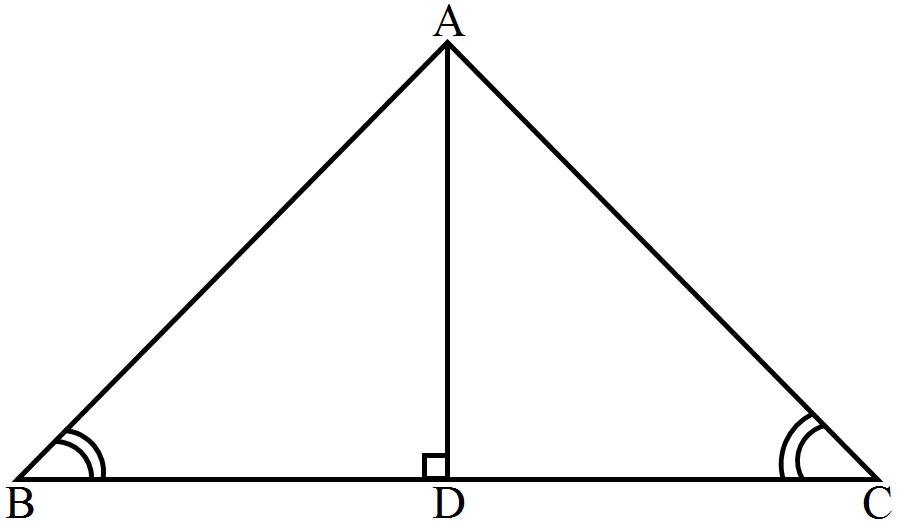
AnswerIn $\triangle\text{ABD}$ and $\triangle\text{ADC},$ we have
$\angle\text{ABD} = \angle\text{ACD} $ (given)
$\angle\text{BDA} = \angle\text{CDA} $ (90$^{\circ}$)
$AD = AD$ (common in both)
Hence, $\triangle\text{ABD}\cong\triangle\text{ADC}$ by $AAS$ criterion.
View full question & answer→MCQ 1261 Mark
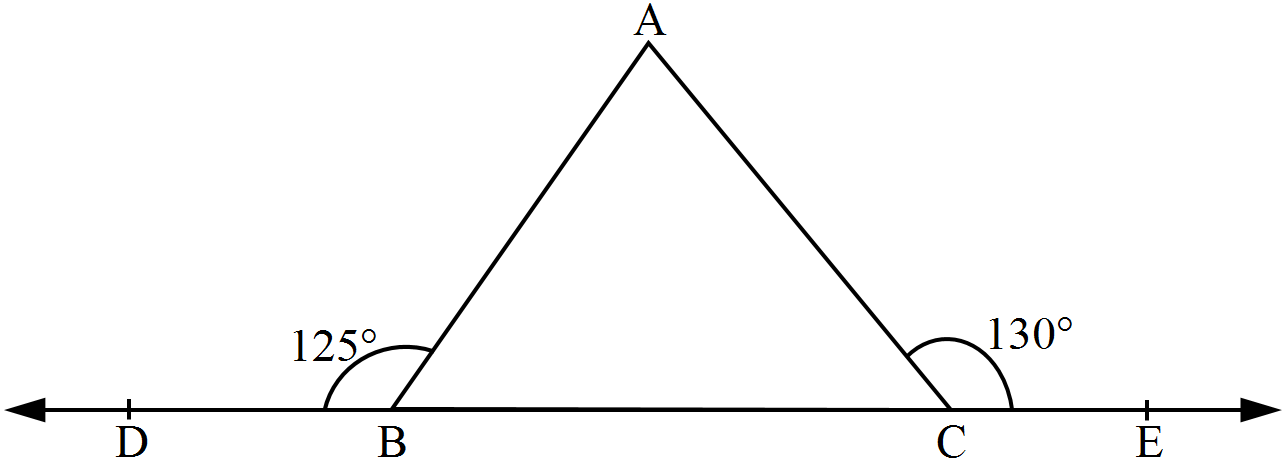
Side $BC$ of $\triangle\text{ABC}$ has been produced to $D$ on left and to $E$ on right-hand side of $BC$ such that $\angle\text{ABD} = 125^\circ$ and $\angle\text{ACE} = 130^\circ.$ Then, $\angle\text{A} = ?$
- A
$55^\circ$
- B
$65^\circ$
- ✓
$75^\circ$
- D
$50^\circ$
AnswerCorrect option: C. $75^\circ$
We have,$\therefore \ \angle\text{ABD}+\angle\text{ABC}=180^\circ$ [$\because $ E is a straight line]
$\Rightarrow 125^\circ+\angle\text{ABC}=180^\circ$
$\Rightarrow \angle\text{ABC}=55^\circ$
Also,
$\angle\text{ACE}+\angle\text{ACB}=180^\circ$
$\Rightarrow 130^\circ+\angle\text{ACB}=180^\circ$
$\Rightarrow \angle\text{ACB}=50^\circ$
$\therefore \angle\text{BAC}+\angle\text{ABC}+\angle\text{ACB}=180^\circ$ [Sum of the angles of a triangle]
$\Rightarrow \angle\text{BAC}+55^\circ+50^\circ=180^\circ$
$\Rightarrow \angle\text{BAC}=75^\circ$
$\Rightarrow \angle\text{A}=75^\circ.$
View full question & answer→MCQ 1271 Mark
The bisects of exterior angles at $B$ and $C$ of $\triangle\text{ABC}$ meet at $O$. If $\angle\text{A}=\text{x}^\circ,$ then $\angle\text{BOC}=$
- A
$90^\circ+\frac{\text{x}^\circ}{2}$
- ✓
$90^\circ-\frac{\text{x}^\circ}{2}$
- C
$180^\circ+\frac{\text{x}^\circ}{2}$
- D
$180^\circ-\frac{\text{x}^\circ}{2}$
AnswerCorrect option: B. $90^\circ-\frac{\text{x}^\circ}{2}$
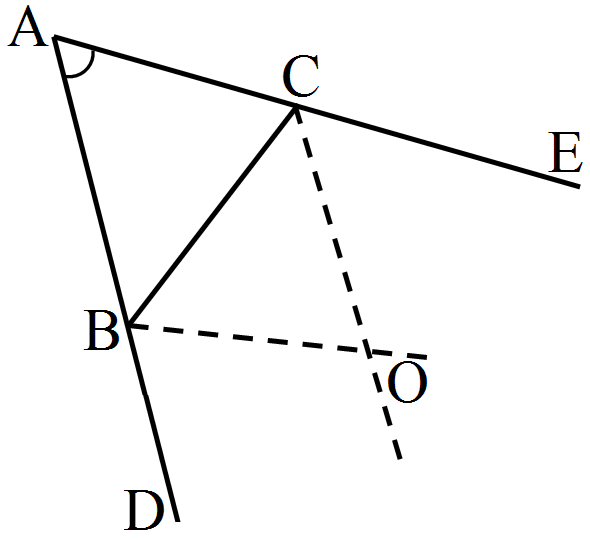
In $\triangle\text{ABC},$
$\angle\text{A}+\angle\text{B}+\angle\text{C}=180^\circ$
$\Rightarrow\angle\text{B}+\angle\text{C}=180^\circ-\text{x}^\circ\dots(1)$
$\Rightarrow\angle\text{CBD}=180^\circ-\angle\text{B}\dots(2)$
$\Rightarrow\angle\text{ECB}=180^\circ-\angle\text{C}\dots(3)$
$\Rightarrow\frac{\angle\text{CBD}}{2}=\angle\text{OBC}=90^\circ-\frac{\angle\text{B}}{2}\dots(4)$ [frpom eq(2)]
$\frac{\angle\text{ECB}}{2}=\angle\text{OCB}=90^\circ-\frac{\angle\text{C}}{2}\dots(5)$
Now, in $\triangle\text{BOC}$
$\angle\text{OBC}+\angle\text{OCB}+\angle\text{BOC}=180^\circ$
$\Rightarrow\angle\text{BOC}=180^\circ-(\angle\text{OBC}+\angle\text{OCB})$
From eq $(4)$ and $(5),$
$\angle\text{BOC}=180^\circ-\Big(90^\circ-\frac{\angle\text{B}}{2}+90^\circ-\frac{\angle\text{C}}{2}\Big)$
$=180^\circ-\Big(180^\circ-\frac{\angle\text{B}}{2}-\frac{\angle\text{C}}{2}\Big)$
$=\Big(\frac{\angle\text{B}+\angle\text{C}}{2}\Big)$ [from eq $(1)]$
$=\frac{180^\circ-\text{x}^\circ}{2}$
$\Rightarrow\angle\text{BOC}=90^\circ-\frac{\text{x}^\circ}{2}$ View full question & answer→MCQ 1281 Mark
In $\triangle\text{ABC}$ and $\triangle\text{PQR}, AB = PR$ and $\angle\text{A} = \angle\text{P}.$ Then, the two triangles will be congruent by $SAS$ axiom if:
- A
$BC = QR$
- ✓
$AC = PQ$
- C
$BC = PQ$
- D
$AC = QR$
AnswerCorrect option: B. $AC = PQ$
$\angle\text{A}$ is included between $AB$ and $AC$ and $\angle\text{P}$ is included between $PQ$ and $PR$ and corresponding sides must be equal. Since $AB = PR$, hence $AC = PQ$ for the given triangles to be congruent by $SAS$ axiom.
View full question & answer→MCQ 1291 Mark
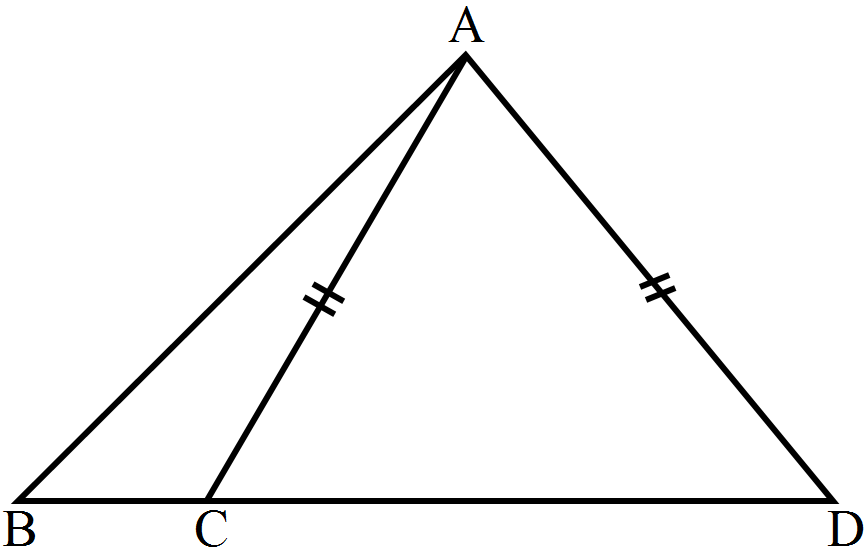
In the adjoining figure, if $AC = AD$, then.
AnswerCorrect option: D. $AB > AD$
$\angle\text{D} = \angle\text{C}$ (As $AC = AD)$
And $\angle\text{C} > \angle\text{B}$ and $\angle\text{D} > \angle\text{B}$
Hence, $AB > AD$
View full question & answer→MCQ 1301 Mark
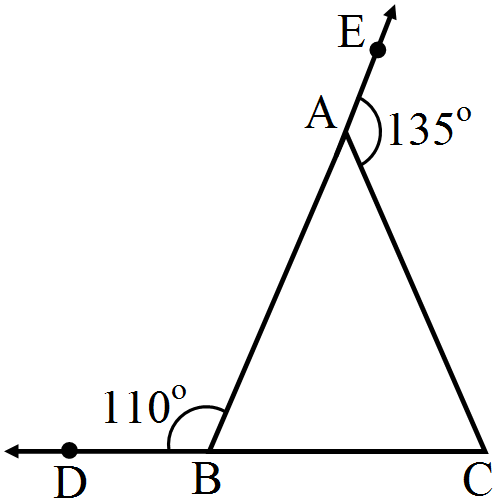
In the given figure, the side $CB$ and $BA$ of $\triangle\text{ABC}$ have been produced to $D$ and $E$ respectively such that $\angle\text{ABD}=110^\circ$ and $\angle\text{CAE}=135^\circ.$ Then, $\angle\text{ACB}=?$
- ✓
$65^\circ$
- B
$45^\circ$
- C
$55^\circ$
- D
$35^\circ$
AnswerCorrect option: A. $65^\circ$
Since $BAE$ is a straight line, we have
$\angle\text{BAC}+\angle\text{CAE}=180^\circ$ .....(Supplementary angles)
$\Rightarrow\angle\text{BAC}+135^\circ=180^\circ$
$\Rightarrow\angle\text{BAC}=45^\circ$
Since $CBD$ is a straight line, we have
$\angle\text{ABD}+\angle\text{ABC}=180^\circ$ ....(Supplmenetary angles)
$\Rightarrow110^\circ+\angle\text{ABC}=180^\circ$
$\Rightarrow\angle\text{ABC}=70^\circ$
In $\triangle\text{ABC},$ we have
$\angle\text{BAC}+\angle\text{ABC}+\angle\text{ACB}=180^\circ$ .....(Angle sum property)
$\Rightarrow45^\circ+70^\circ+\angle\text{ACB}=180^\circ$
$\Rightarrow\angle\text{ACB}=65^\circ$
View full question & answer→MCQ 1311 Mark
Two sides of a triangle are of length $4\ cm$ and $2.5\ cm$. The length of the third side of the triangle cannot be:
- A
$6\ cm$
- ✓
$6.5\ cm$
- C
$5.5\ cm$
- D
$6.3\ cm$
AnswerCorrect option: B. $6.5\ cm$
The sum of any two sides of a triangle is greater than the third side.
Since, $4\ cm + 2.5\ cm = 6.5\ cm$
The length of third side of a triangle cannot be $6.5\ cm.$
View full question & answer→MCQ 1321 Mark
The length of two sides of a triangle are $7$ units and $10$ units. Which of the following length can be the length of the third side?
- A
$17\ cm$
- B
$19\ cm$
- C
$3\ cm$
- ✓
$13\ cm$
AnswerCorrect option: D. $13\ cm$
As per the rule in a triangle, the sum of any $2$ sides should be greater than the third side. So, the length of the third side should be $13$, Since with $7, 10$ and $13$ we have,
$7 + 10 > 13, 7 + 13 > 10$ and $13 + 10 > 7$
View full question & answer→MCQ 1331 Mark
An angle is $4$ time its complement. Find measure.
- A
$42^\circ$
- B
$62^\circ$
- C
$52^\circ$
- ✓
$72^\circ$
AnswerCorrect option: D. $72^\circ$
If x is the angle, its complement will be $(90^\circ - x),$
because they have to add up to $90$, and here $x + (90^\circ - x) = 90^\circ $
$x$ is equal to $4$ times of its complement, so we have
$x = 4 \times (90^\circ - x)$
$\Rightarrow x = 360^\circ - 4x$
$\Rightarrow 5x = 360^\circ $
$\Rightarrow\ \text{X}=\frac{360^\circ}{5}$
$\Rightarrow\ \text{X}=72^\circ$
View full question & answer→MCQ 1341 Mark
In the adjoining figure, $O$ is Mid–point of $AB$. If $\angle\text{ACO} = \angle\text{BDO},$ then $\angle\text{OAC}$ is equal to: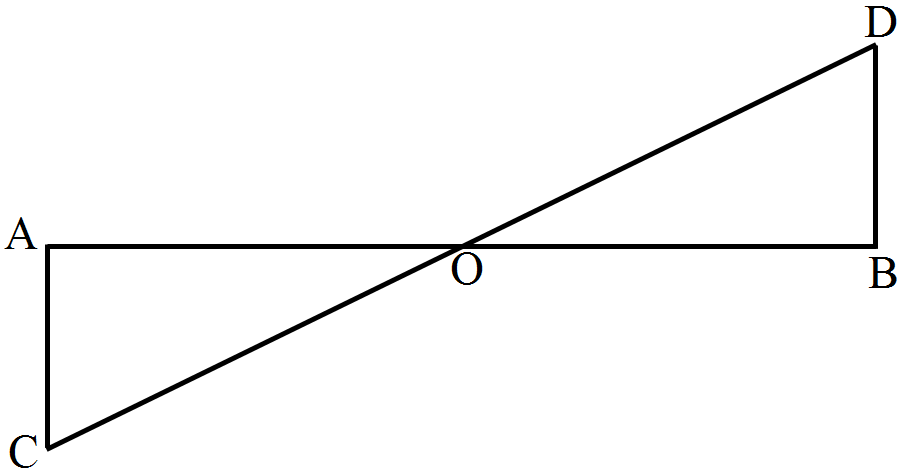
- A
$\angle\text{BOD}$
- B
$\angle\text{OCA}$
- C
$\angle\text{ODB}$
- ✓
$\angle\text{OBD}$
AnswerCorrect option: D. $\angle\text{OBD}$
In $\triangle\text{OAC}$ and $\triangle\text{OBD},$
$AO = OB$ As $O$ is the mid-point of $AB$
$\triangle\text{AOC}=\ \triangle\text{BOD}$ (Vertically Opposite Angles)
$\triangle\text{AOC}=\ \triangle\text{BDO}$ (Given)
$\therefore\ \triangle\text{OAC}=\ \triangle\text{OBD}$ ($AAS$ Axiom)
$\therefore\ \triangle\text{OAC}=\ \triangle\text{OBD}$ $(C.P.C.T.)$
View full question & answer→MCQ 1351 Mark
The triangle is not possible with the given measurements:
- ✓
$5.4\ cm, 2.3\ cm, 3.1\ cm$
- B
$6\ cm, 7\ cm, 7\ cm$
- C
$3\ cm, 5\ cm, 5\ cm$
- D
$8.3\ cm, 3.4\ cm, 6.1\ cm$
AnswerCorrect option: A. $5.4\ cm, 2.3\ cm, 3.1\ cm$
In a triangle, the sum of any two sides must be greater than the third side and here $2.3 + 3.1 = 5.4$ and hence, the triangle is not possible with the given measurements.
View full question & answer→MCQ 1361 Mark
In $\triangle\text{PQR},\ \angle\text{P}=60^\circ,\ \angle\text{Q}=50^\circ.$ Which side of the triangle is the longest?
AnswerIn $\triangle\text{PQR},\ \angle\text{P}=60^\circ,\ \angle\text{Q}=50^\circ.$
Now, by angle sum property, $\angle\text{P} +\angle\text{Q} +\angle\text{R} = 180^\circ$
$60^\circ + 50^\circ + \angle\text{R} = 180^\circ$
or, $ \angle\text{R} = 180^\circ - 110^\circ = 70^\circ$
So, $\angle\text{R}$ is the largest angle and the side opposite to it, i.e, $PQ$ will be the longest side.
View full question & answer→MCQ 1371 Mark
If all the altitudes from the vertices to the opposite sides of a triangle are equal, then the triangle is:
AnswerIn an equilateral triangle all the altitudes,sides, angles, perpendicular bisectors, medians and angular bisectors are equal.
View full question & answer→MCQ 1381 Mark
In $\triangle\text{AOC}$ and $\triangle\text{XYZ},\ \angle\text{A}=\angle\text{X},\ \angle\text{AO} = \angle\text{XY},\ \angle\text{AC} = \angle\text{XZ},$ then by which congruence rule $\triangle\text{AOC}\cong\triangle\text{XYZ}?$
AnswerAccording to $SAS$ criterion, if the corresponding sides and their included angles are equal, then the triangles are congruent. Here, in $\triangle\text{AOC}$ and $\triangle\text{XYZ},$ $AO = XY$, and $AC = XZ$ are the corresponding sides and $\angle\text{A}=\angle\text{X}$ are included angles, Hence, $\triangle\text{AOC}\cong\triangle\text{XYZ},$ by $SAS.$
View full question & answer→MCQ 1391 Mark
In the adjoining figure, the rule by which $\triangle\text{ABC}\cong\triangle\text{ADC}.$
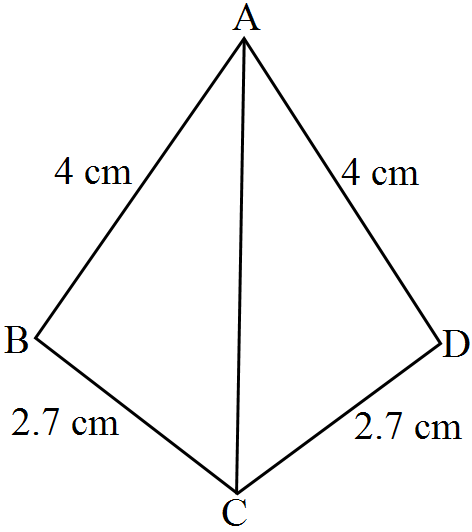
Answeran $\triangle\text{ABC} $ and $\triangle\text{ADC}, $ we have$AB = AD (4\ cm)$
$BC = DC (2.7\ cm)$
$AC = AC$ (commom in both)
Hence, $\triangle\text{ABC}\cong\triangle\text{ADC}$ by $SSS$ criterion.
View full question & answer→MCQ 1401 Mark
What is the sum of the angles of a quadrilateral?
- A
$260^\circ$
- ✓
$360^\circ$
- C
$180^\circ$
- D
$90^\circ$
AnswerCorrect option: B. $360^\circ$
For a quadrilateralNumber of sides $(n) = 4$
Sum of interior angles $= (n - 2) \times 180^\circ $
$p = (4 - 2) \times 180^\circ $
$p = 2 \times 180^\circ $
$p = 360^\circ $
View full question & answer→MCQ 1411 Mark
In a $\triangle\text{ABC},$ if $\angle\text{A}−\angle\text{B}=42^\circ$ and $\angle\text{B}−\angle\text{C}=21^\circ$ then $\angle\text{B} = ?$
- A
$63^\circ$
- B
$32^\circ$
- C
$95^\circ$
- ✓
$53^\circ$
AnswerCorrect option: D. $53^\circ$
Let,
$\angle\text{A}−\angle\text{B}=42^\circ ...\ \text{(i)}$ and
$\angle\text{B}−\angle\text{C}=21^\circ ...\ \text{(ii)}$
Adding $(i)$ and $(ii)$,we get
$\angle\text{A}−\angle\text{C}=63^\circ ...\ \text{(iii)}$
$\angle\text{B}=\angle\text{A}−42^\circ$ [using $(i)]$
$\angle\text{C}=\angle\text{A}−63^\circ$ [Using $(iii)]$
$\therefore \angle\text{A}+\angle\text{B}+\angle\text{C}=180^\circ$ [Sum of the angles of a triangle]
$\Rightarrow \angle\text{A}+\angle\text{A}−42^\circ+\angle\text{A}−63^\circ=180^\circ$
$\Rightarrow 3\angle\text{A}−105^\circ=180^\circ$
$\Rightarrow 3\angle\text{A}=285^\circ$
$\therefore \angle\text{B}=(95−42)^\circ$
$\Rightarrow \angle\text{B}=53^\circ$
View full question & answer→MCQ 1421 Mark
In the adjoining figure, $AC = BD$. If $\angle\text{CAB} = \angle\text{DBA},$ then $\angle\text{ACB}$ is equal to: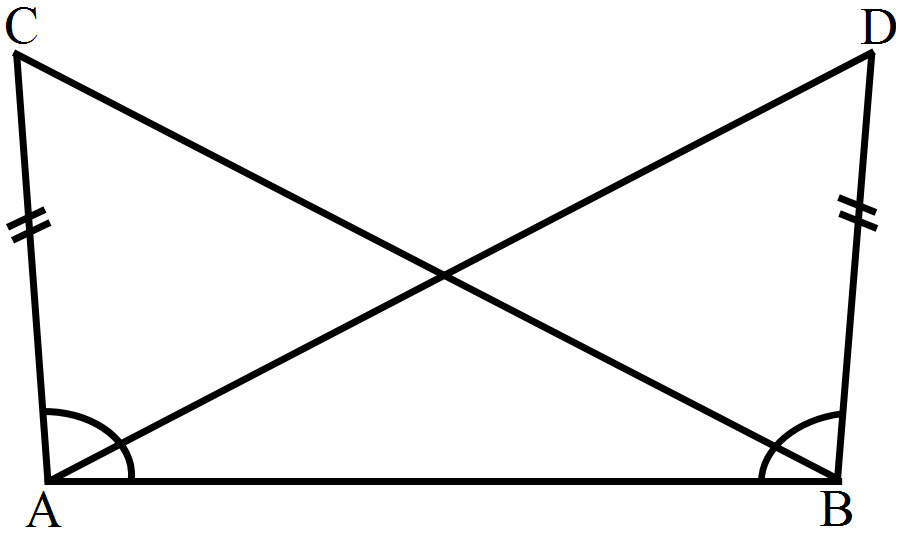
- ✓
$\angle\text{BDA}$
- B
$\angle\text{BAD}$
- C
$\angle\text{ABC}$
- D
$\angle\text{ABD}$
AnswerCorrect option: A. $\angle\text{BDA}$
In Triangle $CAB$ and traingle $DBA,$
$AC = BD$ and $\angle\text{CAB} = \angle\text{DBA}$ (Given)
$AB$ (Common)
Therefore, Triangle $CAB$ and traingle $DBA$ are congruent by $SAS$ criteria
Therefore, $\angle\text{ACB} = \angle\text{BDA}$ (by $CPCT)$
View full question & answer→MCQ 1431 Mark
If $\triangle\text{ABC} \cong\triangle\text{PQR}$ by $SSS$ congruence rule, then:
- A
$AC = PQ$
- B
$AC = QR$
- ✓
$BC = QR$
- D
$BC = PQ$
AnswerCorrect option: C. $BC = QR$
If $\triangle\text{ABC} \cong\triangle\text{PQR}$ by $SSS$ congruence rule, then the corresponding sides must be equal i.e $AB = PQ, BC = QR$ and $AC = PR.$
View full question & answer→MCQ 1441 Mark
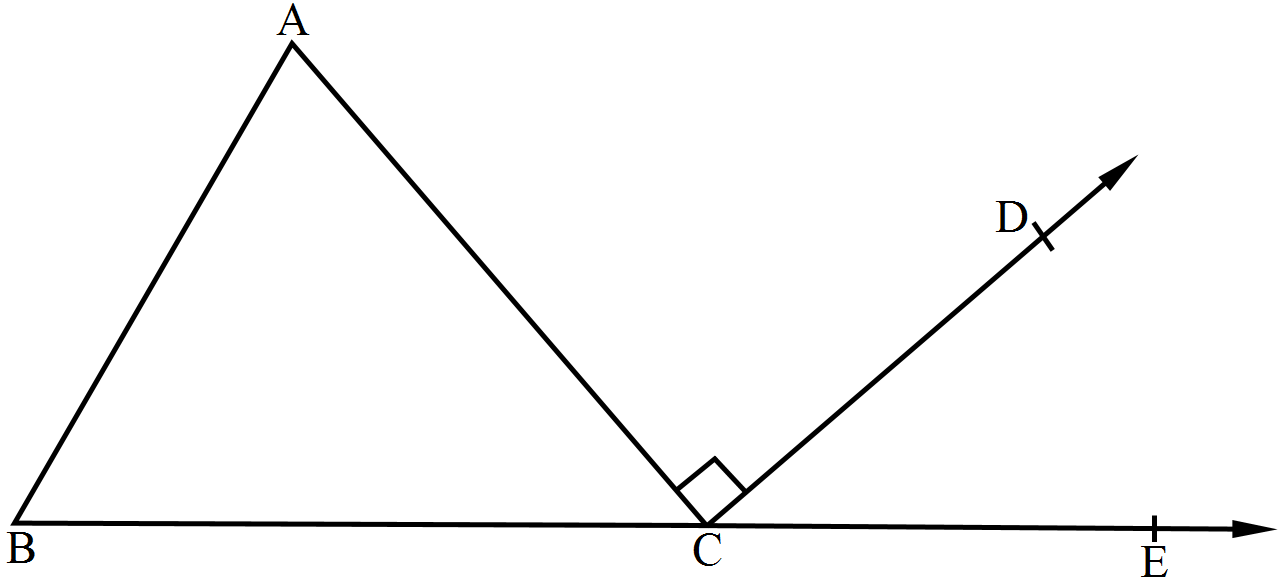
In a $\angle\text{ABC},$ it is given that $\angle\text{A}:\angle\text{B}:\angle\text{C} = 3 : 2 : 1$ and $\angle\text{ACD}=90^\circ.$ If $BC$ is produced to $E$ then $\angle\text{ECD} = ?$
- ✓
$60^\circ$
- B
$50^\circ$
- C
$25^\circ$
- D
$40^\circ$
AnswerCorrect option: A. $60^\circ$
Let $ \angle\text{A}=(3\text{x})^\circ,\ \angle\text{B}=(2\text{x})^\circ$ and $\angle\text{C}=\text{x}^\circ$
Then,
$3x + 2x + x = 180^\circ $ [Sum of the angles of a triangle]
$\Rightarrow 6x = 180^\circ $
$\Rightarrow x = 30^\circ $
Hence, the angles are
$\angle\text{A}=3\times 30^\circ=90^\circ,\ \angle\text{B}=2\times 30^\circ=60^\circ$ and $\angle\text{C}=30^\circ$
Side $BC$ of triangle $ABC$ is produced to $E.$
$\therefore\ \angle\text{ACE}=\angle\text{A}+\angle\text{B}$
$\Rightarrow \angle\text{ACD}+\angle\text{ECD}=90^\circ+60^\circ$
$\Rightarrow 90^\circ+\angle\text{ECD}=150^\circ$
$\Rightarrow \angle\text{ECD}=60^\circ$
View full question & answer→MCQ 1451 Mark
If $\triangle\text{ABC}≅\triangle\text{PQR}$ and $\triangle\text{ABC}$ is not congruent to $\triangle\text{RPQ},$ then which of the following is not true:
- A
$QR = BC$
- B
$AB = PQ$
- ✓
$BC = PQ$
- D
$AC = PR$
AnswerCorrect option: C. $BC = PQ$
According to the condition given in the question,If $\triangle\text{ABC}≅\triangle\text{PQR}$ and $\triangle\text{ABC}$ is not congruent to $\triangle\text{RPQ}.$
Then, clearly $BC \neq PQ$
$\therefore$ It is false
View full question & answer→MCQ 1461 Mark
$D$ is a point on the side $BC$ of a $\triangle\text{ABG}$ such that AD bisects $\triangle\text{BAC}$ then:
- A
$BO = CD$
- ✓
$BA > BD$
- C
$CD > CA$
- D
$BD > BA$
AnswerCorrect option: B. $BA > BD$
Since, $\angle\text{BAC}$ is bisected by $AD$, then $\angle\text{BAD}$ is less than $\angle\text{ABC},$ hence the side opposite $\angle\text{ABC},$ i.e. $BA$ is greater than the side opposite to $\angle\text{BAD}$ i.e., $BD.$
View full question & answer→MCQ 1471 Mark
In $\triangle\text{ABC}, \ \angle\text{B} = \angle\text{C}$ and ray $AX$ bisects the exterior angle $\triangle\text{DAC}.$ If $\triangle\text{DAX} = 70^\circ,$ then $\angle\text{ACB} =$
- A
$55^\circ$
- B
$35^\circ$
- ✓
$70^\circ$
- D
$90^\circ$
AnswerCorrect option: C. $70^\circ$
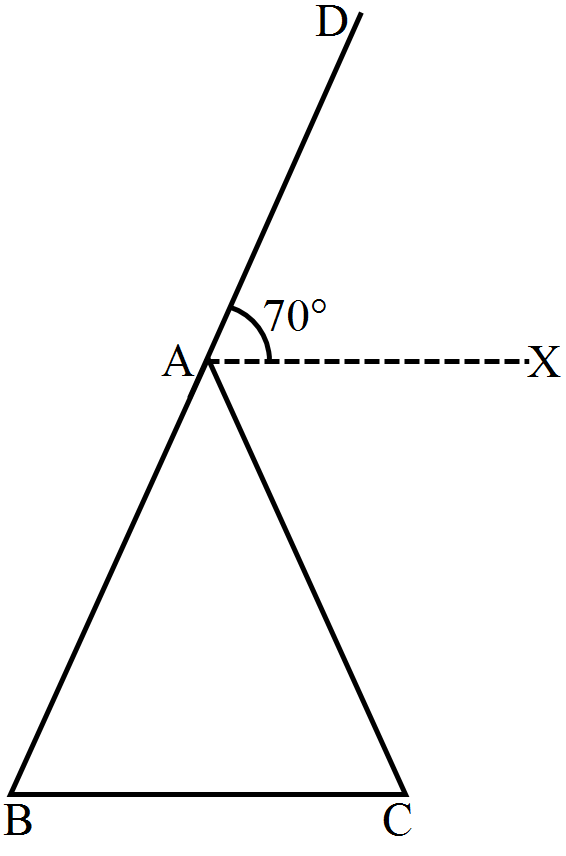
$AX$ is bisector of $\triangle\text{DAC}$
$\Rightarrow\ \angle\text{DAX}=\angle\text{XAC}=70^\circ$
$\Rightarrow\ \angle\text{DAC}=2\times70=140^\circ$
Now, $\angle\text{A} = 180^\circ - \angle\text{DAC} = 180^\circ\text{c}- 180° = 40^\circ$
In $\triangle\text{ABC}$
$\angle\text{A} + \angle\text{B} + \angle\text{C} = 180^\circ$
$\Rightarrow\ 40^\circ + \angle\text{B} + \angle\text{C}= 180^\circ$
$\Rightarrow\ 40^\circ + \angle\text{C} + \angle\text{C}= 180^\circ...(\angle\text{B} = \angle\text{C})$
$\Rightarrow\ 2\angle\text{C} = 140^\circ$
$\Rightarrow\ \angle\text{C} = 70^\circ$
i.e. $\angle\text{ACB} = 70^\circ$ View full question & answer→MCQ 1481 Mark
If triangle $PQR$ is right angled at $Q$, then.
- ✓
$PR > PQ$
- B
$PR < QR$
- C
$PR = PQ$
- D
$PR < PQ$
AnswerCorrect option: A. $PR > PQ$
Then the hypotnuse should be always greater than the remaining two sides.
View full question & answer→MCQ 1491 Mark
- A
An exterior angle of a triangle is less than either of the interior opposite angles.
- B
A triangle can have two obtuse angles.
- ✓
A triangle can have two acute angles.
- D
A triangle can have two right angles.
AnswerCorrect option: C. A triangle can have two acute angles.
True, you may have a triangle with two or more acute angles.
If a triangle has three acute angles, the triangle is called an Acute Triangle.
If a triangle has two acute angles and a single obtuse angle, the triangle is called an Obtuse Triangle.
View full question & answer→MCQ 1501 Mark
In $\triangle\text{ABC}$ and $\triangle\text{PQR},$ it is given that $AB = AC$, $\angle\text{C}=\angle\text{P}$ and $\angle\text{B}=\angle\text{Q}.$ Then, the two triangles are:
- ✓
Isosceles but not congruent
- B
- C
Congruent but not isosceles
- D
Neither congruent nor isosceles
AnswerCorrect option: A. Isosceles but not congruent
In $\triangle\text{ABC}$ and $\triangle\text{PQR},$
$\text{AB = AC}$
$\Rightarrow\angle\text{B}=\angle\text{C}$
Since $\angle\text{C}=\angle\text{P}$ and $\angle\text{B}=\angle\text{Q}$
$\Rightarrow\angle\text{P}=\angle\text{Q}$
$\Rightarrow\text{RQ = RP}$
So, the two triangle are isosceles.
But it is not possible to prove them congruent.
View full question & answer→