Questions · Page 3 of 4

M.C.Q (1 Marks)

MCQ 1011 Mark
An AC source producing emf $\in=\in_{0}\Big[\cos\big(100\pi\text{s}^{-1}\big)\text{t}+\cos\big(500\pi\text{s}^{-1}\big)\text{t}\Big]$ is connected in series with a capacitor and a resistor. The steady-state current in the circuit is found to be $\text{i}=\text{i}_1\cos\Big[\big(100\pi\text{s}^{-1}\big)\text{t}+\phi_1\Big]+\text{i}_2\cos\Big[\big(500\pi\text{s}^{-1}\big)\text{t}+\phi_2\Big].$
  • A
    i1 > i2
  • B
    i1 = i2
  • C
    i1 < i2
  • D
    The information is insufficient to find the relation between i1 and i2
Answer
  1. i1 < i2

Explanation:

$\text{Q}=\text{C}\in=\in_{0}\text{C}\Big[\cos\big(100\pi\text{s}^{-1}\big)\text{t}+\cos\big(500\pi\text{s}^{-1}\big)\text{t}\Big]$

$\text{i}=\frac{\text{dQ}}{\text{dt}}$

$\text{Q}=\text{C}\in=\in_{0}\text{C}\Big[\cos\big(100\pi\text{s}^{-1}\big)\text{t}+\cos\big(500\pi\text{s}^{-1}\big)\text{t}\Big]$

$\in_0\text{C}\times100\pi\Big[\sin\big(100\pi\text{s}^{-1}\big)\text{t}\Big]\\+\in_0\text{C}\times500\pi\Big[\sin\big(500\pi\text{s}^{-1}\big)\text{t}\Big]$

$=100\text{C}\pi\in_0\cos\Big[\big(100\pi\text{s}^{-1}\big)\text{t}+\phi_1\Big]\\+500\text{C}\pi\in_0\cos\Big[\big(500\pi\text{s}^{-1}\big)\text{t}+\phi_2\Big]$

$\text{i}_1=100\pi\in_0\text{C}$ and $\text{i}_2=500\pi\in_0\text{C}$

$\text{i}_2>\text{i}_1$

View full question & answer
MCQ 1021 Mark
Electrical energy is transmitted over large distances at high alternating voltages. Which of the following statements is (are) correct?
  • A
    For a given power level, there is a lower current.
  • B
    Lower current implies less power loss.
  • C
    Transmission lines can be made thinner.
  • D
    It is easy to reduce the voltage at the receiving end using step-down transformers.
Answer
  1. For a given power level, there is a lower current.
  2. Lower current implies less power loss.
  1. It is easy to reduce the voltage at the receiving end using step-down transformers.

Solution:

Key Concept: Power loss due to transmisssion lines having resistance (R) and Irms current flowing in the circuit is I2rms R.

The power is to be transmitted over the large distances ar high alternating voltages, so current flowing through the wires will be low because of given power (P).

For a given power level, we find that

P = ErmsIrms (Irms is low when Erms is high)

Powor loss = I2rms R = low ($\because$ Irms is low)

Now at the receiving end high voltage is reduced by using step-down transformers.

View full question & answer
MCQ 1031 Mark
If the frequency of an alternating e.m.f. is f in L-C-R circuit, then the value of impedance Z as log(frequency) increases:
  • A
    increases
  • B
    increases and then becomes equal to resistance, then it will start decreasing
  • C
    decreases and when it becomes minimum, equal to the resistance then it will start increasing
  • D
    go on decreasing
Answer
  1. decreases and when it becomes minimum, equal to the resistance then it will start increasing

Explanation:

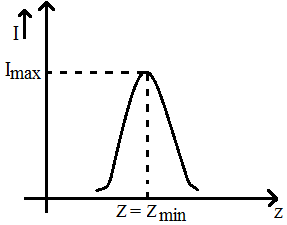
Image result for impedance vs log frequency

If the frequency of an alternating e.m.f. is f in L-C-R circuit, then the value of impedance Z decreases and when it becomes minimum, equal to the resistance then it will start increasing as log(frequency) increases:

View full question & answer
MCQ 1041 Mark
The unit of susceptance is.
  • A
    $\text{ohm}$
  • B
    $\text{ohm}^{-1}$
  • C
    $\frac{\text{ohm}}{\text{cm}}$
  • D
    $\frac{\text{ohm}}{\text{m}}$
Answer
  1. $\text{ohm}^{-1}$

Explanation:

Susceptance is the imaginary part of admittance. 

The admittance is the inverse of impedance. 

Unit of admittance is ohm. Unit of admittance is ohm-1 or siemens. 

Unit of susceptance is same as of admittance.

View full question & answer
MCQ 1051 Mark
If the values of L, C and R in a series L - C - R circuit are $100\text{mH},100\mu\text{F}$ and $100\Omega$ respectively then the value of resonant frequency will be.
  • A
    $\frac{10}{2\pi}\text{Hz}$
  • B
    $2\times10^3\text{Hz}$
  • C
    $2\times\frac{10^3}{\text{pi}}\text{Hz}$
  • D
    ${10^3}\text{Hz}$
Answer
  1. $\frac{10}{2\pi}\text{Hz}$

Explanation:

Resonant frequency $=\frac{1}{2\pi\sqrt{\text{LC}}}$

$=\frac{1}{2\pi\sqrt{10^{-6}}}$

$=\frac{10}{2\pi}\text{Hz}$

View full question & answer
MCQ 1061 Mark
If in a series L - C - R ac circuit, the voltages across L, C and R are V1​, V2​ and V3​ respectively, then the voltage of the source is always.
  • A
    equal to V1 ​+ V2 ​+ V3​
  • B
    equal to V1 ​- V2​ + V3
  • C
    more than V1 ​+ V2​ + V​3
  • D
    none of the above is true
Answer
  1. none of the above is true

Explanation:

The voltages across different elements in AC circuit add vectorially.

The voltages across inductor and capacitor are out of phase and at 90 to that across resistor.

Hence net voltage across source $=\sqrt{(\text{V}_1-\text{V}_2)+\text{V}^2_3}.$

View full question & answer
MCQ 1071 Mark
A coil of self-inductance L is connected in series with a bulb B and an AC source. Brightness of the bulb decreases when.
  • A
    Frequency of the AC source is decreased
  • B
    Number of turns in the coil is reduced
  • C
    A capacitance of reactance XC ​= XL​ is included in the same circuit
  • D
    An iron rod is inserted in the coil
Answer
  1. An iron rod is inserted in the coil

Explanation:

As the iron rod is inserted, the magnetic field inside the coil magnetizes the iron increasing the magnetic field inside it. Hence. the inductance of the coil increases. Consequently, the inductive reactance of the coil increases. As a result, a larger fraction of the applied AC voltage appears across the lnductor, leaving less voltage across the bulb.Therefore' the brightness of the light bulb decreases.

View full question & answer
MCQ 1081 Mark
A coil of $10\text{mH}$ and $10\Omega$ resistance is connected in parallel to a capacitance of $0.1\mu\text{F}$ The impedance of the.
  • A
    $10^2\Omega$
  • B
    $10^4\Omega$
  • C
    $10^6\Omega$
  • D
    $10^8\Omega$
Answer
  1. $10^4\Omega$
View full question & answer
MCQ 1091 Mark
A solenoid of length 10cm, diameter 1cm, number of turns 500 with relative permeability of the core 2000, is connected to an ac source of frequency 50 Hz. Then, the reactance is.
  • A
    $\text{Zero}$
  • B
    $55\Omega$
  • C
    $105\Omega$
  • D
    $155\Omega$
Answer
  1. $155\Omega$

Explanation:

Inductance of the solenoid $=\text{L}=\frac{\mu\text{N}^2\text{A}}{1}=0.493\text{H}$

reactance of this solenoid $=\text{L}\omega=\text{L}2\pi\text{f}=155\Omega$

View full question & answer
MCQ 1101 Mark
When the rms voltages VL​, VC​ and VR​ are measured respectively across the inductor L, the capacitor C and the resistor R in a series LCR circuit connected to an AC source, it is found that the ratio VL ​: VC ​: VR​ = 1 : 2 : 3. If the rms voltage of the AC source is 100 V, then VR​ is close to:
  • A
    50V
  • B
    70V
  • C
    90V
  • D
    100V
Answer
  1. 90V
View full question & answer
MCQ 1111 Mark
An a.c. supply of 100 volts is applied to a capacitor of capacitance 20 μ F. If the current in the circuit is 0.628 A, the frequency of a.c. must be.
  • A
    50 Hz
  • B
    60 Hz
  • C
    25 Hz
  • D
    40 Hz
Answer
  1. 50 Hz

Explanation:

$\text{Y}=100\text{V, C}=2\mu\text{F}=20\times10^{-6}$

$\text{I}=0.628\text{A,v}=?$

$\text{X}_\text{C}=\frac{\text{V}}{\text{I}}=\frac{100}{0.628}$

$\Rightarrow\frac{1}{2\pi\text{vC}}=\frac{100}{0.628}$

$\text{v}=\frac{0.628}{100\times2\pi\text{C}}$

$=50\text{ Hz}$

View full question & answer
MCQ 1121 Mark
A sinusoidal voltage $\text{V}=200\sin314\text{t}$ is applied to a $10\Omega$ resistor. Find the peak voltage.
  • A
    200V
  • B
    400V
  • C
    600V
  • D
    800V
Answer
  1. 200V

Explanation:

General sinusoidal voltage variation is given by:

$\text{V}=\text{V}_0\sin(\omega\text{t})$

Here, in this equation V0​ is peak voltage.

So, on comparing both equation we get:

$\text{V}_0=200\text{V},\omega=314$

View full question & answer
MCQ 1131 Mark
The capacitance in an oscillatory LC circuit is increased by 1%. The change in inductance required to restore its frequency of oscillation is to.
  • A
    decrease it by 0.5%
  • B
    increase it by 1%
  • C
    decrease it by 1%
  • D
    decrease it by 2%
Answer
  1. decrease it by 1%
View full question & answer
MCQ 1141 Mark
The peak voltage in a 220V AC source is:
  • A
    220V.
  • B
    About 160V.
  • C
    About 310V.
  • D
    440V.
Answer
  1. About 310V.

Explanation:

$\text{V}_\text{rms}=220\text{V}$

$\text{V}_\text{p}=\sqrt{2}\times\text{V}_\text{rms}$

$=220\times1.414=311\text{volt}$

View full question & answer
MCQ 1151 Mark
An amplitude modulated (AM) radio operates at 550kHz to 1650kHz. If L is fixed and C is varied for tuning then minimum and maximum value of C is.
  • A
    C, 3C
  • B
    C, 6C
  • C
    C, 9C
  • D
    C, 12C
Answer
  1. C, 9C

Explanation:

$\frac{\text{f}_\text{max}}{\text{f}_\text{max}}=3$

$\therefore\frac{\sqrt{\text{LC}_\text{max}}}{\sqrt{\text{LC}_\text{min}}}=3$

$\frac{\text{C}_\text{max}}{\text{C}_\text{min}}=9$

${\text{C}_\text{min}}=\text{C}$

$\therefore{\text{C}_\text{max}}=\text{9C}$

View full question & answer
MCQ 1161 Mark
When the frequency of the source voltage decreases, the impedance of a parallel RC circuit.
  • A
    increases
  • B
    decreases
  • C
    does not change
  • D
    decreases to zero
Answer
  1. increases

Explanation:

When the frequency of the source voltage decreases, the impedance of a parallel RC circuit will increase.

View full question & answer
MCQ 1171 Mark
As the frequency of an ac circuit increases, the current first increases and then decreases. What combination of circuit elements is most likely to comprise the circuit?
  • A
    Inductor and capacitor.
  • B
    Resistor and inductor.
  • C
    Resistor and capacitor.
  • D
    Resistor, inductor and capacitor.
Answer
  1. Inductor and capacitor.
  1. Resistor, inductor and capacitor.

Solution:

Compare the given circuit by predicting the variation in their reactances with frequency. So, that then we can decide the elements.

Reactance of an inductor of inductance L is $\text{X}_\text{L}=2\pi\text{vL}$, where v is the frequency of the AC circuit.

Xc = Reactance of the capacitive circuit

$=\frac{1}{2\pi\text{fC}}$

With an increase in frequency in (f) of an AC circuit, R remains constant, inductive reactance (XL) increases and capacitive reactance (XC) decreases. For an L-C-R circuit,

Z- Impedance of the circuit,

$=\sqrt{\text{R}^2+(\text{X}_\text{L}-\text{X}_\text{C})^2}$

$=\sqrt{\text{R}^2+\bigg(2\pi\text{vL}-\frac{1}{2\pi\text{vC}}\bigg)^2}$

As frequency (v) increases, Z decreases and at certain value of the frequency known as resonant frequency (v0), impedance Z is minimum that is Zmin = R current varies inversely with impedance and at Zmin current is maximum.

View full question & answer
MCQ 1181 Mark
The angular frequency of an AC source is $\frac{10\text{radian}}{\text{sec}}$ The reactance of $1\mu\text{F}$ capacitor will be.
  • A
    $10^4\Omega$
  • B
    $10^2\Omega$
  • C
    $10^1\Omega$
  • D
    $10^5\Omega$
Answer
  1. $10^5\Omega$

Explanation:

$\text{Reactance}=\frac{1}{\text{C}\omega}\Omega$

$=\frac{1}{10^{-6}\times10}=\frac{1}{10^{-5}}$

$=10^5\Omega$

View full question & answer
MCQ 1191 Mark
In an A.C. circuit the potential difference across an inductance and resistance joined in series are respectively 16V and 20V. The total potential difference across the circuit is.
  • A
    20.0V
  • B
    25.6V
  • C
    31.9V
  • D
    53.5V
Answer
  1. 25.6V

Explanation:

Potential difference across the circuit

$\text{V}=\sqrt{\text{V}^2_\text{R}+\text{V}^2_\text{L}}=\sqrt{20^2+16^2}=\sqrt{656}=25.6\text{V}$

View full question & answer
MCQ 1201 Mark
Transformers are used:
  • A
    In DC circuits only.
  • B
    In AC circuits only.
  • C
    In both DC and AC circuits.
  • D
    Neither in DC nor in AC circuits.
Answer
  1. In AC circuits only.

Explanation:

Transformers are used in AC circuits only.

View full question & answer
MCQ 1211 Mark
In a series RLC circuit that is operating above the resonant frequency, the current.
  • A
    lags the applied voltage
  • B
    leads the applied voltage
  • C
    is in phase with the applied voltage
  • D
    is zero
Answer
  1. lags the applied voltage

Explanation:

Capacitive reactance is given by. $\text{X}_\text{C}=\frac{1}{\text{wC}}$

Inductive reactance is given by $\text{X}_\text{L}={\text{wL}}$

At resonance, $\text{X}_\text{L}={\text{X}_\text{C}}\Rightarrow \text{w}\text{L}=\frac{1}{\text{wC}}$

But a frequency higher than resonance frequency, XL​ > XC

So the circuit behaves as a inductive circuit at a frequency higher that resonant frequency and the current lags behind the voltage in an inductive circuit.

View full question & answer
MCQ 1221 Mark
In a pure capacitive A.C circuit current and voltage differ in phase by.
  • A
  • B
    45°
  • C
    90°
  • D
    180°
Answer
  1. 90°

Explanation:

$\text{i}=\text{i}_\text{o}\sin(\omega\text{t}+\frac{\pi}{2})$

current leads voltage by $\frac{\pi}{2}$ i.e., current and voltage differ in phase by 90°

View full question & answer
MCQ 1231 Mark
An AC source rated 100V (rms) supplies a current of 10A (rms) to a circuit. The average power delivered by the source:
  • A
    Must be 1000W.
  • B
    May be 1000W.
  • C
    May be greater than 1000W.
  • D
    May be less than 1000W.
Answer
  1. May be 1000W.
  1. May be less than 1000W.

Explanation:

Average power $\text{P}_\text{av}=\text{V}_\text{rms}\text{I}_\text{rms}\cos\phi$

$=100\times10\cos\phi$

$\text{P}_\text{av}=1000\cos\phi$

$\therefore\ \cos\phi$ lies "0 to 1".

$\Rightarrow\ 0\leq\text{P}_\text{av}\leq1000.$

View full question & answer
MCQ 1241 Mark
Voltage across each elements of a series LCR circuit are given by VL​ = 60V, VC ​= 20V, VR ​= 30V Find out source voltage.
  • A
    50V
  • B
    100V
  • C
    150V
  • D
    200V
Answer
  1. 50V

Explanation:

$\text{V}=\sqrt{\text{V}_\text{R}^2+(\text{V}_\text{L}-\text{V}_\text{C})^2}=\sqrt{30^2+(60-20)^2}=50\text{V}$

View full question & answer
MCQ 1251 Mark
The power loss is less in transmission lines, when:
  • A
    Voltage is less but current is more
  • B
    Both voltage and current are more
  • C
    Voltage is more but current is less
  • D
    Both voltage and current are less
Answer
  1. Voltage is more but current is less

Explanation:

The power cables have some resistance. 

Power lost in the wires can be calculated as P = I2R with R as the resistance of the wires and I as the current that passes through them.

Power at the load is P = VI. 

From this one can see that if voltage is increased by say n times, then only $\frac{1}{\text{n}}$​ the current is required to deliver the same power. However, if $\frac{1}{\text{n}}$​ current is passed

on the same wires, only $\frac{1}{\text{n}^2}$ of the power will be lost.

View full question & answer
MCQ 1261 Mark
The reactance of a circuit is zero. It is possible that the circuit contains:
  • A
    An inductor and a capacitor.
  • B
    An inductor but no capacitor.
  • C
    A capacitor but no inductor.
  • D
    Neither an inductor nor a capacitor.
Answer
  1. An inductor and a capacitor.

Explanation:

$\text{X}=0$ (Given)

$\text{X}=\text{X}_\text{L}+\text{X}_\text{C}$

$=\omega\text{L}-\frac{1}{\omega\text{C}}=0$

It is possible that the circuit contains an inductor and a capacitor.

View full question & answer
MCQ 1271 Mark
An inductor, a resistance and a capacitor are joined in series with an AC source. As the frequency of the source is slightly increased from a very low value, the reactance:
  • A
    Of the inductor increases.
  • B
    Of the resistor increases.
  • C
    Of the capacitor increases.
  • D
    Of the circuit increases.
Answer
  1. Of the inductor increases.

Explanation:

$\text{X}_\text{L}=\omega\text{L}$

$\text{X}_\text{C}=\frac{1}{\omega\text{C}}$

If frequency increases that causes 'XL' raction of inductor increases and 'XC' reactance of capacitor decreses.

View full question & answer
MCQ 1281 Mark
A capacitor is connected to an A.C. circuit, then the phase difference between current and the voltage is:
  • A
    $\pi$
  • B
    $\frac{\pi}{2}$
  • C
    $\frac{-\pi}{2}$
  • D
    $\text{Zero}$
Answer
  1. $\frac{\pi}{2}$

Explanation:

Current leads voltage by $\frac{\pi}{2}$

$\therefore$ phase difference is $=\frac{\pi}{2}$

View full question & answer
MCQ 1291 Mark
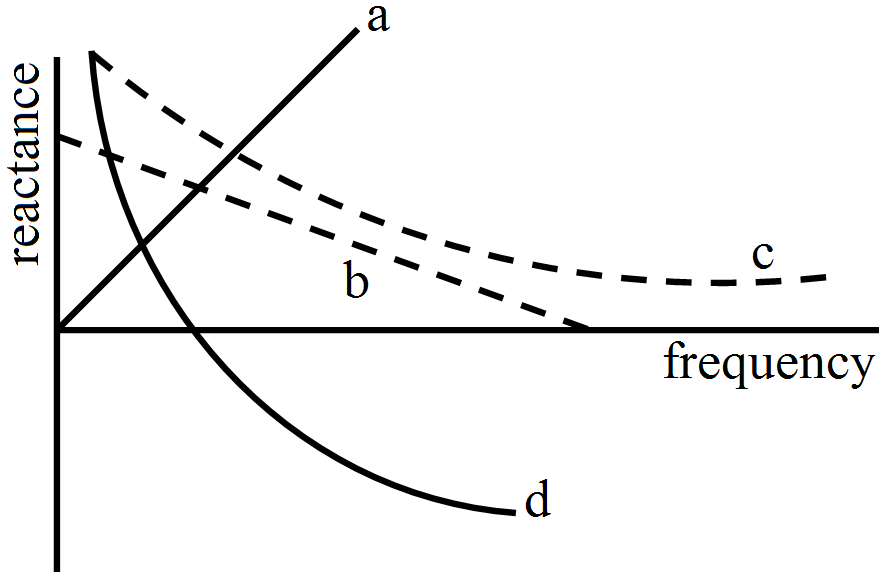
Which of the following plots may represent the reactance of a series LC combination?

  • A
    A
  • B
    B
  • C
    C
  • D
    D
Answer
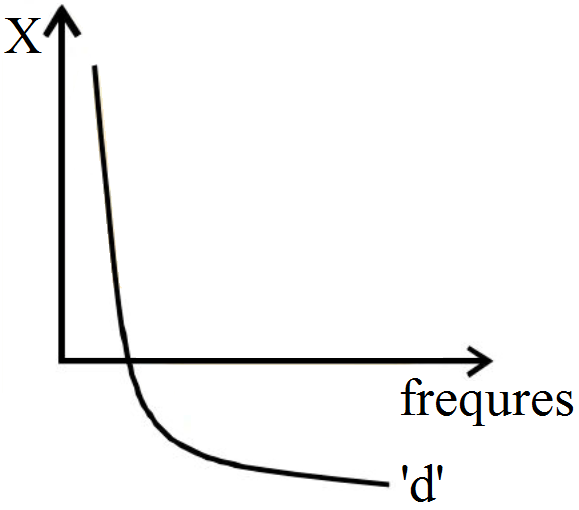
  1. (d)

Explanation:

$\text{X}=\text{X}_\text{L}-\text{X}_\text{C}$

$=\omega\text{L}-\frac{1}{\omega\text{C}}$

$=2\pi\text{fL}-\frac{1}{2\pi\text{fC}}$

View full question & answer
MCQ 1301 Mark
A light bulb is rated at 100W for a 220V supply. Find the peak voltage of the source:
  • A
    111V
  • B
    211V
  • C
    311V
  • D
    411V
Answer
  1. 311V

Explanation:

The rated voltage in bulb is rms voltage.

$\text{V}_\text{rms}=\frac{\text{V}_0}{\sqrt{2}}$

$\text{V}_0=\sqrt{2}\times220=311.08\text{V}$

View full question & answer
MCQ 1311 Mark
In a series LCR circuit the voltage across resistance, capacitance and inductance is 10V each. If the capacitance is short circuited, the voltage across the inductance will be.
  • A
    $10\text{V}$
  • B
    $\big(\frac{10}{\sqrt{2\text{V}}}\big)$
  • C
    $\big(\frac{10}{\sqrt{3\text{V}}}\big)$
  • D
    $30\text{V}$
Answer
  1. $\big(\frac{10}{\sqrt{2\text{V}}}\big)$
View full question & answer
MCQ 1321 Mark
An inductor, a resistor and a capacitor are joined in series with an AC source. As the frequency of the source is slightly increased from a very low value, the reactance of the.
  • A
    inductor increases
  • B
    resistor increases
  • C
    capacitor increases
  • D
    circuit increases
Answer
  1. inductor increases
View full question & answer
MCQ 1331 Mark
An inductance of 0.2 H and a resistance of $100\Omega$ are connected in series to an A.C. 180 V, 50 Hz supply. The apparent current flowing in the circuit will be.
  • A
    0.525 A
  • B
    5.25 A
  • C
    1.525 A
  • D
    15.25 A
Answer
  1. 1.525 A
View full question & answer
MCQ 1341 Mark
An alternating current having peak value 14A is used to heat a metal wire. To produce the same heating effect, a constant current i can be used where i is:
  • A
    14A
  • B
    About 20A.
  • C
    7A.
  • D
    About 10A.
Answer
  1. About 10A.

Explanation:

$\text{I}_\text{p}=14\text{Amp}$

$\text{I}_\text{rms}=\frac{\text{IP}}{\sqrt{2}}=\frac{14}{\sqrt{2}}$

$=9.9=10\text{Amp}.$

View full question & answer
MCQ 1351 Mark
Of the following about capacitive reactance which is correct?
  • A
    The reactance of the capacitor is directly proportional to its ability to store charge
  • B
    Capacitive reactance is inversely proportional to the frequency of the current
  • C
    Capacitive reactance is measured in farad
  • D
    The reactance of a capacitor in an AC circuit is similar to the resistance of a capacitor in a DC circuit
Answer
  1. Capacitive reactance is inversely proportional to the frequency of the current

Explanation:

Capacitative reactance is an opposition to the change of voltage across an element.

It is denoted by XC​ and is inversely proportional to the signal frequency (f) and the capacitance C

$\text{X}_\text{c}=\frac{1}{2\pi\text{fc}}$

View full question & answer
MCQ 1361 Mark
A current source sends a current $\text{I}-\text{i}_0\cos(\omega\text{t}).$ when connected across an unknown load, it gives a voltage output of $\text{v}=\text{v}_0\sin[\omega\text{t}+(\frac{\pi}{4})]$across that load. then the voltage across the current source may be brought in phase with the current through it by.
  • A
    Connecting an inductor in series with the load
  • B
    Connecting a capacitor in series with the load
  • C
    Connecting an inductor in parallel with the load
  • D
    Connecting a capacitor in parallel with the load
Answer
  1. Connecting an inductor in series with the load
View full question & answer
MCQ 1371 Mark
In an LCR circuit inductance is changed from L to $\frac{\text{L}}{2}.$ To keep the same resonance frequency, C should be changed to.
  • A
    $2\text{C}$
  • B
    $\frac{\text{C}}{2}$
  • C
    $4\text{C}$
  • D
    $\frac{\text{C}}{4}$
Answer
  1. $2\text{C}$

Explanation:

Resonance frequency, $(\text{f})=\frac{1}{2\pi\sqrt{\text{LC}}}$

For f to be constant the product LC must be constant.

So, if we half the value of inductance then the value of capacitance must be doubled.

C should be changed to 2C.

View full question & answer
MCQ 1381 Mark
The inductance of a resistanceless coil is 0.5 henry. In the coil, the value of alternating current is 0.2 A, whose frequency is 50 Hz. The reactance of circuit is.
  • A
    $15.7\Omega$
  • B
    $157\Omega$
  • C
    $1.57\Omega$
  • D
    $757\Omega$
Answer
  1. $157\Omega$

Explanation:

$\text{Reactance }=\omega\text{L}$

$=2\pi\text{fL}$

$=2\pi\times50\times0.5$

$157\Omega$

View full question & answer
MCQ 1391 Mark
Reciprocal of Impedance is:
  • A
    Susceptance
  • B
    Conductance
  • C
    Admittance
  • D
    Transconductance
Answer
  1. Admittance

Explanation:

Impedance is the opposition a circuit presents to a current when a voltage is applied.

Admittance is a measure of how easily a circuit or device will allow a current to flow.

Admittance is defined as $\text{Y}=\frac{1}{\text{Z}}$

where Z is the impedance of the circuit.

View full question & answer
MCQ 1401 Mark
In an A.C. circuit, the current flowing in inductance is $\text{I}=5\sin\Big(\frac{100-\text{t}-\pi}{2}\Big)$ ampers and the potential difference is $\text{V}=200\sin(100\text{t})$ volts. The power consumption is equal to.
  • A
    1000 watt
  • B
    40 watt
  • C
    20 watt
  • D
    Zero
Answer
  1. Zero

Explanation:

Power, $\text{P}=\text{I}_\text{rms}\times\text{V}_\text{rms}\times\cos\phi$

In the given problem, the phase difference between voltage and current is $\frac{\text{P}}{2}$ Hence

$\text{P}=\text{I}_\text{rms}\times\text{V}_\text{rms}\times\cos\big(\frac{\pi}{2}\big)=0$

View full question & answer
MCQ 1411 Mark
In alternating current.
  • A
    The direction of current is always positive
  • B
    The direction of current is always negative
  • C
    The direction of current changes constantly
  • D
    The direction of current is either positive or negative
Answer
  1. The direction of current changes constantly

Explanation:

Electric charge in alternating current (AC) changes direction periodically. The voltage in AC circuits also periodically reverses because the current changes direction.

View full question & answer
MCQ 1421 Mark
In series L - C - R circuit voltage drop across resistance is 8V, across inductor is 6V and across capacitor is 12V. Then.
  • A
    Voltage of the source will be leading in the circuit.
  • B
    Voltage drop across each element will be less than the applied voltage.
  • C
    Power factor of the circuit will be $\frac{3}{4}$
  • D
    None of the above.
Answer
  1. None of the above.

Explanation:

$\text{V}=\sqrt{\text{V}_\text{R}^2+(\text{V}_\text{C}-\text{V}_\text{L})^2}=10\text{V}$

VC​ > VL​, hence current leads the voltage.

Power factor $=\cos\phi=\frac{8}{10}=0.8$

View full question & answer
MCQ 1431 Mark
In series L - C - R resonant circuit, to increase the resonant frequency:
  • A
    L will have to be increased
  • B
    C will have to be increased
  • C
    LC will have to be decreased
  • D
    LC will have to be increased
Answer
  1. LC will have to be decreased

Explanation:

$\text{Resonant frequency}=\frac{1}{\sqrt{\text{LC}}}$

$\text{LC}\downarrow\text{if }\omega_\text{r}\uparrow$

View full question & answer
MCQ 1441 Mark
In a L - C - R circuit, as the frequency of an alternating current increases the impedance of the circuit.
  • A
    increases continuously.
  • B
    decreases continuously.
  • C
    remains constant.
  • D
    None of these.
Answer
  1. None of these.

Explanation:

Impedance first decreases then increases. At resonance frequency Z is minimum.

View full question & answer
MCQ 1451 Mark
A series LCR circuit is tuned to resonance. If the angular frequency of the applied AC voltage at resonance is $\omega$ the impedance of the circuit then is:
  • A
    $\text{R}+\omega\text{L}+(\frac{1}{\omega\text{C}})$
  • B
    $\text{R}$
  • C
    $\sqrt{\text{R}^2+\omega\text{L}+(\frac{1}{\omega\text{C}})^2}$
  • D
    $\sqrt{\text{R}^2+(\omega\text{L}-\frac{1}{\omega\text{C}})^2}$
Answer
  1. $\text{R}$

Explanation:

At resonance $\frac{1}{\omega\text{C}}=\omega\text{L}$

$\therefore$ impedance = R

View full question & answer
MCQ 1461 Mark
A capacitor has capacitance 0.5nF. A choke of $5\mu\text{H}$ is connected in series. An electromagnetic wave of wavelength $\lambda$ is found to resonate with it. Find $\lambda$ (in meter).
  • A
    $10\pi$
  • B
    $20\pi$
  • C
    $30\pi$
  • D
    $5\pi$
Answer
  1. $30\pi$
View full question & answer
MCQ 1471 Mark
If the inductance and capacitance are both doubled in L - C - R circuit, the resonant frequency of the circuit will:
  • A
    Decrease to one-half of the original value
  • B
    Decrease to one-fourth of the original value
  • C
    Increase to twice the original value
  • D
    Decrease to twice the original value
Answer
  1. Decrease to one-half of the original value

Explanation:

Resonant frequency in series LCR circuit: $\omega=\sqrt{\frac{1}{\text{LC}}}$

Resonant frequency in series LCR circuit, $\omega=\sqrt{\frac{1}{\text{LC}}}=\sqrt{\frac{1}{\text{2L}\times\text{2C}}}=\frac{\omega}{2}$

View full question & answer
MCQ 1481 Mark
In a purely inductive circuit, the current:
  • A
    is in phase with the voltage
  • B
    is out of phase with the voltage
  • C
    leads the voltage by $\frac{\pi}{2}$
  • D
    lags behind the voltage by $\frac{\pi}{2}$
Answer
  1. lags behind the voltage by $\frac{\pi}{2}$

Explanation:

In a purely inductive circuit (an AC circuit containing inductance only) the current lags behind the voltage by $\frac{\pi}{2}$

View full question & answer
MCQ 1491 Mark
A capacitor acts as an infinite resistance for:
  • A
    DC.
  • B
    AC.
  • C
    DC as well as AC.
  • D
    Neither AC nor DC.
Answer
  1. DC.

Explanation:

$\text{X}_\text{C}\frac{1}{\omega\text{C}}=\frac{1}{0\times\text{C}}$ $\bigg\{\text{in}\stackrel{{\text{DC}}}{{\omega = 0 }}\bigg\}$

$=\infty$

View full question & answer
MCQ 1501 Mark
The power loss in an AC circuit is Erms​ Irms​, when in the circuit there is only.
  • A
    C
  • B
    L
  • C
    R
  • D
    L, C, and R
Answer
  1. R

Explanation:

Inductors and capacitors bring a phase difference between the voltage and current in the circuit, hence changing the p.f. When only a resistance is present, Poer factor = 1.
The power loss in an AC circuit = Erms ​Irms ​Power factor.

View full question & answer