Questions · Page 4 of 4

M.C.Q (1 Marks)

MCQ 1511 Mark
A series R-C circuit is connected to an alternating voltage source. Consider two situation:
(a) When capacitor is filled
(b) When capacitor is mica filled
Current through resister is i and voltage across capacitor is V then:
  • A
    Va​ = Vb
  • B
    Va​ < Vb
  • C
    Va​ > Vb​
  • D
    ia​ = ib​
Answer
  1. Va​ > Vb​

Explanation:

For series C - R circuit, the impedance $\text{Z}=\sqrt{\text{R}^2+\text{X}^2_\text{C}}$ where $\text{X}_\text{C}=\frac{\text{i}}{\omega\text{C}}$ and current $\text{I}=\frac{\text{V}}{\text{Z}}$

When the capacitor is filled by mica, the capacitance will be increased. If C increases, XC​ decreases, so the current will increase and 

hence voltage across resistance increases and voltage across capacitor decreases. thus, Va​ > Vb​

View full question & answer
MCQ 1521 Mark
For a series LCR circuit the power loss at resonance is : -
  • A
    $\frac{\text{V}^2}{\Big[\omega\text{L}-\frac{1}{\omega\text{C}}\Big]}$
  • B
    $\text{I}^2\text{L}\omega$
  • C
    $\text{I}^2\text{R}$
  • D
    $\frac{\text{V}^2}{\text{C}\omega}$
Answer
  1. $\text{I}^2\text{R}$
View full question & answer
MCQ 1531 Mark
In an ideal parallel LC circuit, the capacitor is charged by connecting it to a D.C. source which is then disconnected. The current in the circuit.
  • A
    Becomes zero instantaneously
  • B
    Grows monotonically
  • C
    Decays monotonically
  • D
    Oscillates instantaneously
Answer
  1. Oscillates instantaneously

Explanation:

In an LC circuit current oscillates between, maximum and minimum value. So, LC circuit needs oscillations (electrical). It occurs due to discharging and charging of capacitor and magnetisation and demagnetisation of inductor

View full question & answer
MCQ 1541 Mark
The resonant frequency of an L - C circuit is.
  • A
    $\frac{1}{2\pi\sqrt{\text{LC}}}$
  • B
    $\frac{1}{2\pi}\sqrt\frac{\text{L}}{\text{C}}$
  • C
    $\frac{1}{4\pi}\sqrt\frac{\text{L}}{\text{C}}$
  • D
    $\frac{1}{2\pi}\sqrt\frac{\text{C}}{\text{L}}$
Answer
  1. $\frac{1}{2\pi\sqrt{\text{LC}}}$

Explanation:

Resonance frequency f of an L - C circuit can be written as

Resonance frequency $\text{f}=\frac{1}{2\pi\sqrt{\text{LC}}}$ where L = inductance and C is capacitance.

View full question & answer
MCQ 1551 Mark
In an LCR circuit, capacitance is changed from C to 2C. For the resonant frequency to remain unchanged, the inductance should be changed from L to:
  • A
    4L
  • B
    2L
  • C
    $\frac{\text{L}}{2}$
  • D
    $\frac{\text{L}}{4}$
Answer
  1. $\frac{\text{L}}{2}$

Explanation:

Resonant frequency, $\text{f}_\text{r}=\frac{1}{2\pi\sqrt{\text{LC}}}$

As the frequency is unchanged so fr ​= fr′​

LC = L′C ′= L′(2C)

$\text{L}=\frac{\text{L}}{2}$

View full question & answer
MCQ 1561 Mark
Alternating current is flowing in inductance L and resistance R. The frequency of source is $\frac{\omega}{2\pi}$ Which of the following statement in correct:
  • A
    For low frequency the limiting value of impedance is L.
  • B
    For high frequency the limiting value of impedance is $\omega\text{L}.$.
  • C
    For high frequency the limiting value of impedance is R.
  • D
    For low frequency the limiting value of impedance is $\omega\text{L}.$
Answer
  1. For low frequency the limiting value of impedance is L.
View full question & answer
MCQ 1571 Mark
When an AC voltage of 220V is applied to the capacitor C:
  • A
    The maximum voltage between plates is 220V.
  • B
    The current is in phase with the applied voltage.
  • C
    The charge on the plates is in phase with the applied voltage.
  • D
    Power delivered to the capacitor is zero.
Answer
  1. The charge on the plates is in phase with the applied voltage.
  2. Power delivered to the capacitor is zero.

Solution:

If the alternating voltage is applied to the capacitor, the plate connected to the positive terminal of the source will be at higher potential and the plate connected to the negative terminal of source will be at lower potential. So the plates capacitor is charged.

If $\text{V}=\text{V}_0\sin\omega\text{t},\text{Q}=\text{C V}_0\sin\omega\text{t}$ or we can say that Q and emf are in pahse.

As $\text{P}=\text{V}_\text{rms}\text{I}_\text{rms}\cos\phi$ and in case of a capacitor, $\phi=\frac{\pi}{2}\text{P} = 0,$ or we can say that power delivered to the capacitor is zero.

⇒ Pav = power delivered = 0.

View full question & answer
MCQ 1581 Mark
The simplest type of AC voltage or current is the one which.
  • A
    Varies exponentially
  • B
    Varies sinusoidally
  • C
    Varies linearly
  • D
    Does not vary uniformly
Answer
  1. Varies sinusoidally

Explanation:

AC voltage or current can be of any form, but the simplest type is a sine wave because any periodic wave can be represented as a combination of sine waves.

View full question & answer
MCQ 1591 Mark
'Z' is not.
  • A
    Atomic number
  • B
    Impedance
  • C
    Zeta potential
  • D
    Partition function
Answer
  1. Partition function

Explanation:

Z- Atomic number we study in modern physics

Z- impedance we study in alternating current 

Z-zeta potential

View full question & answer
MCQ 1601 Mark
An alternating current is given by $\text{i}=\text{i}_1\cos\omega\text{t}+\text{i}_2\sin\omega\text{t}.$ The rms current is given by:
  • A
    $\frac{\text{i}_1+\text{i}_2}{\sqrt{2}}$
  • B
    $\frac{|\text{i}_1+\text{i}_2|}{\sqrt{2}}$
  • C
    $\sqrt{\frac{\text{i}_1^2+\text{i}_2^2}{2}}$
  • D
    $\sqrt{\frac{\text{i}_1^2+\text{i}_2^2}{\sqrt{2}}}$
Answer
  1. $\sqrt{\frac{\text{i}_1^2+\text{i}_2^2}{2}}$

Explanation:

$\text{i}=\text{i}_1\cos\omega\text{t}+\text{i}_2\sin\omega\text{t}$

$\text{I}_\text{rms}=\frac{\int\limits_0^\text{T}\text{I}^2\text{dt}}{\int\limits_0^\text{T}\text{dt}}$

if $\text{I}=\cos\omega\text{t}$

$\text{I}_\text{rms}^2=\frac{\text{I}_0^2}{2}$

$\text{i}=\text{i}_1\cos\omega\text{t}+\text{i}_2\sin\omega\text{t}$

Than $\text{i}_\text{rms}^2=\frac{\text{i}_1^2}{2}+\frac{\text{i}_2^2}{2}$

$\text{i}_\text{rms}=\sqrt{\frac{\text{i}_1^2+\text{i}_2^2}{2}}$

View full question & answer
MCQ 1611 Mark
In a circuit, the current lags behind the voltage by a phase difference of $\frac{\pi}{2}$ the circuit will contain which of the following: 
  • A
    Only R
  • B
    Only C
  • C
    R and C
  • D
    Only L
Answer
  1. Only L

Explanation:

In an inductor, current lags behind the input voltage by a phase difference of $\frac{\pi}{2}$.

Current and voltage are in same phase in resistor whereas current leads the voltage by $\frac{\pi}{2}$in a capacitor.

So, the circuit must contain an inductor only.

View full question & answer
MCQ 1621 Mark
Choose the wrong statement of the following:
  • A
    The peak voltage across the inductor can be less than the peak voltage of the source in an LCR circuit
  • B
    In a circuit containing and a capacitor and an ac source the current is zero at the instant source voltage is maximum
  • C
    When an AC source is connected to a capacitor, then the rms current in the circuit gets increased if a dielectric slab is inserted into the capacitor
  • D
    In a pure inductive circuit emf will be in phase with the current
Answer
  1. In a pure inductive circuit emf will be in phase with the current

Explanation:

In pure inductive circuit, 

voltage leads by $\frac{\pi}{2}$ 

View full question & answer
MCQ 1631 Mark
A coil of negligible resistance is connected in series with a $90\Omega$ resistor across a 120 V, 60 Hz line. An ac voltmeter reads 90 V across the resistance, then the inductance of the coil is approximately.
  • A
    0.2 H
  • B
    0.3 H
  • C
    0.4 H
  • D
    0.7 H
Answer
  1. 0.2 H
View full question & answer
MCQ 1641 Mark
Capacitance (C) of the capacitor is.
  • A
    $10\mu\text{F}$
  • B
    $15\mu\text{F}$
  • C
    $20\mu\text{F}$
  • D
    $\text{None of these}$
Answer
  1. $20\mu\text{F}$
View full question & answer
MCQ 1651 Mark
The output of a step-down transformer is measured to be 24V when connected to a 12 watt light bulb. The value of the peak current is:
  • A
    $\frac{1}{\sqrt{2}}\text{A}.$
  • B
    $\sqrt{2}\text{A}.$
  • C
    $2\text{A}.$
  • D
    $2\sqrt{2}\text{A}.$
Answer
  1. $\frac{1}{\sqrt{2}}\text{A}.$

Solution:

Key concept: It decreases voltage and increases current

VS < VP

NS > NP

ES < EP

iS > iP

RS < RP

tS > tP

k < l

According to the problem output/secondary voltage VS = 24V

Power associated with secondary PS = 12W

$\text{I}_\text{S}=\frac{\text{P}_\text{S}}{\text{V}_\text{S}}=\frac{12}{24}=0.5\text{A}$

Amplitude of the current in the secondary winding

$\text{I}_0=\text{I}_\text{S}\sqrt{2}$

$=(0.5)(1.414)=0.707=\frac{1}{\sqrt{2}}\text{A}$

View full question & answer
MCQ 1661 Mark
In an L - C - R circuit the value of XL​, XC​ and R are $300\Omega,200\Omega$, and $100\Omega$ respectively. The total impedance of the circuit will be.
  • A
    $600\Omega$
  • B
    $200\Omega$
  • C
    $141\Omega$
  • D
    $310\Omega$
Answer
  1. $141\Omega$

Explanation:

Total impedance = R + j(XL​ - XC​)

$=100+\text{j}100$

$=100\sqrt{2}\measuredangle45$

$=141\measuredangle45$

View full question & answer
MCQ 1671 Mark
In LCR series AC circuit.
  • A
    If R is increased current will decrease.
  • B
    If L is increased current will decrease.
  • C
    If C is increased current will increase.
  • D
    If C is increased current will decrease.
Answer
  1. If R is increased current will decrease.

Explanation:

$\text{I}=\frac{\text{V}}{\text{Z}}=\frac{\text{V}}{\sqrt{\text{R}^2\Big(\omega\text{L }\sim}\frac{1}{\omega\text{C}}\Big)^2}$

By increasing R, current will definitely decrease by change in L or C, current may increase or decrease.

View full question & answer
MCQ 1681 Mark
An alternating voltage$\text{V}=200\sqrt{2}\sin100\text{t},$ Where V is in volt and t is in seconds, is connected to a series combination of $1\mu\text{F}$ capacitor and $10\text{k}\Omega$ resistor through an AC ammeter. The reading of the ammeter will be_____.
  • A
    $\sqrt{\text{2}}\text{mA}$
  • B
    $10\sqrt{\text{2}}\text{mA}$
  • C
    $\text{2}\text{mA}$
  • D
    $\text{20}\text{mA}$
Answer
  1. $10\sqrt{\text{2}}\text{mA}$

Explanation:

$\text{i}=\frac{\text{V}_\text{rms}}{\sqrt{\text{R}^2+\Big(\frac{1}{\omega\text{C}}-\omega\text{L}\Big)^2}}$

$\Rightarrow\text{i}=\frac{200\sqrt{2}\frac{1}{\sqrt{2}}}{\sqrt{10000^2+\Big(\frac{1}{100\times10^{-6}}-100\times0\Big)^2}}=\frac{200}{\sqrt{2\times10000^2}}$

$10\sqrt{\text{2}}\text{mA}$

View full question & answer
MCQ 1691 Mark
The reactance of a circuit is zero. It is possible that the circuit contains.
  • A
    an inductor and a capacitor
  • B
    an inductor but no capacitor
  • C
    a capacitor but no inductor
  • D
    neither an inductor nor a capacitor
Answer
  1. neither an inductor nor a capacitor

Explanation:

Answer: A an inductor and a capacitor, B neither an inductor nor a capacitor
Reactance in electrical and electronic systems is the opposition of a circuit element to a change of electric current or voltage.Ideally a resistor has zero reactance.
Therefore in a circuit, reactance can be zero either if there are no inductors and capacitors in the circuit, or the individual reactance of inductors and capacitors cancel each other, making net reactance zero.

View full question & answer
MCQ 1701 Mark
The capacitor offers zero resistance to.
  • A
    D.C. only
  • B
    A.C. & D.C.
  • C
    A.C. only
  • D
    neither A.C. nor D.C.
Answer
  1. A.C. only

Explanation:

Capacitive reactance is given as $\text{X}_\text{C}=\frac{1}{\omega\text{C}}$

From this relation we can see that the value of capacitive reactance and therefore its overall impedance (in Ohms) decreases to zero as the frequency increases acting like a short

circuit. Likewise, as the frequency approaches zero or DC, the capacitors reactance increases to infinity, acting like an open circuit which is why capacitors block DC.

View full question & answer
MCQ 1711 Mark
An alternating voltage $\text{E}=50\sqrt{2}\sin(100\text{t})$ V is connected to a $1\mu\text{F}$ capacitor through an ac ammeter. What will be the reading of the ammeter?
  • A
    $10\text{mA}$
  • B
    $5\text{mA}$
  • C
    $5\sqrt{2}\text{mA}$
  • D
    $10\sqrt{2}\text{mA}$
Answer
  1. $5\text{mA}$

Explanation:

$\text{X}_\text{C}=\frac{1}{\text{C}\omega}=10000\Omega$

ammeater reading $=\text{I}_\text{rms}=\frac{\text{V}_\text{rms}}{\mid\text{jX}_\text{c}\mid}=\frac{50}{10000}=5\text{mA}$

View full question & answer
MCQ 1721 Mark
The capacitive reactance in an AC circuit is.
  • A
    effective resistance due to capacity
  • B
    effective wattage
  • C
    effective voltage
  • D
    None of these
Answer
  1. effective resistance due to capacity

Explanation:

Capacitive reactance in an A.C circuit is: $\text{X}_\text{C}=\frac{1}{\omega\text{C}}\text{ohm}$

where, C is the capacitance of capacitor and $\omega=2\pi\text{rn}$ (n is the frequency of A.C source)

View full question & answer
MCQ 1731 Mark
To convert mechanical energy into electrical energy, one can use:
  • A
    DC dynamo.
  • B
    AC dynamo.
  • C
    Motor.
  • D
    Transformer.
Answer
  1. DC dynamo.
  2. AC dynamo.

Explanation:

DC dynamo or AC dynamo use to convert mechnical energy into electrial energy.

View full question & answer
MCQ 1741 Mark
In an LCR series a.c. circuit, the voltage across each of the components. L, C and R is 50V. The voltage across the LC combination will be:
  • A
    50V
  • B
    $50\sqrt{2}\text{v}$
  • C
    100V
  • D
    0V (zero)
Answer
  1. 0V (zero)

Explanation:

In a series LCR circuit, the voltage across the inductor (L) and the capacitor (C) are in opposite phase. 

So the voltage across LC combination will be (50 - 50) = 0V

View full question & answer
MCQ 1751 Mark
In a RLC circuit capacitance is changed from C to 2C. For the resonant frequency to remain unchanged, the inductance should be changed from L to.
  • A
    $4\text{L}$
  • B
    $2\text{L}$
  • C
    $\frac{\text{L}}{2}$
  • D
    $\frac{\text{L}}{4}$
Answer
  1. $\frac{\text{L}}{2}$

Explanation:

$\text{f}=\frac{1}{2\pi\sqrt{(\text{LC})}}$

when C is doubled, L should be halved so that resonant frequency remains unchanged.

View full question & answer
MCQ 1761 Mark
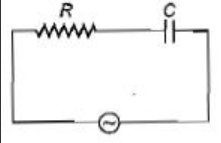
A 50 Hz, 20 V AC source is connected across R series circuit as shown in Figure If the voltage across R is 12V then voltage across capacitor is.
Image
  • A
    8 V
  • B
    16 V
  • C
    10 V
  • D
    cannot be predicted as values of R and C are not given.
Answer
  1. 16 V

Explanation:

$\text{V}^2={\text{V}^2_\text{R}}+{\text{V}^2_\text{c}}$

$20^2=12^2+\text{V}^2_\text{c}$

$\text{V}_\text{c}=\sqrt{20^2-12^2}$

$\text{V}_\text{c}=16\text{ V}$

View full question & answer