Questions · Page 2 of 3

5 Marks Questions

Question 515 Marks
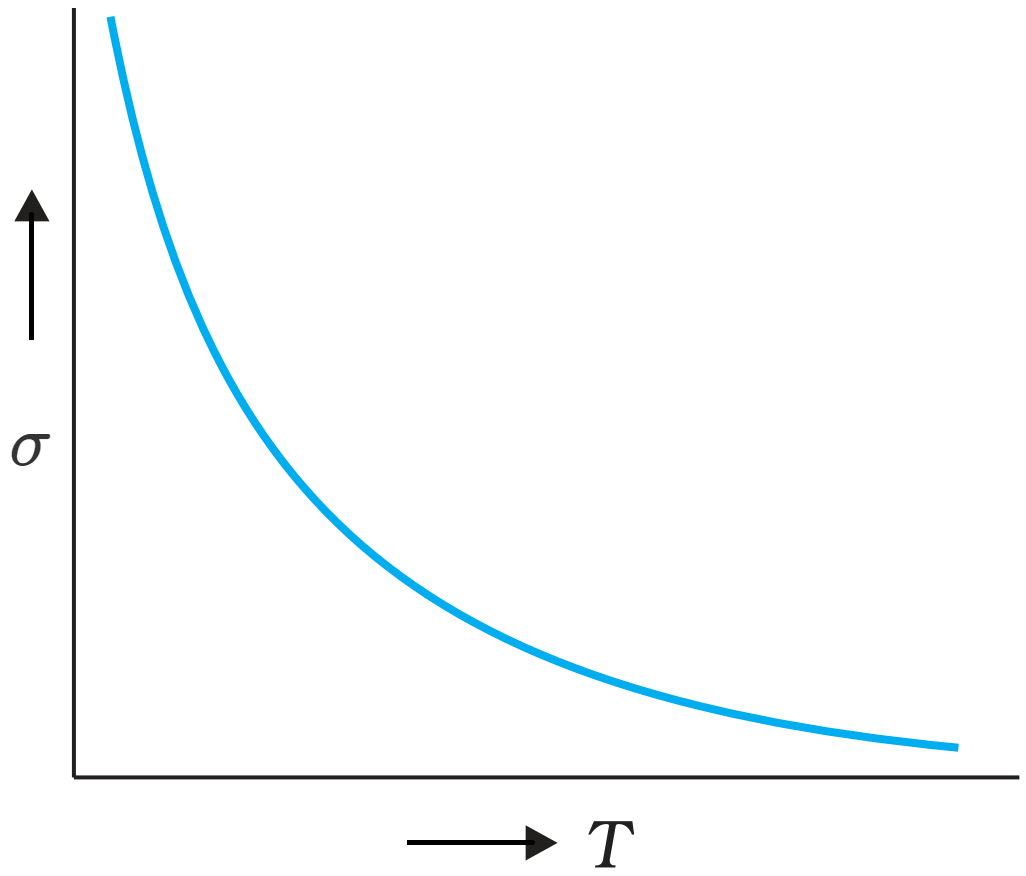
Define resistivity of a conductor. Plot a graph showing the variation of resistivity with temperature for a metallic conductor. How does one explain such a behaviour, using the mathematical expression of the resistivity of a material?
Answer
We know that, $\text{R}=\rho\frac{\text{l}}{\text{A}}$

If $\text{l}=\text{1},\text{A}=1\Rightarrow\rho=\text{R}$

Thus, resistivity of a material is numerically equal to the resistance of the conductor having unit length and unit cross-sectional area.

The resistivity of a material is found to be dependent on the temperature. Different materials do not exhibit the same dependence on temperature. Over a limited range of temperatures, that is not too large, the resistivity of a metallic conductor is approximately given by,

$\rho_\text{T}={\rho_0}[{1}+\alpha(\text{T}-\text{T}_0)]\dots\text{(i)}$

Where $\rho_\text{T}$ is the resistivity at a temperature T and $\rho_0$ is the same at a reference temperature $\text{T}_0,\alpha$ is called the temperature co-efficient of resistivity.

Relation (i) implies that a graph of $\rho_\text{T}$ plotted against T would be a straight line. At temperatures much lower than 0°C, the graph, however, deviates considerably from a straight line (Fig.).
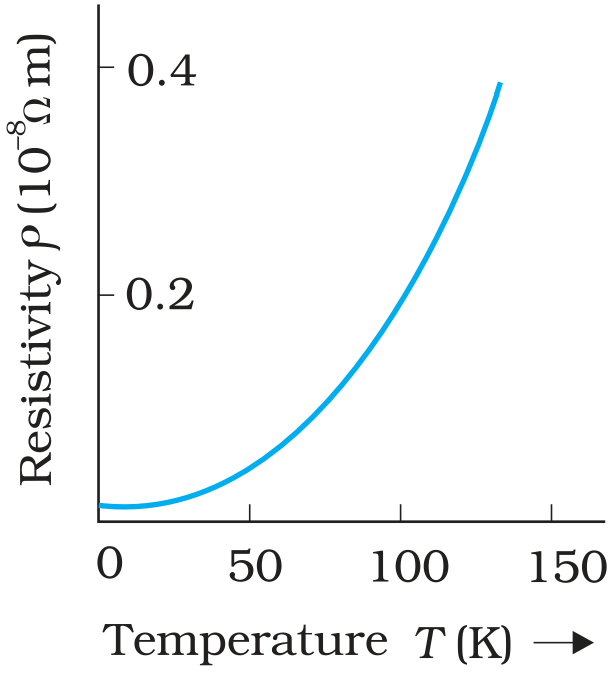
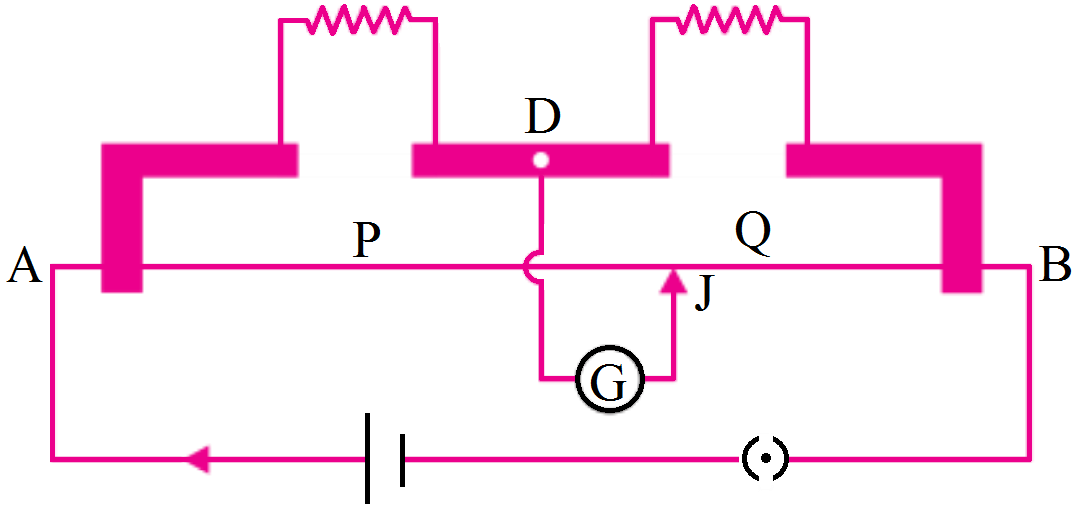
Resistivity $\rho_\text{T}$ of metallic conductor as a function of temperature T.

View full question & answer
Question 525 Marks
In a practical Wheatstone bridge circuit, wire AB is 2m long. When resistance Y = 2.0W and jockey is in position J such that AJ = 1.20m, there is no current in galvanometer, find the value of unknown resistance X. The resistance per unit length of wire AB = 0.01W/cm. Also calculate the current drawn by the cell of emf 4.0V and negligible internal resistance.

Answer
P = Resistance of wire AJ
$=(1.20\times100\text{cm})\times(0.01\Omega/\text{cm})=1.20\Omega$
Q = Resistance of wire BJ
= [(2-1.20)m × 100] × resistance per cm
$=0.80\times100\text{cm}\times0.1\Omega=0.80\Omega$
$\text{Y}=2.0\Omega,\text{X}=?$
When no current flows through the galvanometer, the bridge is balanced so
$\frac{\text{P}}{\text{Q}}=\frac{\text{X}}{\text{Y}}\Rightarrow\text{X}=\frac{\text{P}}{\text{Q}}\text{Y}\text{ or X}=\frac{1.20}{0.80}\times2.0=3.0\Omega $
Total resistance of X and Y connected in series,
$\text{R}_1=\text{X}+\text{Y}=3.0+2.0=5.0\Omega$
Total resistance of P and Q connected in series (or wire AB)
$\text{R}_2=2\times100\times0.1=2.0\Omega$
The resistance R1 and R2 are in parallel, so effective resistance between terminals A and B of bridge is
$\text{R}_\text{AB}=\frac{\text{R}_1\text{R}_2}{\text{R}_1+\text{R}_2}=\frac{5.0\times2.0}{5.0+2.0}=\frac{10}{7}\Omega$
Current drawn from battery $\text{I}=\frac{\varepsilon}{\text{R}_\text{AB}}=\frac{4.0}{\frac{10}{7}}=2.8\text{A}$
View full question & answer
Question 535 Marks
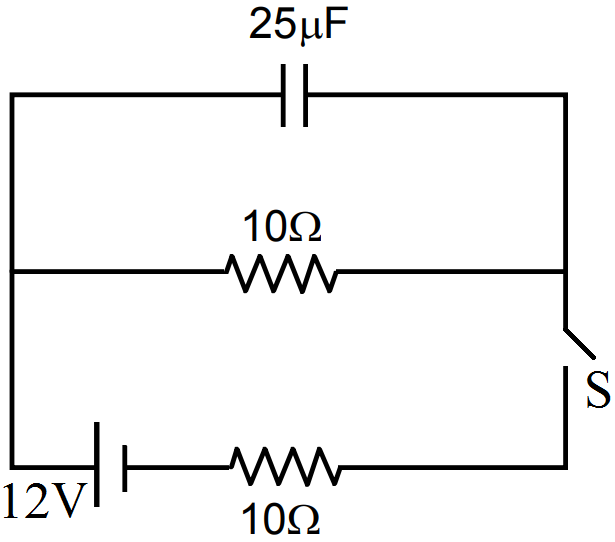
The switch S shown in figure. is kept closed for a long time and is then opened at t = 0. Find the current in the middle $1.0\Omega$ resistor at t = 1ms.

Answer
In steady state condition, no current passes through the $25\mu\text{F}$ capacitor,

$\therefore$ Net resistance $=\frac{10\Omega}{2}=5\Omega$
Potential difference across the capacitor = 5
Potential difference across the $10\Omega$ resistor
$=\frac{12}{5}\times10=24\text{V}$
$\text{q}=\text{Q}\Big(\text{e}^{\frac{-\text{t}}{\text{RC}}}\Big)=\text{V}\times\text{C}\Big(\text{e}^{\frac{-\text{t}}{\text{RC}}}\Big)$ $=24\times25\times10^{-6}\bigg[\text{e}^{\frac{-1\times10^{-3}}{10\times25\times10^{-4}}}\bigg]$
$=24\times25\times10^{-6}\text{e}^{-4}$
$=24\times25\times10^{-6}\times0.0183=10.9\times10^{-6}\text{C}$
Charge given by the capacitor after time t.
Current in the $10\Omega$ resistor $=\frac{10.9\times10^{-6}\text{C}}{1\times10^{-3}\text{sec}}=11\text{mA}.$
View full question & answer
Question 545 Marks
Two cells of emf 1V, 2V and internal resistances $2\Omega$ and $1\Omega$ respectively are connected in (i) series. (ii) Parallel. What should be the external resistance in the circuit so that the current through the resistance be the same in the two cases? In which case is more heat generated in the cells?
Answer
For parallel combination,
Net emf, $\varepsilon=\frac{\varepsilon_1\text{r}_1+\varepsilon_2\text{r}_2}{\text{r}_1+\text{r}_2}$
Net internal resistance, $\text{r}_\text{int}=\frac{\text{r}_1\text{r}_2}{\text{r}_1+\text{r}_2}$
For series combination,
Net emf, $\varepsilon=\varepsilon_1+\varepsilon_2$
Net internal resistance rint $=\text{r}_1+\text{r}_2$
Given, $\varepsilon_1=1\text{V},\varepsilon_2=2\text{V}$ and $\text{r}_1=2\Omega,\text{r}_2=1\text{}\Omega,\text{Rext}=\text{R}$
$\therefore$ Current, $\text{I}_1=\frac{\varepsilon_1+\varepsilon_2}{\text{r}_1+\text{r}_2+\text{R}}=\frac{1+2}{2+1+\text{R}}=\frac{3}{3+\text{R}}\text{A}\dots\text{(i)}$
Current, $\text{I}_2=\frac{\frac{(\varepsilon_1\text{r}_2+\varepsilon_2\text{r}_1)}{(\text{r}_1+\text{r}_2}}{\text{R}\Big\{\frac{(\text{r}_1\text{r}_2)} {(\text{r}_1+\text{r}_2}\Big\}}\dots\text{(ii)}$
$=\frac{\frac{(1\times1+2\times2)}{(2+1)}}{\text{R}+\frac{2\times1}{2+1}}=\frac{\frac53}{\text{R}+\frac23}=\frac{5}{3\text{R}+2}$
Given, I1 = I2
$\therefore\frac{3}{3+\text{R}}=\frac{5}{3\text{R}+2}\text{ or }9\text{R}+6=15+5\text{R}$
$\text{4R}=9\Rightarrow\text{R}=\frac{9}{4}=2.25\Omega$
Heat generated in external resistance (I2R) is same in both cases but heat generated in cells (I2 rint) is more in series than that in parallel combination of cells.
View full question & answer
Question 555 Marks
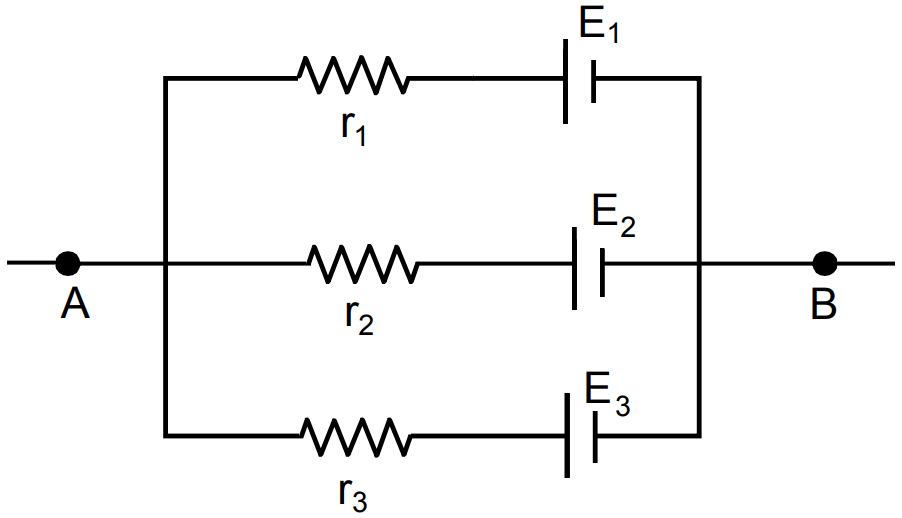
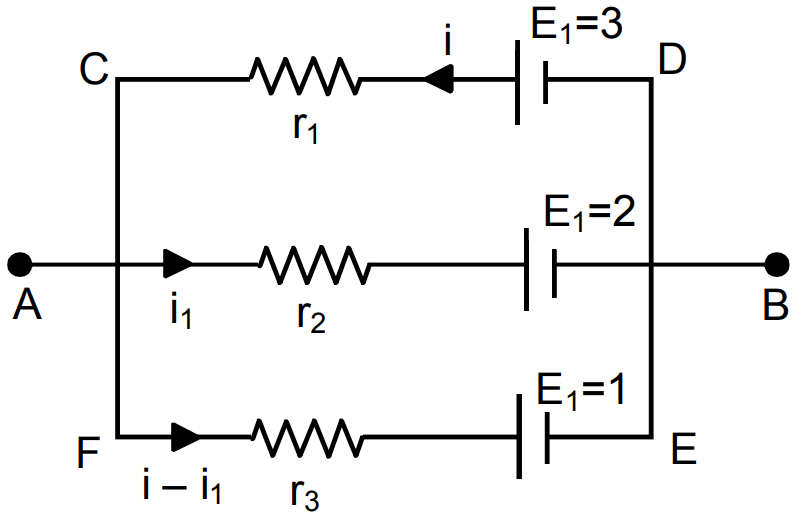
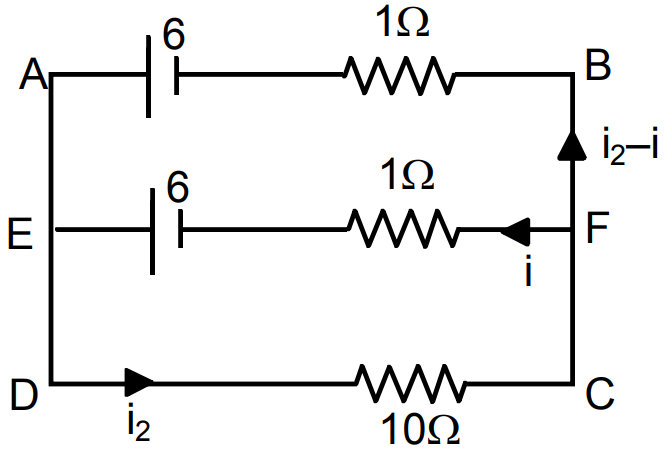
In the circuit shown in the figure. $\in_1=3\text{V},\in_2=2\text{V},\in_3=1\text{V}$ and $\text{r}_1=\text{r}_2=\text{r}_3=1\Omega.$ Find the potential difference between the points A and B and the current through each branch.

Answer
In circuit ABDCA,

$\text{i}_1+2-3+\text{i}=0$
$\Rightarrow\text{i}+\text{i}_1-1=0\ ...(1)$
In circuit CFEDC,
$(\text{i}-\text{i}_1)+1-3+\text{i}=0$
$\Rightarrow2\text{i}-\text{i}_1-2=0\ ...(2)$
From (1) and (2)
$3\text{i}=3\Rightarrow\text{i}=1\text{A}$
$\text{i}_1=1-\text{i}=0\text{A}$
$\text{i}-\text{i}_1=1-0=1\text{A}$
Potential difference between A and B
$=\text{E}-\text{ir}=3-1.1=2\text{V}.$
View full question & answer
Question 565 Marks
Explain the variation of conductivity with temperature for:
  1. A metallic conductor.
  2. Ionic conductors.
  3. Semiconductors.
Answer
Conductivity of a metallic conductor $\sigma=\frac{1}{\rho}=\frac{\text{ne}^2\tau}{\text{m}}.$

Where m = mass of charge carrier, e = charge on each carrier

$\tau$ = relaxation time, n = number density of charge carriers

  1. With rise of temperature, the collision of electrons with fixed lattice ions/ atoms increases so that relaxation time $(\tau)$ decreases. Consequently, the conductivity of metals decreases with rise of temperature.
  2. Conductivity of ionic conductor increases with increase of temperature because with increase of temperature, the ionic bonds break releasing positive and negative ions which are charge carriers in ionic conductors.
  3. In the case of a semiconductors, when temperature increases, covalent bonds break and charge carriers (electrons and holes) become free i.e., n increases, so conductivity increases with rise of temperature.
View full question & answer
Question 575 Marks
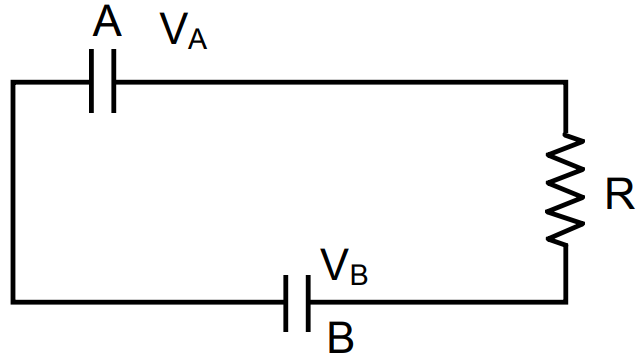
A capacitor of capacitance C is given a charge Q. At t = 0, it is connected to an uncharged capacitor of equal capacitance through a resistance R. Find the charge on the second capacitor as a function of time.
Answer
Let after time t charge on plate B is +Q.

Hence charge on plate A is Q - q.
$\text{V}_\text{A}=\frac{\text{Q}-\text{q}}{\text{C}},\text{V}_\text{B}=\frac{\text{q}}{\text{C}}$
$\text{V}_\text{A}-\text{V}_\text{B}=\frac{\text{Q}-\text{q}}{\text{C}}-\frac{\text{q}}{\text{C}}=\frac{\text{Q}-2\text{q}}{\text{C}}$
Current $=\frac{\text{V}_\text{A}-\text{V}_\text{B}}{\text{R}}=\frac{\text{Q}-2\text{q}}{\text{CR}}$
Current $=\frac{\text{dq}}{\text{dt}}=\frac{\text{Q}-2\text{q}}{\text{CR}}$
$\Rightarrow\frac{\text{dq}}{\text{q}-2\text{q}}=\frac{1}{\text{RC}}\cdot\text{dt}$
$\Rightarrow\int\limits^\text{q}_0\frac{\text{dq}}{\text{Q}-2\text{q}}=\frac{1}{\text{RC}}\cdot\int\limits^\text{t}_0\text{dt}$
$\Rightarrow-\frac{1}{2}\big[\text{In}(\text{Q}-2\text{q})-\text{InQ}\big]=\frac{1}{\text{RC}}\cdot\text{t}$
$\Rightarrow\text{In}\frac{\text{Q}-2\text{q}}{\text{Q}}=\frac{-2}{\text{RC}}\cdot\text{t}$
$\Rightarrow\text{Q}-2\text{q}=\text{Q e}^\frac{-2\text{t}}{\text{RC}}$
$\Rightarrow2\text{q}=\text{Q}\Big(1-\text{e}^\frac{-2\text{t}}{\text{RC}}\Big)$
$\Rightarrow\text{q}=\frac{\text{Q}}{2}\Big(1-\text{e}^\frac{-2\text{t}}{\text{RC}}\Big).$
View full question & answer
Question 585 Marks
The resistance of an iron wire and a copper wire at 20°C are $3.9\Omega$ and $4.1\Omega,$ respectively. At what temperature will the resistance be equal? Temperature coefficient of resistivity for iron is $5.0\times10^{-3}\text{K}^{-1}$ and for copper, it is $4.0\times10^{-3}\text{K}^{-1}.$ Neglect any thermal expansion.
Answer
$\text{R}'_\text{Fe}=\text{R}_\text{Fe}(1+\alpha_\text{Fe}\Delta\theta),\text{R}'_\text{Cu}=\text{R}_\text{Cu}(1+\alpha_\text{Cu}\Delta\theta)$
$\text{R}'_\text{Fe}=\text{R}'_\text{Cu}$
$\Rightarrow\text{R}_\text{Fe}(1+\alpha_\text{Fe}\Delta\theta),=\text{R}_\text{Cu}(1+\alpha_\text{Cu}\Delta\theta)$
$\Rightarrow3.9\big[1+5\times10^{-3}(20-\theta)\big]$ $=4.1\big[1+4\times10^{-3}(20-\theta)\big]$
$\Rightarrow3.9+3.9\times5\times10^{-3}(20-\theta)$ $=4.1+4.1\times4\times10^{-3}(20-\theta)$
$\Rightarrow4.1\times4\times10^{-3}(20-\theta)\\-3.9\times5\times10^{-3}(20-\theta)=3.9-4.1$
$\Rightarrow16.4(20-\theta)-19.5(20-\theta)=0.2\times10^3$
$\Rightarrow(20-\theta)(-3.1)=0.2\times10^3$
$\Rightarrow\theta-20=200$
$\Rightarrow\theta=220^\circ\text{C}.$
View full question & answer
Question 595 Marks
A room has AC run for 5 hours a day at a voltage of 220V. The wiring of the room consists of Cu of 1mm radius and a length of 10m. Power consumption per day is 10 commercial units. What fraction of it goes in the joule heating in wires? What would happen if the wiring is made of aluminium of the same dimensions?
cu = 1.7 × 10⁻⁸Ωm , ρAl = 2.7 × 10-8 Ωm]
Answer
Key concept: The energy dissipated per unit time is the power dissipated $\text{P}=\frac{\Delta\text{W}}{\Delta\text{t}}$ and,
The power across a resistor is P = I2R
Power consumption In a day, i.e., in 5 = 10units
Or power consumption per hour = 2units
Or power consumption = 2units = 2kW = 2000J/s
Also, we know that power consumption in resistor,
P = V × I
⇒ 2000W = 220V × I or I ≈ 9A
Now, the resistance of wire with cross-sectional area A is given by $\text{R}=\rho\frac{\text{I}}{\text{A}}$
Power consumption in first current carrying wire is given by
P = I2R
$\rho\frac{\text{I}}{\text{A}}\text{I}^2=1.7\times10^{-8}\times\frac{10}{\pi\times10^{-6}}\times81\text{J/s}\approx4\text{J/s}$
The fractional loss due to the joule heationg in first wire $=\frac{4}{2000}\times100=0.2\%$
Power loss in Al wire $=4\frac{\rho_\text{Al}}{\rho_\text{Cu}}=1.6\times4=6.4\text{J/s}$
The fractional loss due to the joule heating in second wire $=\frac{6.4}{2000}\times100=0.32\%.$
View full question & answer
Question 605 Marks
In an experiment with a potentiometer, VB = 10V. R is adjusted to be 50Ω (Fig.). A student wanting to measure voltage E1 of a battery (approx. 8V) finds no null point possible. He then diminishes R to 10Ω and is able to locate the null point on the last (4th) segment of the potentiometer. Find the resistance of the potentiometer wire and potential drop per unit length across the wire in the second case.

Answer
Key concept: When emf of primary cell is less than the potential difference across the wires of potentiometer, only then the null point is obtained.

Equivalent resistance of potentiometer and variable resistor (R = 50Ω) is given by = 50Ω + R'

Equivalent voltage applied across potentiometer = 10V

The current through the main circuit,
$\text{I}=\frac{\text{V}}{50\Omega+\text{R}'}=\frac{10}{50\Omega+\text{R}'}$

Potential difference across wore of potentiometer,

Since with 50Ω resistor, null point is not obtained it is possible only when

$\frac{10\times\text{R}'}{50\times\text{R}}<8$

⇒ 10R' < 400 + 8R'

2R' < 400 or R' < 200Ω

Similarly with 10Ω resistor, null point is obtained only when

$\frac{10\times\text{R}'}{10+\text{R}}>8$

$\Rightarrow\ 2\text{R}'>80$

$\Rightarrow\ \text{R}'>40$

$\frac{10\times\frac{3}{4}\text{R}'}{10+\text{R}'}>8$

$\Rightarrow\ 7.5\text{R}'<80+8\text{R}'$

$\text{R}'>160$

$\Rightarrow\ 160<\text{R}'<200$

Any R' between 160Ω and 200Ω will achieve.

Since, the null point on the last (4th) segment of the potentiometer, therefore potential drop across 400cm of wire > 8V.

This imply that potential gradient

k × 400cm > 8V

or k × 4m > 8V

k > 2V/m

Similarly, potential drop across 300cm wire < 8V

k × 300cm < 8V

or k × 3m < 8V

$\text{k}<2\frac{2}{3}\text{V/m}$

Thus, $2\frac{2}{3}\text{V/m}>\text{k}>2\text{V/m}.$

View full question & answer
Question 615 Marks
The relaxation time τ is nearly independent of applied E field whereas it changes significantly with temperature T. First fact is (in part) responsible for Ohm’s law whereas the second fact leads to variation of ρ with temperature. Elaborate why?
Answer
Key concept: Time interval between two successive collisions of electron with positive ions in the metallic lattice is defined as relaxation time $\tau=\frac{\text{mean free path}}{\text{r. m. s. velocity of electrons}}=\frac{\lambda}{\text{v}_\text{rms}}$ with rise in tempereture vrms increase consequently as $\tau$ decreases.
The drift velocity of the elecrons is small because of the frequent collisions suffered by electrons.
Relaxation time is inversely proportional to the velocities of electorns ans ions. The applied electric field produces the insignificant change in velocities of electrons at the order of 1 mm/s, whereas the change in temperature (T) affects velocites at the order of 102m/s.
This decrease the relaxation time considerably in metals and consequently resistivity of metal of conductor increase as
$\rho=\frac{1}{\sigma}=\frac{\text{m}}{\text{ne}^2\tau}$.
View full question & answer
Question 625 Marks
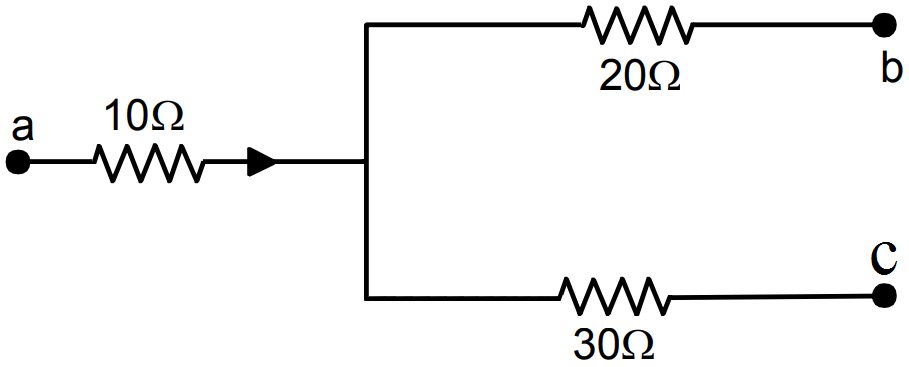
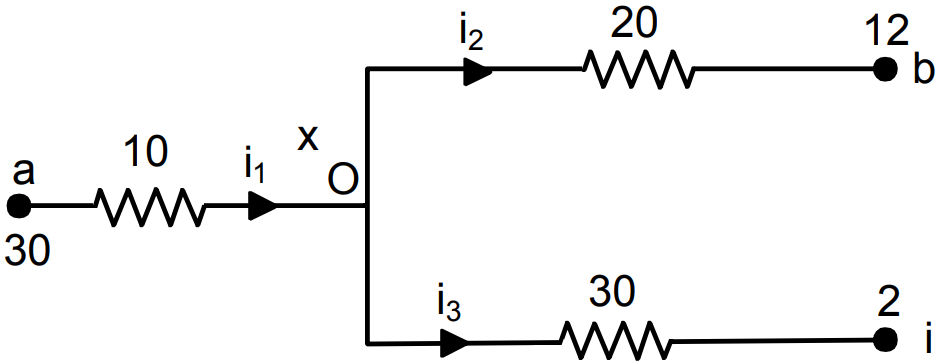
Figure. showa a part of an electric circuit. The potentials at the point a, b and c are 30V, 12V and 2V respectively. Find the currents through the three resistors.

Answer
Let potential at the point be xV

$(30-\text{x})=10\text{i}_1$
$(\text{x}-12)=20\text{i}_2$
$(\text{x}-2)=30\text{i}_3$
$\text{i}_1=\text{i}_2+\text{i}_3$
$\Rightarrow\frac{30-\text{x}}{10}=\frac{\text{x}-12}{20}+\frac{\text{x}-2}{30}$
$\Rightarrow30-\text{x}=\frac{\text{x}-12}{2}+\frac{\text{x}-2}{3}$
$\Rightarrow30-\text{x}=\frac{3\text{x}-36+2\text{x}-4}{6}$
$\Rightarrow180-6\text{x}=5\text{x}-40$
$\Rightarrow11\text{x}=220\Rightarrow\text{x}=\frac{220}{11}=20\text{V}$
$\text{i}_1=\frac{30-20}{10}=1\text{A}$
$\text{i}_2=\frac{20-12}{20}=0.4\text{A}$
$\text{i}_3=\frac{20-2}{30}=\frac{6}{10}=0.6\text{A}$
View full question & answer
Question 635 Marks
A parallel-plate capacitor has plate area 20cm2, plate separation 1.0mm and a dielectric slab of dielectric constant 5.0 filling up the space between the plates. This capacitor is joined to a battery of emf 6.0V through a $100\text{k}\Omega$ resistor. Find the energy of the capacitor $8.9\mu\text{s}$ after the connections are made.
Answer
$\text{A} = 20\text{cm}^2, \text{d} = 1\text{mm, K} = 5, \text{e} = 6\text{V}$
$\text{R}=100\times10^3\Omega,\text{t}=8.9\times10^{-5}\text{s}$
$\text{C}=\frac{\text{KE}_0\text{A}}{\text{d}}=\frac{5\times8.85\times10^{-12}\times20\times10^{-4}}{1\times10^{-3}}$
$=\frac{10\times8.85\times10^{-3}\times10^{-12}}{10^{-3}}=88.5\times10^{-12}$
$\text{q}=\text{EC}\Big(1-\text{e}^{\frac{-\text{t}}{\text{RC}}}\Big)$
$=6\times88.5\times10^{-12}\Big(1-\text{e}^{\frac{-89\times10^{-6}}{88.5\times10^{-12}\times10^4}}\Big)=530.97$
Energy $=\frac{1}{2}\times\frac{500.97\times530}{88.5\times10^{-12}}$
$=\frac{530.97\times530.97}{88.5\times2}\times10^{12}$
View full question & answer
Question 645 Marks
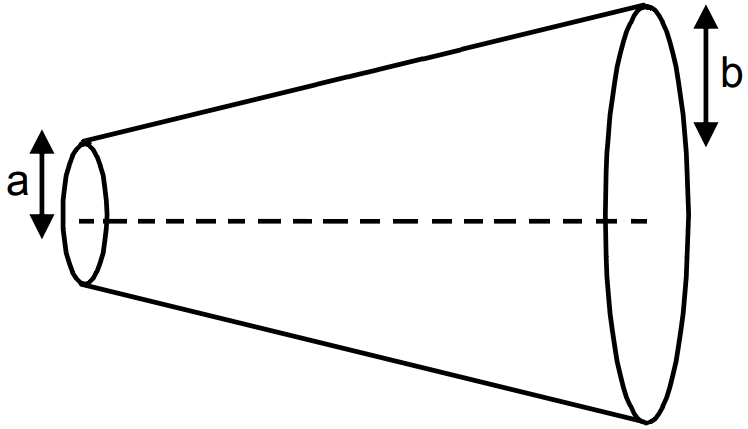
Figure. shows a conductor of length l with a circular cross-section. The radius of the cross-section varies linearly from a to b. The resistivity of the material is ρ. Assuming that b - a << l, find the resistance of the conductor.

Answer
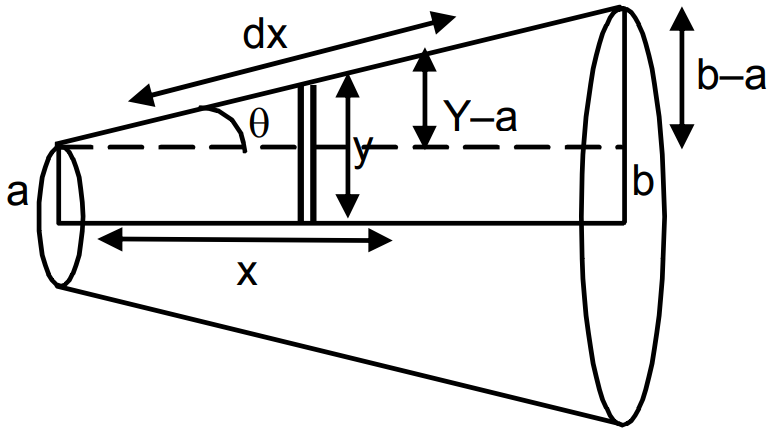
dR, due to the small strip dx at a distanc $\text{x d}=\text{R}=\frac{\text{fdx}}{\pi\text{y}^2}\ ...(1)$

$\tan\theta=\frac{\text{y}-\text{a}}{\text{x}}=\frac{\text{b}-\text{a}}{\text{L}}$
$\Rightarrow\frac{\text{y}-\text{a}}{\text{x}}=\frac{\text{b}-\text{a}}{\text{L}}$
$\Rightarrow\text{L}(\text{y}-\text{a})=\text{x}(\text{b}-\text{a})$
$\Rightarrow\text{Ly}-\text{La}=\text{xb}-\text{xa}$
$\Rightarrow\text{L}\frac{\text{dy}}{\text{dx}}-0=\text{b}-\text{a}\ (\text{diff. w.r.t.x})$
$\Rightarrow\text{L}\frac{\text{dy}}{\text{dx}}=\text{b}-\text{a}$
$\Rightarrow\text{dx}=\frac{\text{Ldy}}{\text{b}-\text{a}}\ ...(2)$
Putting the value of dx in equation (1)
$\text{dR}=\frac{\text{fLdy}}{\pi\text{y}^2(\text{b}-\text{a})}$
$\Rightarrow\text{dR}=\frac{\text{fl}}{\pi(\text{b}-\text{a})}\frac{\text{dy}}{\text{y}^2}$
$\Rightarrow\int\limits^\text{R}_0\text{dR}=\frac{\text{fl}}{\pi(\text{b}-\text{a})}\int\limits^\text{b}_\text{a}\frac{\text{dy}}{\text{y}^2}$
$\Rightarrow\text{R}=\frac{\text{fl}}{\pi(\text{b}-\text{a})}\frac{(\text{b}-\text{a})}{\text{ab}}=\frac{\text{fl}}{\pi\text{ab}}.$
View full question & answer
Question 655 Marks
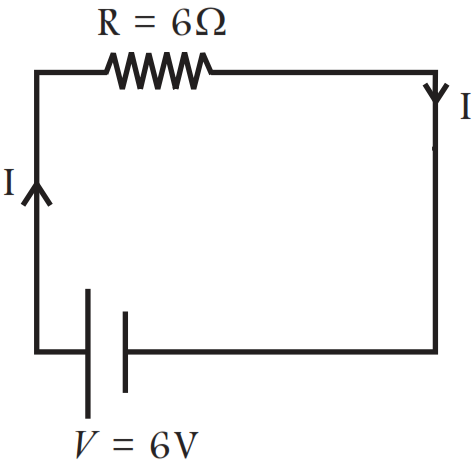
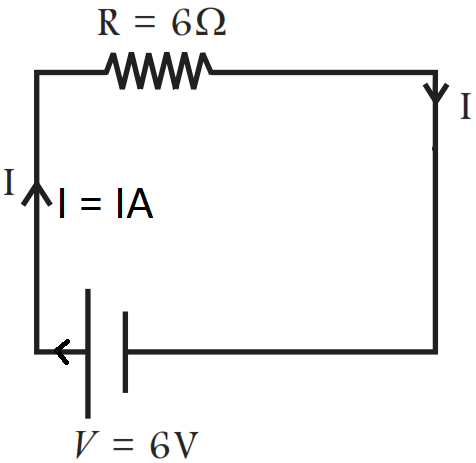
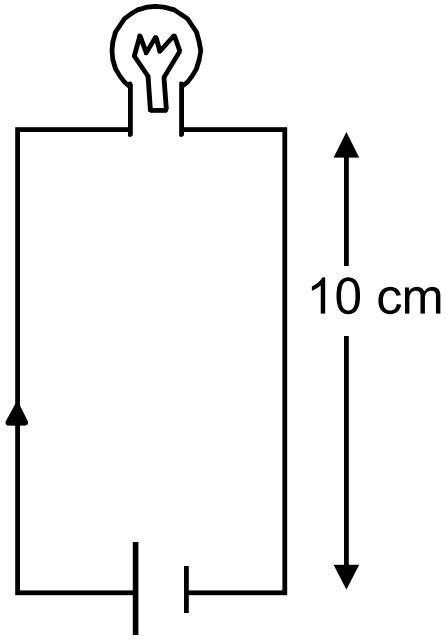
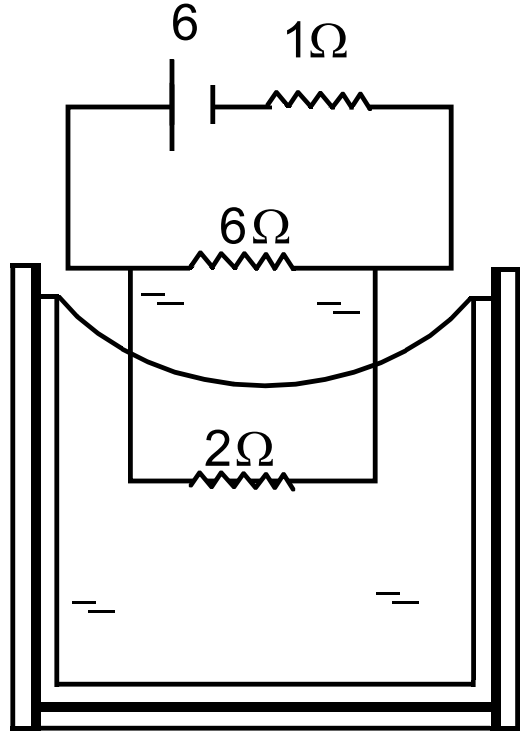
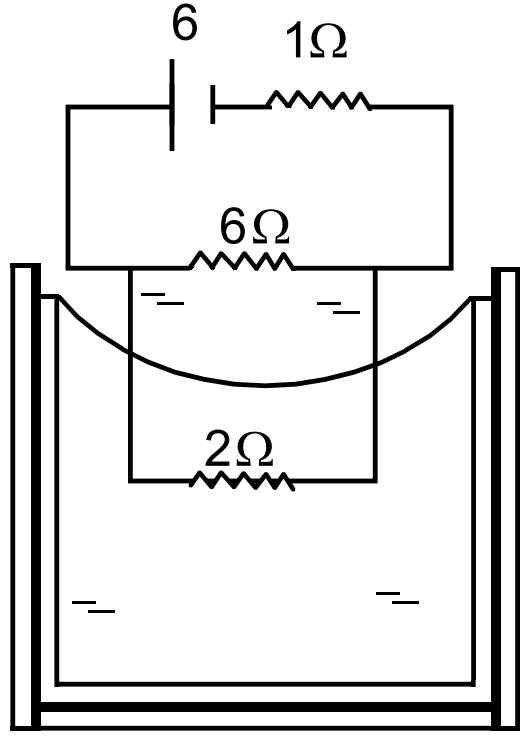
Consider circuit in Fig. How much energy is absorbed by electrons from the initial state of no current (ignore thermal motion) to the state of drift velocity?

Answer
Key concept: Relation between current and drift velocity is given by I = ne Avd,
where vd is the drift speed of electrons and n is the number density of electrons.

According to the Ohm's law current in the circuit

$\text{I}=\frac{\text{V}}{\text{R}}$
$\text{I}=\frac{6\text{V}}{6\Omega}=1\text{A}$
But, $\text{I}=\text{neAv}_\text{d}$
or $\text{v}_\text{d}=\frac{\text{I}}{\text{neA}}$
On substituting the value,
For n = number of electrons/volume = 1029/m3
length of circuit = 10cm, cross-section = A = (1mm)2
$\text{v}_\text{d}=\frac{1}{10^{29}\times16\times10^{-19}\times10^{-6}}$
$=\frac{1}{1.6}\times10^{-4}\text{m/s}$
Therefore, the energy absorbed in the form of KE is given by
Total KE = KE of 1 electron × on. of electrons
$\text{KE}=\frac{1}{2}\text{m}_\text{e}\text{v}_\text{d}^2\times\text{nAl}$
$=\frac{1}{2}\times9.1\times10^{31}\times\frac{1}{2.56}\times10^{-8}\times{10}^{29}\times{10}^{-6}\times10^{-1}$
$=2\times10^{-17}\text{J}$
View full question & answer
Question 665 Marks
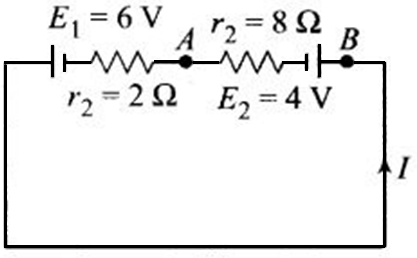
The circuit in Fig. shows two cells connected in opposition to each other. Cell E1 is of emf 6V and internal resistance 2Ω; the cell E2 is of emf 4V and internal resistance 8Ω. Find the potential difference between the points A and B.

Answer
Key concept: In this problem, after finding the electric current flow in the circuit by using Kirchoff’s law or Ohm’s law, the potential difference across AB can be obtained.

Applying Ohm's law

Equivalent emf of two cells 6 - 4 = 2V and equivalent resistance $=2\Omega+8\Omega=10\Omega$, so the electric current is given by

$\text{I}=\frac{6-4}{2+8}=0.2\text{A}$

Taking loop in anti-clockwise direction, since E1 > E2

The direction of flow of current is always from high potential to low potential therefore VB > VA

⇒ VB - 4V - (0.2) × VA

Therefore, VB - VA = 3.6V

Important Point: Sign convention for the applicaton of Kirchoff's law: For the application of Kirchoff's laws fpllowing sign convention are to be considered.

  1. The change in potential in traversing a resistance in the direction of current is -iR while in the opposite direction +iR.

  1. The change in potential in traversing an emf source from negative to positive terminal is +E while in the opposite direction -E irrespective of the direction of current in the circuit.

View full question & answer
Question 675 Marks
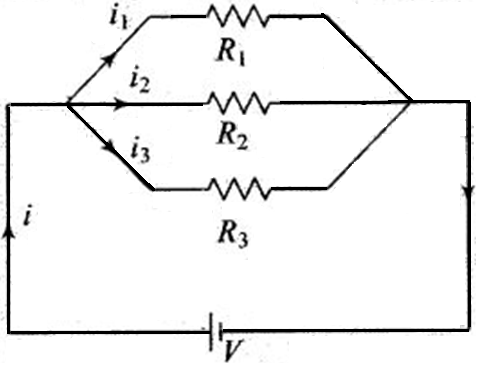
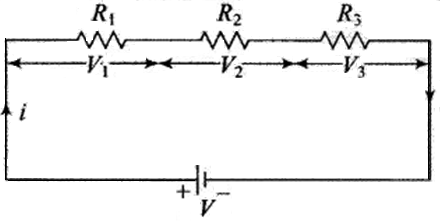
Let there be n resistors R1............Rn with Rmax = max (R1......... Rn) and Rmin = min {R1 ..... Rn}. Show that when they are connected in parallel, the resultant resistance RP < Rmin and when they are connected in series, the resultant resistance RS > Rmax. Interpret the result physically.
Answer
Key concept: parallel grouping: Same potential difference appeared across each resistance but current distributes in the reverse ratio of thier resistance, i.e. $\text{i}\propto\frac{1}{\text{R}}$.

Series grouping: Same current flows through each resistance but potential difference distributes in the ration of resistance, i.e. $\text{V}\propto\text{R}$.

In parallel combination: When all resistances are connected in parallel, the equivalent resistance Rp is given by
$\frac{1}{\text{R}_\text{p}}=\frac{1}{\text{R}_1}+\ .....\ +\frac{1}{\text{R}_\text{n}}$
On Multiplying both sides by Rmin, we have
$\frac{\text{R}_\text{min}}{\text{R}_\text{p}}=\frac{\text{R}_\text{min}}{\text{R}_1}+\frac{\text{R}_\text{min}}{\text{R}_2}+\ ..... \ +\frac{\text{R}_\text{min}}{\text{R}_\text{n}}$
Here, in RHS, there exist one term $\frac{\text{R}_\text{min}}{\text{R}_\text{min}}=1$ and other terms are positive, so we have
$\frac{\text{R}_\text{min}}{\text{R}_\text{p}}=\frac{\text{R}_\text{min}}{\text{R}_1}+\frac{\text{R}_\text{min}}{\text{R}_2}+\ ..... \ +\frac{\text{R}_\text{min}}{\text{R}_\text{n}}>\text{1}$
This shoews that the resultant resistnce Rp < Rmin
Thus, in parallel combination, the equivalent resistance of resistors even less that the minimum resistance available in combination of resistors.
In series combination: when all resistances are connested in series the equivalent resistance Rs is given by
Rs = R1 + .... + Rn
Here, in RHS, there exist one term having resistance Rmax.
So, we have
or Rs = R1 + ..... + Rmax ..... + ..... + Rn
Rs = R1 + ..... + Rmax ..... + Rn = Rmax + ..... (R1 + ..... +) Rn
or $\text{R}_\text{s}\geq\text{R}_\text{max}$
$\text{R}_\text{s}=\text{R}_\text{max}(\text{R}_1+\ ..... +\text{R}_\text{n})$
Thus, in series combination, the equivalent resistance of resistors is greater than the maximum resistance available in combination of resistors.
Physical interpretation:

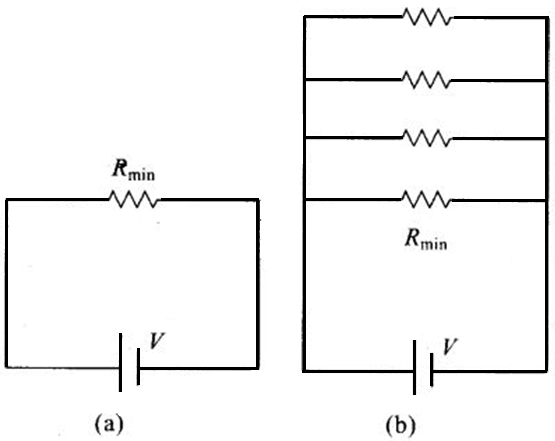
In fig. (b), Rmin provides an equivalent route as in Fig. (a) for current. But in addition there are (n - 1) routes by the remaining (n - 1) resistors. Current in fig. (b) is greater than currenr in Fig. (a). Effective resistance in Fig. (b) < Rmin. Second circuit evidently affords a greater resistance.

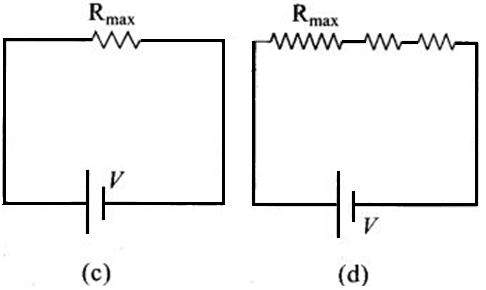
In Fig. (d), Rmax provides an equivalent route as in Fig. (c) for current. Current in Fig. (d) < current In Fig. (c). Effective resistance in Fig. (d) > Rmax. Second circuit affords a greater resistance.
View full question & answer
Question 685 Marks
A capacitor of capacitance C is connected to a battery of emf $\in$ at t = 0 through a resistance R. Find the maximum rate at which energy is stored in the capacitor. When does the rate have this maximum value?
Answer
Let at any time $\text{t},\text{q}=\text{EC}\Big(1-\text{e}^{\frac{-\text{t}}{\text{CR}}}\Big)$
E = Energy stored $=\frac{\text{q}^2}{2\text{c}}=\frac{\text{E}^2\text{C}^2}{2\text{c}}\Big(1-\text{e}^{\frac{-\text{t}}{\text{CR}}}\Big)^2=^{\frac{\text{E}^2\text{C}}{2}}\Big(1-\text{e}^{\frac{-\text{t}}{\text{CR}}}\Big)^2$
R = rate of energy stored $=\frac{\text{q}^2}{2\text{c}}=\frac{-\text{E}^2\text{C}}{2}\Big(\frac{-1}{\text{RC}}\Big)^2\Big(1-\text{e}^{\frac{-\text{t}}{\text{RC}}}\Big)\text{e}^{\frac{-\text{t}}{\text{RC}}}$ $=\frac{\text{E}^2}{\text{CR}}\cdot\text{e}^{\frac{-\text{t}}{\text{RC}}}\Big(1-\text{e}^{\frac{-\text{t}}{\text{CR}}}\Big)$
$\frac{\text{dR}}{\text{dt}}=\frac{\text{E}^2}{2\text{R}}\bigg[\frac{-1}{\text{RC}}\text{e}^{\frac{-\text{t}}{\text{CR}}}.\big(1-\text{e}^{\frac{-\text{t}}{\text{CR}}}\Big)+(-)\cdot\text{e}^{\frac{-\text{t}}{\text{CR}(1-/\text{RC})}}\cdot\text{e}^{\frac{-\text{t}}{\text{CR}}}\bigg]$
$\frac{\text{E}^2}{2\text{R}}=\bigg(\frac{-\text{e}^{\frac{-\text{t}}{\text{CR}}}}{\text{RC}}+\frac{\text{e}^{\frac{-2\text{t}}{\text{CR}}}}{\text{RC}}+\frac{1}{\text{RC}}\cdot\text{e}^{\frac{-2\text{t}}{\text{CR}}}\bigg)$ $=\frac{\text{E}^2}{2\text{R}}\bigg(\frac{2}{\text{RC}}\cdot\text{e}^{\frac{-2\text{t}}{\text{CR}}}-\frac{\text{e}^{\frac{-\text{t}}{\text{CR}}}}{\text{RC}}\bigg)\ ...(1)$
For $\text{R}_\text{max}\frac{\text{dR}}{\text{dt}}=0$
$\Rightarrow2.\text{e}^{\frac{-\text{t}}{\text{RC}}}-1=0\Rightarrow\text{e}^{\frac{-\text{t}}{\text{CR}}}=\frac{1}{2}$
$\Rightarrow\frac{\text{t}}{\text{RC}}=-\text{In}^2\Rightarrow\text{t}=\text{RC In}2$
$\therefore$ Putting t = RC ln 2 in equation (1) We get $\frac{\text{dR}}{\text{dt}}=\frac{\text{E}^2}{4\text{R}}.$
View full question & answer
Question 695 Marks
A capacitor of capacitance $10\mu\text{F}$ is connected to a battery of emf 2V. It is found that it takes 50ms for the charge of the capacitor to become $12.6\mu\text{C}.$ Find the resistance of the circuit.
Answer
$\text{C}=10\mu\text{F}=10^{-5}\text{F},\text{emf}=2\text{V}$
$\text{t}=50\text{ms}=5\times10^{-2}\text{s, q}=\text{Q}\Big(1-\text{e}^{\frac{-\text{t}}{\text{RC}}}\Big)$
$\text{Q}=\text{CV}=10^{-5}\times2$
$\text{q}=12.6\times10^{-6}\text{F}$
$\Rightarrow12.6\times10^{-6}=2\times10^{-5}\Big(1-\text{e}^{\frac{-5\times10^{-2}}{\text{R}\times10^{-5}}}\Big)$
$\Rightarrow\frac{12.6\times10^{-6}}{2\times10^{-5}}=1-\text{e}^{\frac{-5\times10^{-2}}{\text{R}\times10^{-5}}}$
$\Rightarrow1-0.63=\text{e}^{\frac{-5\times10^3}{\text{R}}}$
$\Rightarrow\frac{-5000}{\text{R}}=\text{In}\ 0.37$
$\Rightarrow\text{R}=\frac{5000}{0.9942}$
$=5028\Omega=5.028\times10^3\Omega=5\text{K}\Omega.$
View full question & answer
Question 705 Marks
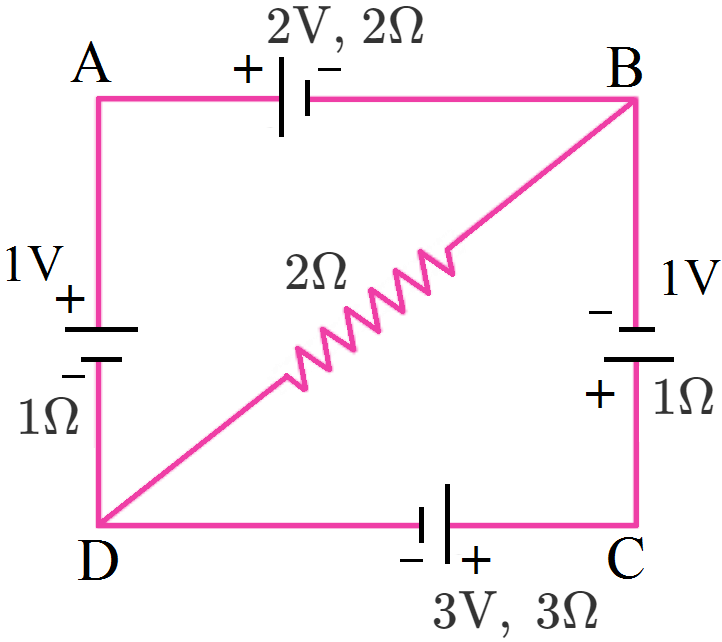
For the circuit shown here, calculate the potential difference between points B and D.

Answer
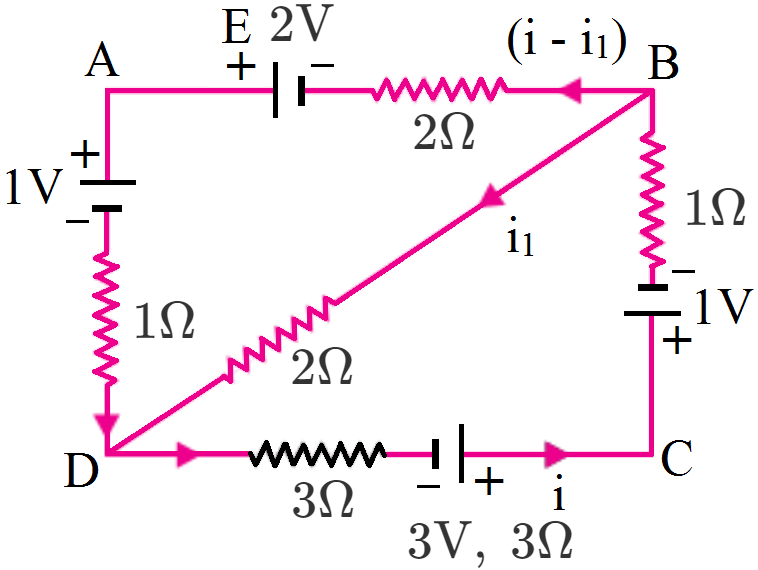
According to Kirchhoff’s first law the distribution of currents is shown in fig.

Applying Kirchhoff’s second law to mesh BADB,

–2(i – i1) +2 – 1 – 1. (i – i1) + 2i1 = 0

⇒ 3i – 5i1 = 1 …(i)

Applying Kirchhoff’s law to mesh DCBD,

-3i + 3 - 1 - 1× i - 2i1 = 0

⇒ 4i + 2i1 = 2

Or 2i + i1 = 1 …(ii)

Multiplying equation (ii) with 5, we get

10i + 5i1 = 5 …(iii)

Adding (i) and (iii), we get

$13\text{i}=6\Rightarrow\text{i}=\frac{6}{13}\text{A}$

From (ii), $\text{i}_1=1-2\text{i}=1-\frac{12}{13}=\frac{1}{13}\text{A}$

Potential difference between B and D is,

$\text{V}_\text{n}-\text{v}_\text{n}=\text{i}-1\times2=\frac{2}{13}\text{V}$

View full question & answer
Question 715 Marks
Two heaters are marked 200V, 300W and 200V, 600W. If the heaters are connected in series and the combination connected to a 200V dc supply, which heater will produce more heat?
Answer
Resitance of heaters $\text{R}_1=\frac{\text{V}^2}{\text{P}_1}=\frac{(200)^2}{300}=\frac{400}{3}\Omega$
$\text{R}_2=\frac{\text{V}^2}{\text{P}_2}=\frac{(200)^2}{600}=\frac{400}{6}\Omega$
When heaters are connected in series, current in circuit,
$\text{I}=\frac{\text{V}}{\text{R}_1+\text{R}_2}=\frac{200}{\frac{400}{3}+\frac{400}{6}}=1\text{A}$
Heat product in 200V, 300W heater per second,
$\text{Q}_1=\text{I}^2\text{R}_1=(1)^2\times\frac{400}{3}=133.33\text{Js}^{-1}$
Heat produced in 200V, 600W heater per second,
$\text{Q}_2=\text{I}^2\text{R}_2=(1)^2\times\frac{400}{6}=66.66\text{Js}^{-1}$
Clearly heat produced in 300W heater is more that produced in 600W heater.
View full question & answer
Question 725 Marks
The coil of an electric bulb takes 40 watts to start glowing. If more than 40W is supplied, 60% of the extra power is converted into light and the remaining into heat. The bulb consumes 100W at 220V. Find the percentage drop in the light intensity at a point if the supply voltage changes from 220V to 200V.
Answer
P = 100w
V = 220v
Case I:
Excess power $=100-40=60\text{w}$
Power converted to light $=\frac{60\times60}{100}=36\text{w}$
Case II:
Power $=\frac{(220)^2}{484}=82.64\text{w}$
Excess power $=82.64-40=42.64\text{w}$
Power converted to light $=42.64\times\frac{60}{100}=25.584\text{w}$
$\Delta\text{P}=36-25.585=10.416$
Required % $=\frac{10.416}{36}\times100=28.93\approx29\%$
View full question & answer
Question 735 Marks
A current of 1.0A exists in a copper wire of cross-section 1.0mm2. Assuming one free electron per atom, calculate the drift speed of the free electrons in the wire. The density of copper is 9000kg/m-3.
Answer
$\text{i} = 1\text{A, A} = 1\text{mm}^2 = 1 \times 10^{-6}\text{m}^2$
$\text{f' cu} = 9000\text{kg/m}^3$
Molecular mass has N0 atoms
= mKg has (N0/M × m) atoms $=\frac{\text{N}_0\text{Al}9000}{63.5\times10^{-3}}$
No.of atoms = No.of electrons
$\text{n}=\frac{\text{No. of electrons}}{\text{Unit volume}}=\frac{\text{N}_0\text{Af}}{\text{mAl}}=\frac{\text{N}_0\text{f}}{\text{M}}$
$=\frac{6\times10^{23}\times9000}{63.5\times10^{-3}}$
$\text{i}=\text{V}_\text{d}\text{n Ae}.$
$\Rightarrow\text{V}_\text{d}=\frac{\text{i}}{\text{nAe}}=\frac{1}{\frac{6\times10^{23}\times9000}{63.5\times10^{-3}}\times10^{-6}\times1.6\times10^{-19}}$
$=\frac{63.5\times10^{-3}}{6\times10^{23}\times9000\times10^{-6}\times1.6\times10^{-19}}$
$=\frac{63.5\times10^{-3}}{6\times9\times1.6\times10^{26}\times10^{-19}\times10^{-6}}$
$=\frac{63.5\times10^{-3}}{6\times9\times1.6\times10}=\frac{63.5\times10^{-3}}{6\times9\times16}$
$=0.074\times10^{-3}\text{m/s}=0.074\text{mm/ s}.$
View full question & answer
Question 745 Marks
Two conductors are made of the same material and have the same length. Conductor A is a solid wire of diameter 1mm. Conductor B is a hollow tube of outer diameter 2mm and inner diameter 1mm. Find the ratio of resistance RA to RB.
Answer
Resistance of a wire is given by, $\text{R}=\rho\Big(\frac{\text{l}}{\text{A}}\Big)$, where l is length of the conductor and A is the area of the cross-section & $\rho$ is a constant.
Resistance of first conductor, $\text{R}_\text{A}=\rho\Big[\frac{\text{l}}{\pi}(10^{-3}\times0.5)^2\Big]$
Resistance of second conductor, $\text{R}_\text{B}=\rho\Big[\frac{\text{l}}{\pi}\{(10^{-3})^2-(0.5\times10^{-3})^2\}\Big]$
Ratio, $\frac{\text{R}_\text{A}}{\text{R}_\text{B}}=\frac{\Big[\pi\{(10^{-3})^2-(0.5\times10^{-3})^2\Big]}{(10^{-3}\times0.5)^2}$
$\Rightarrow\ \frac{\text{R}_\text{A}}{\text{R}_\text{B}}=3:1.$
View full question & answer
Question 755 Marks
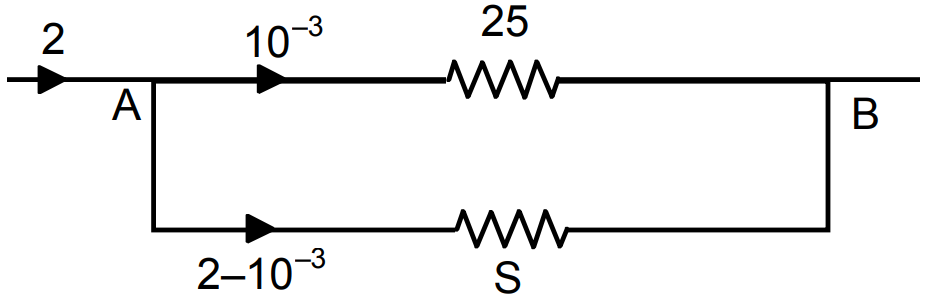
An ammeter is to be constructed that can read currents up to 2.0A. If the coil has resistance of $25\Omega$ and takes 1mA for full-scale deflection, what should be the resistance of the shunt used?
Answer

$\text{G}=25\Omega,\text{lg}=1\text{ma},\text{l}=2\text{A},\text{S}=?$

Potential across A B is same

$25\times10^{-3}=(2-10^{-3})\text{S}$

$\Rightarrow\text{S}=\frac{25\times10^{-3}}{2-10^{-3}}=\frac{25\times10^{-3}}{1.999}$

$=12.5\times10^{-3}=1.25\times10^{-2}.$

View full question & answer
Question 765 Marks
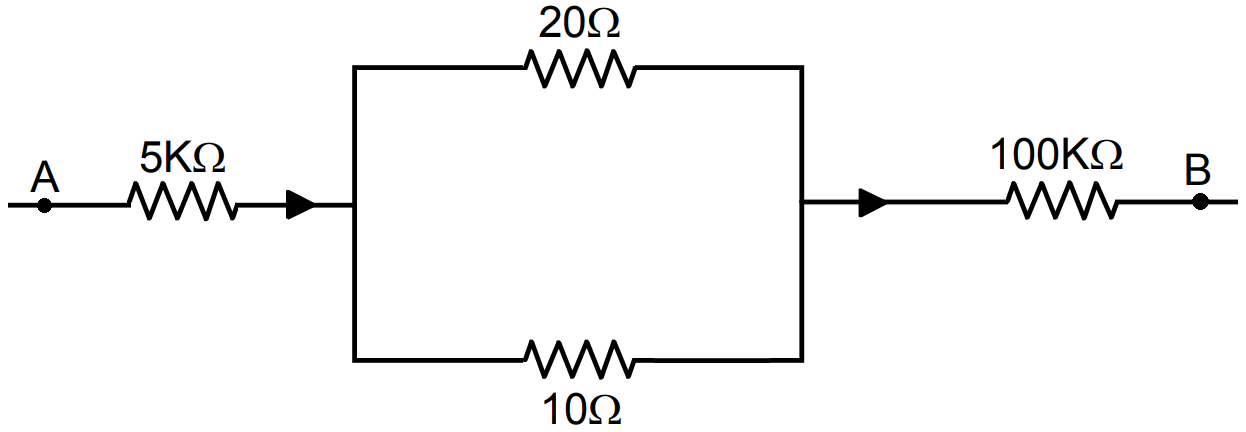
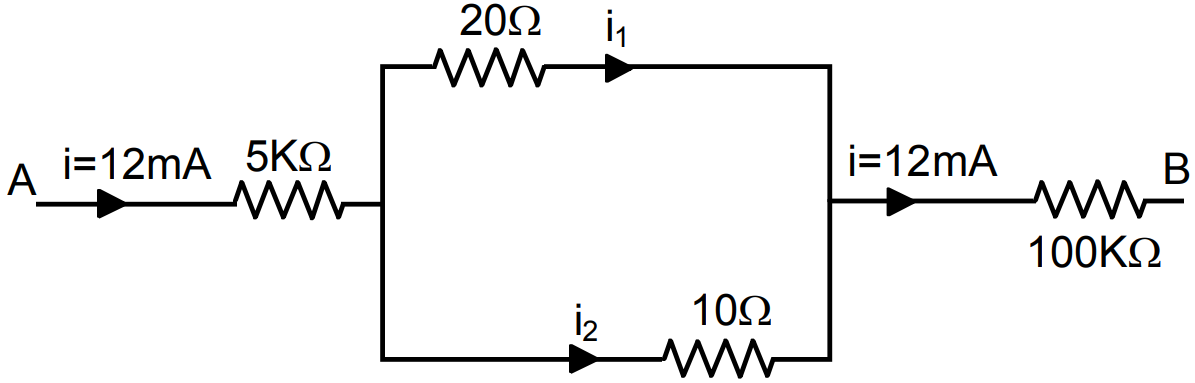
Figure. shows a part of a circuit. If a current of 12mA exists in the $5\text{k}\Omega$ resistor, find the currents in the other three resistors. What is the potential difference between the points A and B?

Answer

$\text{i}_1\times20=\text{i}_2\times10$

$\Rightarrow\frac{\text{i}_1}{\text{i}_2}=\frac{10}{20}=\frac{1}{2}$

i1 = 4mA, i2 = 8mA

Current in $20\text{K}\Omega$ resistor = 4mA

Current in $10\text{K}\Omega$ resistor = 8mA

Current in $100\text{K}\Omega$ resistor = 12mA

$\text{V}=\text{V}_1+\text{V}_2+\text{V}_3$

$=5\text{K}\Omega\times12\text{mA}+10\text{K}\Omega\times8\text{mA}\\+100\text{K}\Omega\times12\text{mA}$

$=60+80+1200=1340\text{ volts}.$

View full question & answer
Question 775 Marks
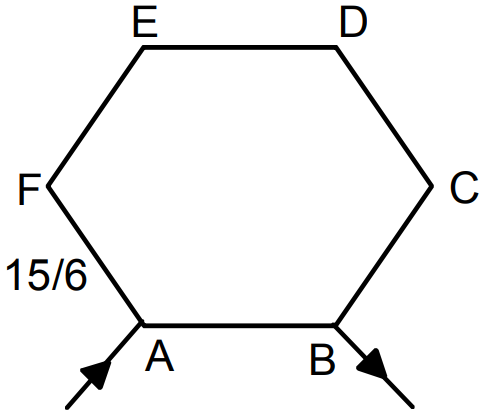
A wire of resistance $15.0\Omega$ is bent to form a regular hexagon ABCDEFA. Find the equivalent resistance of the loop between the points (a) A and B (b) A and C and (c) A and D.
Answer

  1. $\text{R}_\text{eff}=\frac{\frac{15\times5}{6}\times\frac{15}{6}}{\frac{15\times5}{6}+\frac{15}{6}}=\frac{\frac{15\times5\times15}{6\times6}}{\frac{75+15}{6}}$

$=\frac{15\times5\times15}{6\times90}=\frac{25}{12}=2.08\Omega$

  1. Across AC,

$\text{R}_\text{eff}=\frac{\frac{15\times4}{6}\times\frac{15\times2}{6}}{\frac{15\times4}{6}+\frac{15\times2}{6}}=\frac{\frac{15\times4\times15\times2}{6\times6}}{\frac{60+30}{6}}$

$=\frac{15\times4\times15\times2}{6\times90}=\frac{10}{3}=3.33\Omega$

  1. Across AD,

$\text{R}_\text{eff}=\frac{\frac{15\times3}{6}\times\frac{15\times3}{6}}{\frac{15\times3}{6}+\frac{15\times3}{6}}=\frac{\frac{15\times3\times15\times3}{6\times6}}{\frac{60+30}{6}}$

$=\frac{15\times3\times15\times3}{6\times90}=\frac{15}{4}=3.75\Omega.$

View full question & answer
Question 785 Marks
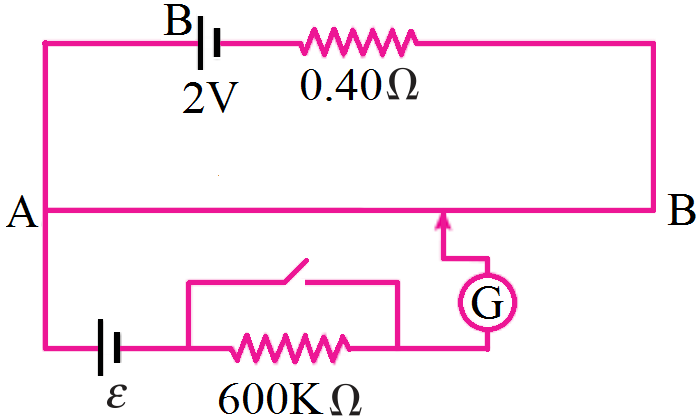
Figure shows a potentiometer with a cell of 2.0V and internal resistance of $0.40\Omega$ maintaining a potential drop across the resistor wire AB. A standard cell which maintains a constant emf of 1.02V (for very moderate currents upto a few mA) gives a balance point at 67.3cm length of the wire. To ensure very low currents drawn from the standard cell, a very high resistance of $600\text{k}\Omega$ is put in series with it, which is shorted close to the balance point. The standard cell is then replaced by a cell of unknown emf and the balance point found similarly, turns out to be at 82.3cm length of the wire.

  1. What is the value of $\varepsilon?$
  2. What purpose does the high resistance of $600\text{k}\Omega$ have?
  3. Is the balance point affected by this high resistance?
  4. Is the balance point affected by the internal resistance of the driver cell?
  5. Would the method work in the above situation if the driver cell of the potentiometer had an emf of 1.0V instead of 2.0V?
  6. Would the circuit work well for determining extremely small emf, say of the order of few mV (such as the typical emf of a thermo couple)? If not, how would you modify the circuit?
Answer
  1. For same potential gradient of potentiometer wire, the formula for comparison of emfs of cells is,

$\frac{\varepsilon_2}{\varepsilon_1}=\frac{\text{l}_2}{\text{l}_1}\Rightarrow\frac{\varepsilon}{\varepsilon_\text{s}}=\frac{\text{l}}{\text{l}_\text{s}}$

$\varepsilon=\frac{\text{l}}{\text{l}_\text{s}}\varepsilon_\text{s}$

$\varepsilon_\text{s}=$ emf of standard cell = 1.02V

Is = balancing with length standard cell = 67.3cm

l = balancing length with cell of unknown emf = 82.3cm

$\therefore$ Unknown emf $\varepsilon=\frac{(82.3\text{cm})}{(67.3\text{cm})}\times1.02\text{V}=1.25\text{V}$

  1. The purpose of high resistance is to reduce the current through the galvanometer. When jockey is far from the balance point, this saves the standard cell from being damaged.
  2. The balance point is not affected by the presence of high resistance because in balanced-position there is no current in cell-circuit (secondary circuit).
  3. No, the balance point is not affected by the internal resistance of driver cell, because we have already set the constant potential gradient of wire.
  4. No, since for the working of potentiometer the emf of driver cell must be greater than emf of secondary circuit.
  5. No, the circuit will have to be modified by putting variable resistance (R) in series with the driver cell the value of R is so adjusted that potential drop across wire is slightly greater than emf of secondary cell, so that the balance point may be obtained at a longer length. This will reduce the error and increase the accuracy of measurement.
View full question & answer
Question 795 Marks
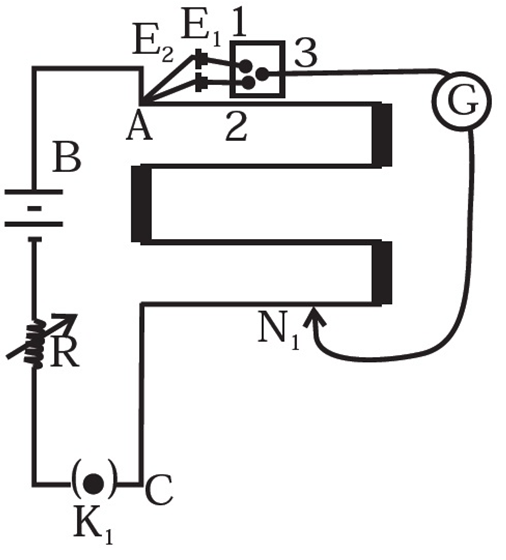
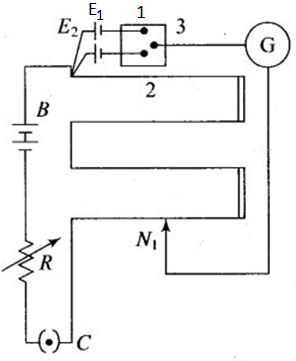
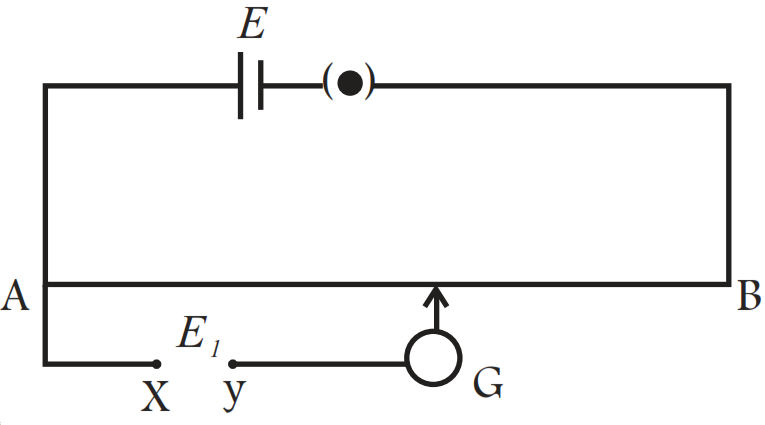
While doing an experiment with potentiometer (Fig.) it was found that the deflection is one sided and (i) the deflection decreased while moving from one end A of the wire to the end B; (ii) the deflection increased. while the jockey was moved towards the end B.

  1. Which terminal +or -ve of the cell E1, is connected at X in case (i) and how is E1 related to E?
  2. Which terminal of the cell E1 is connected at X in case (ii)?
Answer
  1. If the current in auxiliary circuit (lower circuit containing primary cell) decreases, and potential difference across A and jockey/increases. Then deflection in galvanometer is one sided and the deflection decreased, while moving from one end 'A' of the wire to the end 'S'. And clearly this is possible only when positive terminal of the cell E1 is connected at X and E1 > E.
  2. If the current in auxiliary circuit increases, and potential difference across A and jockey J increases. Then also deflection in galvanometer is one sided. And this is possible only when negative terminal of the cell E1 is connected at X.
View full question & answer
Question 805 Marks
A bulb with rating 250V, 100W is connected to a power supply of 220V situated 10m away using a copper wire of area of cross-section 5mm2. How much power will be consumed by the connecting wires? Resistivity of copper $1.7\times10^{-8}\Omega-\text{m}$.
Answer
 

$\text{V}=250\text{V}$

$\text{P}=100\text{w}$

$\text{R}=\frac{\text{v}^2}{\text{P}}=\frac{(250)^2}{100}=625\Omega$

Resistance of wire $=\text{R}=\frac{\text{fl}}{\text{A}}=1.7\times10^{-8}\times\frac{10}{5\times10^{-6}}$

$=0.034\Omega$

$\therefore$ The effect in resistance $=625.034\Omega$

$\therefore$ The current in the conductor $=\frac{\text{V}}{\text{R}}=\Big(\frac{220}{625.034}\Big)\text{A}$

$\therefore$ The power supplied by one side of connecting wire $=\Big(\frac{220}{625.034}\Big)^2\times0.034$

$\therefore$ The total power supplied $=\Big(\frac{220}{625.034}\Big)^2\times0.034\times2$

$\Rightarrow0.0084\text{w}=8.4\text{mw}$

View full question & answer
Question 815 Marks
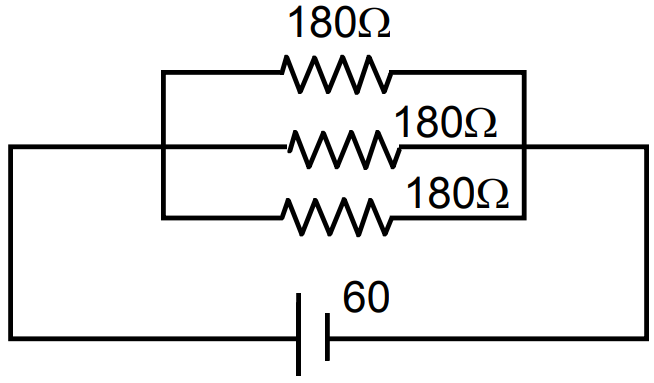
Three bulbs, each with a resistance of $180\Omega,$ are connected in parallel to an ideal battery of emf 60V. Find the current delivered by the battery when.
(a) all the bulbs are switched on, (b) two of the bulbs are switched on and (c) only one bulb is switched on.
Answer

  1. $\text{R}_\text{eff}=\frac{180}{3}=60\Omega$

$\text{i}=\frac{60}{60}=1\text{A}$

  1. $\text{R}_\text{eff}=\frac{180}{2}=90\Omega$

$\text{i}=\frac{60}{90}=0.67\text{A}$

  1. $\text{R}_\text{eff}=180\Omega\Rightarrow\text{i}=\frac{60}{180}=0.33$
View full question & answer
Question 825 Marks
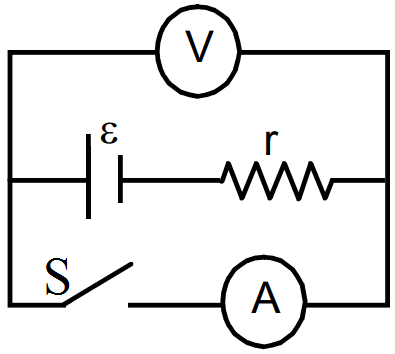
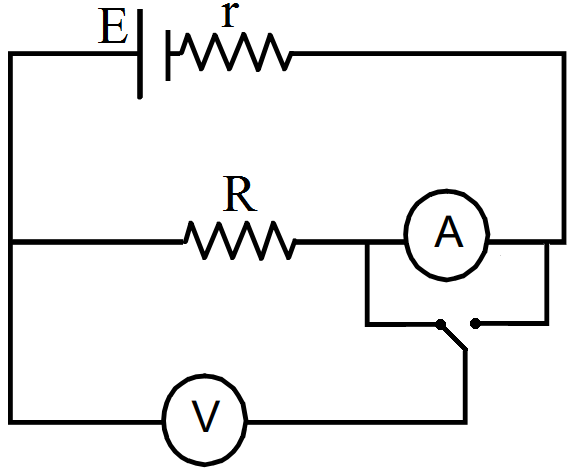
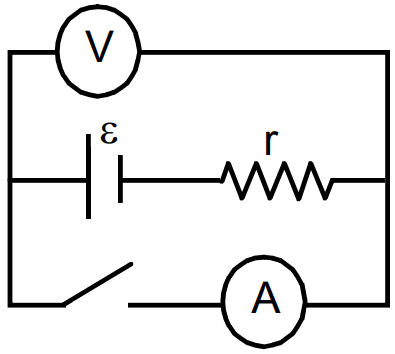
Figure. shows an arrangement to measure the emf $\in$ and internal resistance r of a battery. The voltmeter has a very high resistance and the ammeter also has some resistance. The voltmeter reads 1.52V when the switch S is open. When the switch is closed, the voltmeter reading drops to 1.45V and the ammeter reads 1.0A. Find the emf and the internal resistance of the battery.

Answer

  1. When switch is open, no current passes through the ammeter. In the upper part of the circuit the Voltmenter has $\infty$ resistance. Thus current in it is 0.

$\therefore$ Voltmeter read the emf. (There is not Pot. Drop across the resistor).

  1. When switch is closed current passes through the circuit and if its value of i.

The voltmeter reads

$\in-\text{ir}=1.45$

$\Rightarrow1.52-\text{ir}=1.45$

$\Rightarrow\text{ir}=0.07$

$\Rightarrow1\text{r}=0.07\Rightarrow\text{r}=0.07\Omega.$

View full question & answer
Question 835 Marks
Find the charge required to flow through an electrolyte to liberate one atom of.
  1. A monovalent material.
  2. A divalent material.
Answer
  1. 1eq. mass of the substance requires 96500 coulombs

Since the element is monoatomic, thus eq. mass = mol. Mass

6.023 × 1023 atoms require 96500C

1 atoms require $\frac{96500}{6.023\times10^{23}}\text{C}=1.6\times10^{-19}\text{C}$

  1. Since the element is diatomic eq.mass = $=\frac{1}{2}\text{mol.mass}$

$\therefore\Big(\frac{1}2{}\Big)\times6.023\times10^{23}$ atoms 2eq. 96500C

$\Rightarrow1\ \text{atom require}=\frac{96500\times2}{6.023\times10^{23}}$

$=3.2\times10^{-19}\text{C}$

View full question & answer
Question 845 Marks
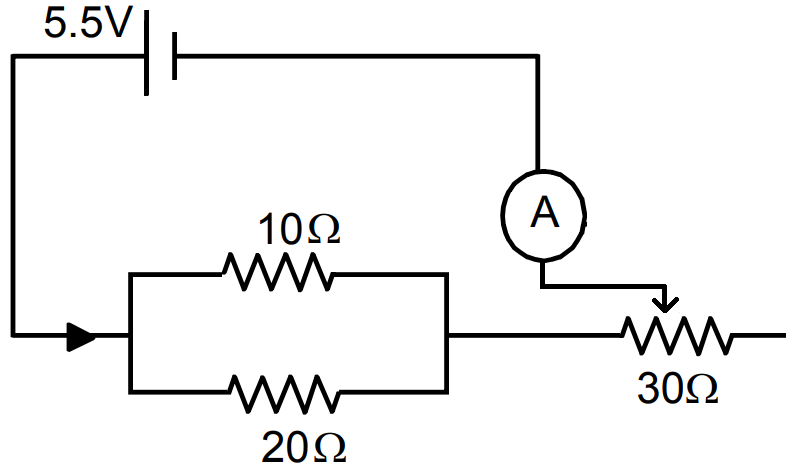
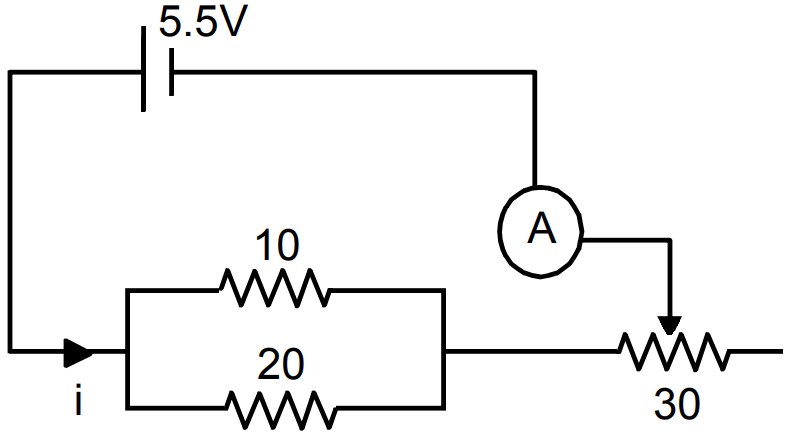
The resistance of the rheostat shown in the figure. is $30\Omega.$ Neglecting the meter resistance, find the minimum and maximum currents through the ammeter as the rheostat is varied.

Answer


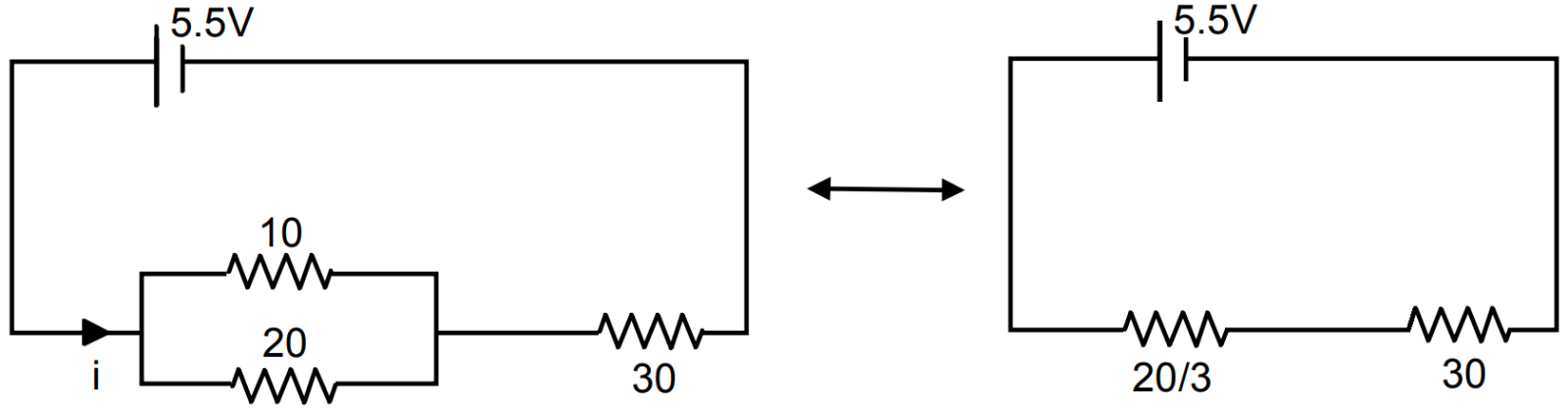
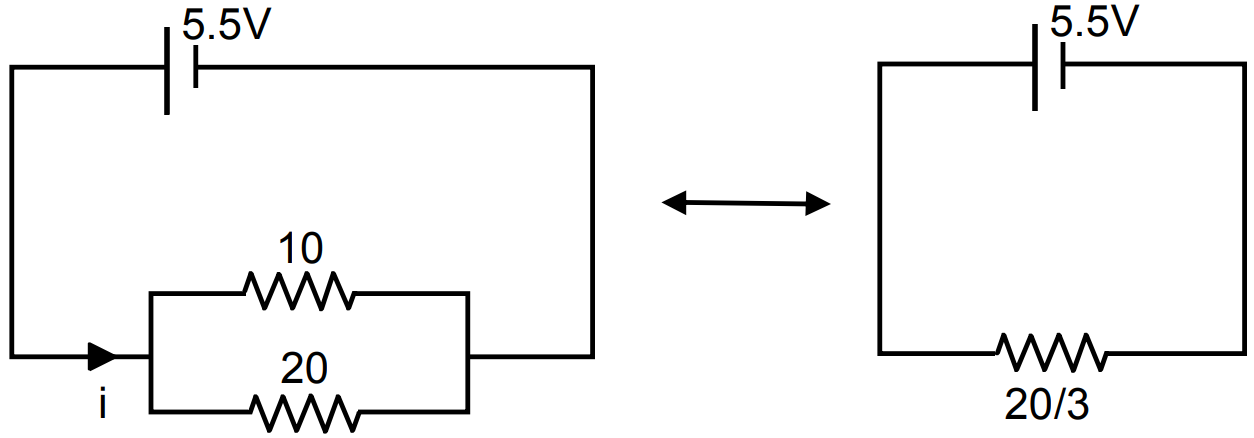
$\text{i}_\text{min}=\frac{5.5\times3}{110}=0.15$

$\text{i}_\text{min}=\frac{5.5\times3}{20}=\frac{16.5}{20}=0.825.$

View full question & answer
Question 855 Marks
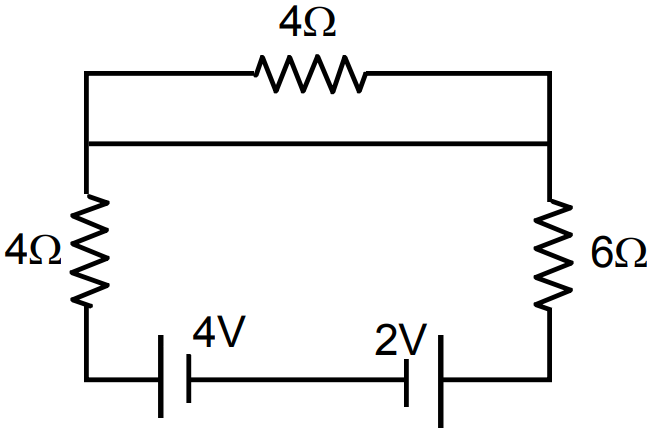
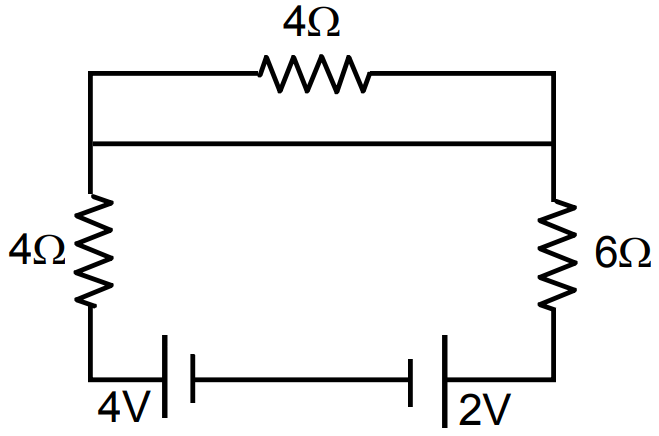
Find the currents through the three reaiators shown in figure.

Answer

  1. Current through (1) $4\Omega$ resistor = 0
  2. Current through (2) and (3)

net E = 4V - 2V = 2V

(2) and (3) are in series,

$\text{R}_\text{eff}=4+6=10\Omega$

$\text{i}=\frac{2}{10}=0.2\text{A}$

Current through (2) and (3) are 0.2A.

View full question & answer
Question 865 Marks
 An electric kettle used to prepare tea, takes 2 minutes to boil 4 cups of water (1 cup contains 200cc of water) if the room temperature is 25C.
  1. If the cost of power consumption is Rs. 1.00 per unit (1 unit - 1000 watt-hour), calculate the cost of boiling 4 cups of water.
  2. What will be the corresponding cost if the room temperature drops to 5°C?
Answer
  1. Volume of water boiled = 4 × 200cc = 800cc

T1 = 25°C

T2 = 100°C

⇒ T2 – T1 = 75°C

Mass of water boiled = 800 × 1 = 800gm = 0.8kg(heat req.) $=\text{MS}\Delta\theta=0.8\times4200\times75=252000\text{J}.$

1000 watt-hour = 1000 × 3600 watt-sec = 1000 × 3600J

No. of units $=\frac{252000}{1000\times3600}=0.07=7\ \text{paise}$

  1. $\text{Q}=\text{mS}\Delta\text{T}=0.8\times4200\times95\text{J}$

No. of units $=\frac{0.8\times4200\times95}{1000\times3600}=0.0886\approx0.09$

Money consumed = 0.09 Rs = 9 paise.

View full question & answer
Question 875 Marks
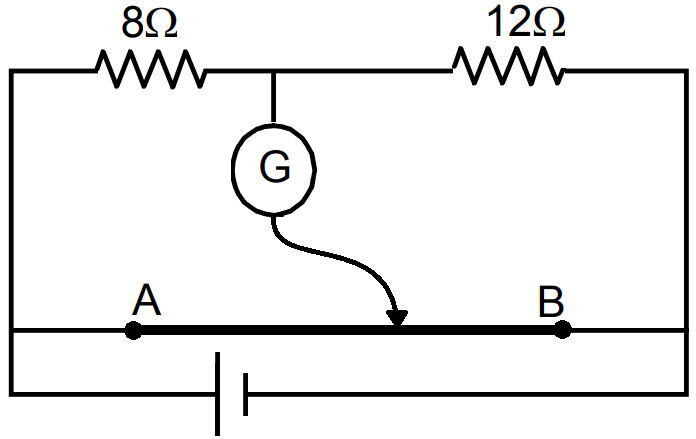
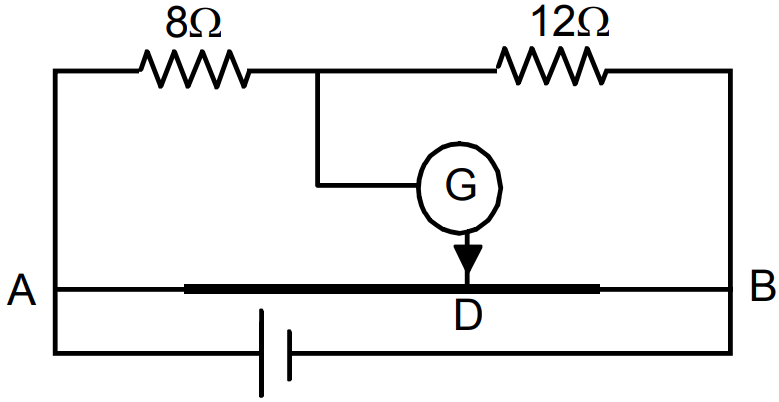
The potentiometer wire AB shown in the figure. is 40cm long. Where should the free end of the galvanometer be connected on AB so that the galvanometer may show zero deflection?

Answer

If the wire is connected to the potentiometer wire so that $\frac{\text{R}_\text{AD}}{\text{R}_\text{DB}}=\frac{8}{12},$ then according to wheat stone’s bridge no current will flow through galvanometer.

$\frac{\text{R}_\text{AB}}{\text{R}_\text{DB}}=\frac{\text{L}_\text{AB}}{\text{L}_\text{B}}=\frac{8}{12}=\frac{2}{3}$ (Acc. To principle of potentiometer).

$\text{I}_\text{AB}+\text{I}_\text{DB}=40\text{cm}$

$\Rightarrow\text{I}_\text{DB}\frac{2}{3}+\text{I}_\text{DB}=40\text{cm}$

$\Rightarrow\Big(\frac{2}{3}+1\Big)\text{I}_\text{DB}=40\text{cm}$

$\Rightarrow\frac{5}{3}\text{I}_\text{DB}=40$

$\Rightarrow\text{L}_\text{DB}=\frac{40\times3}{5}=24\text{cm}.$

$\text{I}_\text{AB}=(40-24)\text{cm}=16\text{cm}.$

View full question & answer
Question 885 Marks
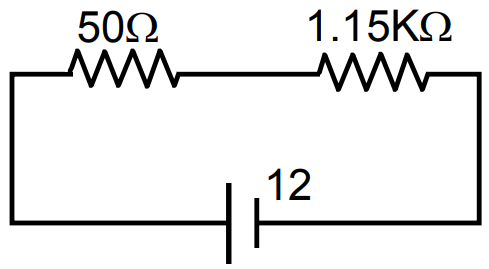
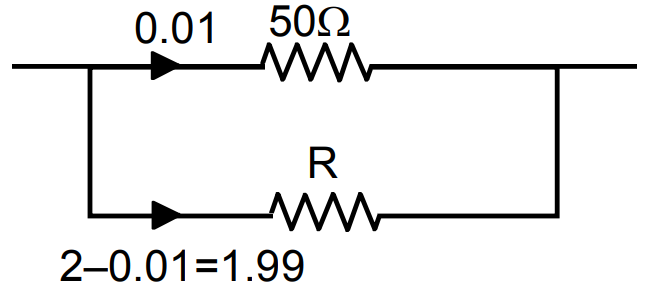
A voltmeter coil has resistance $50.0\Omega$ and a resistor of $1.15\text{k}\Omega$ is connected in series. It can read potential differences up to 12 volts. If this same coil is used to construct an ammeter that can measure currents up to 2.0A, what should be the resistance of the shunt used?
Answer


$\text{R}_\text{eff}=(1150+50)\Omega=1200\Omega$

$\text{i}=\Big(\frac{12}{1200}\Big)\text{A}=0.01\text{A}.$

(The resistor of $50\Omega$ can tolerate)

Let R be the resistance of sheet used.

The potential across both the resistors is same.

$0.01\times50=1.99\times\text{R}$

$\Rightarrow\text{R}=\frac{0.01\times50}{1.99}=\frac{50}{199}=0.251\Omega$

View full question & answer
Question 895 Marks
A 6 volt battery of negligible internal resistance is connected across a uniform wire AB of length 100cm. The positive terminal of another battery of emf 4V and internal resistance $1\Omega$ is joined to the point A, as shown in the figure. Take the potential at B to be zero. (a) What are the potentials at the points A and C? (b) At which point D of the wire AB, the potential is equal to the potential at C? (c) If the points C and D are connected by a wire, what will be the current through it? (d) If the 4V battery is replaced by a 7.5V battery, what would be the answers of parts (a) and (b)?

Answer
  1. Potential difference between A and B is 6V.

B is at 0 potential.

Thus potential of A point is 6V.

The potential difference between Ac is 4V.

$\text{V}_\text{A}-\text{V}_\text{C}=0.4$

$\text{V}_\text{C}=\text{V}_\text{A}-4=6-4=2\text{V}$

  1. The potential at $\text{D}=2\text{V},\text{V}_\text{AD}=4\text{V};\text{V}_\text{BD}=\text{OV}$

Current through the resisters R1 and R2 are equal

Thus, $\frac{4}{\text{R}_1}=\frac{2}{\text{R}_2}$

$\Rightarrow\frac{\text{R}_1}{\text{R}_2}=2$

$\Rightarrow\frac{\text{I}_1}{\text{I}_2}=2$ (Acc. to the law of potentiometer)

$\text{I}_1+\text{I}_2=100\text{cm}$

$\Rightarrow\text{I}_1+\frac{\text{I}_1}{2}=100\text{cm}\Rightarrow\frac{3\text{I}_1}{2}=100\text{cm}$

$\Rightarrow\text{I}_1=\frac{200}{3}\text{cm}=66.67\text{cm}.$

$\text{AD}=66.67\text{cm}$

  1. When the points C and D are connected by a wire current flowing through it is 0 since the points are equipotential.

  2. Potential at A = 6 v

Potential at C = 6 - 7.5 = -1.5V

The potential at B = 0 and towards A potential increases.

Thus -ve potential point does not come within the wire.

View full question & answer
Question 905 Marks
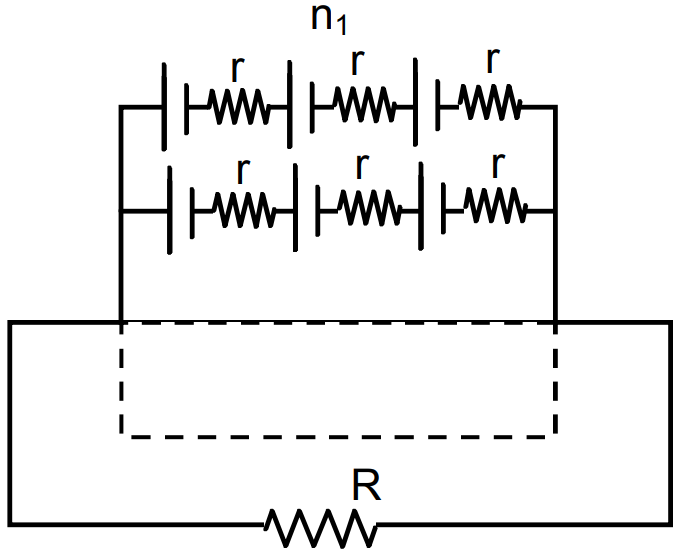
Consider N = n1n2 identical cells, each of emf $\in$ and internal resistance r. Suppose n1 cells are joined in series to form a line and n2 such lines are connected in parallel. The combination drives a current in an external resistance R. (a) Find the current in the external resistance. (b) Assuming that n1 and n2 can be continuously varied, find the relation between n1, n2, R and r for which the current in R is maximum.
Answer

  1. Total emf = n1E

in 1 row

Total emf in all news = n1E

Total resistance in one row = n1r

Total resistance in all rows $=\frac{\text{n}_1\text{r}}{\text{n}_2}$

Net resistance $=\frac{\text{n}_1\text{r}}{\text{n}_2}+\text{R}$

Current $=\frac{\text{n}_1\text{E}}{\frac{\text{n}_1}{\text{n}_2\text{r}}+\text{R}}=\frac{\text{n}_1\text{n}_2\text{E}}{\text{n}_1\text{r}+\text{n}_2\text{R}}$

  1. $\text{I}=\frac{\text{n}_1\text{n}_2\text{E}}{\text{n}_1\text{r}+\text{n}_2\text{R}}$

for I = max,

n1r + n2R = min

$\Rightarrow\Big(\sqrt{\text{n}_1\text{r}}-\sqrt{\text{n}_2\text{R}}\Big)^2+2\sqrt{\text{n}_1\text{rn}_2\text{R}}=\text{min}$

it is min, when

$\sqrt{\text{n}_1\text{r}}=\sqrt{\text{n}_2\text{R}}$

$\Rightarrow\text{n}_1\text{r}=\text{n}_2\text{R}$

I is max when n1r = n2R.

View full question & answer
Question 915 Marks
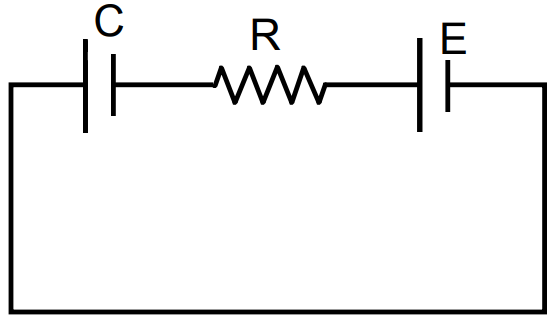
A capacitance C, a resistance R and an emf $\in$ are connected in series at t = 0. What is the maximum value of (a) the potential difference across the resistor (b) the current in the circuit (c) the potential difference across the capacitor (d) the energy stored in the capacitor (e) the power delivered by the battery and (f) the power converted into heat?
Answer

  1. Potential difference = E across resistor

  2. Current in the circuit $=\frac{\text{E}}{\text{R}}$

  3. Pd. Across capacitor $=\frac{\text{E}}{\text{R}}$

  4. Energy stored in capacitor $=\frac{1}{2}\text{CE}^2$

  5. Power delivered by battery $=\text{E}\times\text{I}=\text{E}\times\frac{\text{E}}{\text{R}}=\frac{\text{E}^2}{\text{R}}$

  6. Power converted to heat $=\frac{\text{E}^2}{\text{R}}$

View full question & answer
Question 925 Marks
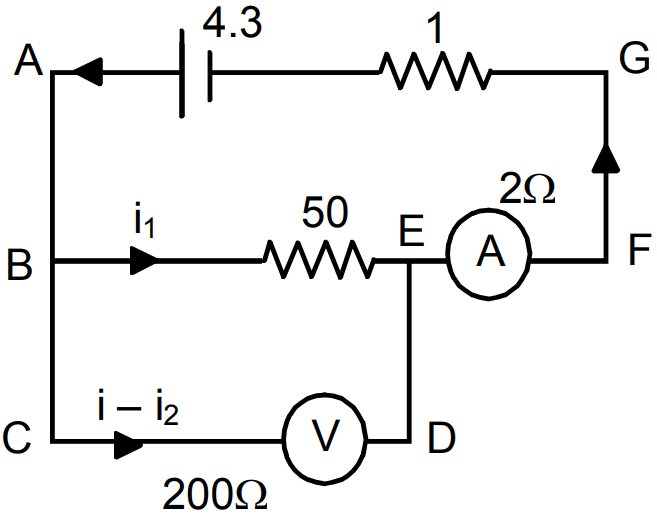
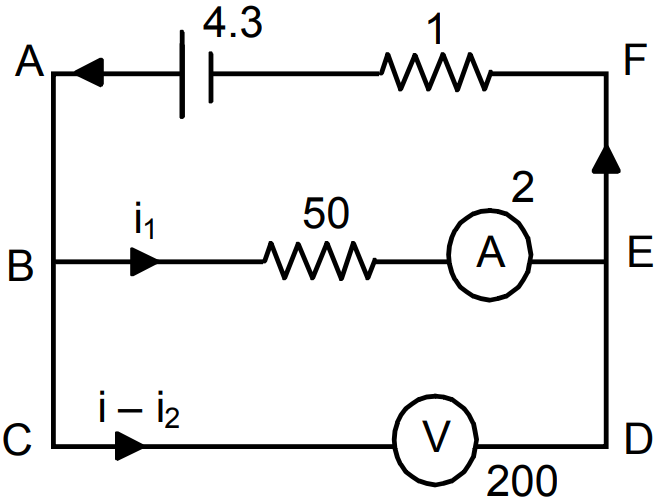
The emf $\in$ and the internal resistance r of the battery, shown in the figure. are 4.3V and $1.0\Omega$ respectively. The external resistance R is $50\Omega.$ The resistances of the ammeter and voltmeter are $2.0\Omega$ and $200\Omega$ respectively. (a) Find the readings of the two $200\Omega$ respectively. (a) Find the readings of the two meters. (b) The switch is thrown to the other side. What will be the readings of the two meters now?

Answer
  1. In circuit ABFGA,

$\text{i}_150+2\text{i}+\text{i}-4.3=0$

$\Rightarrow50\text{i}_1+3\text{i}=4.3\ ...(1)$

In circuit BEDCB,

$50\text{i}-200\text{i}+200\text{i}_1=0$

$\Rightarrow250\text{i}_1-200\text{i}=0$

$\Rightarrow50\text{i}_1-40\text{i}=0\ ...(2)$

From (1) and (2)

$43\text{i}=4.3\Rightarrow\text{i}=0.1$

$5\text{i}_1=4\times\text{i}=4\times0.1$

$\Rightarrow\text{i}_1=\frac{4\times0.1}{5}=0.08\text{A}$

Ammeter reads a current $=\text{i}=0.1\text{A}$

Voltmeter reads a potential difference equal to $\text{i}_1\times50=0.08\times50=4\text{V}.$

  1. In circuit ABEFA,

$50\text{i}_1+2\text{i}_1+1\text{i}-4.3=0$

$\Rightarrow52\text{i}_1+\text{i}=4.3$

$\Rightarrow200\times52\text{i}_1+200\text{i}=4.3\times200\ ...(1)$

In circuit BCDEB,

$(\text{i}-\text{i}_1)200-\text{i}_12-\text{i}_150=0$

$\Rightarrow200\text{i}-200\text{i}_1-2\text{i}_1-50\text{i}_1=0$

$\Rightarrow200\text{i}-252\text{i}_1=0\ ...(2)$

From (1) and (2)

$\text{i}_1(10652)=4.3\times2\times100$

$\Rightarrow\text{i}_1=\frac{4.3\times2\times100}{10652}=0.08$

$\text{i}=4.3-52\times0.08=0.14$

Reading of the ammeter = 0.08a

Reading of the voltmeter $=(\text{i}-\text{i}_1)200=(0.14-0.08)\times200=12\text{V}.$

View full question & answer
Question 935 Marks
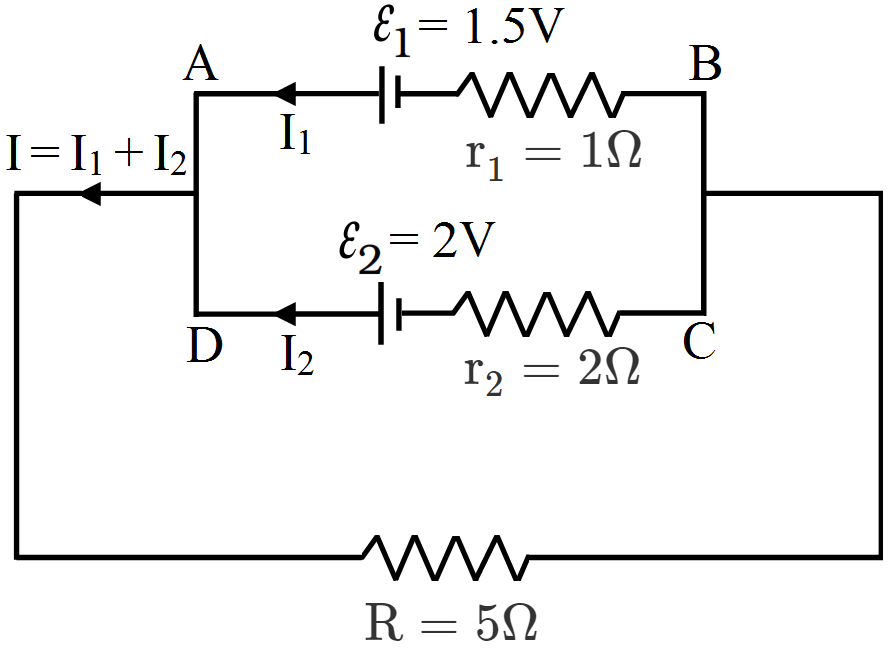
Two cells of emf 1.5V and 2V and internal resistance $1\Omega$ and $2\Omega$ respectively are connected in parallel to pass a current in the same direction through an external resistance of $5\Omega.$

  1. Draw the circuit diagram.
  2. Using Kirchhoff’s laws, calculate the current through each branch of the circuit and potential difference across $5\Omega$ resistor.

​​​​​​​

Answer
  1. The circuit is shown in figure.
  2. Suppose I1 are I2 current drawn from cells $\varepsilon_1$ and $\varepsilon_2$ respectively, then

According to Kirchhoff’s junction law, current in $\text{R}=5\Omega,\text{I}=\text{I}_1+\text{I}_2.$

Applying Kirchhoff’s second law to mesh ABFEA

$1\times\text{I}_1+1.5-5(\text{I}_1+\text{I}_2)=0$

$\Rightarrow\text{I}_1+5\text{I}_2=1.5\dots\text{(i)}$

Applying Kirchhoff’s second law to mesh CDEFC

$-2\text{I}_2+2-5(\text{I}_1+\text{I}_2=0$

$\Rightarrow\text{5I}_1+7\text{I}_2=2\dots\text{(ii)}$

Solving equation (i) and (ii), we get

$\text{I}_1=\frac{1}{34}\text{A},\text{I}_2=\frac{9}{34}\text{A}$

$\text{I}=\text{I}_1+\text{I}_2=\frac{1}{34}+\frac{9}{34}=\frac{10}{34}$

Potential difference avross $\text{R}=5\Omega$ resistor

$(\text{I}_1+\text{I}_2)\text{R}=\frac{10}{34}\times5=\frac{25}{17}\text{Volt}$

View full question & answer
Question 945 Marks
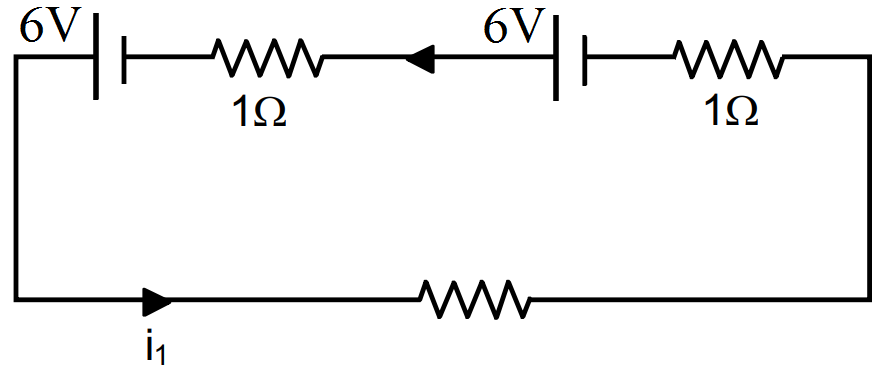
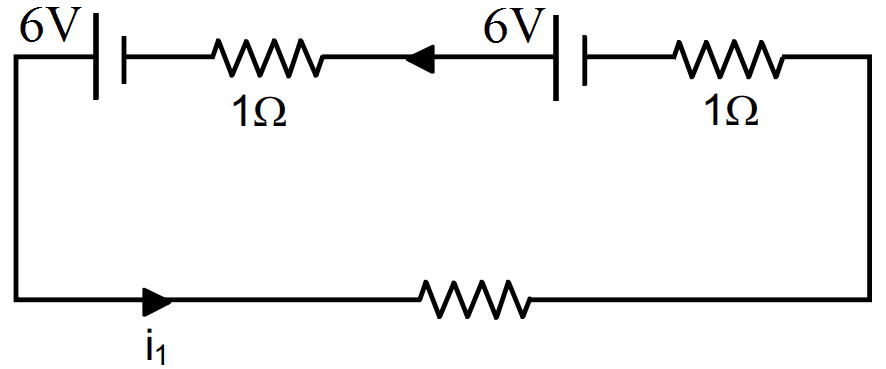
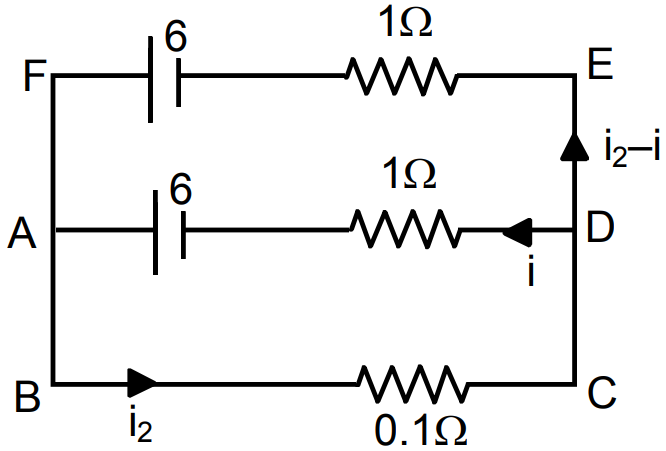
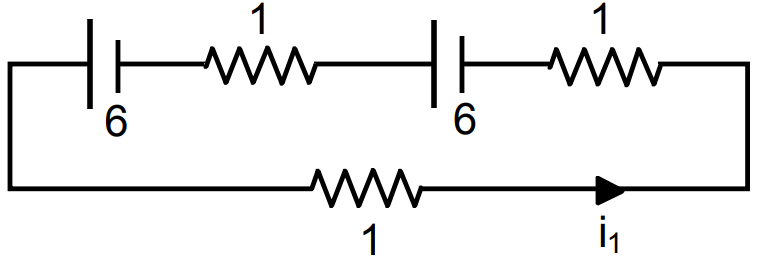
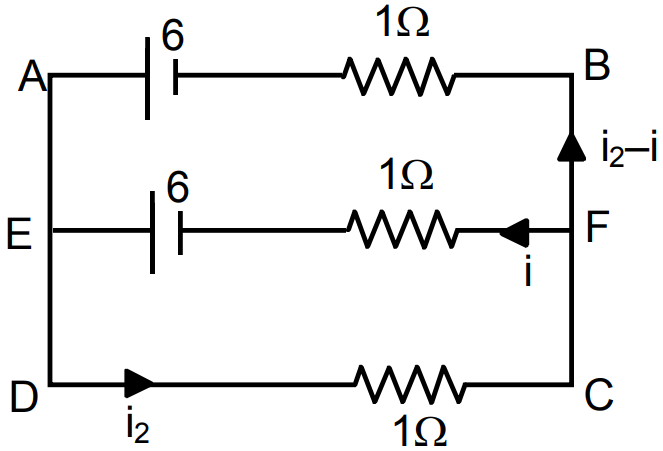
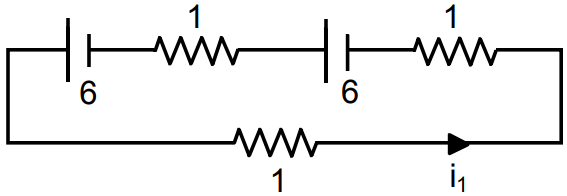
Find the value of $\frac{\text{i}_1}{\text{i}_2}$ in the figure. if (a) $\text{R}=0.1\Omega$ (b) $\text{R}=1\Omega$ and (c) $\text{R}=10\Omega.$ Note from your answers that in order to get more current from a combination of two batteries, they should be joined in parallel if the external resistance is small and in series if the external resistance is large, compared to the internal resistance.

Answer
  1. $0.1\text{i}_1+1\text{i}_1-6+1\text{i}_1-6=0$

$\Rightarrow0.1\text{i}_1+1\text{i}_1+1\text{i}_1=12$

$\Rightarrow\text{i}_1=\frac{12}{2.1}$

$\text{ABCDA}$

$\Rightarrow0.1\text{i}_2+1\text{i}-6=0$

$\Rightarrow0.1\text{i}_2+1\text{i}$

$\text{ADEFA}$

$\Rightarrow\text{i}-6+6-(\text{i}_2-\text{i})1=0$

$\Rightarrow\text{i}-\text{i}_2+\text{i}=0$

$\Rightarrow2\text{i}-\text{i}_2=0\Rightarrow-2\text{i}\pm0.2\text{i}=0$

$\Rightarrow\text{i}_2=0.$

  1. $1\text{i}_1+1\text{i}_1-6+1\text{i}_1=0$

$\Rightarrow3\text{i}_1=12\Rightarrow\text{i}_1=4$

$\text{DCFED}$

$\Rightarrow\text{i}_2+\text{i}-6=0\Rightarrow\text{i}_2+\text{i}=6$

$\text{ABCDA}$

$\text{i}_2+(\text{i}_2-\text{i})-6=0$

$\Rightarrow\text{i}_2+\text{i}_2-\text{i}=6\Rightarrow2\text{i}_2-\text{i}=6$

$\Rightarrow-2\text{i}_2\pm2\text{i}=6\Rightarrow\text{i}=-2\text{i}_2+\text{i}=6$

$\Rightarrow\text{i}_2-2=6\Rightarrow\text{i}_2=8$

$\frac{\text{i}_1}{\text{i}_2}=\frac{4}{8}=\frac{1}{2}.$

  1. $10\text{i}_1+1\text{i}_1-6+1\text{i}_1-6=0$

$\Rightarrow12\text{i}_1=12\Rightarrow\text{i}_1=1$

$10\text{i}_2-\text{i}_1-6=0$

$\Rightarrow10\text{i}_2-\text{i}_1=6$

$\Rightarrow10\text{i}_2+(\text{i}_2-\text{i})1-6=0$

$\Rightarrow11\text{i}_2=6$

$\Rightarrow-\text{i}_2=0.$

View full question & answer
Question 955 Marks
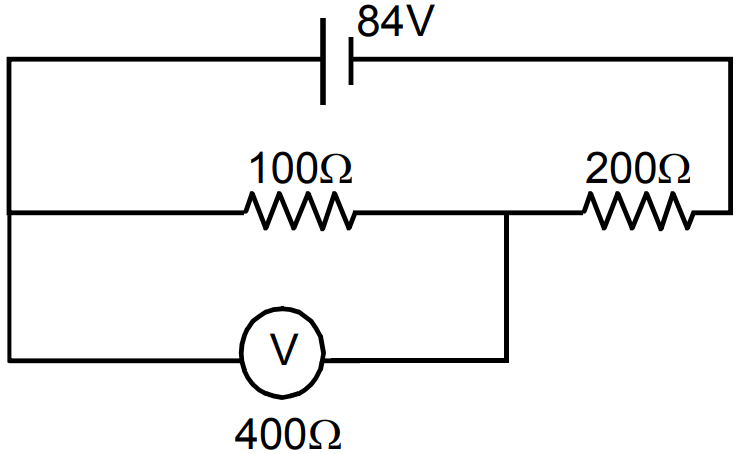
A voltmeter of resistance $400\Omega$ is used to measure the potential difference across the $100\Omega$ resistor in the circuit shown in the figure. (a) What will be the reading of the voltmeter? (b) What was the potential difference across $100\Omega$ before the voltmeter was connected?

Answer

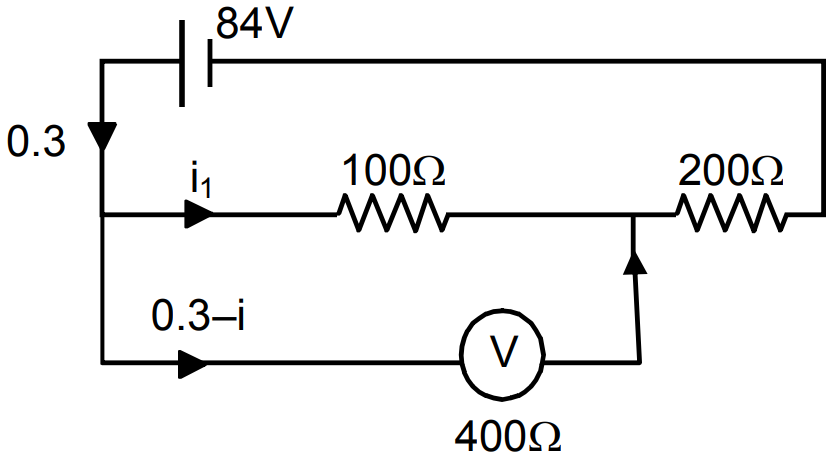
  1. $\text{R}_\text{eff}=\frac{100\times400}{500}+200=280$

$\text{i}=\frac{84}{280}=0.3$

$100\text{i}=(0.3-\text{i})400$

$\Rightarrow\text{i}=1.2-4\text{i}$

$\Rightarrow5\text{i}=1.2\Rightarrow\text{i}=0.24$

Voltage measured by the voltmeter $=\frac{0.24\times100}{24\text{V}}$

  1. If voltmeter is not connected

$\text{R}_\text{eff}=(200+100)=300\Omega$

$\text{i}=\frac{84}{300}=0.28\text{A}$

Voltage across $100\Omega=(0.28\times100)=28\text{V}.$

View full question & answer
Question 965 Marks
A capacitor of capacitance $12.0\mu\text{F}$ is connected to a battery of emf 6.00V and internal resistance $1.00\Omega$ through resistanceless leads. $12.0\mu\text{s}$ after the connections are made, what will be (a) the current in the circuit (b) the power delivered by the battery (c) the power dissipated in heat and (d) the rate at which the energy stored in the capacitor is increasing.
Answer
  1. $\text{C} = 12.0 \mu\text{F} = 12 \times 10^{-6}$

$\text{emf} = 6.00 \text{V, R} = 1\Omega$

$\text{t} = 12 \mu\text{c}, \text{ i} = \text{i}_0 \text{e}^{\frac{-\text{t}}{\text{RC}}}$

$=\frac{\text{CV}}{\text{T}}\times\text{e}^\frac{-\text{t}}{\text{RC}}=\frac{12\times10^{-6}\times6}{12\times10^{-6}}\times\text{e}^{-1}$

$=2.207=2.1\text{A}$

  1. Power delivered by battery

We known, $\text{V}=\text{V}_0\text{e}^{\frac{-\text{t}}{\text{RC}}}$ (where V and V0 are potential VI)

$\text{VI}=\text{V}_0\text{I}\text{e}^{\frac{-\text{t}}{\text{RC}}}$

$\Rightarrow\text{VI}=\text{V}_0\text{I}\times\text{e}^{-1}=6\times6\times\text{e}^{-1}=13.24\text{W}$

  1. $\text{U}=\frac{\text{CV}^2}{\text{T}}\Big(\text{e}^{\frac{-\text{t}}{\text{RC}}}\Big)^2$ $\Big[\frac{\text{CV}^2}{\text{T}}$ = energy drawing per unit time$\Big]$

$=\frac{12\times10^{-6}\times36}{12\times10^{-6}}\times\big(\text{e}^{-1}\big)^2=4.872.$

View full question & answer
Question 975 Marks
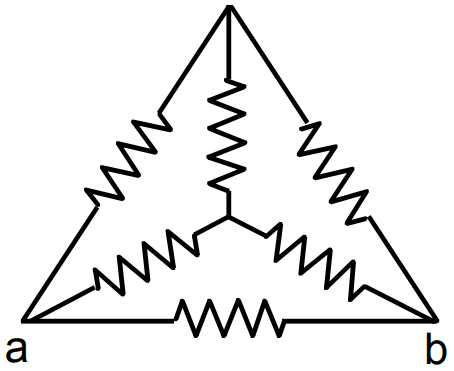
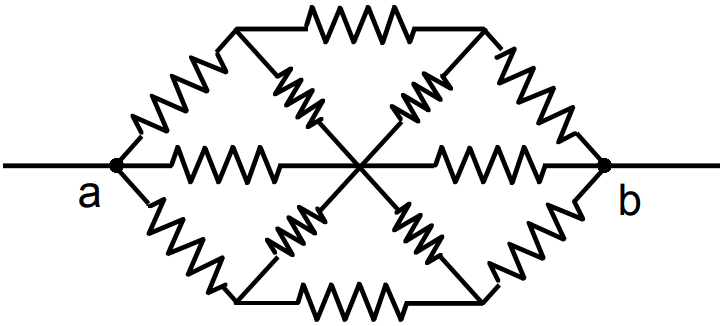
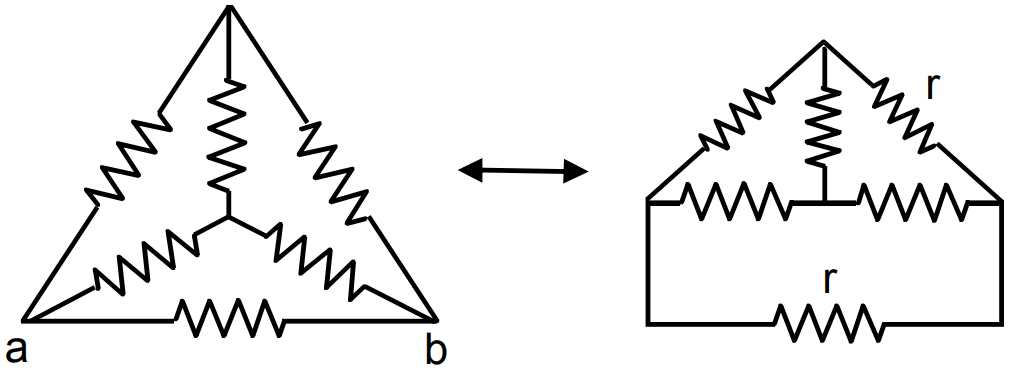
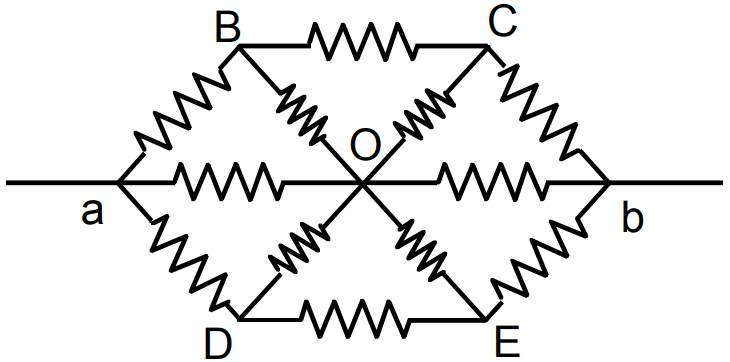
Find the equivalent resistance of the circuits shown in the figure. between the points a and b. Each resistor has resistance r.
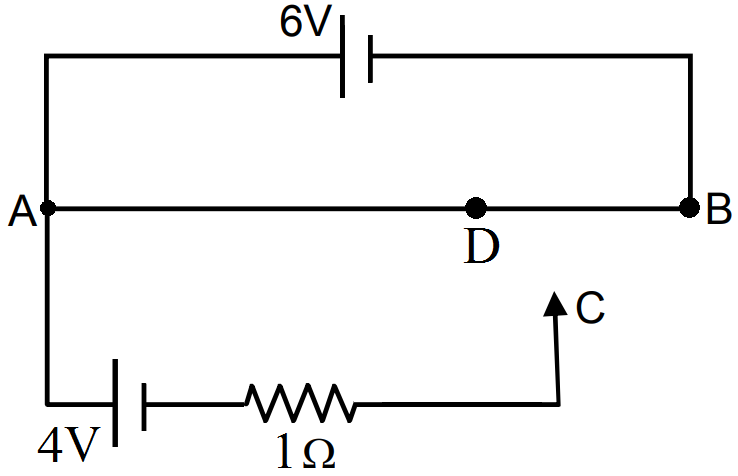

Answer
  1. $\text{R}_\text{eff}=\frac{\Big(\frac{2\text{r}}{2}\Big)\times\text{r}}{\Big(\frac{2\text{r}}{2}\Big)+\text{r}}$

$=\frac{\text{r}^2}{2\text{r}}=\frac{\text{r}}{2}$

  1. At 0 current coming to the junction is current going from BO = Current going along OE.

Current on CO = Current on OD

Thus it can be assumed that current coming in OC goes in OB.

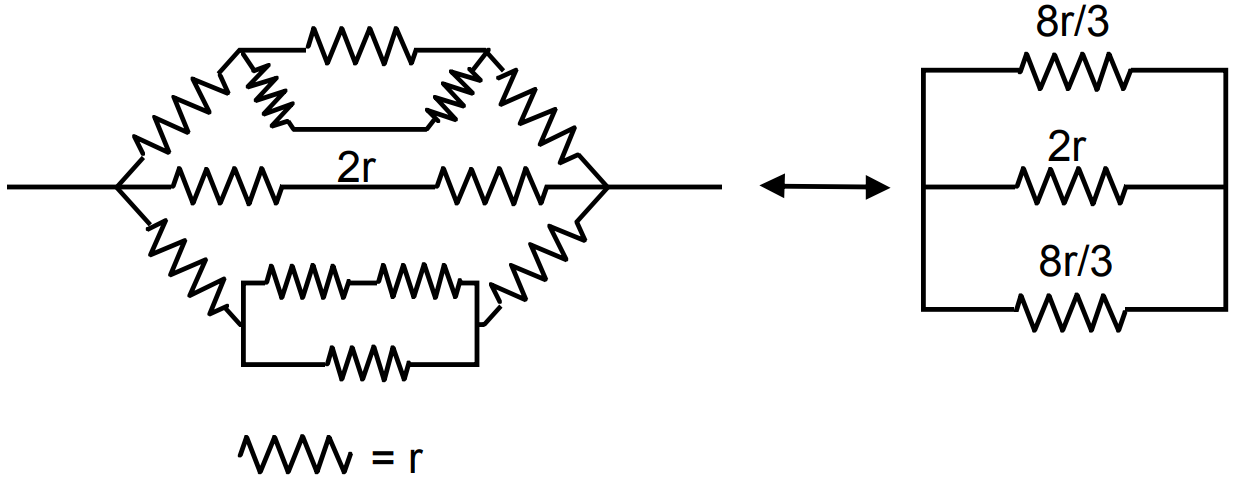
Thus the figure becomes

$\Bigg[\text{r}+\Big(\frac{2\text{r}\times\text{r}}{3\text{r}}\Big)+\text{r}\Bigg]=2\text{r}+\frac{2\text{r}}{3}=\frac{8\text{r}}{3}$

$\text{R}_\text{eff}=\frac{\Big(\frac{8\text{r}}{6}\Big)\times2\text{r}}{\Big(\frac{8\text{r}}{6}\Big)+2\text{r}}=\frac{\frac{8\text{r}^2}{3}}{\frac{20\text{r}}{6}}=\frac{8\text{r}^2}{3}\times\frac{6}{20}=\frac{8\text{r}}{10}=4\text{r}.$

View full question & answer
Question 985 Marks
The 2.0Ω resistor shown in the figure is dipped into a calorimeter containing water. The heat capacity of the calorimeter together with water is 2000JK-1.
  1. If the circuit is active for 15 minutes, what would be the rise in the temperature of the water?
  2. Suppose the 6.0Ω resistor gets burnt. What would be the rise in the temperature of the water in the next 15 minutes?

Answer

$\text{R}_\text{eff}=\frac{12}{8}+1=\frac{5}{2}$

$\text{i}=\frac{6}{\frac{5}{2}}=\frac{12}{5}\text{Amp.}$

$\text{i}'6=({\text{i-i}'})2\Rightarrow\text{i}'6=\frac{12}{\frac{5}{2}}\times2-2\text{i}$

$8\text{i}'=\frac{24}{5}\Rightarrow\text{i}'=\frac{24}{5\times8}=\frac{3}{5}\text{Amp}$

$\text{i-i}'=\frac{12}{5}-\frac{3}{5}=\frac{9}{5}\text{Amp}$

  1. Heat $=\text{i}^2\text{RT}=\frac{9}{5}\times\frac{9}{5}\times2\times15\times60=5832$

2000J of heat raises the temp. by 1K

5832J of heat raises the temp. by 2.916K.

  1. When $6\Omega$ resistor get burnt $\text{R}_\text{eff}=1+2=3\Omega$

$\text{i}=\frac{6}{3}=2\text{Amp}$

Heat = 2 × 2 × 2 × 15 × 60 = 7200J

2000J raises the temp. by 1K

7200J raises the temp by 3.6k.

View full question & answer
Question 995 Marks
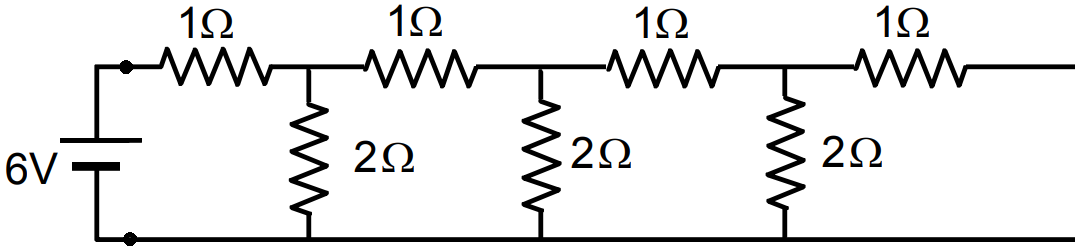
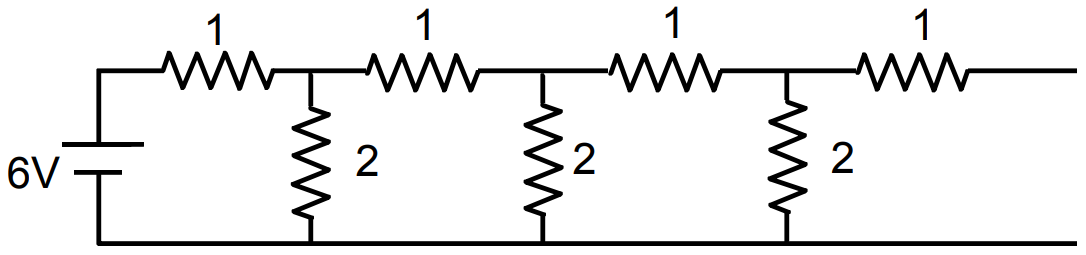
An infinite ladder is constructed with $1\Omega$ and $2\Omega$ resistors, as shown in the figure.

(a) Find the effective resistance between the points A and B. (b) Find the current that passes through the $2\Omega$ resistor nearest to the battery.
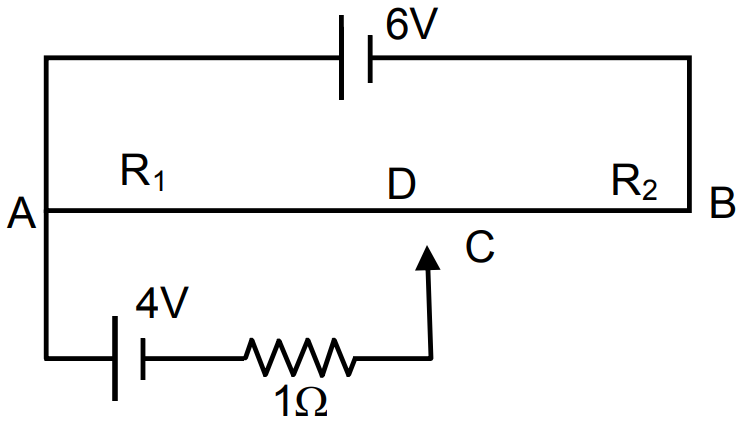
Answer
  1. Let the equation resistance of the combination be R.
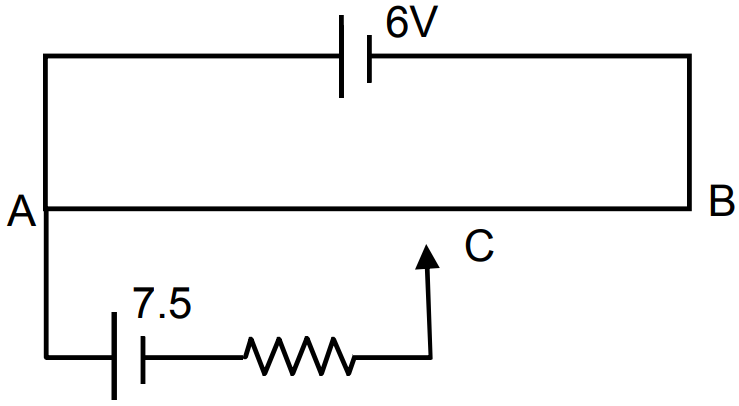
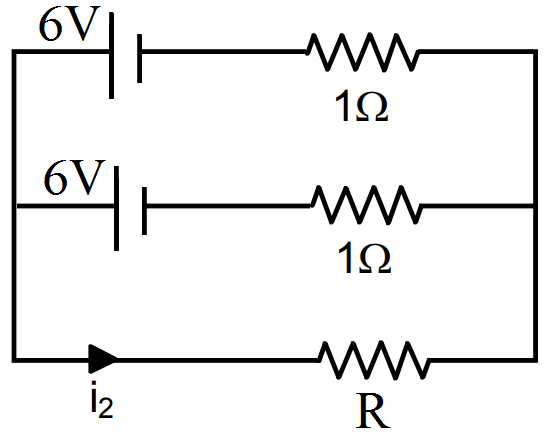
$\Big(\frac{2\text{R}}{\text{R}+2}\Big)+1=\text{R}$

$\Rightarrow\frac{2\text{R}+\text{R}+2}{\text{R}+2}=\text{R}\Rightarrow3\text{R}+2=\text{R}^2+2\text{R}$

$\Rightarrow\text{R}^2-\text{R}-2=0$

$\Rightarrow\text{R}=\frac{+1\pm\sqrt{1+4\times1\times2}}{2.1}$

$=\frac{1\pm\sqrt{9}}{2}=\frac{1\pm3}{2}=2\Omega.$

  1. Total current sent by battery $=\frac{6}{\text{R}_\text{eff}}=\frac{6}{2}=3$

Potential between A and B

$3.1+2\text{i}=6$

$\Rightarrow3+2\text{i}=6\Rightarrow2\text{i}=3$

$\Rightarrow\text{i}=1.5\text{a}$

View full question & answer
Question 1005 Marks
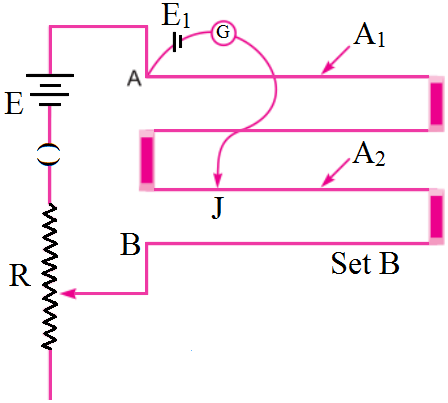
You are given two sets of potentiometer circuits to measure the emf E1 of a cell.

Set A: consists of a potentiometer wire of a material of resistivity $\rho_1$, area of cross-section A1 and length l.

Set B: consists of a potentiometer of two composite wire of equal lengths $\frac{\text{l}}2{}$ each, of resistivity $\rho_1,\rho_2$ and area of cross-section A1, A2 respectively.

Find the relation between resistivity of the two wires with respect to their area of cross section, if the current flowing in the two sets is same.

Compare the balancing length obtained in the two sets.

Answer
  1.  $\text{I}=\frac{\varepsilon}{\text{R}+\frac{\rho_1\text{l}}{\text{A}_1}}$ for set A and $\text{I}=\frac{\in}{\text{R}+\frac{\rho_1\text{l}}{2\text{A}_1}+\frac{\rho_2\text{l}}{2\text{A}_2}}\text{for set B}$

Equating the above two expressions, we have,

$\frac{\varepsilon}{\text{R}+\frac{\rho_1\text{l}}{2\text{A}_1}}=\frac{\varepsilon}{\text{R}+\frac{\rho_1\text{l}}{2\text{A}_1}+\frac{\rho_2\text{l}}{2\text{A}_2}}$

$\Rightarrow\text{R}+\frac{\rho_1\text{l}}{\text{A}_1}=\text{R}+\frac{\rho_1\text{l}}{2\text{A}_1}+\frac{\rho_1\text{l}}{2\text{A}_2}$

$\Rightarrow\frac{\rho_1\text{l}}{\text{A}_1}-\frac{\rho_1\text{l}}{2\text{A}_1}=\frac{\rho_2\text{l}}{2\text{A}_2}\dots\text{(i})$

$\Rightarrow\frac{\rho_1}{\text{A}_1}=\frac{\rho_2}{\text{A}_2}$

  1. Potential gradient of the potentiometer wire for set $\text{A},\text{K}=\text{I}\frac{\rho_1}{\text{A}_1}$

Potential drop across the potentiometer wire in set B

$\text{V}=\text{I}\Big(\frac{\rho_1\text{l}}{2\text{A}_1}+\frac{\rho_2\text{l}}{2\text{A}_2}\Big)\Rightarrow\text{V}=\frac{1}{2}\Big(\frac{\rho_1}{\text{A}_1}+\frac{\rho_2}{\text{A}_2}\Big)\text{I}$

$\text{K}'=\frac{\text{I}}{2}\Big(\frac{\text{r}_1}{\text{A}_1}+\frac{\text{r}_2}{\text{A}_2}\Big),$

Using the condition (i), we get

$\text{K}'=\text{I}\frac{\rho_1}{\text{A}_1},$ which is equal to K.

Therefore, balancing length obtained in the two sets is same.

View full question & answer