Questions · Page 2 of 2

3 Marks Question

Question 513 Marks
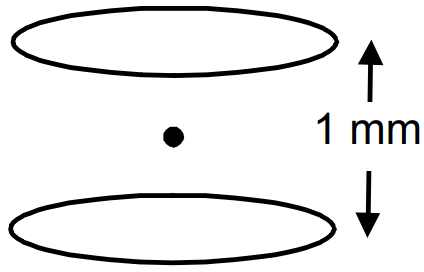
Suppose, one wishes to construct a 1.0 farad capacitor using circular discs. If the separation between the discs be kept at 1.0mm, what would be the radius of the discs?
Answer
Let the radius of the disc = R

$\therefore$ Area $=\pi\text{R}^2$

$\text{C}=1\text{f}$

$\text{D}=1\text{mm}=10^{-3}\text{m}$

$\therefore\text{C}=\frac{\in_0\text{A}}{\text{d}}$

$\Rightarrow1=\frac{8.85\times10^{-12}\times\pi\text{r}^2}{10^{-3}}$

$\Rightarrow\text{r}^2=\frac{10^{-3}\times10^{12}}{8.85\times\pi}=\frac{10^9}{27.784}$

$=5998.5\text{m}=6\text{Km}$
View full question & answer
Question 523 Marks
Consider two conducting spheres of radii R1 and R2 with R1 > R2. If the two are at the same potential, the larger sphere has more charge than the smaller sphere. State whether the charge density of the smaller sphere is more or less than that of the larger one.
Answer
Since, the two spheres are at the same potential, therefore

$\frac{1}{4\pi\in_0}\frac{\text{q}_1}{\text{R}_1}=\frac{1}{4\pi\in_0}\frac{\text{q}_2}{\text{R}_2}$

$\Rightarrow\ \frac{\text{R}_1}{\in_0}\frac{\text{q}}{4\pi\text{R}_1^2}=\frac{\text{R}_2}{\in_0}\frac{\text{q}_2}{4\pi\text{R}_2^2}$

or $\sigma_1\text{R}_1=\sigma_2\text{R}_2\Rightarrow\ \frac{\sigma_1}{\sigma_2}=\frac{\text{R}_2}{\text{R}_1}$

As $\text{R}_2>\text{R}_1$, this imply that $\sigma_1>\sigma_2$.

The charge density of the smalller sphere is more than thet of the larger one.

View full question & answer
Question 533 Marks
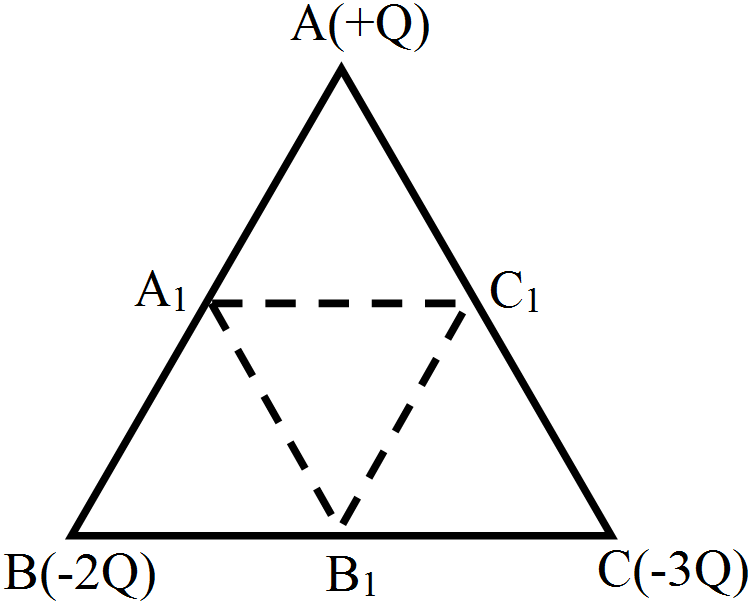
Three point charges +Q, -2Q and -3Q are placed at the vertices of an equilateral triangle ABC of side l.
If these charges are displaced to the mid points A1, B1 and C1 respectively, calculate the amount of work done in shifting the charges to the new locations.
Answer
Work done to put the three charges at A, B and C,

$\text{U}_{\text{initial}}=\frac{1}{4\pi\varepsilon_{0}}\Big[\frac{\text{Q}(-2\text{Q})}{\text{l}}+\frac{\text{Q}(-3\text{Q})}{\text{l}}+\frac{2\text{Q}(3\text{Q})}{\text{l}}\Big]$

$=\frac{1}{4\pi\varepsilon_0}\frac{1\text{Q}^2}{\text{l}}.$

Work done to take the three charges to position A1, B1 and C1,

$\text{U}_{\text{initial}}=\frac{1}{4\pi\varepsilon_0}\bigg[\frac{\text{Q}(-2\text{Q})}{\frac{\text{l}}{2}}+\frac{\text{Q}(-3\text{A})}{\frac{\text{l}}{2}}+\frac{2\text{Q}(3\text{Q})}{\frac{\text{l}}{2}}\bigg]$

$=\frac{1}{4\pi\varepsilon_0}\frac{2\text{Q}^2}{\text{l}}.$

Work done to shift the charges to the new locations is:

$\text{W}=\text{U}_{\text{final}}-\text{U}_{\text{initial}}=-\frac{1}{4\pi\varepsilon_0}\frac{2\text{Q}^2}{\text{l}}$

View full question & answer
Question 543 Marks
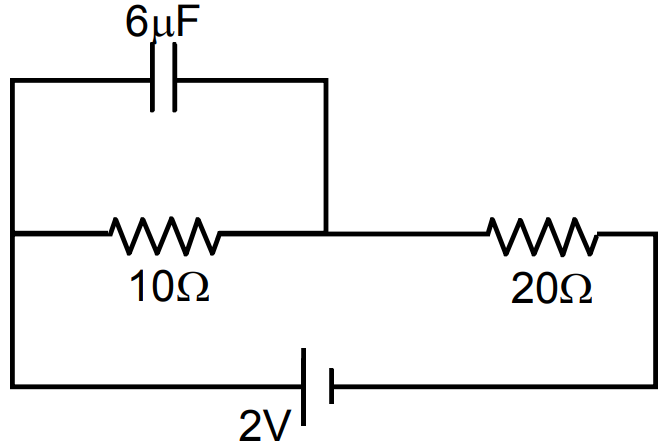
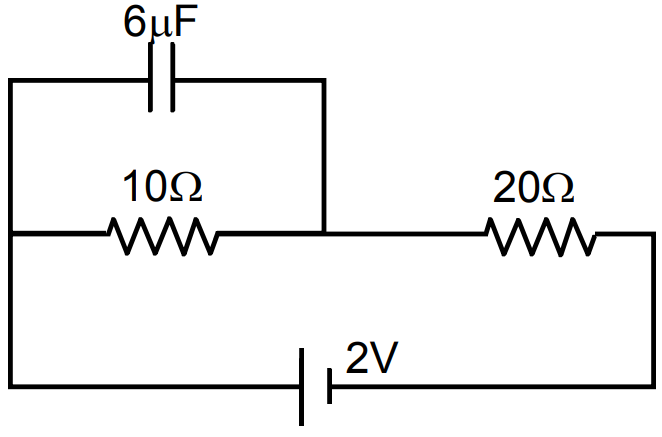
Find the charge on the capacitor shown in figure.

Answer
In steady stage condition no current flows through the capacitor.

$\text{R}_\text{eff}=10+20=30\Omega$

$\text{i}=\frac{2}{30}=\frac{1}{15}\text{A}$

Voltage drop across $10\Omega$ resistor = i × R

$=\frac{1}{15}\times10=\frac{10}{15}=\frac{2}{3}\text{V}$

Charge stored on the capacitor (Q) = CV

$=6\times10^{-6}\times\frac{2}{3}=4\times10^{-6}\text{C}=4\mu\text{C}.$

View full question & answer
Question 553 Marks
Two charges 5nC and -2nC are placed at points (5cm, 0, 0) and (23cm, 0, 0) in a region of space where there is no other external field. Calculate the electrostatic potential energy of this charge system.
Answer
Given q1 = 5nC = 5 × 10⁻⁹C, q2 = -2nC = -2 × 10⁻⁹C,

The charges are placed on X-axis. The distance between the charges,

x = x2 –x1 = (23 – 5)cm = 18cm = 0.18m

$\therefore$ Electrostatic potential energy of charges,

$\text{U}=\frac{1}{4\pi\varepsilon_0}\frac{\text{q}_1\text{q}_2}{\text{x}}$

$\frac{9\times10^9\big(5\times10^{-9}\big)\big(-2\times10^{-9}\big)}{0.18}=5\times10-7\text{J}$

View full question & answer
Question 563 Marks
“Gauss’s law in electrostatics is true for any closed surface, no matter what its shape or size is”. Justify this statement with the help of a suitable example.
Answer
According to Gauss theorem, the electric flux through a closed surface depends only on the net charge enclosed by the surface and not upon the shape or size of the surface.
For any closed arbitrary slope of the surface enclosing a charge the outward flux is the same as that due to a spherical Gaussian surface enclosing the same charge.
Justification: This is due to the fact that,
  1. Electric field is radial,
  2. The electric field $\text{E}\propto\frac{1}{\text{R}^2}$
View full question & answer
Question 573 Marks
When 1.0 × 10¹² electrons are transferred from one conductor to another, a potential difference of 10V appears between the conductors. Calculate the capacitance of the two-conductor system.
Answer
Given that

Number of electron = 1 × 10¹²

Net charge Q = 1 × 1012 × 1.6 × 10-19 = 1.6 × 10⁻⁷C

$\therefore$ The net potential difference = 10L.

$\therefore$ Capacitance

$\text{C}=\frac{\text{q}}{\text{v}}$

$=\frac{1.6\times10^{-7}}{10}=1.6\times10^{-8}\text{F}.$

View full question & answer
Question 583 Marks
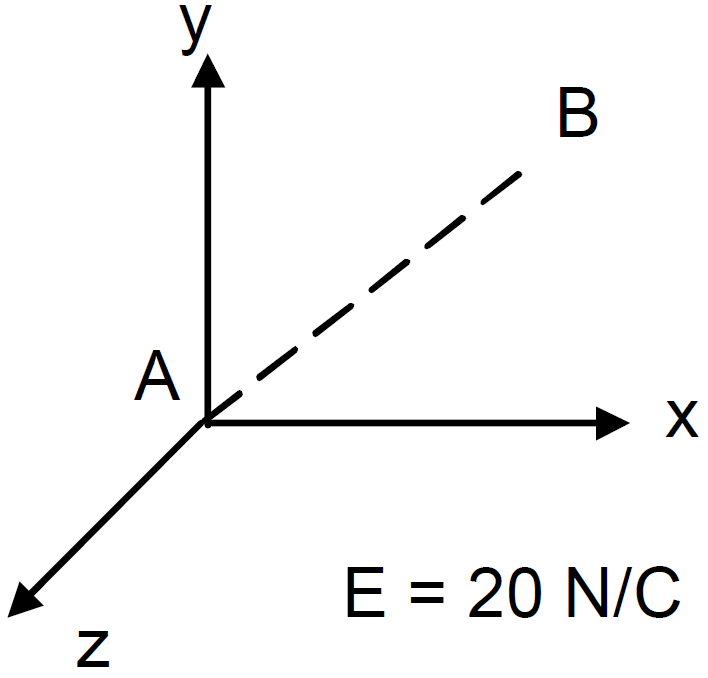
An electric field of 20NC-1 exists along the x-axis in space. Calculate the potential difference VB - VA where the points A and B are given by,
  1. A = (0, 0); B = (4m, 2m)
  2. A = (4m, 2m); B = (6m, 5m)
  3. A = (0, 0); B = (6m, 5m)
Do you find any relation between the answers of parts (a), (b) and (c)?
Answer

  1. $\text{A}=(0,0);\ \text{B}=(4,2)$

$\Rightarrow\text{V}_\text{B}-\text{V}_\text{A}=\text{E}\times\text{d}$

$=20\times\sqrt{16}$

$=80\text{V}$

  1. $\text{A}=(4\text{m},2\text{m});\ \text{B}=(6\text{m},5\text{m})$

$\Rightarrow\text{V}_\text{B}-\text{V}_\text{A}=\text{E}\times\text{d}$

$=20\times\sqrt{(6-4)^2}$

$=20\times2$

$=40\text{V}$

  1. $\text{A}=(0,0);\ \text{B}=(6\text{m},5\text{m})$

$\Rightarrow\text{V}_\text{B}-\text{V}_\text{A}=\text{E}\times\text{d}$

$=20\times\sqrt{(6-0)^2}$

$=20\times6$

$=120\text{V}.$

View full question & answer
Question 593 Marks
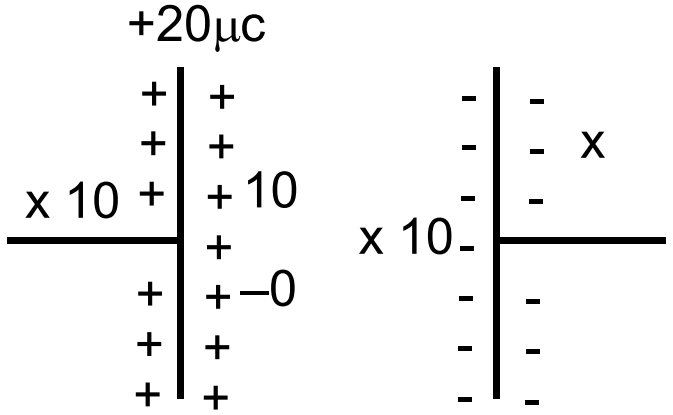
A charge of $20\mu\text{C}$ is placed on the positive plate of an isolated parallel-plate capacitor of capacitance $10\mu\text{F}.$ Calculate the potential difference developed between the plates.
Answer

$\therefore$ Given that

Capacitance $=10\mu\text{F}$

Charge $=20\mu\text{C}$

$\therefore$ The effective charge $=\frac{20-0}{2}=10\mu\text{F}$

$\therefore\text{C}=\frac{\text{q}}{\text{V}}$

$\Rightarrow\text{V}=\frac{\text{q}}{\text{C}}=\frac{10}{10}=1\text{V}$

View full question & answer
Question 603 Marks
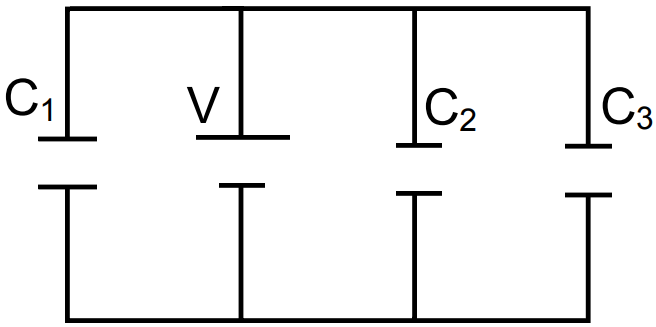
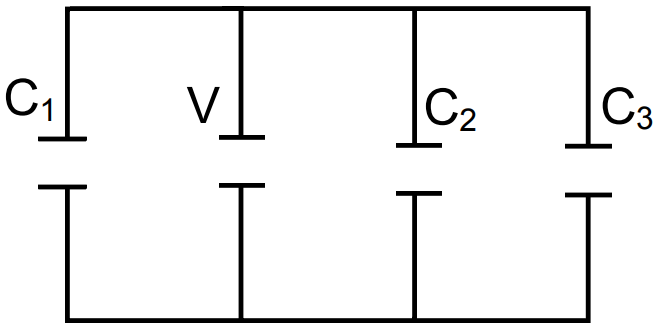
Find the charges on the three capacitors connected to a battery as shown in figure. Take $\text{C}_1=2.0\mu\text{F},\ \text{C}_2=4.0\mu\text{F},\ \text{C}_3=6.0\mu\text{F}$ and V = 12 volts.

Answer

$\text{C}_1=2\mu\text{F},\ \text{C}_2=4\mu\text{F},\ \text{C}_3=6\mu\text{F}$

$\text{V}=12\text{V}$

$\text{cq}=\text{C}_1+\text{C}_2+\text{C}_3$

$=2+4+6=12\mu\text{F}$

$=12\times10^{-6}\text{F}$

$\text{q}_1=12\times2=24\mu\text{C}$

$\text{q}_2=12\times4=48\mu\text{C}$

$\text{q}_3=12\times6=72\mu\text{C}$

View full question & answer
Question 613 Marks
The potential V due to a charge distribution at a point (x, y) is given by V = -x2 + 3y
Calculate the electric field, in magnitude and direction, due to this charge configuration at the point (1, 1).
Answer
$\text{V}=-4\text{x}^2+3\text{y}$

$\therefore\text{E}_{\text{x}}=-\frac{\partial\text{V}}{\partial\text{x}}=+8\text{x}\ \text{and}\ \text{E}_{\text{y}}=-\frac{\partial\text{V}}{\partial\text{y}}=-3$

$\therefore\ \text{Total}\ \vec{\text{E}}=8\text{x}\hat{\text{i}}-3\hat{\text{j}}$

$\therefore|\vec{\text{E}}|=\sqrt{(8)^2+(3)^2}=\sqrt{73}\frac{\text{N}}{\text{C}}$

Also angle $\theta,$ which $\vec{\text{E}}$ makes with x-axis, is given by,

$\tan\theta=\frac{\text{E}_{\text{y}}}{\text{E}_{\text{z}}}=-\frac{3}{8}=-0.375$

$\theta=\tan^{-1}(-0.375)$

View full question & answer
Question 623 Marks
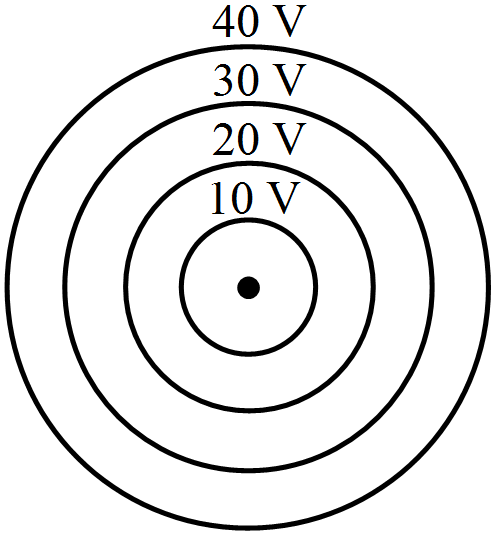
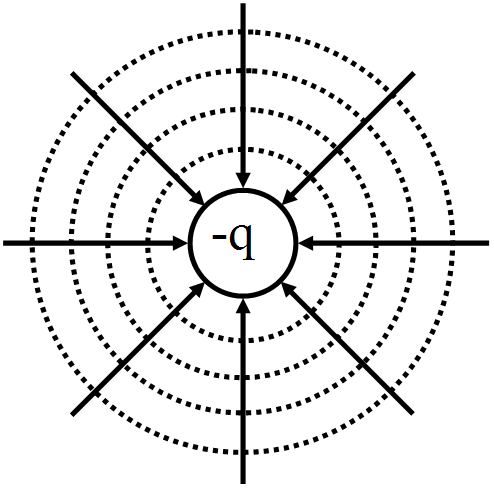
Concentric equipotential surfaces due to a charged body placed at the centre are shown. Identify the polarity of the charge and draw the electric field lines due to it.
Answer

For a single charge the potential is given by $\text{V}=\frac{1}{4\pi\varepsilon_0}\frac{\text{q}}{\text{r}}$


This shows that V is constant if r is constant. Greater the radius smaller will be the potential. In the given figure, potential is increasing. This shows that the polarity of charge is negative (-q). The direction of electric field will be radially inward. The field lines are directed from higher to lower potential.

View full question & answer
Question 633 Marks
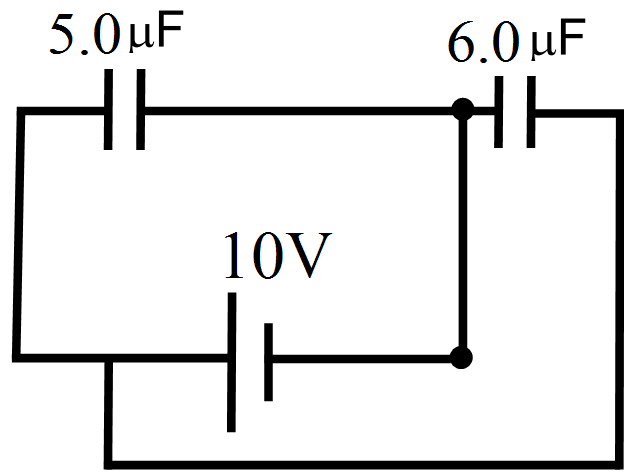
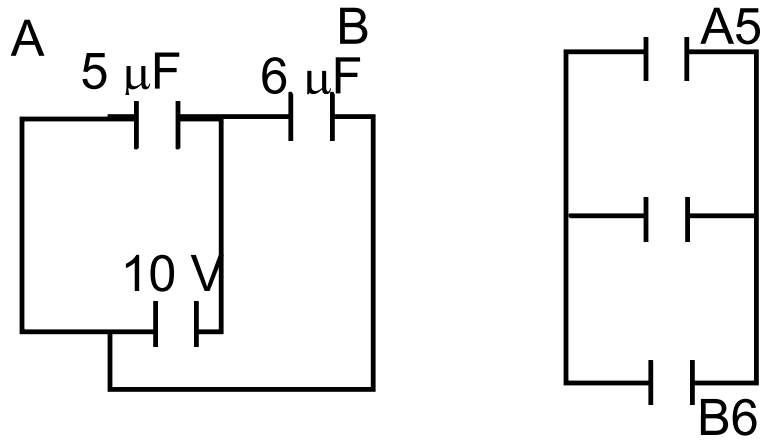
Find the charge supplied by the battery in the arrangement shown in figure.

Answer

$\text{V}=\text{10v}$

$\text{C}_{\text{eq}}=\text{C}_1+\text{C}_2$ $[\therefore$ They are parallel$]$

$=5+6=11\mu\text{F}$

$\text{q}=\text{CV}=11\times10=110\mu\text{C}$

View full question & answer
Question 643 Marks
Can two equipotential surfaces cut each other?
Answer
At the point of intersection, two normals can be drawn. Also, we know that electric field lines are perpendicular to the equipotential surface. This implies that at that point two different directions of the electric field are possible, which is not possible physically.
Hence, two equipotential surfaces cannot cut each other.
View full question & answer
Question 653 Marks
A parallel-plate capacitor having plate area 25cm2 and separation 1.00mm is connected to a battery of 6.0V. Calculate the charge flown through the battery. How much work has been done by the battery during the process?
Answer

$\text{A}=25\text{cm}^2=2.5\times10^{-3}\text{cm}^2$

$\text{d}=1\text{mm}=0.01\text{m}$

$\text{V}=\text{6V},\ \text{Q}=1$

$\text{C}=\frac{\in_0\text{A}}{\text{d}}=\frac{8.854\times10^{-12}\times2.5\times10^{-3}}{0.01}$

$\text{Q}=\text{CV}=\frac{8.854\times10^{-12}\times2.5\times10^{-3}}{0.01}\times6$

$=1.32810\times10^{-10}\text{C}$

$\text{W}=\text{Q}\times\text{V}=1.32810\times10^{-10}\text{C}\times6$

$=8\times10^{-10}\text{J}.$

View full question & answer
Question 663 Marks
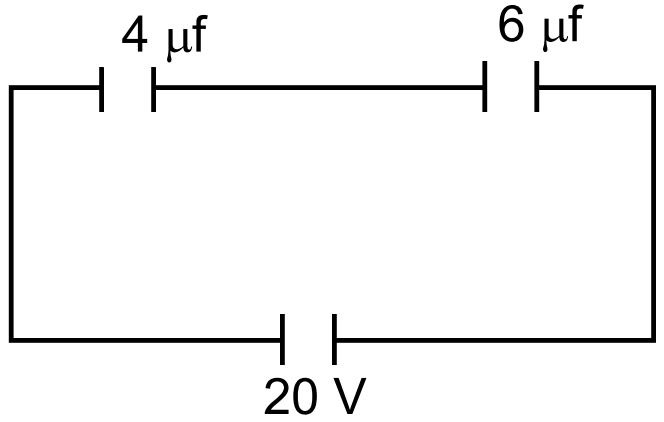
Two capacitors of capacitances $4.0\mu\text{F}$ and $6.0\mu\text{F}$ are connected in series with a battery of 20V. Find the energy supplied by the battery.
Answer

$\therefore\text{C}_1=4\mu\text{F},\ \text{C}_2=6\mu\text{F},\ \text{V}=20\text{V}$

Eq. capacitor $\text{C}_{\text{eq}}=\frac{\text{C}_1\text{C}_2}{\text{C}_1+\text{C}_2}=\frac{4\times6}{4+6}=2.4$

$\therefore$ The Eq Capacitance $\text{C}_{\text{eq}}=2.5\mu\text{F}$

$\therefore$ The energy supplied by the battery to each plate

$\text{E}=\Big(\frac{1}{2}\Big)\text{CV}^2$

$=\Big(\frac{1}{2}\Big)\times2.4\times20^2=480\mu\text{J}$

$\therefore$ The energy supplies by the battery to capacitor $=2\times480=960\mu\text{J}$

View full question & answer
Question 673 Marks
Two charged particles, having equal charges of 2.0 × 10-5C each, are brought from infinity to within a separation of 10cm. Find the increase in the electric potential energy during the process.
Answer
$\text{q}_1=\text{q}_2=2\times10^{-5}\text{C}$

Each are brought from infinity to 10cm a part d = 10 × 10-2m

So work done = negative of work done. (Potential E)

$\text{P.E}=\int\limits_\infty^{10}\text{F}\times\text{ds}$

$\text{P.E}=\text{K}\times\frac{\text{q}_1\text{q}_2}{\text{r}}$

$=\frac{9\times10^9\times4\times10^{10}}{10\times10^{-2}}$

$=36\text{J}$

View full question & answer
Question 683 Marks
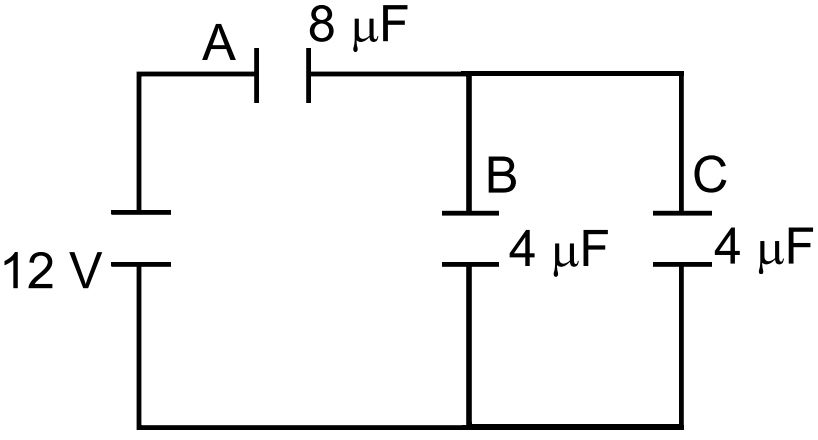
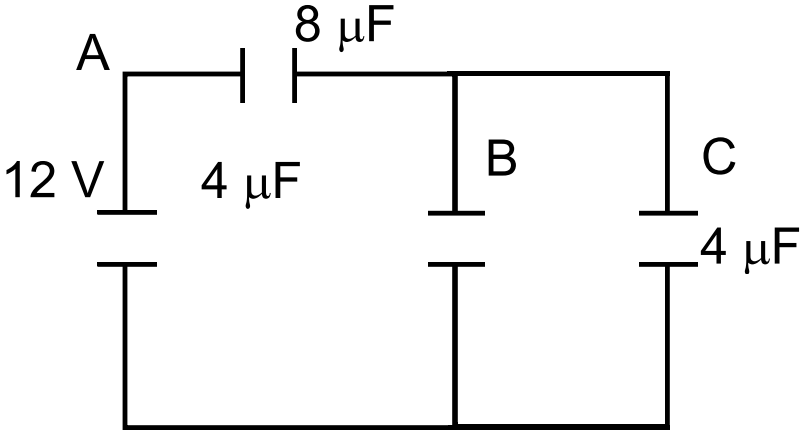
Find the charge appearing on each of the three capacitors shown in figure.

Answer

$\text{C}_1=8\mu\text{F},\ \text{C}_2=4\mu\text{F},\ \text{C}_3=4\mu\text{F}$

$\text{C}_{\text{eq}}=\frac{(\text{C}_2+\text{C}_3)\times\text{C}_1}{\text{C}_1+\text{C}_2+\text{C}_3}$

$=\frac{8\times8}{16}=4\mu\text{F}$

Since B & C are parallel & are in series with A.

So, $\text{q}_1=8\times6=48\mu\text{C}$

$\text{q}_2=4\times6=24\mu\text{C}$

$\text{q}_3=4\times6=24\text{C}\mu$

View full question & answer
Question 693 Marks
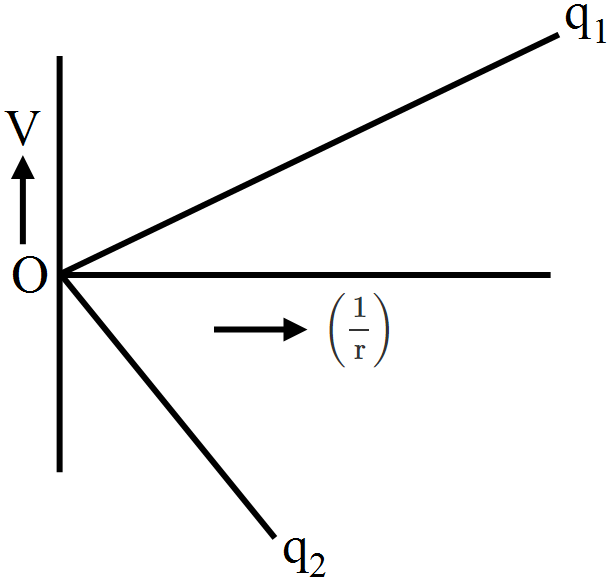
The two graphs are drawn below, show the variations of electrostatic potential (V) $\frac{1}{\text{r}}$ (r being the distance of field point from the point charge) for two point charges q1 and q2.
  1. What are the signs of the two charges?
  2. Which of the two charges has the larger magnitude and why?
​​​​​​​​​​​​​​
Answer
  1. The potential due to positive charge is positive and due to negative charge, it is negative, so, is q1 positive and q2 is negative.

$\text{V}=\frac{1}{4\pi\varepsilon_0}\frac{\text{q}}{\text{r}}$

  1. The graph between V and $\frac{1}{\text{r}}$ is a straight line passing through the origin with slope $\frac{\text{q}}{4\pi\varepsilon_0},$

As the magnitude of slope of the line due to charge q2 is greater than that due to q1, q2 has larger magnitude.

View full question & answer
Question 703 Marks
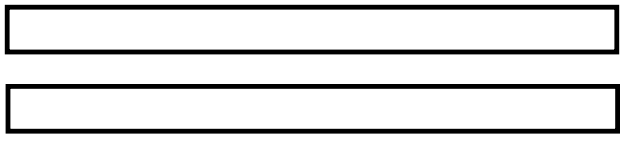
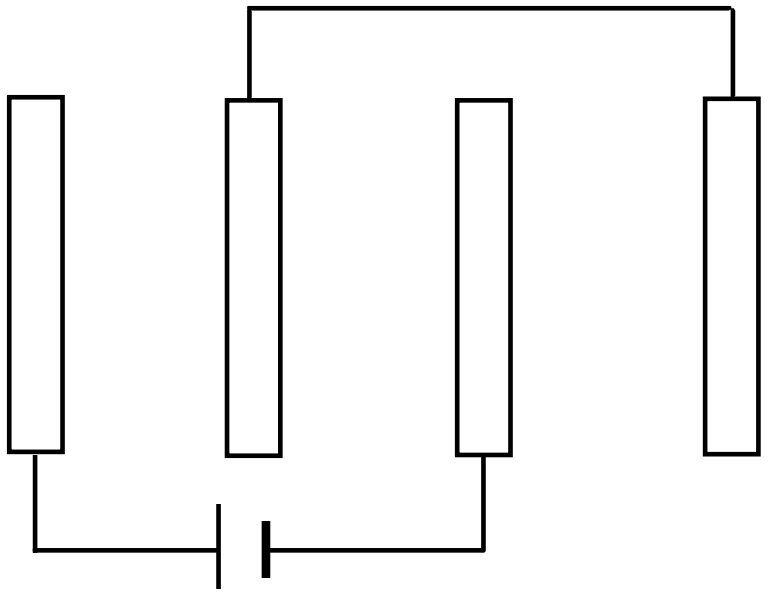
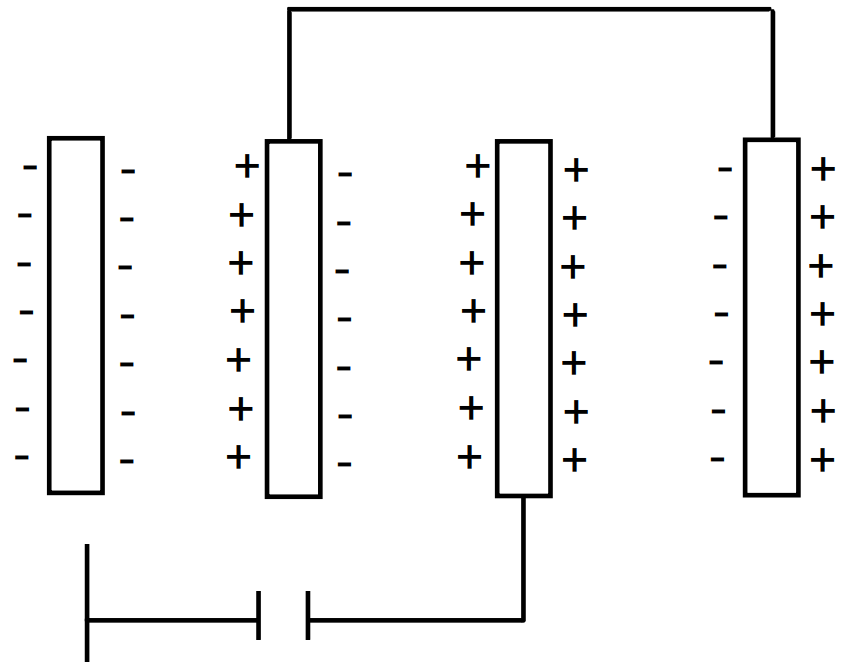
Each of the plates shown in figure has surface area $\Big(\frac{96}{\in_0}\Big)\times10^{-12}\text{Fm}$ on one side and the separation between the consecutive plates is 4.0mm. The emf of the battery connected is 10 volts. Find the magnitude of the charge supplied by the battery to each of the plates connected to it.

Answer

Here three capacitors are formed

And each of $\text{A}=\frac{96}{\in_0}\times10^{-12}\text{f.m.}$

$\text{d}=4\text{mm}=4\times10^{-3}\text{m}$

$\therefore$ Capacitance of a capacitor

$\text{C}=\frac{\in_0\text{A}}{\text{d}}=\frac{\in_0\frac{96\times10^{-12}}{\in_0}}{4\times10^{-3}}=24\times10^{-9}\text{F}$

$\therefore$ As three capacitor are arranged is series

So, $\text{C}_\text{eq}=\frac{\text{C}}{\text{q}}=\frac{24\times10^{-9}}{3}=8\times10^{-9}$

$\therefore$ The total charge to a capacitor = 8 × 10-9 × 10 = 8 × 10⁻⁸c

$\therefore$ The charge of a single Plate = 2 × 8 × 10-8 = 16 × 10-8 = 0.16 × 10-6 = 0.16μc.

View full question & answer
3 Marks Question - Page 2 - Physics STD 12 Science Questions - Vidyadip