Questions · Page 4 of 6

M.C.Q (1 Marks)

MCQ 1511 Mark
Energy is stored in a capacitor in the form of:
  • A
    Electrostatic energy.
  • B
    Magnetic energy.
  • C
    Light energy.
  • D
    Heat energy.
Answer
  1. Electrostatic energy.
View full question & answer
MCQ 1521 Mark
From a supply of identical capacitors rated 8 μF, 250 V, the minimum number of capacitors required to form a composite 16 μF, 1000 V capacitor is:
  • A
    2
  • B
    4
  • C
    16
  • D
    32
Answer
  1. 32

Explanation:

The required voltage is 1000v and the capacitors are parallel as 250v.

So number of capacitors required will be 4  i.e250 × 4 = 1000 in series.

Now example of four capacitor in series will be equal 2μf (micro farade) but the equivalent capacitance required is given as 16μf so there must be 8 series of parallel arrange capacitors each of capacitor 2 micro farad hence total number of capacitor = 4 × 8 = 32

View full question & answer
MCQ 1531 Mark
The amount of energy that a unitary point electric charge would have, if located at any point in space, is defined its:
  • A
    Electric potential energy.
  • B
    Electric potential.
  • C
    Electric potential difference.
  • D
    Electric field.
Answer
  1. Electric potential.

Explanation:

The electric potential is the electric potential energy per unit charge.

View full question & answer
MCQ 1541 Mark
ECG is a method of diagnosis used to check the functioning of heart, it is based on the principle that there is:
  • A
    A pattern of magnetic field associated with the functioning of heart.
  • B
    An electrical impulse associated with the functioning of organs and tissues of human body.
  • C
    A varying electrical field associated. with organs and tissues of human body.
  • D
    A varying magnetic field associated with organs and tissues of human body.
Answer
  1. An electrical impulse associated with the functioning of organs and tissues of human body.

Explanation:

The heart generates by itself an electrical activity which is transmitted through all the organ and produces its contraction. The Electrocardiogram is no other than the graphical representation of this electrical activity.

View full question & answer
MCQ 1561 Mark
The total capacitance of capacitors connected in parallel is given by _____?
  • A
    Product of the individual capacitors in parallel.
  • B
    Sum of all the individual capacitors in parallel.
  • C
    Sum of their reciprocals.
  • D
    Product of their reciprocals.
Answer
  1. Sum of all the individual capacitors in parallel.

Explanation:

The equivalent capacitance of the capacitors connected in parallel is given by sum of their individual capacitances, that is if there are n capacitors in parallel the total capacitance is given by, C = C+ C+ C+ C+ ….. + Cn.

View full question & answer
MCQ 1571 Mark
What is the maximum energy that can be stored in a capacitor?
  • A
    Depends on the maximum area of the capacitor.
  • B
    Depends on the maximum resistance offered.
  • C
    Depends on the maximum electric field.
  • D
    Depends on the maximum current passing through the capacitor.
Answer
  1. Depends on the maximum electric field.

Explanation:

The maximum energy that can be desirably stored in a capacitor is depends on the maximum electric field that the dielectric can withstand without breaking down. Therefore, capacitors of the same type have about the same maximum energy density, i.e. joules of energy per cubic meter.

View full question & answer
MCQ 1581 Mark
A capacitor is charged by a battery and then the battery is disconnected. A dielectric slab is introduced between the plates. The result is:
  • A
    P.d between the plates increases, charge on the plate decreases.
  • B
    P.d between the plates decreases, charge remains same.
  • C
    P.d increases, charge remain constant.
  • D
    P.d decreases, charge increases.
Answer
  1. P.d between the plates decreases, charge remains same.

Explanation:

As dielectric slab does not affect charges:

$\text{V}=\frac{\text{Q}}{\text{C}}=\frac{\text{Qd}}{\text{K}\in_0\text{A}}$
View full question & answer
MCQ 1591 Mark
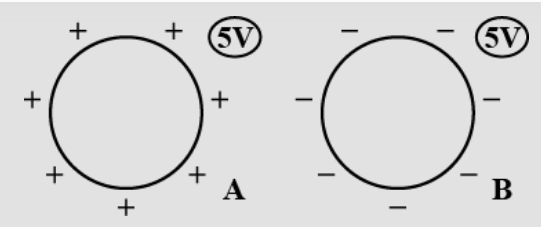
Identify the correct statement from below:

  • A
    A will be at higher potential.
  • B
    B will be at higher potential.
  • C
    Both will be at same potential.
  • D
    Can't be said.
Answer
  1. A will be at higher potential.

Explanation:

Point A have positive charge.

More is the positive charge, more will be the potential. So, A will be at higher potential.

View full question & answer
MCQ 1601 Mark
The electrostatic potential on the surface of a charged conducting sphere is 100V. Two statements are made in this regard S1 at any point inside the sphere, electric intensity is zero. S2 at any point inside the sphere, the electrostatic potential is 100V. Which of the following is a correct statement?
  • A
    S1 is true but S2 is false.
  • B
    Both S1 and S2 are false.
  • C
    S1 is true, S2 is also true and S1 is the cause of S2.
  • D
    S1 is true, S2 is also true, but the statements are independant.
Answer
  1. S1 is true, S2 is also true and S1 is the cause of S2.
View full question & answer
MCQ 1611 Mark
An arrangement which consists of two conductors separated by a dielectric medium is called:
  • A
    Resistor.
  • B
    Inductor.
  • C
    Rectifier.
  • D
    Capacitor.
Answer
  1. Capacitor.
View full question & answer
MCQ 1621 Mark
The interior of a conductor can have no excess ____ in the static situation.
  • A
    Electric field.
  • B
    Electric potential.
  • C
    Electric energy.
  • D
    Charge.
Answer
  1. Charge.
View full question & answer
MCQ 1631 Mark
The dimensions of electric potential are:
  • A
    [M1 L2 T-3 A-1]
  • B
    [M L-2 T3 A-1]
  • C
    [M L-3 T-3 A-2]
  • D
    [M L-3 T-2 A-1]
Answer
  1. [M1 L2 T-3 A-1]
View full question & answer
MCQ 1641 Mark
How does the potential difference change with the effect of the dielectric when the battery remains connected across the capacitor?
  • A
    Increases
  • B
    Decreases
  • C
    Remains constant
  • D
    Becomes zero
Answer
  1. Remains constant

Explanation:

As the battery remains connected across the capacitor, so the potential difference remains constant at V0 even after the introduction of the dielectric slab. In this way, dielectric has an effect on potential difference.

View full question & answer
MCQ 1651 Mark
A charge is brought from a point on the equatorial plane of a dipole to its mid-point. Which of the following quantities remains constant?
  • A
    Electric field.
  • B
    Force on the charge brought.
  • C
    Torque exerted by the charge on dipole.
  • D
    Electric potential.
Answer
  1. Electric potential.
View full question & answer
MCQ 1661 Mark
When a thin mica sheet is placed between the plates of a condenser then the amount of charge, so compared to its previous value, on its plates will become:
  • A
    unchanged
  • B
    zero
  • C
    less
  • D
    more
Answer
  1. unchanged

Explanation:

As no cell is connected to the capacitor, the charge will remain constant.

View full question & answer
MCQ 1671 Mark
What is the value of capacitance of a capacitor if it has a charge of 9C and voltage of 5V?
  • A
    1.8F
  • B
    45F
  • C
    4.5F
  • D
    8.1F
Answer
  1. 1.8F

Explanation:

Since we know that capacitance$=\frac{\text{charge}}{\text{voltage}}$

Therefore capacitance$=\frac{9}{5}=1.8\text{f.}$

View full question & answer
MCQ 1681 Mark
In the circuit shown in Fig. initially key K1 is closed and key K2 is open. Then K1 is opened and K2 is closed (order is important). [Take Q1' and Q2' as charges on C1 and C2 and V1 and V2 as voltage respectively.]


Then

  • A
    Charge on C1 gets redistributed such that V1 = V2.
  • B
    Charge on C1 gets redistributed such that Q1' = Q2'.
  • C
    Charge on C1 gets redistributed such that C1V1 + C2V2 = C1 E.
  • D
    Charge on C1 gets redistributed such that Q1' + Q2' = Q.
Answer
  1. Charge on C1 gets redistributed such that V1 = V2.
  1. Charge on C1 gets redistributed such that Q1' + Q2' = Q.

Initially key K1 is closed and key K2 is open, the capacitor C1 is charged by battery and capacitor C2 is still uncharged. Now K1 is opened and K2 is closed, the capacitors C1 and C2 both are connected in parallel. The charge stored by capacitor C1, gets redistributed between C1 and C2 till their potentials become same, i.e., V2 = V1.

By law of conservation of charge, the charge stored in capacitor Cx is equal to sum of charges on capacitors C1 and C2 when K1 is opened and K2 is closed, i.e., Q'1 + Q'2 = Q.

View full question & answer
MCQ 1691 Mark
The capacity of the parallel plate capacitor increases when:
  • A
    Area of the plate is decreased.
  • B
    Area of the plate is increased.
  • C
    Distance between the plates increases.
  • D
    None of the option.
Answer
  1. Area of the plate is increased.
View full question & answer
MCQ 1701 Mark
Some charge is being given to a conductor. Then its potential:
  • A
    is maximum somewhere between surface and centre.
  • B
    is maximum at surface.
  • C
    is maximum at centre.
  • D
    remains same throughout the conductor.
Answer
  1. remains same throughout the conductor.

Explanation:

Given that some charge is given to a conductor then the whole charge is distributed over its surface only. Inside of conductor, electric field is zero whereas potential is same as on the surface. Hence, throughout the conductor, potential is same i.e, the whole conductor is equipotential.

View full question & answer
MCQ 1711 Mark
A parallel plate condenser is immersed in an oil of dielectric constant 2. The field between the plates is:
  • A
    Increased, proportional to 2.
  • B
    Decreased, proportional to 1/ 2.
  • C
    Increased, proportional to - 2.
  • D
    Decreased, proportional to -1/ 2.
Answer
  1. Decreased, proportional to 1/ 2.
View full question & answer
MCQ 1721 Mark
Capacitiors are used in electrical circuits where appliances need more:
  • A
    Voltage.
  • B
    Current.
  • C
    Resistance.
  • D
    Power.
Answer
  1. Current.
View full question & answer
MCQ 1731 Mark
There are two metallic spheres of same radii, but one is solid, and the other is hollow, then:
  • A
    Solid sphere can be given more charge.
  • B
    Hollow sphere can be given more charge.
  • C
    They can be charged equally (maximum).
  • D
    None of the above.
Answer
  1. They can be charged equally (maximum).
View full question & answer
MCQ 1751 Mark
Three capacitors of capacitances $6\mu\text{F}$ each are available. The minimum and maximum capacitances, which may be obtained are:
  • A
    $6\mu\text{F},\ 18\mu\text{F}$
  • B
    $3\mu\text{F},\ 12\mu\text{F}$
  • C
    $2\mu\text{F},\ 12\mu\text{F}$
  • D
    $2\mu\text{F},\ 18\mu\text{F}$
Answer
  1. $2\mu\text{F},\ 18\mu\text{F}$

Explanation:

The minimum capacitance can be obtained by connecting all capacitors in series. It can be calculated as follows:

$\frac{1}{\text{C}}=\frac{1}{6}+\frac{1}{6}+\frac{1}{6}=\frac{1}{2}$

$\Rightarrow\text{C}=2\mu\text{F}$

The maximum capacitance can be obtained by connecting all capacitors in parallel. It can be calculated as follows:

$\text{C}=6+6+6=18\mu\text{F}$

View full question & answer
MCQ 1761 Mark
what is the potential difference between two points, if 2J of work must be done to move a 4 mC charge from one point to another is:
  • A
    50 V
  • B
    500 V
  • C
    5 V
  • D
    5000 V
Answer
  1. 500 V

Explanation:

The total work done = energy transferred.

So, we might see the equation energy = voltage x charge, E = V × Q, written as,

work = voltage x charge, W = V × Q.

In this case, the charge is 4 mC, that is, 0.004 C and work done is 2J.

View full question & answer
MCQ 1771 Mark
Which of the following is an example of a molecule whose centre of mass of positive and negative charges does not coincide each other?
  • A
    NH3
  • B
    H2
  • C
    CH4
  • D
    CO2
Answer
  1. NH3

Explanation:

NH3 is a molecule in which the centre of mass of positive and negative charges does not collide with each other and is called a polar molecule. They have a permanent dipole moment. They have unsymmetrical shapes.

View full question & answer
MCQ 1781 Mark
An example of an equipotential surface in earth is:
  • A
    A line passing through the centre of the earth connecting two points along the diameter.
  • B
    A plane that passes through the circular section of the hemisphere of the earth.
  • C
    A spherical surface at a distance of 1km from the surface of the earth with its centre at centre of earth.
  • D
    A plane on the surface of the earth, which is a tangent to the earth.
Answer
  1. A spherical surface at a distance of 1km from the surface of the earth with its centre at centre of earth.

Explanation:

The potential is seen to be a constant on a sphere at all points.

View full question & answer
MCQ 1791 Mark
For any charge configuration, equipotential surface through a point is _____ to electric field at that point.
  • A
    Perpendicular.
  • B
    Normal.
  • C
    Parallel.
  • D
    Both a and b.
Answer
  1. Both a and b.
View full question & answer
MCQ 1801 Mark
Work done to bring a unit positive charge from infinity to a point in an electric field is known as _______?
  • A
    Electric potential.
  • B
    Electric field intensity.
  • C
    Electric dipole moment.
  • D
    The total energy of the point charge.
Answer
  1. Electric potential.

Explanation:

Electric potential is defined as the amount of work done to bring a unit positive charge from an infinite distance to a particular point of an electric field. The total energy of that point charge means the sum of kinetic energy and potential energy which is not the same as the potential energy if the particle is in motion.

View full question & answer
MCQ 1811 Mark
What type of surface is the surface of a conductor?
  • A
    Equipotential
  • B
    Unipolar
  • C
    Unipotential
  • D
    Bipolar
Answer
  1. Equipotential

Explanation:

Electric field at any point is equal to the negative of the potential gradient. But inside a conductor, the electric field is zero. Hence, the electric potential is constant throughout the volume of a conductor and has the same value on its surface. Thus the surface of a conductor is equipotential.
View full question & answer
MCQ 1821 Mark
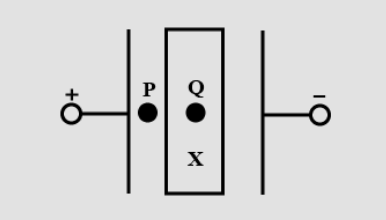
A slab X is placed between the two parallel isolated charged plates as shown in the figure. If Ep​ and Eq​ denotes the intensity of electric field at P and Q, then:

  • A
    Ep​ is reduced by the presence of X, if X is metallic.
  • B
    Eq​ is increased by presence of X, if X is dielectric.
  • C
    Eq​ is in the opposite sense to Ep​, if X is dielectric.
  • D
    Eq​ is zero, if X is metallic.
Answer
  1. Eq​ is zero, if X is metallic.

Explanation:

There is no effect of the metal on the external electric field(thus A is incorrect) while the dielectric reduces the net electric field outside. The dielectric produces an electric field inside it due to the induced charges which is opposite to the external field. Thus EQ​ is reduced and B and C are also incorrect.(Note that EP​ is not the external field). Now as the electric field inside the conductor is zero, the field Ep​ is zero if X is a metallic.

View full question & answer
MCQ 1831 Mark
What is the nature of equipotential surfaces in case of a positive point charge?
  • A
    Circular
  • B
    Spherical
  • C
    Cubical
  • D
    Cylindrical
Answer
  1. Spherical

Explanation:

We know that electric field lines cross the equipotential surfaces perpendicularly. Electric field lines are generated radially from a positive point charge. Therefore, for holding both the conditions, the equipotential surfaces must be spherical.

View full question & answer
MCQ 1851 Mark
If the capacitors having capacitance C1 and C2 are connected in parallel then their effective capacitance is given by:
  • A
    C = C1 - C2
  • B
    C = C1 + C2
  • C
    1/C = 1/C1 + 1/C2
  • D
    1/C = 1/C1 - 1/C2
Answer
  1. C = C1 + C2
View full question & answer
MCQ 1861 Mark
Potential energy is the characteristic of the:
  • A
    The present state of the configuration.
  • B
    The way the state is achieved.
  • C
    Both a and b.
  • D
    None.
Answer
  1. The present state of the configuration.
View full question & answer
MCQ 1871 Mark
The net charge on a condenser is:
  • A
    infinity
  • B
    q/ 2
  • C
    2q
  • D
    zero
Answer
  1. zero

Explanation:

Every condenser is made with two plates. The charge on one plate is +Q and other is −Q.

Thus total charge of condenser is Qt​ = +Q - Q = 0

View full question & answer
MCQ 1881 Mark
1 volt = ?
  • A
    1 joule.
  • B
    1 joule per coulomb.
  • C
    1 coulomb per metre.
  • D
    1 newton per coulomb.
Answer
  1. 1 joule per coulomb.

Explanation:

Using: $\text{V}=\frac{\text{W}}{\text{q}}$

⟹ 1 volt is equal to 1 joule per coulomb

View full question & answer
MCQ 1891 Mark
A charge q is at the center of the circle ABCDE. Which among the following is true if the charge is taken from A to B, C, D, and E?

  • A
    Work done along AB is the minimum.
  • B
    Work done along AD is the maximum.
  • C
    Work done along all the paths are zero.
  • D
    Work done along all the paths are equal but positive.
Answer
  1. Work done along all the paths are zero.

Explanation:

As the charge q is situated at the center of the circle ABCDE, therefore the circle is an equipotential surface. That means all the points on the circle i.e. A, B, C, D, and E have the same potential. Therefore, work done to bring the charge from A to any point on the circle is zero always.

View full question & answer
MCQ 1911 Mark
What is the amount of work done to bring a charge of 4 × 10-3C charge from infinity to a point whose electric potential is 2 × 102V?
  • A
    0.8J
  • B
    -0.8J
  • C
    1.6J
  • D
    -0.4J
Answer
  1. 0.8J

Explanation:

Work done = potential × charge by definition. We know that the potential of a point is the amount of work done to bring a unit charge from infinity to a certain point. Therefore, work done W = q × V = 4 × 10-3 × 200J = 0.8J. The work done is positive in this case.


View full question & answer
MCQ 1921 Mark
The process in which a region is made free from any electric field is known as _____________.
  • A
    Electrostatic forcing
  • B
    Electrostatic binding
  • C
    Electrostatic shielding
  • D
    None of the options
Answer
  1. Electrostatic shielding

Explanation:

Electrostatic shielding is a phenomenon seen when a Faraday cage is used to block the effects of an electric field.

View full question & answer
MCQ 1931 Mark
What is the electric potential at the perpendicular bisector of an electric dipole?
  • A
    Positive
  • B
    Negative
  • C
    Zero
  • D
    Depends on medium
Answer
  1. Zero

Explanation:

Any point on the perpendicular bisector is equidistant from both the charges of the dipole. Therefore, the electric potential at that point is equal and opposite due to the two different charges. Therefore, the total electric potential at that point is zero.

View full question & answer
MCQ 1941 Mark
If a charged body is moved in an electric field against the Coulomb force, then ________?
  • A
    Work is done on the body by an external agent.
  • B
    Work is done by the electric field.
  • C
    Electric field intensity decreases.
  • D
    The total energy of the system decreases.
Answer
  1. Work is done on the body by an external agent.

Explanation:

To move a body against some force, work is to be done on the body. In this case, an external force is to be applied on the body to move it i.e. an external work is to be done. As we are moving the body against the Coulomb’s force, hence no work is done on the body by the electric field.
View full question & answer
MCQ 1951 Mark
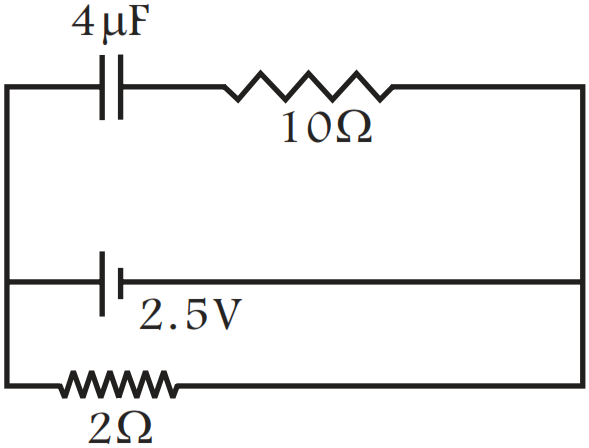
A capacitor of 4μ F is connected as shown in the circuit (Fig.). The internal resistance of the battery is 0.5Ω. The amount of charge on the capacitor plates will be:

  • A
    0.
  • B
    4μ C.
  • C
    16μ C.
  • D
    8μ C.
Answer
  1. 8μ C.

The capacitor offers infinite resistance in a DC circuit. Here, no current will flow through the capacitor and 10Ω resistance after the capacitor is full charged. 

The potential difference across 10Ω resistance will be zero. It will act like a plain wire.

Current flowing through 2Ω resistance is given by

$\text{I}=\frac{\text{V}}{(\text{R}+\text{r})}=\frac{2.5}{(2+0.5)}=1\text{A}$

Potential difference across 2Ω resistance V = IR = 1 × 2 = 2V

Here, capacitor is connected in parallel with 2 Ω resistance, so it will also have 2V potential difference across it.

The charge on capacitor, q = CV = (2 mF) × 2V = 8 mC.

View full question & answer
MCQ 1961 Mark
A parallel plate condenser is connected to a battery of emf 4 volt. If a plate of dielectric constant 8 is inserted into it, the potential difference on the condenser will be:
  • A
    32V
  • B
    4V
  • C
    1/ 2V
  • D
    2V
Answer
  1. 4V

Explanation:

Total charged is conserved in the condenser. Here the potential difference on the condenser is equal to the emf of battery. When dielectric is inserted between the plates the charge will maintain the constant potential in the capacitor. Thus, the potential difference on the condenser is 4V

View full question & answer
MCQ 1971 Mark
When a dielectric slab is introduced between the two plates of condenser then its capacity ___________.
  • A
    Remains constant
  • B
    Increases
  • C
    Decreases
  • D
    May increase or decrease depending on the material of dielectric slab
Answer
  1. Increases

Explanation:

As the dielectric slab is introduced there is some charge distribution in the slab and because of this the electric field between the two plates is decreased, due to which the capacitor can hold more charge. Thus, the capacity to hold charge of the capacitor is increased.

View full question & answer
MCQ 1981 Mark
Work done in moving an object through an equipotential surface is:
  • A
    Positive
  • B
    Negative
  • C
    Zero
  • D
    Depends on the field direction
Answer
  1. Zero

Explanation:

Work done is given difference in potentials. In an equipotential surface, all points will have same potential. Thus work done is zero

View full question & answer
MCQ 1991 Mark
. The electric potential inside a conducting sphere _____________?
  • A
    is zero.
  • B
    increases from centre to the surface.
  • C
    decreases from centre to the surface.
  • D
    remains constant from centre to the surface.
Answer
  1. remains constant from centre to the surface.
View full question & answer
MCQ 2001 Mark
Which of the following is correct statement:
  • A
    Equipotential lines are always perpendicular to the electric field.
  • B
    Work done for moving a charge along the conducting surface (closed and containing charge) very close to it may be negative or positive.
  • C
    Electric field may cross each other.
  • D
    None of the above.
Answer
  1. Equipotential lines are always perpendicular to the electric field.

Explanation:

There is no potential gradient along any direction parallel to the surface, and no electric field is parallel with the surface, This means electric field are always at right angle to the equipotential surface.

View full question & answer