MCQ 511 Mark
Mark $(\checkmark)$ against the correct answer in the following:
Which is smaller out of $\frac{5}{-6}$ and $\frac{-7}{12}?$
- ✓
$\frac{5}{-6}$
- B
$\frac{-7}{12}$
- C
AnswerCorrect option: A. $\frac{5}{-6}$
The correct option is $(a).$
$\frac{5\times-1}{-6\times-1}=\frac{-5}{6}$
$LCM$ of $6$ and $12$ is $12$
$\therefore\frac{-5\times2}{6\times2}=\frac{-10}{12}$ and $\frac{-7\times1}{12\times1}=\frac{-7}{12}$
Hence, $\frac{5}{-6}$ is smaller than $\frac{-7}{12}$
View full question & answer→MCQ 521 Mark
If $\frac{\text{x}}{3}+\frac{1}{3}=1,$ then $x = ?$
- A
$\frac{3}{4}$
- ✓
$\frac{4}{3}$
- C
$-\frac{3}{4}$
- D
$\frac{-4}{3}$
AnswerCorrect option: B. $\frac{4}{3}$
$\frac{\text{x}}{2}+\frac{1}{3}=1$
$\Rightarrow\frac{\text{x}}{2}=1-\frac{1}{3}$
$\Rightarrow\frac{\text{x}}{2}=\frac{3\times1-1}{3}$
$\Rightarrow\frac{\text{x}}{2}=\frac{3-1}{3}$
$\Rightarrow\frac{\text{x}}{2}=\frac{2}{3}$
$\Rightarrow\frac{2\text{x}}{2}=\frac{2\times2}{3}$ (Multiplying both sides by $2)$
$\Rightarrow\text{x}=\frac{4}{3}$
Hence, the correct answer is option $(b).$
View full question & answer→MCQ 531 Mark
Arational number $\frac{-2}{3}$
AnswerCorrect option: A. Lies to the left side of $0$ on the number line
Since $\frac{-2}{3} < {0}$ it lies on left side of $0$ on the number line.
View full question & answer→MCQ 541 Mark
Mark $(\checkmark)$ against the correct answer in the following:
$-2\frac{1}{3}+4\frac{3}{5}=?$
- A
$-2\frac{4}{15}$
- ✓
$2\frac{4}{15}$
- C
$-2\frac{1}{5}$
- D
$2\frac{2}{15}$
AnswerCorrect option: B. $2\frac{4}{15}$
The correct option is $(b).$
$-2\frac{1}{3}+4\frac{3}{5}$
$=\frac{-7}{3}+\frac{23}{5}$
$LCM$ of $5$ and $5$ is $15$
$=\frac{-35+69}{15}$
$=\frac{34}{15}$
$=2\frac{4}{15}$
View full question & answer→MCQ 551 Mark
Mark $(\checkmark)$ against the correct answer in the following: $78\frac{3}{4}\div2\frac{1}{2}=?$
- ✓
$31\frac{1}{2}$
- B
$39\frac{3}{8}$
- C
$40\frac{1}{3}$
- D
AnswerCorrect option: A. $31\frac{1}{2}$
$78\frac{3}{4}\div2\frac{1}{2}$
$=\frac{315}{4}\div\frac{5}{2}$
$=\frac{315}{4}\times\frac{2}{5}$
$=\frac{63}{2}$
$=31\frac{1}{2}$
View full question & answer→MCQ 561 Mark
Which one of the following is a rational number:
- ✓
$(\sqrt{2})^{2}$
- B
$2\sqrt{2}$
- C
$2 + \sqrt{2}$
- D
$\frac{\sqrt{2}}{2}$
AnswerCorrect option: A. $(\sqrt{2})^{2}$
Observe that, $ (2^{\frac{1}{2}})^{2}=2$
$\therefore$ it is a rational number , All other numbers are irrational.
View full question & answer→MCQ 571 Mark
Which of the following pairs of rational numbers are on the opposite side of the zero on the number line?
- A
$\frac{3}{7}\text{ and }\frac{5}{12}$
- B
$-\frac{3}{7}\text{ and }\frac{-5}{12}$
- ✓
$\frac{3}{7}\text{ and }\frac{-5}{12}$
- D
AnswerCorrect option: C. $\frac{3}{7}\text{ and }\frac{-5}{12}$
The rational numbers $\frac{3}{7}\text{ and }\frac{5}{12}$ are positive rational numbers. We know that every positive rational number is greater than $0$, so both the rational numbers $\frac{3}{7}\text{ and }\frac{5}{12}$ are represented by points on the right of the zero on the number line.
The rational numbers $-\frac{3}{7}\text{ and }\frac{-5}{12}$ are negative rational numbers. We know that every negative rational number is less than $0$, so both the rational numbers $\frac{3}{7}\text{ and }\frac{5}{12}$ are represented by points on the left of the zero on the number line.
The rational numbers $\frac{3}{7}$ is a positive rational number whereas the rational number $\frac{-5}{12}$ is a negative rational numbers. We know that every negative rational number is less than $0$ and every positive rational number is greater than $0$, so the rational number $\frac{3}{7}$ is represented by point on the right of the zero and $\frac{-5}{12}$ is represented by point on the left of the zero on the number line.
Thus, the rational numbers $-\frac{3}{7}\text{ and }\frac{-5}{12}$ are on the opposite side of the zero on the number line.
Hence, the correct answer is option $(c).$
View full question & answer→MCQ 581 Mark
Which is greater number in the following?
- A
$\frac{1}{-2}$
- B
$0$
- ✓
$\frac{1}{2}$
- D
$-2$
AnswerCorrect option: C. $\frac{1}{2}$
Obviously, $\frac{1}{2}$ is greater, since this is ony number which is on the rightmost side of the number line among others.
View full question & answer→MCQ 591 Mark
If $\frac{\text{p}}{\text{q}}$ and $\frac{\text{R}}{\text{S}}$are equivalent fraction, then we have:
- A
$P + s = q + r$
- B
$P ÷ s = q ÷ s$
- C
$Pq = rs$
- ✓
$Ps = rq$
AnswerCorrect option: D. $Ps = rq$
$Ps = rq$
View full question & answer→MCQ 601 Mark
The standard from of $\frac{55}{-99}$ is:
- A
$\frac{5}{9}$
- ✓
$\frac{-5}{9}$
- C
$\frac{-55}{99}$
- D
$\frac{-99}{55}$
AnswerCorrect option: B. $\frac{-5}{9}$
$\frac{-5}{9}$
View full question & answer→MCQ 611 Mark
Which of the following rational numbers is equal to its reciprocal?
- ✓
$1$
- B
$2$
- C
$\frac{1}{2}$
- D
$0$
Answer$1.$ Reciparocal of $1=\frac{1}{1}=1$
$2.$ Reciparocal of $2\frac{1}{2}$
$3.$ Reciparocal of $\frac{1}{2}=\frac{1}{\frac{1}{2}}=2$
$4.$ Reciparocal of $0=\frac{1}{0}$
Note: $1$ is the only number, which is equal its recprocal.
View full question & answer→MCQ 621 Mark
The product $3\times\frac{1}{7}\times1\frac{5}{6}\times1\frac{2}{5}\times1\frac{1}{11}$is equal to:
- A
$5\frac{5}{8}$
- B
$5\frac{4}{5}$
- ✓
$8\frac{4}{5}$
- D
$7\frac{4}{5}$
AnswerCorrect option: C. $8\frac{4}{5}$
$3\frac{1}{7}\times1\frac{5}{6}\times1\frac{2}{5}\times1\frac{1}{11}$
$=\frac{22}{7}\times\frac{11}{6}\times\frac{7}5{}\times\frac{12}{11}$
$=\frac{22\times11\times7\times2}{7\times6\times5\times11}$ $\Big(\frac{\text{a}}{\text{b}}\times\frac{\text{c}}{\text{d}}=\frac{\text{a}\times\text{c}}{\text{b}\times\text{d}}\Big)$
$=\frac{44}{5}$
$=\frac{8\times5+4}{5}$
$=8\frac{4}{5}$
Hence, the correct answer is option $(c).$
View full question & answer→MCQ 631 Mark
Which of the following is equivalent to $\frac{4}{5}?$
- A
$\frac{4}{5}$
- B
$\frac{16}{25}$
- ✓
$\frac{16}{20}$
- D
$\frac{15}{25}$
AnswerCorrect option: C. $\frac{16}{20}$
Given rational number is $\frac{4}{5},$
So, equivalent rational number $=\frac{4\times4}{5\times4}$
$=\frac{16}{20}$ [Multipying numerator and denominator by $4]$
Note: If the numerator and denominator of a rational number is multiplied/divided by a non-zero integer, then the result we get, is equivalent rational number.
View full question & answer→MCQ 641 Mark
A rational number can be expressed asa terminating decimal if thedenominator has factors:
- ✓
$2$ or $5$
- B
$2, 3$ or $5$
- C
$3$ or $5$
- D
AnswerCorrect option: A. $2$ or $5$
$2$ or $5$
View full question & answer→MCQ 651 Mark
The product of $\frac{2}{9}$ and $\frac{27}{8}$ is.....
- A
$\frac{4}{3}$
- ✓
$\frac{3}{4}$
- C
$3$
- D
$4$
AnswerCorrect option: B. $\frac{3}{4}$
$\frac{3}{4}$
View full question & answer→MCQ 661 Mark
Mark $(\checkmark)$ against the correct answer in the following:
Which is larger out of $\frac{2}{-3}$ and $\frac{-4}{5}?$
- ✓
$\frac{2}{-3}$
- B
$\frac{2}{-4}$
- C
AnswerCorrect option: A. $\frac{2}{-3}$
The correct option is $(a).$
$\frac{2\times1}{-3\times-1}=\frac{-2}{3}$
$LCM$ of $3$ and $5$ is $15$
$\therefore\frac{-2\times5}{3\times5}=\frac{-10}{15}$ and $\frac{-4\times3}{5\times3}=\frac{-12}{15}$
Thus $\frac{2}{-3}$ is greater than $\frac{-4}{5}$
View full question & answer→MCQ 671 Mark
Classify the result as rational or irrationals. $(3+\sqrt{23})-\sqrt{23}$
Answer$(3+\sqrt{23})-\sqrt{23}$
$3+\sqrt{23} - \sqrt{23} = {3}$
Here, $3$ is a rational number.
View full question & answer→MCQ 681 Mark
If $P$: every fraction is a rational number and $Q$: every rational number is a fraction, then which of the following options hold?
- ✓
$P$ is true and $Q$ is false
- B
$P$ is false and $Q$ is true
- C
Both $p$ and $q$ are true
- D
Both $p$ and $q$ are false
AnswerCorrect option: A. $P$ is true and $Q$ is false
$P:$ Every fraction is a rational number: True
$Q:$ Every rational number is a fraction: False
View full question & answer→MCQ 691 Mark
Mark $(\checkmark)$ against the correct answer in the following:What should be subtracted from $\frac{-2}{7}$ to get $\frac{3}{4}?$
- ✓
$\frac{-17}{12}$
- B
$\frac{17}{12}$
- C
$\frac{-12}{17}$
- D
$\frac{-12}{17}$
AnswerCorrect option: A. $\frac{-17}{12}$
Let the number to be subtracted be $x$
$\Rightarrow\text{x}=\frac{-2}{3}-\frac{3}{4}$
$LCM$ of $3$ and $4$ is $12$
$=\frac{-8-9}{12}$
$\frac{-17}{12}$
View full question & answer→MCQ 701 Mark
Mark $(\checkmark)$ against the correct answer in the following:
$-2\frac{1}{9}-6=?$
- ✓
$-8\frac{1}{9}$
- B
$8\frac{1}{9}$
- C
$4\frac{1}{9}$
- D
$-4\frac{1}{9}$
AnswerCorrect option: A. $-8\frac{1}{9}$
The correct option is $(a).$
$=\frac{-73}{9}=-8\frac{1}{9}$
View full question & answer→MCQ 711 Mark
If $\frac{4}{3}=\frac{\text{x}}{12}$ Than $x =$
View full question & answer→MCQ 721 Mark
A rational number $\frac{-2}{3}$
AnswerCorrect option: A. Lies to the left side of $0$ on the number line
$\frac{-2}{3} = -0.667 - 0.667 < 0$ it will lie to the left side of $0$ on the number line.
View full question & answer→MCQ 731 Mark
$1\div\frac{-5}{7}=$
- A
$\frac{2}{7}$
- B
$\frac{5}{7}$
- C
$-\frac{2}{7}$
- ✓
$\frac{-7}{5}$
AnswerCorrect option: D. $\frac{-7}{5}$
$1\div\frac{-5}{7}$
$=1\times\frac{7}{-5}$ $\Big(\text{x}\div\text{y}=\text{x}\times\frac{1}{\text{y}}\Big)$
$=\frac{7}{-5}$
$=\frac{7\times(-1)}{-5\times(-1)}$
$=\frac{-7}{5}$
Hence, the correct answer is option $(d).$
View full question & answer→MCQ 741 Mark
$\frac{-3}{0}$is a:
- A
- B
- C
Either positive or negative rational number
- ✓
Answer$\frac{-3}{0}$ is undefined. Which means that it is neither a negative rational number nor a positive rational number.
View full question & answer→MCQ 751 Mark
A fraction is a rational number, and a rational number:
- A
- ✓
May or may not be a fraction.
- C
- D
Can always be reduced to a fraction.
AnswerCorrect option: B. May or may not be a fraction.
May or may not be a fraction.
View full question & answer→MCQ 761 Mark
The reciprocal of a positive rational number is positive:
MCQ 771 Mark
Product of $3.92 \times 0.1 \times 0.0 \times 6.3$ is:
- A
$0.392$
- B
$0.1176$
- ✓
$0$
- D
$6.3$
AnswerWhen a number is multiplied by zero, it gives always zero. Then $3.92 \times 0.1 \times 0.0 \times 6.3 = 0$
View full question & answer→MCQ 781 Mark
The value of the fraction $\displaystyle \frac{5}{\sqrt{0.0025}}$ is
- A
$\frac{1}{5}$
- B
$5$
- ✓
$100$
- D
$50$
AnswerWe need to find value of $\frac {5}{\sqrt {0.0025}}\therefore \displaystyle \frac{5}{\sqrt{0.0025}} = \frac{5}{0.05} = 100$
View full question & answer→MCQ 791 Mark
If the product of two non-zero rational numbers is $1,$
Then they are:
- A
Additve inverse of each other.
- B
Multiplicative inverse of each other.
- C
Reciprocal of each other.
- ✓
Both $(b)$ and $(c)$
AnswerCorrect option: D. Both $(b)$ and $(c)$
For every non-zero rational number $\frac{\text{a}}{\text{b}}$ there exists a rational number $\frac{\text{b}}{\text{a}}$ such that:
$\frac{\text{a}}{\text{b}}\times\frac{\text{b}}{\text{a}}=1$
Here, the rational number $\frac{\text{b}}{\text{a}}$ is called the multiplicative inverse or reciprocal of $\frac{\text{a}}{\text{b}}$
Thus, if the product of two non-zero rational numbers is $1$, then they are multiplicative inverse or reciprocal of each other.
Hence, the correct answer is option $(d).$
View full question & answer→MCQ 801 Mark
The division of $\frac { 18 }{ 6 }$ is:
AnswerThe value of $ \frac{18}{6}= 18 \div 6$ as $18$ is divisible by $6 = 3$
View full question & answer→MCQ 811 Mark
The sum of $\frac{8}{15}$ and $\frac{7}{15}$ is:
- ✓
$1$
- B
$\frac{1}{15}$
- C
$\frac{1}{30}$
- D
Answer$\frac{8}{15}+\frac{7}{15}=\frac{8+7}{15}=1$
View full question & answer→MCQ 821 Mark
The rational number equal to $\frac{2}{-3}$ is:
- A
$\frac{14}{-18}$
- ✓
$\frac{-6}{9}$
- C
$\frac{-8}{-12}$
- D
$\frac{3}{-2}$
AnswerCorrect option: B. $\frac{-6}{9}$
We know that two rational numbers are equal if they have the same standard form.
$\frac{2}{-3}=\frac{2\times(-1)}{-3\times(-1)}=\frac{-2}{3}$
The standard form of $\frac{2}{-3}\text{ is }\frac{-2}{3}$
Consider the rational number $\frac{-6}{9}$
$HCF$ of $6$ and $9 = 3$
Dividing the numerator and denominator of $\frac{-6}{9}$ by $3,$
We have:
$\frac{-6}{9}=\frac{-6\div3}{9\div3}=\frac{-2}{3}$
So, the rational number $\frac{-6}{9}$ is equal to $\frac{2}{-3}$
It can be checked that:
Standard form of $\frac{14}{-18}=\frac{-7}{9}$
Standard form of $\frac{3}{-2}=\frac{-3}{2}$
Hence, the correct answer is option $(b).$
View full question & answer→MCQ 831 Mark
Which of the following is correct?
- ✓
$\frac{5}{9}>\frac{-3}{8}$
- B
$\frac{5}{9}<\frac{-3}{-8}$
- C
$\frac{2}{-3}<\frac{-8}{7}$
- D
$\frac{4}{-3}>\frac{-8}{7}$
AnswerCorrect option: A. $\frac{5}{9}>\frac{-3}{8}$
Consider the rational numbers $\frac{5}{9}\text{ and } \frac{-3}{-8}$
We write the rational number $\frac{-3}{-8}$ with positive denominator.
$\frac{-3}{-8}=\frac{-3\times(-1)}{-8\times(-1)}=\frac{3}{8}$
Now, we write the rational numbers so that they have a common denominator.
$LCM$ of $8$ and $9 = 72$
So, $\frac{5}{9}=\frac{5\times8}{9\times8}=\frac{40}{72}$ and $\frac{3}{8}=\frac{3\times9}{8\times9}=\frac{27}{72}$
Now,
$40>27$
$\Rightarrow\frac{40}{72}>\frac{27}{72}$
$\Rightarrow\frac{5}{9}>\frac{3}{8}$
$\Rightarrow\frac{5}{9}>\frac{-3}{-8}$
Hence the correct option is $(a).$
View full question & answer→MCQ 841 Mark
How many rational numbers are there between two rational numbers?
Answer$(c)$ There are unlimited numbers between two rational numbers.
View full question & answer→MCQ 851 Mark
Mark $(\checkmark)$ against the correct answer in the following:
$\frac{-102}{119}$ in standard form is:
- A
$\frac{-4}{7}$
- ✓
$\frac{-6}{7}$
- C
$\frac{-6}{17}$
- D
AnswerCorrect option: B. $\frac{-6}{7}$
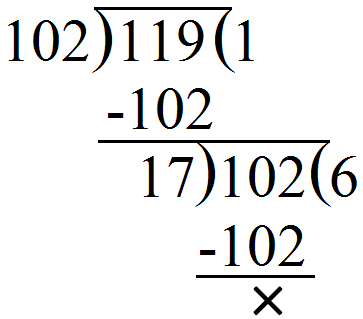
$H.C.F$ of $102 $and $119$ is $17$
$=\frac{-102\div11}{119\div17}=\frac{-6}{7}$
The standard from of $\frac{-102}{119}\text{ is }\frac{-6}{7}$
View full question & answer→MCQ 861 Mark
Mark $(\checkmark)$ against the correct answer in the following:The product of two numbers is $\frac{-1}{6}$ If one of them is $\frac{-5}{8}$ the other number is:
- A
$\frac{-4}{15}$
- ✓
$\frac{4}{15}$
- C
$\frac{15}{4}$
- D
$\frac{-15}{4}$
AnswerCorrect option: B. $\frac{4}{15}$
Let the other number to be $x$
$\frac{-5}{8}\times\text{x}=\frac{-1}{6}$
$\Rightarrow\text{x}=\frac{-1}{6}\div\Big(\frac{-5}{8}\Big)$
$=\frac{-1}{6}\times\Big(\frac{8}{-5}\Big)$
$=\frac{-4}{-15}$
$=\frac{4}{15}$
View full question & answer→MCQ 871 Mark
$-2\frac{3}{7}+4=?$
- A
$\frac{-11}{7}$
- B
$\frac{11}{7}$
- C
$\frac{-45}{7}$
- ✓
View full question & answer→MCQ 881 Mark
The standard form of $\frac{-48}{60}$ is:
- A
$\frac{48}{60}$
- B
$\frac{-601}{48}$
- ✓
$\frac{-4}{5}$
- D
$\frac{-4}{-5}$
AnswerCorrect option: C. $\frac{-4}{5}$
Given rational number is $\frac{-48}{60}.$
For standrad/ simplest form, divide numerator and denomin by their $HCF$
i.e. $\frac{-48+12}{60+12}=\frac{-4}{5}$
Hence, the standard form of $\frac{-48}{60}$ is $\frac{-4}{5}.$
View full question & answer→MCQ 891 Mark
The rational number equivalent to the rational number $\frac{7}{19}$ is:
- A
$\frac{17}{119}$
- B
$\frac{14}{57}$
- C
$\frac{21}{38}$
- ✓
$\frac{21}{57}$
AnswerCorrect option: D. $\frac{21}{57}$
$\frac{7}{19}$ can be written as $\frac{{7\times}\text{n}}{{19\times}\text{n}}$ where n is integer.The only equation which satisfies this equation is option $D$ as $\frac{21}{57} = \frac{7\times{3}}{19\times{3}}$ where $n = 3$
View full question & answer→MCQ 901 Mark
Write five rational numbers which are smaller than $2:$
- ✓
$1,\frac{1}{2},\,0,\,-1,\,-\frac{1}{2}$
- B
$0, 1 , 1.414, \sqrt3, -1$
- C
$0, 1 , \sqrt2, \sqrt3, -1$
- D
$0, 1 , 1.732, \sqrt2, -1$
AnswerCorrect option: A. $1,\frac{1}{2},\,0,\,-1,\,-\frac{1}{2}$
Five rational numbers less than $2$ may be taken $1,\frac{1}{2},\,0,\,-1,\,-\frac{1}{2}$(There can be many more such rational numbers).
View full question & answer→MCQ 911 Mark
Decimal representation of a rational number cannot be:
- A
- B
Non$-$Terminating
- C
Non$-$Terminating, Repeating
- ✓
Non$-$Terminating, Non$-$Repeating
AnswerCorrect option: D. Non$-$Terminating, Non$-$Repeating
Non$-$Terminating, Non$-$Repeating
View full question & answer→MCQ 921 Mark
The value of the root $ \sqrt{\frac{16}{36}+\frac{1}{4}}$ is:
- A
$ \frac{2}{5}$
- B
$ \frac{1}{3}$
- ✓
$\frac{5}{6}$
- D
$ \frac{7}{6}$
AnswerCorrect option: C. $\frac{5}{6}$
$\therefore \sqrt{\frac{16}{36}+\frac{1}{4}}$
$\therefore\sqrt{\frac{16}{36}+\frac{1}{4}}$
$=\sqrt{\frac{16+9}{36}} = \sqrt{\frac{25}{36}} = \frac{5}{6}$
View full question & answer→MCQ 931 Mark
The reciprocal of $\frac{1}{2}$ is:
Answer$(b)$ Reciprocal of $\frac{1}{2}=\frac{1}{\frac{1}{2}}=2$
View full question & answer→MCQ 941 Mark
The rational number $ {\frac{0}{7}}$
- A
- B
- C
Has either a positive numerator or a negative numerator
- ✓
Has neither a positive numerator nor a negative numerator
AnswerCorrect option: D. Has neither a positive numerator nor a negative numerator
In the given question numerator is $0$ and $0$ is neither positive nor negative.
View full question & answer→MCQ 951 Mark
Evaluate: $ \frac {1}{(-5)^2}$
- A
$\frac {-1}{25}$
- ✓
$\frac {1}{25}$
- C
$25$
- D
$-25$
AnswerCorrect option: B. $\frac {1}{25}$
The value of $\frac {1}{(-5)^2}=\dfrac {1}{(-5)(-5)} = \frac{1}{25}$
View full question & answer→MCQ 961 Mark
Match the correct product to the given expression $3 \times 5 \times 2 \times 5 = ..........$
Answer$3 \times 5 \times 2 \times 5 = 150$ The given expression has more than $2$ factors. So, it is a composite number.
View full question & answer→MCQ 971 Mark
The whole number nearest to $457$ and divisible by $11$ is:
AnswerThe numbers $450$ and $460$ are not divisible by $11.$
Now, both the numbers $451$ and $462$ are divisible by $11.$
Distance between $457$ and $451$ on the number line $= 457 - 451 = 6$
Distance between $457$ and $462$ on the number line $= 462 - 457 = 5$
Thus, the whole number nearest to $457$ and divisible by $11$ is $462.$
Hence, the correct answer is option $(d).$
View full question & answer→MCQ 981 Mark
If $-\frac{3}{4}=\frac{6}{\text{x}},$ then $x =$
Answer$-\frac{3}{4}=\frac{6}{\text{x}}$
$\Rightarrow-3\times\text{x}=6\times4$
$\Big(\frac{\text{a}}{\text{b}}=\frac{\text{c}}{\text{d}}\Rightarrow\text{ad}=\text{bc}\Big)$
$\Rightarrow-3\text{x}=24$
$\Rightarrow\frac{-3\text{x}}{-3}=\frac{24}{-3}$ (Dividing both sides by $-3)$
$\Rightarrow\text{x}=-8$
Hence, the correct answer is option $(a).$
View full question & answer→MCQ 991 Mark
Which one of the following is not true?
- A
Every natural number is a rational number
- ✓
Every real number is a rational number
- C
Every whole number is a rational number
- D
Every integer is a rational number
AnswerCorrect option: B. Every real number is a rational number
Every real number is a rational number
View full question & answer→MCQ 1001 Mark
Find the unknown value $x: \frac{5}{13} +\text{ x} = \frac{5}{13}$
- ✓
$0$
- B
$1$
- C
$ \frac{5}{13}$
- D
$ \frac{2}{13}$
AnswerGiven, $\frac {5}{13}+ \text{x}= \frac {5}{13}$
$\therefore \text{x}= \frac{5}{13}-\frac{5}{13}$
$\therefore \text{x}= 0$
View full question & answer→