Questions

M.C.Q

Take a timed test

18 questions · 7 auto-graded MCQ + 11 self-marked written.

MCQ 11 Mark
The curved surface area of a cylinder and a cone is equal. If their base radius is same, then the ratio of the slant height of the cone to the height of the cylinder is
  • A
    $1 : 1$
  • B
    $2 : 3$
  • C
    $1 : 2$
  • $2 : 1$
Answer
Correct option: D.
$2 : 1$
$\text{CSA}$ of cone $= \text{CSA}$ of cylinder
$\pi rl =2 \pi rh$
$l =2 h$
$l : h =2: 1$
View full question & answer
MCQ 21 Mark
In a histogram, which of the following is proportional to the frequency of the corresponding class?
  • A
    Width of the rectangle
  • B
    Length of the rectangle
  • C
    Perimeter of the rectangle
  • D
    Area of the rectangle
Answer
(b) Length of the rectangle
Explanation: In, Histogram each rectangle is drawn, where width equivalent to class interval and height equivalent to the frequency of the class.
View full question & answer
MCQ 31 Mark
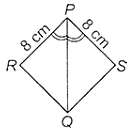
The congruence rule, by which the two triangles in the given figure are congruent is$............$
Image
  • A
    $\text{ASA}$
  • $\text{SAS}$
  • C
    $\text{SSS}$
  • D
    $\text{RHS}$
Answer
Correct option: B.
$\text{SAS}$
In $\triangle \text{PQR}$ and $\triangle \text{PQS}$
$\text{PR = PS} = 8 \ cm$
$\angle \text{RPQ} =\angle \text{SPQ} ($Given$)$
$\text{PQ = PQ}($Common$)$
$\therefore \triangle \text{PQR} \cong \triangle \text{PQS} ($ By $\text{SAS}$ congruency $)$
View full question & answer
MCQ 41 Mark
Which of the following point does not lie on the line y = 2x + 3?
  • A
    $(-5,-7)$
  • B
    $(-1,1)$
  • C
    $(3,9)$
  • D
    $(3,7)$
Answer
(d) (3, 7)
Explanation: Let us put x = 3 in the give equation,
Then, y = 2(3) + 3
y = 6 + 3 = 9
So, the point will be (3, 9)
For x = 3, y = 9. But in the given option, y = 7
So, the given point (3, 7) will not lie on the line y = 2x + 3. 
View full question & answer
MCQ 51 Mark
The simplest form of $0.5 \overline{7}$ is
  • A
    $\frac{26}{45}$
  • B
    $\frac{57}{99}$
  • C
    $\frac{57}{100}$
  • D
    $\frac{57}{90}$
Answer
(a) $\frac{26}{45}$
Explanation : $0.5 \overline{7}=\frac{57-5}{90}$
$=\frac{52}{90}=\frac{26}{45}$
View full question & answer
MCQ 61 Mark
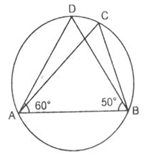
In the figure, if $\ce{\angle DAB=60^{\circ}, \angle ABD}=50^{\circ}$, then $\ce{\angle ACB}$ is equal to :
Image
  • A
    $80^{\circ}$
  • B
    $60^{\circ}$
  • C
    $50^{\circ}$
  • $70^{\circ}$
Answer
Correct option: D.
$70^{\circ}$
Image
In, $\ce{\triangle ABD}$
$\angle D=180^{\circ}-\angle A-\angle B$
$=180^{\circ}-110^{\circ}$
$=70^{\circ}$
Since angles made by same chord at any point of circumference are equal.
so, $\ce{\angle ACB=\angle ADB}=70^{\circ}$
View full question & answer
MCQ 71 Mark
Diagonals of a quadrilateral $\text{ABCD}$ bisect each other. If $\angle A=45^{\circ}$, then $\angle B=$
  • A
    $125^{\circ}$
  • B
    $115^{\circ}$
  • C
    $120^{\circ}$
  • $135^{\circ}$
Answer
Correct option: D.
$135^{\circ}$
Given,
Image
$\text{ABCD}$ is a quadrilateral
$\angle A =45^{\circ}$,
$\because$ diagonals of quadrilateral bisects each other hence $\text{ABCD}$ is a parallelogram,
$\Rightarrow \angle A +\angle B =180^{\circ}$
$\Rightarrow 45^{\circ}+\angle B =180^{\circ}$
$\Rightarrow \angle B =180^{\circ}-45^{\circ}=135^{\circ}$
View full question & answer
MCQ 81 Mark
ABCD is a Rhombus such that $\angle A C B=40^{\circ}$, then $\angle A D B$ is
  • A
    $100^{\circ}$
  • B
    $40^{\circ}$
  • C
    $60^{\circ}$
  • D
    $50^{\circ}$
Answer
(d) $50^{\circ}$
Explanation : In Rhombus, digonals bisect each other right angle. By using angle sum property in any of the four triangles formed by intersection of diagonals, we get $\angle C B D=50$ and $\angle C B D=\angle A D C$ ( alternate angles).
So, $\angle ADC =50$
View full question & answer
MCQ 91 Mark
Express $y$ in terms of $x$ in the equation $5x - 2y = 7.$
  • $y=\frac{5 x-7}{2}$
  • B
    $y=\frac{7-5 x}{2}$
  • C
    $y=\frac{7 x+5}{2}$
  • D
    $y=\frac{5 x+7}{2}$
Answer
Correct option: A.
$y=\frac{5 x-7}{2}$
$5 x-2 y=7$
$-2 y=7-5 x$
$2 y=5 x-7$
$y=\frac{5 x-7}{2}$
View full question & answer
MCQ 101 Mark
Zero of the zero polynomial is -
  • A
    every real number
  • B
    1
  • C
    not defined
  • D
    $0$
Answer
(a) every real number  
Explanation : Zero of the zero polynomial is any real number.
e.g., Let us consider zero polynomial be 0(x - k), where k is a real number.
For determining the zero, put $x - k =0 \Rightarrow x = k$ Hence, zero of the zero polynomial be any real number.
View full question & answer
MCQ 111 Mark
The diagonals $\text{AC}$ and $\text{BD}$ of a rectangle $\text{ABCD}$ intersect each other at $P. $If $\ce{\angle ABD} =50^{\circ}$, then $\ce{\angle DPC =}$
  • A
    $70^{\circ}$
  • $80^{\circ}$
  • C
    $90^{\circ}$
  • D
    $100^{\circ}$
Answer
Correct option: B.
$80^{\circ}$
Given, $\text{ABCD}$ is a rectangle
Image
Diagonals $\text{ACBD}$ intersect each other at $P$
$\ce{\angle ABD}=50^{\circ}$
$\because$ diagonals of rectangle bisect each other and are equal in length
$\ce{\Rightarrow \angle ABD =\angle PDC}[$ alternate angles $]$
$\ce{\Rightarrow \angle PDC =\angle PCD} =50^{\circ}$
In $\ce{\triangle DPC}$
$\ce{\Rightarrow \angle DPC + \angle PCD + \angle PDC = 180^{\circ}}$
$\ce{\Rightarrow \angle DPC} + 50^{\circ}+50^{\circ}=180^{\circ}$
$\ce{\Rightarrow \angle DPC} =180^{\circ}-100^{\circ}=80^{\circ}$
View full question & answer
MCQ 121 Mark
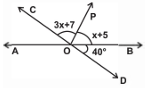
In the figure $\ce{AB\ \&\ CD}$ are two straight lines intersecting at $\text{O , OP}$ is a ray. What is the measure of $\ce{\angle AOD}$.
Image
  • A
    $128^{\circ}$
  • B
    $40^{\circ}$
  • $140^{\circ}$
  • D
    $100^{\circ}$
Answer
Correct option: C.
$140^{\circ}$
From the figure it follows that
$(3 x+7)+(x+5)+40=180$
$\Rightarrow 4 x+52=180$
$\Rightarrow 4 x=180-52=128$
$\Rightarrow x=32$
Now,
$\ce{\angle AOD=\angle COP + \angle POB}$
$\Rightarrow \ce{\angle AOD}=(3 x+7)+(x+5)$
$\Rightarrow \ce{\angle AOD}=4 x+12$
$\Rightarrow \ce{\angle AOD}=4 \times 32+12$
$\Rightarrow \ce{\angle AOD}=128+12$
$\Rightarrow \ce{\angle AOD}=140$
View full question & answer
MCQ 131 Mark
Euclid stated that all right angles are equal to each other in the form of
  • A
    A postulate
  • B
    A proof
  • C
    An axiom
  • D
    A definition
Answer
(a) A postulate
Explanation: Eucid's fourth postulate states that all right angles are equal to one another.
View full question & answer
MCQ 141 Mark
The graph of the linear equation 2x + 3y = 6 is a line which meets the x-axis at the point
  • A
    (0,3)
  • B
    (3,0)
  • C
    (2, 0)
  • D
    (0 ,2)
Answer
(b) (3,0)
Explanation : 2x + 3y = 6 meets the X-axis.
Put y = 0,
2x + 3(0) = 6
x = 3
Therefore, graph of the given line meets X-axis at (3, 0).
View full question & answer
MCQ 161 Mark
Two points having same abscissa but different ordinates lie on
  • A
    y-axis
  • B
    x-axis
  • C
    a line parallel to y-axis
  • D
    a line parallel to x-axis
Answer
(c) a line parallel to y-axis
Explanation: Two points having same abscissa but different ordinate always make a line which is parallel to the y-axis as abscissa is fixed and the only ordinate keeps changing.  
View full question & answer
MCQ 171 Mark
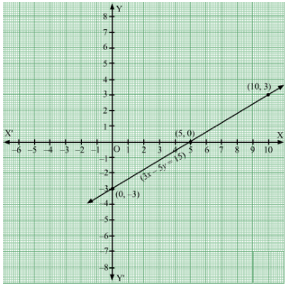
The linear equation 3x - 5y = 15 has
  • A
    no solution
  • B
    infinitely many solutions
  • C
    a unique solution
  • D
    two solutions
View full question & answer
MCQ 181 Mark
$\pi$ is
  • A
    a rational number
  • B
    an integer
  • C
    an irrational number
  • D
    a whole number
Answer
(c) an irrational number
Explanation: $\pi=3.14159265359\ldots\ldots$ which is non-terminating non-recurring.
Hence, it is an irrational number.
View full question & answer
M.C.Q - Maths STD 9 Questions - Vidyadip