Question 13 Marks
Estimate the total number of air molecules (inclusive of oxygen, nitrogen, water vapour and other constituents) in a room of capacity $25.0m^3$ at a temperature of $27°C$ and $1$ atm pressure.
AnswerVolume of the room, $\mathrm{V}=25.0 \mathrm{~m}^3$ Temperature of the room, $\mathrm{T}=27^{\circ} \mathrm{C}=300 \mathrm{~K}$ Pressure in the room, $\mathrm{P}=1 \mathrm{~atm}=1 \times$
$1.013 \times 10^5 \mathrm{~Pa}$ The ideal gas equation relating pressure ( P ), Volume ( V ), and absolute temperature ( T ) can be written as, $\mathrm{PV}=\mathrm{k}_{\mathrm{B}} \mathrm{NT}$ Where, $\mathrm{K}_{\mathrm{B}}$ is Boltzmann constant $=1.38 \times 10^{-23} \mathrm{~m}^2 \mathrm{~kg} \mathrm{~s}^{-2} \mathrm{k}^{-1} \mathrm{~N}$ is the number of air molecules in the room $\therefore \mathrm{N}=\frac{\mathrm{PV}}{\mathrm{K}_{\mathrm{B}} \mathrm{T}}=\frac{1.013 \times 10^5 \times 25}{\left(1.38 \times 10^{23} \times 300\right)}=6.11 \times 10^{26}$ molecules Therefore, the total number of air molecules in the given room is $6.11 \times 10^{26}$
View full question & answer→Question 23 Marks
Molar volume is the volume occupied by 1mol of any (ideal) gas at standard temperature and pressure: (STP: 1 atmospheric pressure, $0°C$). Show that it is $22.4$ litres.
AnswerThe ideal gas equation relating pressure $(P)$, volume $(V)$, and absolute temperature $(T)$ is given as: $P V=n R T$ Where, $R$ is the universal gas constant $=8.314 \mathrm{~J} \mathrm{~mol}^{-1} \mathrm{~K}^{-1} \mathrm{n}=$ Number of moles $=1 \mathrm{~T}=$ Standard temperature $=273 \mathrm{KP}=$ Standard pressure $=1 \mathrm{~atm}=1.013 \times 10^5 \mathrm{Nm}^{-2}$
$\therefore \mathrm{~V}=\frac{\mathrm{nRT}}{\mathrm{P}}=\frac{1 \times 8.314 \times 273}{\left(1.013 \times 10^5\right)}=0.0224 \mathrm{~m}^3=22.4$ litres Hence, the molar volume of a gas at STP is 22.4 litres.
View full question & answer→Question 33 Marks
Calculate the temperature at which the root mean square velocity of nitrogen molecules will be equal to $8km-s^{-1}$.
AnswerGiven, r.m.s. velocity, $C = 8km-s^{-1} = 8 \times 10^5cm-s^{-1}$ Molar gas constant $= R = 8.31 \times 10^7erg ~mol^{-1}K^{-1}$ Molecular weight of nitrogeru M = 28 Let T be the required temperature Then, $\text{C}=\sqrt{\frac{3\text{RT}}{\text{M}}}$ or $\text{C}^2=\frac{3\text{RT}}{\text{M}}$ or $\text{T}=\frac{\text{MC}^2}{3\text{R}}$$=\frac{28\times(8\times10^5)^2}{3\times8.31\times10^7}\text{K}=71881\text{K}$
View full question & answer→Question 43 Marks
At what temperature would the root-mean square speed of a gas molecule have twice its value at 100°C?
AnswerWe know that$\text{C}^2=3\frac{\text{RT}}{\text{Nm}}=3\frac{\text{Kt}}{\text{m}}$
Thus $\text{C}^2_1=\frac{3\text{kT}_1}{\text{m}}$ and $\text{C}_2^2=\frac{3\text{kT}_2}{\text{m}}$$\therefore\frac{\text{C}^2_1}{\text{C}^2_2}=\frac{\text{T}_1}{\text{T}_2}$
Here $\text{C}_2=2\text{C}_1,\text{T}=273+100=373\text{K}$$\text{T}_2=\text{T}_1\times\frac{\text{C}^2_2}{\text{C}^2_1}$
$=373\times4=1492\text{K}=1219^{\circ}\text{C}$
View full question & answer→Question 53 Marks
On what parameter does the $\lambda ($mean free path$)$ depends?
AnswerWe know that :$\lambda=\frac{\text{kT}}{\sqrt{2}\pi\text{d}^2\rho}=\frac{\text{m}}{\sqrt{2}\pi\text{d}^2\rho}=\frac{1}{\sqrt{2}\pi\text{n}\text{d}^2}$
$\therefore\lambda$ depends upon:
- Diameter $(d)$ of the molecule, smaller the $'d\ '$, larger is the mean free path $\lambda.$
- $\lambda\propto\text{T}$ i.e., higher the temperature larger is the $\lambda.$
- $\lambda\propto\frac{1}{\text{P}}$ i.e., smaller the pressure larger is the $\lambda.$
- $\lambda\propto\frac{1}{\text{P}}$ i.e., smaller the density $(\rho)$ larger will be the $\lambda.$
- $\lambda\propto\frac{1}{\text{P}}$ i.e., smaller the number of molecules per unit volume of the gas, larger is the $\lambda.$
View full question & answer→Question 63 Marks
Equal masses of air are sealed in two vessels, one of volume $V_0$ and the other of volume $2V_0$. If the first vessel is maintained at a temperature $300K$ and the other at $600K$, find the ratio of the pressures in the two vessels.
AnswerSince mass is same
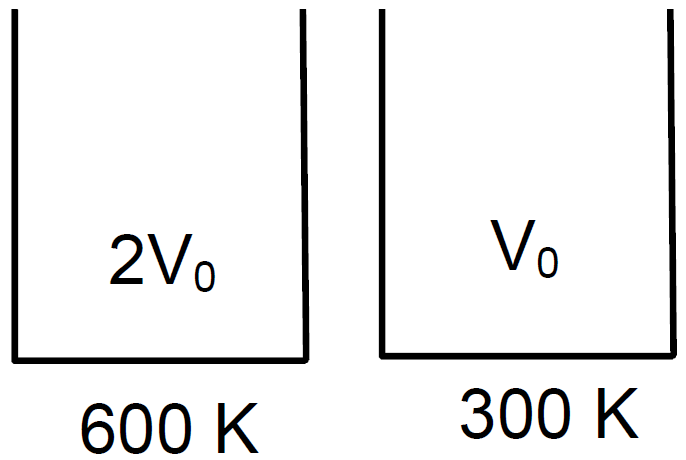
$n_1 = n_2 = n \text{P}_1=\frac{\text{nR}\times300}{\text{V}_0},\text{P}_2=\frac{\text{nR}\times600}{2\text{V}_0}$
$\frac{\text{P}_1}{\text{P}_2}=\frac{\text{nR}\times300}{\text{V}_0}\times\frac{2\text{V}_0}{\text{n}\text{R}\times600}=\frac{1}{1}=1:1$ View full question & answer→Question 73 Marks
An ideal gas has a specific heat at constant pressure $\text{C}_{\text{p}}=\frac{5\text{R}}{2}.$ The gas is kept in a closed vessel of volume $0.0083m^3$ at a temperature of 300K and a pressure of $1.6 \times 10^6Nm^{-2}$. An amount of $2.49 \times 10^4J$ of heat energy is supplied to the gas. Calculate the final temperature and pressure of the gas.
Answer$P = 1.6 \times 10^6Nm^{-2}, V = 0.0083m^3, T = 300K$ We know that $PV = nRT$, where $R = 8.3JK^{-1} mol^{-1}$ Therefore $\text{n}=\frac{\text{PV}}{\text{RT}}$$=\frac{1.6\times10^6\times0.0083}{8.3\times300}=\frac{16}{3}\text{mole}$
Now $\text{C}_{\text{P}}-\text{C}_{\text{V}}=\text{R},$ therefore $\text{C}_{\text{V}}=\text{C}_{\text{P}}-\text{R}=\frac{5\text{R}}{2}-\text{R}=\frac{3\text{R}}{2}$ When heat energy Q is supplied to the gas, the inoease $\Delta\text{T}$ in its temperatue is obtained
from the relation$\text{Q}=\text{nC}_{\text{V}}\Delta\text{T}$ or $\Delta\text{T}=\frac{\text{Q}}{\text{nC}_{\text{V}}}=\frac{2.49\times10^4}{\frac{16}{3}\times\frac{3}{2}\times8.3}=375\text{K}$
$\therefore$ Final temperature T’ = 300 + 375 = 675K. Since the gas is kept in a closed vessel, its volume remains constant. Hence the final pressure P is obtained from the relation.
$\frac{\text{P}'}{\text{T}'}=\frac{\text{P}}{\text{T}}$ or $\text{P}'=\text{P}\times\frac{\text{T}'}{\text{T}}$
$=\frac{1.6\times10^6\times675}{300}=3.6\times10^6\text{Nm}^{-2}$
View full question & answer→Question 83 Marks
Three moles of an ideal diatomic gas is taken at a temperature of $300K$. Its volume is doubled keeping its pressure constant. Find the change in internal energy of gas.
AnswerHere, $\mu=3,\text{T}_1=300\text{K}$ and for an ideal monoatomic gas $\text{C}_{\text{v}}=\frac{5}{2}\text{R}$
As volume of gas is doubled $(V_2 = 2V_1)$ at corstant pressure, hence according to Charlds law$\text{T}_2=\frac{\text{T}_1\text{V}_2}{\text{V}_1}=\frac{300\times2\text{V}_1}{\text{V}_1}=600\text{K}$
$\therefore$ Gain in internal energy $\text{u}_2-\text{u}_1=\mu\text{C}_{\text{v}}(\text{T}_2-\text{T}_1)$
$=3\times\frac{5}{2}\text{R}\times(600-300)$
$=2250\text{R}=2250\times8.31\times10^4\text{J}$
View full question & answer→Question 93 Marks
Give the essential feature of kinetic theory of gases. Show that the pressure exerted by a gas is equal to two$-$third of the average kinetic energy.
AnswerPostulates of kinetic theory of gases:
- A gas consists of a very large number of molecules $($of the order of Avogadro's number, $10^{23}),$ which are perfect elastic spheres. They are identical in all respects for a given gas and are different for different gases.
- The molecules of a gas are in a state of incessant random motion. They move in all directions with different speeds and obey Newton's laws of motion.
- The molecules do not exert any force of attraction or repulsion on each other, except during collision.
From the kinetic theory of gases, the pressure $P$ exerted by an ideal gas of density $\rho$ and $\text{r.m.s}$. velocity of its gas molecules $c$ is given by
$\text{p}=\frac{1}{3}\rho\text{c}^2$
Mass of unit volume of the gas $=1\times\rho=\text{p}$
Mean kinetic energy of translation per unit volume of the gas is
$\text{E}=\frac{1}{2}\rho\text{c}^2$
$\therefore\frac{\text{P}}{\text{E}}=\frac{\big(\frac{1}{3}\big)\rho\text{c}^2}{\big(\frac{1}{2}\big)\rho\text{c}^2}=\frac{2}{3}\Rightarrow\text{P}=\frac{2}{3}\text{E}$ View full question & answer→Question 103 Marks
The density of an ideal gas is $1.25 \times 10^{-3}gcm^3$ at STP. Calculate the molecular weight of the gas.
Answer$\text{P}=\frac{\text{nRT}}{\text{V}}=\frac{\text{m}}{\text{M}}\times\frac{\text{RT}}{\text{V}}=\frac{\text{fRT}}{\text{M}}$
$ f \rightarrow 1.25 \times 10^{-3} \mathrm{~g} / \mathrm{cm}^3$
$\mathrm{R} \rightarrow 8.31 \times 10^7 \mathrm{ert} / \mathrm{deg} / \mathrm{mole}$
$\mathrm{T} \rightarrow 273 \mathrm{~K}$
$\Rightarrow\text{M}=\frac{\text{fRT}}{\text{P}}=\frac{1.25\times10^{-3}\times8.31\times10^7\times273}{13.6\times980\times76}$
$=0.002796\times10^4\approx28\text{g/ mol}$
View full question & answer→Question 113 Marks
The molecules of a given mass of a gas have root mean square speeds of 100m/s at 27°C and 1.00 atmospheric pressure. What will be the root mean square speeds of the molecules of the gas at 127°C and 2.0 atmospheric pressure?
AnswerHere $\text{C}_1=100\text{m/s C}_2=?$$\text{T}_1=27^{\circ}\text{C}=(27+273)\text{K}=300\text{K}$
$\text{T}_2=127^{\circ}\text{C}=(127+273)\text{K}=400\text{K}$
$\text{P}_1=1.00\text{ atm}$
$\text{P}_2=2.0\text{ atm}$
From $\frac{\text{P}_1\text{V}_1}{\text{T}_1}=\frac{\text{P}_2\text{V}_2}{\text{T}_2};\frac{\text{V}_1}{\text{V}_2}=\frac{\text{P}_2}{\text{P}_1}\frac{\text{T}_1}{\text{T}_2}$$=2\times\frac{300}{400}=\frac{3}{2}$
Again $\text{P}_1=\frac{1}{3}\frac{\text{M}}{\text{V}_1}\text{C}^2_1$ and $\text{P}_2=\frac{1}{3}\text{M}$
View full question & answer→Question 123 Marks
Calculate the root-mean square speed of oxygen molecules at $1092K$. Density of oxygen at STP = $1.424kg-m^{-3}$.
AnswerWe first calculate the root-mean square speed of oxygen at STP.$\text{P}_0=0.76\text{m}$ of $\text{Hg}=1.01\times10^5\text{Nm}^{-2}$
$\rho_0=1.424\text{kg-m}^{-3}$
The root-mean square speed at 0°C is given by$\text{c}_0=\sqrt{\frac{3\text{P}_0}{\rho_0}}=\sqrt{\frac{3\times1.01\times10^5}{1.424}}\text{ms}^{-1}$
$=4.61\times10^2\text{ms}^{-1}$
Now $c_{rms}$ is also given by$\text{c}_{\text{rms}}=\sqrt{\frac{3\text{kT}}{\text{m}}}$
$\therefore\frac{\text{c}_{\text{rms}}}{\text{c}_0}=\sqrt{\frac{\text{T}}{\text{T}_0}}$
Here $\text{T}_0=273\text{K}$ and $\text{T}=1092\text{K}$$\text{c}_{\text{rms}}=\text{c}_0\sqrt{\frac{\text{T}}{\text{T}_0}}$
$=4.61\times10^2\times\sqrt{\frac{1092}{273}}$
$=9.22\times10^2\text{ms}^{-1}$
View full question & answer→Question 133 Marks
A vessel containing one mole of a monatomic ideal gas (molecular weight =$20gmol^{-1}$) is moving on a floor at a speed of $50ms^{-1}$. The vessel is stopped suddenly. Assuming that the mechanical energy lost has gone into the internal energy of the gas, find the rise in its temperature.
AnswerN = 1mole, M = 20g/mol, V = 50m/s K.E. of the vessel = Internal energy of the gas$=\Big(\frac{1}{2}\Big)\text{mv}^2$
$=\Big(\frac{1}{2}\Big)\times20\times10^{-3}\times50\times50=25\text{J}$
$\Rightarrow25=\text{n}\frac{3}{2}\text{r}(\triangle\text{T})$
$\Rightarrow25=1\times\frac{3}{2}\times8.31\times\triangle\text{T}$
$\Rightarrow\triangle\text{T}=\frac{50}{3\times8.3}\approx2\text{k}$
View full question & answer→Question 143 Marks
Figure. shows a vessel partitioned by a fixed diathernnc separator. Different ideal gases are filled in the two parts. The rms speed of the molecules in the left part equals the mean speed of the molecules in the right part. Calculate the ratio of the mass of a molecule in the left part to the mass of a molecule in the right part.

AnswerThe left side of the container has a gas, let having molecular wt. $M_1$ Right part has Mol. $wt = M_2$ Temperature of both left and right chambers are equal as the separating wall is diathermic,$\sqrt{\frac{3\text{RT}}{\text{M}_1}}=\sqrt{\frac{8\text{RT}}{\pi\text{M}_2}}\Rightarrow\frac{3\text{RT}}{\text{M}_1}=\frac{8\text{RT}}{\pi\text{M}_2}$
$\Rightarrow\frac{\text{M}_1}{\pi\text{M}_2}=\frac{3}{8}\Rightarrow\frac{\text{M}_1}{\text{M}_2}=\frac{3\pi}{8}=1.1778\approx1.18$
View full question & answer→Question 153 Marks
You have the following group of particles, $n_i$ represents no. of molecules with speed $v_i(ms^{-1})$:
| $n_i$ |
$2$ |
$4$ |
$8$ |
$6$ |
$3$ |
| $v_i$ |
$1.0$ |
$2.0$ |
$3.0$ |
$4.0$ |
$5.0$ |
Calculate:
- The average speed.
- The $\text{r.m.s}$. speed.
- The most probable speed.
Answer$n_i$ = Number of molecules $v_i$ = Speed of molecules
| $n_i$ |
$2$ |
$4$ |
$8$ |
$6$ |
$3$ |
| $v_i$ |
$1.0$ |
$2.0$ |
$3.0$ |
$4.0$ |
$5.0$ |
- The average speed
$\text{v}_{\text{avg}}=\frac{\text{n}_1\text{v}_1+\text{n}_2\text{v}_2+\text{n}_3\text{v}_3+...+\text{n}_5\text{v}_5}{\text{n}_1+\text{n}_2+\text{n}_3+...+\text{n}_5}$
$=\frac{(2\times1)+(4\times2)+(8\times3)+(6\times4)+(3\times5)}{2+4+8+6+3}$
$=\frac{2+8+24+24+15}{23}=\frac{73}{23}=3.17\text{ms}^{-1}$
- $\text{v}_{\text{rms}}=\sqrt{\frac{\text{n}_1\text{v}_1^2+\text{n}_2\text{v}_2^2+\text{n}_3\text{v}_3^2+\text{n}_4\text{v}_4^2+\text{n}_5\text{v}_5^2}{\text{n}_1+\text{n}_2+\text{n}_3+\text{n}_4+\text{n}_5}}$
$=\sqrt{\frac{2(1)^2+4(2)^2+8(3)^2+6(4)^2+3(5)^2}{2+4+8+6+3}}$
$=\sqrt{\frac{2+16+72+96+75}{23}}$
$=\sqrt{\frac{261}{23}}=\sqrt{11.347}$
$=3.37\text{ms}^{-1}$
- The most probable sped $=3\text{ms}^{-1}$
View full question & answer→Question 163 Marks
At what temperature the mean speed of the molecules of hydrogen gas equals the escape epeed from the earth?
AnswerMean speed of the molecule $=\sqrt{\frac{8\text{RT}}{\pi\text{M}}}$Escape velocity $=\sqrt{2\text{gr}}$
$\sqrt{\frac{8\text{RT}}{\pi\text{M}}}=\sqrt{2\text{gr}}\Rightarrow\frac{8\text{RT}}{\pi\text{M}}=2\text{gr}$
$\Rightarrow\text{T}=\frac{2\text{gr}\pi\text{M}}{8\text{R}}=\frac{2\times9.8\times6400000\times3.14\times2\times10^{-3}}{8\times8.3}$ $=11863.9\approx11800\text{m/s}.$
View full question & answer→Question 173 Marks
If one mole of ideal monoatomic gas $\Big(\gamma=\frac{7}{5}\Big)$ is mixed with one mole of diatomic gas $\Big(\gamma=\frac{7}{5}\Big).$ What is the value of y for the mixtures? (Here, $\gamma$ represents the ratio of specific heat at constant pressure to that at constant volume)
AnswerFor monoatomic gas, $\text{C}_{\text{V}}=\frac{3}{2}\text{R}$ For diatomic gas, $\text{C}'_{\text{V}}=\frac{5}{2}\text{R}$ Let, $\mu$ and $\mu'$ be moles of mono and diatomic gases then. $C_V$ (mixture) $=\frac{\mu\text{C}_{\text{V}}+\mu'\text{C}'_{\text{V}}}{\mu+\mu'}$$\text{C}_{\text{V}}=\frac{1\times\frac{3}{2}\text{R}+1\times\frac{5}{2}\text{R}}{1+1}=2\text{R}$
$\gamma(\text{mixture})=1+\frac{\text{R}}{\text{C}_{\text{V (mixture)}}}$
$=1+\frac{\text{R}}{2\text{R}}=1.5$
View full question & answer→Question 183 Marks
Calculate the diameter of a molecule if $\mathrm{n}=2.79 \times 10^{25}$ molecules per $\mathrm{m}^3$ and mean free path $=2.2 \times 10^{-8}$.
AnswerHere $\text{n}=2.79\times10^{25}\text{molecules m}^{-3};$$\lambda=2.2\times10^{-8}\text{m}$
Using the relation,$\lambda=\frac{1}{\sqrt{2}\pi\text{nd}^2}$
We get $\text{d}^2=\frac{1}{\sqrt{2}\pi\text{n}\lambda}$$=\frac{1}{\sqrt{2}\times3.14\times2.79\times10^{25}\times2.2\times10^{-8}}$
$=0.03666\times10^{-17}\text{m}^2$
$=0.367\times10^{-18}\text{m}^2$
$\Rightarrow\text{d}=\sqrt{0.367\times10^{-18}}\text{m}^2$
$=0.606\times10^{-9}\text{m}=0.606\text{nm}$
View full question & answer→Question 193 Marks
Figure. shows a cylindrical tube with adiabatic walls and fitted with a diathermic separator. The separator can be slid in the tube by an external mechanism. An ideal gas is injected into the two sides at equal pressures and equal temperatures. The separator remains in equilibrium at the middle. It is now slid to a position where it divides the tube in the ratio of 1 : 3. Find the ratio of the pressures in the two parts of the vessel.

Answer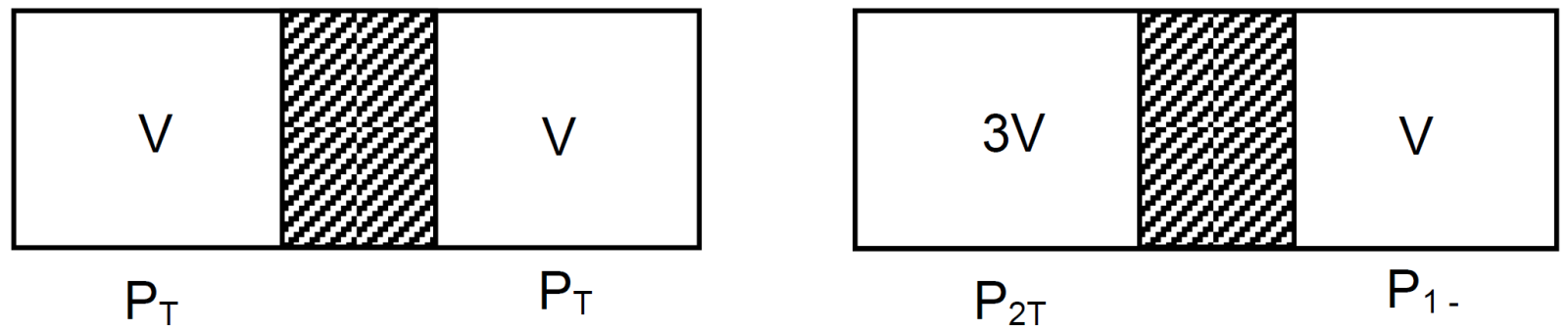 $\text{n}_1=\text{n}_2=\text{n}$
$\text{P}_1=\frac{\text{nRT}}{\text{V}},\text{P}_2=\frac{\text{nRT}}{3\text{V}}$
$\frac{\text{P}_1}{\text{P}_2}=\frac{\text{nRT}}{\text{V}}\times\frac{3\text{V}}{\text{nRT}}=3:1$ View full question & answer→Question 203 Marks
Consider a sample of oxygen at 300K. Find the average time taken by a molecule to travel a distance equal to the diameter of the earth.
Answer$\text{V}_\text{avg}=\sqrt{\frac{8\text{RT}}{\pi\text{M}}}=\sqrt{\frac{8\times8.3\times300}{3.14\times0.032}}=445.25\text{m/s}$$\text{T}=\frac{\text{Distance}}{\text{Speed}}=\frac{6400000\times2}{445.25}=445.25\text{m/s}$
$=\frac{28747.83}{3600}\text{km}=7.985\approx8\text{hrs}.$
View full question & answer→Question 213 Marks
Explain the pressure exerted by an ideal gas and also find the average kinetic energy per molecule of the gas.
AnswerFrom kinetic theory of gases, the pressure P exerted by an ideal gas of density p and r.m.s. velocity of its gas molecules C is given by$\text{P}=\frac{1}{3}\rho\text{C}^2$
Mass of unit volume of the gas $=1\times\rho=\rho$ Mean kinetic energy of translation per unit volume of the gas is$\text{E}=\frac{1}{2}\rho\text{C}^2,$
$\therefore\frac{\text{P}}{\text{E}}=\frac{\big(\frac{1}{3}\big)\rho\text{C}^2}{\big(\frac{1}{2}\big)\rho\text{C}^2}=\frac{2}{3}$
$\text{P}=\frac{2}{3}\text{E}$
"The pressure exerted by an ideal gas is numerically equal to two third of the mean kinetic energy of translation per unit volume of the gas." Average Kinetic Energy per Molecule of the Gas: Consider one gram mole of an ideal gas occupying a volume V at temperature T. Let m be the mass of each molecule of the gas. Then $M = m \times N_A$ where $N_A$ is Avogadro's number. If C is the r.m.s. velocity of the gas molecules, then pressure P exerted by ideal gas is$\text{P}=\frac{1}{3}\rho\text{C}^2=\frac{1}{3}\frac{\text{M}}{\text{V}}\rho\text{C}^2$
$\text{PV}=\frac{1}{3}\text{MC}^2$
From perfect gas equation, PV = RT, where R is a universal gas constant for one gram mole of the gas.$\therefore\frac{1}{3}\text{MC}^2=\text{RT}$
$\frac{1}{3}\text{MC}^2=\frac{3}{2}\text{RT}$
$\therefore$ Average kinetic energy of translation of one mole of the gas $=\frac{1}{2}\text{MC}^2=\frac{3}{2}\text{RT}$
$\frac{1}{2}\text{mN}_{\text{A}}\text{C}^2=\frac{3}{2}\text{RT}$ $(\because\text{M = mN}_{\text{A}})$
$=\frac{1}{2}\text{mC}^2=\frac{3}{2}\Big(\frac{\text{R}}{\text{N}_{\text{A}}}\Big)\text{T}=\frac{3}{2}\text{k}_{\text{B}}\text{T}$ $\Big(\because\frac{\text{R}}{\text{N}}=\text{k}_{\text{B}}\Big)$
where $k_B$ is called Boltzmarm constant.$\therefore$ Average K.E. of trarulation per molecule of gas $=\frac{1}{2}\text{mC}^2=\frac{3}{2}\text{k}_{\text{B}}\text{T}.$
View full question & answer→Question 223 Marks
What will be the internal energy of $8g$ of oxygen at STP?
AnswerOxygen is a diatomic gas Number of moles of $O_2$ gas$=\frac{\text{Atomic wt.}}{\text{Molecular wt.}}=\frac{8}{32}$
$=\frac{1}{4}=0.25$
$\therefore$ Energy associated with 1 mole of oxygen
$\text{U}=\frac{5}2{}\text{RT}$
$\therefore$ Internal energy of 8g of oxygen $=0.25\times\frac{5}{2}\text{RT}$
$=0.25\times\frac{5}{2}\times8.31\times273=1417.9\text{J}$
View full question & answer→Question 233 Marks
The average translational kinetic energy of air molecules is $0.040 \mathrm{eV}\left(1 \mathrm{eV}=1.6 \times 10^{-19}J\right)$. Calculate the temperature of the air. Boltzmann constant $\mathrm{k}=1.38 \times 10^{-23} \mathrm{JK}^{-1}$.
AnswerAgv. K.E. $=\frac{3}{2}\text{KT}$$\Rightarrow \frac{3}{2}\text{KT}=0.04\times1.6\times10^{-19}$
$\Rightarrow\Big(\frac{3}{2}\Big)\times1.38\times10^{-23}\times\text{T}=0.04\times1.6\times10^{-19}$
$\Rightarrow\text{T}=\frac{2\times0.04\times1.6\times10^{-19}}{3\times1.38\times10^{-23}}$ $=0.0309178\times10^4=309.178\approx310\text{K}$
View full question & answer→Question 243 Marks
A vessel contains two non$-$reactive gases: neon $($monoatomic$)$ and oxygen $($diatomic$)$. The ratio of their partial pressures is $3: 2$. Estimate the ratio of $(i)$ number of molecules, $(ii)$ mass density of neon and oxygen in the vessel. Atomic mass of $\mathrm{Ne}=20.2 \mathrm{u}$, molecular mass of $\mathrm{O}_2=32.0 \mathrm{u}$.
Answer
- It is given that $\frac{\text{P}_{\text{Ne}}}{\text{P}_{\text{O}_2}}=\frac{3}{2}$
As $\text{P}=\frac{\pi\text{RT}}{\text{V}}$
Hence for a given temp€rafure and volume of vessel,
$\frac{\text{P}_{\text{Ne}}}{\text{P}_{\text{O}_2}}=\frac{\mu_{\text{Ne}}}{\mu_{\text{O}_2}}=\frac{\text{N}_{\text{Ne}}}{\text{N}_{\text{O}_2}}=\frac{3}{2}$
- If $\text{m}_{\text{Ne}}$ and $\text{m}_{\text{O}_2}$ be the actual masses of the two gases present in the mixture and $\text{M}_{\text{Ne}}$ and $\text{M}_{\text{O}_2}$ be their molecular masses, then $\mu_{\text{Ne}}=\frac{\text{m}_{\text{Ne}}}{\text{M}_{\text{Ne}}}$ and $\mu_{\text{O}_2}=\frac{\text{m}_{\text{O}_2}}{\text{M}_{\text{O}_2}}.$
If $\rho_{\text{Ne}}$ and $\rho_{\text{O}_2}$ be the mass densities of two gases, then
$\frac{\rho_{\text{Ne}}}{\rho_{\text{O}_2}}=\frac{\text{m}_{\text{Ne}}/{\text{V}}}{\text{m}_{\text{O}_2}/{\text{V}}}=\frac{\text{m}_{\text{Ne}}}{\text{m}_{\text{O}_2}}\times\frac{\text{M}_{\text{Ne}}}{\text{M}_{\text{O}_2}}$
$=\frac{3}{2}\times\frac{20.2}{32.0}=\frac{0.947}{1}$ View full question & answer→Question 253 Marks
Using the expression for pressure exerted by a gas, deduce Avogadro's law and Graham's law of diffusion.
AnswerAvogadro's law: Consider two gases A and B having equal volume V at same temperature T and pressure P. For gas A,$\text{P}=\frac{1}{3}\frac{\text{M}\rho_1}{\text{V}}\text{c}^2_1$
For gas B,$\text{P}=\frac{1}{3}\frac{\text{M}_2}{\text{V}}\text{c}^2_2$
$\therefore\text{P}=\frac{\text{M}_1\text{c}^2_1}{3\text{V}}=\frac{\text{M}_2\text{c}^2_2}{3\text{V}}$
or $\text{M}_1\text{c}^2_1=\text{M}_2\text{c}^2_2 \ ...(\text{i})$ As gases are at the same temperature. Average K.E. per molecule of gas A = Average K.E. per molecule of gas A$\frac{1}{2}\text{m}_1\text{c}^2_1=\frac{1}{2}\text{m}_2\text{c}^2_2$
$\text{m}_1\text{c}^2_1=\text{m}_2\text{c}^2_2 \ ...(\text{ii})$
Dividing (i) by (ii)$\frac{\text{M}_1\text{c}^2_1}{\text{m}_1\text{c}^2_1}=\frac{\text{M}_2\text{c}^2_2}{\text{m}_2\text{c}^2_2}$
$\frac{\text{m}_1\text{n}_1\text{c}^2_1}{\text{m}_1\text{c}^2_1}=\frac{\text{m}_2\text{n}_2\text{c}^2_2}{\text{m}_2\text{c}^2_2}$
$\therefore\text{n}_1=\text{n}_2$ (which is Avogadro's law)
Graham's law:$\text{P}_1=\frac{1}{3}\rho_1\text{c}^2_1\text{P}_2=\frac{1}{3}\rho_2\text{c}^2_2$
When the steady state of diffusion is reached,$\text{P}_1=\text{P}_2$
$\frac{1}{3}\rho_1\text{c}^2_1=\frac{1}{3}\rho_2\text{c}^2_2$
$\frac{\text{c}^2_1}{\text{c}^2_2}=\frac{\rho_2}{\rho_1}$
or $\frac{\text{c}_1}{\text{c}_2}=\sqrt{\frac{\rho_2}{\rho_1}}$ If $r_1$ and $r_2$ are rates of diffusion of A and B respectively, then$\text{r}_1\propto\text{c}_1,\text{r}_2\propto\text{C}_2$
$\frac{\text{r}_1}{\text{r}_2}=\frac{\text{c}_1}{\text{c}_2}$
or $\frac{\text{r}_1}{\text{r}_2}=\sqrt{\frac{\rho_2}{\rho_1}}$$\Rightarrow\text{r}\propto\frac{1}{\sqrt{\rho}}$
View full question & answer→Question 263 Marks
A vessel contains $1.60g$ of oxygen and $2.80g$ of nitrogen. The temperature is maintained at $300K$ and the volume of the vessel is $0.166m^3$. Find the pressure of the mixture.
Answer$\text{P}_{\text{O}_2}=\frac{\text{n}_{\text{O}_2}\text{RT}}{\text{V}},\text{P}_{\text{H}_2}=\frac{\text{n}_{\text{H}_2}\text{RT}}{\text{V}}$$\text{n}_{\text{O}_2}=\frac{\text{m}}{\text{M}_{\text{O}_2}}=\frac{1.60}{32}=0.05$
Now, $\text{P}_\text{mix}=\Big(\frac{\text{n}_{\text{O}_2}+\text{n}_{\text{H}_2}}{\text{V}}\Big)\text{RT}$
$\text{n}_{\text{H}_2}=\frac{\text{m}}{\text{M}_{\text{H}_2}}=\frac{2.80}{28}=0.1$
$\text{P}_\text{mix}=\frac{(0.05+0.1)\times8.3\times300}{0.166}=2250\text{N/m}^2$
View full question & answer→Question 273 Marks
Calculate the temperature atoms at which rms speed of Argon gas is equal to the rms speed of Helium gas atoms at $-10^\circ C$? (Atomic mass of $Ar = 39.9u$, that of $He = 4u$)
AnswerAs we know that, $V_{rms} =\sqrt{\frac{3\text{RT}}{\text{M}}}$
Thus, $\frac{\text{V}_{\text{rms}}}{\text{AR}}=\frac{\text{V}_{\text{rms}}}{\text{He}}$$\Rightarrow\sqrt{\frac{\text{T}_{\text{Ar}}}{\text{M}_{\text{Ar}}}}=\sqrt{\frac{\text{T}_{\text{He}}}{\text{M}_{\text{He}}}}$
$\text{T}_{\text{Ar}}=?\text{ T}_{\text{He}}=273-10=263\text{K}$
$\text{M}_{\text{Ar}}=39.9\text{u, M}_{\text{He}}=4\text{u}$
Thus, $\frac{\text{T}_{\text{Ar}}}{39.9}=\frac{263}{4}$$\text{T}_{\text{Ar}}=\frac{263\times39.9}{4}=2623.43\text{K}$
View full question & answer→Question 283 Marks
- Write ideal gas equation in terms of density.
- If molar volume is the volume occupied by $1$ mole of any $($ideal$)$ gas at $\text{STP}$, show that it is $22.4L$ $($take $R = 8.313\ mol-^1 K^{-1}).$
Answer
- In terms of density, perfect gas equation is
$\text{p}=\frac{\rho\text{Rt}}{\text{M}_0}$
where, $\rho=$ mass density of the gas,
$M_0 =$ molar mass of the gas, $($mass of one mole of the gas$)$
$R = 8.314\ J mol^{-1}K^{-1}$
$k_B =$ Boltmann's constant $= 1.38 \times 10^{-23} J/K.$
- $p = 1 atm = 0.76m$ of $Hg$
$=0.76\times(13.6\times10^3)\times9.8\text{Pa}$
$\Rightarrow\text{T}=273\text{K, R}=8.31\text{J mol}^{-1}\text{K}^{-1},\mu=1\text{mole}$
As $\text{pV}=\mu\text{RT}$
$\text{V}=\frac{\mu\text{RT}}{\text{p}}=\frac{1\times8.31\times273}{0.76\times(13.6\times10^3)\times9.8}$
$=22.4\times10^{-3}\text{m}^3=22.4\text{L}$ View full question & answer→Question 293 Marks
Give a formula for mean free path of the molecules of a gas. Briefly explain, how its value is affected by $(i)$ change in temperature and $(ii)$ change in pressure.
AnswerAs, we know that the value of mean free path of the molecules of a given gas is given by Mean free path, $\lambda=\frac{1}{\sqrt{2}\pi\text{nd}^2}$ Here, $n =$ number of gas molecules present in unit volume of given gas and $d =$ molecular diameter.
- Effect of temperature: As temperature of a gas is increased at constant pressure, volume of gas increases and hence $n,$ the number of molecules per unit volume decrease. In fact
$\text{n}\propto\frac{1}{\text{V}}$ and $\text{V}\propto\text{T},$
Thus, $\text{n}\propto\frac{1}{\text{T}}$
Due to decrease in molecular number density, the value of mean free path of the gas increase i.e. $\lambda\propto\frac{1}{\text{n}}\propto\text{T}.$ Thus, pressure remaining constant, the mean free path of a gas is directly proportional to its absolute temperature.
- Effect of pressure: At constant temperature, on increasing pressure, the volume $V$ decrease, the molecular number density $n$ increases and consequently, the mean free path decreases
i.e. $\text{p}\propto\frac{1}{\text{V}}\propto\text{n}$
$\therefore\lambda\propto\frac{1}{\text{n}}$
$\lambda\propto\frac{1}{\text{p}}$
Thus, at a constant temperature, the mean free path of a gas is inversely proportional to its pressure. View full question & answer→Question 303 Marks
A uniform tube closed at one end, contains a pellet of mercury $10cm$ long. When the tube is kept vertically with the closed-end upward, the length of the air column trapped is $20cm$. Find the length of the air column trapped when the tube is inverted so that the closedend goes down. Atmospheric pressure = $75cm$ of mercury.
Answer
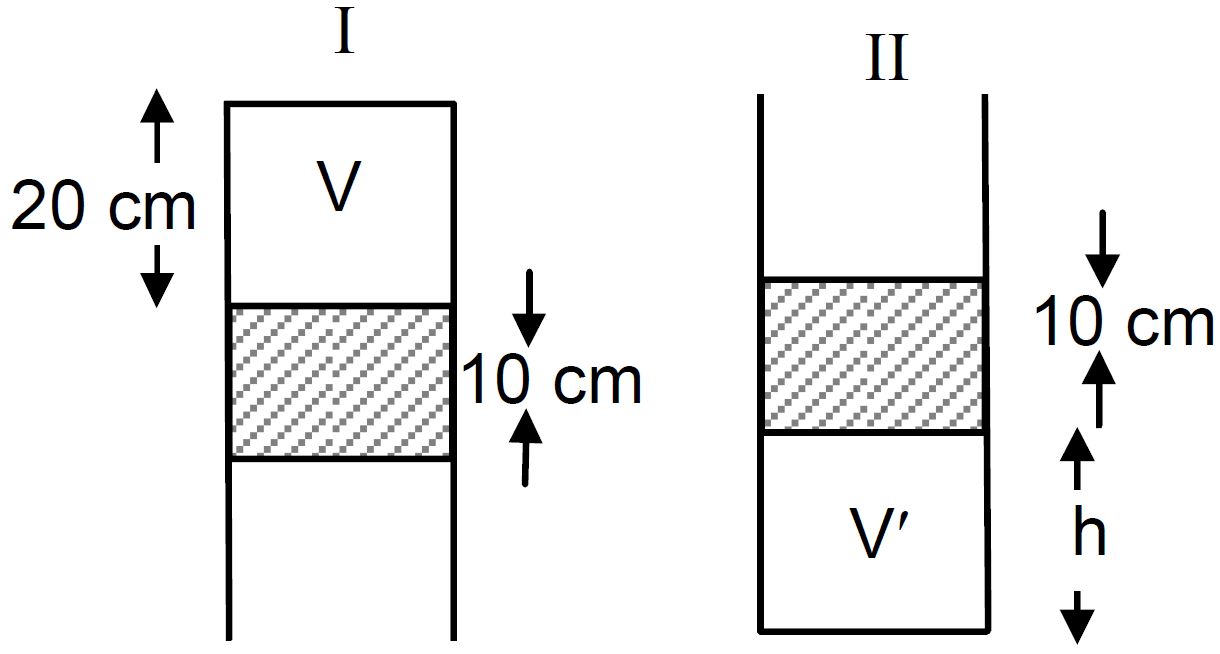
Case I → Net pressure on air in volume V
$= P_{atm} - hfg = 75 \times f_{Hg} - 10f_{Hg} = 65 \times f_{Hg} \times g$
Case II → Net pressure on air in volume $‘V’ = P_{atm} + f_{Hg} \times g \times h$
$P_1V_1 = P_2V_2$
$\Rightarrow f_{Hg} \times g \times 65 \times A \times 20 = f_{Hg} \times g \times 75 + f_{Hg} \times g \times 10 \times A \times h$
$\Rightarrow 62 \times 20 = 85h$
$\Rightarrow\text{h}=\frac{65\times20}{85}=15.2\text{cm}\approx15\text{cm}$ View full question & answer→Question 313 Marks
What will be the mean free path of nitrogen gas at STP of given diameter of nitrogen molecule $=2\mathring{\text{A}}?$
AnswerGiven, Diameter of nitrogen molecule, $\text{d}=2\mathring{\text{A}}$$=2\times10^{-10}\text{m}$
At STP, one mole of gas (or 22.4L) of gas have$\text{N}_{\text{A}}=6.023\times10^{23}\text{molecules}$
$\therefore$ Number density of nitrogen molecules
$\text{n}=\frac{\text{N}_{\text{A}}}{22.4\text{L}}=\frac{6.023\times10^{23}}{22.4\times10^{-3}\text{m}^3}$
$=2.69\times10^{25}\text{m}^{-3}$
$\therefore$ Mean free path of nitrogen at STP condition,
$\lambda=\frac{1}{\sqrt{2}\pi\text{nd}^2}$
$\lambda=\frac{1}{1.414\times3.142\times(2.69\times10^{25})\times(2\times10^{-10})^2}$
$=2.1\times10^{-7}\text{m}$
View full question & answer→Question 323 Marks
Calculate the total number of degrees of freedom possessed by the molecules in one $cm^3$ of $H_2$ gas at NTP.
Answer$22400cm^3$ of every gas contains $6.02 \times 10^{23}$ molecules.
$\therefore$ Number of molecules in $1cm^3$ of $H_2$ gas
$=\frac{6.02\times10^{23}}{22400}=0.26875\times10^{20}$
Number of degrees of freedom of a $H_2$ gas molecule = 5
$\therefore$ Total number of degrees of freedom of $0.26875 \times 10^{20}$ molecules
$= 0.26875 \times 10^{20} \times 5 = 1.34375 \times 10^{20}$
View full question & answer→Question 333 Marks
Two ideal monoatomic gases A and B at 27°C and 37°C are mixed. The number of moles in gas A are 2 and number of moles in gas B are 3. What will be the temperature of the mixture?
AnswerSum of K.E. of gases A and B = K.E. of the mixture$\mu_1\Big(\frac{3}{2}\text{RT}_1\Big)+\mu_2\Big(\frac{3}2{}\text{RT}_2\Big)$
$=(\mu_1+\mu_2)\Big(\frac{3}{2}\text{RT}\Big)$
$\therefore\text{T}=\frac{\mu_1\text{T}_1+\mu_2\text{T}_2}{\mu_1+\mu_2}$
$=\frac{2\times300+3\times310}{2+3}=306\text{K}$
$\therefore$ Temperature of mixture $=33^{\circ}\text{C}$
View full question & answer→Question 343 Marks
An electric bulb of volume 250 cc was sealed during manufacturing at a pressure of $10^{-3} \mathrm{~mm}$ of mercury at $27^{\circ} \mathrm{C}$. Compute the number of air molecules contained in the bulb. Avogadro constant $=6 \times 10^{23} \mathrm{~mol}^{-1}$, density of mercury $=13600 \mathrm{~kg} / \mathrm{m}^{-3}$ and $\mathrm{g}=10 \mathrm{~ms}^{-2}$.
Answer$\mathrm{V}=250 \mathrm{cc}=250 \times 10^{-3} \mathrm{P}=10^{-3} \mathrm{~mm}=10^{-3} \times 10^{-3} \mathrm{~m}=10^{-6} \times 13600 \times 10$ pascal $=136 \times 10^{-3}$ pascal $\mathrm{T}=27^{\circ} \mathrm{C}=300 \mathrm{~K}$$\text{n}=\frac{\text{PV}}{\text{RT}}=\frac{136\times10^{-3}\times250}{8.3\times300}\times10^{-3}$
$=\frac{136\times250}{8.3\times300}\times10^{-6}$
No. of molecules $=\frac{136\times250}{8.3\times300}\times10^{-6}\times6\times10^{23}$$=81\times10^{17}\approx0.8\times10^{15}$
View full question & answer→Question 353 Marks
Two moles of gas A at 27°C are mixed with 3 moles of gas B at 37°C. If both are monoatomic ideal gases, what will be the temperature of the mixture?
AnswerAs there is no loss of energy in the process, therefore, sum of KE of gases A and B = KE of mixture,$\mu_1\Big(\frac{3}{2}\text{RT}_1\Big)+\mu_2\Big(\frac{3}{2}\text{RT}_2\Big)$
$=(\mu_1+\mu_2)\frac{3}{2}\text{RT}$
where T is temperature of the mixture.$\therefore\text{T}=\frac{\mu_1\text{T}_1+\mu_2\text{T}_2}{\mu_1+\mu_2}$
$=\frac{2(27+273)+3(37+273)}{2+3}$
$=\frac{600+930}{5}=\frac{1530}{5}$
$=306-273=3^{\circ}\text{C}$
View full question & answer→Question 363 Marks
An enclosure of volume four litres contains a mixture of $8g$ of oxygen, $14g$ of nitrogen and $22g$ of carbon dioxide. If the temperature of the mixture is $27°C$, find the pressure of the mixture of gases. Given $R = 8.315J-K^{-1}mol^{-1}$.
AnswerTemperature $T = 300K$ Volume $V = 4$ liter $= 4 \times 10^{-3}m^3$ The pressure exerted by a gas is given by$\text{P}=\frac{\text{nRT}}{\text{V}}=\frac{\text{mass}}{\text{molecular weight}}\times\frac{\text{RT}}{\text{V}}$
Pressure exerted by oxygen $\text{P}_1=\frac{8}{32}\frac{\text{RT}}{\text{V}}=\frac{1}{4}\frac{\text{RT}}{\text{V}}$ Pressure exerted by nitrogen $\text{P}_2=\frac{14}{28}\frac{\text{RT}}{\text{V}}=\frac{1}{2}\frac{\text{RT}}{\text{V}}$ Pressure exerted by carbon dioxide $\text{P}_3=\frac{22}{44}\frac{\text{RT}}{\text{V}}=\frac{1}2{}\frac{\text{RT}}{\text{V}}$ From Dalton's law of partial pressures, the total pressure exerted by the mixture is given by$\text{P = P}_1+\text{P}_2+\text{P}_3$
$=\frac{1}{4}\frac{\text{RT}}{\text{V}}+\frac{1}{2}\frac{\text{RT}}{\text{V}}+\frac{1}{2}\frac{\text{RT}}{\text{V}}$
$=\frac{5}{4}\frac{\text{RT}}{\text{V}}=\frac{\text{RT}}{\text{V}}=\frac{5}{4}\times\frac{8.315\times300}{4\times10^{-3}}$
$=7.79\times10^5\text{Nm}^{-2}$
View full question & answer→Question 373 Marks
A vertical cylinder of height $100cm$ contains air at a constant temperature. The top is closed by a frictionless light piston. The atmospheric pressure is equal to $75cm$ of mercury. Mercury is slowly poured over the piston. Find the maximum height of the mercury column that can be put on the piston.
Answer$P_1=\text { Atmospheric pressure }=75 \times \mathrm{fgV}_1=100 \times \mathrm{A}$
$\mathrm{P}_2=\text { Atmospheric pressure }+ \text { Mercury pessue }=75 \mathrm{fg}+\mathrm{hgfg} \text { (if } \mathrm{h}=\text { height of mercury) }$
$\mathrm{V}_2=(100-\mathrm{h}) \mathrm{A}$
$\mathrm{P}_1 \mathrm{~V}_1=\mathrm{P}_2 \mathrm{~V}_2$
$\Rightarrow 75 \mathrm{fg}(100 \mathrm{~A})=(75+\mathrm{h}) \mathrm{fg}(100-\mathrm{h}) \mathrm{A}$
$\Rightarrow 75 \times 100=(74+\mathrm{h})(100-\mathrm{h})$
$\Rightarrow 7500=7500-75 \mathrm{~h}+100 \mathrm{~h}-\mathrm{h}^2$
$\Rightarrow \mathrm{~h}^2-25 \mathrm{~h}=0$
$\Rightarrow \mathrm{~h}^2=25 \mathrm{~h}$
$\Rightarrow \mathrm{~h}=25 \mathrm{~cm}$
Height of mercury that can be poured $=25 \mathrm{~cm}$.
View full question & answer→Question 383 Marks
Write the difference between ideal gas and real gas.
Answer
| |
Ideal Gas
|
Real Gas
|
| (i) |
It obeys ideal gas equation, $\text{pV}=\mu\text{RT}$ at all temperatures and pressures
|
It does not obey, $\text{pV}=\mu\text{RT}$ at all values of temperature and pressure.
|
| (ii) |
The volume of the molecules of an ideal gas is zero.
|
The volume of the molecules of a real gas is non-zero.
|
| (iii) |
There is no intermolecular force between the molecules.
|
There is intermolecular force of attraction or repulsion depending on whether intermolecular separation is larger or small.
|
| (iv) |
There is no intermolecular potential energy (U) because intermolecular force (F) is zero.
|
Potential energy (U) does not equal to zero as intermolecular force (F) is not zero.
|
| (v) |
It has only kinetic energy.
|
It has both kinetic and potential energy.
|
| (vi) |
At absolute zero, the volume, pressure and internal energy become zero.
|
All real gases get liquified before reaching absolute zero. The internal energy of the liquified gas is not zero.
|
View full question & answer→Question 393 Marks
At what temperature will the average velocity of oxygen molecules be sufficient so as to escape from the earth? Escape velocity from the earth is $11.0km/sec$ and the mass of one molecule of oxygen is $5.34 \times 10^{-26}kg$ (Boltzmann constant $k = 1.38 \times 10^{-23} Joule/K)$.
AnswerWe know $\frac{1}2{}\text{mv}^2=\frac{3}{2}\text{kT}$ or $\text{T}=\frac{\text{mv}^2}{3\text{k}}$ Here, $\text{m}=5.34\times10^{-26}\text{kg}$$\text{v}=11.0\text{km/s}=11\times10^3\text{ms}^{-1}$
$\text{k}=1.38\times10^{-23}\text{Jk}^{-1}$
$\therefore\text{T}=\frac{5.34\times10^{-26}\times(11\times10^3)^2}{3\times1.38\times10^{-23}}$
$=1.56\times10^5\text{K}$
View full question & answer→Question 403 Marks
The velocities of ten particles in $ms^{-1}$ are $0, 2, 3, 4, 4, 4, 5, 5, 6, 9.$ Calculate $(i)$ Average speed and $(ii) \text{r.m.s}.$ speed.
Answer
- Average speed:
$\text{v}_{\text{av}}=\frac{0+2+3+4+4+4+5+5+6+9}{10}=\frac{42}{10}=4.2$
- $\text{R.M.S}$. speed:
$\text{v}_{\text{rms}}=\Big[\frac{(0)^2+(2)^2+(3)^2+(4)^2+(4)^2+(4)^2+(5)^2+(5)^2+(6)^2+(9)^2}{10}\Big]^{\frac{1}{2}}$
$=\Big[\frac{228}{10}\Big]^{\frac{1}{2}}=4.77\text{ms}^{-1}$ View full question & answer→Question 413 Marks
Explain the concept of absolute zero of temperature on the basis of kinetic theory of gases.
AnswerLet us consider one gram mole of the gas. Let M and V be its mass and volume. The pressure exerted by the gas is given by$\text{P}=\frac{1}3{}\text{mnv}^{-2}$ [M = mn]
$\text{PV}=\frac{1}{3}\text{n}\text{Vmv}^{-2}$
$\text{PV}=\frac{2}{3}\text{N}\times\frac{1}{2}\text{mv}^{-2}$
But $\text{PV = RT}$$\text{RT}=\frac{2}{3}\text{N}\times\frac{1}{2}\text{mv}^{-2}$
$\frac{1}{2}\text{mv}^{-2}=\frac{3}{2}\frac{\text{R}}{\text{N}}\text{T}$ $\Big[\frac{\text{R}}{\text{N}}=\text{K}_{\text{B}'}\text{Boltzmann Constant}\Big]$
$\frac{1}{2}\text{mv}^{-2}=\frac{3}{2}\text{K}_{\text{B}}\text{T}$
$\bar{\text{v}}\propto\sqrt{\text{T}}$
Hence, absolute temperature is the temperature at which the root mean square velocity of gas molecules reduces to zero.
View full question & answer→Question 423 Marks
- What is the relation between $C_p$ and $C_v$?
- Calculate the value of $\gamma ($ratio between $C_p$ and $C_v)$ for diatomic gas.
Answer
- $C_p - C_v = R$.
- For diatomic gases, degree of freedom $f = 5$
$\therefore\text{C}_\text{v}=\frac{5}2{}\text{R}=\frac{5}{2}\times1.98$
$=4.95\ \text{cal/mole/k}$
$\therefore\text{C}_\text{p}=\Big(1+\frac{5}{2}\Big)\times1.98$
$=6.93\ \text{cal}/\text{mole}/\text{K}$
$\therefore\gamma=\frac{\text{C}_{\text{p}}}{\text{C}_{\text{v}}}=\frac{6.93}{4.95}=1.4$ View full question & answer→Question 433 Marks
A vessel $A$ contains hydrogen and another vessel $B$ whose volume is twice of $A$ contains same mass of oxygen at the same temperature. Compare $(i)$ average kinetic energies of hydrogen and oxygen molecules $(ii)$ root mean square speeds of the molecules $(iii)$ pressure of gases in $A$ and $B$. Molecular weights of hydrogen and oxygen are $2$ and $32$ respectively.
Answer
- For all gases at the same temperature, the kinetic energy per molecule is the same. So, the ratio of the average kinetic energies of hydrogen and oxygen molecules is $1 : 1.$
- $\frac{\text{C}_1}{\text{C}_2}=\sqrt{\frac{\text{M}_2}{\text{M}_1}}=\sqrt{\frac{32}2{}}=4:1$
- we know that $\text{P}=\frac{1}3{}\frac{\text{M}}{\text{V}}\text{C}^2$
In the given problem, $M$ is constant
$\therefore\frac{\text{P}_1}{\text{P}_2}=\frac{\text{C}^2_1}{\text{V}_1}\times\frac{\text{V}_2}{\text{C}^2_2}=\frac{\text{V}_2}{\text{V}_1}\Big[\frac{\text{C}_1}{\text{C}_2}\Big]^2$ or $\frac{\text{P}_1}{\text{P}_2}=\frac{2}{1}\times\frac{16}{1}=32$ View full question & answer→Question 443 Marks
A gas cylinder has walls that can bear a maximum pressure of $1.0 \times 10^6Pa$. It contains a gas at $8.0 \times 10^5Pa$ and $300K$. The cylinder is steadily heated. Neglecting any change in the volume, calculate the temperature at which the cylinder will break.
Answer$P_1 = 8.0 \times 10^5 Pa, P_2 = 1 \times 10^6Pa, T_1 = 300K, T_2 = ?$ Since, $V_1 = V_2 = V$
$\frac{\text{P}_1\text{V}_1}{\text{T}_1}=\frac{\text{P}_2\text{V}_2}{\text{T}_2}$
$\Rightarrow\frac{8\times10^5\times\text{V}}{300}=\frac{1\times10^6\times\text{V}}{\text{T}_2}$
$\Rightarrow\text{T}_2=\frac{1\times10^6\times300}{8\times10^5}=375^\circ\text{K}$
View full question & answer→Question 453 Marks
Show that the average K.E. of a gas molecule is directly proportional to the temperature of the gas. Hence give the kinetic interpretation of temperature.
AnswerConsider 1g mole of an ideal gas occupying a volume V at temperature T. Let m be the mass of each molecule of the gas. Then $M = m \times N_A$. where $N_A$ is Avogadro's number. If C is the r.m.s. velocity of the gas molecules, then pressure P exerted by ideal gas is$\text{MC}^2\text{ P}=\frac{1}{3}\rho\text{C}^2=\frac{1}{3}\frac{\text{M}}{\text{V}}\text{C}^2$ or $\text{PV}=\frac{1}{3}$
From perfect gas equation, PV = RT, where R is a universal gas constant for 1g mole of the gas.
$\therefore\frac{1}{3}\text{MC}^2=\text{RT}$
$\frac{1}{3}\text{MC}^2=\frac{3}{2}\text{RT}$
$\therefore$ Average of K.E. of translation of 1 mole of the gas
$=\frac{1}{2}\text{MC}^2$
$\Rightarrow\text{E}=\frac{3}{2}\text{RT}$
According to kinetic theory of gases, the pressure P exerted by 1 mole of an ideal gas is given by$\text{P}=\frac{1}{3}\rho\text{C}^2=\frac{1}{3}\frac{\text{M}}{\text{V}}\text{C}^2$
$\text{PV}=\frac{1}{3}\text{MC}^2$
$\frac{1}3{}\text{MC}^2=\text{RT}$ $(\because\text{PV = RT})$
$\Rightarrow\text{C}^2=\frac{3\text{RT}}{\text{M}}\Rightarrow\text{C}^2\propto\text{T}$ ($\because$ R and M are constants)
$\Rightarrow\text{C}^2\propto\sqrt{\text{T}}\Rightarrow\sqrt{\text{T}}\propto\text{C}$
Thus, the square root of the absolute temperature of an ideal gas is directly proportional to root mean square velocity of its molecules.
View full question & answer→Question 463 Marks
Why the molecular motion of the molecules ceases at zero kelvin?
AnswerWe know, kinetic energy of a molecule is proportional to the absolute temperature. i.e., $\frac{1}{2}\text{mv}^2_\text{rms}\propto\text{T}$ At $\text{T}=0$$\frac{1}{2}\text{mv}^2_{\text{rms}}=0,$ Since $\frac{1}{2}\text{m}\neq0,\therefore\text{v}_{\text{rms}}=0$
Thus molecular motion ceases at zero kelvin.
View full question & answer→Question 473 Marks
A cylinder of fixed capacity contains $44.8L$ of helium gas at STP. Calculate the amount of heat required to raise the temperature of container by $15^\circ C$? [given $R = 8.31J-mol^{-1}K^{-1}$]
AnswerAt STP, 1 mole of gas occupy 22.4L of volume.$\therefore$ Moles of helium in container, $\mu=\frac{44.8}{22.4}=2\text{ moles}$
Now, helium is monoatomic, so, $\text{C}_{\text{V}}=\frac{3}{2}\text{R}$ Change in temperatue,$\Delta\text{T = T}_2-\text{T}_1=15^{\circ}\text{C}=15\text{K}$
$\therefore\Delta\text{W}=\text{p}\Delta\text{V}=0$
$\Rightarrow\Delta\text{Q}=\Delta\text{U}+\Delta\text{W}$
Amourt of heat required, $\Delta\text{Q}=\Delta\text{U}=\mu\text{C}_{\text{V}}\Delta\text{T}$$=2\times\frac{3}{2}\text{R}\times15=45\text{R}$
$=45\times8.31=374\text{J}$
View full question & answer→Question 483 Marks
Isothermal curves for a given mass of gas are shown at two different temperatures $T_1$ and $T_2$. State whether $T_1 > T_2$ or $T_2 > T_1$. Justify your answer.
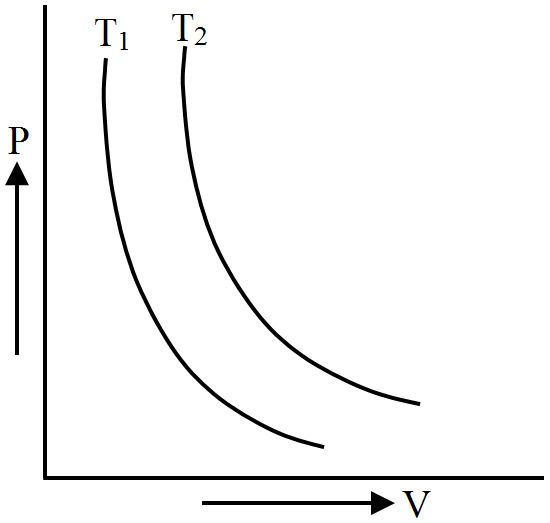
AnswerFrom ideal gas equation$\text{PV}=\mu\text{RT}$
$\text{T}=\frac{\text{PV}}{\mu\text{R}}$
As mass of gas is constant, μ is constant, R is already a constant.$\therefore\text{T}\propto\text{PV}$
Since PV is greater for the curve at $T_2$ than for the curve at $T_1$, therefore, $T_2 > T_1$.
View full question & answer→Question 493 Marks
$2g$ of hydrogen is sealed in a vessel of volume $0.02m^3$ and is maintained at $300K$. Calculate the pressure in the vessel.
Answer$m = 2g, V = 0.02m^3 = 0.02 \times 10^6cc = 0.02 \times 10^3L, T = 300K, P = ? M = 2g,$
$\text{PV}=\text{nRT}\Rightarrow\text{PV}=\frac{\text{m}}{\text{M}}\text{RT}$
$\Rightarrow\text{P}\times20=\frac{2}{2}\times0.082\times300$
$\Rightarrow\text{P}=\frac{0.082\times300}{20}$
$=1.23\text{ atm}=1.23\times10^5\text{ pa}\approx1.23\times10^5\text{pa}$
View full question & answer→Question 503 Marks
The temperature and relative humidity in a room are $300K$ and $20\%$ respectively. The volume of the room is $50m^3$. The saturation vapour pressure at $300K$ is $3.3kPa$. Calculate the mass of the water vapour present in the room.
Answer$\mathrm{T}=300 \mathrm{~K}$, Rel. humidity $=20 \%, \mathrm{~V}=50 \mathrm{~m}^3 \mathrm{SVP}$ at $300 \mathrm{~K}=3.3 \mathrm{KPa}, \mathrm{V} . \mathrm{P} .=$ Relative humidity $\times \mathrm{SVP}=0.2 \times 3.3 \times 10^3$$\text{PV}=\frac{\text{m}}{\text{M}}\text{RT}$
$\Rightarrow0.2\times3.3\times10^3\times50=\frac{\text{m}}{18}\times8.3\times300$
$\Rightarrow\text{m}=\frac{0.2\times3.3\times50\times18\times10^3}{8.3\times300}=238.55\text{g}\approx238\text{g}$
Mass of water present in the room = $238g$.
View full question & answer→