Question 15 Marks
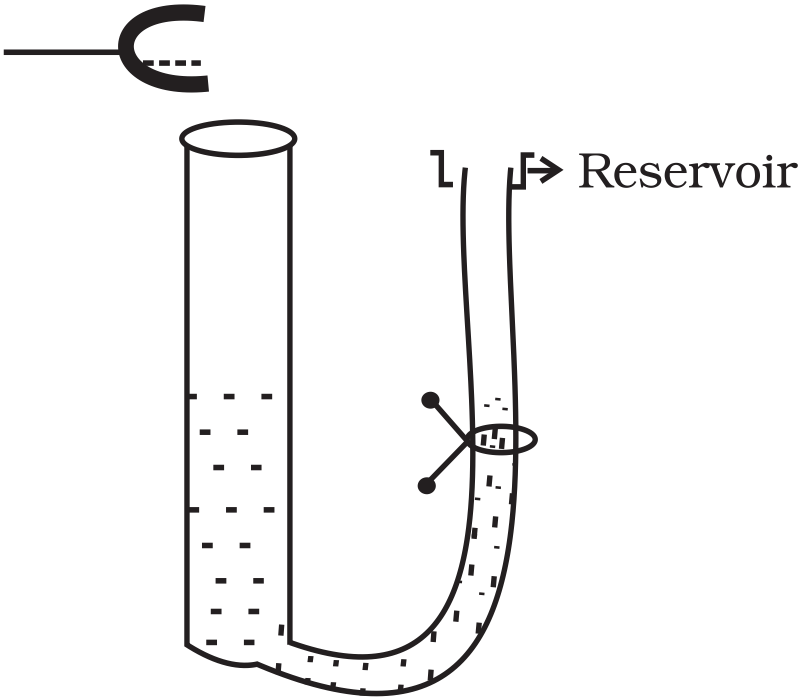
A tuning fork vibrating with a frequency of 512Hz is kept close to the open end of a tube filled with water The water level in the tube is gradually lowered. When the water level is 17cm below the open end, maximum intensity of sound is heard. If the room temperature is 20° C, calculate
- Speed of sound in air at room temperature
- Speed of sound in air at 0° C
- If the water in the tube is replaced with mercury, will there be any difference in your observations?
Answer
For observation of first maxima of intensity,
$\frac{\text{v}_{20}}{\text{v}_0}=\sqrt{\frac{273+20}{273+0}}=\sqrt{\frac{293}{273}}$
$\frac{\text{v}_{20}}{\text{v}_0}=\sqrt{1.073}=1.03$
$\text{v}_0=\frac{\text{v}_{20}}{1.03}=\frac{348.16}{1.03}=338\text{m/ s}$
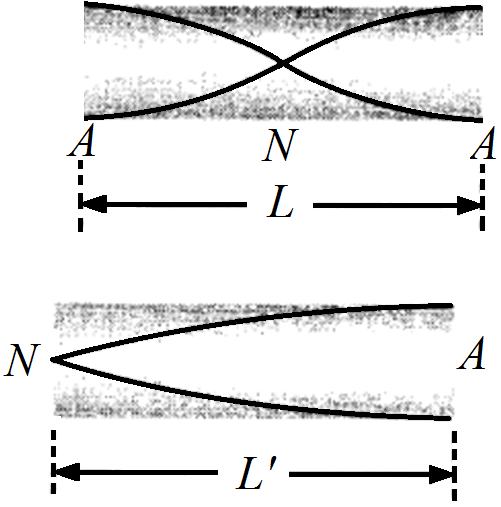
View full question & answer→- If a pipe partially filled with water whose upper surface of the water acts as a reflecting surface of a closed organ pipe. If the length of the air column is varied until its natural frequency equals the frequency of the fork, then the column resonates and emits a loud note.
For observation of first maxima of intensity,
- We know that $\text{v}\propto\sqrt{\text{T}}$
$\frac{\text{v}_{20}}{\text{v}_0}=\sqrt{\frac{273+20}{273+0}}=\sqrt{\frac{293}{273}}$
$\frac{\text{v}_{20}}{\text{v}_0}=\sqrt{1.073}=1.03$
$\text{v}_0=\frac{\text{v}_{20}}{1.03}=\frac{348.16}{1.03}=338\text{m/ s}$
- The resonance will still be observed for 17cm length of air column above mercury. However, due to more complete reflection of sound waves at mercury surface, the intensity of reflected sound increases.