Question 15 Marks
Find the centroid of $\triangle\text{ABC}$ whose vertices are A(2, 2), B(-4, -4) and C(5, -8).
AnswerThe given points are $A(2,2), B(-4,-4)$ and $C(5,-8)$. Here, $\left( x _1=2, y _1=2\right),\left( x _2=-4, y _2=-4\right)$ and $\left( x _3=5, y _3=-8\right)$
Let G(x, y) be the centroid of $\triangle\text{ABC}.$ Then,
$\text{x}=\frac{1}{3}(\text{x}_1+\text{x}_2+\text{x}_3)$
$=\frac{1}{3}(2-4+5)$
$=1$
$\text{y}=\frac{1}{3}(\text{y}_1+\text{y}_2+\text{y}_3)$
$=\frac{1}{3}(2-4-8)$
$=\frac{-10}{3}$
Hence, the centroid of $\triangle\text{ABC}$ is $\text{G}\Big(1,\frac{-10}{3}\Big).$
View full question & answer→Question 25 Marks
If the point A(0, 2) is equidistant from the points B(3, p) and C(p, 5), find P.
AnswerThe given points are A(0, 2), B(3, p) and C(p, 5).
$AB = AC \Rightarrow AB^2 = AC^2$
$\Rightarrow (3 - 0)^2 + (p - 2)^2 = (p - 0)^2 + (5 - 2)^2$
$\Rightarrow 9 + p^2 - 4p + 4 = P^2 + 9$
$\Rightarrow 4p = 4 \Rightarrow p = 1$
$Hence, p = 1$
View full question & answer→Question 35 Marks
Find the lengths of the medians AD and BE of $\triangle\text{ABC}$ whose vertices are A(7, -3), B(5, 3) and C(3, 1).
AnswerThe given vertices are A(7, -3), B(5, 3) and C(3, -1).
Since D and E are the mid-points of BC and AC respectively, therefore
Coordinates of D $=\Big(\frac{5+3}{2},\frac{3-1}{2}\Big)=(4,1)$
Coordinates of E $=\Big(\frac{7+3}{2},\frac{-3-1}{2}\Big)=(5,-2)$
Now,
$\text{AD}=\sqrt{(7-4)^2+(-3-1)^2}$
$=\sqrt{9+16}=5$
$\text{BE}=\sqrt{(5-5)^2+(3+2)^2}$
$=\sqrt{0+25}=5$
Hence, AD = BE = 5 units.
View full question & answer→Question 45 Marks
Find the coordinates of a point A, where AB is a diameter of a circle with center C(2, -3) and the other end of the diameter is B(1, 4).
AnswerA, B are the end points of a diameter. Let the coordinates of A be (x, y). The point B is (1, 4).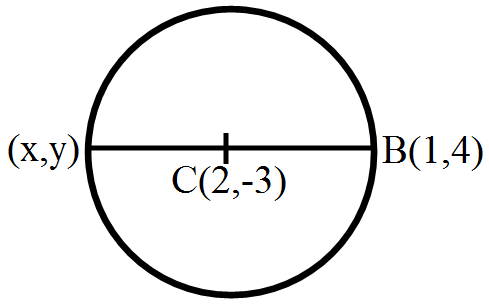
The center C(2, -3) is the mid-point of AB $\therefore\ \frac{\text{x}+1}{2}=2\Rightarrow\ \text{x}=3$ $\frac{\text{y}+2}{2}=-3\Rightarrow\ \text{y}=-10$ The points A is (3, -10) View full question & answer→Question 55 Marks
Find the ratio in which the point P(x, 2) divides the join of A(12, 5) and B(4, -3).
AnswerLet k be the ratio in which the point P(x, 2) divides the joining the points $A(x_1 = 12, y_1 = 5)$ and $B(x_2 = 4, y_2 = -3)$. Then
$\text{x}=\frac{\text{k}\times4+12}{\text{k}+1}$ and $2=\frac{\text{k}\times(-3)+5}{\text{k}+1}$
Now
$2=\frac{\text{k}\times(-3)+5}{\text{k}+1}\Rightarrow\ 2\text{k}+2=-3\text{k}+5\Rightarrow\ \text{k}=\frac{3}{5}$
Hence, the required ratio is 3 : 5.
View full question & answer→Question 65 Marks
The base QR of an equilateral triangle PQR lies on x-axis. The coordinates of the point Q are (-4, 0) and origin is the midpoint of the base. Find the coordinates of the points P and R.
Answer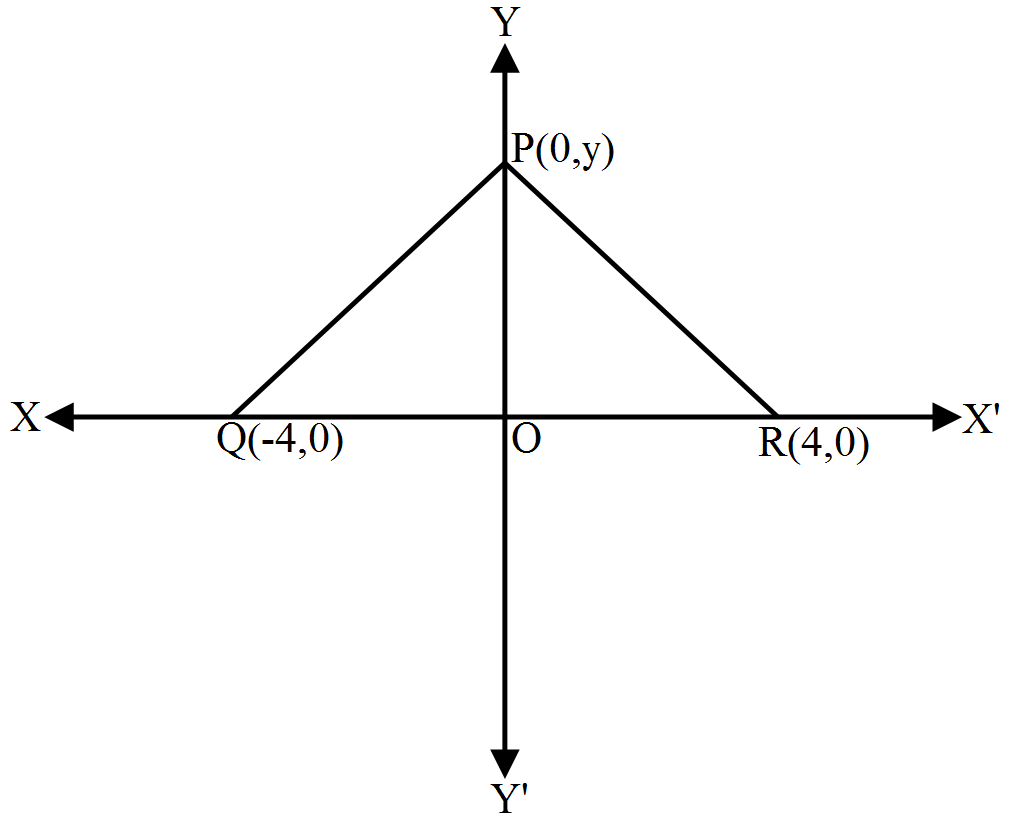
Given PQR is an equilateral triangle such that
QR lies on x-axis.
Clearly, orgin O is the mid-point of QR,
⇒ OQ = OR = 4 units
⇒ Coordinates of R are (4, 0)
Now, P lies on y-axis.
Let the coordinates of P be (0, y).
Now, PQ = QR = PR
Consider PQ = QR
$\Rightarrow\ \sqrt{(-4-0)^2+(0-\text{y})^2}=\sqrt{(4+4)^2+(0-0)^2}$
$\Rightarrow\ \sqrt{16+\text{y}^2}=\sqrt{64}$
$\Rightarrow\ 16+\text{y}^2=64$
$\Rightarrow\ \text{y}^2=48$
$\Rightarrow\ \text{y}=\pm4\sqrt{3}$
Thus, coordinates of P are $(0+4\sqrt{3})$ or $(0-4\sqrt{3})$. View full question & answer→Question 75 Marks
If the point (x, y) is equidistant from the points (a + b, b - a) and (a - b, a + b),
prove that bx = ay.
AnswerIt is being given that (x, y) is equidustant from the points (a + b, b - a) and (a - b, a + b)
Thus, we have
$[x - (a + b)]^2 + [y - (b - a)]^2 = [x - (a - b)]^2 + [y - (a + b)]^2$
$\Rightarrow [(x - a) - b]^2 + [(y - b) + a]^2= [(x - a)+ b]^2 + [(y - b) - a]^2$
$\Rightarrow [(x - a) + b]^2 - [(x - a) - b]^2 = [(y - b) + a]^2 - [(y - b) - a]^2$
$\Rightarrow (x - a)^2 + b^2 + 2(x - a)b - (x - a)^2 - b^2 + 2(x - a)b$
$\Rightarrow (y - b)^2 + a^2 + 2(y - b)a - (y - b)^2 - a^2 + 2(y - b)a$
$\Rightarrow 4(x - a)b = 4(y - b)a$
$\Rightarrow bx - ab = ay - ab$
$\Rightarrow bx = ay$
View full question & answer→Question 85 Marks
Find the distance between the points:
$\text{P}(\text{a}\sin\alpha,\text{a}\cos\alpha)$ and $\text{Q}(\text{a}\cos\alpha, -\text{a}\sin\alpha)$
AnswerThe given points are $\text{P}(\text{a}\sin\alpha,\text{a}\cos\alpha)$ and $\text{Q}(\text{a}\cos\alpha, -\text{a}\sin\alpha)$
Then, $(\text{x}_1=\text{a}\sin\alpha,\text{y}_1=\text{a}\cos\alpha)$ and $(\text{x}_2=\text{a}\cos\alpha,\text{ y}_2=-\text{a}\sin\alpha)$
$\therefore\text{PQ}=\sqrt{(\text{x}_2-\text{x}_1)^2+(\text{y}_2-\text{y}_1)^2}$
$=\sqrt{(\text{a}\cos\alpha -\text{a}\sin\alpha)^2+(-\text{a}\sin\alpha -\text{a}\cos\alpha)^2}$
$=\sqrt{\text{a}^2\cos^2\alpha+\text{a}^2\sin^2\alpha+\text{a}^2\cos^2\alpha+\text{a}^2\sin^2\alpha}$
$=\sqrt{\text{a}^2(\cos^2\alpha+\sin^2\alpha)\text{a}^2(\cos^2\alpha+\sin^2\alpha)}$
$=\sqrt{\text{a}^2+\text{a}^2}$
$=\sqrt{\text{2a}^2}=\sqrt{2}\text{a}\text{ units}.$
View full question & answer→Question 95 Marks
Find the ratio in which the point (-3, k) divides the join of A(-5, -4) and B(-2, 3). Also find the value of k.
AnswerLet P is dividing the given segment joining A(-5, -4) and B(-2, 3) in the ratio r : 1.
$\therefore$ coordinates of point P $\Big(\frac{-2\text{r}+1\times(-5)}{\text{r}+1},\frac{\text{r}\times3+1\times(-4)}{\text{r}+1}\Big)\text{i.e}\Big(\frac{-2\text{r}-5}{\text{r}+1},\frac{3\text{r}-4}{\text{r}+1}\Big)$ Also, the coordinates of points P are (-3, k). $\therefore\ \frac{-2\text{r}-5}{\text{r}+1}=-3\Rightarrow\ -2\text{r}-5=-3\text{r}-3,$ $\Rightarrow\ \text{r}=2$ And $\text{k}=\frac{3\text{r}-4}{\text{r}+1}=\frac{3\times2-4}{2+1}=\frac{2}{3}$ $\therefore$ P is dividing AB in the ratio 2 : 1 and $\text{k}=\frac{2}{3}$ View full question & answer→Question 105 Marks
Show taht the following points are collinear:A(5, 1), B(1, -1) and C(11, 4)
AnswerLet $A(x_1 = 5, y_1= 1), B(x_2 = 1, y_2= -1)$ and $C(x_3 = 11, y_3= 4)$ be the given points.
Now
$x_1(y_2 - y_3) + x_2(y_3 - y_1) + x_3(y_1 - y_2)$
$= 5(-1 - 4) + 1(4 - 1) + 11(1 + 1)$
$= -25+ 3 + 22$
$= 0$
Hence the given point are collinear.
View full question & answer→Question 115 Marks
If the vertices of $\triangle\text{ABC}$ be A(1, -3), B(4, p) and C(-9, 7) and its area is 15 square units, find the values of p.
AnswerLet $A \left( x _1, y _1\right)= A (1,-3), B \left( x _2, y _2\right)= B (4, p )$ and $C \left( x _3, x _4\right)= C (-9,7)$. Now,
$\text{ar}(\triangle\text{ABC})=\frac{1}{2}[\text{x}_1(\text{y}_2-\text{y}_3)+\text{x}_2(\text{y}_3-\text{y}_1)+\text{x}_3(\text{y}_1-\text{y}_2)]$
$\Rightarrow15=\frac{1}{2}[1(\text{p}-7)+4(7+3)-9(-3-\text{p})]$
$\Rightarrow15=\frac{1}{2}[10\text{p}+60]$
$\Rightarrow[10\text{p}+60]=30$
Therefore
$\Rightarrow[10\text{p}+60]=-30\text{ or}30$
$\Rightarrow10\text{p}=-9\text{ or}-30$
$\Rightarrow\text{p}=-9\text{ or}-3$
Hence, p = -9 or p = -3.
View full question & answer→Question 125 Marks
Find the distance between of the following points from the origin:
A(5, -12)
AnswerThe gven point is A(5, -12) and let O(0, 0) be the origin
Then, $\text{AO}=\sqrt{(5-0)^2+(-12-0)^2}$
$=\sqrt{5^2+(-12)^2}$
$=\sqrt{25+144}$
$=\sqrt{169}=13\text{ units}.$
View full question & answer→Question 135 Marks
In what ratio does y-axis divide the line segment joining the points (-4, 7) and (3, -7)?
AnswerLet the y-axis cut the join of A(-4, 7) and B(3, -7) at the point p in the ratio k : 1. Then,
By section formula,
Coordinates of p $=\Big(\frac{\text{k}\times3+1\times(-4)}{\text{k}+1},\frac{\text{k}\times(-7)+1\times7}{\text{k}+1}\Big)$
$=\Big(\frac{3\text{k}-4}{\text{k}+1},\frac{-7\text{k}+7}{\text{k}+1}\Big)$
But p lies on y-axis. So, its abscissa is 0.
$\therefore\ \frac{3\text{k}-4}{\text{k}+1}=0$
$\Rightarrow\ 3\text{k}-4=0$
$\Rightarrow\ 3\text{k}=4$
$\Rightarrow\ \text{k}=\frac{4}{3}$
So, the required ratio is 4 : 3.
View full question & answer→Question 145 Marks
Find the coordinates of the point on x-axis which is equidistance from the points (-2, 5) and (2, -3).
Question 155 Marks
Find the area of quadrilateral PQRS whose vertices are P(-5, -3), Q(-4, -6), R(2, -3) and S(1, 2)
AnswerBy joining P and R, We get triangle PQR and PRS.
Let
$P\left(x_1, y_1\right)=P(-5,-3), Q\left(x_2, y_2\right)=Q(-4,-6), R\left(x_3, y_3\right)=R(2,-3)$ and $S\left(x_4, y_4\right)=S(1,2)$
Then
Area of $\triangle\text{PQR}=\frac{1}{2}[\text{x}_1(\text{y}_2-\text{y}_3)+\text{x}_2(\text{y}_3-\text{y}_1)+\text{x}_3(\text{y}_1-\text{y}_2)]$
$=\frac{1}{2}[(-5)(-6+3)-4(-3+3)+2(-3+6)]$
$=\frac{1}{2}[15-0+6]$
$=\frac{21}{2}\ \text{sq.units}$
Area of $\triangle\text{PRS}=\frac{1}{2}[\text{x}_1(\text{y}_3-\text{y}_4)+\text{x}_3(\text{y}_4-\text{y}_1)+\text{x}_4(\text{y}_1-\text{y}_3)]$
$=\frac{1}{2}[-5(-3-2)+2(2+3)+1(-3+3)]$
$=\frac{1}{2}[25+10+0]$
$=\frac{35}{2}\ \text{sq}.\text{units}$
So, the area of the quadrilateral is $=\frac{21}{2}+\frac{35}{2}=28\ \text{sq}.\text{units}$
View full question & answer→Question 165 Marks
Find the value of x for which the points A(x, 2), B(-3, -4) and C(7, -5) are collinear.
AnswerLet $A \left( x _1, y _1\right)= A ( x , 2), B \left( x _2, y _2\right)= B (-3,-4)$ and $C \left( x _3, y _3\right)= C (7,-5)$ so, the condition for three collinear point is.
$x_1(y_2 - y_3) + x_2(y_3 - y_1) + x_3(y_1 - y_2) = 0$
$= x(-4 + 5) - 3(-5 - 2) + 7(2 + 4) = 0$
$= x + 21 + 42 = 0$
$= x = -63$
Hence, x = -63.
View full question & answer→Question 175 Marks
The midpoint of the line segment joining A(2a, 4) and B(-2, 3b) is C(1, 2a + 1). Find the values of a and b.
AnswerC(1, 2a + 1) is the mid-point of A(2a, 4) and B(-2, 3b)
$\text{x}=\frac{\text{x}_2+\text{x}_1}{2}$ and $\text{y}=\frac{\text{y}_2-\text{y}_1}{2}$
$1=\frac{-2+2\text{a}}{2}$ and $2\text{a}+1=\frac{3\text{a}+4}{2}$
2 = -2 + 2a and 4a + 2 = 3b + 4 ...(1)
a = 2 ...(2)
Putting a = 2 in (1), we get
4 × 2 + 2 = 3b + 4 ⇒ 10 - 4 = 3b
⇒ 3b = 6
$\Rightarrow\ \text{b}=\frac{6}{3}=2$
Hence, a = 2 and b = 2
View full question & answer→Question 185 Marks
Find a relation between x and y, if the points A(2, 1), B(x, y), and C(7, 5) are collinear.
AnswerLet $A (x_1 = 2, y_1 = 1), B (x_2 = x, y_2 = y)$ and $(x_3 = 7, y_3 = 5)$ be the given points.The given point are collinear if
$x_1(y_2 - y_3) + x_2(y_3 - y_1) + x_3(y_1 - y_2) = 0$
$\Rightarrow 2(y - 5) + x(5 - 1) + 7(1 - y) = 0$
$\Rightarrow -2y - 10 + 4x + 7 - 7y = 0$
$\Rightarrow 2y - 10 + 4x + 7 - 7y = 0$
$\Rightarrow 4x - 5y - 3 = 0$
Hence, the required relation is 4x - 5y - 3 = 0.
View full question & answer→Question 195 Marks
Find the point on the y-axis which is equidistant from the points A(6, 5) and B(-4, 3).
AnswerLet the required point be C(0, y)
Then, we have
$AC = BC$
$\Rightarrow AC^2 = BC^2$
$\Rightarrow (6 - 0)^2 + (5 - y)^2 = (-4 - 0)^2 + (3 - y)^2$
$\Rightarrow (6)^2 + (25 + y^2 - 10y) = (-4)^2 + (9 + y^2 - 6y)$
$\Rightarrow 36 + 25 + y^2 - 10y = 16 + 9 + y^2 - 6y$
$\Rightarrow 61 - 10y = 25 - 6y$
$\Rightarrow 4y = 36$
$\Rightarrow y = 9$
Hence, the required point is C(0, 9).
View full question & answer→Question 205 Marks
Find the third vertex of a $\triangle\text{ABC}$ if two of its vertices are B(-3, 1) and C(0, -2), and its centroid is at the origin.
AnswerTwo vertices of $\triangle\text{ABC}$ are B(-3, 1) and C(0, -2) and third vertex be A(a, b). Then,
The coordinates of its centroid are
$\text{G}\Big(\frac{-3+0+\text{a}}{3},\frac{1-2+\text{b}}{3}\Big),\text{i.e},\text{G}\Big(\frac{-3+\text{a}}{3},\frac{-1+\text{b}}{3}\Big)$
But it is given that the centroid is G(0, 0).
$\frac{-3+\text{a}}{3}=0$ and $\frac{-1+\text{b}}{3}=0$
-3 + a = 0 and -1 + b = 0
⇒ a = 3 and b = 1
Hence the third vertices A of $\triangle\text{ABC}$ is A(3, 1).
View full question & answer→Question 215 Marks
Find the value of y for which the points A(-3, 9), B(2, y) and C(-4, -5) are collinear.
AnswerLet $A (x_1 = -3, y_1 = 9), B (x_2 = 2, y_2 = y)$ and $(x_3 = 4, y_3 = -5)$ be the given points.The given point are collinear if
$x_1(y_2 - y_3) + x_2(y_3 - y_1) + x_3(y_1 - y_2) = 0$
$\Rightarrow (-3)(y + 5) + 2(-5 - 9) + 4(9 - y) = 0$
$\Rightarrow 3y - 15 - 28 + 36 - 4y = 0$
$\Rightarrow 7y = 36 - 43$
$\Rightarrow y = -1$
View full question & answer→Question 225 Marks
In what ratio does point$\Big(\frac{24}{11},\text{y}\Big)$ divide the line segment joining the points P(2, -2) and Q(3, 7)? Also, find the value of y.
Answer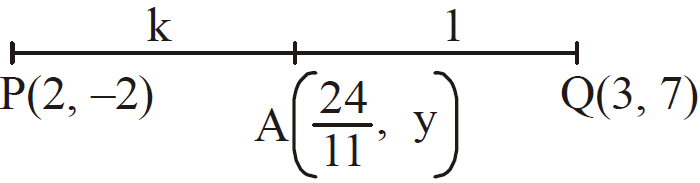
Let PA : AQ = k : 1
$\therefore \frac{2 + 3\text{k}}{\text{k + 1}} = \frac{24}{11}$
$\Rightarrow \text{k} = \frac{2}{9}$
Hence the ratio is 2 : 9.
Therefore $\text{y} = \frac{-18 + 14}{11} = \frac{-4}{11}$ View full question & answer→Question 235 Marks
Find the area of $\triangle\text{ABC}$ with A(1, -4) and midpoints of sides through A being (2, -1) and (0, -1).
AnswerLet $(x_2, y_2)$ and $(x_3, y_3)$ be the coordinates of B and C respectively. Since, the cordinates of A are (1, -4), therefore $\frac{1+\text{x}_2}{2}=2=\text{x}_2=3$
$\frac{-4+\text{y}_2}{2}=-1=\text{y}_2=2$
$\frac{-4+\text{y}_3}{2}=-1=\text{y}_3=2$
Let $A(x_1, y_1) = A(1, -4), B(x_2, y_2) = B(3, 2)$ and $C(x_3, x_4) = C(-1, 2).$
Now,
$\text{ar}(\triangle\text{ADC})=\frac{1}{2}[\text{x}_1(\text{y}_2-\text{y}_3)+\text{x}_2(\text{y}_3-\text{y}_1)+\text{x}_3(\text{y}_1-\text{y}_2)]$ $=\frac{1}{2}[1(2-2)+3(2+4)-1(-4-2)$ $=\frac{1}{2}[0+18+6]$ $=12\text{sq. units}$ Hence, the area of the triangle $\triangle\text{ABC}$ is 12sq. units.
View full question & answer→Question 245 Marks
Find a relation between x and y, if the points A(x, y), B(-5, 7), and C(-4, 5) are collinear.
AnswerLet $A(x_1 = x, y_1 = y), B(x_2 = -5, y_2 = 7)$ and $(x_3 = -4, y_3 = 5)$ be the given points.The given point are collinear if
$x_1(y_2 - y_3) + x_2(y_3 - y_1) + x_3(y_1 - y_2) = 0$
$\Rightarrow x(7 - 5) + (-5)(5 - y) + (-4)(y - 7) = 0$
$\Rightarrow 7x - 5x - 25 + 5y - 4y + 28= 0$
$\Rightarrow 2x + y + 3 = 0$
Hence, the required relation is 2x + y + 3 = 0.
View full question & answer→Question 255 Marks
Find the value of a, so that the point (3, a) lies on the line respresented by 2x - 3y = 5.
AnswerThe point (3, a) lies on the line 2x - 3y = 5.
If point (3, a) lies on the line 2x - 3y = 5,
Then
2x - 3y = 5
⇒ (2 × 3) - (3 × a) = 5
⇒ 6 - 3a = 5
⇒ 3a = 1
$\Rightarrow\ \text{a}=\frac{1}{3}$
Hence, the value of a is $\frac{1}{3}.$
View full question & answer→Question 265 Marks
Show that the points A(3, 0), B(4, 5), C(-1, 4) and D(-2, -1) are the vertices of a rhombus. Find its area.
Answer
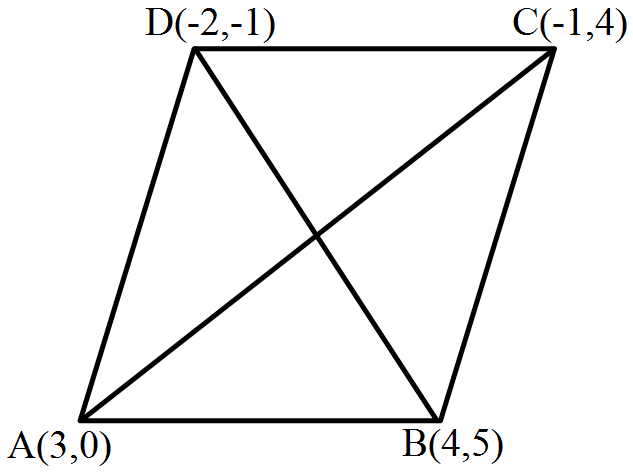 Let A(3, 0), B(4, 5) C(-1, 4) and D(-2, -1) be the angular points of a quadrilateral ABCD. Join AC and BD.
Now,
$\text{AB}=\sqrt{(4-3)^2+(5-0)^2}$
$=\sqrt{(1)^2+(5)^2}$
$=\sqrt{1+25}=\sqrt{26}\text{ units}$
$\text{BC}=\sqrt{(-1-4)^2+(4-5)^2}$
$=\sqrt{(-5)^2+(1)^2}$
$=\sqrt{25+1}=\sqrt{26}\text{ units}$
$\text{CD}=\sqrt{(-2+1)^2+(-1-4)^2}$
$=\sqrt{(-1)^2+(-5)^2}$
$=\sqrt{1+25}=\sqrt{26}\text{ units}$
$\text{DA}=\sqrt{(3+2)^2+(0+1)^2}$
$=\sqrt{(-7)^2+(2)^2}$
$=\sqrt{25+1}=\sqrt{26}\text{ units}$
$\therefore\text{AB}=\text{BC}=\text{CD}=\text{DA}=\sqrt{26}\text{ units}$
$\text{Diag}.\text{AC}=\sqrt{(-1-3)^2+(4-0)^2}$
$=\sqrt{(-4)^2+(4)^2}$
$=\sqrt{16+16}$
$=\sqrt{32}=4\sqrt{2}\text{ units}$
$\text{Diag}.\text{BD}=\sqrt{(-2-4)^2+(-1-5)^2}$
$=\sqrt{(-6)^2+(6)^2}$
$=\sqrt{36+36}$
$=\sqrt{72}=6\sqrt{2}\text{ units}$
$\therefore\text{Diag}.\text{AC}\not=\text{Diag}.\text{BD}$
Thus, ABCD is a quadrilateral having all sides equal but diagonals are unequal.
$\therefore\text{ABCD}$ is a rhombus but not a square.
$\therefore\text{Area of rhombus ABCD}$ $=\frac{1}{2}\times\text{product of its diagonals}.$
$=\Big(\frac{1}{2}\times\text{AC}\times\text{BD}\Big)$
$=\Big(\frac{1}{2}\times4\sqrt{2}\times6\sqrt{2}\Big)$
$=24\text{ sq.units}$ View full question & answer→Question 275 Marks
If the point $\text{P}\Big(\frac{1}{2},\text{y}\Big)$ lies on the line segment joining the points A(3, -5) and B(-7, 9) then find the ratio in which P divides AB. Also, find the value of y.
AnswerLet the point $\text{P}\Big(\frac{1}{2},\text{y}\Big)$ divides the line segment joining the points A(3, -5) and B(-7, 9) in the ratio k : 1.
Then, by section formula,
Coordinates of P $=\Big(\frac{\text{k}\times(-7)+1\times3}{\text{l}+1},\frac{\text{k}\times9+1\times(-5)}{\text{k}+1}\Big)$
$=\Big(\frac{-7\text{k}+3}{\text{k}+1},\frac{\text{k}\times9+1\times(-5)}{\text{k}+1}\Big)$
$=\Big(\frac{-7\text{k}+3}{\text{k}+1},\frac{9\text{k}-5}{\text{k}+1}\Big)$
Given, coordinates of P $=\Big(\frac{1}{2},\text{y}\Big)$
$\therefore\ \frac{-7\text{k}+3}{\text{k}+1}=\frac{1}{2}$
$\Rightarrow\ -14\text{k}+6=\text{k}+1$
$\Rightarrow\ 15\text{k}=5$
$\Rightarrow\ \text{k}=\frac{1}{3}$
So, the required ratio is 1 : 3.
Also,
$\Rightarrow\ \frac{9\text{k}-5}{\text{k}+1}=\text{y}$
$\Rightarrow\ \frac{9\times\frac{1}{3}-5}{\frac{1}{3}+1}=\text{y}$
$\Rightarrow\ \frac{3-5}{\frac{4}{3}}=\text{y}$
$\Rightarrow\ \text{y}=\frac{-6}{4}=\frac{-3}{2}$
View full question & answer→Question 285 Marks
For what value of y are the points P(1, 4), Q(3, y) and R(-3, 16) are collinear.
AnswerLet $P(1,4)=Q(3, y)$ and $R(-3,16)$ are the given points. then, $\left(x_1=1, y_1=4\right),\left(x_2=3, y_2=y\right)$ and $\left(x_3=-3, y_3=16\right)$ It is given that the points $A , B$ and C are collinear. therefore,
$x_1(y_2 - y_3) + x_2(y_3 - y_1) + x_3(y_1 - y_2) = 0$
$\Rightarrow 1(y - 16) + 3(16 - 4) + (-3) + (4 - y) = 0$
$\Rightarrow 1(y - 16) + 3(12) - 3(4 - y) = 0$
$\Rightarrow y - 16 + 36 - 12 + 3y = 0$
$\Rightarrow 8 + 4y = 0$
$\Rightarrow 4y = -8$
$\Rightarrow\text{y}=\frac{-8}{4}=-2$
when y = -2, the given points are collinear.
View full question & answer→Question 295 Marks
Find the distance between of the following points from the origin:
B(-5, 5)
AnswerThe gven point is A(-5, 5) and let O(0, 0) be the origin
Then, $\text{BO}=\sqrt{(-5-0)^2+(5-0)^2}$
$=\sqrt{5^2+(-5)^2}$
$=\sqrt{25+25}$
$=\sqrt{50}=5\sqrt2\text{ units}.$
View full question & answer→Question 305 Marks
Find the area of the triangle formed by joining the midpoint of the sides of the triangle whose vertices are A(2, 1), B(4, 3) and C(2, 5).
AnswerThe vertices of the teriangle are $A(2,1), B(4,3)$ and $C(2,5)$.
$\text { Coordinates of midpoint of } \left.AB=P x_1, y_1\right)=\left(\frac{2+4}{2}, \frac{1+3}{2}\right)=(3,2)$
$\text { Coordinates of midpoint of } BC=Q\left(x_2, y_2\right)=\left(\frac{4+2}{2}, \frac{3+5}{2}\right)=(3,4)$
$\text { Coordinates of midpoint of } AC=R\left(x_3, y_3\right)=\left(\frac{2+2}{2}, \frac{1,+5}{2}\right)=(3,2)$
$\text { Area of } \triangle PQR=\frac{1}{2}\left[x_1\left(y_2-y_3\right)+x_2\left(y_3-y_1\right)+x_3\left(y_1-y_2\right)\right] $
$=\frac{1}{2}[3(4-3)+3(3-2)+2(2-4)$
$=\frac{1}{2}[3+3-4]$
$=1 \text { sq.units }$
Hence, the area of the required triangle is 1 sq. unit.
View full question & answer→Question 315 Marks
Show that the points A(3, 1), B(0, -2), C(1, 1) and D(4, 4) are the vertices of a parallelogram ABCD.
AnswerLet A(3, 1), B(0, -2), C(1, 1) and D(4, 4) be the vertices of quadrilateral join AC, BD. AC and BD, intersect other at the point O.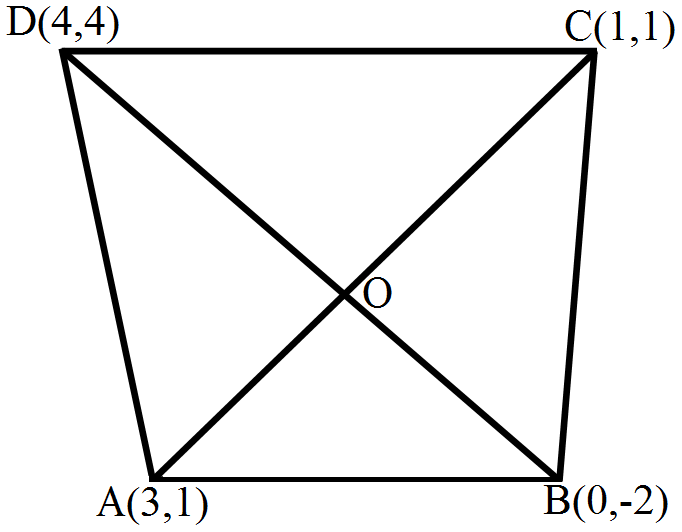
We know that the diagonal of a parallelogram bisect each other. Therefore, O is mid-point of AC as well as that of BD. Now mid-point of AC is $\Big(\frac{3+1}{2},\frac{1+1}{2}\Big)\text{i.e},(2,1)$ And mid-point of BD is $\Big(\frac{0+4}{2},\frac{-2+4}{2}\Big)\text{i.e},(2,1)$ Mid-point of AC is the same as mid-point of BD. Hence, A, B, C, D are the vertices of a parallelogram ABCD. View full question & answer→Question 325 Marks
Show that the following points are the vertices of a square:
P(0, -2), Q(3, 1), R(0, 4) and S(-3, 1)
AnswerLet P(0, -2), Q(3, 1) R(0, 4) and S(-3, 1) be the angular points of quad. PQRS.
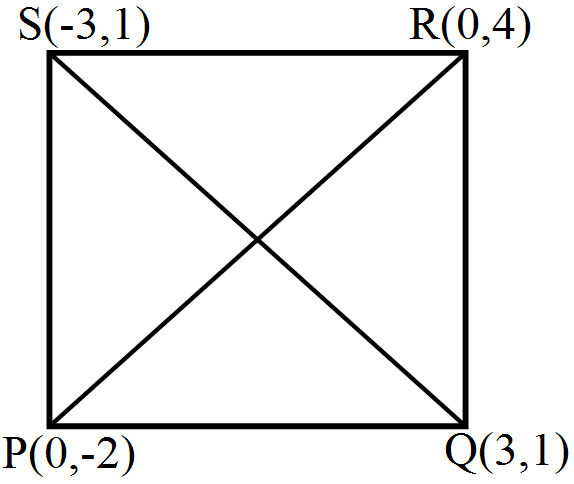
Join PR and QSD
Now,
$\text{PQ}=\sqrt{(3-0)^2+(1+2)^2}$
$=\sqrt{(3)^2+(3)^2}$
$=\sqrt{9+9}=\sqrt{18}=3\sqrt{2}\text{ units}$
$\text{QR}=\sqrt{(0-3)^2+(4-1)^2}$
$=\sqrt{(-3)^2+(3)^2}$
$=\sqrt{9+9}=\sqrt{18}=3\sqrt{2}\text{ units}$
$\text{RS}=\sqrt{(-3-0)^2+(1-4)^2}$
$=\sqrt{(-3)^2+(-3)^2}$
$=\sqrt{9+9}=\sqrt{18}=3\sqrt{2}\text{ units}$
$\text{SP}=\sqrt{(0+3)^2+(-2-1)^2}$
$=\sqrt{(3)^2+(-3)^2}$
$=\sqrt{9+9}=\sqrt{18}=3\sqrt{2}\text{ units}$
Thus, $\text{PQ}=\text{QR}=\text{RS}=\text{SP}$
$\text{Diag}.\text{PR}=\sqrt{(0-0)^2+(4+2)^2}$
$=\sqrt{(6)^2}=6\text{ units}$
$\text{Diag}.\text{QS}=\sqrt{(-3-3)^2+(1-1)^2}$
$=\sqrt{(-6)^2}=6\text{ units}$
$\therefore\text{Diag}.\text{PR}=\text{Diag}.\text{QS}$
Thus, PQRS is a quadrilateral in which all sides are equal and the diagonals are equal
Hence, quad. PQRS is a square View full question & answer→Question 335 Marks
If two adjacent vertices of a parallelogram are (3, 2) and (-1, 0) and the diagonals intersect at (2, -5) then find the coordinates of the other two vertices.
Answer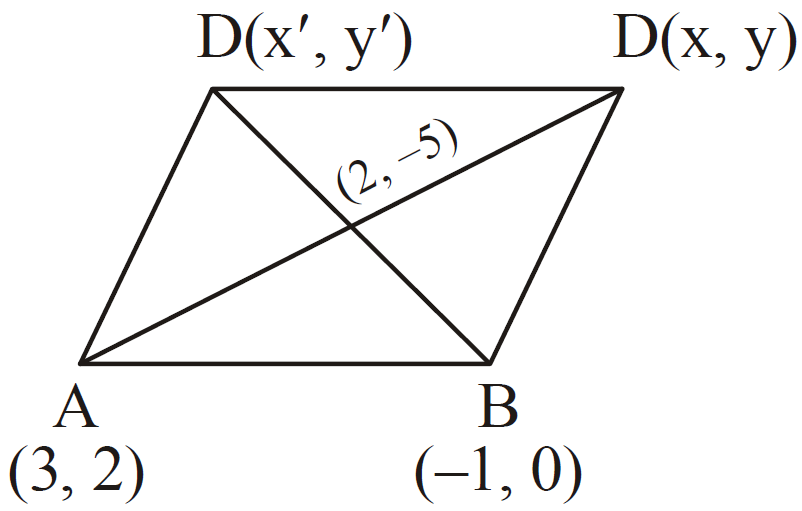
Let other two coordinates are:
(x, y) and (x', y')
$2 = \frac{\text{x + 3}}{2}$
$\Rightarrow \text{x = 1}$
And
$-5 = \frac{2 + \text{y}}{2}$
$\text{y} = -12$
Again
$\frac{-1 +\text{x}'}{2} = 2$
$\text{x}' = 5$
And
$\frac{0 \text{ + } \text{y}'}{2} = -5$
$\text{y}' = -10$
Hence co-ordinates are (1, –12) and (5, –10). View full question & answer→Question 345 Marks
Find the area of $\triangle\text{ABC}$ whose vertices are:
A(1, 2), B(-2, 3) and C(-3, -4)
Answer$A (1,2), B (-2,3)$ and $C (-3,-4)$ are the vertices of Then, $\left( x _1=1, y _1=2\right),\left( x _2=-2, y _2=3\right)$ and $\left( x _3=-3, y _3=-4\right)$ Area of triangle $A B C$
$=\frac{1}{2}\big\{\text{x}_1(\text{y}_2-\text{y}_3)+\text{x}_2(\text{y}_3-\text{y}_1)+\text{x}_3(\text{y}_1-\text{y}_2)\big\}$
$=\frac{1}{2}\big\{1(3-(-4))+(-2))(-4-2)+(-3)(2-3)\big\}$
$=\frac{1}{2}\big\{1(3+4)-2(-6)-3(-1)\big\}$
$=\frac{1}{2}\big\{7+12+3\big\}$
$=\frac{1}{2}(22)$
$=11\ \text{sq}.\text{units}$
View full question & answer→Question 355 Marks
Show that the following points are the vertices of a square:
A(6, 2), B(2, 1), C(1, 5) and D(5, 6)
AnswerLet A(6, 2), B(2, 1) C(1, 5) and D(5, 6) be the angular points of quad. ABCD. Join AC and BD
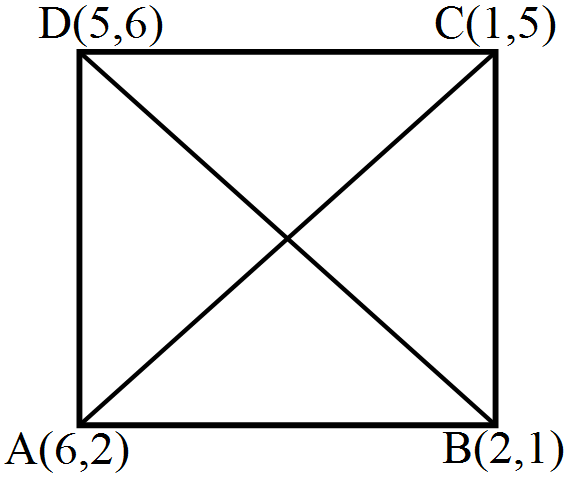
Now,
$\text{AB}=\sqrt{(2-6)^2+(1-2)^2}$
$=\sqrt{(-4)^2+(-1)^2}$
$=\sqrt{16+1}=\sqrt{17}\text{units}$
$\text{BC}=\sqrt{(1-2)^2+(5-1)^2}$
$=\sqrt{(-1)^2+(4)^2}$
$=\sqrt{1+16}=\sqrt{17}\text{units}$
$\text{CD}=\sqrt{(5-1)^2+(6-5)^2}$
$=\sqrt{(4)^2+(1)^2}$
$=\sqrt{16+1}=\sqrt{17}\text{units}$
$\text{DA}=\sqrt{(6-5)^2+(2-6)^2}$
$=\sqrt{(1)^2+(-4)^2}$
$=\sqrt{1+16}=\sqrt{17}\text{units}$
$\text{AB}=\text{BC}=\text{CD}=\text{DA}$
$\text{Diag}.\text{AC}=\sqrt{(1-6)^2+(5-2)^2}$
$=\sqrt{(-5)^2+(3)^2}$
$=\sqrt{25+9}=\sqrt{34}\text{units}$
$\text{Diag}.\text{BD}=\sqrt{(5-2)^2+(6-1)^2}$
$=\sqrt{(3)^2+(5)^2}$
$=\sqrt{9+25}=\sqrt{34}\text{units}$
$\therefore\text{Diag}.\text{AC}=\text{Diag}.\text{BD}$
Thus, all sides of quad. ABCD are equal and diagonals are also equal
Quad. ABCD is a square. View full question & answer→Question 365 Marks
Find the area of quadrilateral ABCD whose vertices are A(-7, 5), B(-6, -7), C(-3, -8) and D(2, 3).
Question 375 Marks
A(7, -3), B(5, 3) and C(3, -1) are the vertices of a $\triangle\text{ABC}$ and is its median. Prove that the median AD divides
$\triangle\text{ABC}$ into two triangles of equal areas.
AnswerThe vertices of the teriangle are $A (7,-3), B (5,3)$ and $C (3,-1)$. Coordinates of $D =\left(\frac{5+3}{2}, \frac{3-3}{2}\right)=(4,1)$ For the area of the triangle $A D C$, letA $\left(x_1, y_1\right)=A(7,-3), D\left(x_2, y_2\right)=D(4,1)$ and $C\left(x_3, x_4\right)=C(3,-1)$.
Then,
Area of $\triangle\text{ADC}=\frac{1}{2}[\text{x}_1(\text{y}_2-\text{y}_3)+\text{x}_2(\text{y}_3-\text{y}_1)+\text{x}_3(\text{y}_1-\text{y}_2)]$
$=\frac{1}{2}[7(1+1)+4(-1+3)+3(-3-1)$ $=\frac{1}{2}[14+8-12]$ $=5\text{sq. units}$ Now, for the area of triangle ABD, let Area of $\triangle\text{ABC}=\frac{1}{2}[\text{x}_1(\text{y}_2-\text{y}_3)+\text{x}_2(\text{y}_3-\text{y}_1)+\text{x}_3(\text{y}_1-\text{y}_2)]$ $=\frac{1}{2}[7(3-1)+5(1+3)+4(-3-3)$ $=\frac{1}{2}[14+20-24]$ $=5\text{sq. units}$ Thus, $\text{ar}(\triangle\text{ADC})=\text{ar}(\triangle\text{ABD})=5\text{sq}.\ \text{units}.$ Hence, AD divides $\triangle\text{ABC}$ into two triangles of equal areas.
View full question & answer→Question 385 Marks
Find the area of $\triangle\text{ABC}$ with vertices A(0, -1), B(2, 1) and C(0, 3). Also, find the area of the triangle formed by joining the midpoints of its sides. Show that the ratio of the areas of two triangles is 4 : 1
AnswerLet $\left.A \left( x _1=0\right), y _1=-1\right), B\left( x _2=2, y _2=1\right)$ and $C \left( x _3=0, y _3=3\right)$ be the given points. then
$\operatorname{ar}(\triangle ABC)=\frac{1}{2}\left[x_1\left(y_2-y_3\right)+x_2\left(y_3-y_1\right)+x_3\left(y_1-y_2\right)\right]$
$=\frac{1}{2}[0(1-3)+2(3+1)+0(-1-1)$
$=\frac{1}{2} \times 8=4 \text { sq. units }$
So, the area of the triangle $\triangle ABC$ is 4 sq . units.
Let $D\left(a_1, b_1\right), E\left(a_2, b_2\right)$, and $F\left(a_3, b_3\right)$ be the midpoint of $A B, B C$ and $A C$ respectively.
Then,
$a_1=\frac{0+2}{2}=1, b_1=\frac{-1+1}{2}=0$
$a_2=\frac{2+0}{2}=1, b_2=\frac{1+3}{2}=2$
$a_3=\frac{0+0}{2}=0, b_3=\frac{-1+3}{2}=1$
Thus, the coordinates of $D, E$ and $F$ are $D\left(a_1=1, b_1=0\right), E\left(a_2=1, b_2=2\right)$ and $F\left(a_3=0, b_3=1\right)$.
Now,
$\operatorname{ar}(\triangle DEF)=\frac{1}{2}\left[a_1\left(b_2-b_3\right)+a_2\left(b_3-b_1\right)+a_3\left(b_1-b_2\right)\right]$
$=\frac{1}{2}[1(2-1)+1(1-0)+0(0-2)]$
$=\frac{1}{2}[1+1+1]$
$=1 \text { sq. unit }$
So, the area of the triangle $\triangle DEF$ is 1 sq. unit.
Hence, $\triangle ABC : \triangle DEF =4: 1$
View full question & answer→Question 395 Marks
Using the distance formula, show taht the given points are collinear:
(6, 9), (0, 1) and (-6, -7)
AnswerLet A(6, 9), B(0, 1) and C(-6, -7) be the given points
Then,
$\text{AB}=\sqrt{(0-6)^2+(1-9)^2}=\sqrt{(6)^2+(-8)^2}$
$=\sqrt{36+64}=\sqrt{100}=10\text{ units}$
$\text{BC}=\sqrt{(-6-0)^2+(-7-1)^2}=\sqrt{(-6)^2+(-8)^2}$
$=\sqrt{36+64}=\sqrt{100}=10\text{ units}$
$\text{AC}=\sqrt{(-6-6)^2+(-7-9)^2}=\sqrt{(-12)^2+(-16)^2}$
$=\sqrt{144+256}=\sqrt{400}=20\text{ units}$
$\therefore\text{AB}+\text{AC}=10+10=20\text{ units}=\text{BC}$
$\Rightarrow\text{AB}+\text{AC}=\text{BC}$
Hence, the given points are collinear.
View full question & answer→Question 405 Marks
Using the distance formula, show taht the given points are collinear:
(1, -1), (5, 2) and (9, 5)
AnswerLet A(1, -1), B(5, 2) and C(9, 5) be the given points
Then,
$\text{AB}=\sqrt{(1-5)^2+(-1-2)^2}=\sqrt{(4)^2+(-3)^2}$
$=\sqrt{16+9}=\sqrt{25}=5\text{ units}$
$\text{BC}=\sqrt{(5-9)^2+(2-5)^2}=\sqrt{(-4)^2+(-3)^2}$
$=\sqrt{16+9}=\sqrt{25}=5\text{ units}$
$\text{AC}=\sqrt{(1-9)^2+(-1-5)^2}=\sqrt{(-8)^2+(-6)^2}$
$=\sqrt{64+36}=\sqrt{100}=10\text{ units}$
$\therefore\text{AB}+\text{AC}=5+5=10\text{ units}=\text{BC}$
$\Rightarrow\text{AB}+\text{AC}=\text{BC}$
Hence, the given points are collinear.
View full question & answer→Question 415 Marks
Show that the points (-3, -3), (3, 3) and $(-3\sqrt{3},3\sqrt{3})$ are the vertices of an equilateral triangle.
View full question & answer→Question 425 Marks
Show that the points A(6, 1), B(8, 2), C(9, 4) and D(7, 3) are the vertices of a rhombus. Find its area.
AnswerLet A(6, 1), B(8, 2) C(9, 4) and D(7, 3) be the angular points of quad. ABCD. Join AC and BD.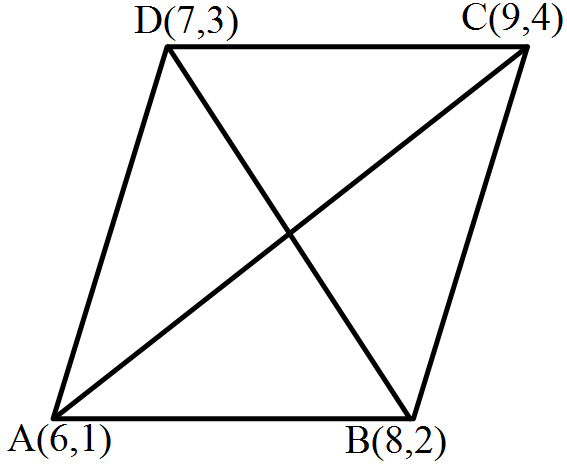
Now, $\text{AB}=\sqrt{(8-6)^2+(2-1)^2}$ $=\sqrt{(2)^2+(1)^2}$ $=\sqrt{4+1}=\sqrt{5}\text{ units}$ $\text{BC}=\sqrt{(9-8)^2+(4-2)^2}$ $=\sqrt{(1)^2+(2)^2}$ $=\sqrt{1+4}=\sqrt{5}\text{ units}$ $\text{CD}=\sqrt{(7-9)^2+(3-4)^2}$ $=\sqrt{(-2)^2+(-1)^2}$ $=\sqrt{4+1}=\sqrt{5}\text{ units}$ $\text{DA}=\sqrt{(7-6)^2+(3-1)^2}$ $=\sqrt{(1)^2+(2)^2}$ $=\sqrt{1+4}=\sqrt{5}\text{ units}$ Thus, $\text{AB}=\text{BC}=\text{CD}=\text{DA}=\sqrt{5}\text{ units}$ $\text{Diag}.\text{AC}=\sqrt{(9-6)^2+(4-1)^2}$ $=\sqrt{(3)^2+(3)^2}$ $=\sqrt{9+9}$ $=\sqrt{18}=3\sqrt{2}\text{ units}$ $\text{Diag}.\text{BD}=\sqrt{(7-8)^2+(3-2)^2}$ $=\sqrt{(-1)^2+(1)^2}$ $=\sqrt{1+1}$ $=\sqrt{2}\text{ units}$ $\therefore\text{Diag}.\text{AC}\not=\text{Diag}.\text{BD}$ Thus, ABCD is a quadrilateral having all sides equal but diagonals are unequal. Hence, ABCD is a rhombus. $\text{Area of rhombus ABCD}$ $=\frac{1}{2}\times\text{product of its diagonals}.$ $=\Big(\frac{1}{2}\times\text{AC}\times\text{BD}\Big)$ $=\Big(\frac{1}{2}\times3\sqrt{2}\times\sqrt{2}\Big)$ $=3\text{ sq.units}$ View full question & answer→Question 435 Marks
Using the distance formula, show taht the given points are collinear:
(-2, 5), (0, 1) and (2, -3).
AnswerLet A(-2, 5), B(0, 1) and C(2, -3) be the given points
Then,
$\text{AB}=\sqrt{(0-2)^2+(1-5)^2}=\sqrt{(2)^2+(-4)^2}$
$=\sqrt{4+16}=\sqrt{20}=2\sqrt{5}\text{ units}$
$\text{BC}=\sqrt{(2+0)^2+(-3-1)^2}=\sqrt{(2)^2+(-4)^2}$
$=\sqrt{4+16}=\sqrt{20}=2\sqrt{5}\text{ units}$
$\text{AC}=\sqrt{(2+2)^2+(-3-5)^2}=\sqrt{(4)^2+(-8)^2}$
$=\sqrt{16+64}=\sqrt{80}=4\sqrt{5}\text{ units}$
$\therefore\text{AB}+\text{AC}=2\sqrt{5}+2\sqrt{5}=4\sqrt{5}\text{ units}=\text{BC}$
$\Rightarrow\text{AB}+\text{AC}=\text{BC}$
Hence, the given points are collinear.
View full question & answer→Question 445 Marks
In what ratio is the line segments joining A(2, -3) and B(5, 6) divided by the x-axis? Also, find the coordinates of the point of divesion.
AnswerLet the x-axis cut the join of A(2, -3) and B(5, 6) in the ratio k : 1, at the point P. Then, by the section forfmula, the coordinates of P are $\Big(\frac{5\text{k}+2}{\text{k}+1},\frac{6\text{k}-3}{\text{k}+1}\Big)$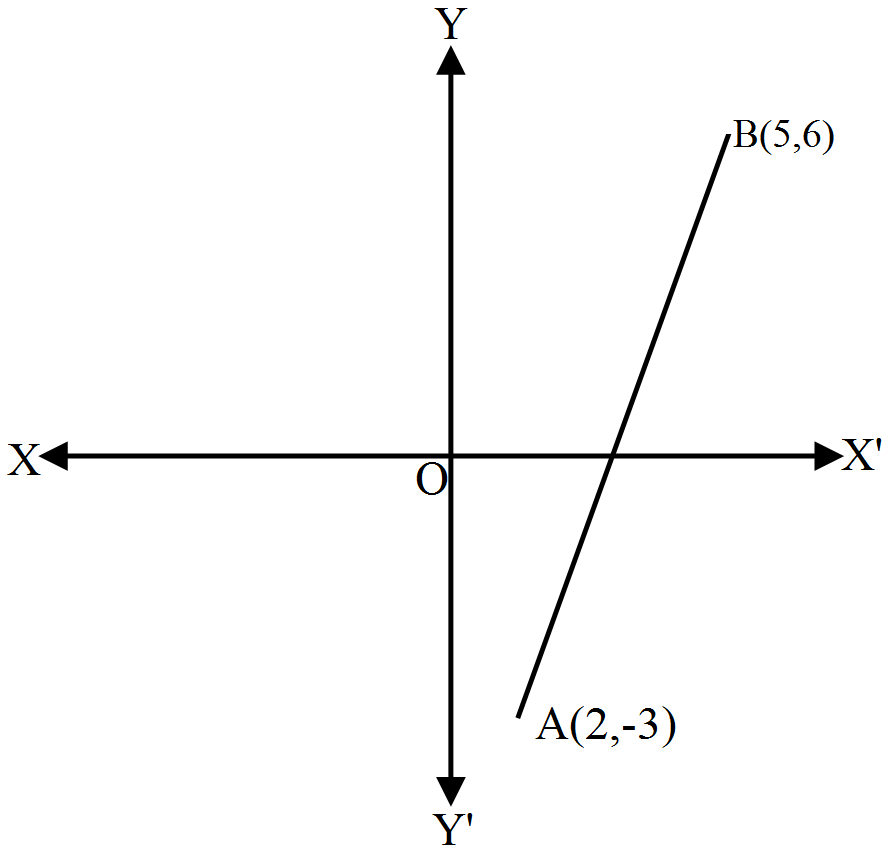
But P lies on the x-axis so, its ordinate must be 0. $\therefore\ \frac{6\text{k}-3}{\text{k}+1}=0$ $\Rightarrow\ 6\text{k}-3=0,\text{k}=\frac{1}{2}$ So the required ratio 1 : 2 Thus the x-axis divides AB in the ratio 1 : 2 Putting $\text{k}=\frac{1}{2}$ in $\frac{5\text{k}+2}{\text{k}+1},$ we get the point P as $\text{P}\bigg(\frac{5\times\frac{1}{2}+2}{\frac{1}{2}+1},0\bigg)$ or P(3, 0) Thus, P is (3, 0) and k = 1 : 2. View full question & answer→Question 455 Marks
Show taht the following points are collinear:A(-5, 1), B(5, 5) and C(10, 7)
AnswerLet $A\left(x_1=-5, y_1=1\right), B\left(x_2=5, y_2=5\right)$ and $C\left(x_3=10, y_3=7\right)$ be the given points.
Now
$x_1\left(y_2-y_3\right)+x_2\left(y_3-y_1\right)+x_3\left(y_1-y_2\right)$
$=(-4)(5-7)+5(7-1)+10(1-5)$
$=-5(-2)+5(6)+10(-4)$
$=10+30-40$
$=0$
Hence the given point are collinear.
View full question & answer→Question 465 Marks
A line intersects the y-axis and x-axis at the points P and Q respectively. If (2, -5) is the midpoint Of PQ then find the coordinates of P and Q.
AnswerThe mid-point of the line segment joining the points $P(x_1, y_1)$ and $Q(x_2, y_2)$ is $\Big(\frac{\text{x}_1+\text{x}_2}{2},\frac{\text{y}_1+\text{y}_2}{2}\Big)$
Let the coordinates of the point P and Q be (0, b) and (a, 0) respectively.
Mid point is $\Big(\frac{0+\text{a}}{2},\frac{\text{b}+0}{2}\Big)=\Big(\frac{\text{a}}{2},\frac{\text{b}}{2}\Big)$
Compare it with the given mid-point (2, -5).
$\frac{\text{a}}{2}=2,\frac{\text{b}}{2}=-5$
$\text{a}=4,\text{b}=-4$
Coordinates P and Q are (0, -10) and (4, 0) respectively.
View full question & answer→Question 475 Marks
Show that the following points are the vertices of a rectangle:
A(0, -4), B(6, 2), C(3, 5) and D(-3, -1)
AnswerLet A(0, -4), B(6, 2), C(3, 5) and D(-3, -1) are the vertices of quad. ABCD. Then,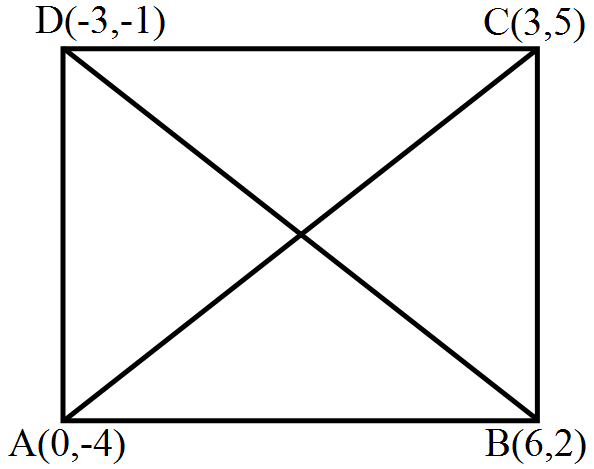
$\text{AB}=\sqrt{(6-0)^2+(2+4)^2}$ $=\sqrt{(6)^2+(6)^2}$ $=\sqrt{36+36}=\sqrt{72}=6\sqrt{2}\text{ units}$ $\text{BC}=\sqrt{(3-6)^2+(5-2)^2}$ $=\sqrt{(-3)^2+(3)^2}$ $=\sqrt{9+9}=\sqrt{18}=3\sqrt{2}\text{ units}$ $\text{DC}=\sqrt{(-3-3)^2+(-1-5)^2}$ $=\sqrt{(-6)^2+(-6)^2}$ $=\sqrt{36+36}=\sqrt{72}=6\sqrt{2}\text{ units}$ $\text{AD}=\sqrt{(-3-0)^2+(-1+4)^2}$ $=\sqrt{(-3)^2+(3)^2}$ $=\sqrt{9+9}=\sqrt{18}=3\sqrt{2}\text{ units}$ Thus, $\text{AB}=\text{DC}$ and $\text{AD}=\text{BC}$ $\text{Diag}.\text{AC}=\sqrt{(3-0)^2+(5+4)^2}$ $=\sqrt{(3)^2+(9)^2}$ $=\sqrt{9+81}$ $=\sqrt{90}=3\sqrt{10}\text{ units}$ $\text{Diag}.\text{BD}=\sqrt{(-3-6)^2+(-1-2)^2}$ $=\sqrt{(-9)^2+(-3)^2}$ $=\sqrt{81+9}$ $=\sqrt{90}=3\sqrt{10}\text{ units}$ Thus, ABCD is a quadrilateral whose opposite sides are equal and the diagonals are equal. Hence, quad. ABCD is a rectangle. View full question & answer→Question 485 Marks
The base BC of an equilateral triangle ABC lies on y-axis. The coordinates of the point C are (0, -3). The origin is the midpoint of the base. Find the coordinates of the points A and B. Also, find the coordinates of another points D such that ABCD is a rhombus.
Answer
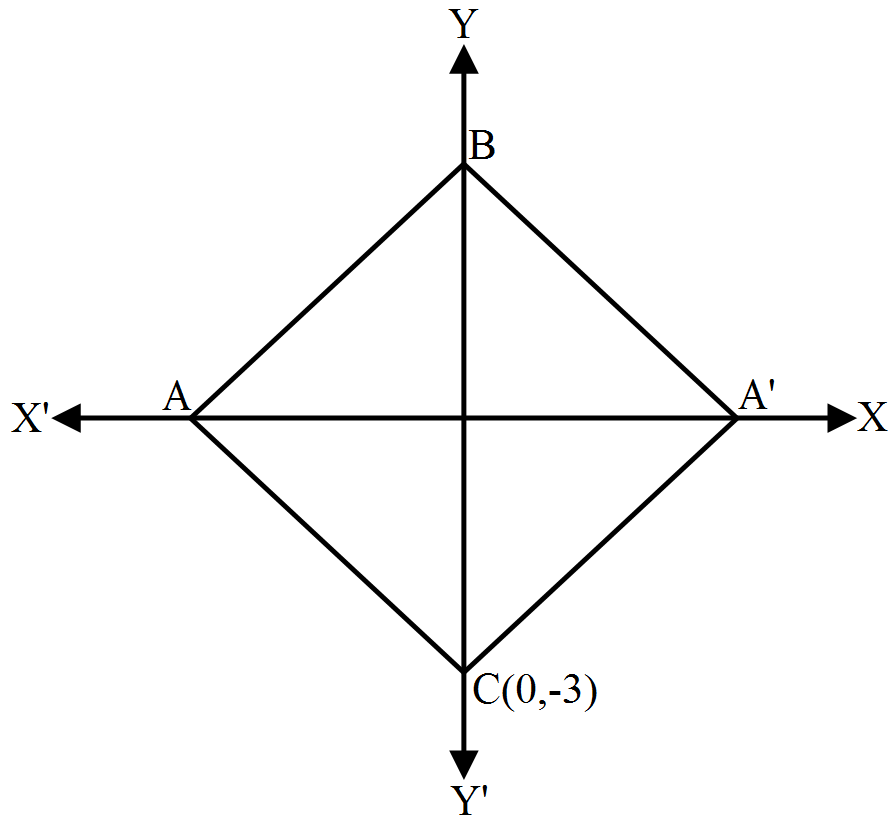 The base BC of an equilateral triangle ABC lies on y-axis and O is the mid-point of base BC.
⇒ OC = OB = 3 units
$\therefore$ Coordinates of B are (0, 3).
Since OX is perpendicular to BC and altitude of equilater triangle passes throught the opposite vertex A, A lies on x-axis.
Let the coordinates of A be (x, 0).
Since AB = BC, we have
$\sqrt{(\text{x}-0)^2+(0-3)^2}=\sqrt{(0-0)^2+(3+3)^2}$
$\Rightarrow\ \sqrt{\text{x}^2+9}=\sqrt{36}$
$\Rightarrow\ \text{x}^2+9=36$
$\Rightarrow\ \text{x}^2=27$
$\Rightarrow\ \text{x}=\pm3\sqrt{3}$
$\therefore$ Coordinates A are $(3\sqrt{3},0)$ or $(-3\sqrt{3},0)$
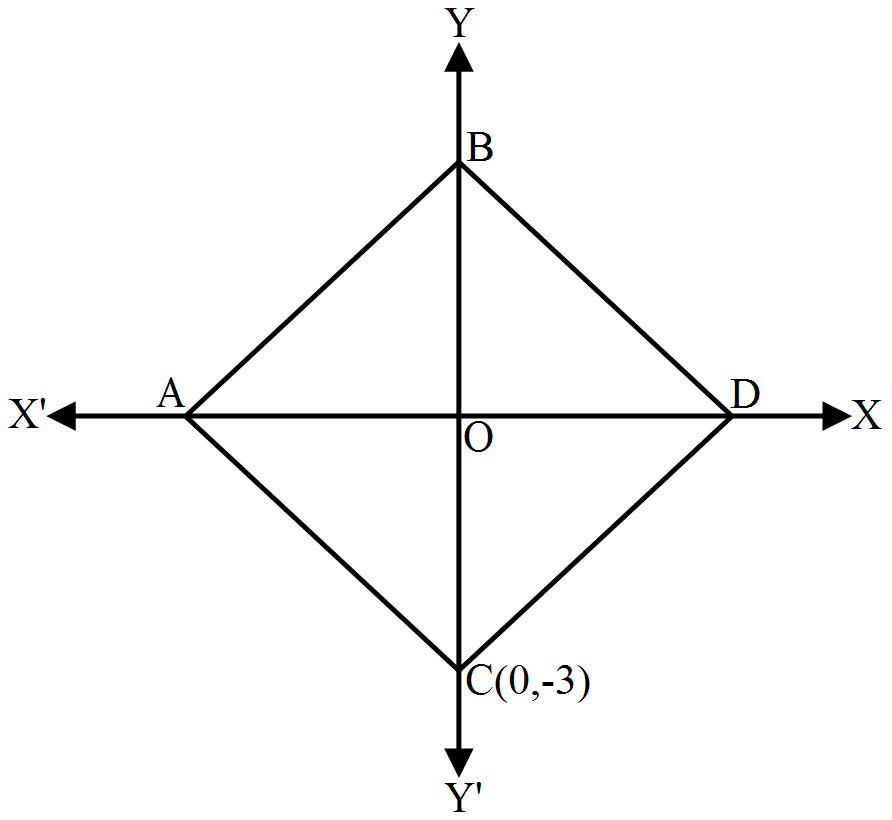 Since ABCD is a rhombus,
⇒ Coordinates of D $=(3\sqrt{3},0)$ View full question & answer→Question 495 Marks
If the points A(4, 3) and B(x, 5) lie on the circle with centre O(2, 3), find the value of x.
AnswerThe given points A(4, 3) and B(x, 5) lie on the circle with centre O(2, 3).
Then, OA = OB
$\Rightarrow\ \sqrt{(\text{x}-2)^2+(5-3)^2}=\sqrt{(4-2)^2+(3-3)^2}$
$\Rightarrow (x - 2)^2 + 2^2 = 2^2 + 0^2$
$\Rightarrow (x - 2)^2 = (2^2 - 2^2)$
$\Rightarrow (x - 2)^2 = 0$
$\Rightarrow x - 2 = 0$
$\Rightarrow x = 2$
Hence, the value of x = 2.
View full question & answer→Question 505 Marks
Prove that the point A(2, 4), B(2, 6) and $\text{C}(2+\sqrt{3},5)$ are the vertices of an equilateral triangle.
AnswerGiven: A(2, 4), B(2, 6) and $\text{C}(2+\sqrt{3},5)$
$\text{AB}=\sqrt{(2-2)^2+(6-4)^2}$
$=\sqrt{0+2}=\sqrt{4}=2\text{ units}$
$\text{BC}=\sqrt{(2+\sqrt{3}-2)^2+(5-6)^2}$
$=\sqrt{(\sqrt{3})^2+(-1)^2}$
$=\sqrt{3+1}=\sqrt{4}=2\text{ units}$
$\text{AC}=\sqrt{(2+\sqrt{3}-2)^2+(5-4)^2}$
$=\sqrt{(\sqrt{3})^2+(1)^2}$
$=\sqrt{3+1}=\sqrt{4}=2\text{ units}$
We find that AB = BC = AC
Hence, the given points are the vertices of an equilateral triangle.
View full question & answer→Question 515 Marks
Show that $\triangle\text{ABC},$ with vertices A(-2, 0), B(0, 2) and C(2, 0) is similar to $\triangle\text{DEF}$ with vertices D(-4, 0), F(4, 0) and E(0, 4).
Answer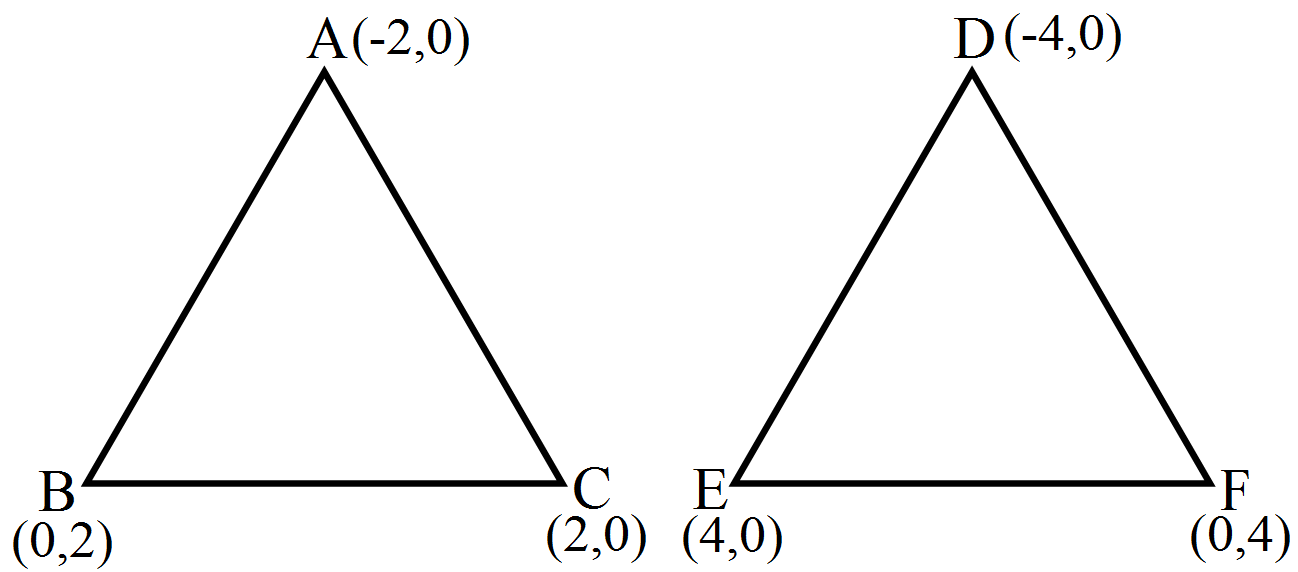
Using Distance formula
$\text{AB}=\sqrt{(0+2)^2+(2-0)^2}$
$=\sqrt{(2)^2+(2)^2}$
$=\sqrt{4+4}=\sqrt{8}=2\sqrt{2}\text{ units}$
$\text{BC}=\sqrt{(2-0)^2+(0-2)^2}$
$=\sqrt{(2)^2+(2)^2}$
$=\sqrt{4+4}=\sqrt{8}=2\sqrt{2}\text{ units}$
$\text{CA}=\sqrt{(-2-2)^2+(0-0)^2}$
$=\sqrt{(-4)^2+(0)^2}$
$=\sqrt{16+0}=\sqrt{16}=4\text{ units}$
$\text{DE}=\sqrt{(4+0)^2+(4-0)^2}$
$=\sqrt{(4)^2+(4)^2}$
$=\sqrt{16+16}=\sqrt{32}=4\sqrt{2}\text{ units}$
$\text{EF}=\sqrt{(4-0)^2+(0-4)^2}$
$=\sqrt{16+16}=\sqrt{32}=4\sqrt{2}\text{ units}$
$\text{FD}=\sqrt{(-4-4)^2+(0-0)^2}$
$=\sqrt{64+0}=\sqrt{64}=8\text{ units}$
i.e. $\frac{\text{AB}}{\text{DE}}=\frac{\text{BC}}{\text{EF}}=\frac{\text{AC}}{\text{DF}}$
$=\frac{2\sqrt{2}}{4\sqrt{2}}=\frac{2\sqrt{2}}{4\sqrt{2}}=\frac{4}{8}=\frac{1}{2}$ View full question & answer→Question 525 Marks
If the point A(0, 2) is equidistance from the points B(3, p) and C(p, 5), find the value of p. Also, find the length of AB.
AnswerIt is being given that A(0, 2) is equidistance from the points B(3, p) and C(p, 5)
Thus, we have
$AB = AC$
$\Rightarrow AB^2 = AC^2$
$\Rightarrow (0 - 3)^2 + (2 - p)^2= (0 - p)^2 + (2 - 5)^2$
$\Rightarrow (-3)^2 + (4 + p^2 - 4p)^2 = (-p)^2 + (-3)^2$
$\Rightarrow 9 + 4 + p^2 - 4p = p^2 + 9$
$\Rightarrow 4p = 4$
$\Rightarrow p = 1$
$\therefore\text{AB}=\sqrt{(0-3)^2+(2-1)^2}=\sqrt{(-3)^2+(1)^2}$
$=\sqrt{9+1}=\sqrt{10}$
$\Rightarrow\text{AB}=\sqrt{10}\text{ units}.$
View full question & answer→Question 535 Marks
Show that points A(-5, 6), B(3, 0) and C(9, 8) are the vertices of an isosceles right-angled triangle. Calculate its area.
AnswerLet A(-5, 6), B(3, 0) and C(9, 8) be the given points. Then
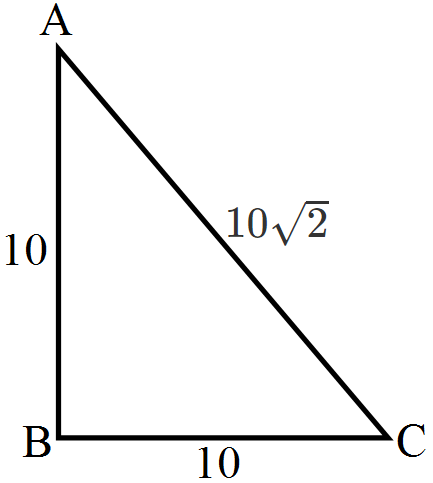
$\text{AB}=\sqrt{(3+5)^2+(0-6)^2}$
$=\sqrt{(8)^2+(-6)^2}=\sqrt{100}=10\text{ units}$
$\text{BC}=\sqrt{(9+5)^2+(8-0)^2}$
$=\sqrt{(6)^2+(8)^2}=\sqrt{100}=10\text{ units}$
$\text{AC}=\sqrt{(9+5)^2+(8-6)^2}$
$=\sqrt{(14)^2+(2)^2}=\sqrt{200}=10\sqrt{2}\text{ units}$
Thus, AB = BC = 10 units
$\therefore\triangle\text{ABC}$ is isosceeles
This show that $\triangle\text{ABC}$ is a right angled at B
In $\triangle\text{ABC},$ we have
Area of $\triangle\text{ABC}=\Big(\frac{1}{2}\times\text{base}\times\text{height}\Big)$
$=\Big(\frac{1}{2}\times\text{10}\times\text{10}\Big)\text{sq.unit}$
$=50\text{ sq.unit}$ View full question & answer→Question 545 Marks
In what ratio does the point C(4, 5) divide the join of A(2, 3) and B(7, 8)?
AnswerLet the required ratio be k : 1.
Then, by section formula, the coordinates of C are
$\text{C}\Big(\frac{7\text{k}+2}{\text{k}+1},\frac{8\text{k}+3}{\text{k}+1}\Big)$
Therefore,
$\frac{7\text{k}+2}{\text{k}+1}=4$ and $\frac{8\text{k}+3}{\text{k}+1}=5$ $[\because$ C(4, 5) is given$]$
⇒ 7k + 2 = 4k + 4 and 8k + 3 = 5k + 5
⇒ 3k = 2 and 3k = 2
$\Rightarrow\ \text{k}=\frac{2}{3}$ in each case
So, the required ratio is $\frac{2}{3}:1,$ which is same 2 : 3.
View full question & answer→Question 555 Marks
If (2, p) is the mipoint of the line segment joining the points A(6, -5) and B(-2, 11), find the values of a and p.
AnswerThe mid-point of line segment joining the points A(6, -5) and B(-2, 11) is
$\Big(\frac{6-2}{2},\frac{-5+11}{2}\Big)$ or (2, 3)
Also, given the mid-point of AB is (2, p)
⇒ p = 3
View full question & answer→Question 565 Marks
Find all possible values of x for which the distance between the points A(x, -1) and B(5, 3) is 5 units.
AnswerThe gven point is A(x, -1) and B(5, 3) be the origin
Now, $AB = 5$
$\Rightarrow AB^2 = 25$
$\Rightarrow (5 - x)^2 + (3 + 1)^2 = 25$
$\Rightarrow 25 + x^2 - 10x + 16 = 25$
$\Rightarrow x^2 - 10x + 16 = 0$
$\Rightarrow x^2- 8x - 2x + 16 = 0$
$\Rightarrow x(x - 8) - 2(x - 8) = 0$
$\Rightarrow (x - 8)(x - 2) = 0$
$\Rightarrow x - 8 = 0 or x - 2 = 0$
$\Rightarrow x = 8 or x = 2$
Hence x = 8, or x = 2
View full question & answer→Question 575 Marks
The line segment joining A(-2, 9) and B(6, 3) is a diameter of a circle with center C. Find the coordinates of C.
AnswerLet A(-2, 9) and B(6, 3) be the two points of the given diameter AB and let C(a, b) be the center of the circle. Then, clearly C is the mid-point of AB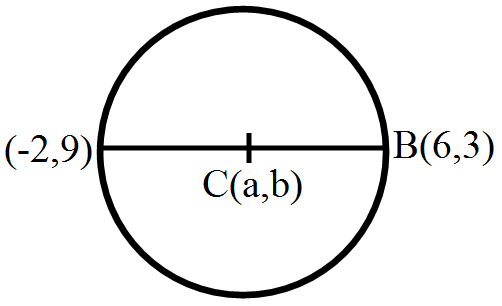
By the mid-point formula of the co-ordinates, Co-ordinates of C are $\Big(\frac{-2+6}{2},\frac{9+3}{2}\Big)$ But the co-ordinates of C are (a, b) $\therefore\ \frac{-2+6}{2}=\text{a}$ and $\frac{9+3}{2}=\text{b}$ a = 2 and b = 6 Hence, the required point C(2, 6) View full question & answer→Question 585 Marks
Points P, Q, R and S divide the line segments joining the points A(1, 2) and B(6, 7) in five equal parts. Find the coordinates of the points P, Q and R.
Answer
Point P divides line segment AB in the ratio 1 : 4
$\therefore\text{Coordinates of P}=\Big(\frac{1\times6+4\times1}{1+4},\frac{1\times7+4\times2}{1+4}\Big)$
$=\Big(\frac{6+4}{5},\frac{7+8}{5}\Big)$
$=\Big(\frac{10}{5},\frac{15}{5}\Big)$
$=(2,3)$
Point Q divides line segment AB in the ratio 2 : 3,
$\therefore\text{Coordinates of Q}=\Big(\frac{2\times6+3\times1}{2+3},\frac{2\times7+3\times2}{2+3}\Big)$
$=\Big(\frac{12+3}{5},\frac{14+6}{5}\Big)$
$=\Big(\frac{15}{5},\frac{20}{5}\Big)$
$=(3,4)$
Point R divides line segment AB in the ratio 3 : 2,
$\therefore\text{Coordinates of R}=\Big(\frac{3\times6+2\times1}{3+2},\frac{3\times7+2\times2}{3+2}\Big)$
$=\Big(\frac{18+2}{5},\frac{21+4}{5}\Big)$
$=\Big(\frac{20}{5},\frac{25}{5}\Big)$
$=(4,5)$ View full question & answer→Question 595 Marks
Find the distance between the points $\Big(\frac{-8}{5},2\Big)$ and $\Big(\frac{2}{5},2\Big).$
AnswerThe given points are $\text{A}\Big(\frac{-8}{5},2\Big)$ and $\text{B}\Big(\frac{2}{5},2\Big).$
Then, $\Big(\text{x}_1=\frac{-8}{5},\text{y}_1=2\Big)$ and $\Big(\text{x}_2=\frac{2}{5},\text{y}_2=2\Big)$
Therefore,
$\text{AB}=\sqrt{(\text{x}_2-\text{x}_1)^2+(\text{y}_2-\text{y}_1)^2}$
$=\sqrt{\Big\{\frac{2}{5}-\Big(\frac{-8}{5}\Big)\Big\}^2+(2-2)^2}$
$=\sqrt{(2)^2+(0)^2}=\sqrt{4+0}$
$=\sqrt{4}$
$=2\text{ units}$
View full question & answer→Question 605 Marks
Show that the points A(2, 1), B(5, 2), C(6, 4) and D(3, 3) are the angular points of a parallelogram. Is this figure a rectangle?
AnswerLet A(2, 1), B(5, 2) C(6, 4) and D(3, 3) are the angular points of a Parallogram ABCD. Then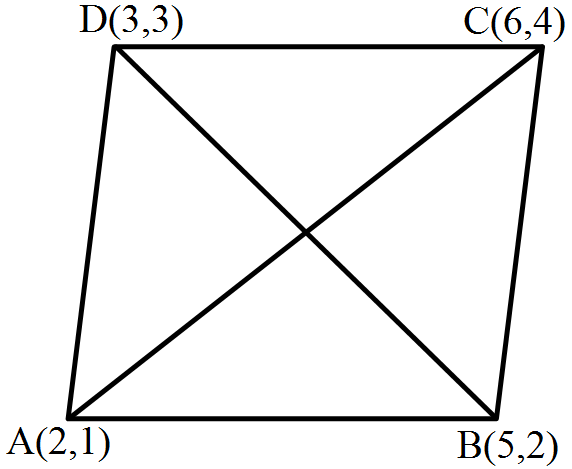
Now, $\text{AB}=\sqrt{(5-2)^2+(2-1)^2}$ $=\sqrt{(3)^2+(1)^2}$ $=\sqrt{10}=\sqrt{10}\text{ units}$ $\text{BC}=\sqrt{(6-5)^2+(4-2)^2}$ $=\sqrt{(1)^2+(2)^2}$ $=\sqrt{1+4}=\sqrt{5}\text{ units}$ $\text{DC}=\sqrt{(6-3)^2+(4-3)^2}$ $=\sqrt{(3)^2+(1)^2}$ $=\sqrt{9+1}=\sqrt{10}\text{ units}$ $\text{AD}=\sqrt{(3-2)^2+(3-1)^2}$ $=\sqrt{(1)^2+(2)^2}$ $=\sqrt{1+4}=\sqrt{5}\text{ units}$ Thus, $\text{AB}=\text{DC}$ and $\text{AD}=\text{BC}$ $\text{Diag}.\text{AC}=\sqrt{(6-2)^2+(4-1)^2}$ $=\sqrt{(4)^2+(3)^2}$ $=\sqrt{16+9}$ $=\sqrt{25}=5\text{ units}$ $\text{Diag}.\text{BD}=\sqrt{(3-5)^2+(3-2)^2}$ $=\sqrt{(2)^2+(1)^2}$ $=\sqrt{4+1}$ $=\sqrt{5}\text{ units}$ $\text{Diag}.\text{AC}\not=\text{Diag}.\text{BD}$ Thus, ABCD is not a rectangle but it is a parallelogram its opposite sides are equal and diagonals are not equal. View full question & answer→Question 615 Marks
If the centroid of $\triangle\text{ABC}$ having vertices A(a, b), B(b, c) and C(c, a) is the origin, then find the value of (a + b + c).
AnswerThe given points are A(a, b), B(b, c) and C(c, a).
Here,
$(x_1 = a, y_1 = b), (x_2 = b, y_2 = c)$ and $(x_3 = c, y_3 = a)$
Let the centroid be (x, y).
Then,
$\text{x}=\frac{1}{3}(\text{x}_1+\text{x}_2+\text{x}_3)$
$=\frac{1}{3}(\text{a}+\text{b}+\text{c})$
$=\frac{\text{a}+\text{b}+\text{c}}{3}$
$\text{y}=\frac{1}{3}(\text{y}_1+\text{y}_2+\text{y}_3)$
$=\frac{1}{3}(\text{b}+\text{c}+\text{a})$
$=\frac{\text{a}+\text{b}+\text{c}}{3}$
But it is given that the centroid of the triangle is the origin.
Then, we have:
$\frac{\text{a}+\text{b}+\text{c}}{3}=0$
$\Rightarrow\ \text{a}+\text{b}+\text{c}=0$
View full question & answer→Question 625 Marks
If the point P(x, y) is equidistant from the points A(5, 1) and B(-1, 5), prove that 3x = 2y.
AnswerIt is being given that P(x , y) is equidistant from the points A(5, 1) and B(-1, 5).
Thus, we have
$AP = BP$
$\Rightarrow AP^2 = BP^2$
$\Rightarrow (5 - x)^2 + (1 - y)^2 = (-1 - x)^2 + (5 - y)^2$
$\Rightarrow 25 + x^2 - 10x + 1 + y^2 - 2y = 1 + x^2 + 2x + 25 + y^2 - 10y$
$\Rightarrow -10x - 2y = 2x - 10y$
$\Rightarrow 12x = 8y$
$\Rightarrow 3x = 2y$
View full question & answer→Question 635 Marks
Find the ratio in which the line segment joining the points A(3, -3) and B(-2, 7) is divided by x-axis. Also, find the point of division.
AnswerLet the x-axis cut the join of A(3, -3) and B(-2, 7) at the point P in the ratio k : 1. Then,
By section formula,
Coordinates of P $=\Big(\frac{\text{k}\times(-2)+1\times3}{\text{k}+1},\frac{\text{k}\times7+1\times(-3)}{\text{k}+1}\Big)$
$=\Big(\frac{-2\text{k}+3}{\text{k}+1},\frac{7\text{k}-3}{\text{k}+1}\Big)$
But P lies on x-axis. So, its coordinate is 0.
$\therefore\ \frac{7\text{k}-3}{\text{k}+1}=0$
$\Rightarrow\ 7\text{k}-3=0$
$\Rightarrow\ 7\text{k}=3$
$\Rightarrow\ \text{k}=\frac{3}{7}$
So, the required ratio is 3 : 7.
$\therefore$ Point of division P $=\Big(\frac{-2\text{k}+3}{\text{k}+1},\frac{7\text{k}-3}{\text{k}+1}\Big)$
$=\Bigg(\frac{-2\times\frac{3}{7}+3}{\frac{3}{7}+1} ,\frac{7\times\frac{3}{7}-3}{\frac{3}{7}+1}\Bigg)$
$=\Bigg(\frac{\frac{-6}{7}+3}{\frac{3+7}{7}},\frac{3-3}{\frac{3+7}{7}}\Bigg)$
$=\Bigg(\frac{\frac{-6+3}{7}}{\frac{10}{7}},\frac{0}{\frac{10}{7}}\Bigg)$
$=\Big(\frac{-3}{10},0\Big)$
View full question & answer→Question 645 Marks
ABCD is a rectangle whose three vertices are B(4, 0), C(4, 3) and D(0, 3). Find the length of one of its diagonal.
AnswerThe given vertices are B(4, 0), C(4, 3) and D(0, 3). Here, BD is one of the diagonals. So
$\text{BD}=\sqrt{(4-0)^2+(0-3)^2}$
$=\sqrt{(4)^2+(-3)^2}$
$=\sqrt{16+9}$
$=\sqrt{25}$
$=5$
Hence, the lenght of the diagonal is 5 units.
View full question & answer→Question 655 Marks
Find the ratio in which the point P(-1, y) lying on the line segment joining points A(-3, 10) and B(6, -8) divides it. Also, find the value of y.
AnswerLet the point P(-1, y) divides the line segment joining the points A(-3, 10) and B(6, -8) in the ratio k : 1.
Then, by section formula,
Coordinates of P $=\Big(\frac{\text{k}\times6+1\times(-3)}{\text{k}+1},\frac{\text{k}\times(-8)+1\times10}{\text{k}+1}\Big)$
$=\Big(\frac{6\text{k}-3}{\text{k}+1},\frac{-8\text{k}+10}{\text{k}+1}\Big)$
Given, coordinates of P = (-1, y)
$\therefore\ \frac{6\text{k}-3}{\text{k}+1}=-1$
$\Rightarrow\ 6\text{k}-3=-\text{k}-1$
$\Rightarrow\ 7\text{k}=2 $
$\Rightarrow\ \text{k}=\frac{2}{7}$
So, the required ratio is 2 : 7.
Also,
$\Rightarrow\ \frac{-8\text{k}+10}{\text{k}+1}=\text{y}$
$\Rightarrow\ \frac{-8\times\frac{2}{7}+10}{\frac{2}{7}+1}=\text{y}$
$\Rightarrow\ \frac{\frac{-16}{7}+10}{\frac{9}{7}}=\text{y}$
$\Rightarrow\ \frac{\frac{54}{7}}{\frac{9}{7}}=\text{y}$
$\Rightarrow\ \text{y}=\frac{54}{9}$
$\Rightarrow\ \text{y}=6$
View full question & answer→Question 665 Marks
Find all possible values of y for which the distance between the points A(2, -3) and B(10, y) is 10 units.
AnswerWe have,
$AB = 10$
$\Rightarrow AB^2 = 100$
$\Rightarrow (10 - 2)^2 + (y + 3)^2 = 100$
$\Rightarrow 8^2 + (y + 3)^2 = 100$
$\Rightarrow 64 + (y + 3)^2 = 100$
$\Rightarrow (y + 3)^2 = 36$
$\Rightarrow\text{y}+3=\pm6$
$\Rightarrow y + 3 = 6 or y + 3 = -6$
$\Rightarrow y = 3 or y = -9$
Hence, the required values of y are 3 and -9.
View full question & answer→Question 675 Marks
If the points A(2, 3), B(4, k) and C(6, -3) are collinear, find the value of k.
AnswerThe given points are A(2, 3), B(4, K) and C(6, -3).
Here,
$(x_1 = 2, y_1 = 3), (x_2 = 4, y_2 = k)$ and $(x_3 = 6, y_3 = -3)$
It is given that the points A, B and C are collliner. Then
$x_1(y_2 - y_3) + x_2(y_3 - y_1) + x_3(y_1 - y_2) = 0$
$\Rightarrow 2(k + 3) + 4(-3 - 3) + 6(3 - k) = 0$
$\Rightarrow 2k + 6 - 24 + 18 - 6k = 0$
$\Rightarrow -4k = 0$
$\Rightarrow k = 0$
View full question & answer→Question 685 Marks
Show that $\triangle\text{ABC},$ with where A(22, 0), B(2, 0) and C(0, 2) and $\triangle\text{PQR}$ where P(-4, 0), Q(4, 0) and R(0, 4) are similar triangles.
Answer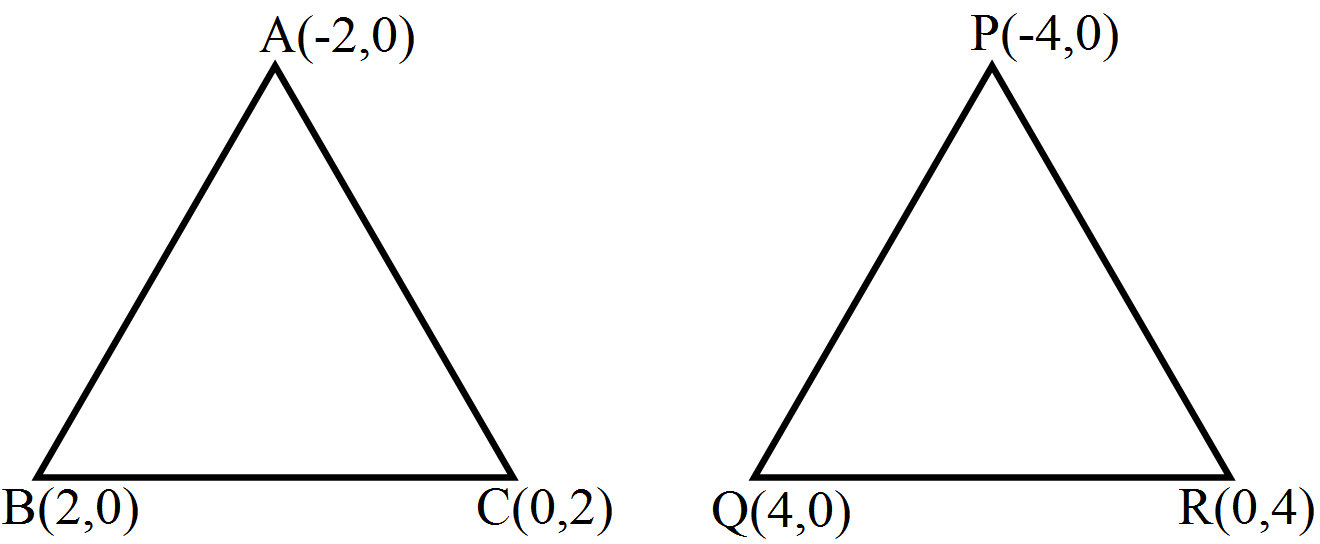
Using Distance formula
$\text{AB}=\sqrt{(\text{x}_2-\text{x}_1)^2+(\text{y}_2-\text{y}_1)^2}$
$=\sqrt{(2-2)^2+(0-0)^2}$
$=\sqrt{(4)^2}$
$=4\text{ units}$
$\text{AC}=\sqrt{(\text{x}_2-\text{x}_1)^2+(\text{y}_2-\text{y}_1)^2}$
$=\sqrt{(-2-2)^2+(-2-2)^2}$
$=\sqrt{(4)^2+(4)^2}$
$=\sqrt{16+16}=\sqrt{32}=4\sqrt{2}\text{ units}$
$\text{BC}=\sqrt{(2)^2+(2)^2}$
$=\sqrt{(2)^2+(2)^2}$
$=\sqrt{4+4}=\sqrt{8}=2\sqrt{2}\text{ units}$
$\text{PQ}=\sqrt{(-4-4)^2+(0-0)^2}$
$=\sqrt{(8)^2+(0)^2}$
$=\sqrt{64+0}=\sqrt{64}=8\text{ units}$
$\text{PR}=\sqrt{(-4+0)^2+(4-0)^2}$
$=\sqrt{(-4)^2+(4)^2}$
$=\sqrt{16+16}=\sqrt{32}=4\sqrt{2}\text{ units}$
$\text{QR}=\sqrt{(4-0)^2+(0-4)^2}$
$=\sqrt{16+16}=\sqrt{32}=4\sqrt{2}\text{ units}$
is per BPT.
i.e. $\frac{\text{AB}}{\text{PQ}}=\frac{\text{AC}}{\text{PR}}=\frac{\text{BC}}{\text{QR}}$
$=\frac{2\sqrt{2}}{4\sqrt{2}}=\frac{2\sqrt{2}}{4\sqrt{2}}=\frac{4}{8}=\frac{1}{2}$
$\frac{1}{2}=\frac{1}{2}$ View full question & answer→Question 695 Marks
Show taht the following points are collinear:A(8, 1), B(3, -4) and C(2, -5)
AnswerLet $A \left( x _1=8, y _1=1\right), B \left( x _2=3, y _2=-4\right)$ and $C \left( x _3=2, y _3=-5\right)$ be the given points.
Now
$x_1(y_2 - y_3) + x_2(y_3 - y_1) + x_3(y_1 - y_2)$
$= 8(-4 + 5) + 3(-5 - 1) + 2(1 + 4)$
$= 8 - 18 + 10$
$= 0$
Hence the given point are collinear.
View full question & answer→Question 705 Marks
The area of a triangle is 5 sq.units. Two of its vertices are (2,1) and (3, -2). If the third vertex is $\Big(\frac{7}{2},\text{y}\Big),$ find the value of y.
AnswerLet $A\left(x_1, y_1\right)=A(2,1), B\left(x_2, y_2\right)=B(3,-2)$ and $C\left(x_3, y_3\right)$ = $\text{C}\Big(\frac{7}{2},\text{y}\Big).$Now
$\text{Area}(\triangle\text{ABC})=\frac{1}{2}\big[\text{x}_1(\text{y}_2-\text{y}_3)+\text{x}_2(\text{y}_3-\text{y}_1)+\text{x}_3(\text{y}_1-\text{y}_2)\big]$
$\Rightarrow5=\frac{1}{2}\big[2(-2-\text{y})+3(\text{y}-1)+\frac{7}{2}(1+2)\big]$
$\Rightarrow10=\big[-4-2\text{y}+3\text{y}-3+\frac{21}{2}\big]$
$\Rightarrow10=\big[\text{y}+\frac{7}{2}\big]$
$\Rightarrow10=\text{y}+\frac{7}{2}$ or $-10=\text{y}+\frac{7}{2}$
$\Rightarrow\text{y}=\frac{13}{2}$ or $\text{y}=\frac{-27}{2}$
Hence, $\text{y}=\frac{13}{2}$ or $\frac{-27}{2}.$
View full question & answer→Question 715 Marks
If the point A(x, 2) is equidistance from the points B(8, -2) and C(2, -2), find the value of x. Also, find the length of AB.
AnswerIt is being given that A(x, 2) is equidistance from the points B(8, -2) and C(2, -2)
Thus, we have
$AB = AC$
$\Rightarrow AB^2 = AC^2$
$\Rightarrow (x - 8)^2 + (2 + 2)^2= (x - 2)^2 + (2 + 2)^2$
$\Rightarrow (x^2 + 64 - 16x) + (4)^2 = (x^2 + 4 - 4x) + (4)^2$
$\Rightarrow x^2 + 64 - 16x = x^2 + 4 - 4x$
$\Rightarrow 12x = 60$
$\Rightarrow x = 5$
$\therefore\text{AB}=\sqrt{(5-8)^2+(2+2)^2}=\sqrt{(-3)^2+(4)^2}$
$=\sqrt{9+16}=\sqrt{25}=5$
$\Rightarrow\text{AB}=5\text{ units}.$
View full question & answer→Question 725 Marks
The midpoint of the sides BC, CA and AB of a $\triangle\text{ABC}$ are D(3, 4), E(8, 9) and F(6, 7) respectively. Find the coordinates of the vertices of the triangle.
Answer
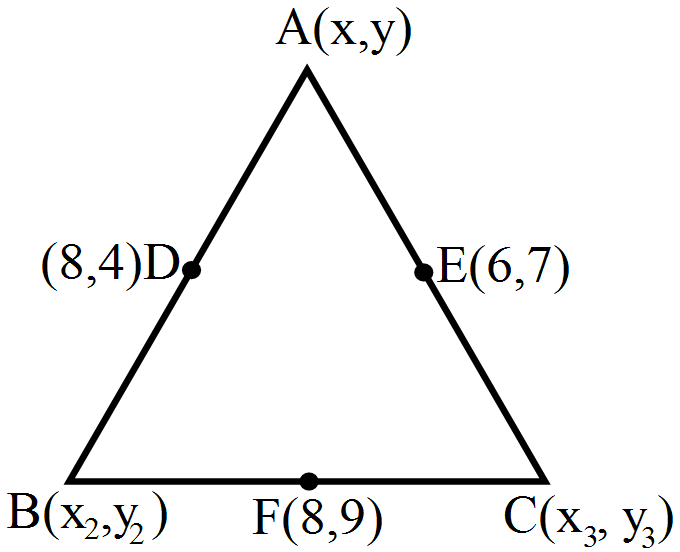
Let, $A \left( x _1, y _1\right), B \left( x _2, y _2\right), C \left( x _3, y _3\right)$ be the vertices of given $\triangle ABC$.
So, $D$ is the mid-point of $A B$.
$\frac{x_1+x_2}{2}=3 \text { or } \frac{y_1+y_2}{2}=4$
$x_1+x_2=6 \ldots \text { (i) or } y_1+y_2=8$
$\therefore F$ is the mid-point of $B C$
$\frac{x_2+x_3}{2}=8 \text { or } \frac{y_2+y_3}{2}=9$
$x_2+x_3=16 \ldots \text { (iii) or } y_2+y_3=18$
$E$ is the mid-point of $A C$
$\frac{x_1+x_3}{2}=6 \text { or } \frac{y_1+y_3}{2}=7$
$x_1+x_3=12 \ldots(v) \text { or } y_1+y_3=14$
Adding equation (i) + (iii) + (v)
$x_2+x_3+x_1+x_2+x_1++x_3=34$
$2\left(x_1+x_2+x_3\right)=34$
$x_1+x_2+x_3=17$
Using (i), (iii) and (v) with (vii) we get:
$x_1=1, x_2=5, x_3=11 \ldots(v i i)$
Adding equation (ii) + (iv) + (vi)
$2\left(y_1+y_2+y_3\right)=40$
$y_1+y_2+y_3=20 \ldots$
Using 0 , (iv), (vi) with (viii)
$y_1=12, y_2=2, y_3=8$
Hence, the vertices of $\triangle ABC A(11,12), B (1,2), C (5,8)$. View full question & answer→Question 735 Marks
If the points A(4, 3) and B(x, 5) lie on a circle with the center O(2, 3), find the value of x.Hint: $OA^2 = OB^2.$
AnswerIt is being given that A(4, 3) and B(x, 5) lie on a circle with centre O(2, 3).
$\Rightarrow OA = OB$
$\Rightarrow OA^2 = OB^2$
$\Rightarrow (2 - 4)^2 + (3 - 3)^2 = (2 - x)^2 + (3 - 5)^2$
$\Rightarrow (-2)^2 + 0 = (2 - x)^2 + (-2)^2$
$\Rightarrow 4 = (2 - x)^2 + 4$
$\Rightarrow (2 - x)^2 = 0$
$\Rightarrow 2 - x = 0$
$\Rightarrow x = 2$
View full question & answer→Question 745 Marks
Points A(-1, y) and B(5, 7) lie on a circle with centre O(2, -3y). Find the values of y.
AnswerThe given points are A(-1, y), B(5, 7) and O(2, -3y).
Here, AO and BO are the radii of the circle. So
$AO = BO$
$\Rightarrow AO^2 = BO^2$
$\Rightarrow (2 + 1)^2 + (-3y - y)^2 = (2 - 5)^2 + (-3y - 7)^2$
$\Rightarrow 9 + (4y)^2 = (-3)^2 + (3y + 7)^2$
$\Rightarrow 9 + 16y^2 = 9 + 9y^2 + 49 + 42y$
$\Rightarrow 7y^2 - 42y - 49 = 0$
$\Rightarrow y^2 - 6y -4 = 0$
$\Rightarrow y^2 - 7y + y = 0$
$\Rightarrow y(y - 7) + 1(y - 7) = 0$
$\Rightarrow (y - 7)(y + 1) = 0$
$\Rightarrow y = -1 or y = 7$
Hence, y = 7 or y - -1
View full question & answer→Question 755 Marks
Find the area of quadrilateral ABCD whose vertices are A(-3, -1), B(-2, -4), C(4, -1) and D(3, 4).
AnswerBy joining P and R, We get triangle PQR and PRS.
Let
$A \left( x _1, y _1\right)= A (-3,-1), B \left( x _2, y _2\right)= B (-2,-4), C \left( x _3, y _3\right)= C (4,-1)$ and $D \left( x _4, y _4\right)= S (3)$.
Then
Area of $\triangle\text{ABC}=\frac{1}{2}[\text{x}_1(\text{y}_2-\text{y}_3)+\text{x}_2(\text{y}_3-\text{y}_1)+\text{x}_3(\text{y}_1-\text{y}_2)]$
$=\frac{1}{2}[(-3)(-4+1)-2(-1+1)+4(-1+4)]$
$=\frac{1}{2}[9-0+12]$
$=\frac{21}{2}\ \text{sq.units}$
Area of $\triangle\text{ACD}=\frac{1}{2}[\text{x}_1(\text{y}_3-\text{y}_4)+\text{x}_3(\text{y}_4-\text{y}_1)+\text{x}_4(\text{y}_1-\text{y}_3)]$
$=\frac{1}{2}[-3(-1-4)+4(4+1)+3(-1+1)]$
$=\frac{1}{2}[15+20+0]$
$=\frac{35}{2}\ \text{sq}.\text{units}$
So, the area of the quadrilateral is $=\frac{21}{2}+\frac{35}{2}=28\ \text{sq}.\text{units}$
View full question & answer→Question 765 Marks
Find the point on x-axis which is equidistant from points A(-1, 0) and B(5, 0).
AnswerLet P(x, 0) be the point on x-axis. Then
$AP = BP$
$\Rightarrow AP^2 = BP^2$
$\Rightarrow (x + 1)^2 + (0 - 0)^2 = (x - 5)^2 + (0 - 0)^2$
$\Rightarrow x^2 + 2x + 1 = x^2 - 10x + 25$
$\Rightarrow 12x = 24$
$\Rightarrow x = 2$
Hence, x = 2.
View full question & answer→Question 775 Marks
If the point C(-2, 3) is equidistant from the points A(3, -1) and B(x , 8),
find the values of x. Also find the distance BC.
AnswerIt is being given that C(-2, 3) is equidustant from the points A(3, -1) and B(x, 8).
Thus, we have
$AC = BC$
$\Rightarrow AC^2 = BC^2$
$\Rightarrow (3 + 2)^2 + (-1 - 3)^2 = (x + 2)^2 + (8 - 3)^2$
$\Rightarrow (5)^2 + (-4)^2 = (x^2 + 4 + 4x) + (5)^2$
$\Rightarrow 16 = x^2 + 4 + 4x$
$\Rightarrow x^2 + 4x - 12 = 0$
$\Rightarrow x^2 + 6x - 2x - 12 = 0$
$\Rightarrow x(x + 6) - 2(x + 6) = 0$
$\Rightarrow (x + 6)(x - 2) = 0$
$\Rightarrow x + 6 = 0 or x - 2 = 0$
$\Rightarrow x = -6 or x = 2$
When x = -6
$\text{BC}=\sqrt{(-6+2)^2+(8-3)^2}$
$=\sqrt{(-4)^2+(5)^2}$
$=\sqrt{16+25}=\sqrt{41}$
$\text{BC}=\sqrt{41}\text{units}$
When x = 2
$\text{BC}=\sqrt{(2+2)^2+(8-3)^2}$
$=\sqrt{(4)^2+(5)^2}$
$=\sqrt{16+25}=\sqrt{41}$
$\Rightarrow\text{BC}=\sqrt{41}\text{units}$
View full question & answer→Question 785 Marks
Find the area of quadrilateral ABCD whose vertices are A(3, -1), B(9, -5), C(14, 0) and D(9, 19)
AnswerBy joining A and C, we get two triangles ABC and ACD.
Let
$A \left( x _1, y _1\right)= A (3,-1), B \left( x _2, y _2\right)= B (9,-5), C \left( x _3, y _3\right)= C (14,0)$ and $D \left( x _4, y _4\right)= D (9,19)$.
Then
Area of $\triangle\text{ABC}$
$=\frac{1}{2}[\text{x}_1(\text{y}_2-\text{y}_3)+\text{x}_2(\text{y}_3-\text{y}_1)+\text{x}_3(\text{y}_1-\text{y}_2)]$
$=\frac{1}{2}[3(-5-0)+9(0+1)+14(-1+5)]$
$=\frac{1}{2}[-15+9+56]$
$=25\ \text{sq.units}$
Area of $\triangle\text{ACD}$
$=\frac{1}{2}[\text{x}_1(\text{y}_3-\text{y}_4)+\text{x}_3(\text{y}_4-\text{y}_1)+\text{x}_4(\text{y}_1-\text{y}_3)]$
$=\frac{1}{2}[3(0-19)+14(19+1)+9(-1-0)]$
$=\frac{1}{2}[-57+280-9]$
$=107\ \text{sq}.\text{units}$
So, the area of the quadrilateral is 25 + 107 = 132 sq.units.
View full question & answer→Question 795 Marks
Find the coordinate of the point which divides the join of A(-5, 11) and B(4, -7) in the ratio 7 : 2.
AnswerThe point of AB are A(-5, 11) and B(4, -7)
$\therefore$ $(x_1 = -5, y_1 = 11)$ and $(x_2 = 4, y_2 = -7)$
Also m = 7 and n = 2
Let the required point be R(x, y)

$\Rightarrow\text{x}=\frac{(\text{mx}_2+\text{nx}_1)}{(\text{m+n})},\text{y}=\frac{(\text{my}_2+\text{ny}_1)}{(\text{m+n})}$
$\Rightarrow\text{x}=\frac{[7\times4+2\times(-5)]}{(7+2)},\text{y}=\frac{[(7\times(-7)+2\times11)]}{(7+2)}$
$\Rightarrow\text{x}=\frac{28-10}{9}=\frac{18}{9}=2,\text{y}=\frac{(-49+22)}{9}=\frac{-27}{9}=3$
Hence the required point is (2, -3) View full question & answer→Question 805 Marks
If the distances of P(x, y) from A(5, 1) and B(-1, 5) are equal then prove that 3x = 2y.
AnswerP(x , y)
A(5, 1)
B(-1, 5)
Given PA = PB
$PA^2 = PB^2$
$(x - 5)^2 + (y - 1)^2= (x + 1)^2 + (y - 5)^2$
$x^2 + y^2 - 10x - 2y + 26 = x^2+ y^2 + 2x - 10y + 26$
$12x = 8y$
$3x = 2y$
Hence proved
View full question & answer→Question 815 Marks
Find the lengths of the medians of a $\triangle\text{ABC}$ whose vertices are A(0, -1), B(2, 1) and B(2, 1) and C(0, 3).
AnswerLet D, E, F be the mid-point of side BC, CA and AB respectively in $\triangle\text{ABC}.$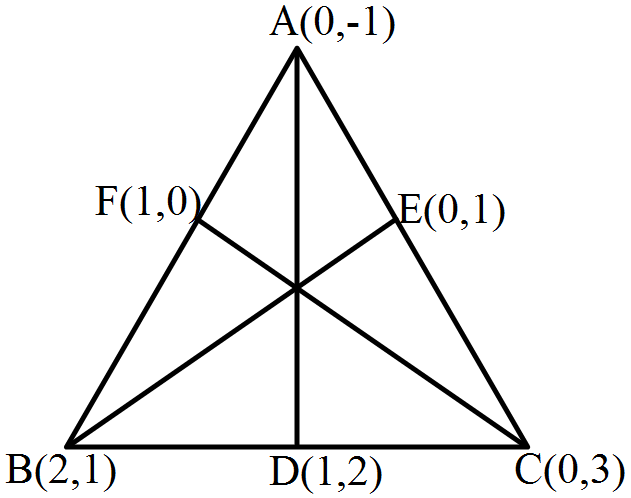
Then, by the mid-point formula, we have $\text{D}\Big(\frac{2+0}{2},\frac{1+3}{2}\Big),\text{E}\Big(\frac{0+0}{2},\frac{3-1}{2}\Big),\text{F}\Big(\frac{0+2}{2},\frac{-1+1}{2}\Big)$ i.e, D(1, 2), E(0, 1), F(1, 0) Hence the lengths of medians AD, BE and CF are given by $\text{AD}=\sqrt{(1-0)^2+(2+1)^2}$ $=\sqrt{1+9}=\sqrt{10}\text{ units}$ $\text{BE}=\sqrt{(0-2)^2+(1-1)^2}$ $=\sqrt{4+0}=\sqrt{4}=2\text{ units}$ $\text{CF}=\sqrt{(1-0)^2+(0-3)^2}$ $=\sqrt{1+9}=\sqrt{10}\text{ units}$ Hence, $\text{AD}=\sqrt{10},\text{BE}=2,\text{CF}=\sqrt{10}$ View full question & answer→Question 825 Marks
If A(5, 2), B(2, -2) and C(-2, t) are vertices of a right triangle with $\angle\text{B}=90^\circ$ then find the value of t.
AnswerGiven: A(5, 2), B(2, -2) and C(-2, t) are the vertices of a right triangle with $\angle\text{B}=90^\circ.$
$\Rightarrow AB^2 + BC^2= AC^2$
we have
$AB^2 = (2 - 5)^2 + (-2 - 2)^2 = (-3)^2 + (-4)^2 = 9 + 16 = 25$
$BC^2 = (-2 - 2)^2 + (t + 2)^2 = (-4)^2+ (t^2 + 4 + 4t) = 16 + t^2 + 4 + 4t = t^2 + 4t + 20$
$AC^2 = (-2 - 5)^2 + (t - 2)^2 = (-7)^2 + (t^2 + 4 - 4t) = 49 + t^2 + 4 - 4t = t^2 - 4t + 53$
Now,
$25 + t^2 + 4t + 20 = t^2- 4t + 53$
$\Rightarrow t^2 + 4t + 45 = t^2 - 4t + 53$
$\Rightarrow 8t = 8$
$\Rightarrow t = 1$
View full question & answer→Question 835 Marks
Prove that the diagonals of a rectangle ABCD with vertices A(2, -1), B(5, -1), C(5, 6) and D(2, 6) are equal and bisect each other.
AnswerThe vertices of the rectangle ABCD are A(2, -1), B(5, -1), C(5, 6) and D(2, 6). Now
Coordinates of mid-point of AC $=\Big(\frac{2+5}{2},\frac{-1+6}{2}\Big)=\Big(\frac{7}{2},\frac{5}{2}\Big)$
Coordinates of mid-point of BD $=\Big(\frac{5+2}{2},\frac{-1+6}{2}\Big)=\Big(\frac{7}{2},\frac{5}{2}\Big)$
Since, the mid-points of AC and BD coincide, therefore the diagonals of rectangle ABCD bisect each other.
View full question & answer→Question 845 Marks
In what ratio does the line x - y - 2 = 0 divide the line segment joining the points A(3, -1) and B(8, 9)
AnswerLet the line segment joining A(3, -1) and B(8, 9) is divided by x - y - 2 = 0 in ratio k : 1 at p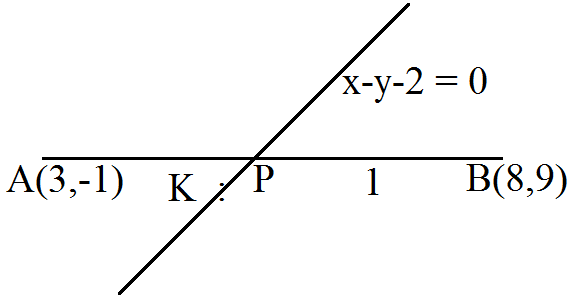
$\therefore$ Coordinates of P are $\Big(\frac{\text{k}\times8+1\times3}{\text{k}+1},\frac{\text{k}\times9+1\times(-1)}{\text{k}+1}\Big)$ Or $\Big(\frac{8\text{k}+3}{\text{k}+1},\frac{9\text{k}-1}{\text{k}+1}\Big)$ p lies on the line x - y - 2 = 0 $\therefore\frac{8\text{k}+3}{\text{k}+1},\frac{9\text{k}-1}{\text{k}+1}-2=0$ Multiplying by k + 1. $(8\text{k}+3)-(9\text{k}-1)-2(\text{k}+1)=0$ $\Rightarrow\ 8\text{k}-9\text{k}+3+1-2\text{k}-2=0$ $\Rightarrow-3\text{k}+2=0\ \therefore\text{k}=\frac{2}{3}$ Thus the line x - y - 2 = 0 divides AB in the ratio 2 : 3. View full question & answer→Question 855 Marks
For what value of x are the points A(-3, 12), B(7, 6) and C(x, 9) colinear?
AnswerLet $A(-3,12)=B(7,6)$ and $C(x, 9)$ are the given points. then, $\left(x_1=-3, y_1=12\right),\left(x_2=7, y_2=6\right)$ and $\left(x_3=x, y_3=9\right)$ It is given that the points $A , B$ and C are collinear. therefore,
$x_1(y_2 - y_3) + x_2(y_3 - y_1) + x_3(y_1 - y_2) = 0$
$\Rightarrow (-3)(6 - 9) + 7(-3) + x(6) = 0$
$\Rightarrow 9 - 21 + 6x = 0$
$\Rightarrow 6x - 12 = 0$
⇒ 6x = 12 $\Rightarrow\text{x}=\frac{12}{6}=2$
Therefore, when x = 2, the given points are collinear.
View full question & answer→Question 865 Marks
If the points P(-3, 9), Q(a, b) and R(4, -5) are collinear and a + b = 1, find the values of a and b.
AnswerLet $A \left( x _1=-3, y _1=9\right), B\left(x_2=a, y_2=b\right)$ and $\left(x_3=4, y_3=-5\right)$ be the given points.
The given that the point are collinear if,
$x_1(y_2 - y_3) + x_2(y_3 - y_1) + x_3(y_1 - y_2) = 0$
$\Rightarrow (-3)(b + 5) + a(-5 - 9) + 4(9 - b) = 0$
$\Rightarrow -3b - 15 -14a + 36 - 4b = 0$
$\Rightarrow 2a + b = 3$
Now, solving a + b = 1 and 2a + b = 3, We get a = 2 and b = -1.
Hence, a = 2 and b = -1.
View full question & answer→Question 875 Marks
Prove that the points A(a, 0), B(0, b) and C(1, 1) are collinear, if $\frac{1}{\text{a}{}}+\frac{1}{\text{b}}=1.$
AnswerConsider the point A(a, 0), B(0, b), and C(1, 1)
Here, $\left(x_1=x, y_1=y\right), B\left(x_2=-5, y_2=7\right)$ and $\left(x_3=-4, y_3=5\right)$ be the given points.
it is given that the point are collinear so,
$x_1(y_2 - y_3) + x_2(y_3 - y_1) + x_3(y_1 - y_2) = 0$
$\Rightarrow a(b - 1) + 0(1 - 0) + 1(0 - b) = 0$
$\Rightarrow ab - a - b = 0$
Dividing the equation by ab:
$\Rightarrow1-\frac{1}{\text{b}}-\frac{1}{\text{a}}=0$
$\Rightarrow1-\Big(\frac{1}{\text{a}}+\frac{1}{\text{b}}\Big)=0$
$\Rightarrow\Big(\frac{1}{\text{a}}+\frac{1}{\text{b}}\Big)=1$
Therefore, the given point are collinear if $\Big(\frac{1}{\text{a}}+\frac{1}{\text{b}}\Big)=1.$
View full question & answer→Question 885 Marks
Using the distance formula, show taht the given points are collinear:
(-1, -1), (2, 3) and (8, 11)
AnswerLet A(-1, -1), B(2, 3) and C(8, 11) be the given points
Then,
$\text{AB}=\sqrt{(2-1)^2+(3+1)^2}=\sqrt{(3)^2+(4)^2}$
$=\sqrt{9+16}=\sqrt{25}=5\text{ units}$
$\text{BC}=\sqrt{(8-2)^2+(11-3)^2}=\sqrt{(6)^2+(8)^2}$
$=\sqrt{36+64}=\sqrt{100}=10\text{ units}$
$\text{AC}=\sqrt{(8+1)^2+(11+1)^2}=\sqrt{(9)^2+(12)^2}$
$=\sqrt{81+144}=\sqrt{225}=15\text{ units}$
$\therefore\text{AB}+\text{AC}=5+10=15\text{ units}=\text{BC}$
$\Rightarrow\text{AB}+\text{AC}=\text{BC}$
Hence, the given points are collinear.
View full question & answer→Question 895 Marks
If the point P(2, 2) is equidistant from the points A(-2, k) and B(-2k , -3),
find k. Also, find the length of AP.
AnswerIt is being given that P(2, 2) is equidustant from the points A(-2, k) and B(-2k, -3).
Thus, we have
AP = BP
$\Rightarrow AP^2 = BP^2$
$\Rightarrow (-2 - 2)^2 + (k - 2)^2 = (-2k - 2)^2 + (-3 - 2)^2$
$\Rightarrow (-4)^2 + (k^2 + 4 - 4k) = (4k^2 + 4 + 8k) + (-5)^2$
$\Rightarrow 16 + k^2 + 4 - 4k = 4k^2 + 4 + 8k + 25$
$\Rightarrow k^2 - 4k + 20 = 4k^2 + 8k + 29$
$\Rightarrow 3k^2 + 12k + 9 = 0$
$\Rightarrow 3k^2 + 3k + 9k + 9 = 0$
$\Rightarrow 3k(k + 1) + 9(k + 1) = 0$
$\Rightarrow (k + 1)(3k + 9) = 0$
$\Rightarrow k + 1 = 0 or 3k + 9 = 0$
$\Rightarrow k = -1 or k = -3$
When, k = -1
$\text{AP}=\sqrt{(-2-2)^2+(-1-2)^2}$
$=\sqrt{(-4)^2+(-3)^2}$
$=\sqrt{16+9}$
$=\sqrt{25}=5$
$\Rightarrow\text{AP}=5\text{ units}$
When, k = -3
$\text{AP}=\sqrt{(-2-2)^2+(-3-2)^2}$
$=\sqrt{(-4)^2+(-5)^2}$
$=\sqrt{16+25}$
$=\sqrt{41}$
$\Rightarrow\text{AP}=\sqrt{41}\text{units}$
View full question & answer→Question 905 Marks
A(6, 1), B(8, 2) and C(9, 4) are the vertices of a parallelogram ABCD. If E is the midpoint of DC, find the area of $\triangle\text{ADE}.$
AnswerLet (x, y) be the coordinats of D and (x', y') be the coordinates of E. since, the diagonals of a parallelogram bisect each other of the same point, therefore $\frac{\text{x}+8}{2}=\frac{6+9}{2}=\text{x}=7$ $\frac{\text{y}+2}{2}=\frac{1+4}{2}=\text{y}=3$ Thus, the coordinates of D are (7, 3). E is the midpoint of DC, therefore $\text{x}'=\frac{7+9}{2}=\text{x}'=8$ $\text{y}'=\frac{3+4}{2}=\text{y}'=\frac{7}{2}$ Thus, the coordinats of E are $\Big(8,\frac{7}{2}\Big).$Let $A(x_1, y_1) = A(6, 1), E(x_2, y_2) =$ E$\Big(8,\frac{7}{2}\Big).$ and $D(x_3, x_4) = D(7, 3).$
Now,
$\text{ar}(\triangle\text{ABC})=\frac{1}{2}[\text{x}_1(\text{y}_2-\text{y}_3)+\text{x}_2(\text{y}_3-\text{y}_1)+\text{x}_3(\text{y}_1-\text{y}_2)]$ $=\frac{1}{2}\Big[6\Big(\frac{7}{2}-3\Big)+8(3-1)+7\Big(1-\frac{7}{2}\Big)\Big]$ $=\frac{1}{2}\big[\frac{3}{2}\big]$ $=\frac{3}{4}\text{sq. units}$ Hence, the area of the triangle $\triangle\text{ADE}$ is $\frac{3}{4}$sq. units.
View full question & answer→Question 915 Marks
Find the distance between of the following points from the origin:
C(-4, -6)
AnswerThe gven point is A(-4, -6) and let O(0, 0) be the origin
Then, $\text{CO}=\sqrt{(-4-0)^2+(-6-0)^2}$
$=\sqrt{(-4)^2+(-6)^2}$
$=\sqrt{16+36}$
$=\sqrt{52}=2\sqrt{13}\text{ units}.$
View full question & answer→Question 925 Marks
For what values of k are points A(8, 1), B(3, -2k) and C(k, -5) collinear.
AnswerLet $A \left( x _1=8, y _1=1\right), B \left( x _2=3, y _2=-2 k \right)$ and $\left( x _3= k , y _3=-5\right)$ be the given points. The given point are collinear if
$x_1(y_2 - y_3) + x_2(y_3 - y_1) + x_3(y_1 - y_2) = 0$
$\Rightarrow 8(-2k + 5) + 3(-5 - 1) + k(1 + 2k) = 0$
$\Rightarrow -16k + 40 - 18 + k + 2k^2 = 0$
$\Rightarrow 2k^2 - 11k - 4k + 22 = 0$
$\Rightarrow k(2k - 11) -2(2k - 11) = 0$
$\Rightarrow (k - 2)(2k - 11) = 0$
⇒ k = 2 or $\text{k}=\frac{11}{2}$
Hence, k = 2 or $\text{k}=\frac{11}{2}$
View full question & answer→Question 935 Marks
If $a \neq b \neq c$, prove that $\left(a, a^2\right),\left(b . b^2\right),(0,0)$ will not be collinear.
View full question & answer→Question 945 Marks
Find points on the x-axis, each of which is at a distance of 10 units from the point A(11, -8).
AnswerLet A(11, -8) be the given point and let P(x, 0) be the required point on x-axis
Then,
PA = 10 units
$\Rightarrow PA^2 = 100$
$\Rightarrow (x - 11)^2 + (0 + 8)^2 = 100$
$\Rightarrow x^2 + 121 - 22x + 64 = 100$
$\Rightarrow x^2- 22x + 185 - 100 = 0$
$\Rightarrow x^2 - 22x + 85 = 0$
$\Rightarrow x^2 - 17x - 5x + 85 = 0$
$\Rightarrow x(x - 17) - 5(x - 17) = 0$
$\Rightarrow (x - 17)(x - 5) = 0$
$\Rightarrow x = 17 or x = 5$
Hence, the required points are (17, 0) and (5, 0).
View full question & answer→