MCQ 11 Mark
Directions : In the following questions, a statement of assertion $(A)$ is followed by a statement of reason $(R)$. Mark the correct choice as:
Assertion : In the given figures, $\triangle\text{ABC} \sim \triangle\text {GHI}.$
Reason : If the corresponding sides of two triangles are proportional, then they are similar.
- ✓
Both assertion $(A)$ and reason $(R)$ are true and reason $(R)$ is the correct explanation of assertion $(A)$.
- B
Both assertion $(A)$ and reason $(R)$ are true but reason $(R)$ is not the correct explanation of assertion $(A)$.
- C
Assertion $(A)$ is true but reason $(R)$ is false.
- D
Assertion $(A)$ is false but reason $(R)$ is true.
AnswerCorrect option: A. Both assertion $(A)$ and reason $(R)$ are true and reason $(R)$ is the correct explanation of assertion $(A)$.
View full question & answer→MCQ 21 Mark
DIRECTION : In the following questions, a statement of assertion $(A)$ is followed by a statement of reason $(R)$. Mark the correct choice as:
Assertion : If a line intersects sides $AB$ and $AC$ of a $ \triangle \ \text{ABC}$ at $D$ and $E$ respectively and is parallel to $BC,$ then $\frac{\text{AD}}{\text{AB}}=\frac{\text{AE}}{\text{AC}}$
Reason : If a line is parallel to one side of a triangle then it divides the other two sides in the same ratio.
- ✓
Both assertion $(A)$ and reason $(R)$ are true and reason $(R)$ isthe correct explanation of assertion $(A)$.
- B
Both assertion $(A)$ and reason $(R)$ are true but reason $(R)$ is not the correct explanation of assertion $(A)$.
- C
Assertion $(A)$ is true but reason $(R)$ is false.
- D
Assertion $(A)$ is false but reason $(R)$ is true
AnswerCorrect option: A. Both assertion $(A)$ and reason $(R)$ are true and reason $(R)$ isthe correct explanation of assertion $(A)$.
We know that If a line is parallel to one side of a triangle then,
it divides the $A$ other two sides in the same ratio.
This is Basic Proportionality theorem.
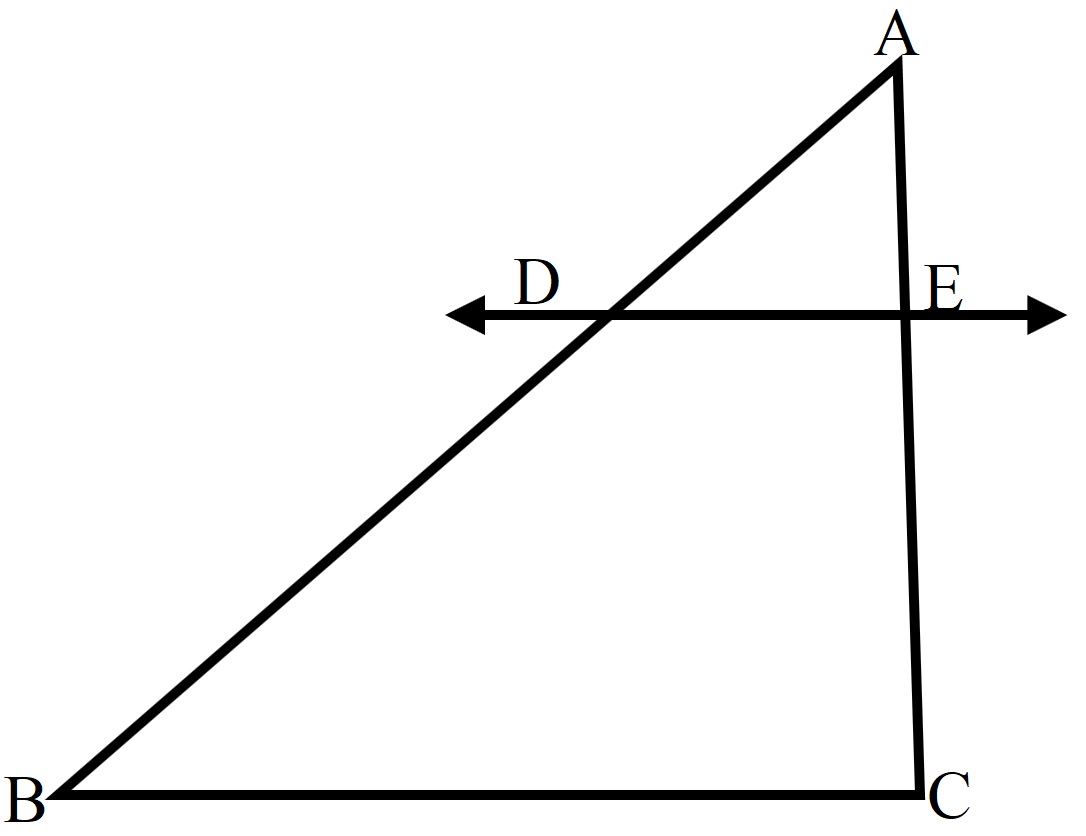
By Basic Proportionality theorem,
we have $\frac{\text{AD}}{\text{AB}}=\frac{\text{AE}}{\text{AC}}$
$=\frac{\text{DB}}{\text{AD}}=\frac{\text{EC}}{\text{AE}}$
$=\frac{\text{DB}}{\text{AD}}+1=\frac{\text{EC}}{\text{AE}}+1'$
$ =\frac{\text{DB+AD}}{\text{AD}} =\frac{\text{EC+AE}}{\text{AE}}$
$ =\frac{\text{AB}}{\text{AD}} =\frac{\text{AC}}{\text{AE}}$
$ =\frac{\text{AD}}{\text{AB}} =\frac{\text{AE}}{\text{AC}}$
So, Assertion is correct.$(A)$ View full question & answer→MCQ 31 Mark
Directions : In the following questions, a statement of assertion $(A)$ is followed by a statement of reason $(R)$. Mark the correct choice as:
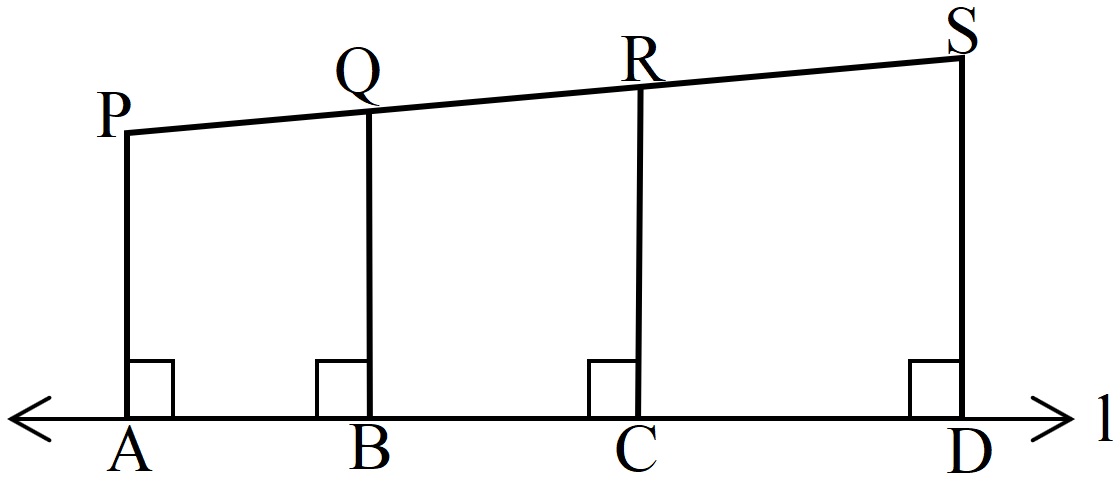
Assertion : In the given figure $, PA \| QB \| RC \| SD.$
Reason : If three or more line segments are perpendiculars to one line, then they are parallel to each other.
Reason $(R)$ : If three or more line segments are perpendiculars to one line, then they are parallel to each other.
- ✓
Both assertion $(A)$ and reason $(R)$ are true and reason $(R)$ is the correct explanation of assertion $(A)$.
- B
Both assertion $(A)$ and reason $(R)$ are true but reason $(R)$ is not the correct explanation of assertion $(A)$.
- C
Assertion $(A)$ is true but reason $(R)$ is false.
- D
Assertion $(A)$ is false but reason $(R)$ is true.
AnswerCorrect option: A. Both assertion $(A)$ and reason $(R)$ are true and reason $(R)$ is the correct explanation of assertion $(A)$.
View full question & answer→MCQ 41 Mark
$\text{DIRECTION:}$ In the following questions, a statement of assertion $(A)$ is followed by a statement of reason $(R).$ Mark the correct choice as:
Assertion: $A B C$ is an isosceles triangle with $A C=B C$. If $A B^2=2 A C^2$ then triangleltext $\{A B C\} $ is a right triangle.
Reason: If in atriangle, square of one side is equal to the sum of the squares of the other two sides, then the angle opposite the first side is a right angle.
- ✓
Both assertion $(A)$ and reason $(R)$ are true and reason $(R)$ is the correct explanation of assertion $(A)$.
- B
Both assertion $(A)$ and reason $(R)$ are true but reason $(R)$ is not the correct explanation of assertion $(A)$.
- C
Assertion $(A)$ is true but reason $(R)$ is false.
- D
Assertion $(A)$ is false but reason $(R)$ is true.
AnswerCorrect option: A. Both assertion $(A)$ and reason $(R)$ are true and reason $(R)$ is the correct explanation of assertion $(A)$.
We know that If in a triangle,
square of one side is equal to the sum of the squares of the other two sides,
then the angle opposite the first side is a right angle.
This is converse of Pythagoras theorem.
View full question & answer→MCQ 51 Mark
Direction : In the following questions, a statement of assertion $(A)$ is followed by a statement of reason $(R)$. Mark the correct choice as:
Assertion : $D$ and $E$ are points on the sides $AB $ and $AC$ respectively of a $\triangle\text{ABC}$ such that $AD = 5.7\ cm, DB = 9.5\ cm, AE = 4.8\ cm$ and $EC = 8\ cm$ then $DE$ isnot parallel to $BC.$
Reason : If a line divides any two sides of a triangle in the same ratio then it is parallel to the third side.
- A
Both assertion $(A)$ and reason $(R)$ are true and reason $(R)$ isthe correct explanation of assertion $(A)$.
- B
Both assertion $(A)$ and reason $(R)$ are true but reason $(R)$ is not the correct explanation of assertion $(A)$.
- C
Assertion $(A)$ is true but reason $(R)$ is false.
- ✓
Assertion $(A)$ is false but reason $(R)$ is true.
AnswerCorrect option: D. Assertion $(A)$ is false but reason $(R)$ is true.
If a line divides any two sides of a triangle in the same ratio then it is parallel to the third side.
This is Converse of Basic Proportionality theorem.
So, Reason is correct.
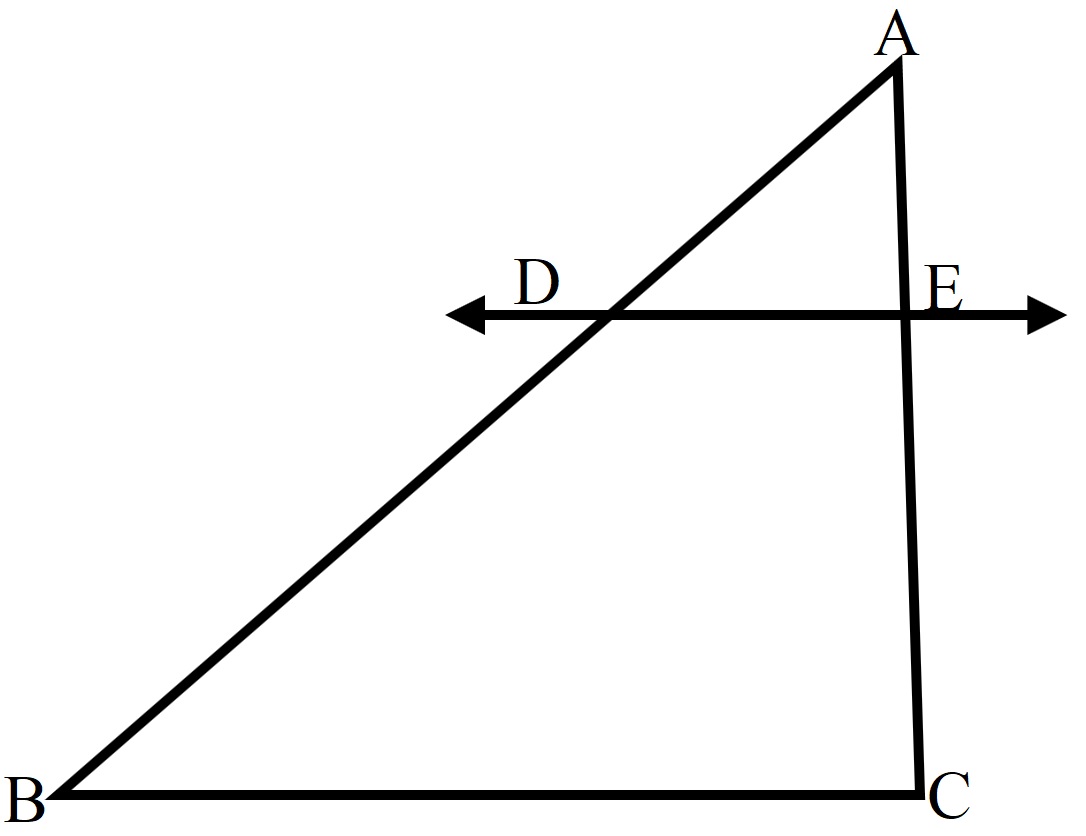
Now, $ \frac{\text{AD}}{\text{DB}}=\frac{5.7}{9.5}=\frac{57}{95}=\frac{3}{5}$
and $ \frac{\text{AE}}{\text{EC}}=\frac{4.8}{8}=\frac{48}{8}=\frac{3}{5}$
$\Rightarrow\frac{\text{AD}}{\text{DB}}=\frac{\text{AE}}{\text{EC}}$
By Converse of Basic Proportionality theorem, $DE \| BC$
So, Assertion is not correct. View full question & answer→MCQ 61 Mark
DIRECTION: In the following questions, a statement of assertion $(A)$ is followed by a statement of reason $(R).$ Mark the correct choice as:
Assertion: D and E are points on the sides AB and AC respectively of a $ \triangle\text{ABC}$ such that $DE \|$ BCthen the value of $x$ is $4$, when $AD = x \ cm, DB = (x - 2) \ cm, AE = (x + 2) \ cm $ and $EC = (x - 1) \ cm.$
Reason: If a line is parallel to one side of a triangle then it divides the other two sides in the same ratio.
- ✓
Both assertion $(A)$ and reason $(R)$ are true and reason $(R)$ is the correct explanation of assertion $(A)$.
- B
Both assertion $(A)$ and reason $(R)$ are true but reason $(R)$ is not the correct explanation of assertion $(A)$.
- C
Assertion $(A)$ is true but reason $(R)$ is false.
- D
Assertion $(A)$ is false but reason $(R)$ is true.
AnswerCorrect option: A. Both assertion $(A)$ and reason $(R)$ are true and reason $(R)$ is the correct explanation of assertion $(A)$.
By Basic Proportionality theorem, we have $\frac{\text{AD}}{\text{DB}}=\frac{\text{AE}}{\text{EC}}$
$ \Rightarrow\frac{\text{x}}{\text{x}-2}=\frac{\text{x}+2}{\text{x}-1}$
$\Rightarrow x(x - 1) = (x - 2)(x + 2)$
$\Rightarrow x^2 - x = x^2 - 4$
$\Rightarrow x = 4\ cm$
So, Assertion is correct
View full question & answer→MCQ 71 Mark
DIRECTION: In the following questions, a statement of assertion $(A)$ is followed by a statement of reason $(R)$. Mark the correct choice as:
Assertion: $\triangle\text{ABC} \sim \triangle\text{DEF}$ such that ar $(\triangle\text{ABC})$ = $36cm^2$? and ar$\triangle\text{DEF}$= $49cm^2$?. Then, the ratio of their corresponding sides is $6:7$
Reason: The ratio of the areas of two similar triangles is equal to the square of the ratio of their corresponding sides.
- ✓
Both assertion $(A)$ and reason $(R)$ are true and reason $(R)$ is the correct explanation of assertion $(A)$.
- B
Both assertion $(A)$ and reason $(R)$ are true but reason $(R)$ is not the correct explanation of assertion $(A)$.
- C
Assertion $(A)$ is true but reason $(R)$ is false.
- D
Assertion $(A)$ is false but reason $(R)$ is true.
AnswerCorrect option: A. Both assertion $(A)$ and reason $(R)$ are true and reason $(R)$ is the correct explanation of assertion $(A)$.
$=\frac{\text{ar}(\triangle\text{ABC})}{\text{ar}(\triangle DEF)}$
$ =\frac{\text{AB}^2}{\text{DE}^2}$
$=\frac{\text{36}}{\text{49}} =\frac{\text{AB}^2}{\text{DE}^2}$
$ =\frac{\text{AB}}{\text{DE}}=\frac{6}{7}$
So, Assertion is correct
View full question & answer→MCQ 81 Mark
Directions : In the following questions, a statement of assertion $(A)$ is followed by a statement of reason $(R).$ Mark the correct choice as:
Assertion : In the $\triangle \text{ABC}, AB = 24\ cm, BC = 10\ cm$ and $AC = 26\ cm,$ then $\triangle \text{ABC},$ is a right angle triangle.
Reason : If in two triangles, their corresponding angles are equal, then the triangles are similar.
- A
Both assertion $(A)$ and reason $(R)$ are true and reason $(R)$ is the correct explanation of assertion $(A)$.
- ✓
Both assertion $(A)$ and reason $(R)$ are true but reason $(R)$ is not the correct explanation of assertion $(A)$.
- C
Assertion $(A)$ is true but reason $(R)$ is false.
- D
Assertion $(A)$ is false but reason $(R)$ is true.
AnswerCorrect option: B. Both assertion $(A)$ and reason $(R)$ are true but reason $(R)$ is not the correct explanation of assertion $(A)$.
View full question & answer→MCQ 91 Mark
DIRECTION: In the following questions, a statement of assertion $(A)$ is followed by a statement of reason $(R).$ Mark the correct choice as:
Assertion: In $ \triangle\text{ABC}, \text{AB} = 6\sqrt{3}, AC = 12 \text{cm}$ and $BC = 6\ cm$ then $2B = 90^\circ.$
Reason: If in atriangle, square of one side is equal to the sum of the squares of the other two sides, then the angle opposite the first side is a right angle.
- ✓
Both assertion $(A)$ and reason $(R)$ are true and reason $(R)$ is the correct explanation of assertion $(A)$.
- B
Both assertion $(A)$ and reason $(R)$ are true but reason $(R)$ is not the correct explanation of assertion $(A)$.
- C
Assertion $(A)$ is true but reason $(R)$ is false.
- D
Assertion $(A)$ is false but reason $(R)$ is true.
AnswerCorrect option: A. Both assertion $(A)$ and reason $(R)$ are true and reason $(R)$ is the correct explanation of assertion $(A)$.
We know that If in a triangle, square of one side is equal to the sum of the squares of the other two sides, then the angle opposite the first side is a right angle.
This is converse of Pythagoras theorem.
So, Reason is correct
Now, $AB ^2=(6 \sqrt{3})^2=108$
$A C^2=12^2=144$
and $B C^2=6^2=36$
$A C^2=A B^2+B C^2$
So, Assertion is also correct.
View full question & answer→MCQ 101 Mark
Direction : In the following questions, a statement of assertion $(A)$ is followed by a statement of reason $(R)$. Mark the correct choice as:
Assertion : The areas of two similar triangles $\text{ABC}$ and $\text{PQR}$ are in the ratio $9:16$. If $BC=4.5\ cm,$ then the length of $QR$ is $6\ cm.$
Reason : The ratio of the areas of two similar triangles is equal to the ratio of their corresponding sides.
- A
Both assertion $(A)$ and reason $(R)$ are true and reason $(R)$ isthe correct explanation of assertion $(A)$.
- B
Both assertion $(A)$ and reason $(R)$ are true but reason $(R)$ is not the correct explanation of assertion $(A)$.
- ✓
Assertion $(A)$ is true but reason $(R)$ is false.
- D
Assertion $(A)$ is false but reason $(R)$ is true
AnswerCorrect option: C. Assertion $(A)$ is true but reason $(R)$ is false.
We know that the ratio of the areas of two similar triangles,
is equal to the square of the ratio of their corresponding sides.
So, Reason is not correct
$\Rightarrow\frac{\text{ar}(\triangle \text{ABC})}{\text{ar}(\triangle \text{PQR})}=\frac{\text{BC}^2}{\text{QR}^2}$
$ \Rightarrow\frac{9}{16}=\frac{\text{BC}^2}{\text{QR}^2}$
$\Rightarrow\frac{\text{BC}}{\text{QR}}=\frac{3}{4}=\frac{4.5}{\text{QR}}=\frac{3}{4}$
$ \Rightarrow\frac{4.5\times4}{3}$
$\Rightarrow\text{QR}=6\text{ cm}$
So, Assertion is correct.
View full question & answer→MCQ 111 Mark
Directions : In the following questions, a statement of assertion $(A)$ is followed by a statement of reason $(R).$ Mark the correct choice as:
Assertion $(A)$ : If two sides of a right angle are $7\ cm$ and $8\ cm,$ then its third side will be $9\ cm.$
Reason $(R)$ : In a right triangle, the square of the hypotenuse is equal to the sum of the squares of the other two sides.
- A
Both assertion $(A)$ and reason $(R)$ are true and reason $(R)$ is the correct explanation of assertion $(A)$.
- B
Both assertion $(A)$ and reason $(R)$ are true but reason $(R)$ is not the correct explanation of assertion $(A)$.
- C
Assertion $(A)$ is true but reason $(R)$ is false.
- ✓
Assertion $(A)$ is false but reason $(R)$ is true.
AnswerCorrect option: D. Assertion $(A)$ is false but reason $(R)$ is true.
View full question & answer→MCQ 121 Mark
DIRECTION: In the following questions, a statement of assertion $(A)$ is followed by a statement of reason $(R)$. Mark the correct choice as:
Assertion: In the A $ABC, AB= 24 \ cm, BC=7 \ cm$ and $AC= 25\ cm$, then $ \triangle \text{ABC}$ is a right angle triangle.
Reason: The ratio of the areas of two similar triangles is equal to the square of the ratio of their corresponding sides. Ans: We know that the ratio of the areas of two similar triangles is equal to the
- A
Both assertion $(A)$ and reason $(R)$ are true and reason $(R)$ isthe correct explanation of assertion $(A).$
- ✓
Both assertion $(A)$ and reason $(R)$ are true but reason $(R)$ is not the correct explanation of assertion $(A).$
- C
Assertion $(A)$ is true but reason $(R)$ is false.
- D
Assertion $(A)$ is false but reason $(R)$ is true.
AnswerCorrect option: B. Both assertion $(A)$ and reason $(R)$ are true but reason $(R)$ is not the correct explanation of assertion $(A).$
We know that the ratio of the areas of two similar triangles, is equal to the square of the ratio of their corresponding sides.
$\text { Now, } A B^2+B C^2=24^2+10^2$
$=576+49=625$
$=A C^2$
$=A B^2+B C^2+A C^2$
By converse of Pythagoras theorem, $ \triangle \operatorname\{A B C\}$ is a right angled triangle.
View full question & answer→MCQ 131 Mark
Directions : In the following questions, a statement of assertion $(A)$ is followed by a statement of reason $(R)$. Mark the correct choice as:
Assertion : If $\triangle \text{ABC}$ and $\triangle \text{PQR}$ are congruent triangles, then they are also similar triangles.
Reason : All congruent triangles are similar but the similar triangles need not be congruent.
- ✓
Both assertion $(A)$ and reason $(R)$ are true and reason $(R)$ is the correct explanation of assertion $(A)$.
- B
Both assertion $(A)$ and reason $(R)$ are true but reason $(R)$ is not the correct explanation of assertion $(A)$.
- C
Assertion $(A)$ is true but reason $(R)$ is false.
- D
Assertion $(A)$ is false but reason $(R)$ is true.
AnswerCorrect option: A. Both assertion $(A)$ and reason $(R)$ are true and reason $(R)$ is the correct explanation of assertion $(A)$.
View full question & answer→MCQ 141 Mark
Direction : In the following questions, a statement of assertion $(A)$ is followed by a statement of reason $(R)$. Mark the correct choice as:
Assertion : $D$ and $E$ are points on the sides $AB$ and $AC$ respectively of a $ \triangle\text{ABC}$ such that $AB = 10.8\ cm, AD = 6.3\ cm, AC = 9.6\ cm$ and $EC = 4\ cm$ then $DE$ is parallel to $BC.$
Reason : If a line is parallel to one side of a triangle then it divides the other two sides in the same ratio.
- A
Both assertion $(A)$ and reason $(R)$ are true and reason $(R)$ isthe correct explanation of assertion $(A)$.
- ✓
Both assertion $(A)$ and reason $(R)$ are true but reason $(R)$ is not the correct explanation of assertion $(A)$.
- C
Assertion $(A)$ is true but reason $(R)$ is false.
- D
Assertion $(A)$ is false but reason $(R)$ is true
AnswerCorrect option: B. Both assertion $(A)$ and reason $(R)$ are true but reason $(R)$ is not the correct explanation of assertion $(A)$.
We know that If a line is parallel to one side of atriangle then,
It divides the other two sidesin the same ratio.
This is Basic Proportionality theorem.
A So, Reason is correct.
$DB = 10.8 - 6.3 = 4.5 = \ cm$ and $AE = 9.6 - 4 = 5.6\ cm$
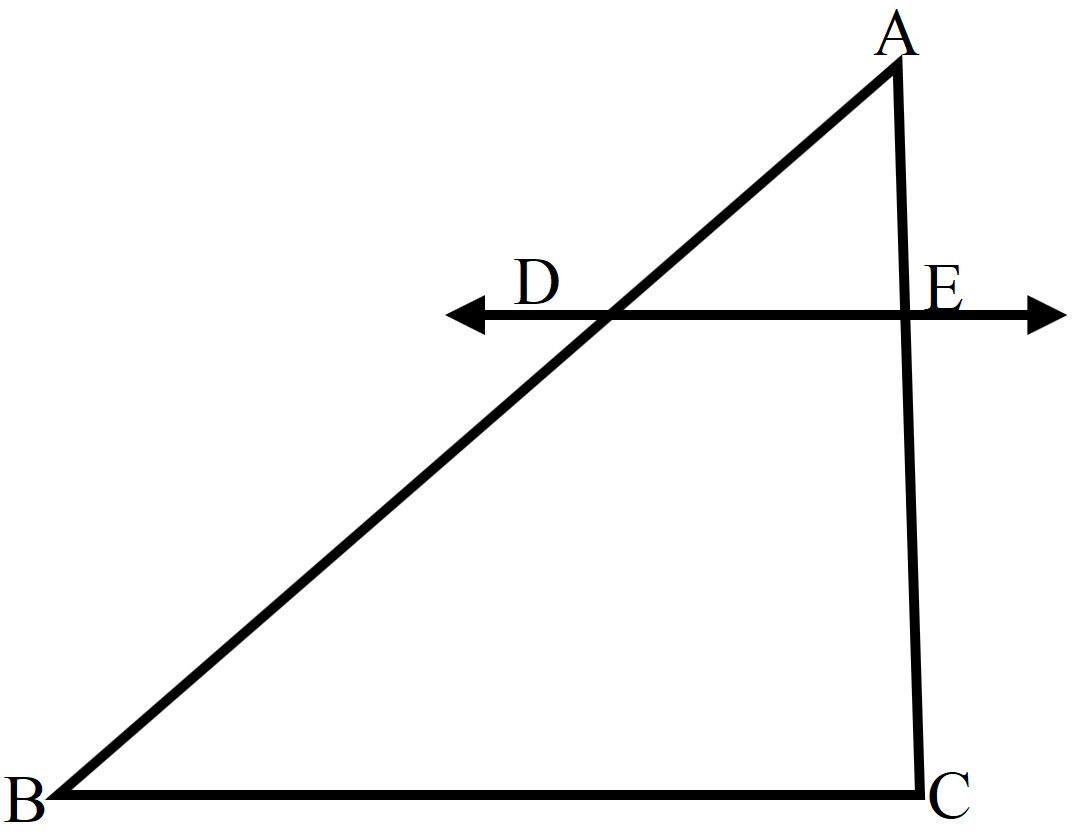
Now, $ \frac{\text{AD}}{\text{DB}}=\frac{6.3}{4.5}=\frac{63}{45}=\frac{7}{5}$
and $ \frac{\text{AE}}{\text{EC}}=\frac{5.6}{4}=\frac{56}{40}=\frac{7}{5}$
$\Rightarrow\frac{\text{AD}}{\text{DB}}=\frac{\text{AE}}{\text{EC}}$
By Converse of Basic Proportionality theorem $, DE\|BC.$ View full question & answer→MCQ 151 Mark
Directions : In the following questions, a statement of assertion $(A)$ is followed by a statement of reason $(R)$. Mark the correct choice as :
Assertion : The sides of two similar triangles are in the ratio $2:5,$ then the areas of these triangles are in the
ratio $4 : 25.$
Reason : The ratio of the areas of two similar triangles is equal to the square of the ratio of their sides.
- ✓
Both assertion $(A)$ and reason $(R)$ are true and reason $(R)$ is the correct explanation of assertion $(A)$.
- B
Both assertion $(A)$ and reason $(R)$ are true but reason $(R)$ is not the correct explanation of assertion $(A)$.
- C
Assertion $(A)$ is true but reason $(R)$ is false.
- D
Assertion $(A)$ is false but reason $(R)$ is true.
AnswerCorrect option: A. Both assertion $(A)$ and reason $(R)$ are true and reason $(R)$ is the correct explanation of assertion $(A)$.
View full question & answer→MCQ 161 Mark
Statement $A ($Assertion$)$ : In $\triangle \ce{ABC, DE\| BC}$ and $\ce{DE: BC}=2: 5$ if $\text{AD}=6 \ cm$, then $\text{BD}=15 \ cm$.
Statement $R ($Reason$):$ In $\triangle \text{ABC}$, if $\ce{DE \| BC}$, then $\text{DE}$ divides the sides $\text{AB}$ and $\text{AC}$ in the same ratio.
- A
Both assertion $(A)$ and reason $( R )$ are true and reason $(R)$ is the correct explanation of assertion $(A).$
- B
Both assertion $(A)$ and reason $(R)$ are true and reason $(R)$ is not the correct explanation of assertion $(A).$
- C
Assertion $(A)$ is true but reason $(R)$ is false.
- ✓
Assertion $(A)$ is false but reason $(R)$ is true.
AnswerCorrect option: D. Assertion $(A)$ is false but reason $(R)$ is true.
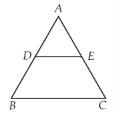
By Thales theorem, $\frac{A D}{D B}=\frac{A E}{E C}$
$\Rightarrow \frac{A D}{A B}=\frac{D E}{B C}=\frac{A E}{A C}[\because \triangle \text{ADE} \sim \triangle \text{ABC}]$
$\Rightarrow \frac{2}{5}=\frac{6}{A B}\left[\because \frac{D E}{B C}=\frac{2}{5}, A D=6 \ cm \right]$
$\Rightarrow A B=\frac{5 \times 6}{2}=15$
$\therefore \text{BD=AB-AD}=15-6=9 \ cm $ View full question & answer→MCQ 171 Mark
Statement A (Assertion) : In the given figure, if $D E \| A C$, then, the value of $x$ is 1 .
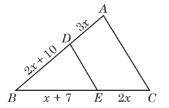
Statement $R$ (Reason) : A line segment dividing the two sides of a triangle in same ratio is parallel to third side. - ✓
Both assertion (A) and reason ( $R$ ) are true and reason $(R)$ is the correct explanation of assertion $(A)$.
- B
Both assertion $(A)$ and reason $(R)$ are true and reason $(R)$ is not the correct explanation of assertion (A).
- C
Assertion (A) is true but reason $(R)$ is false.
- D
Assertion (A) is false but reason (R) is true.
AnswerCorrect option: A. Both assertion (A) and reason ( $R$ ) are true and reason $(R)$ is the correct explanation of assertion $(A)$.
(a): In $\triangle A B C, D E \| A C$
$
\begin{array}{ll}
\therefore & \frac{B D}{A D}=\frac{B E}{E C} [By\quad B.P.T]\\
\Rightarrow & \frac{2 x+10}{3 x}=\frac{x+7}{2 x} \\
\Rightarrow & 4 x^2+20 x=3 x^2+21 x \Rightarrow x^2-x=0 \\
\Rightarrow & x(x-1)=0 \\
\Rightarrow & x=1\quad\quad [ \therefore Side\quad can't\quad be\quad zero]
\end{array}
$
$\therefore \quad$ Assertion is true.
Clearly, Reason is true.
$\therefore \quad$ Assertion and Reason both are true and Reason is the correct explanation of Assertion.
View full question & answer→MCQ 181 Mark
Statement A (Assertion) : $A B C$ is a triangle in which $A B=A C$ and $D$ is a point on $A C$ such that $B C^2=A C \times C D$. Then, $\triangle A B C \sim \triangle B D C$ by SAS similarity criterion.
Statement R (Reason) : If two angles of one triangle are respectively equal to the two angles of another triangle, then the two triangles are similar. This is knownas SAS similaritycriterion.
- A
Both assertion (A) and reason ( $R$ ) are true and reason $(R)$ is the correct explanation of assertion $(A)$.
- B
Both assertion $(A)$ and reason $(R)$ are true and reason $(R)$ is not the correct explanation of assertion (A).
- ✓
Assertion (A) is true but reason $(R)$ is false.
- D
Assertion (A) is false but reason (R) is true.
AnswerCorrect option: C. Assertion (A) is true but reason $(R)$ is false.
(c) : Clearly, Reason is false as it is AA similarity criterion.
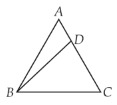
We are given that $B C^2=A C \times C D$
$
\Rightarrow \frac{B C}{C D}=\frac{A C}{B C}\ldots(i)
$
In $\triangle A B C$ and $\triangle B D C$, we have
$
\frac{A C}{B C}=\frac{B C}{C D}(From (i)
$
and $\angle B C A=\angle D C B$(Common)
$\therefore \quad \triangle A B C \sim \triangle B D C$(By SAS similarity criterion)
$\therefore \quad$ Assertion is true. View full question & answer→MCQ 191 Mark
Statement $A ($Assertion$)$ : If the bisector of an angle of a triangle bisects the opposite side, then the triangle is isosceles.
Statement $R ($Reason$)$ : The internal bisector of an angle of a triangle divides the opposite side internally in the ratio of the sides containing the angle.
- ✓
Both assertion $(A)$ and reason $( R )$ are true and reason $(R)$ is the correct explanation of assertion $(A).$
- B
Both assertion $(A)$ and reason $(R)$ are true and reason $(R)$ is not the correct explanation of assertion $(A).$
- C
Assertion $(A)$ is true but reason $(R)$ is false.
- D
Assertion $(A)$ is false but reason $(R)$ is true.
AnswerCorrect option: A. Both assertion $(A)$ and reason $( R )$ are true and reason $(R)$ is the correct explanation of assertion $(A).$
Clearly, Reason is true.
Now, in $\triangle \text{ABC}$, the bisector $\text{AD}$ of $\angle A$ bisects the side $\text{BC}$.
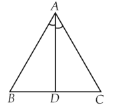
$\therefore \frac{AB}{AC}=\frac{BD}{DC}$
$\Rightarrow \frac{AB}{AC}=1$
$(\because D$ is the mid$-$point of $BC \therefore BD=DC)$
$\Rightarrow AB=AC$
Hence, the triangle $\text{ABC}$ is isosceles.
$\therefore$ Assertion and Reason both are true and Reason is the correct explanation of Assertion. View full question & answer→MCQ 201 Mark
Statement $A ($Assertion$) : \triangle \text{ABC} \sim \triangle \text{DEF}$ such that $\operatorname{ar}(\triangle\text{ABC})=100 \ cm ^2$ and $\operatorname{ar}(\triangle \text{DEF})$
$=144 \ cm ^2$. If $A B=24 \ cm$, then $D E=36 \ cm$.
Statement $R ($Reason$) :$ The ratio of the areas of two similar triangles is equal to the ratio of the squares of their corresponding medians.
- A
Both assertion $(A)$ and reason ( $R$ ) are true and reason $(R)$ is the correct explanation of assertion $(A)$.
- B
Both assertion $(A)$ and reason $(R)$ are true and reason $(R)$ is not the correct explanation of assertion $(A).$
- C
Assertion $(A)$ is true but reason $(R)$ is false.
- ✓
Assertion $(A)$ is false but reason $(R)$ is true.
AnswerCorrect option: D. Assertion $(A)$ is false but reason $(R)$ is true.
Clearly, Reason is true.
Now, we know that, ratio of area of two similar triangles is equal to the ratio of squares of their corresponding sides.
$\therefore \frac{\operatorname{ar}(\triangle A B C)}{\operatorname{ar}(\triangle D E F)}=\frac{A B^2}{D E^2}$
$\Rightarrow \frac{100}{144}=\frac{24 \times 24}{D E^2}$
$\Rightarrow D E^2=\frac{24 \times 24 \times 144}{100}$
$\Rightarrow D E=\frac{24 \times 12}{10}=\frac{288}{10}$
$=28.8 \neq 36$
$\therefore$ Assertion is false.
View full question & answer→MCQ 211 Mark
Statement A (Assertion) : In two similar triangles $A B C$ and $P Q R$, if their corresponding altitudes $A D$ and $P S$ are in the ratio $4: 9$, then the ratio of the areas of $\triangle A B C$ and $\triangle P Q R$ is $16: 81$.
Statement R (Reason) : The ratio of the areas of two similar triangles is equal to the ratio of their corresponding altitudes.
- A
Both assertion (A) and reason ( $R$ ) are true and reason $(R)$ is the correct explanation of assertion $(A)$.
- B
Both assertion $(A)$ and reason $(R)$ are true and reason $(R)$ is not the correct explanation of assertion (A).
- ✓
Assertion (A) is true but reason $(R)$ is false.
- D
Assertion (A) is false but reason (R) is true.
AnswerCorrect option: C. Assertion (A) is true but reason $(R)$ is false.
(c) : Clearly, Reason is false.
Since the ratio of areas of two similar triangles is equal to the ratio of the squares of their corresponding altitudes.
$
\therefore \quad \frac{\operatorname{ar}(\triangle A B C)}{\operatorname{ar}(\triangle P Q R)}=\frac{A D^2}{P S^2}=\left(\frac{4}{9}\right)^2=\frac{16}{81}
$
$\therefore \quad$ Assertion is true.
View full question & answer→MCQ 221 Mark
Statement A (Assertion) : In figure, $D E|| A C$ and $D C|| A P$. Then $\frac{B E}{E C}=\frac{B C}{C P}$.
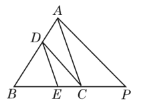
Statement $R$ (Reason) : If a line divides any two sides of a triangle in the same ratio, then the line must be parallel to the third side. - A
Both assertion (A) and reason ( $R$ ) are true and reason $(R)$ is the correct explanation of assertion $(A)$.
- ✓
Both assertion $(A)$ and reason $(R)$ are true and reason $(R)$ is not the correct explanation of assertion (A).
- C
Assertion (A) is true but reason $(R)$ is false.
- D
Assertion (A) is false but reason (R) is true.
AnswerCorrect option: B. Both assertion $(A)$ and reason $(R)$ are true and reason $(R)$ is not the correct explanation of assertion (A).
(b): As in $\triangle B A C, D E \| A C$
$\Rightarrow \frac{B D}{D A}=\frac{B E}{E C}$[By B.P.T]$\ldots(i)$
Also, in $\triangle B A P, D C \| A P$
$\Rightarrow \frac{B D}{D A}=\frac{B C}{C P} \quad$ [By B.P.T]$\ldots(ii)$
From (i) and (ii), $\frac{B E}{E C}=\frac{B C}{C P}$
Both (A) and (R) are true but (R) is not the correct explanation of (A).
View full question & answer→MCQ 231 Mark
Statement $A ($Assertion$)$ : In a $\triangle \text{ABC}$, if $\ce{DE \| BC}$ and intersects $AB$ at $D$ and $AC$ at $E$, then $\frac{AB}{AD}=\frac{AC}{AE}$.
Statement $R ($Reason$)$ : If a line is drawn parallel to one side of a triangle to intersect the other two sides in distinct points, then these sides are divided in the same ratio.
- ✓
Both assertion $(A)$ and reason $(R)$ are true and reason $(R)$ is the correct explanation of assertion $(A)$.
- B
Both assertion $(A)$ and reason $(R)$ are true and reason $(R)$ is not the correct explanation of assertion $(A).$
- C
Assertion $(A)$ is true but reason $(R)$ is false.
- D
Assertion $(A)$ is false but reason $(R)$ is true.
AnswerCorrect option: A. Both assertion $(A)$ and reason $(R)$ are true and reason $(R)$ is the correct explanation of assertion $(A)$.
Clearly, Reason is true as it is Thales theorem.
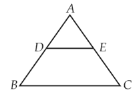
Since, $\ce{DE \| BC}$, by Thales theorem, we have
$\frac{AD}{DB}=\frac{AE}{EC}$
$\Rightarrow \frac{DB}{AD}=\frac{EC}{AE}$
$\Rightarrow 1+\frac{DB}{AD}=1+\frac{EC}{AE}$
$\Rightarrow \frac{AD+DB}{AD}=\frac{AE+EC}{AE}$
$\Rightarrow \frac{AB}{AD}=\frac{AC}{AE},$ which is true.
$\therefore$ Assertion and Reason both are true and Reason is the correct explanation of Assertion. View full question & answer→MCQ 241 Mark
Statement A (Assertion) : All regular polygons such as equilateral triangle, squares etc. are similar.
Statement R (Reason): Two polygons of the same number of sides are said to be similar, if their corresponding angles are equal and lengths of corresponding sides are proportional.
- ✓
Both assertion (A) and reason ( $R$ ) are true and reason $(R)$ is the correct explanation of assertion $(A)$.
- B
Both assertion $(A)$ and reason $(R)$ are true and reason $(R)$ is not the correct explanation of assertion (A).
- C
Assertion (A) is true but reason $(R)$ is false.
- D
Assertion (A) is false but reason (R) is true.
AnswerCorrect option: A. Both assertion (A) and reason ( $R$ ) are true and reason $(R)$ is the correct explanation of assertion $(A)$.
(a) : Two polygons of the same number of sides are similar if their corresponding angles are equal and corresponding sides are proportional.
$\because$ In equilateral triangles or squares, each angle are equal and sides are also proportional. Therefore, all regular polygons are similar.
$\therefore \quad$ Assertion and Reason both are true and Reason is the correct explanation of Assertion.
View full question & answer→