Question 11 Mark
Write the formula of the compound of iodine which is obtained when conc. $\mathrm{HNO}_3$ oxidises $\mathrm{I}_2$.
View full question & answer→Question 21 Mark
Why does $NH_3$ act as a Lewis base?
Answer$NH_3$ can donate its lone pair of electrons.
View full question & answer→Question 31 Mark
Write the formula of the compound of sulphur which is obtained when conc. $\mathrm{HNO}_3$ oxidises $\mathrm{S}_8$.
Answer$\mathrm{H}_2 \mathrm{SO}_4$
View full question & answer→Question 41 Mark
$Pb(NO_3)_2$ on heating gives a brown gas which undergoes dimerization on cooling? Identify the gas.
View full question & answer→Question 51 Mark
Write the formulae of any two oxoacids of phosphorus.
Answer$ \mathrm{H}_3 \mathrm{PO}_2, \mathrm{H}_3 \mathrm{PO}_3, \mathrm{H}_4 \mathrm{P}_2 \mathrm{O}_5, \mathrm{H}_4 \mathrm{P}_2 \mathrm{O}_6, \mathrm{H}_3 \mathrm{PO}_4, \mathrm{H}_4 \mathrm{P}_2 \mathrm{O}_7, \mathrm{H}_3 \mathrm{PO}_5, \mathrm{H}_4 \mathrm{P}_2 \mathrm{O}_8,\left(\mathrm{HPO}_3\right)_3 $
$ \left(\mathrm{HPO}_3\right) \mathrm{n}$
View full question & answer→Question 61 Mark
Write the formula of the compound of phosphorus which is obtained when conc. $\mathrm{HNO}_3$ oxidises $\mathrm{P}_4$.
Answer$\mathrm{H}_3 \mathrm{PO}_4$.
View full question & answer→Question 71 Mark
What is the basicity of $\mathrm{H}_3 \mathrm{PO}_3$ ?
View full question & answer→Question 81 Mark
Name two poisonous gases which can be prepared form chlorine gas.
AnswerPhosgene gas $\left(\mathrm{COCl}_2\right)$, Cholorpicrin (or tear gas) $\left(\mathrm{CCl}_2 \mathrm{NO}_2\right)$, Mustard gas $\left(\mathrm{ClCH}_2 \mathrm{CH}_2 \mathrm{SCH}_2 \mathrm{CH}_2 \mathrm{Cl}\right)$.
View full question & answer→Question 91 Mark
Which is a stronger reducing agent, $\mathrm{SbH}_3$ or $\mathrm{BiH}_3$, and why?
Answer$\mathrm{BiH}_3$, because the stability of hydrides decreases on moving from $\mathrm{SbH}_3$ to $\mathrm{BiH}_3$.
View full question & answer→Question 101 Mark
Fluorine does not exhibit any positive oxidation state. Why?
AnswerBecause Fluorine is the most electronegative element.
View full question & answer→Question 111 Mark
Why is red phosphorus less reactive than white phosphorus?
AnswerDue to its polymeric structure, red phosphorus is much less reactive than white phosphorus or white phosphorus is under strain.
View full question & answer→Question 121 Mark
Why is the bond angle in $\mathrm{PH}_3$ molecule lesser than that in $\mathrm{NH}_3$ molecule?
AnswerBecause of decrease in $\mathrm{sp}^3$ hybridization character from $\mathrm{NH}_3$ to $\mathrm{PH}_3$.
View full question & answer→Question 131 Mark
Arrange the following hydrides of Group-16 elements in the decreasing order of their reducing character :
$\mathrm{H}_2 \mathrm{O}, \mathrm{H}_2 \mathrm{~S}, \mathrm{H}_2 \mathrm{Se}, \mathrm{H}_2 \mathrm{Te}$
Answer$\mathrm{H}_2 \mathrm{Te}>\mathrm{H}_2 \mathrm{Se}>\mathrm{H}_2 \mathrm{~S}>\mathrm{H}_2 \mathrm{O}$
View full question & answer→Question 141 Mark
On heating Cu turnings with conc. $\mathrm{HNO}_3$, a brown coloured gas is evolved which on cooling dimerises. Identify the gas.
Answer$\mathrm{NO}_2$ gas
View full question & answer→Question 151 Mark
Arrange the following hydrides of Group-16 elements in the decreasing order of their acidic strength:
$\mathrm{H}_2 \mathrm{O}, \mathrm{H}_2 \mathrm{~S}, \mathrm{H}_2 \mathrm{Se}, \mathrm{H}_2 \mathrm{Te}$
Answer$\mathrm{H}_2 \mathrm{Te}>\mathrm{H}_2 \mathrm{Se}>\mathrm{H}_2 \mathrm{~S}>\mathrm{H}_2 \mathrm{O}$
View full question & answer→Question 161 Mark
On adding NaOH to ammonium sulphate, a colourless gas with pungent odour is evolved which forms a blue coloured complex with $\mathrm{Cu}^{2+}$ ion. Identify the gas.
View full question & answer→Question 171 Mark
Arrange the following in increasing order of basic strength:
$\mathrm{C}_6 \mathrm{H}_5 \mathrm{NH}_2, \mathrm{C}_6 \mathrm{H}_5 \mathrm{NHCH}_3, \mathrm{C}_6 \mathrm{H}_5 \mathrm{~N}\left(\mathrm{CH}_3\right)_2$
Answer$\mathrm{C}_6 \mathrm{H}_5 \mathrm{NH}_2<\mathrm{C}_6 \mathrm{H}_5 \mathrm{NHCH}_3<\mathrm{C}_6 \mathrm{H}_5 \mathrm{~N}\left(\mathrm{CH}_3\right)_2$.
View full question & answer→Question 181 Mark
Arrange the following in increasing order of basic strength:
$C_6H_5NH_2, C_6H_5NHCH_{3,} C_6H_5CH_2NH_2$
Answer$C_6H_5NH_2< C_6H_5NH – CH_3< C_6 H_5 – CH_2 – NH_{2}.$
View full question & answer→Question 191 Mark
What is the basicity of $H_3PO_4?$
View full question & answer→Question 201 Mark
What is the covalency of nitrogen in $N_2O_5?$
View full question & answer→Question 211 Mark
Which one of ${PCl^+}_4$ and ${PCl^–}_4$ is not likely to exist and why?
Answer${PCl^–}_4$, because P has 10 electrons which cannot be accommodated in $sp^3$ hybrid orbitals.
View full question & answer→Question 221 Mark
Draw the structure of $XeF_2$ molecule.
View full question & answer→Question 231 Mark
Why does $NO_2$ dimerise?
AnswerBecause $NO_2$ contains odd number of valence electrons and on dimerisation it is converted to stable $N_2O_4$ molecule with even number of electrons.
View full question & answer→Question 241 Mark
Why is Bi(v) a stronger oxidant than Sb(v)?
AnswerDue to “inert pair effect” or because lower oxidation state becomes more stable for Bi than Sb.
View full question & answer→Question 251 Mark
Give reason for the following:
$CN^-$ ion is known but $CP^-$ ion is not known.
AnswerNitrogen being smaller in size forms $\text{p}\pi-\text{p}\pi$ multiple bonding with carbon, so $CN^-$ ion is known, but phosphorus does not form $\text{p}\pi-\text{p}\pi$ bond as it is larger in size.
View full question & answer→Question 261 Mark
Explain why fluorine forms only one oxoacid, HOF.
AnswerCl, Br and I form four series of oxo acids of general formula HOX, HOXO, HOXO2 and $HOXO_3$. In these oxo-adds, the oxidation states of halogens are +1, +3, +5, and +7 respectively. However, due to high electronegativity, small size and absence of dorbitals, F does not form oxo-acids with +3, + 5 and +7, oxidation states. It just forms one oxo-acid (HOF).
View full question & answer→Question 271 Mark
Can $PCl_5$ act as an oxidising as well as a reducing agent? Justify.
Answer$PCl_5$ can only act as an oxidizing agent. The highest oxidation state that P can show is +5. In $PCl_5$, phosphorus is in its highest oxidation state (+5). However, it can decrease its oxidation state and act as an oxidizing agent.
View full question & answer→Question 281 Mark
Give reason for the following:
$NO_2$ dimerises to form $N_2O_4.$
AnswerThis is because $NO_2$ is an odd electron molecule and therefore gets dimerised to stable $N_2O_4.$
View full question & answer→Question 291 Mark
Give the disproportionation reaction of $H_3PO_3.$
AnswerOn heating, orthophosphorus acid $( H_3PO_3)$ disproportionates to give orthophosphoric acid $(H_3PO_3)$ and phosphine $( PH_3)$. The oxidation states of P in various species involved in the reaction are mentioned below. $4\text{H}_3\stackrel{{+3}}{{\text{P}}}\text{O}_3\rightarrow3\text{H}_3\stackrel{{\text{+5}}}{{\text{P}}}\text{O}_4+\stackrel{{-3}}{{\text{P}}}\text{H}_3$
View full question & answer→Question 301 Mark
Name two poisonous gases which can be prepared from chlorine gas.
AnswerPhosgene $(COCl_2)$ & tear gas $(CCl_3NO_2).$
View full question & answer→Question 311 Mark
What is the difference between the nature of $\pi-$bonds present in $H_3PO_3$ and $HNO_3$ molecules?
AnswerIn $H_3PO_3$, there is $\text{p}\pi-\text{d}\pi$ bond whereas in $HNO_3,$ there is $\text{p}\pi-\text{p}\pi$ bond.
View full question & answer→Question 321 Mark
The maximum number of covalent bonds formed by nitrogen is 4. Why?
AnswerNitrogen has three unpaired electrons and one lone pair of electrons, therefore, it can form three covalent bonds and one coordinate bond.
View full question & answer→Question 331 Mark
Why does the reactivity of nitrogen differ from phosphorus?
AnswerNitrogen molecule is a diatomic and the two nitrogen atoms are linked by triple bond (N ≡ N). Forming a $\text{P}\pi-\text{P}\pi$ bonding and thus the bond dissociation energy is very high $(946$ kj mol$^{–1})$, it is not possible to cleave the triple bond so easily. Therefore, the reactivity of nitrogen differ from phosphorus.
View full question & answer→Question 341 Mark
Why is ICl more reactive than $I_2?$
AnswerICl is more reactive than $I_2$ because I-Cl bond in ICl is weaker than I-I bond in $I_2$.
View full question & answer→Question 351 Mark
Why is $H_2O$ a liquid and $H_2S$ a gas?
Answer$H_2O$ has oxygen as the central atom. Oxygen has smaller size and higher electronegativity as compared to sulphur. Therefore, there is extensive hydrogen bonding in $H_2O$, which is absent in $H_2S$. Molecules of $H_2S$ are held together only by weak van der Waal’s forces of attraction.
Hence, $H_2O$ exists as a liquid while $H_2S$ as a gas.
View full question & answer→Question 361 Mark
Why are pentahalides more covalent than trihalides?
AnswerIn pentahalides, the oxidation state is +5 and in trihalides, the oxidation state is +3. Since the metal ion with a high charge has more polarizing power, pentahalides are more covalent than trihalides.
View full question & answer→Question 371 Mark
Account for the following:
Ozone acts as a powerful oxidising agent.
AnswerDue to the ease with which it liberates atoms of nascent oxygen, it acts as a powerful oxidising agent.
$O_3 → O_2 + O$ (nascent oxygen).
View full question & answer→Question 381 Mark
What inspired N. Bartlett for carrying out reaction between Xe and $PtF_6?$
AnswerN. Bartlett observed that PtF6 reacts with 02to give an compound $\text{PtF}_6(\text{g})+\text{O}_2$
$\rightarrow\text{O}_2+[\text{PtF}_6]^-$
Since the first ionization enthalpy of Xe (1170 kJ rnol' )is fairly close to that of $O_2$ molecule $(1175\ kJ\ mol^{-1} ),$
he thought that $PtF_6$ should also oxidise Xe to $xe^+$.
This inspired Bartlett to carryout the reaction between Xe and PtF6.
When PtF6 and Xe were made to react, a rapid reaction took place and a red solid,
$Xe + [PtF_6]^-$ was obtained.
$\text{Xe}+\text{PtF}_6\xrightarrow[]{278 \ \text{K}}\text{Xe}^+[\text{PtF}_6]^-$
View full question & answer→Question 391 Mark
How does ammonia react with a solution of $Cu^{2+}?$
Answer$\text{Cu}^{2+}(\text{aq})+4\text{NH}_4\text{OH}(\text{aq})\rightarrow\ [\text{Cu(NH}_3)_4]^{2+}\\ \ \ \ \ \ \ \ \ \ \ \ \ \ \ \ \ \ \ \ \ \ \ \ \ \ \ \ \ \ \ \ \ \ \ \ \ \ \ \ \ \ \ \ \ \ \ \ \ \ \ \ \text{tetrammine copper}\\ \ \ \ \ \ \ \ \ \ \ \ \ \ \ \ \ \ \ \ \ \ \ \ \ \ \ \ \ \ \ \ \ \ \ \ \ \ \ \ \ \ \ \ \ \ \ \ \ \ \ \ \text{(II) ion (deep blue)}\\ \ \ \ \ \ \ \ \ \ \ \ \ \ \ \ \ \ \ \ \ \ \ \ \ \ \ \ \ \ \ \ \ \ \ \ \ \ \ \ \ \ \ \ \ \ \ \ \ \ \ \ \ \ \ \ \ \ \ \ \ \ \ \ \ \ \ \ \ \ \ \ \ \ \ \ +4\text{H}_2\text{O}$
View full question & answer→Question 401 Mark
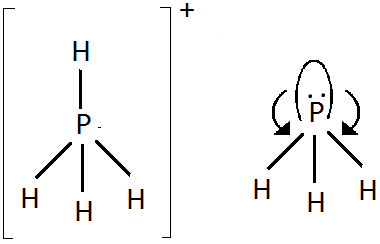
Bond angle in $PH_4^+$ is higher than that in $PH_3.$ Why?
AnswerIn $PH_3,$ P is sp hybridized. Three orbitals are involved in bonding with three hydrogen atoms and the fourth one contains a lone pair. As lone pair-bond pair repulsion is stronger than bond pair-bond pair repulsion, the tetrahedral shape associated with $Sp_{3}$ changed to pyramidal. $PH_3$ combines with a proton to form in which the lone pair is absent. Due to the absence of lone pair in, there is no lone pair-bond pair repulsion. Hence, the bond angle in is higher than the bond angle in $PH_3.$
View full question & answer→Question 411 Mark
Which of the three is the strongest oxidising agent:
$\text{ClO}^-_4,\ \text{BrO}^-_4,\ \text{IO}^-_4\ ?$
Answer$\text{BrO}^-_4$ is the strongest oxidising agent.
View full question & answer→Question 421 Mark
Why sulphurous acid acts as a reducing agent?
AnswerDue to the presence of a lone pair of electrons on the sulphur atom, sulphurous acid can be easily oxidised to sulphuric acid. Therefore, it acts as a reducing agent.
View full question & answer→Question 431 Mark
Why is $NH_3$ a good complexing agent?
Answer$NH_3$ is a good complexing agent because nitrogen has a lone pair of electrons which it can donate to form coordinate bond.
View full question & answer→Question 441 Mark
In interhalogen compounds of the type $AB_5$ and $AB_7,$ B is invariably fluorine. Why?
AnswerFluorine being the strongest oxidising agent, can form interhalogen compounds in $^+5$ and $^+7$ oxidation state.
View full question & answer→Question 451 Mark
In the preparation of $H_2SO_4$ by Contact Process, why is $SO_3$ not absorbed directly in water to form $H_2SO_4?$
AnswerAcid fog is formed, which is difficult to condense.
View full question & answer→Question 461 Mark
Concentrated $H_2SO_4$ is used as a dehydrating agent. Explain.
AnswerSulphuric acid has a strong affinity for water. It, therefore, removes water not only from materials which contain it but frequently removes oxygen and hydrogen from other compounds in the proportion required to form water $(H_2O).$
View full question & answer→Question 471 Mark
Fluorine exhibits only -1 oxidation state whereas other halogens exhibit +1, +3, +5 and +7 oxidation states also. Explain.
AnswerFluorine is the most electronegative element and cannot exhibit any positive oxidation state. Other halogens have d-orbitals and therefore, can expand their octets and show +1, +3, +5 and +7 oxidation states also.
View full question & answer→Question 481 Mark
Arrange the following in the order of property indicated for each set:
$F_2, Cl_2, Br_2, I_2 -$ increasing bond dissociation enthalpy.
AnswerThe order of increasing bond enthalpy
$I_2 < Br_2 < F_2 < Cl_2.$
View full question & answer→Question 491 Mark
What happens when $PCl_5$ is heated?
AnswerWhen $PCl_5$ is heated, it sublimes but decomposes on stronger heating.
$PCl_5$ heat $→ PCl_3 + Cl_2PCl_5 →$ heat $PCl_3 + Cl_2$
View full question & answer→Question 501 Mark
Why does $O_3$ act as a powerful oxidising agent?
Answer$O_3$ being endothermic compound readily decomposes on heating to give dioxygen or nascent oxygen.
$O_3 → O_2 + O$ (nascent oxygen)
since nascent oxygen is very reactive therefore O act as powerful oxidising agent.
View full question & answer→Question 511 Mark
Which of the following does not react with oxygen directly?
Zn, Ti, Pt, Fe.
AnswerPt is a noble metal and does not react very easily. All other elements, Zn, Ti, Fe, are quite reactive. Hence, oxygen does not react with platinum (Pt) directly.
View full question & answer→Question 521 Mark
Sulphur disappears when boiled with sodium sulphite. Why?
AnswerWhen sodium sulphite is heated with sulphur, we get sodium thiosulphate which is soluble in water that is why sulphur disappears.
$\text{Na}_2\text{SO}_3+\text{S}\xrightarrow{\ \ \text{Heat}\ \ }\text{Na}_2\text{S}_2\text{O}_3$
View full question & answer→Question 531 Mark
Why is $BiH_3$ the strongest reducing agent amongst all the hydrides of Group 15 elements?
AnswerThis is because as we move down the group, the size increases, as a result, length of E-H bond increases and its strength decreases, so that the bond can be broken easily to release $H_2$ gas. Hence, $BiH_3$ is the strongest reducing agent.
View full question & answer→Question 541 Mark
Complete the following reactions:
- $C_2H_4 + O_2 →$
- $4Al + 3O_2 →$
Answer
- $\text{C}_2\text{H}_4+3\text{O}_2\xrightarrow[]{\text{Heat}}2\text{CO}_2+2\text{H}_2\text{O}$
- $4\text{Al}+3\text{O}_2\xrightarrow[]{\text{Heat}}2\text{CO}_2+2\text{Al}_2\text{O}_3$
View full question & answer→Question 551 Mark
$\text{BH}^-_4$ and $\text{NH}^+_4$ are isolobal. Explain.
AnswerBoth $\text{BH}^-_4$ and $\text{NH}^+_4$ have tetrahedral shapes, i.e., four lobes of $sp^3-$ hydridised orbitals. Hence, they are isolobal.
View full question & answer→Question 561 Mark
Give reason for the following:
Solid phosphorus pentachloride exhibits some ionic character.
AnswerSolid $PCl_5$ exists as $[PCl_4]^+ [PCl_6]^- $ and hence exhibits some ionic character.
View full question & answer→Question 571 Mark
Comment on the nature of two S–O bonds formed in $SO_2$ molecule. Are the two S–O bonds in this molecule equal?
AnswerBoth the S-O bonds are covalent and have equal strength due to resonating structures.
View full question & answer→Question 581 Mark
Why are the elements of Group 18 known as noble gases?
AnswerThe elements present in Group 18 have their valence shell orbitals completely filled and, therefore, react with a few elements only under certain conditions. Therefore, they are known as noble gases.
View full question & answer→Question 591 Mark
Why is $F_2O$ referred to as a fluoride but $Cl_2O$ is an oxide?
Answer$F_2O$ is called oxygen fluoride because fluorine is more electronegative than oxygen whereas $Cl_2O$ is called chlorine oxide because oxygen is more electronegative than chlorine.
View full question & answer→Question 601 Mark
Arrange the following in the order of property indicated for each set:
HF, HCl, HBr, HI - increasing acid strength.
AnswerIn the order of increasing acid strength in water (i.e., aqueous solution) HI is strongest acid while HF is the weakest acid.
This is because as moving down the group size increase and hence weaken the bond as a result more availability of hydrogen.
H - F < H - Cl < H - Br < H - I
View full question & answer→Question 611 Mark
Which of the following hyride has the largest bond angle?
$H_2O, H_2S, H_2Se$ or $H_2Te$
AnswerAs the electronegativity of the central atom decreases, the repulsions between element-hydrogen bond pairs decreases and hence the angle decreases accordingly. Thus, $H_2O$ has the largest bond angle $(104.5^\circ).$
View full question & answer→Question 621 Mark
Iodine form $\text{I}^-_3$ but $\text{F}_2$ does not form $\text{F}^-_3$ ions. Why?
Answer$I_2,$ because of the presenve of vacant d-orbitals, accepts electrons from $I^-$ ions to from $\text{I}^-_3$ ions but $F_2$ because of the absence of d-orbitals does not accept electrons from $F^-$ ions to from $\text{F}^-_3$ ions.
View full question & answer→Question 631 Mark
Write two uses of $ClO_2.$
Answer
- $ClO_2$ is an excellent bleaching agent. It is 30 times stronger bleaching agent then the $Cl_2.$ It is used as a bleaching agerit for paper pulp in paper industry and in textile industry.
- Cl02 is also a powerful oxidising agent and chlorinating agent. It acts as a germicide for disinfecting water. It is used for purifying drinking water.
View full question & answer→Question 641 Mark
What happens when $H_3PO_3$ is heated?
Answer$H_3PO_3,$ on heating, undergoes disproportionation reaction to form $PH_3$ and $H_3PO_4$. The oxidation numbers of P in $H_3PO_3, PH_3,$ and $H_3PO_4$ are $+3, −3,$ and +5 respectively. As the oxidation number of the same element is decreasing and increasing during a particular reaction, the reaction is a disproportionation reaction.
$H_3PO_3$ on heating disproportionates to give orthophosphoric acid and phosphine.
$4H_3 PO_3→ 3H_3PO_4 + PH_3$
View full question & answer→Question 651 Mark
Account for the following:
Compounds of fluorine with oxygen are called fluorides of oxygen and not the oxides of fluorine.
AnswerThis is because fluorine is more electronegative than oxygen.
View full question & answer→Question 661 Mark
List the important sources of sulphur.
AnswerSulphur mainly exists in combined form in the earth’s crust primarily as sulphates [gypsum $(CaSO_4.2H_2O),$ Epsom salt $(MgSO_4.7H_2O),$ baryte $(BaSO_4)]$ and sulphides [(galena (PbS), zinc blends (ZnS), copper pyrites $(CuFeS_2)].$
View full question & answer→Question 671 Mark
How is nitrogen prepared in the laboratory? Write the chemical equations of the reactions involved.
AnswerNitrogen is prepared by treating an aqueous solution of ammonium chloride with sodium nitrite.
$NH_4Cl(aq) + NaNO_2(aq) → N_2(g) + 2H_2O(l) + NaCl(aq)$
View full question & answer→Question 681 Mark
Write the structure of pyrophosphoric acid.
Answer$\ \ \ \ \ \ \ \ \ \ \ \text{O}\ \ \ \ \ \ \ \ \ \ \ \ \text{O}\\\ \ \ \ \ \ \ \ \ \ \ || \ \ \ \ \ \ \ \ \ \ \ \ \ \ ||\\\text{HO}-\text{P}-\text{O}-\text{P}-\text{OH}\\\ \ \ \ \ \ \ \ \ \ \ |\ \ \ \ \ \ \ \ \ \ \ \ \ \ \ |\\\ \ \ \ \ \ \ \ \ \text{OH}\ \ \ \ \ \ \ \ \ \ \text{OH}$Pyrophosphoric acid
View full question & answer→Question 691 Mark
Why are the Group 16 elements called chalcogens?
AnswerChalcogens means ore forming. The elements of Group 16 are called chalcogens because many metals are found as oxides and sulphides and a few such as selenides and tellurides.
View full question & answer→Question 701 Mark
What are the oxidation states of phosphorus in the following:
$H_3PO_3$
AnswerOxidation can be calculated as:
$H_3PO_3$
oxidation state of hydrogen is $+1$
oxidation state of oxygen is $-2$
calculation for P oxidation state is:
$1 × 3 + P + (-2) × 3 = 0$
$3 + P + (-6) = 0$
$3 + P = 6$
$P = 6 - 3$
$= 3$
here oxidation state is $+3.$
View full question & answer→Question 711 Mark
Explain why inspite of nearly the same electronegativity, oxygen forms hydrogen bonding while chlorine does not.
AnswerBoth, nitrogen (N) and chlorine (Cl) have electronegativity of 3.0. However, only
nitrogen is involved in the hydrogen bonds (e.g., NH3) and not chlorine. This is due to smaller atomic size of nitrogen (atomic radius = 70 pm) as compared to chlorine (atomic radius = 99 pm), therefore, N can cause greater polarisation of N-H bond than Cl in case of CI-H bond.Consequently, N atom is involved in hydrogen bonding and not chlorine.
View full question & answer→Question 721 Mark
Why are halogens strong oxidising agents?
AnswerThe halogens are strong oxidising agents due to low bond dissociation enthalpy, high electronegativity and large negative electron gain enthalpy.
View full question & answer→Question 731 Mark
Give reasons for the least reactivity of nitrogen molecule.
AnswerDue to presence of a triple bond between the two N-atoms, the bond dissociation enthalpy $(941.4\ kJ\ mol^{-1})$ is very high. Hence, $N_2$_ is the least reactive.
View full question & answer→Question 741 Mark
Why do boiling points of noble gases increase from helium to radon?
AnswerAs the size of the noble gas increases, van der Waals forces of attraction increase accordingly and hence the boiling points increase from He to Rn.
View full question & answer→Question 751 Mark
Can $FCl_3$ exist? Comment.
AnswerNo, because F atom has no d-orbital and therefore it cannot expand its valance shell. Further, three big sized Cl atoms cannot be accommodated around a small F atom.
View full question & answer→Question 761 Mark
What are the oxidation states of phosphorus in the following:$Na_3PO_{4}$
Answer$Na_3PO_{4}$
here oxidation state of sodium is $+1$
oxidation state of oxygen is $-2$
$1 × 3 + P + (-2) × 4 = 0$
$3 + P + (-8) = 0$
$3 + P = 8$
$P = 8 - 3 = 5$
oxidation state is $+5$ View full question & answer→Question 771 Mark
Why is $I_2$ more soluble in KI than in water?
AnswerIt is due to formation of soluble complex $KI_3.$
$I_2 + KI → KI_3$
View full question & answer→Question 781 Mark
Elements of Group 16 generally show lower value of first ionisation enthalpy compared to the corresponding periods of Group 15. Why?
AnswerDue to extra stable half-filled p-orbitals electronic configurations of Group 15 elements, larger amount of energy is required to remove electrons compared to Group 16 elements.
View full question & answer→Question 791 Mark
Write balanced equation for the following:
Chlorine gas is passed into a solution of Nal in water.
Answerwhen chlorine gas is passed into a solution of Nal it libert iodine.
$2\text{NaI}+\text{Cl}_2\rightarrow2\text{NaCl}+\text{I}_2$
View full question & answer→Question 801 Mark
Why are halogens coloured?
AnswerThe halogens are coloured because their molecules absorb light in the visible region. As a result of which their electrons get excited to higher energy levels while the remaining light is transmitted. The color of halogens is the color of this transmitted light.
View full question & answer→Question 811 Mark
Why has it been difficult to study the chemistry of radon?
AnswerIt is difficult to study the chemistry of radon because it is a radioactive substance having a half - life of only 3.82 days. Also, compounds of radon such as $RnF_2$ have not been isolated.
They have only been identified.
View full question & answer→Question 821 Mark
Account for the following:
Noble gases have comparatively large atomic sizes.
AnswerNoble gases have only Van der Waals’ radii while others have covalent radii. As van der Waals’ radii are larger than covalent radii, hence, noble gases have comparatively large atomic sizes.
View full question & answer→Question 831 Mark
Give reason for the following:
Helium is used in diving apparatus.
AnswerHelium is used as a diluent for oxygen in modern diving apparatus because of its very low solubility in blood.
View full question & answer→Question 841 Mark
Write balanced equation for the following:
NaCl is heated with sulphuric acid in the presence of $MnO_2.$
AnswerChlorine gas is produced when NaCl is heated with sulphuric acid in the presenc of $MnO_2$
$2\text{NaCl}+\text{MnO}_2+2\text{H}_2\text{SO}_4\rightarrow\text{Na}_2\text{SO}_4+\text{MnSO}_4+2\text{H}_2\text{O}+\text{Cl}_2\\ \ \ \ \ \ \ \ \ \ \ \ \ \ \ \ \ \ \ \ \ \ \ \ \ \ \ \ \ \ \ \ \ \ (\text{conc.})$
View full question & answer→Question 851 Mark
What is the covalence of nitrogen in $N_2O_5?$
Answer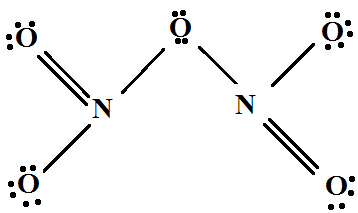
From the structure of $N_2O_5,$ it is evident that the covalence of nitrogen is 4. View full question & answer→Question 861 Mark
What happens when white phosphorus is heated with concentrated NaOH solution in an inert atmosphere of $CO_2?$
Answer$\text{P}_4+3\text{NaOH}+3\text{H}_2\text{O}\xrightarrow[\text{CO}_2\text{atm}]{\Delta}\text{PH}_3+\\ \ \ \ \ \ \ \ \ \ \ \ \ \ \ \ \ \ \ \ \ \ \ \ \ \ \ \ \ \ \ \ \ \ \ \ \ \ \ \ \ \ \ \ \ \ \ \ \ \ \ \ \text{Phosphine}\\ \ \ \ \ \ \ \ \ \ \ \ \ \ \ \ \ \ \ \ \ \ \ \ \ \ \ \ \ \ \ \ \ \ \ \ \ \ \ \ \ \ \ \ \ \ \ \ \ \ \ \ \ \ \ \ 3\text{NaHPO}_2\\\ \ \ \ \ \ \ \ \ \ \ \ \ \ \ \ \ \ \ \ \ \ \ \ \ \ \ \ \ \ \ \ \ \ \ \ \ \ \ \ \ \ \ \ \ \ \ \ \ \ \ \text{sod.hypo-phosphine}$
View full question & answer→Question 871 Mark
Write the order of thermal stability of the hydrides of Group 16 elements.
AnswerThe thermal stability of hydrides of group 16 elements decreases down the group.
This is because down the group, size of the element (M) increases, M-H bond length increases and thus,
stability of M-H bond decreases so that it can be broken down easily.
Hence, we have order of thermal stability as
$H_2O > H_2S > H_2Se > H_2Te > H_2PQ.$
View full question & answer→Question 881 Mark
In what way can it be proved that $PH_3$ is basic in nature?
Answer$PH_3 $ reacts with acids like HI to form $PH_4$ I which shows that it is basic in nature.
$\text{PH}_3+\text{HI}\ \ \ \rightarrow \ \ \text{PH}_4\text{I}$
Due to lone pair of electrons on P atom, $PH_3$ is acting as a Lewis base in the above reaction.
View full question & answer→Question 891 Mark
Why does $NH_3$ form hydrogen bond but $PH_3$ does not?
AnswerFormation of hydrogen bonding depend on the size of molecule. smaller the size greater the hydrogen bonding. Nitrogen has smaller size than phosphrous thus having a more abilty to form hydrogen bond.
N—H bond is reasonably polar and this leads to hydrogen bonding. As the bond polarity of the P—H bond is almost negligible, $PH_3$ is not involved in hydrogen bonding.
View full question & answer→Question 901 Mark
What are the oxidation states of phosphorus in the following:$POF_3$
Answeroxidation state fulorine is $(-1)$
oxidation state is $(-2)$
$P + (-2) + (-1) × 3 = 0$
$P = 5$
oxidation state is $+5$ View full question & answer→Question 911 Mark
What are the oxidation states of phosphorus in the following:$Ca_3P_2$
Answeroxdation state of calcium is $+2$
$2 × 3 + 2P = 0$
$⇒ 6 + 2P$
$⇒ 2P = -6$
$⇒ P = -6/2 = -3$
oxidation state is $-3$
View full question & answer→Question 921 Mark
Why is $N_2$ less reactive at room temperature?
AnswerDinitrogen $(N_2)$ is formed by sharing three electron pairs between two nitrogen atoms. The two nitrogen atoms are joined by triple bond $(N≡N).$ The nitrogen atom is very small in size, therefore the bond length is also quite small (109.8 pm) & as a result the bond dissociation energy is quite high (946Kj / mol).This reason leads $N_2$ to be very less reactive at room temperature.
View full question & answer→Question 931 Mark
How does xenon atom form compounds with fluorine even though the xenon atom has a closed shell configuration?
AnswerThis is because 1, 2 or 3 electrons from the 5p-orbitals can be excited to empty 5d-orbitals and thus making 2, 4 or 6 half-filled orbitals available for bond formation.
View full question & answer→Question 941 Mark
What happens when sulphur dioxide is passed through an aqueous solution of Fe(III) salt?
Answer$SO_2$ acts as a reducing agent and reduces aqueous solution of Fe (III) salt to Fe (II) salt.
$\text{SO}_2+2\text{H}_2\text{O}\rightarrow\text{SO}_4^{2-}+4\text{H}^++2\text{e}^-\\2\text{Fe}^{3+}+2\text{e}^-\rightarrow2\text{Fe}^{2+}\\\overline{2\text{Fe}^{3+}+\text{SO}_2+2\text{H}_2\text{O}\rightarrow2\text{Fe}^{2+}+\text{SO}_4^{2-}+4\text{H}^+}$
View full question & answer→Question 951 Mark
Balance the following equation:$ XeF_6 + H_2O → XeO_2F_2 + HF$
Answer$XeF_6 + 2H_2O → XeO_2Fe_2 + 4HF.$
View full question & answer→Question 961 Mark
In which one of the two structures, $\text{NO}^+_2$ and $\text{NO}^-_2$ the bond angle has a higher value?
Answer$\text{NO}^+_2$ has higher bond angle than $\text{NO}^-_2$ which has a lone pair of electrons on the central atom.
View full question & answer→Question 971 Mark
Arrange the following in the order of property indicated for each set:
$NH_3, PH_3, AsH_3, SbH_3, BiH_3$ – increasing base strength.
AnswerGoing from Nitrogen to bismuth size increase as a result electron density decrease hence basicity decrease. In order of increasing base strength.
$NH_3> PH_3> AsH_3> SbH_3> BiH_3$
View full question & answer→Question 981 Mark
Give the reason for bleaching action of $Cl_2.$
AnswerWhen chlorine reacts with water, it produces nascent oxygen. This nascent oxygen then combines with the coloured substances present in the organic matter to oxide them into colourless substances.
$\text{Cl}_2+\text{H}_2\text{O}\rightarrow2\text{HCl}+[\text{O}]$
Coloured substances + [O] → Oxidized colourless substance.
View full question & answer→Question 991 Mark
Why does $R_3P = O$ exist but $R_3N = O$ does not (R = alkyl group)?
Answer$R_3P = 0$ exists but $R_2N = 0$ does not exist because N- due to the absence of d-orbitals cannot form $\text{d}\pi-\text{p}\pi$ multiple bond thus N- cannot expand its covalency beyond the 4.
On other hand P due to having d- oribital forms $\text{d}\pi-\text{p}\pi$ mutiple bonds and hence can expand covalency beyond 4.
thus $R_3P = 0$ exists but $R_2N = 0$ does not exist.
View full question & answer→Question 1001 Mark
Explain why the tendency to show-2 oxidation state diminishes from sulphur to polonium?
AnswerAtomic size increases from sulphur to polonium, therefore, tendency to gain two electrons decreases.
View full question & answer→Question 1011 Mark
In the ring test of $\text{NO}_3^-$ ion, $Fe^{2+}$ ion reduces nitrate ion to nitric oxide, which combines with $Fe^{2+}$ (aq) ion to form brown complex. Write the reactions involved in the formation of brown ring.
Answer$\text{NO}_3^-+3\text{Fe}^{2+}+4\text{H}^+\xrightarrow{\ \ \ \ \ \ \ \ \ \ }\text{NO}+3\text{Fe}^{3+}+2\text{H}_2\text{O}$
$[\text{Fe}(\text{H}_2\text{O})_6]^{2+}+\text{NO}\xrightarrow{\ \ \ \ \ \ \ \ \ }[\text{Fe}(\text{H}_2\text{O})_5(\text{NO})]^{2+}+\text{H}_2\text{O}\\\ ^{(\text{brown complex})}$
View full question & answer→Question 1021 Mark
With what neutral molecule is $ClO^–$ isoelectronic? Is that molecule a Lewis base?
AnswerIsoelectronic can be define as the molecules which have same number of electron.
$CIO^–$ is isoelectronic with ClF.
The molecule is a Lewis base.
View full question & answer→Question 1031 Mark
Write a balanced chemical equation for the reaction showing catalytic oxidation of $NH_3$ by atmospheric oxygen.
Answer$4\text{NH}_3+5\text{O}_2\xrightarrow{\text{Pt gauze}}4\text{NO}+6\text{H}_2\text{O}\\\ \ \ \ \ \ \ \ \ \ \ \ ^{(\text{from air})}$
View full question & answer→Question 1041 Mark
Why does orthophosphoric acid exist as a syrupy liquid?
AnswerOrthophosphoric acid contains three O-H groups and hence undergoes extensive H-bonding.
View full question & answer→Question 1051 Mark
Why does $PCl_3$ fume in moisture?
Answer$PCl_3$ hydrolyses in the presence of moisture giving fumes of HCl.
$\text{PCl}_3+3\text{H}_2\text{O}\ \ \ \rightarrow \ \ \ \text{H}_3\text{PO}_3+3\text{HCl}$
View full question & answer→Question 1061 Mark
Write a balanced equation for the hydrolytic reaction of $PCl_5$ in heavy water.
Answer$\text{PCl}_5+\text{D}_2\text{O}\rightarrow\text{POCl}_3+2\text{DCl}_2$
$\text{POCl}_3+3\text{D}_2\text{O}\rightarrow\text{D}_3\text{PO}_4+3\text{DCl}$
Therefore, the net reaction can be written as,
$\text{PCl}_5+4\text{D}_2\text{O}\rightarrow\text{D}_3\text{PO}_4+5\text{DCl}$
View full question & answer→Question 1071 Mark
What are the oxidation states of phosphorus in the following:
$PCl_3$
Answer$PCl_3$
Oxidation state of chlorine is $-3$
thus
$P+(-3) = 0$
$P = 3$
Here oxidation state is $+3.$
View full question & answer→Question 1081 Mark
In trimethylamine, the nitrogen has a pyramidal geometry whereas in trisilylamine $N(SiH_3)_3$, it has a planar geometry.
Answer$(CH_3)_3N$ is pyramidal due to sp^3 hybridisation and has a lone pair of electrons. $(SiH_3)_3N$ has $sp^2$ hybridisation because lone pair of nitrogen is donated to vacant d-orbital of Si.
View full question & answer→