Questions

Assertion (A) & Reason (B) MCQ

Take a timed test

20 questions · 3 auto-graded MCQ + 17 self-marked written.

Question 11 Mark
Two statements are given-one labelled Assertion (A) and the other labelled Reason (R). Select the correct answer to these questions from the codes (a), (b), (c) and (d) as given below.
  1. Both A and R are true and R is the correct explanation of A.
  2. Both A and R are true but R is not the correct explanation of A.
  3. A is true but R is false.
  4. A is false and R is also false.
Assertion: Endoscopy involves use of optical fibres to study intemal organs.
Reason: Optical fibres are based on phenomena of total internal reflection.
Answer
  1. Both A and R are true and R is the correct explanation of A.
Explanation:

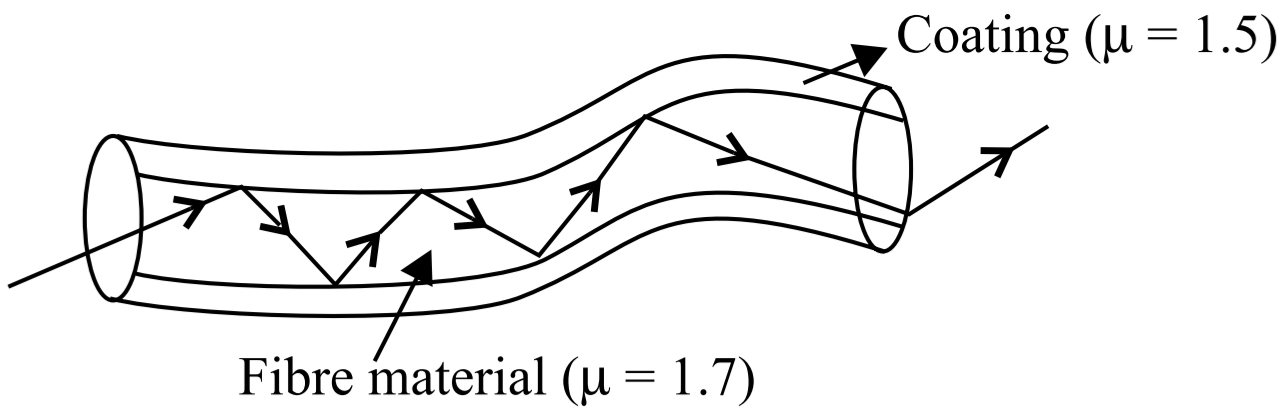
An endoscope is made of optical fibres. Its core is made of optically denser material. Its outer cladding is made of optically rarer material. It is based on total internal reflection.
View full question & answer
MCQ 21 Mark
Two statements are given$-$one labelled Assertion $(A)$ and the other labelled Reason $(R)$. Select the correct answer to these questions from the codes $(a), (b), (c)$ and $(d)$ as given below.
Assertion: The focal length of an equiconvex lens placed in air is equal to radius of curvature of either face. Lens is made up of material of refractive index of $1.5.$
Reason: For an equiconvex lens, radius of curvature of both the faces is same.
  • A
    Both $A$ and $R$ are true and $R$ is the correct explanation of $A.$
  • Both $A$ and $R$ are true but $R$ is not the correct explanation of $A.$
  • C
    $A$ is true but $R$ is false.
  • D
    $A$ is false and $R$ is also false.
Answer
Correct option: B.
Both $A$ and $R$ are true but $R$ is not the correct explanation of $A.$
For an equiconvex lens, $R_1= R_2= R$
From $\frac{1}{\text{f}}=(\mu-1)\Big(\frac{1}{\text{R}_1}-\frac{1}{\text{R}_2}\Big)$
Using lens maker's formula for glass, $\mu = 1.5$
placed in air $\frac{1}{\text{f}}=(1.5-1)\frac{2}{\text{R}}\Rightarrow\text{f}=\text{R}.$
View full question & answer
Question 31 Mark
Two statements are given-one labelled Assertion (A) and the other labelled Reason (R). Select the correct answer to these questions from the codes (a), (b), (c) and (d) as given below.
  1. Both A and R are true and R is the correct explanation of A.
  2. Both A and R are true but R is not the correct explanation of A.
  3. A is true but R is false.
  4. A is false and R is also false.
Assertion: The minimum distance between an object and its real image formed by a convex lens is 2f.
Reason: The distance between an object and its real image is minimum when its magnification is two.
Answer
  1. A is false and R is also false.
Explanation:

The distance between the object and its real image is minimum when magnification is I. We know that the magnification of convex lens is given by $\text{m}=-\frac{\text{v}}{\text{u}}$ for m = 1, v = -u.

Now from lens formula, v = u = 2f

Hence, minimum distance v + u = 4f.
View full question & answer
Question 41 Mark
Two statements are given-one labelled Assertion (A) and the other labelled Reason (R). Select the correct answer to these questions from the codes (a), (b), (c) and (d) as given below.
  1. Both A and R are true and R is the correct explanation of A.
  2. Both A and R are true but R is not the correct explanation of A.
  3. A is true but R is false.
  4. A is false and R is also false.
Assertion: The light travelling from air to glass can not suffer total internal reflection.
Reason: Air is rarer than glass.
Answer
  1. Both A and R are true but R is not the correct explanation of A.
Explanation:

The light travelling from air to glass cannot suffer total internal reflection because for total internal reflection, the essential condition is that light should travel from a denser medium to a rarer medium with incidence angle more than the critical angle.
View full question & answer
Question 51 Mark
Two statements are given-one labelled Assertion (A) and the other labelled Reason (R). Select the correct answer to these questions from the codes (a), (b), (c) and (d) as given below.
  1. Both A and R are true and R is the correct explanation of A.
  2. Both A and R are true but R is not the correct explanation of A.
  3. A is true but R is false.
  4. A is false and R is also false.
Assertion: The images formed by total intemal reflections are brighter than those formed by mirrors or lenses.
Reason: There is no loss of intensity in total internal reflection.
Answer
  1. Both A and R are true and R is the correct explanation of A.
Explanation:

In total internal reflection, 100% of incident light is reflected back into the same medium, and there is no loss of intensity, while in reflection from mirrors and refraction from lenses, th ere is always some loss of intensity. Therefore images formed by total internal reflection are much brighter than those formed by mirrors or lenses.
View full question & answer
Question 61 Mark
Two statements are given-one labelled Assertion (A) and the other labelled Reason (R). Select the correct answer to these questions from the codes (a), (b), (c) and (d) as given below.
  1. Both A and R are true and R is the correct explanation of A.
  2. Both A and R are true but R is not the correct explanation of A.
  3. A is true but R is false.
  4. A is false and R is also false.
Assertion: If optical density ofa substance is more than that of water, then the mass density of substance can be less than water.
Reason: Optical density and mass density are not related.
Answer
  1. Both A and R are true and R is the correct explanation of A.
Explanation:

Optical density and mass density are not related to each other. Mass density is mass per unit volume. It is possible that mass density of an optically denser medium be less than that of an optically rarer medium (optical density is the ratio of the speed of light in two media). e.g., turpentine and water. Mass density of turpentine is less than that of water but its optical density is higher.
View full question & answer
Question 71 Mark
Two statements are given-one labelled Assertion (A) and the other labelled Reason (R). Select the correct answer to these questions from the codes (a), (b), (c) and (d) as given below.
  1. Both A and R are true and R is the correct explanation of A.
  2. Both A and R are true but R is not the correct explanation of A.
  3. A is true but R is false.
  4. A is false and R is also false.
Assertion: A convex lens is made of two different materials. A point object is placed on the principal axis. The number of images formed by the lens will be two.
Reason: The image formed by convex lens is always virtual.
Answer
  1. A is true but R is false.
Explanation:

Since thelensis made of two different materials of different refractive indices, there will be two different focal lengths of the lens. Hence two images will be fanned. The image fanned by convex lens is always real except in case when object is placed between optical centre and focus.
View full question & answer
MCQ 81 Mark
Two statements are given-one labelled Assertion $(A)$ and the other labelled Reason $(R)$. Select the correct answer to these questions from the codes $(a), (b), (c)$ and $(d)$ as given below.
Assertion: Goggles have zero power.
Reason: Radius of curvature of both sides of lens is same.
  • Both $A$ and $R$ are true and $R$ is the correct explanation of $A.$
  • B
    Both $A$ and $R$ are true but $R$ is not the correct explanation of $A.$
  • C
    $A$ is true but $R$ is false.
  • D
    $A$ is false and $R$ is also false.
Answer
Correct option: A.
Both $A$ and $R$ are true and $R$ is the correct explanation of $A.$
Goggles have zero power.
The focal length is given by $\frac{1}{\text{f}}=(\mu-1)\Big(\frac{1}{\text{R}_1}-\frac{1}{\text{R}_2}\Big).$
For goggle lenses, both sides are curved the same way. $R_1$ and $R_2$ are positive.
If they are the same, $\frac{1}{\text{f}}=0$
i.e., power is zero.
View full question & answer
MCQ 91 Mark
Two statements are given-one labelled Assertion $(A)$ and the other labelled Reason $(R).$ Select the correct answer to these questions from the codes $(a), (b), (c)$ and $(d)$ as given below.
Assertion: If objective and eye lenses of a microscope are interchanged then it can work as telescope.
Reason: The objective lens of telescope has small focal length.
  • A
    Both $A$ and $R$ are true and $R$ is the correct explanation of $A.$
  • B
    Both $A$ and $R$ are true but $R$ is not the correct explanation of $A.$
  • C
    $A$ is true but $R$ is false.
  • $A$ is false and $R$ is also false.
Answer
Correct option: D.
$A$ is false and $R$ is also false.
We cannot interchange the objective and eye lenses of a microscope to make a telescope. The reason is that the focal length of lenses in microscope are very small, of the order of mm or a few cm and the difference $(f_0 - f_e)$ is very small, while the telescope objective have a very large focal length as compared to eye lens of microscope.
View full question & answer
Question 101 Mark
Two statements are given-one labelled Assertion (A) and the other labelled Reason (R). Select the correct answer to these questions from the codes (a), (b), (c) and (d) as given below.
  1. Both A and R are true and R is the correct explanation of A.
  2. Both A and R are true but R is not the correct explanation of A.
  3. A is true but R is false.
  4. A is false and R is also false.
Assertion: Optical fibers are used to transmit light without any loss in its intensity over distance of several kilometers. Reason: Optical fibers are very thick and all the light is passed through it without any loss.
Answer
  1. A is true but R is false.
Explantion:
Optical fiber is extremely thin (radius of few microns) and long strand of very fine quality glass or quartz. When tight is incident at a small angle at one end, it gets refracted into the strands (or fibres) and incident on the interface of the fibres and the coating. The angle of incidence being greater than the critical angle, the ray of light undergoes total internal reflections. It suffers the internal reflection again and again, till the angle of incidence remains greater than the critical angle for fibre material with respect to coating. Due to successive total internal reflection there is no loss of intensity in optical fibres.
View full question & answer
Question 111 Mark
Two statements are given-one labelled Assertion (A) and the other labelled Reason (R). Select the correct answer to these questions from the codes (a), (b), (c) and (d) as given below.
  1. Both A and R are true and R is the correct explanation of A.
  2. Both A and R are true but R is not the correct explanation of A.
  3. A is true but R is false.
  4. A is false and R is also false.
Assertion: Convergent lens property of converging remains same in all media.
Reason: Property of lens whether the ray is diverging or converging is independent of the surrounding medium.
Answer
  1. A is false and R is also false.
Explanation:

A convex lens made of glass behaves as a convergent lens when placed in air or water. However when the same lens is immersed in carbon disulphide $(\mu = 1.63),$ it behaves as a divergent lens. Therefore when a convergent lens is placed inside a transparent medium of refractive index greater than that of material of the lens, it behaves as a divergent lens. Behaviour of a lens depends on the refractive index of a surrounding medium.
View full question & answer
Question 121 Mark
Two statements are given-one labelled Assertion (A) and the other labelled Reason (R). Select the correct answer to these questions from the codes (a), (b), (c) and (d) as given below.
  1. Both A and R are true and R is the correct explanation of A.
  2. Both A and R are true but R is not the correct explanation of A.
  3. A is true but R is false.
  4. A is false and R is also false.
Assertion: Optical fibres are used for telecommunication.
Reason: Optical fibres are based on the phenomenon of total internal reflection.
Answer
  1. Both A and R are true and R is the correct explanation of A.
Explanation:

Optical fibers are used in communication and it is because of the phenomenon named as total internal reflection, taking place inside the fiber for the incident signal.
View full question & answer
Question 131 Mark
Two statements are given-one labelled Assertion (A) and the other labelled Reason (R). Select the correct answer to these questions from the codes (a), (b), (c) and (d) as given below.
  1. Both A and R are true and R is the correct explanation of A.
  2. Both A and R are true but R is not the correct explanation of A.
  3. A is true but R is false.
  4. A is false and R is also false.
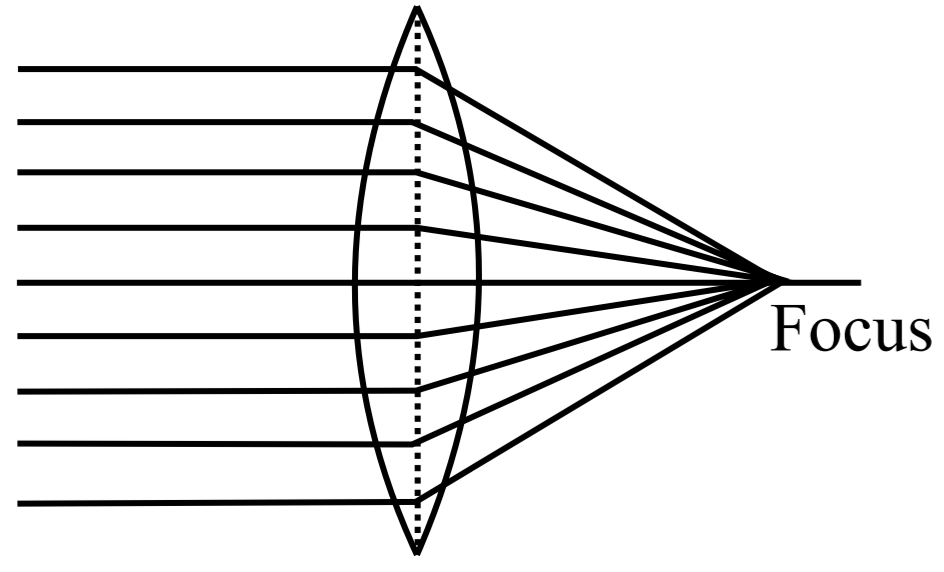
Assertion: The illuminance of an image produced by a convex lens is greater in the middle and less towards the edges.
Reason: The middle part of image is fanned by undeflected rays while outer part by inclined rays.
Answer
  1. Both A and R are true and R is the correct explanation of A.
Explanation:

Image formed by convex lens,

View full question & answer
Question 141 Mark
Two statements are given-one labelled Assertion (A) and the other labelled Reason (R). Select the correct answer to these questions from the codes (a), (b), (c) and (d) as given below.
  1. Both A and R are true and R is the correct explanation of A.
  2. Both A and R are true but R is not the correct explanation of A.
  3. A is true but R is false.
  4. A is false and R is also false.
Assertion: A convex lens of glass $(\mu = 1.5)$ behave as a diverging lens when immersed in carbon disulphide of higher refractive index $(\mu = 1.65).$
Reason: A diverging lens is thinner in the middle and thicker at the edges.
Answer
  1. Both A and R are true but R is not the correct explanation of A.
Explanation:

$\mu=\frac{\mu_\text{g}}{\mu_\text{c}}=\frac{1.5}{1.65}<1$

From $\frac{1}{\text{f}}=(\mu-1)\Big(\frac{1}{\text{R}_1}-\frac{1}{\text{R}_2}\Big)$ f becomes negative.

Therefore, the lens behaves as a diverging lens.
View full question & answer
Question 151 Mark
Two statements are given-one labelled Assertion (A) and the other labelled Reason (R). Select the correct answer to these questions from the codes (a), (b), (c) and (d) as given below.
  1. Both A and R are true and R is the correct explanation of A.
  2. Both A and R are true but R is not the correct explanation of A.
  3. A is true but R is false.
  4. A is false and R is also false.
Assertion: A double convex lens $(\mu = 1.5)$ has focal length 10cm. When the lens is immersed in water $\big(\mu=\frac{4}{3}\big)$ its focal length becomes 78.24cm.
Reason: $\frac{1}{\text{f}}=\frac{\mu_\text{g}-\mu_\text{m}}{\mu_\text{m}}\Big(\frac{1}{\text{R}_1}-\frac{1}{\text{R}_2}\Big).$
Answer
  1. Both A and R are true and R is the correct explanation of A.
Explanation:

$\frac{1}{\text{f}}=(^\text{w}\mu_\text{g}-1)\Big[\frac{1}{\text{R}_1}-\frac{1}{\text{R}_2}\Big]$

$=\Big(\frac{\mu_\text{g}}{\mu_\text{w}}-{1}\Big)\Big(\frac{1}{\text{R}_1}-\frac{1}{\text{R}_2}\Big)$

$\frac{1}{\text{f}}=\Big(\frac{\mu_\text{g}-\mu_\text{w}}{\mu_\text{w}}\Big)\times\Big[\frac{1}{\text{R}_1}-\frac{1}{\text{R}_2}\Big]$

$=\Big(\frac{1.5-1.33}{1.33}\Big)\times\Big[\frac{1}{\text{R}_1}+\frac{1}{\text{R}_2}\Big]$

$\therefore\text{f}=78.24\text{cm}$
View full question & answer
Question 161 Mark
Two statements are given-one labelled Assertion (A) and the other labelled Reason (R). Select the correct answer to these questions from the codes (a), (b), (c) and (d) as given below.
  1. Both A and R are true and R is the correct explanation of A.
  2. Both A and R are true but R is not the correct explanation of A.
  3. A is true but R is false.
  4. A is false and R is also false.
Assertion: By increasing the diameter of the objective of telescope, we can increase its range.
Reason: The range of a telescope tells us how far away a star of some standard brightness can be spotted by telescope.
Answer
  1. Both A and R are true but R is not the correct explanation of A.
Explanation:

The light gathering power (or brightness) of a telescope is directly proportional to the area of the objective lens.

i.e., light gathering power $\propto\pi\text{r}^2=\frac{\pi\text{D}^2}{4},$ where D is the diameter of the objective. Thus telescope will have large light gathering power if the diameter of the objective lens is large. So by increasing the objective diameter even far off stars may produce images of optimum brightness.
View full question & answer
Question 171 Mark
Two statements are given-one labelled Assertion (A) and the other labelled Reason (R). Select the correct answer to these questions from the codes (a), (b), (c) and (d) as given below.
  1. Both A and R are true and R is the correct explanation of A.
  2. Both A and R are true but R is not the correct explanation of A.
  3. A is true but R is false.
  4. A is false and R is also false.
Assertion: It is possible to eliminate dispersion by combining two prism of same refracting angles but of different materials.
Reason: The angular dispersion does not depend on refractive index of the material of the prism.
Answer
  1. A is false and R is also false.
Explanation:

For a prism of small angle A, the angular dispersion produced $=(\mu_\text{v}-\mu_\text{R})\text{A}.$ This can be cancelled by a second prism of angle A' made of different material such that $(\mu'_\text{v}-\mu'_\text{R})\text{A}'=(\mu_\text{v}-\mu_\text{R})\text{A}.$

If only A = A', then the dispersion produced by one prism cannot be cancelled by the dispersion produced by the other prism because,

$(\mu'_\text{v}-\mu'_\text{R})\text{A}'=(\mu_\text{v}-\mu_\text{R})\text{A}$ for different materials Therefore in order to eliminate dispersion by combining two prism they should have same refracting angle and made of same material.
View full question & answer
Question 181 Mark
Two statements are given-one labelled Assertion (A) and the other labelled Reason (R). Select the correct answer to these questions from the codes (a), (b), (c) and (d) as given below.
  1. Both A and R are true and R is the correct explanation of A.
  2. Both A and R are true but R is not the correct explanation of A.
  3. A is true but R is false.
  4. A is false and R is also false.
Assertion: The diamond shines due to multiple total intemal reflections.
Reason: The critical angle for diamond is 24.4°.
Answer
  1. Both A and R are true but R is not the correct explanation of A.
Explanation:

The brilliance of diamond is due to total internal reflection of tight. $\mu$ t for diamond is 2.42, so that critical angle for diamond air interface is C = 24.4° $\big($from sin $\text{C}=\frac{1}{\mu}\big).$ The diamond is cut suitable so that light entering the diamond from any face suffers multiple total internal reflections at the various faces and remains within the diamond Hence the diamond sparkles.
View full question & answer
Question 191 Mark
Two statements are given-one labelled Assertion (A) and the other labelled Reason (R). Select the correct answer to these questions from the codes (a), (b), (c) and (d) as given below.
  1. Both A and R are true and R is the correct explanation of A.
  2. Both A and R are true but R is not the correct explanation of A.
  3. A is true but R is false.
  4. A is false and R is also false.
Assertion: A single lens produces a coloured image of an object illuminated by white light.
Reason: The refractive index of the material of lens is different for different wavelengths of light.
Answer
  1. Both A and R are true and R is the correct explanation of A.
Explanation:

Due to the variation of the refractive index of the material of the lens, the focal length also varies accordingly. Now as white tight is composed of different colours of light, each colour will produce its own image based on the focal length for that colour. This particular phenomenon for a single lens is known as chromatic aberration.
View full question & answer
Question 201 Mark
Two statements are given-one labelled Assertion (A) and the other labelled Reason (R). Select the correct answer to these questions from the codes (a), (b), (c) and (d) as given below.
  1. Both A and R are true and R is the correct explanation of A.
  2. Both A and R are true but R is not the correct explanation of A.
  3. A is true but R is false.
  4. A is false and R is also false.
Assertion: Microscope magnifies the image.
Reason: Angular magnification for image is more than object in microscope.
Answer
  1. Both A and R are true and R is the correct explanation of A.
Explanation:

Microscope is an optical instrument which forms a magnified image of a small near by object and thus, increases the visual angle subtended by the image at the eye so that the object is seen to be bigger and distinct. Therefore, angular magnification for image is more than object.
View full question & answer