Questions

3 Marks Question

Take a timed test

23 questions · self-marked practice — reveal the answer and mark yourself.

Question 13 Marks
What should be added to $4c (-a + b + c)$ to obtain $3a(a + b + c) - 2b(a – b + c)?$
Answer
Let $x$ be added to the given expression
$4c(-a + b + c)$ to obtain $3a(a + b + c) - 2b(a - b + c)$
i.e., $4c(-a + b + c)$
$= 3a(a + b + c) - 2b(a + b + c)$
$x = 3a(a + b + c) - 2b(a - b + c) - 4c(-a + b + c)$
$ =3 a^2+3 a b+3 a c-2 b a+2 b^2-2 b c+4 c a-4 c b-4 c^2 $
$ x=3 a^2+a b+7 a c+2 b^2-6 b c-4 c^2 $
View full question & answer
Question 23 Marks
Verify the following: $(a + b)(a + b)(a + b) = a^3+ 3a^2b + 3ab^2+ b^3$
Answer
$(a + b)(a + b)(a + b) = a^3+ 3a^2b + 3ab^2+ b^3$
Taking $LHS$
$ (a+b)(a+b)(a+b) $
$ =(a+b)(a+b)^2 $
$ =(a+b)\left(a^2+b^2+2 a b\right) $
$ =a\left(a^2+2 a b+b^2\right)+b\left(a^2+2 a b+b^2\right) $
$ =a^3+2 a^2 b+a b^2+b a^2+2 a b^2+b^3 $
$ =a^3+3 a^2 b+3 a b^2+b^3 $
$= RHS$
Hence verified
View full question & answer
Question 33 Marks
Multiply the following: $(2x - 2y - 3), (x + y + 5)$
Answer
$(2x - 2y - 3), (x + y + 5)$
We have,
$(2 x-2 y-3)(x+y+5) $
$ =2 x(x+y+5)-2 y(x+y+5)-3(x+y+5) $
$ =2 x^2+2 x y+10 x-2 y x-2 y^2-10 y-3 x-3 y-15 $
$ =2 x^2+2 x y-2 y x+10 x-3 x-2 y^2-10 y-3 y-15 $
$ =2 x^2+7 x-13 y-2 y^2-15 $
View full question & answer
Question 43 Marks
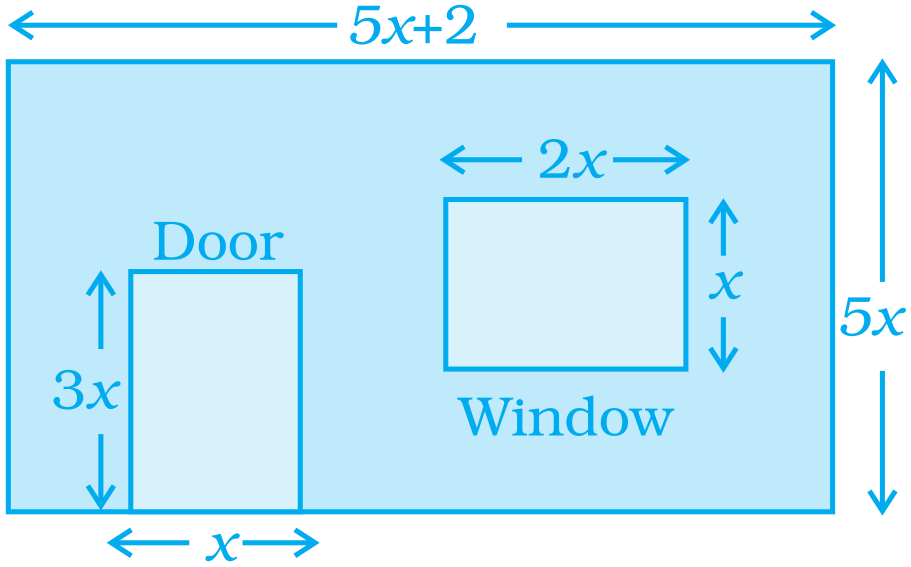
The figure shows the dimensions of a wall having a window and a door of a room. Write an algebraic expression for the area of the wall to be painted.
Answer
A wall dimensions $5x \times (5x + 2)$ having a window & a door of dimensions $(2x \times 3)$ and $(3x \times x)$ respectively Then,
Area of the window $= 2x \times x = 2x^2$ sq.units
Area of the door $= 3x \times x = 3x2$ sq.units
And the area of wall $= 5x + 2 \times 5x = (25x2 + 10x)$ sq.units
Now,
Area of the required part of the wall to be painted
= Area of the wall - (Area of the window + Area of the door)
$ =25 x^2+10 x-\left(2 x^2+3 x^2\right) $
$ =25 x^2+10 x-5 x^2 $
$ =20 x^2+10 x $
$= 2 \times 2 \times 5 \times x \times x + 2 \times 5 \times x$
$= 2 \times 5 \times x(2x + 1)$
$= 10x(2x + 1)$ sq.units
View full question & answer
Question 53 Marks
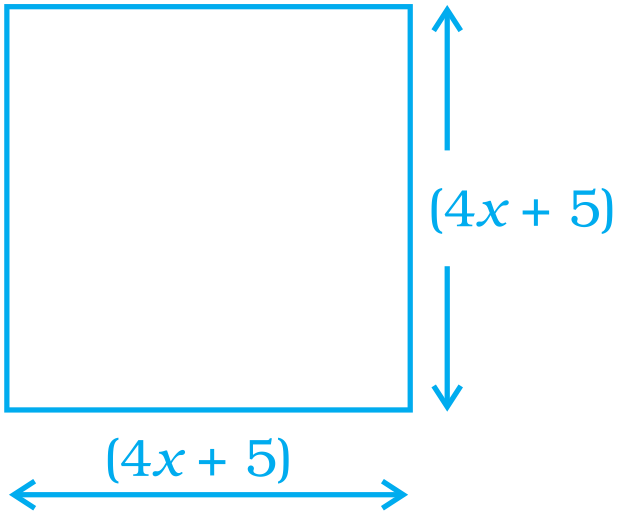
Find the length of the side of the given square if area of the square is $625$ square units and then find the value of $x. $
Answer
A square having length of a side $(4x + 5)$ units and area is $625$ sq.units.
Area of a square $= (side)^2$
$(4x + 5)^2= 625$
$(4x + 5)^2= (25)^2$
$4x + 5 = 25$
$4x = 25 - 5$
$\text{x}=\frac{20}{4}=5$
Hence, side $= 4x + 5 = 4 \times 5 + 5 = 25$ units
View full question & answer
Question 63 Marks
The product of two expressions is $x^5+ x^3+ x$. If one of them is $x^2+ x + 1$, find the other.
Answer
The product of two expressions $= x^5+ x^3+ x$ and one $= x^2+ x +1$ Let the expression be A$\text{A}(\text{x}^2+\text{x}+1)=\text{x}^5+\text{x}^3+\text{x}$
$\text{A}=\frac{\text{x}^5+\text{x}^3+\text{x}}{\text{x}^2+\text{x}+1}$
$=\frac{\text{x}(\text{x}^4+\text{x}^2+1)}{\text{x}^2+\text{x}+1}$
$\text{A}=\frac{\text{x}(\text{x}^4+2\text{x}^2-\text{x}^2+1)}{\text{x}^2+\text{x}+1}$
$=\frac{\text{x}(\text{x}^4+2\text{x}^2+1-\text{x}^2)}{\text{x}^2+\text{x}+1}$
$=\frac{\text{x}\Big[\big(\text{x}^4+2\text{x}^2+1\big)\Big]}{\text{x}^2+\text{x}+1}$
$=\frac{\text{x}\Big[\big(\text{x}^2+1\big)^2-\text{x}^2\Big]}{\text{x}^2+\text{x}+1}$
$=\frac{\text{x}\Big(\text{x}^2+1+\text{x}\Big)\Big(\text{x}^2+1-\text{x}\Big)}{\text{x}^2+\text{x}+1}$
$=\text{x}(\text{x}^2+1-\text{x})$
Hence, the other expression is $x(x^2+ 1 - x)$
View full question & answer
Question 73 Marks
Subtract: $3t^4- 4t^3+ 2t^2- 6t + 6$ from $-4t^4+ 8t^3- 4t^2- 2t + 11$
Answer
The required distance is given by
$ =\left(-4 t^4+8 t^2-4 t^2-2 ?+11\right)-\left(3 t^4-4 t^3+2 t^2-6 t+6\right) $
$ =-4 t^4+8 t^3-4 t^2-2 t+11-3 t^4+4 t^3-2 t^2+6 t-t $
$ =\left(-4 t^4-3 t^4\right)+\left(8 t^3+4 t^3\right)+\left(-4 t^4-2 t^2\right)+(-2 t+6 t)+(11-6) $
$ =\left(-7 t^4+12 t^3-6 t^2+4 t+5\right) $
View full question & answer
Question 83 Marks
Match the expressions of column $I$ with that of column $II:$
 
Column $I$
 
Column $II$
$(1)$
$(21 x+13 y)^2$
$(a)$
$441 x^2-169 y^2$
$(2)$
$(21 x-13 y)^2$
$(b)$
$441 x^2+169 y^2+546 x y$
$(3)$
$(21 x-13 y)(21 x+13 y)$
$(c)$
$441 x^2+169 y^2-546 x y$
 
 
$(d)$
$441 x^2-169 y^2+546 x y$
Answer
 
Column $I$
 
Column $II$
$(1)$
$(21 x+13 y)^2$
$(b)$
$441 x^2+169 y^2+546 x y$
$(2)$
$(21 x-13 y)^2$
$(c)$
$441 x^2+169 y^2-546 x y$
$(3)$
$(21 x-13 y)(21 x+13 y)$
$(a)$
$441 x^2-169 y^2$
Solution:
$i. (21x + 13y)^2$
$ =(21 x)^2+(13 y)^2+2 \times 21 x \times 13 y $
$ =441 x^2+169 y^2+546 x y $
$ii. (21x - 13y)^2$
$ =(21 x)^2+(13 y)^2-2 \times 21 x \times 13 y $
$ =441 x^2+169 y^2-546 x y $
$iii. (21x - 13y)(21x + 13y)$
$ =(21 x)^2-(13 y)^2 $
$ =441 x^2-169 y^2 $
View full question & answer
Question 93 Marks
Verify the following: $(ab + bc)(ab - bc) + (bc + ca)(bc - ca) + (ca + ab)(ca - ab) = 0$
Answer
$(ab + bc)(ab - bc) + (bc + ca)(bc - ca) + (ca + ab)(ca - ab) = 0$
Taking $LHS$
$(ab + bc)(ab - bc) + (bc + ca)(bc - ca) + (ca + ab)(ca - ab)$
$ =\left[(a b)^2-(b c)^2\right]+\left[(b c)^2-(c a)^2\right]+\left[(c a)^2-(a b)^2\right] $
$=a^2 b^2-b^2 c^2+b^2 c^2-c^2 a^2+c^2 a^2-a^2 b^2=0 $
$= RHS$
Hence verified
View full question & answer
Question 103 Marks
Perform the following divisions:
$\left(x^3 y^3+x^2 y^3-x y^4+x y\right) \div x y$
Answer
$\left(x^3 y^3+x^2 y^3-x y^4+x y\right) \div x y$
$\frac{\text{x}^3\text{y}^3+\text{x}^2\text{y}^3-\text{xy}^4+\times\text{xy}}{\text{xy}}$
$=\frac{\text{x}^3\text{y}^3}{\text{xy}}+\frac{\text{x}^2\text{y}^3}{\text{xy}}-\frac{\text{xy}^4}{\text{xy}}+\frac{\text{xy}}{\text{xy}}$
$=\frac{\text{x}^3\text{y}^3\times\text{x}^2\text{y}^3\times\text{xy}^4\text{xy}}{\text{xy}}$
$=\frac{\text{x}^3\text{y}^3}{\text{xy}}+\frac{\text{x}^2\text{y}^3}{\text{xy}}-\frac{\text{xy}^4}{\text{xy}}+\frac{\text{xy}}{\text{xy}}$
$=\frac{\text{x}\times\text{x}\times\text{x}\times\text{y}\times\text{y}\times\text{y}}{\text{x}\text{y}}+\frac{\text{x}\times\text{x}\times\text{y}\times\text{y}\times\text{y}}{\text{x}\times\text{y}}-\frac{\text{x}\times\text{y}\times\text{y}\times\text{y}\times\text{y}}{\text{x}\times\text{y}}+\frac{\text{x}\times\text{y}}{\text{x}\times\text{y}}$
$=\text{x}^2\text{y}^2+\text{xy}^2-\text{y}^3+1$
View full question & answer
Question 113 Marks
Subtract:
$2 a b^2 c^2+4 a^2 b^2 c-5 a^2 b c^2$ from $-10 a^2 b^2 c+4 a b^2 c^2+2 a^2 b c^2$
Answer
The required difference is given by
$ \left(-10 a^2 b^2 c+4 a b^2 c^2+2 a b c^2\right)-\left(2 a b^2 c^2+4 a^2 b^2 c-5 a^2 b c^2\right) $
$ =-10 a^2 b^2 c+4 a^2 b^2 c+2 a^2 b c^2-2 a b^2 c^2-4 a^2 b^2 c+5 a^2 b c^2 $
$ =\left(-10 a^2 b^2 c-4 a^2 b^2 c\right)+\left(4 a b^2 c-2 a b^2 c^2\right)+\left(2 a^2 b c^2+5 a^2 b c^2\right) $
$ =\left(-14 a^2 b^2 c+2 a b^2 c^2+7 a^2 b c^2\right)$
View full question & answer
Question 123 Marks
Multiply the following:
$ \left(3 x^2+4 x-8\right),\left(2 x^2-4 x+3\right)$
Answer
$ \left(3 x^2+4 x-8\right),\left(2 x^2-4 x+3\right)$
$\left(3 x^2+4 x-8\right)\left(2 x^2-4 x+3\right)$
$=3 x^2\left(2 x^2-4 x+3\right)+4 x\left(2 x^2-4 ?+3\right)-8\left(2 x^2-4 x+3\right)$
$=6 x^4-12 x^3+9 x^2 $
$ +8 x^3-16 x^2+12 x-6 x^2+32 x-24$
$=6 x^4-12 x^3+8 x^3+9 x^2-16 x^2-16 x^2+12 x+32 x-24$
$=6 x^4-4 x^3-23 x^2+44 x-24 $
View full question & answer
Question 133 Marks
Multiply the following:

$\Big(\frac{3}{4}\text{x}-\frac{4}{3}\text{y}\Big),\Big(\frac{2}{3}\text{x}+\frac{3}{2}\text{y}\Big)$

Answer
$\Big(\frac{3}{4}\text{x}-\frac{4}{3}\text{y}\Big),\Big(\frac{2}{3}\text{x}+\frac{3}{2}\text{y}\Big)$

$\Big(\frac{3}{4}\text{x}-\frac{4}{3}\text{y}\Big)\Big(\frac{2}{3}\text{x}+\frac{3}{2}\text{y}\Big)$$=\frac{3}{4}\text{x}\Big(\frac{2}{3}\text{x}+\frac{3}{2}\text{y}\Big)-\frac{4}{3}\text{y}\Big(\frac{2}{3}\text{x}+\frac{3}{2}\text{y}\Big)$

$=\frac{3}{4}\times\frac{2}{3}\text{x}^2+\frac{3}{4}\times\frac{3}{2}\text{xy}-\frac{4}{3}\times\frac{2}{3}\text{yx}-\frac{4}{3}\times\frac{3}{2}\text{y}^2$

$=\frac{1}{2}\text{x}^2+\frac{9}{8}\text{xy}-\frac{8}{9}\text{xy}-2\text{y}^2$

$=\frac{1}{2}\text{x}^2+\Big(\frac{9}{8}-\frac{9}{8}\Big)\text{xy}-2\text{y}^2$

$=\frac{1}{2}\text{x}^2\Big(\frac{81-64}{72}\Big)\text{xy}-2\text{y}^2$

$=\frac{1}{2}\text{x}^2\Big(\frac{17}{72}\Big)\text{xy}-2\text{y}^2$

View full question & answer
Question 143 Marks
Multiply the following:$\frac{3}{2}\text{p}^2+\frac{2}{3}\text{q}^2,\big(2\text{p}^2-3\text{q}^2\big)$
Answer
$\frac{3}{2}\text{p}^2+\frac{2}{3}\text{q}^2,\big(2\text{p}^2-3\text{q}^2\big)$$\Big(\frac{3}{2}\text{p}^2+\frac{2}{3}\text{q}^2\Big)\big(2\text{p}^2-3\text{q}^2\big)\\=\frac{3}{2}\text{p}^2\big(2\text{p}^2-3\text{q}^2\big)+\frac{2}{3}\text{q}^2\big(2\text{p}^2-3\text{q}^2\big)$
$=\frac{3}{2}\text{p}^2\times2\text{p}^2-\frac{9}{2}\text{p}^2\text{q}^2+\frac{4}{3}\text{q}^2\text{p}^2-2\text{q}^4$
$=3\text{p}^4+\Big(\frac{4}{3}-\frac{9}{2}\Big)\text{p}^2\text{q}^2-2\text{q}^4$
$=3\text{p}^4+\Big(\frac{8-27}{6}\Big)\text{p}^2\text{q}^2-2\text{q}^4$
$=3\text{p}^4-\frac{19}{6}\text{p}^2\text{q}^2-2\text{q}^4$
View full question & answer
Question 153 Marks
The sum of $(x + 5)$ observations is $x^4- 625$. Find the mean of the observations.
Answer
The sum of $(x+ 5)$ observations $= x^4- 625$
The mean n observation $x1, x2 …. x_n$ is given by $\frac{(\text{x}_1+\text{x}_2+....\text{x}_\text{n})}{\text{n}}$
The mean of $(x + 5)$ observations
$=\frac{\text{Sum of }(\text{x}+5)\text{observations}}{\text{x}+5}$
$=\frac{\text{x}^4-625}{\text{x}+5}=\frac{(\text{x}^2)^2-(25)^2}{\text{x}+5}$
$=\frac{(\text{x}^2+25)(\text{x}^2-25)}{\text{x}+5}$
$=\frac{(\text{x}^2+25)[(\text{x})^2-(5)^2]}{\text{x}+5}$
$=\frac{(\text{x}^2+25)(\text{x}+5)(\text{x}-5)}{\text{x}+5}$
$(\text{x}^2+25)(\text{x}-5)$
View full question & answer
Question 163 Marks
The cost of a chocolate is Rs $(x + y)$ and Rohit bought $(x + y)$ chocolates. Find the total amount paid by him in terms of $x$. If $x = 10,$ find the amount paid by him.
Answer
Cost of a chocolate $= Rs. (x + 4)$
Rohit brought $(x + 4)$ chocolates
The cost of $(x + 4)$ chocolates = cost of one $x$ Number of chocolates
$= (x + 4)(x + 4)$
$= (x + 4)^2$
$= x^2+ 8x + 16$
The total amount paid by Rohit = Rs. $(x^2+ 8x + 16)$
Now, if $x = 10.$
Then, the amount paid by Rohit $= 102 + 8 \times 10 + 16$
$= 100 + 80 + 16$
$= Rs. 196$
View full question & answer
Question 173 Marks
Verify the following: $(7p - 13q)^2+ 364pq = (7p + 13q)^2$
Answer
$(7p - 13q)^2+ 364pq = (7p + 13q)^2$
Taking $LHS$
$ =(7 p-13 q)^2+364 p q $
$ =(7 p)^2+(13 q)^2-2 \times 7 p \times 3 q+364 p q $
$ =(7 p)^2+(13 q)^2-182 p q+364 p q $
$ =(7 p)^2+(13 q)^2+182 p q $
$ =(7 p)^2+(13 q)^2+2 \times 7 p \times 13 q $
$=(7 p+13 q)^2 $
$= RHS$
Hence verified
View full question & answer
Question 183 Marks
Verify the following: $(5x + 8)^2- 160x = (5x - 8)^2$
Answer
$(5x + 8)^2- 160x = (5x - 8)^2$
Taking $LHS$
$ =(5 x+8)^2-160 x $
$ =(5 x)^2+(8)^2+2 \times 5 x \times 8-160 x $
$ =(5 x)^2+(8)^2+80 x-160 x $
$ =(5 x)^2+(8)^2-80 x $
$ =(5 x)^2+(8)^2-2 \times 5 x-8 $
$ =(5 x-8)^2 $
$= RHS$
Hence verified
View full question & answer
Question 193 Marks
Verify the following:$ (a - b)(a - b)(a - b) = a^3- 3a^2b + 3ab^2- b^3$
Answer
$ (a - b)(a - b)(a - b) = a^3- 3a^2b + 3ab^2- b^3$
Taking $LHS$
$ =(a-b)(a-b)(a-b) $
$ =(a-b)(a-b)^2 $
$ =(a-b)\left(a^2-b^2+2 a b\right) $
$ =a\left(a^2-2 a b+b^2\right)-b\left(a^2-2 a b+b^2\right) $
$=a^3-2 a^2 b+a b^2-b a^2+2 a b^2-b^3 $
$ =a^3-3 a^2 b+3 a b^2-b $
$= RHS$
Hence verified
View full question & answer
Question 203 Marks
Verify the following:
$(a+b+c)\left(a^2+b^2+c^2-a b-b c-c a\right)=a^3+b^3+c^3-3 a b c$
Answer
$(a+b+c)\left(a^2+b^2+c^2-a b-b c-c a\right)=a^3+b^3+c^3-3 a b c$
Taking $LHS$
$ (a+b+c)\left(a^2+b^2+c^2-a b-b c-c a\right) $
$ =a\left(a^2+b^2+c^2-a b-b c-c a\right)+b\left(a^2+b^2+c^2-a b-b c-c a\right) c\left(a^2+b^2+c^2-a b-b c-c a\right) $
$ =a^3+a b^2+a c^2-a^2 b-a b c-a^2 c+b a^2+b^3+b c^2-b^2 a-b^2 c-b c a+c a^2+c b^2+c^3-c a b-c^2 b-c^2 a $
$ =a^3+b^3+c^3-3 a b c $
Hence verified
View full question & answer
Question 213 Marks
Verify the following:$\Big(\frac{3\text{p}}{7}+\frac{7}{6\text{p}}\Big)^2-\Big(\frac{3}{7}\text{p}+\frac{7}{6\text{p}}\Big)^2=2$
Answer
$\Big(\frac{3\text{p}}{7}+\frac{7}{6\text{p}}\Big)^2-\Big(\frac{3}{7}\text{p}+\frac{7}{6\text{p}}\Big)^2=2$Taking $LHS$
$=\Big(\frac{3\text{p}}{7}+\frac{7}{6\text{p}}\Big)^2-\Big(\frac{3}{7}\text{p}+\frac{7}{6\text{p}}\Big)^2$
$=\bigg[\Big(\frac{3\text{p}}{7}+\frac{7}{6\text{p}}\Big)+\Big(\frac{3\text{p}}{7}-\frac{7}{6\text{p}}\Big)\bigg]\\\ \ \ \ \bigg[\Big(\frac{3\text{p}}{7}+\frac{7}{6\text{p}}\Big)-\Big(\frac{3\text{p}}{7}-\frac{7}{6\text{p}}\Big)\bigg]$
$=\Big(\frac{3\text{p}}{7}+\frac{7}{6\text{p}}+\frac{3\text{p}}{7}-\frac{7}{6\text{p}}\Big)\\\ \ \ \ \Big(\frac{3\text{p}}{7}+\frac{7}{6\text{p}}-\frac{3\text{p}}{7}+\frac{7}{6\text{p}}\Big)$
$=\frac{6\text{p}}{7}\times\frac{14}{6\text{p}}=2$
$= RHS$
Hence Verified
View full question & answer
Question 223 Marks
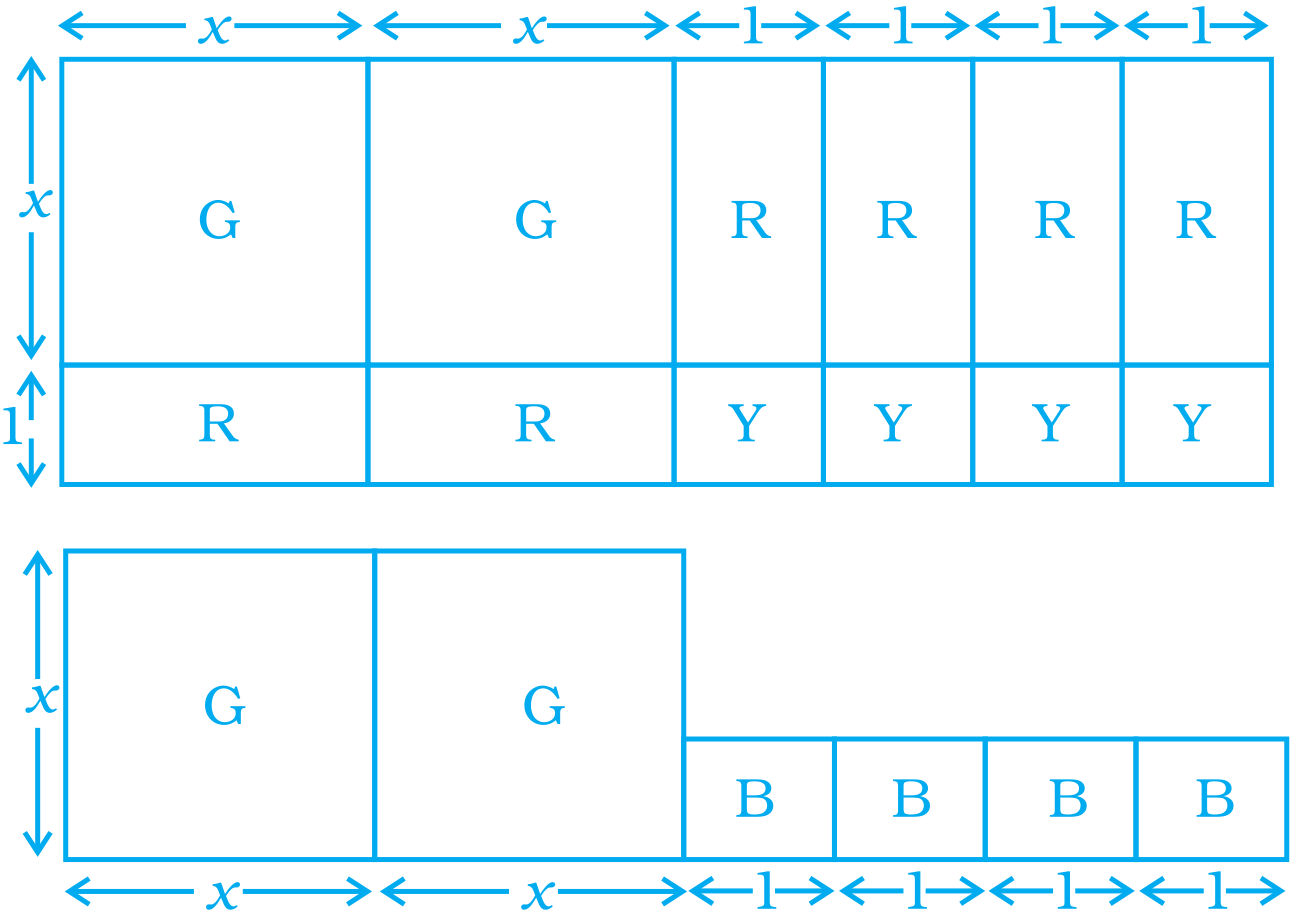
Take suitable number of cards given in the adjoining diagram $[G(x \times x)$ representing $x^2, r(x \times 1)$ representing $x$ and $? (1 \times 1)$ representing $1]$ to factorise the following expressions, by arranging the cards in the form of rectangles:
$i. 2x^2+ 6x + 4.$
$ii. x^2+ 4x + 4.$
Factorise $2? 2 + 6? + 4$ by using the figure.

Calculate the area of figure.
Answer
SELF
View full question & answer
Question 233 Marks
The curved surface area of a cylinder is $2\pi(\text{y}^2-7\text{y}+12)$ and its radius is $(y - 3)$. Find the height of the cylinder $(C.S.A$. of cylinder = $2\pi\text{rh}$).
Answer
Let the height of cylinder be h Given, curved surface area of a cylinder = $2\pi(\text{y}^2-7\text{y}+12)$ and its radius $= (y - 3)$ curved surface area of a cylinder is $2\pi\text{rh}$$2\pi\text{rh}=2\pi(\text{y}^2-7\text{y}+12)$
$2\pi\text{rh}=2\pi(\text{y}^2-4\text{y}-3\text{y}+12)$
$2\pi\text{rh}=2\pi[\text{y}(\text{y}-4)-3(\text{y}-4)]$
$=2\pi(\text{y}-3)(\text{y}-4)$
$2\pi\text{rh}=2\pi\text{r}(\text{y}-4)$
On comparing the both sides $h = y - 4$. Hence, height of the cylinder is $y - 4.$
View full question & answer