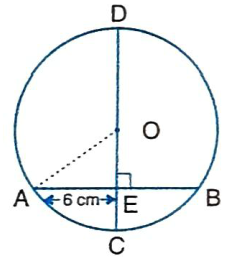
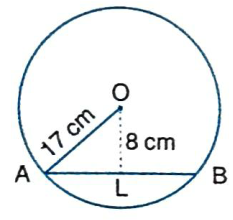
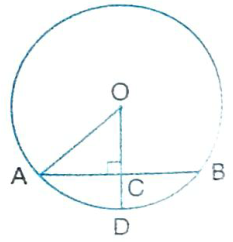
MCQ 11 Mark
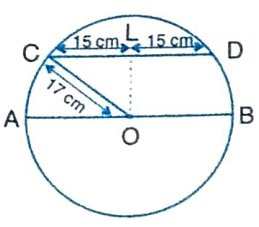
If the length of a chord of a circle is $16\ cm$ and is at a distance of $15\ cm$ from the centre of the circle, then the radius of the circle is:
- A
$15\ cm.$
- B
$16\ cm.$
- ✓
$17\ cm.$
- D
$34\ cm.$
AnswerCorrect option: C. $17\ cm.$
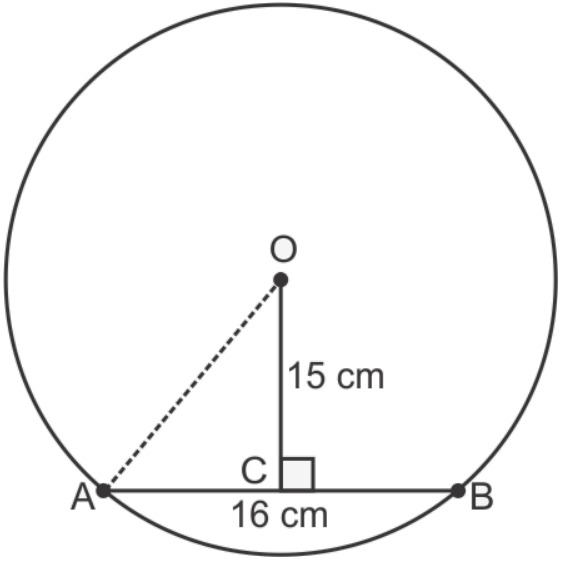
$AB = 16\ cm$
$OC = 15\ cm$
$C$ is the mid-point of $AB$.
$\text{AC}=\text{BC}=\frac{16}{2}=8\text{cm}$
Consider $\triangle\text{OCA},$
$\text{OC}=\text{15cm},\ \text{AC}=\text{8cm}$
$\Rightarrow\text{OA}=\sqrt{(15)^2+(8)^2}$
$=\sqrt{225-64}$
$=\sqrt{289}$
$\Rightarrow\text{OA}=17\text{cm}$ View full question & answer→MCQ 21 Mark
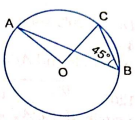
In the given figure, if $\angle\text{ABC} = 45^\circ,$ then $\angle\text{AOC} =$
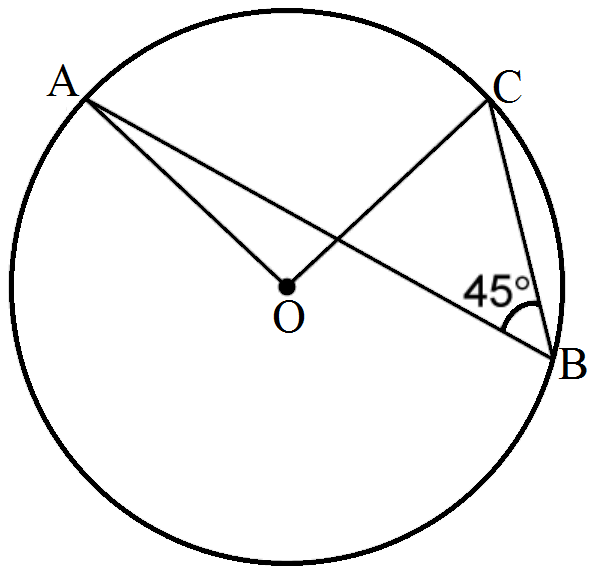
- A
$45^\circ $
- B
$60^\circ$
- C
$75^\circ$
- ✓
$90^\circ$
AnswerCorrect option: D. $90^\circ$
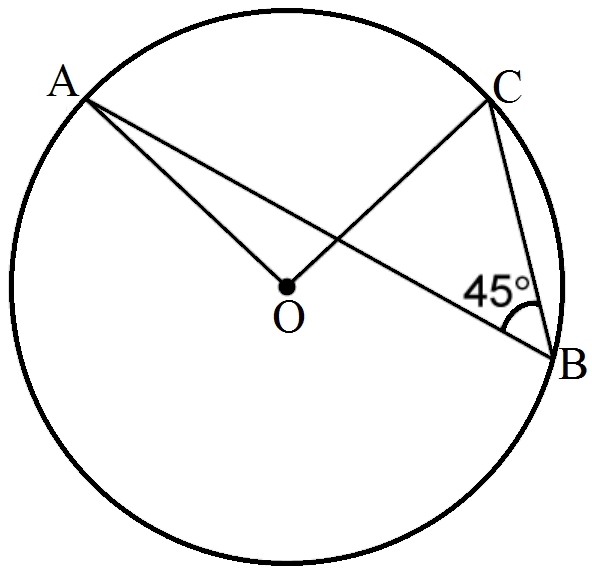
$\angle\text{AOC}$ is made by arc $\widehat{\text{AC}}$ at centre and $\angle\text{ABC}$ is made by $\widehat{\text{AC}}$ on circumference in major segment.
$\Rightarrow\angle\text{ABC}=\frac{1}{2}\angle\text{AOC}$
$\Rightarrow\angle\text{AOC}=2\times\angle\text{ABC}$
$=2\times45^\circ=90^\circ$ View full question & answer→MCQ 31 Mark
$ABC$ is a triangle with $B$ as right angle, $AC = 5\ cm$ and $AB = 4\ cm$. A circle is drawn with $A$ as centre and $AC$ as radius. The length of the chord of this circle passing through $C$ and $B$ is:
- A
$3\ cm.$
- B
$4\ cm.$
- C
$5\ cm.$
- ✓
$6\ cm.$
AnswerCorrect option: D. $6\ cm.$
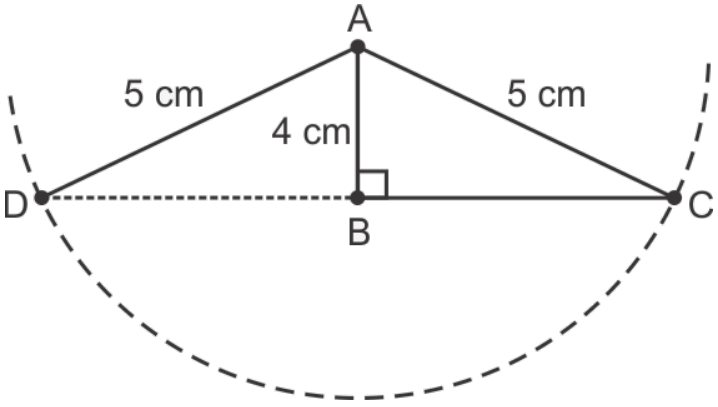
$A D$ and $A C$ are radii of same circle and $C D$ is a chord.
Consider $\triangle \mathrm{ABC}$,
$B C^2=(A C)^2-(A B)^2$
$=5^2-4^2=25-16=9$
$\Rightarrow B C=3 \mathrm{~cm}$
Chord $C D=2 \times B C=6 \mathrm{~cm}$
View full question & answer→MCQ 41 Mark
If $A , B, C$ are three points on a circle with centre $O$ such that $\angle\text{AOB} = 90^\circ$ and $\angle\text{BOC} = 120^\circ,$ then $\angle\text{ABC} =$
- A
$60^\circ $
- ✓
$75^\circ$
- C
$90^\circ$
- D
$135^\circ$
AnswerCorrect option: B. $75^\circ$
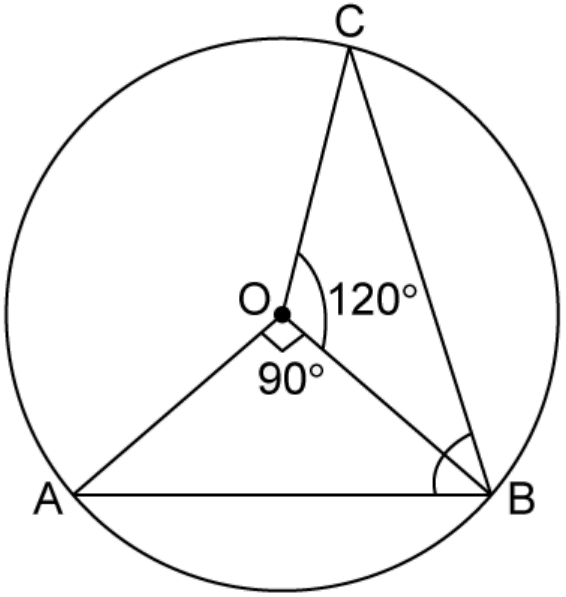
$\angle\text{AOC}=\angle\text{AOB}+\angle\text{BOC}$
$=90^\circ+120^\circ=210^\circ$
$\angle\text{COA}=360^\circ-210^\circ=150^\circ$
If arc $\widehat{\text{COA}}$ makes $150^\circ$ at centre, then it will make half angle of the centre at circumference.
$\Rightarrow\angle\text{CBA}$ or $\angle\text{ABC}=\frac{150^\circ}{2}=75^\circ$ View full question & answer→MCQ 51 Mark
Two equal circles of radius r intersect such that each passes through the centre of the other. The length of the common chord of the circle is:
AnswerCorrect option: C. $\sqrt{3}\text{r}$
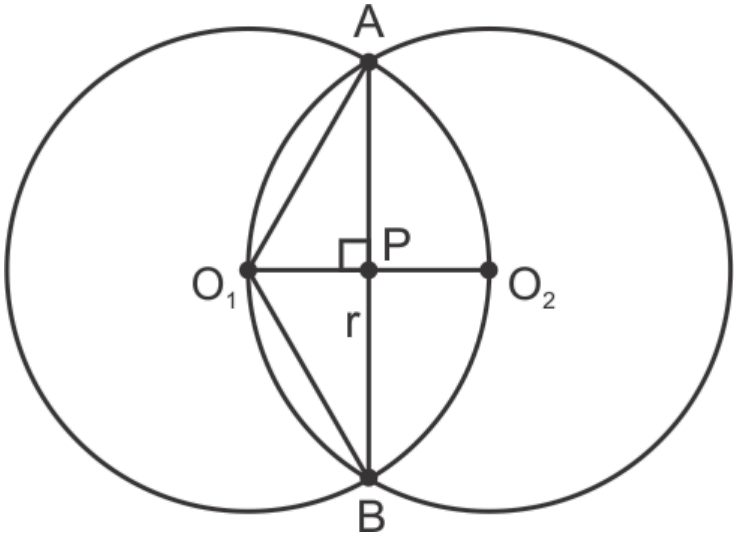
Both the circles pass through the centre of each other
$\Rightarrow \mathrm{O}_1 \mathrm{O}_2=\mathrm{r}$
Common chord is $AB$
We know that perpendicular drawn from centre of circle to any chord bisects it.
$\Rightarrow P$ is the midpoint of $A B$
$\Rightarrow \mathrm{PA}=\mathrm{PB}$
$\mathrm{O}_1 \mathrm{~A}=\mathrm{r}$ (radius of circle)
Consider $\triangle\text{O}_1\text{PA}$
$\big(\text{O}_1\text{A}\big)^2=\text{AP}^2+\text{O}_1\text{P}^2$
$\Rightarrow\text{r}^2=\text{AP}^2+\Big(\frac{\text{r}}{2}\Big)^2$ ...($P$ is also mid-point of $\mathrm{O_1O_2}$)
$\Rightarrow\text{AP}^2=\text{r}^2-\frac{\text{r}^2}{4}=\frac{\text{3r}^2}{4}$
$\Rightarrow\text{AP}=\frac{\sqrt3}{2}\text{r}$
Lenght of chord $\text{AP}=\text{2AP}=\sqrt{3}\text{r}$
View full question & answer→MCQ 61 Mark
The radius of a circle is $6\ cm$. The perpendicular distance from the centre of the circle to the chord which is $8\ cm$ in length, is:
- A
$\sqrt{5}\text{cm}.$
- ✓
$2\sqrt{5}\text{cm}.$
- C
$2\sqrt{7}\text{cm}.$
- D
$\sqrt{7}\text{cm}.$
AnswerCorrect option: B. $2\sqrt{5}\text{cm}.$
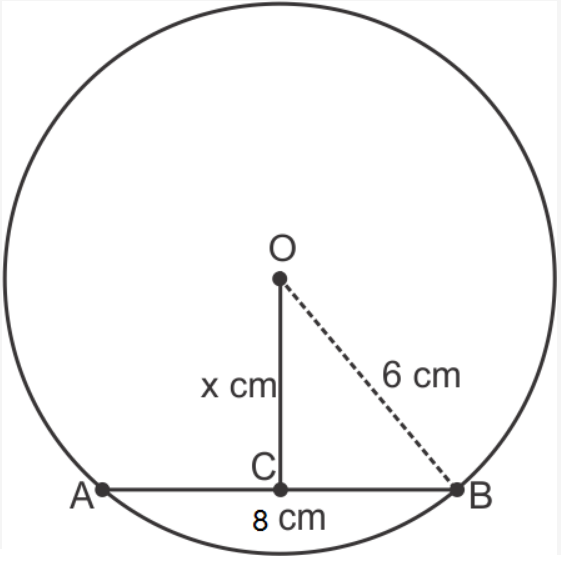
$A B=8 \mathrm{~cm}$
$\Rightarrow A C=B C=4 \mathrm{~cm}$
Consider $\triangle \mathrm{OCB}$, where $\mathrm{BC}=8 \mathrm{~cm}$,
$O B=6 \mathrm{~cm}$
$\text { Now, }(O C)^2+(B C)^2=(O B)^2$
$\Rightarrow(O C)^2+4^2=6^2$
$\Rightarrow(O C)^2+16=36$
$\Rightarrow(O C)^2=20$
$\Rightarrow O C=\sqrt{20}=2 \sqrt{5}$
View full question & answer→MCQ 71 Mark
If $O$ is the centre of a circle of radius $r$ and $AB$ is a chord of the circle at a distance $\frac{\text{r}}2{}$ from $O$, then $\angle\text{BAO} =$
- A
$60^\circ$
- B
$45^\circ$
- ✓
$30^\circ$
- D
$15^\circ$
AnswerCorrect option: C. $30^\circ$
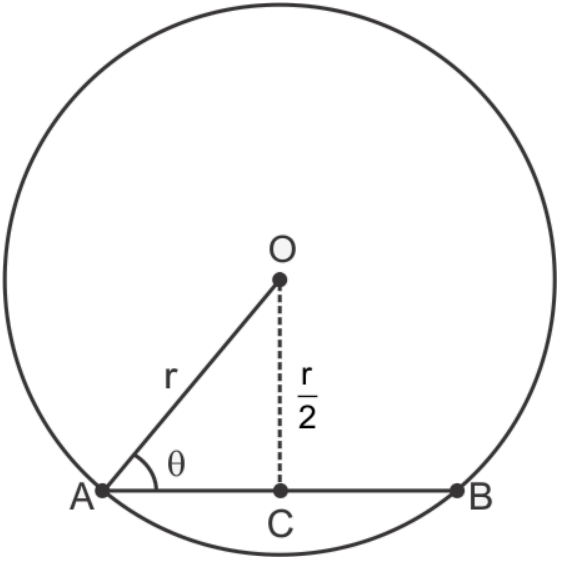
Let $\angle\text{BAO}=\theta$
Consider $\triangle\text{OAC},$
$\sin\theta=\frac{\text{OC}}{\text{OA}}=\frac{\frac{\text{r}}{2}}{\text{r}}$
$=\frac{1}{2}=\sin30^\circ$
$\Rightarrow\theta=30^\circ$ View full question & answer→MCQ 81 Mark
In a circle with centre $O, AB$ and $CD$ are two diameters perpendicular to each other. The length of chord $AC$ is:
AnswerCorrect option: D. $\frac{1}{\sqrt{2}}\text{AB}$
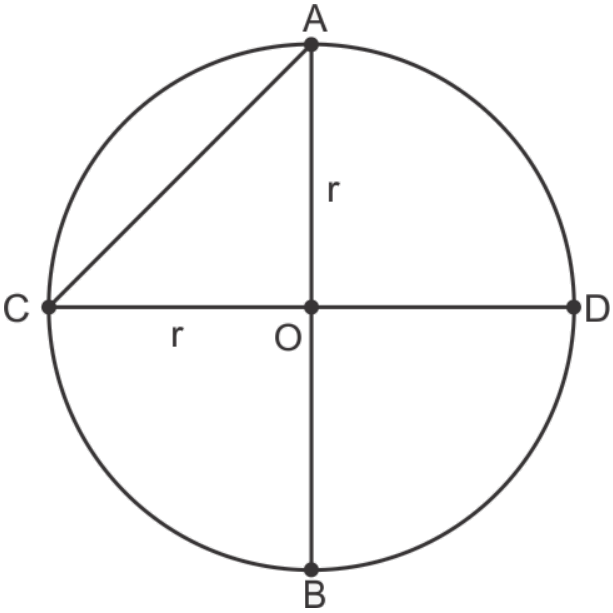
$OC = OA = r$ (radius)
$AB$ = Diameter $= 2r$
$\text{AC}=\sqrt{(\text{OA})^2+(\text{OC})^2}$
$=\sqrt{\text{r}^2+\text{r}^2}$
$=\sqrt{2}\text{r}$
$=\sqrt{2}\Big(\frac{\text{AB}}2{}\Big)$
$\Rightarrow\text{AC}=\frac{1}{\sqrt2}\text{AB}$ View full question & answer→MCQ 91 Mark
The greatest chord of a circle is called its:
AnswerThe greatest chord of the circle is diameter of the circle.
View full question & answer→MCQ 101 Mark
If two diameters of a circle intersect each other at right angles, then quadrilateral formed by joining their end points is a:
Answer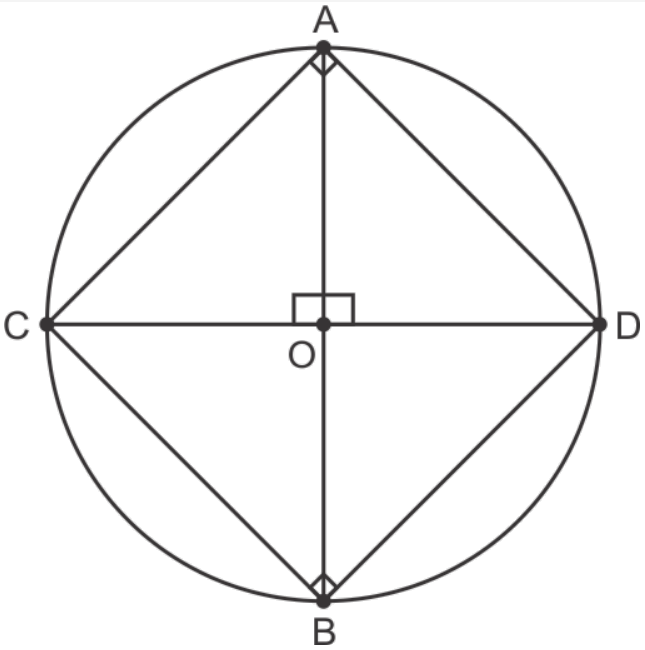
$AB$ and $CD$ are diameters of a circle and diameter makes $90^\circ$ at any point on circle.
$\Rightarrow\angle\text{CAD}=\angle\text{CBD}=\angle\text{BCA}=\angle\text{ADB}=90^\circ$
Also, diagonals $AB$ and $CD$ are perpendicular to each other.
Thus, $ABCD$ is a square. View full question & answer→MCQ 111 Mark
If $AB, BC$ and $CD$ are equal chords of a circle with $O$ as centre and $AD$ diameter, than $\angle\text{AOB} =$
- ✓
$60^\circ$
- B
$90^\circ$
- C
$120^\circ$
- D
AnswerCorrect option: A. $60^\circ$
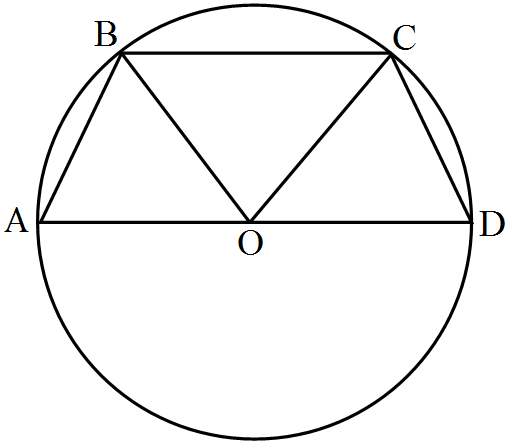
Chord $AB$ = Chord $BC$ = Chord $CD$
$\Rightarrow\angle\text{AOB}=\angle\text{BOC}=\angle\text{COD}$ (equal chords subtend equal angles at the center)
Now, $\angle\text{AOB}+\angle\text{BOC}+\angle\text{COD}=180^\circ$
$\Rightarrow\angle\text{AOB}+\angle\text{AOB}+\angle\text{AOB}=180^\circ$
$\Rightarrow3\angle\text{AOB}=180^\circ$
$\Rightarrow\angle\text{AOB}=60^\circ$ View full question & answer→MCQ 121 Mark
Let $C$ be the mid-point of an arc $AB$ of a circle such that $\text{m}\widehat{\text{AB}}=183^\circ.$ If the region bounded by the arc $ACB$ and the line segment $AB$ is denoted by $S$, then the centre $O$ of the circle lies:
AnswerCorrect option: A. In the interior of $S$.
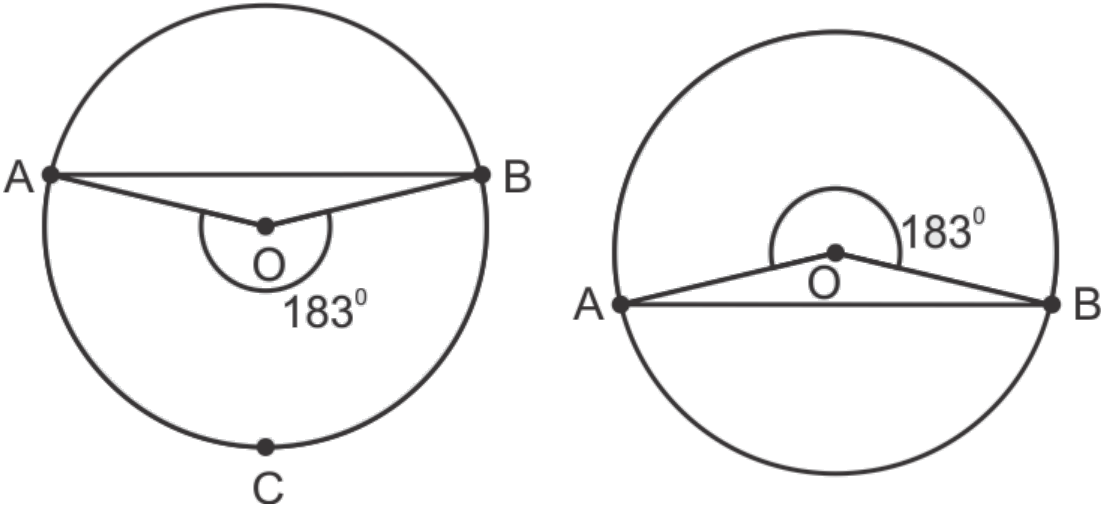
$\text{m}\widehat{\text{AB}}=183^\circ$
O is the center of the circle and $AB$ is a chord.
The region bounded by arc and line segment $AB$ is shaded.
We can see, $'O'$, the center, always lie in the interior of $S$. View full question & answer→MCQ 131 Mark
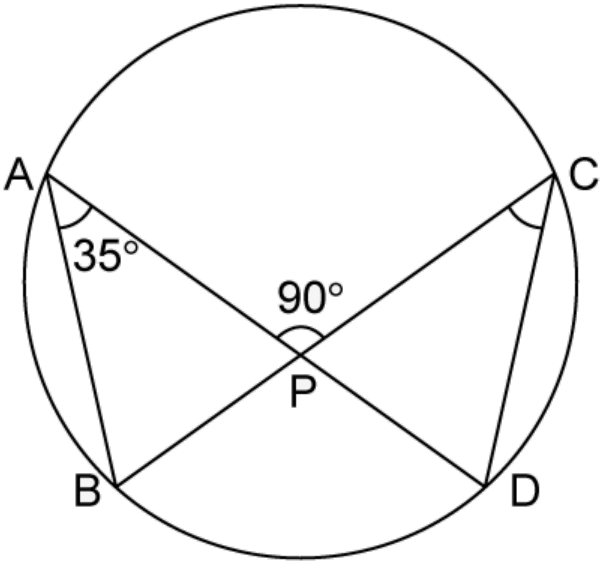
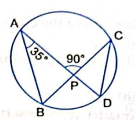
In the given figure, chords $AD$ and $BC$ intersect each other at right angles at a point $P$. If $\angle\text{DAB} = 35^\circ,$ then $\angle\text{ADC}=$
- A
$35^\circ $
- B
$45^\circ$
- ✓
$55^\circ$
- D
$65^\circ$
AnswerCorrect option: C. $55^\circ$
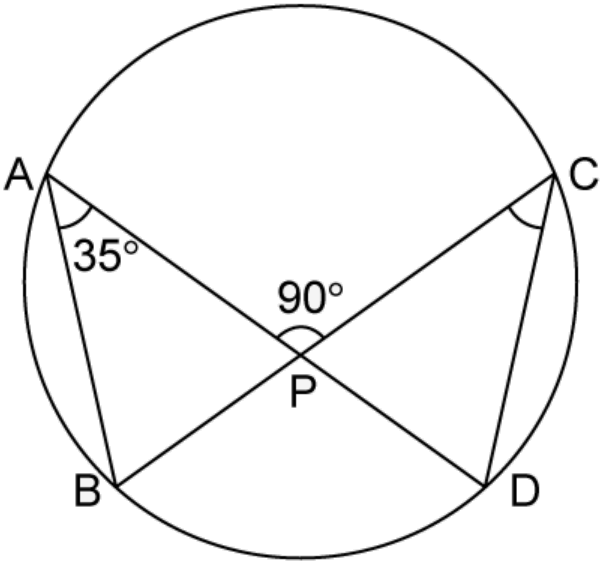
$\angle\text{APC}+\angle\text{APB}=180^\circ$
$\Rightarrow\angle\text{APB}=180^\circ-90^\circ=90^\circ$
In $\triangle\text{APB},$
$\angle\text{ABP}=180^\circ-\angle\text{APB} -\angle\text{BAP}$
$180^\circ-90^\circ-35^\circ=55^\circ$
Now Arc $\widehat{\text{AC}}$ makes $\angle\text{ABC}$ and $\angle\text{ADC}$ on circle.
$\Rightarrow\text{ABC}=\angle\text{ADC}$
$\Rightarrow\angle\text{ADC}=55^\circ$ View full question & answer→MCQ 141 Mark
The chord of a circle is equal to its radius. The angle subtended by this chord at the minor arc of the circle is:
- A
$60^\circ$
- B
$75^\circ$
- C
$120^\circ$
- ✓
$150^\circ$
AnswerCorrect option: D. $150^\circ$
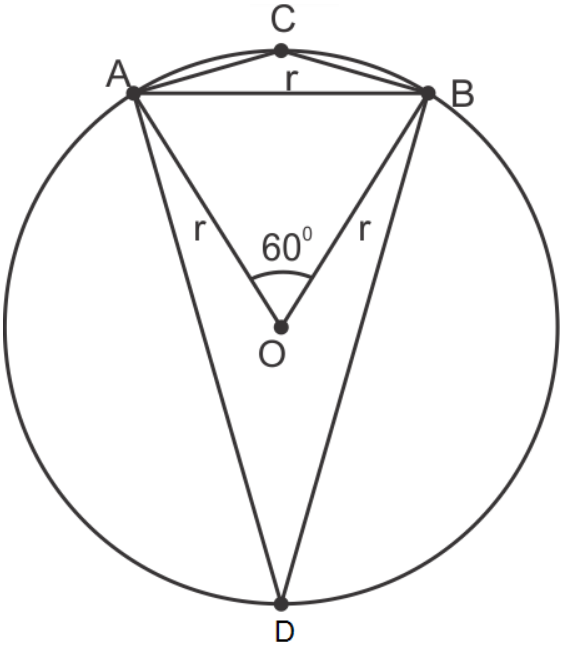
$\angle\text{AOB}=60^\circ$ $($Since $ \triangle\text{AOB}$ is equilateral triangle$)$
Now, $\angle\text{ADB}=30^\circ$
(Since chord $AB$ makes $60$ at centre, same chord will make half of the angle at circumference of angle made at centre)
Now $\angle\text{ACB}$ is angle made by chord at minor arc of circle.
$ABCD$ is cyclic Quadrilateral.
$\Rightarrow\angle\text{C}+\angle\text{D}=180^\circ$
$\Rightarrow\angle\text{ACB}+\angle\text{ADB}=180^\circ$
$\Rightarrow\angle\text{ACB}=180^\circ-30^\circ=150^\circ$ View full question & answer→MCQ 151 Mark
$AB$ and $CD$ are two parallel chords of a circle with centre $O$ such that $AB = 6\ cm$ and $CD = 12\ cm$. The chords are on the same side of the centre and the distance between them is $3\ cm$. The radius of the circle is:
- A
$6\text{cm}$
- B
$5\sqrt{2}\text{cm}$
- C
$7\text{cm}$
- ✓
$3\sqrt{5}\text{cm}$
AnswerCorrect option: D. $3\sqrt{5}\text{cm}$
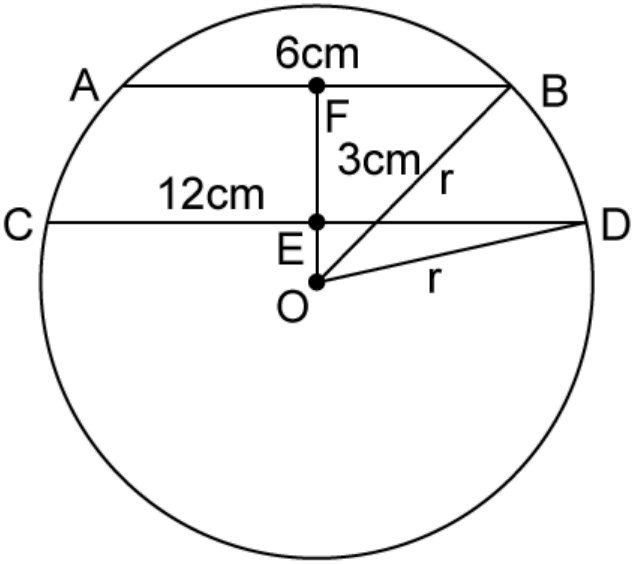
$OB$ and $OD$ are the radii of a circle.
In $\triangle\text{OED},$
$\text{r}^2=\text{OE}^2+\text{ED}^2=\text{OE}^2+(6)^2$
$\Rightarrow\text{OE}=\sqrt{\text{r}^2-36}\dots(1)$
In $\triangle\text{OFB},$
$\text{r}^2=\text{OF}^2+\text{BF}^2=\text{OF}^2+(3)^2$
$\Rightarrow\text{OF}=\sqrt{\text{r}^2-9}\dots(2)$
$\text{OF}-\text{OE}=3\text{cm}$(given)
$\sqrt{\text{r}^2-9}-\sqrt{\text{r}^2-36}=3$
$\sqrt{\text{r}^2-9}=\sqrt{\text{r}^2-36}+3\dots(3)$
Squaring equation $(3)$, we have
$\text{r}^2-9=\text{r}^2-36+9+2\times3\sqrt{\text{r}^2-36}$
$\Rightarrow\text{r}^2-9=\text{r}^2-27+6\sqrt{\text{r}^2-36}$
$\Rightarrow18=6\sqrt{\text{r}^2-36}$
$\Rightarrow3=\sqrt{\text{r}^2-36}$
$\Rightarrow9=\text{r}^2-36$
$\Rightarrow\text{r}=\sqrt{45}=3\sqrt{5}\text{cm}$ View full question & answer→MCQ 161 Mark
If $A$ and $B$ are two points on a circle such that $\text{m}\big(\widehat{\text{AB}}\big)=260^\circ.$ A possible value for the angle subtended by arc $BA$ at a point on the circle is:
- A
$100^\circ$
- B
$75^\circ$
- ✓
$50^\circ$
- D
$25^\circ$
AnswerCorrect option: C. $50^\circ$
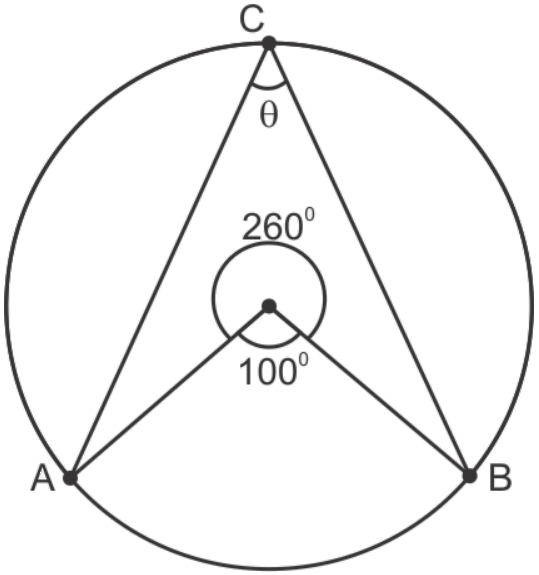
$\text{m}\big(\widehat{\text{AB}}\big)=260^\circ$
$\Rightarrow\text{m}\big(\widehat{\text{BA}}\big)=100^\circ$
Now Let $\widehat{\text{BA}}$ subtend an angle $\theta$ at a point $C$ on circle.
Now, we know that angle subtend by an arc at the center is double the angle subtended at any point on the circle.
$\Rightarrow100^\circ=2\theta$
$\Rightarrow\theta=50^\circ$ View full question & answer→MCQ 171 Mark
If $AB$ is a chord of a circle, $P$ and $Q$ are the two points on the circle different from $A$ and $B$, then:
- A
$\angle\text{APB}=\angle\text{AQB}$
- ✓
$\angle\text{APB}+\angle\text{AQB}=180^\circ\ \text{or }\angle\text{APB}=\angle\text{AQB}$
- C
$\angle\text{APB}+\angle\text{AQB}=90^\circ$
- D
$\angle\text{APB}+\angle\text{AQB}=180^\circ$
AnswerCorrect option: B. $\angle\text{APB}+\angle\text{AQB}=180^\circ\ \text{or }\angle\text{APB}=\angle\text{AQB}$
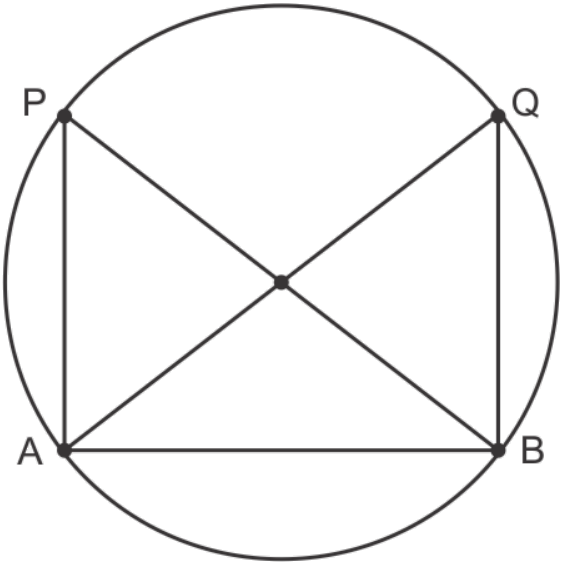
$\angle\text{APB}$ and $\angle\text{AQB}$ are on the same arc.
$\Rightarrow\angle\text{APB}=\angle\text{AQB}$
But, if $AB$ = diameter, then $\angle\text{APB}=\angle\text{AQB}=90^\circ$
(Because diameter makes Right angle at any point on circumference of circle)
$\angle\text{APB}+\angle\text{AQB}=180^\circ$ View full question & answer→MCQ 181 Mark
In a circle, the major arc is $3$ times the minor arc. The corresponding central angles and the degree measures of two arcs are:
- ✓
$90^\circ$ and $270^\circ $
- B
$90^\circ$ and $90^\circ$
- C
$270^\circ$ and $90^\circ $
- D
$60^\circ$ and $210^\circ $
AnswerCorrect option: A. $90^\circ$ and $270^\circ $
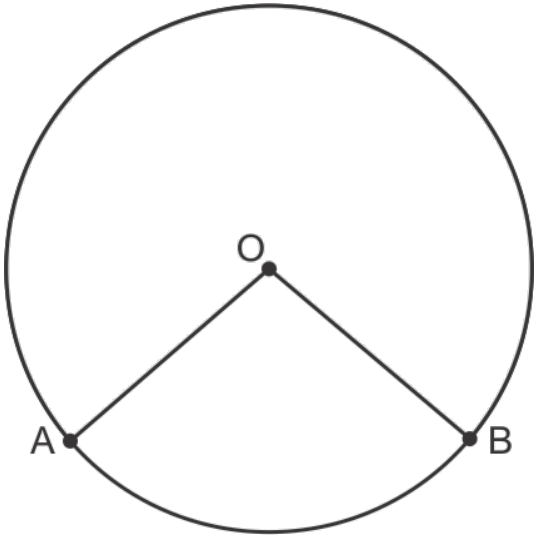
$\frac{\widehat{\text{AB}}\text{minor}}{\widehat{\text{AB}}\text{major}}=\frac{1}{3}=\frac{\angle\widehat{\text{AB}}\text{minor}}{\angle\widehat{\text{AB}}\text{major}}$
Let $\angle\widehat{\text{AB}}\text{minor}=\text{x}$
$\Rightarrow\angle\widehat{\text{AB}}\text{major}=\text{3x}$
Now we know $x + 3x = 360^\circ $
$\Rightarrow 4x = 360^\circ $
$\Rightarrow x = 90^\circ $
$\Rightarrow 3x = 270^\circ $ View full question & answer→MCQ 191 Mark
In a circle of radius $17\ cm,$ two parallel chords are drawn on opposite side of a diameter. The distance between the chords is $23\ cm$. If the length of one chord is $16\ cm$, then the length of the other is:
- A
$34\ cm.$
- B
$15\ cm.$
- C
$23\ cm.$
- ✓
$30\ cm.$
AnswerCorrect option: D. $30\ cm.$
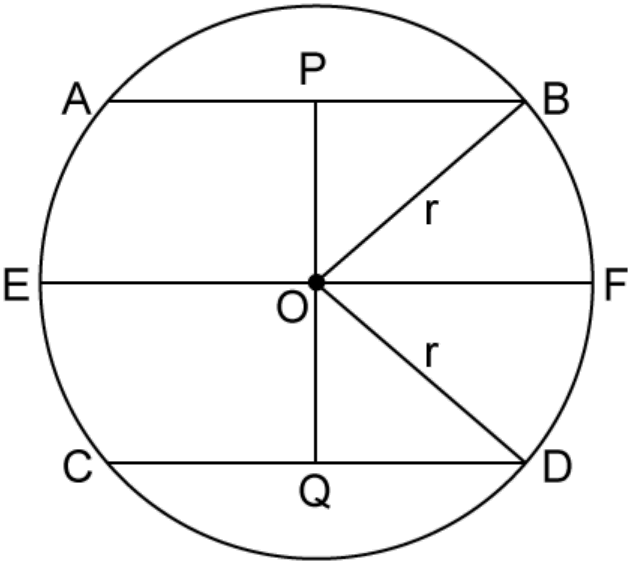
$\mathrm{PQ}=23 \mathrm{~cm}$
$\mathrm{AB}=16 \mathrm{~cm}$
$\Rightarrow B P=A P=8 \mathrm{~cm}$
$\mathrm{r}=17 \mathrm{~cm}$
$\Rightarrow E F=\text { diameter }=2 \mathrm{r}=34 \mathrm{~cm}$
Consider $\triangle \mathrm{OPB}$,
$r^2=O P^2+B P^2$
$\Rightarrow O P^2=(17)^2-(8)^2=289-64=225$
$\Rightarrow O P=15 \mathrm{~cm}$
$\Rightarrow O Q=23-15=8 \mathrm{~cm}$
Consider $\triangle \mathrm{OQD}$,
$r^2=O Q^2+Q D^2$
$\Rightarrow Q D^2=r^2-O Q^2=(17)^2-(8)^2=225$
$\Rightarrow O D=15 \mathrm{~cm}$
$\Rightarrow C D=2 \times Q D=30 \mathrm{~cm}$
View full question & answer→MCQ 201 Mark
If $ABC$ is an arc of a circle and $\angle\text{ABC} = 135^\circ,$ then the ratio of arc $\widehat{\text{ABC}}$ to the circumference is:
- ✓
$1 : 4$
- B
$3 : 4$
- C
$3 : 8$
- D
$1 : 2$
AnswerCorrect option: A. $1 : 4$
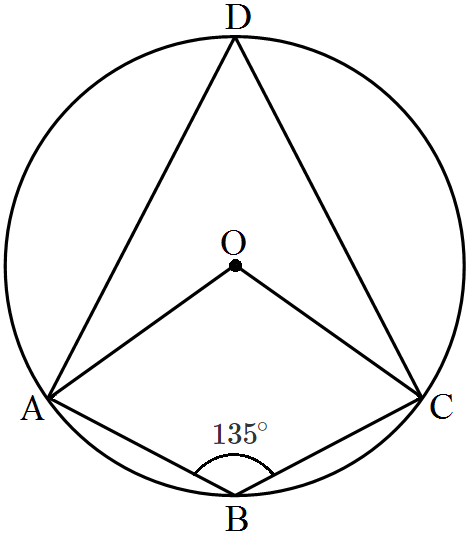
$ABC$ is an arc of circle.
Take point $D$ in the altrenative segment and join $AD$ and $CD$.
$\angle\text{ABC}=135^\circ$ (Given)
$\angle\text{ABC}+\angle\text{ADC}=180^\circ$ (Sum of opposite angles of cyclic quadrilateral is 180°)
$\Rightarrow\angle\text{ADC}=180^\circ-\angle\text{ABC}=180^\circ-135^\circ=45^\circ$
Now, $\angle\text{AOC}=2\times\angle\text{ADC}=2\times45^\circ=90^\circ$
$\widehat{\text{ABC}}=$ measure of the central angle $=\angle\text{AOC}=90^\circ$
$\Rightarrow\text{Required ratio}=\frac{\text{arc}\widehat{\text{ABC}}}{\text{circumference}}$
$=\frac{90^\circ}{360^\circ}=\frac{1}{4}=1:4$ View full question & answer→MCQ 211 Mark
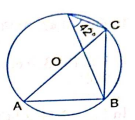
In the given figure, $O$ is the centre of the circle and $\angle\text{BDC} = 42^\circ.$ The measure of $\angle\text{ACB}$ is: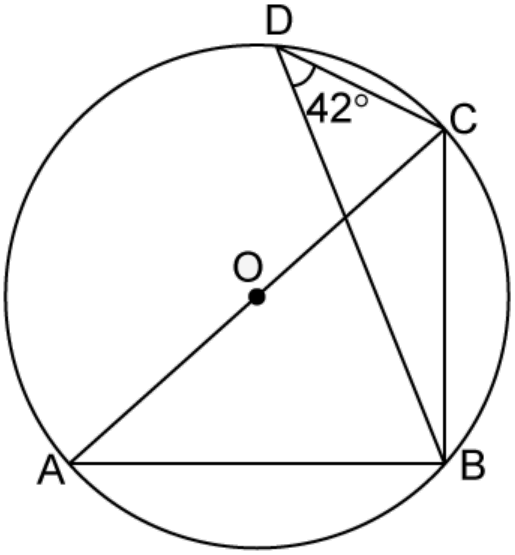
- A
$42^\circ$
- ✓
$48^\circ$
- C
$58^\circ$
- D
$52^\circ$
AnswerCorrect option: B. $48^\circ$
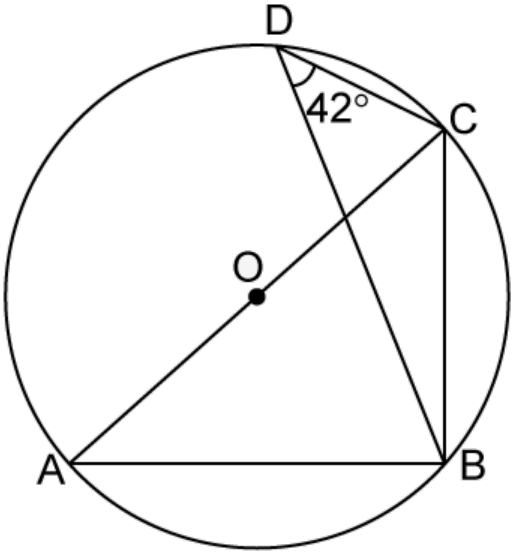
$\angle\text{ABC}=90^\circ$ ...(Diameter $AC$ makes $90^\circ$ at circumference)
$\angle\text{CDB}=\angle\text{CAB}$ ...(Angles on the same arc)
$\Rightarrow\angle\text{CAB}=42^\circ$
In $\triangle\text{ABC},$
$\angle\text{ACB}=180^\circ-90^\circ-42^\circ=48^\circ$ View full question & answer→MCQ 221 Mark
An equilateral triangle $ABC$ is inscribed in a circle with centre $O$. The measures of $\angle\text{BOC}$ is:
- A
$30^\circ$
- B
$60^\circ$
- C
$90^\circ$
- ✓
$120^\circ$
AnswerCorrect option: D. $120^\circ$
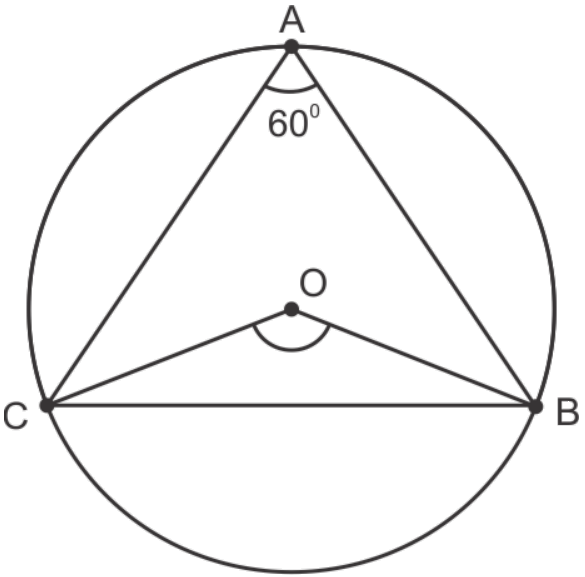
$\angle\text{BAC}=60^\circ$ (Angle of equilateral triangle)
Arc $\widehat{\text{BC}}$ makes angle $\angle\text{BAC}$ at circle and $\angle\text{BOC}$ at center of circle.
$\Rightarrow\angle\text{BAC}=\frac{1}{2}\angle\text{BOC}$
$\Rightarrow2\times\angle\text{BAC}=\angle\text{BOC}$
$\Rightarrow2\times60^\circ=\angle\text{BOC}$
$\Rightarrow\angle\text{BOC}=120^\circ$ View full question & answer→MCQ 231 Mark
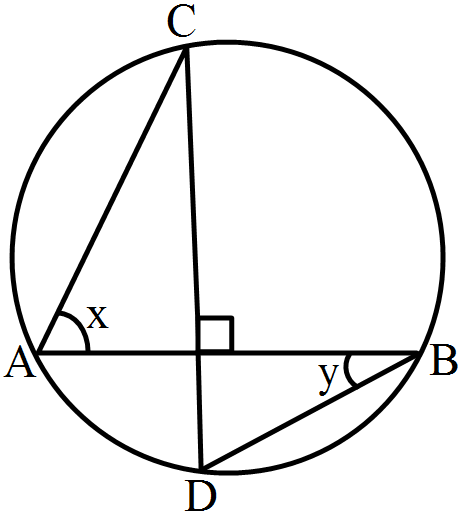
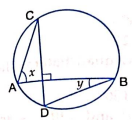
In the given figure, if chords $AB$ and $CD$ of the circle intersect each other at right angles, then $x + y =$
- A
$45^\circ $
- B
$60^\circ $
- C
$75^\circ $
- ✓
$90^\circ $
AnswerCorrect option: D. $90^\circ $
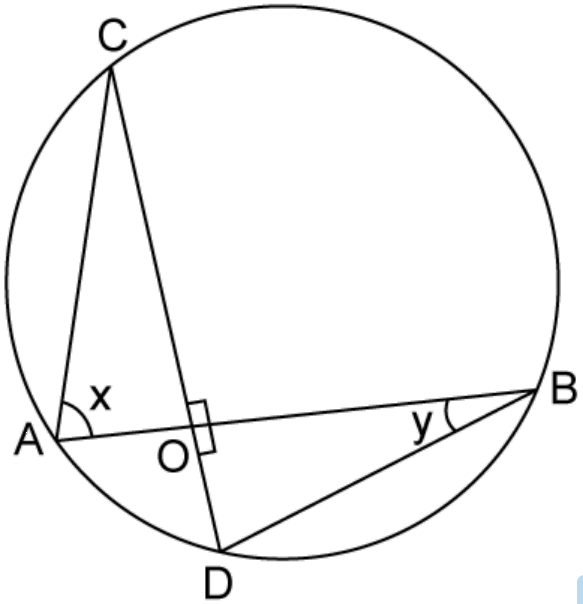
$\angle\text{CAB}=\angle\text{CDB}=\text{x}^\circ$ ...(Both are on the same arc)
Consider $\triangle\text{ODB},$
$\angle\text{DOB}=90^\circ,\ \angle\text{OBD}=\text{y},\ \angle\text{ODB}=\text{x}$
In $\triangle\text{ODB},$
$x + y + 90^\circ = 180^\circ $
$\Rightarrow x + y = 90^\circ $ View full question & answer→MCQ 241 Mark
Angle formed in minor segment of a circle is:
Answer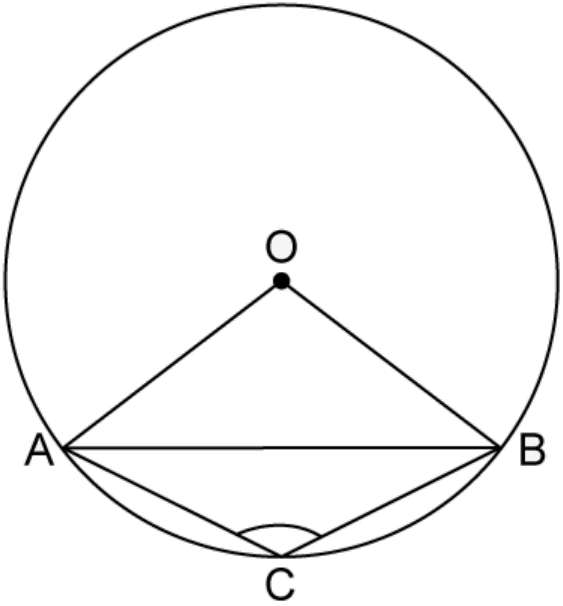
Angle formed in a minor segment is always a obtuse angle.
View full question & answer→MCQ 251 Mark
Number of circles that can be drawn through three non-collinear points is:
Answer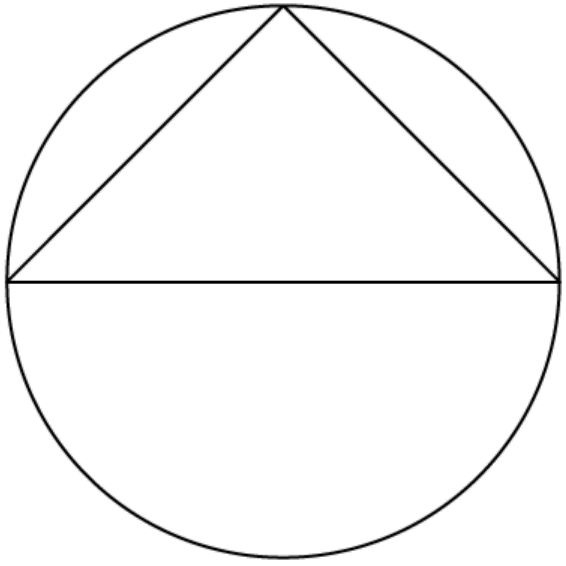
Three non-collinear points make a triangle and there is only one circle that can pass through all three points,
i.e. circumcircle of that triangle.
View full question & answer→MCQ 261 Mark
In the given figure, $O$ is the centre of the circle such that $\angle\text{AOC} = 130^\circ,$ then $\angle\text{ABC} =$
- A
$130^\circ$
- ✓
$115^\circ $
- C
$65^\circ$
- D
$165^\circ $
AnswerCorrect option: B. $115^\circ $
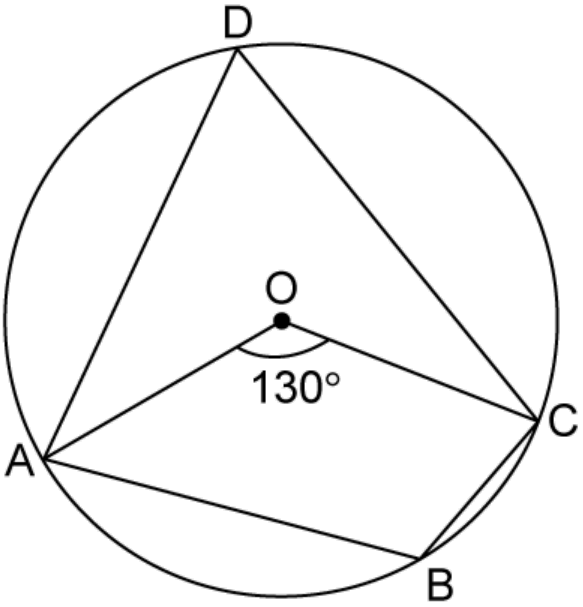
$\angle\text{ADC}=\frac{1}{2}\angle\text{AOC}$
$\big\{\angle\text{ADC}$ and $\angle\text{AOC}$ are made by same $\widehat{\text{AC}}$ on centre and cricumference$\big\}$
$\Rightarrow\angle\text{ADC}=\frac{1}{2}\times130^\circ=65^\circ$
$ADCB$ is a cyclic Quadrilateral.
$\Rightarrow\angle\text{D}+\angle\text{B}=180^\circ$
$\Rightarrow\angle\text{ABC}=180^\circ-65^\circ=115^\circ$ View full question & answer→MCQ 271 Mark
One chord of a circle is known to be $10\ cm$. The radius of this circle must be:
AnswerCorrect option: B. Greater than $5\ cm.$
The longest chord of a circle is its diameter.
$\Rightarrow $ Diameter $> 10\ cm$
$\Rightarrow 2 \times $ Radius $> 10\ cm$
$\Rightarrow $ Radius $> 5\ cm$
View full question & answer→MCQ 281 Mark
$PQRS$ is a cyclic quadrilateral such that $PR$ is a diameter of the circle. If $\angle\text{QPR} = 67^\circ$ and $ \angle\text{SPR} = 72^\circ,$ then $\angle\text{QRS} =$
- ✓
$41^\circ $
- B
$23^\circ$
- C
$67^\circ$
- D
$18^\circ$
AnswerCorrect option: A. $41^\circ $
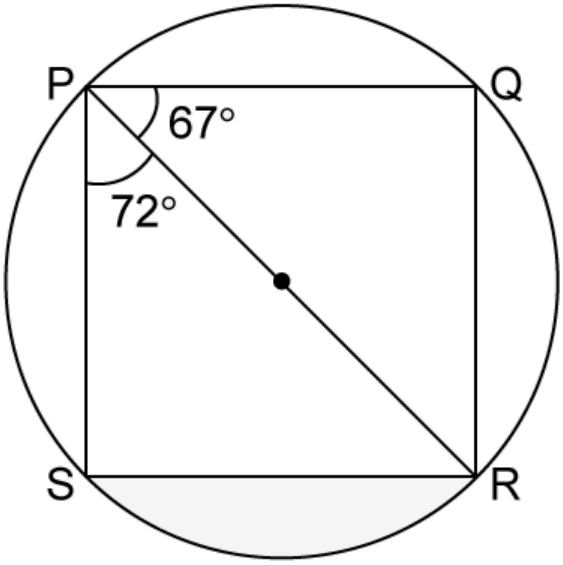
In a cyclic quadrilateral, Opposite angles are supplementary.
$\Rightarrow\angle\text{P}+\angle\text{R}=180^\circ$
Now, $\angle\text{P}=67^\circ+72^\circ=139^\circ$
Thus, $\angle\text{R}=180^\circ-139^\circ=41^\circ$
i.e. $\angle\text{R}=\angle\text{QRS}=41^\circ$ View full question & answer→MCQ 291 Mark
$ABCD$ is a cyclic quadrilateral such that $\angle\text{ADB} = 30^\circ$ and $\angle\text{DCA} = 80^\circ,$ then $\angle\text{DAB} =$
- ✓
$70^\circ$
- B
$100^\circ$
- C
$125^\circ$
- D
$150^\circ$
AnswerCorrect option: A. $70^\circ$
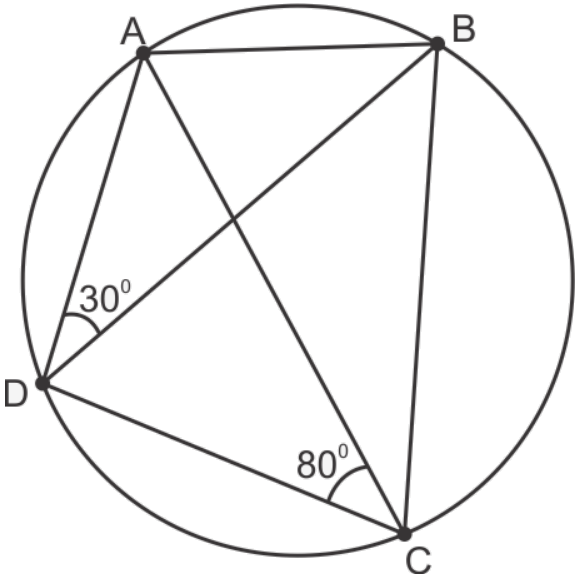
$ABCD$ is a cyclic Quadrilateral.
Consider $\triangle\text{ABD}$ and $\triangle\text{ABC}.$
Both are on the same base $AB$ and $\angle\text{ADB}$ and $\angle\text{ACB}$ are the angles in the same segment $AB$.
$\Rightarrow\angle\text{ADB}=\angle\text{ACB}=30^\circ$
$\Rightarrow\angle\text{BCD}=80^\circ+30^\circ=110^\circ$
In a cyclic Quadrilateral, sum of opposite angles is $180^\circ$
$\Rightarrow\angle\text{A}+\angle\text{C}=180^\circ$
$\Rightarrow\angle\text{DAB}+\angle\text{BCD}=180^\circ$
$\Rightarrow\angle\text{DAB}=180^\circ-110^\circ=70^\circ$ View full question & answer→MCQ 301 Mark
- A
$30^{\circ}$
- B
$45^{\circ}$
- ✓
$60^{\circ}$
- D
$120^{\circ}$
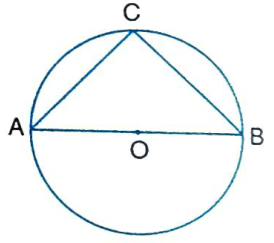
AnswerCorrect option: C. $60^{\circ}$
(c) $60^{\circ}$
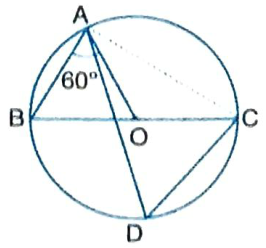
We observe that $\angle B A C$ is the angle in a semi-circle. Therefore, $\angle B A C=90^{\circ}$.
$\therefore \quad \angle O A C=\angle B A C-\angle O A B=90^{\circ}-60^{\circ}-30^{\circ}$
In $\triangle O A C$, we have
$O A=O C \Rightarrow \angle O A C=\angle O C A \Rightarrow \angle O C A=30^{\circ}$
Thus, in $\triangle O A C$, we have
$\begin{array}{ll}& \angle O A C=\angle O C A=30^{\circ} \\
\therefore \quad & \angle A O C=180^{\circ}-(\angle O A C+\angle O C A)=180^{\circ}
\left(30^{\circ}+30^{\circ}\right)=120^{\circ}\end{array}$
Clearly, arc $A C$ makes angle $\angle A O C=120^{\circ}$ at the centre $O$ and $\angle A D C$ at point on the remaining part of the circle.
$\therefore \quad \angle A D C=\frac{1}{2} \angle A O C=\frac{1}{2} \times 120^{\circ}=60^{\circ}$
View full question & answer→MCQ 311 Mark
- A
$30^{\circ}$
- B
$45^{\circ}$
- C
$90^{\circ}$
- ✓
$60^{\circ}$
AnswerCorrect option: D. $60^{\circ}$
(d) $60^{\circ}$
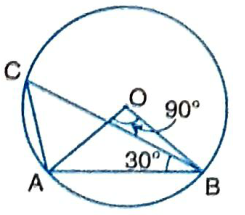
In $\triangle A O B$, we find that
$\begin{array}{ll}& O A=O B \\
\Rightarrow \quad & \angle O A B=\angle O B A\end{array}$
Using angle sum property in $\triangle O A B$, we obtain
$\begin{array}{ll}& \angle O A B+\angle O B A+\angle A O B=180^{\circ} \\
\Rightarrow \quad & 2 \angle O A B+90^{\circ}=180^{\circ} \Rightarrow \angle O A B=45^{\circ} \Rightarrow \angle O BA=45^{\circ}\end{array}$
Arc $A B$ subtends $\angle A O B=90^{\circ}$ at the centre $O$ and $\angle A C B$ at a point on the remaining part of the circle.
$\therefore \quad \angle A C B=\frac{1}{2} \angle A O B=\frac{1}{2} \times 90^{\circ}=45^{\circ}$
Thus, in $\triangle A B C$, we have $\angle A B C=30^{\circ}$ and $\angle A C B=45^{\circ}$.
$\begin{array}{ll}\therefore & \angle B A C=180^{\circ}-30^{\circ}-45^{\circ}=105^{\circ} \quad \text { [Using angle sum property in } \triangle A B C \text { ] } \\
\Rightarrow & \angle C A O+\angle O A B=105^{\circ} \Rightarrow \angle C A O+45^{\circ}=105^{\circ} \Rightarrow
\angle C A O=60^{\circ}\end{array}$
View full question & answer→MCQ 321 Mark
- A
$60^{\circ}$
- B
$50^{\circ}$
- ✓
$70^{\circ}$
- D
$80^{\circ}$
AnswerCorrect option: C. $70^{\circ}$
(c) $70^{\circ}$
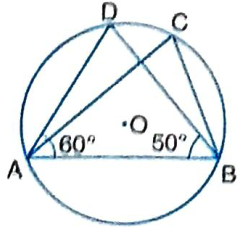
In $\triangle A B D$, we have
$\begin{array}{l}\angle D A B=60^{\circ} \text { and } \angle A B D=50^{\circ} \\
\angle A D B=180^{\circ}-60^{\circ}-50^{\circ}=70^{\circ}\end{array}$
We find that $\angle A D B$ and $\angle A C B$ are angles made by the are $A B$ in the same segment.
$
∴\quad$ \angle A C B=\angle A D B \Rightarrow \angle A C B=70^{\circ}$
View full question & answer→MCQ 331 Mark
- ✓
$50^{\circ}$
- B
$40^{\circ}$
- C
$60^{\circ}$
- D
$70^{\circ}$
AnswerCorrect option: A. $50^{\circ}$
(a) $50^{\circ}$
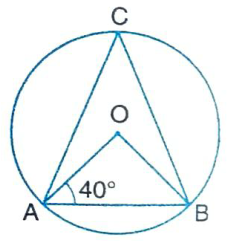
In $\triangle O A B$, we have
$O A=O B \Rightarrow \angle O B A=\angle O A B \Rightarrow \angle O B A=40^{\circ}$
Using angle sum property in $\triangle A O B$, we obtain
$\begin{array}{ll}& \angle O A B+\angle O B A+\angle A O B=180^{\circ} \\
\Rightarrow & 40^{\circ}+40^{\circ}+\angle A O B=180^{\circ} \Rightarrow \angle A O B=100^{\circ}\end{array}$
Thus, $\operatorname{arc} A B$ subtends $\angle A O B=100^{\circ}$ at the centre and $\angle A C B$ at a point on the circumference.
$\therefore \quad \angle A C B=\frac{1}{2} \angle A O B=50^{\circ}$
View full question & answer→MCQ 341 Mark
- A
$30^{\circ}$
- B
$60^{\circ}$
- C
$90^{\circ}$
- ✓
$45^{\circ}$
AnswerCorrect option: D. $45^{\circ}$
(d) $45^{\circ}$
We find that angle in a semi-circle is a right angle. Therefore, $\angle A C B=90^{\circ}$.
It is given that
$A C=B C \Rightarrow \angle C A B=\angle C B A$
Using angle sum property in $\triangle A B C$, we obtain
$\angle A C B+\angle C A B+\angle C B A=180^{\circ} \Rightarrow 90^{\circ}+2 \angle C A B=180^{\circ} \Rightarrow\angle C A B=45^{\circ}$
View full question & answer→MCQ 351 Mark
- A
$20^{\circ}$
- ✓
$40^{\circ}$
- C
$60^{\circ}$
- D
$10^{\circ}$
AnswerCorrect option: B. $40^{\circ}$
(b) $40^{\circ}$
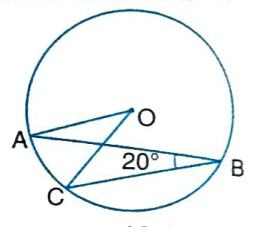
We observe that arc AC makes angle $\angle A B C=20^{\circ}$ at a point B on the circumference of the circle and $\angle A O C$ at the centre O.
$\therefore \quad \angle A O C=2 \angle A B C=2 \times 20^{\circ}=40^{\circ}$
View full question & answer→MCQ 361 Mark
If $A B=12 cm, B C=16 cm$ and $A B$ is perpendicular to $B C$, then the radius of the circle passing through the points A, B and C is
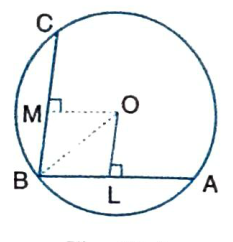
Answer(c) 10 cm
Perpendicular from the centre to a chord bisects the chord. Therefore, $L$ and $M$ are mid-points of $A B$ and $B C$ respectively. Thus, in right triangle $O L B$, we have
$O L=B M=\frac{1}{2} B C=8 cm \text { and } B L=\frac{1}{2} A B=6 cm$
Applying Pythagoras theorem in $\triangle O L B$, we obtain
$O B^2=O L^2+L B^2 \Rightarrow O B=\sqrt{8^2+6^2}=\sqrt{100}=10 cm$
View full question & answer→MCQ 371 Mark
AD is a diameter of a circle and AB is a chord. If AD = 34 cm, AB = 30 cm, the distance of AB from the centre of the circle is
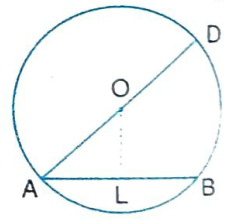
Answer(d) 8 cm
Let O be the centre of the circle and $O L \perp A B$. Then, $L$ is the midpoint of $A B$. We have, $O A=17 cm$ and $A L=15 cm$.
Applying Pythagoras theorem in $\triangle O L A$, we obtain
$\begin{array}{ll}& O A^2=O L^2+A L^2 \\
\Rightarrow \quad & O L=\sqrt{O A^2-O L^2}=\sqrt{17^2-15^2}=\sqrt{289-225}=\sqrt{64}=8 cm\end{array}$
View full question & answer→MCQ 381 Mark
- A
$2: 1$
- B
$1: 2$
- ✓
$3: 1$
- D
$1: 3$
AnswerCorrect option: C. $3: 1$
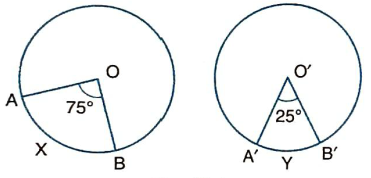
(c) $3: 1$
$\frac{\operatorname{arc} A X B}{\operatorname{arc} A^{\prime} Y^{\prime} B}=\frac{m(\widehat{A X B})}{m\left(A^{\prime} X B^{\prime}\right)}=\frac{75^{\circ}}{25^{\circ}}=\frac{3}{1}$
View full question & answer→MCQ 391 Mark
- A
$30^{\circ}$
- ✓
$45^{\circ}$
- C
$15^{\circ}$
- D
$60^{\circ}$
AnswerCorrect option: B. $45^{\circ}$
(b) $15^{\circ}$
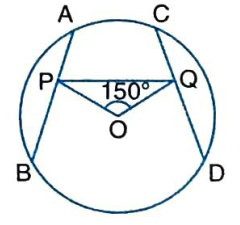
Equal chords of a circle are equidistant from the centre. Therefore, in $\triangle O P Q$, we have
$O P=O Q \Rightarrow \angle O P Q=\angle O Q P$
Using angle sum property in $\triangle O P Q$, we obtain
$\begin{array}{ll}& \angle O P Q+\angle O Q P+\angle P O Q=180^{\circ} \\
\Rightarrow & 2 \angle O P Q+150^{\circ}=180^{\circ} \Rightarrow \angle O P Q=15^{\circ} \\
\therefore & \angle A P Q=\angle O P A-\angle O P Q=90^{\circ}-15^{\circ}=75^{\circ}\end{array}$
View full question & answer→MCQ 401 Mark
- ✓
$30^{\circ}$
- B
$45^{\circ}$
- C
$60^{\circ}$
- D
$50^{\circ}$
AnswerCorrect option: A. $30^{\circ}$
(a) $30^{\circ}$
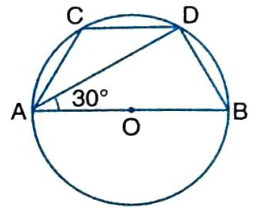
Given that $A B \| C D$ and $\angle B A D=30^{\circ}$. Therefore, $\angle A D C=30^{\circ}$.
AB is a diameter and D is a point on the circle. Therefore, $\angle A D B=90^{\circ}$.
$\therefore \quad \angle B D C=\angle A D B+\angle A D C=90^{\circ}+30^{\circ}=120^{\circ}$
$A B C D$ is a cyclic quadrilateral.
$\therefore \quad \angle B D C+\angle B A C=180^{\circ} \Rightarrow \angle B A C=180^{\circ}-120^{\circ}=60^{\circ}$
Hence, $\angle C A D=\angle B A C-\angle B A D=60^{\circ}-30^{\circ}=30^{\circ}$
View full question & answer→MCQ 411 Mark
- A
$25^{\circ}$
- B
$80^{\circ}$
- ✓
$50^{\circ}$
- D
$40^{\circ}$
AnswerCorrect option: C. $50^{\circ}$
(c) $50^{\circ}$
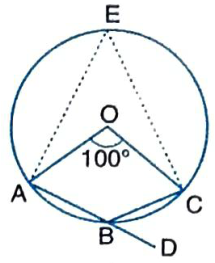
Let $E$ be a point on the circle. We observe that arc ABC makes $\angle A O C=100^{\circ}$ at O and $\angle A E C$ at E.
$\therefore \quad \angle A E C=\frac{1}{2} \angle A O C=\frac{1}{2} \times 100^{\circ}=50^{\circ}$
Using exterior angle property in cyclic quadrilateral $A B C E$, we obtain
$\text { ext } \angle C B D=\angle A E C=50^{\circ}$
View full question & answer→MCQ 421 Mark
- A
$95^{\circ}$
- B
$85^{\circ}$
- ✓
$105^{\circ}$
- D
$75^{\circ}$
AnswerCorrect option: C. $105^{\circ}$
(c) $105^{\circ}$
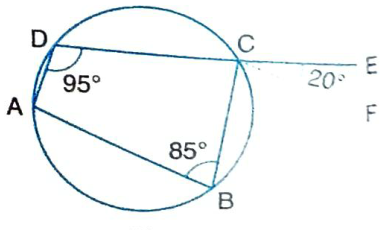
Given that $C F \| A B$ and $\angle A B C=85^{\circ}$.
$\therefore \angle B C F=85^{\circ} \Rightarrow \angle B C E=105^{\circ} \Rightarrow \angle B A D=105^{\circ} \quad$ [Exterior angle $=$ Interior opposite angle]
View full question & answer→MCQ 431 Mark
- A
$110^{\circ}$
- B
$100^{\circ}$
- C
$140^{\circ}$
- ✓
$130^{\circ}$
AnswerCorrect option: D. $130^{\circ}$
(d) $130^{\circ}$
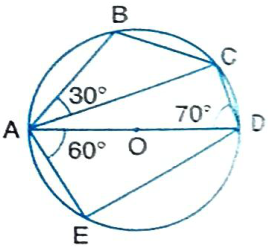
In $\triangle A E D$, we find that
$\angle A E D=90^{\circ} \text { (angle in a semi-circle) and } \angle E A D=60^{\circ} \text {. Therefore, } \angle A DE=30^{\circ} \text {. }$
$A E D C$ is a cyclic quadrilateral such that
$\begin{array}{ll}& \angle E D C=\angle E D A+\angle A D C=30^{\circ}+70^{\circ}=100^{\circ} \\
\therefore \quad & \angle C A E=80^{\circ} \Rightarrow \angle D A C=20^{\circ}\end{array}$
Thus, $A B C D$ is a cyclic quadrilateral, such that $\angle D A B=20^{\circ}+30^{\circ}=50^{\circ}$
$\therefore \quad \angle B C D=180^{\circ}-50^{\circ}=130^{\circ}$
View full question & answer→MCQ 441 Mark
- A
$70^{\circ}$
- ✓
$110^{\circ}$
- C
$100^{\circ}$
- D
$130^{\circ}$
AnswerCorrect option: B. $110^{\circ}$
(b) $110^{\circ}$
ABCD is a cyclic quadrilateral such that $\angle A D C=70^{\circ}$.
$\therefore \quad \angle A B C+\angle A D C=180^{\circ} \Rightarrow \angle A B C+70^{\circ}=180^{\circ} \Rightarrow\angle A B C=110^{\circ}$
View full question & answer→MCQ 451 Mark
- A
$110^{\circ}$
- B
$50^{\circ}$
- C
$40^{\circ}$
- ✓
$80^{\circ}$
AnswerCorrect option: D. $80^{\circ}$
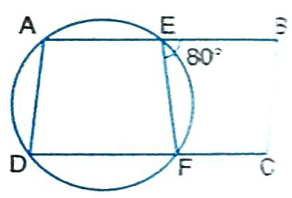
(d) $80^{\circ}$
We observe that DAEF is a cyclic quadrilateral.
$\therefore \quad \angle A D F=80^{\circ} \quad$ [Exterior angle $=$ Opposite interior angle]
Since ABCD is a parallelogram. Therefore,
$\angle A B C=\angle A D C=\angle A D F=80^{\circ}$
View full question & answer→MCQ 461 Mark
- A
$70^{\circ}$
- B
$75^{\circ}$
- C
$60^{\circ}$
- ✓
$105^{\circ}$
AnswerCorrect option: D. $105^{\circ}$
(d) $105^{\circ}$
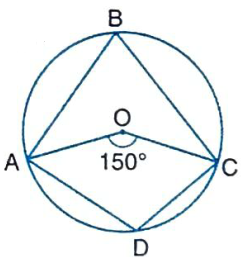
Clearly, arc AC subtends $\angle A O C=105^{\circ}$ at the centre O and $\angle A B C$ at point B on the circumference. Therefore,
$\angle A B C=\frac{1}{2} \angle A O C=\frac{1}{2} \times 150^{\circ}=75^{\circ}$
Since $A B C D$ is a cyclic quadrilateral. Therefore,
$\angle A D C+\angle A B C=180^{\circ} \Rightarrow \angle A D C+75^{\circ}=180^{\circ} \Rightarrow \angle A DC=105^{\circ}$
View full question & answer→MCQ 471 Mark
- A
$43^{\circ}$
- B
$30^{\circ}$
- ✓
$34^{\circ}$
- D
$40^{\circ}$
AnswerCorrect option: C. $34^{\circ}$
(c) $34^{\circ}$
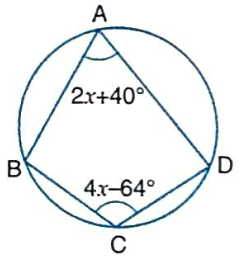
Since ABCD is a cyclic quadrilateral.
$\begin{array}{ll}\therefore & \angle A+\angle C=180^{\circ} \\
\Rightarrow & 2 x+40^{\circ}+4 x-64^{\circ}=180^{\circ} \\
\Rightarrow & 6 x=204^{\circ} \Rightarrow x=34^{\circ}\end{array}$
View full question & answer→MCQ 481 Mark
- A
$60^{\circ}$
- B
$70^{\circ}$
- ✓
$50^{\circ}$
- D
$80^{\circ}$
AnswerCorrect option: C. $50^{\circ}$
(c) $50^{\circ}$
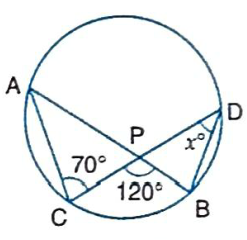
we have, $\angle C P B=120^{\circ}$. Therefore, $\angle B P D=180^{\circ}-120^{\circ}=60^{\circ}$.
Arc $A D$ subtends $\angle A C D=70^{\circ}$ at $C$ and $\angle A B D$ at $B$ and angles in the same segment are equal.
Therefore, $\angle A B D=70^{\circ}$.
Using angle sum property in $\triangle P B D$, we obtain
$\angle B P D+\angle A B D+x^{\circ}=180^{\circ} \Rightarrow 60^{\circ}+70^{\circ}+x^{\circ}=180^{\circ} \Rightarrow x=50^{\circ}
$
In $\triangle A C P$, we have
$\begin{array}{rlrl}& \angle A C P =70^{\circ} \text { and } \angle A P C=60^{\circ} \\
\therefore \quad \angle C A B & =\angle C A P=180^{\circ}-70^{\circ}-60^{\circ}=50^{\circ}\end{array}$
Clearly, $C B$ makes angle $\angle C A B$ and $\angle C D B$ in the same segment.$
\therefore \quad \angle C D B=\angle C A B \Rightarrow \angle C D B=50^{\circ}$
View full question & answer→MCQ 491 Mark
- A
$60^{\circ}$
- B
$70^{\circ}$
- ✓
$80^{\circ}$
- D
$69^{\circ}$
AnswerCorrect option: C. $80^{\circ}$
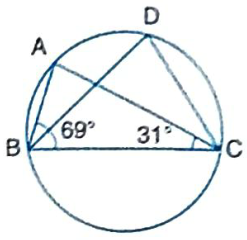
(c) $80^{\circ}$
In $\triangle A B C$, we have
$\begin{array}{l}\angle B A C+\angle A B C+\angle A C B=180^{\circ} \\
\angle B A C+69^{\circ}+31^{\circ}=180^{\circ} \Rightarrow \angle B A C=80^{\circ}\end{array}$
We observe that $\angle B A C$ and $\angle B D C$ are angles in the same segment.$
\therefore \quad \angle B D C=\angle B A C \Rightarrow \angle B D C=80^{\circ}$
View full question & answer→MCQ 501 Mark
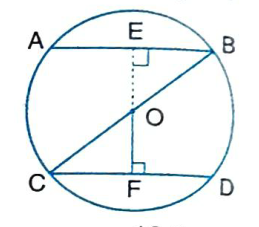
Answer(b) 10 cm
In triangles OEB and OFC, we have
$\begin{aligned}\angle O E B & =\angle O F C \\
O B & =O C\end{aligned}
$and, $\quad \angle B O E=\angle C O F$
So, by using $A A S$-congruence criterion, we obtain
$\begin{array}{ll}& \Delta B O E \cong \triangle C O F \\
\Rightarrow & O E=O F \\
\Rightarrow & \text { Chords } A B \text { and } C D \text { are equidistant from the centre. } \\
\Rightarrow \quad & A B=C D \Rightarrow C D=10 cm .\end{array}$
View full question & answer→MCQ 511 Mark
Answer(a) 8 cm
Applying Pythagoras theorem in $\triangle O L C$, we obtain
$\begin{array}{ll}& O C^2=O L^2+L C^2 \\
\Rightarrow \quad & O L=\sqrt{O C^2-L C^2}=\sqrt{17^2-15^2}=\sqrt{64} cm=8 cm\end{array}$
View full question & answer→MCQ 521 Mark
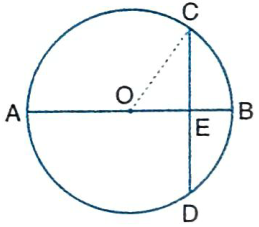
Answer(a) 10 cm
In right triangle OEC, we obtain
$\begin{array}{ll}& O C^2=O E^2+E C^2 \\
\Rightarrow & O C^2=(O B-E B)^2+8^2 \\
\Rightarrow & O C^2=(O C-4)^2+64 \\
\Rightarrow & 0=-8 O C+16+64 \Rightarrow O C=10 cm\end{array}$
View full question & answer→MCQ 531 Mark
Answer(c) 7.5 cm
In right triangle OEA, applying Pythagoras theorem, we obtain
$\begin{array}{ll}& O A^2=O E^2+A E^2 \\
\Rightarrow & O A^2=(O C-C E)^2+6^2 \\
\Rightarrow & O A^2=(O A-3)^2+36 \\
\Rightarrow \quad & 0=-6 \cdot O A+9+36 \Rightarrow O A=\frac{45}{6} cm=7.5 cm\end{array}$
View full question & answer→MCQ 541 Mark
Answer(c) 30cm
Let AB be a chord of a circle of radius 17 cm such that AB is at a distance of 8 cm from the origin. Clearly, L is the mid-point of AB.
In right triangle OLA, applying Pythagoras theorem, we obtain
$\begin{array}{ll}& O A^2=O L^2+A L^2 \Rightarrow A L=\sqrt{O A^2-O L^2}=\sqrt{17^2-8^2}=\sqrt{289-64}=15 cm \\
\therefore \quad & A B=2 A L=2 \times 15 cm=30 cm .\end{array}$
View full question & answer→MCQ 551 Mark
Answer(a) 2 cm
We have, $A B=8 cm$. Therefore, $A C=B C=4 cm$
Applying Pythagoras theorem in $\triangle O C A$, we obtain
$\begin{aligned}& O A^2=O C^2+A C^2 \Rightarrow O C=\sqrt{O A^2-A C^2}=\sqrt{5^2-4^2}=3 cm \\
\therefore & \quad C D=O D-O C=O A-O C=(5-3)=2 cm\end{aligned}$
View full question & answer→MCQ 561 Mark
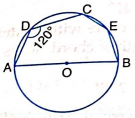
In Fig. AB is a diameter of the circle. If $\angle A D C=120^{\circ}$, then $\angle C A B=$
- A
$60^{\circ}$
- B
$45^{\circ}$
- ✓
$30^{\circ}$
- D
$40^{\circ}$
AnswerCorrect option: C. $30^{\circ}$
View full question & answer→MCQ 571 Mark
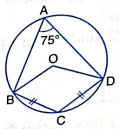
In Fig. $\angle B O D=$
- ✓
$150^{\circ}$
- B
$140^{\circ}$
- C
$105^{\circ}$
- D
$145^{\circ}$
AnswerCorrect option: A. $150^{\circ}$
View full question & answer→MCQ 581 Mark
In Fig. $\angle B C D=$
- A
$95^{\circ}$
- B
$85^{\circ}$
- C
$100^{\circ}$
- ✓
$105^{\circ}$
AnswerCorrect option: D. $105^{\circ}$
View full question & answer→MCQ 591 Mark
In Fig. $\angle O B D=$
- A
$30^{\circ}$
- ✓
$15^{\circ}$
- C
$20^{\circ}$
- D
$35^{\circ}$
AnswerCorrect option: B. $15^{\circ}$
View full question & answer→MCQ 601 Mark
In Fig. O is the centre of the circle. If $\angle B A D=75^{\circ}$ and chord BC = chord CD then $\angle B O C=$
- A
$80^{\circ}$
- B
$65^{\circ}$
- ✓
$75^{\circ}$
- D
$105^{\circ}$
AnswerCorrect option: C. $75^{\circ}$
View full question & answer→MCQ 611 Mark
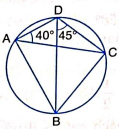
In Fig. ABCD is a quadrilateral inscribed in a circle. If $\angle D A C=40^{\circ}$ and $\angle B D C=45^{\circ}$, then $\angle B C D=$
- A
$85^{\circ}$
- ✓
$95^{\circ}$
- C
$75^{\circ}$
- D
$105^{\circ}$
AnswerCorrect option: B. $95^{\circ}$
View full question & answer→MCQ 621 Mark
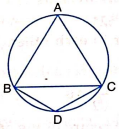
In Fig. if equilateral triangle ABC is inscribed in a circle and ABCD is a quadrilateral, then $\angle B D C=$
- A
$90^{\circ}$
- B
$60^{\circ}$
- ✓
$120^{\circ}$
- D
$150^{\circ}$
AnswerCorrect option: C. $120^{\circ}$
View full question & answer→MCQ 631 Mark
In Fig. AOB is a diameter of the circle. If $\angle A D C=120^{\circ}$, then $\angle B A C=$
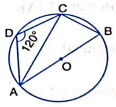
- A
$60^{\circ}$
- ✓
$30^{\circ}$
- C
$45^{\circ}$
- D
$20^{\circ}$
AnswerCorrect option: B. $30^{\circ}$
View full question & answer→MCQ 641 Mark
In Fig. ABCD is a cyclic quadrilateral in which AB || DC. If $\angle A=80^{\circ}$, then $\angle B=$
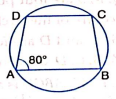
- A
$100^{\circ}$
- ✓
$80^{\circ}$
- C
$120^{\circ}$
- D
$60^{\circ}$
AnswerCorrect option: B. $80^{\circ}$
View full question & answer→MCQ 651 Mark
In Fig. sides AB and AD of quadrilateral ABCD are produced to E and F respectively. If $\angle C B E=100^{\circ}$, then $\angle C D F=$
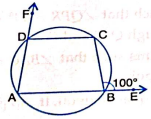
- A
$100^{\circ}$
- ✓
$80^{\circ}$
- C
$130^{\circ}$
- D
$90^{\circ}$
AnswerCorrect option: B. $80^{\circ}$
View full question & answer→MCQ 661 Mark
In Fig. O is the centre of the circle such that $\angle A O C=130^{\circ}$, then $\angle A B C=$
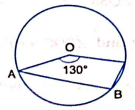
- A
$130^{\circ}$
- ✓
$115^{\circ}$
- C
$65^{\circ}$
- D
$165^{\circ}$
AnswerCorrect option: B. $115^{\circ}$
View full question & answer→MCQ 671 Mark
In a circle of radius 17 cm, two parallel chords are drawn on opposite side of a diameter. The distance between the chords is 23 cm. If the length of one chord is 16 cm, then the length of the other is
MCQ 681 Mark
AB and CD are two parallel chords of a circle with centre O such that AB = 6cm and CD = 12cm The chords are on the same side of the centre and the distance between them is 3 cm. The radius of the circle, is
- A
- B
$5 \sqrt{2} cm$
- C
- ✓
$3 \sqrt{5} cm$
AnswerCorrect option: D. $3 \sqrt{5} cm$
View full question & answer→MCQ 691 Mark
If AB is a chord of a circle, P and Q are the two points on the circle different A and B, then
- A
$\angle A P B=\angle A Q B$
- ✓
$\angle A P B+\angle A Q B=180^{\circ}$ or $\angle A P B=\angle A Q B$
- C
$\angle A P B+\angle A Q B=90^{\circ}$
- D
$\angle A P B+\angle A Q B=180^{\circ}$
AnswerCorrect option: B. $\angle A P B+\angle A Q B=180^{\circ}$ or $\angle A P B=\angle A Q B$
View full question & answer→MCQ 701 Mark
Two equal circles of radius r intersect such that each passes through the of the other. The length of the common chord of the circles, is
- A
$\sqrt{r}$
- B
$\sqrt{2} r A B$
- ✓
$\sqrt{3} r$
- D
$\frac{\sqrt{3}}{2} r$
AnswerCorrect option: C. $\sqrt{3} r$
View full question & answer→MCQ 711 Mark
In a circle with centre O, AB and CD are two diameters perpendicular each other. The length of chord AC, is
- A
- B
$\sqrt{2}$
- C
$\frac{1}{2} A B$
- ✓
$\frac{1}{\sqrt{2}} A B$
AnswerCorrect option: D. $\frac{1}{\sqrt{2}} A B$
View full question & answer→MCQ 721 Mark
In Fig. O is the centre of the circle and $\angle B D C=42^{\circ}$. The measure of $\angle A C B$ is
- A
$42^{\circ}$
- ✓
$48^{\circ}$
- C
$58^{\circ}$
- D
$52^{\circ}$
AnswerCorrect option: B. $48^{\circ}$
View full question & answer→MCQ 731 Mark
In Fig. chords AD and BC intersect each other at right angles at a point P. If $\angle D A B=35^{\circ}$, then $\angle A D C=$
- A
$35^{\circ}$
- B
$45^{\circ}$
- ✓
$55^{\circ}$
- D
$65^{\circ}$
AnswerCorrect option: C. $55^{\circ}$
View full question & answer→MCQ 741 Mark
In Fig. if $\angle A B C=45^{\circ}$, then $\angle A O C=$
- A
$45^{\circ}$
- B
$60^{\circ}$
- C
$75^{\circ}$
- ✓
$90^{\circ}$
AnswerCorrect option: D. $90^{\circ}$
View full question & answer→MCQ 751 Mark
In Fig. if chords AB and CD of the circle intersect each other at right angles, then x + y =
- A
$45^{\circ}$
- B
$60^{\circ}$
- C
$75^{\circ}$
- ✓
$90^{\circ}$
AnswerCorrect option: D. $90^{\circ}$
View full question & answer→MCQ 761 Mark
Number of circles that can be drawn through three non-collinear points, is
MCQ 771 Mark
Angle formed in minor segment of a circle, is
MCQ 781 Mark
The greatest chord of a circle is called its
MCQ 791 Mark
If A, B, C are three points on a circle with centre O such that $\angle A O B=90^{\circ}$ and $\angle B O C=120^{\circ}$, then $\angle A B C=$
- A
$60^{\circ}$
- ✓
$75^{\circ}$
- C
$90^{\circ}$
- D
$135^{\circ}$
AnswerCorrect option: B. $75^{\circ}$
View full question & answer→MCQ 801 Mark
PQRS is a cyclic quadrilateral such that PR is a diameter of the circle. If $\angle Q P R=67^{\circ}$ and $\angle S P R=72^{\circ}$, then $\angle Q R S=$
- ✓
$41^{\circ}$
- B
$23^{\circ}$
- C
$67^{\circ}$
- D
$18^{\circ}$
AnswerCorrect option: A. $41^{\circ}$
View full question & answer→MCQ 811 Mark
The chord of a circle is equal to its radius. The angle subtended by this chord at the minor arc of the circle, is
- A
$60^{\circ}$
- B
$75^{\circ}$
- C
$120^{\circ}$
- ✓
$150^{\circ}$
AnswerCorrect option: D. $150^{\circ}$
View full question & answer→MCQ 821 Mark
If ABC is an arc of a circle and $\angle A B C=135^{\circ}$, then the ratio of arc $\widehat{A B C}$ to the circumference, is
View full question & answer→MCQ 831 Mark
If two diameters of a circle intersect each other at right angles, then quadrilateral formed by joining their end points is a
MCQ 841 Mark
An equilateral triangle ABC is inscribed in a circle with centre O. The measures of $\angle B O C$ is
- A
$30^{\circ}$
- B
$60^{\circ}$
- C
$90^{\circ}$
- ✓
$120^{\circ}$
AnswerCorrect option: D. $120^{\circ}$
View full question & answer→MCQ 851 Mark
If A and B are two points on a circle such that $m(\overparen{A B})=260^{\circ}$. A possible value for the angle subtended by arc BA at a point on the circle is
- A
$100^{\circ}$
- B
$75^{\circ}$
- ✓
$50^{\circ}$
- D
$25^{\circ}$
AnswerCorrect option: C. $50^{\circ}$
View full question & answer→MCQ 861 Mark
In a circle, the major arc is 3 times the minor arc. The corresponding central angles and the degree measures of two arcs are
- A
$90^{\circ}$ and $270^{\circ}$
- B
$90^{\circ}$ and $90^{\circ}$
- ✓
$270^{\circ}$ and $90^{\circ}$
- D
$60^{\circ}$ and $210^{\circ}$
AnswerCorrect option: C. $270^{\circ}$ and $90^{\circ}$
View full question & answer→MCQ 871 Mark
Let C be the mid-point of an arc AB of a circle such that m$\overparen{A B}=183^{\circ}$. If the region bounded by the arc ACB and line segment AB is denoted by S, then the centre O of the circle lies
View full question & answer→MCQ 881 Mark
If AB, BC and CD are equal chords of a circle with O as centre and AD diameter, than $\angle A O B=$
- ✓
$60^{\circ}$
- B
$90^{\circ}$
- C
$120^{\circ}$
- D
AnswerCorrect option: A. $60^{\circ}$
View full question & answer→MCQ 891 Mark
ABC is a triangle with B as right angle, AC = 5 cm and AB = 4 cm. A circle is drawn with A as centre and AC as radius. The length of the chord of this circle passing through C and B is
MCQ 901 Mark
One chord of a circle is known to be 10 cm. The radius of this circle must be
- A
- ✓
- C
greater than or equal to 5 cm
- D
View full question & answer→MCQ 911 Mark
A chord of length 14 cm is at a distance of 6 cm from the centre of a circle. The length of another chord at a distance of 2 cm from the centre of the circle is
MCQ 921 Mark
ABCD is a cyclic quadrilateral such that $\angle A D B=30^{\circ}$ and $\angle D C A=80^{\circ}$, then $\angle D A B=$
- ✓
$70^{\circ}$
- B
$100^{\circ}$
- C
$125^{\circ}$
- D
$150^{\circ}$
AnswerCorrect option: A. $70^{\circ}$
View full question & answer→MCQ 931 Mark
If O is the centre of a circle of radius rand AB is a chord of the circle at a distance r/2 from O, then $\angle B A O=$
- A
$60^{\circ}$
- B
$45^{\circ}$
- ✓
$30^{\circ}$
- D
$15^{\circ}$
AnswerCorrect option: C. $30^{\circ}$
View full question & answer→MCQ 941 Mark
The radius of a circle is 6 cm. The perpendicular distance from the centre of the circle to the chord which is 8 cm in length, is
- A
$\sqrt{5} cm$
- ✓
$2 \sqrt{5} cm$
- C
$2 \sqrt{7} cm$
- D
$\sqrt{7} cm$
AnswerCorrect option: B. $2 \sqrt{5} cm$
View full question & answer→MCQ 951 Mark
If the length of a chord of a circle is 16 cm and is at a distance of 15 cm from the centre of the circle, then the radius of the circle is