Questions

Case study ( 4 Marks )

Take a timed test

5 questions · self-marked practice — reveal the answer and mark yourself.

Question 14 Marks
The force acting on an object perpendicular to the surface is called thrust. When you stand on loose sand, the force, that is, the weight of your body is acting on an area equal to area of your feet. When you lie down then the same force acts on an area equalto the contact area of your whole body, which is larger than the area of your feet. Thus, the effects of forces of the same magnitude on different areas are different. In the above cases, thrust is the same. But effects are different. Therefore the effect of thrust depends on the area on which it acts. The effect of thrust on sand is larger while standing than while lying. The thrust on unit area is called pressure.Pressure=thrust/area. SI unit of pressure as $N/m^2$ or Pascal.
(i) SI unit of thrust is
$(a)$ m/s
$(b)$ $m/s^2$
$(c)$ Newton$(N)$
$(d)$ None of these
(ii) We have two different areas A and B. where A>B. Then relation between pressure on $A(P_A)$ and pressure on $B (P_B)$ is
$(a)$ $P_{A>}P_B$
$(b)$ $P_{B>}P_A$
$(c)$ $P_{A=}P_A$
$(d)$ None of these
(iii)SI unit of pressure is
$(a)$ $N/m^2$
$(b)$ Pascal.
$(c)$ Both $a$ and $b$
$(d)$ None of these
(iv) The effects of forces of the same magnitude on different areas are different. True or false
$(a)$ True
$(b)$ False
$(c)$ None of these
$(v)$ Define pressure.
Answer
$(i)$ $c$
$(ii)$ $b$
$(iii)$ $c$
$(iv)$ $a$
$(v)$ pressure is defined as thrust or perpendicular force acting per unit area
View full question & answer
Question 24 Marks
As you know, the density of a substance is defined as mass of a unit volume. The unit ofdensity is kilogram per meter cube $\left( kg / m ^{-3}\right)$. The density of a given substance, under specified conditions, remains the same. Therefore the density of a substance is one of its characteristic properties. It is different for different substances. For example, the density of gold is $19300\left(kg / m ^{-3}\right)$ while that of water is $1000\left(kg / m ^{-3}\right)$. The density of a given sample of a substance can help us to determine its purity. It is often convenient to express density of a substance in comparison with that of water. The relative density of a substance is the ratio of its density to that of water:Density of a substance
Relative density =
Density of water
Since the relative density is a ratio of similar quantities, it has no unit. Answer the following.
(i) SI unit of density is
$(a)$ $kg/m$
$(b)$ $kg /m^2$
$(c)$ $kg /m^3$
$(d)$ None of these
(ii) SI unit of relative density is
$(a)$ $
$(b)$ No unit
$(c)$ $kg /s^3$
$(d)$ None of these
(iii) Relative density of water is
$(a)$ $1000$
$(b)$ $1$
$(c)$ $10$
$(d)$ None of these
(iv)Define relative density.
(v) Comment of relative density value of substance which
(1) Sink in water
(2) float on water
Answer
$(i)$ $c$
$(ii)$ $b$
$(iii)$ $b$
$(iv)$ The relative density of a substance is defined as the ratio of density of that substance to that of density of water.
$(v)$ Relative density of substance which sinks in water is greater than one. That is density of that substance is more than density of water. While Relative density of substance which float on water is less than one. That is density of that substance is less than density of water.
View full question & answer
Question 34 Marks
Archimedes’ principle, stated as follows: When a body is immersed fully or partiallyin a fluid, it experiences an upward force thatis equal to the weight of the fluid displacedby it. The upward force is known as up thrust or buoyant force. In fact, all objects experience a force of buoyancy when they are immersed in a fluid. The magnitude of this buoyant force depends on the density of the fluid.Objects having density less than that of the liquid in which they are immersed float on the surface of the liquid. If the density of the object is more than the density of the liquid in which it is immersed then it sinks in the liquid. Hence body will float or sink depends upon difference between density of body and fluid.
(i)The up thrust of the body is equal to the
$(a)$ Mass of liquid
$(b)$ Weight of liquid
$(c)$ Weight of liquid displaced by body
$(d)$ None of these
(ii) If the density of the object is more than the density of the liquid in which it is immersed then
$(a)$ It sinks in liquid
$(b)$ It floats on liquid
$(c)$ It comes out of liquid
$(d)$ None of these
(iii) When anybody immersed in liquid it experience a force called as
$(a)$ Gravitational force
$(b)$ Buoyancy force
$(c)$ Nuclear force
$(d)$ None of these
(iv) State Archimedes’ principle.
(v) Why does cube of plastic released deep down under the water come up to surface of water?

 
Answer
$(i) c$
$(ii) a$
$(iii) c$
$(iv)$ Archimedes’ principle, stated as follows: When a body is immersed fully or partially in a fluid, it experiences an upward force thatis equal to the weight of the fluid displaced by it.
$(v)$ Cube of plastic released deep down under the water come up to surface of water because it has less density than that of water also it experiences upward buoyancy force on it due to liquid.
View full question & answer
Question 44 Marks
We know that the earth attracts every object with a certain force and this force depends on the mass $(m)$ of the object and the acceleration due to the gravity $(g)$. The weight of an object is the force with which it is attracted towards the earth. Mathematically $W = m\ x\ g$
Where, $W$= weight of object
$m$= mass of object
$g$= acceleration due to the gravitational force
As the weight of an object is the force with which it is attracted towards the earth, the SI unit of weight is the same as that of force, that is, Newton $(N)$. The weight is a force acting vertically downwards; it has both magnitude and direction. We have learnt that the value of g is constant at a given place. Therefore at a given place, the weight of an object is directly proportional to the mass, say $m$, of the object, that is, $W$ αm. It is due to this reason that at a given place, we can use the weight of an object as a measure of its mass. Answer the following questions.
(i) Unit of acceleration due to the gravity (g) is
$(a)$ m/s
$(b)$ $m/s^2$
$(c)$ Newton$(N)$
$(d)$ None of these
(ii) Direction of weight of any object is
$(a)$ Always towards centre of earth
$(b)$ Always away from centre of earth
$(c)$ Weight don’t have direction
$(d)$ None of these
(iii) Which of the following has same unit
$(a)$ Mass and weight
$(b)$ Weight and force
$(c)$ Velocity and acceleration
$(d)$ None of these
(iv) Whether weight is scalar quantity or vector quantity? Justify your answer.
(v) Differentiate between mass and weight.
Answer
$(i)$ $b$
$(ii)$ $a$
$(iii)$ $b$
$(iv)$ Weight is vector quantity as it has magnitude as well as direction which is always towards centre of a earth.
$(v)$ Difference between mass and weight is given below
No mass weight
$1$ Mass is amount of matter in a body. Weight is the measure of force acting on a mass due to acceleration due to gravity.
$2$ it is a scalar quantity it is a vector quantity
$3$ SI unit of mass is Kilogram $(Kg)$. $SI$ unit of weight is Newton $(N).$
$4.$ Mass can never be zero Weight can be zero where gravity is zero.
View full question & answer
Question 54 Marks
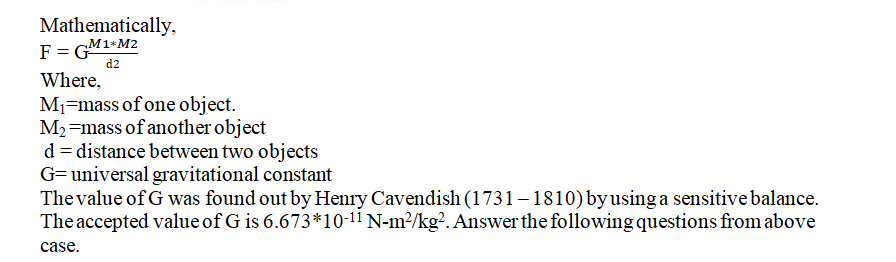
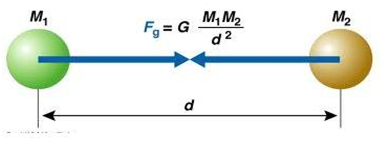
Every object in the universe attracts every other object with a force which is proportional to the product of their masses ($m1*m2$) and inversely proportional to the square of the distance ($d^2$) between them. The force is along the line joining the centers of two objects.

(i)Gravitational force does not depend on
$(a)$ Masses of objects
$(b)$ Separation between objects
$(c)$ Charges on objects
$(d)$ None of these
(ii) Force of gravitation varies with masses of object as
$(a)$ Product of masses
$(b)$ Sum of masses
$(c)$ Difference of masses
$(d)$ None of these
(iii) When mass of one body is doubled then force of gravitation will become
$(a)$ Force will remain same
$(b)$ Force will become double
$(c)$ Force will become halved
$(d)$ None of these
(iv)What is universal gravitational constant? What is its SI unit?
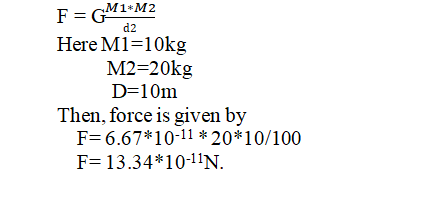
(v) Two objects of masses 10kg and 20kg separated by distance 10m. What is gravitational force between them?
Answer

$(i)$ $c$
$(ii)$ $a$
$(iii)$ $b$
$(iv)$ The force of attraction between any two unit masses separated by a unit distance is called universal gravitational constant denoted by $G$ measured in $Nm^2/kg^2.$
$(v)$ Mathematically
,
View full question & answer