Sample QuestionsGravitation questions
One sample from each question group in this chapter. Select any group above to see the full set with answer keys.
If the distance between two masses be doubled, then the force between will become:
- ✓
$\frac{1}{4}$times
- B
- C
$\frac{1}{2}$times
- D
Answer: A.
View full solution →The gravitational attraction between the two bodies increases when their masses are:
- A
Reduced and distance is reduced
- ✓
Increased and distance is reduced
- C
Reduced and distance is increased
- D
Increased and distance is increased
Answer: B.
View full solution → A body is brought from the earth to the moon is ___?
- A
- ✓
- C
Mass and weight will change
- D
Both mass and weight will change
Answer: B.
View full solution →A ball weighing $4\ kg$ of density $4000\ kg m^{-3}$ is completely immersed in water of density $103\ kg m^{-3}$. What will be the buoyant force acting on it?
- A
$100\ N$
- ✓
$10\ N$
- C
$1600\ N$
- D
$16\ N$
Answer: B.
View full solution →- ✓
Measured by spring balance
- B
- C
- D
Answer: A.
View full solution →A statement of Assertion is given by the corresponding statement of Reason. Of the statements, mark the correct answer as:
Assertion: A planet is heavently body revolving around the sun.
Reason: A planet revolving around the sun follows Kepler's law.
- A
If both Assertion and Reason are true and Reason is the correct explanation of Assertion.
- ✓
If both Assertion and Reason are true, but Reason is not the correct explanation of Assertion.
- C
If Assertion is true, but Reason is false.
- D
If Assertion is false, but Reason is true.
Answer: B.
View full solution →A statement of Assertion is given by the corresponding statement of Reason. Of the statements, mark the correct answer as:
Assertion: At the centre of earth, the value of gravitational acceleration is maximum.
Reason: On going below the earth surface, the value of gravitational acceleration increases.
- A
If both Assertion and Reason are true and Reason is the correct explanation of Assertion.
- B
If both Assertion and Reason are true, but Reason is not the correct explanation of Assertion.
- C
If Assertion is true, but Reason is false.
- ✓
If Assertion and Reason both are false.
Answer: D.
View full solution →In the following Question, the Assertion and Reason have been put forward. Read the statements carefully and choose the correct alternative from the following:
Assertion: Nobody can sink in the Dead Sea.
Reason: The upthrust exerted by a fluid; independent of the volume of the immersed body.
- A
Both the Assertion and the Reason are correct and the Reason is the correct explanation of the Assertion.
- B
The Assertion and the Reason are correct but the Reason is not the correct explanation of the Assertion.
- ✓
Assertion is true but the Reason is false.
- D
The statement of the Assertion is false but the Reason is true.
Answer: C.
View full solution →In the following Questions, the Assertion and Reason have been put forward. Read the statements carefully and choose the correct alternative from the following:
Assertion: Mass remains constant at every point in the universe.
Reason: Mass of a body can be zero.
- A
Both the Assertion and the Reason are correct and the Reason is the correct explanation of the Assertion.
- B
The Assertion and the Reason are correct but the Reason is not the correct explanation of the Assertion.
- ✓
Assertion is true but the Reason is false.
- D
The statement of the Assertion is false but the Reason is true.
Answer: C.
View full solution →A statement of Assertion is given by the corresponding statement of Reason. Of the statements, mark the correct answer as:
Assertion: To float, a body must displace liquid whose weight is greater than actual weight of the body.
Reason: During floating the body will experience no net downward force in that case.
- A
If both Assertion and Reason are true and Reason is the correct explanation of Assertion.
- B
If both Assertion and Reason are true, but Reason is not the correct explanation of Assertion.
- ✓
If Assertion is true, but Reason is false.
- D
If Assertion is false, but Reason is true.
Answer: C.
View full solution →State true/ false. If false, correct the statement: “Earth exerts a greater force of attraction on apple than apple exerts on the earth.”
The following statements are true or false: The value of $G$ on the moon is about one-sixth $\big(\frac{1}{6}\big)$ of the value of G on the earth.
View full solution → The following statements are true or false:
The force of gravitation between two objects depends on the nature of medium between them.
The following statements are true or false: The acceleration due to gravity acting on a freely falling body is directly proportional to the mass of the body.
State whether the following statements are true or false: The buoyant force depends on the nature of object immersed in the liquid.
Fill in the following blanks with suitable word:
If the weight of a body is $6N$ on the moon, it will be about _______ on the earth.
View full solution →Acceleration due to gravity is ________ at centre of earth.
Fill in the following blanks with suitable word: The weight of an object on the earth is about _______ of its weight on the moon.
Fill in the following blanks with suitable word: The weight of an object on the moon is about ________ of its weight on the earth.
Acceleration due to gravity is independent of _________ of falling body.
lire relative density of mercury is $13.6.$ What does this statement mean$?$
View full solution →Name these force: The upward push of water on a submerged object.
What is the other name of buoyant force?
Name the force which makes heavy objects appear light when immersed in a liquid.
What will be the weight of following objects on the earth when their weight on the moon is:
- $1800N$
- $400N$
View full solution →Why do camels have large flat feet?
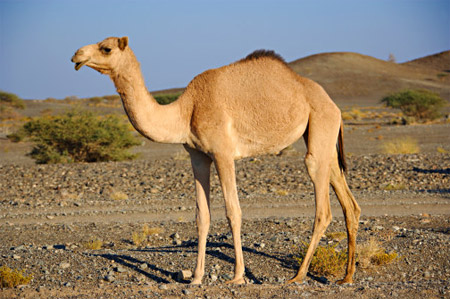
A camel.
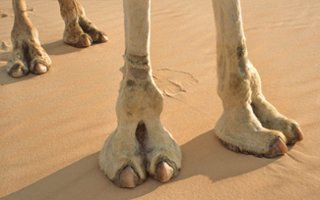
A large flat foot of camel.
A stone and the earth attract each other with an equal and opposite force. Why then we see only the stone falling towards the earth but not the earth rising towards the stone?
Explain why, buildings and dams have wide foundations.
Explain why a truck or a motor bus has much wider tyres?
Define thrust. What is its unit$?$
View full solution →A stone is thrown vertically upwards with a speed of $20m/s$. How high will it go before it begins to fall? $(g = 9.8m/s^2)$
View full solution →A stone is dropped from a height of $20m$. What will be its speed when it hits the ground? $(g = 10m/s^2)$
View full solution →A student thought that two bricks tied together would fall faster than a single one under the action of gravity. Do you agree with his hypothesis or not? Comment.
A stone is allowed to fall from the top of a tower $100m$ high and at the same time another stone is projected vertically upwards from the ground with a velocity of $25m/ s$. Calculate when and where the two stones will meet.
View full solution →Explain why, when a person stands on a cushion, the depression is much more than when he lies down on it.
If the distance between two masses is increased by a factor of $5,$ by what factor would the mass of one of them have to be altered to maintain the same gravitational force$?$ Would this be an increase or decrease in the mass$?$
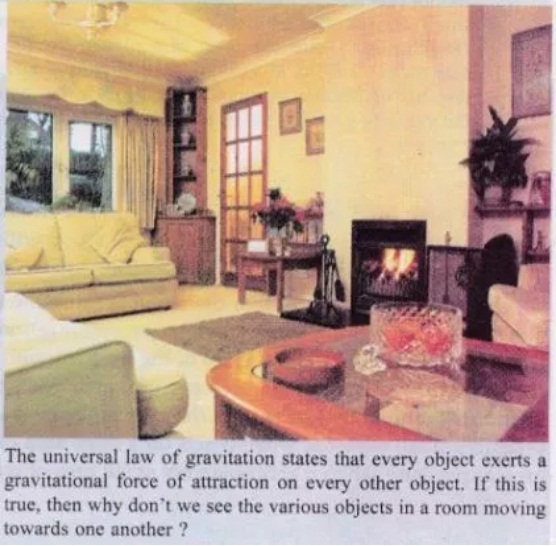
View full solution → Universal law of gravitation states that every object exerts a gravitational force of attraction on every other object. If this is true, why don’t we notice such forces? Why don’t the two objects in a room move towards each other due to this force?
The mass of a planet is $6 \times 10^{24} \mathrm{~kg}$ and its diameter is $12.8 \times 10^3 \mathrm{~km}$. If the value of gravitational constant be $6.7 \times 10^{-11} \mathrm{Nm}^2 / \mathrm{kg}^2$, calculate the value of acceleration due to gravity on the surface of the planet. What planet could this be?
View full solution →a. How does a boat float in water$?$
b. A piece of steel has a volume of $12 cm^3$, and a mass of $96\ g .$ What is its density: $(i)$ in $g / cm ^3$ $(ii)$ in $kg / m ^3 ?$
View full solution →Write the differences between mass and weight of an object.
The force acting on an object perpendicular to the surface is called thrust. When you stand on loose sand, the force, that is, the weight of your body is acting on an area equal to area of your feet. When you lie down then the same force acts on an area equalto the contact area of your whole body, which is larger than the area of your feet. Thus, the effects of forces of the same magnitude on different areas are different. In the above cases, thrust is the same. But effects are different. Therefore the effect of thrust depends on the area on which it acts. The effect of thrust on sand is larger while standing than while lying. The thrust on unit area is called pressure.Pressure=thrust/area. SI unit of pressure as $N/m^2$ or Pascal.
(i) SI unit of thrust is
$(a)$ m/s
$(b)$ $m/s^2$
$(c)$ Newton$(N)$
$(d)$ None of these
(ii) We have two different areas A and B. where A>B. Then relation between pressure on $A(P_A)$ and pressure on $B (P_B)$ is
$(a)$ $P_{A>}P_B$
$(b)$ $P_{B>}P_A$
$(c)$ $P_{A=}P_A$
$(d)$ None of these
(iii)SI unit of pressure is
$(a)$ $N/m^2$
$(b)$ Pascal.
$(c)$ Both $a$ and $b$
$(d)$ None of these
(iv) The effects of forces of the same magnitude on different areas are different. True or false
$(a)$ True
$(b)$ False
$(c)$ None of these
$(v)$ Define pressure.
View full solution →As you know, the density of a substance is defined as mass of a unit volume. The unit ofdensity is kilogram per meter cube $\left( kg / m ^{-3}\right)$. The density of a given substance, under specified conditions, remains the same. Therefore the density of a substance is one of its characteristic properties. It is different for different substances. For example, the density of gold is $19300\left(kg / m ^{-3}\right)$ while that of water is $1000\left(kg / m ^{-3}\right)$. The density of a given sample of a substance can help us to determine its purity. It is often convenient to express density of a substance in comparison with that of water. The relative density of a substance is the ratio of its density to that of water:Density of a substance
Relative density =
Density of water
Since the relative density is a ratio of similar quantities, it has no unit. Answer the following.
(i) SI unit of density is
$(a)$ $kg/m$
$(b)$ $kg /m^2$
$(c)$ $kg /m^3$
$(d)$ None of these
(ii) SI unit of relative density is
$(a)$ $
$(b)$ No unit
$(c)$ $kg /s^3$
$(d)$ None of these
(iii) Relative density of water is
$(a)$ $1000$
$(b)$ $1$
$(c)$ $10$
$(d)$ None of these
(iv)Define relative density.
(v) Comment of relative density value of substance which
(1) Sink in water
(2) float on water
View full solution →Archimedes’ principle, stated as follows: When a body is immersed fully or partiallyin a fluid, it experiences an upward force thatis equal to the weight of the fluid displacedby it. The upward force is known as up thrust or buoyant force. In fact, all objects experience a force of buoyancy when they are immersed in a fluid. The magnitude of this buoyant force depends on the density of the fluid.Objects having density less than that of the liquid in which they are immersed float on the surface of the liquid. If the density of the object is more than the density of the liquid in which it is immersed then it sinks in the liquid. Hence body will float or sink depends upon difference between density of body and fluid.
(i)The up thrust of the body is equal to the
$(a)$ Mass of liquid
$(b)$ Weight of liquid
$(c)$ Weight of liquid displaced by body
$(d)$ None of these
(ii) If the density of the object is more than the density of the liquid in which it is immersed then
$(a)$ It sinks in liquid
$(b)$ It floats on liquid
$(c)$ It comes out of liquid
$(d)$ None of these
(iii) When anybody immersed in liquid it experience a force called as
$(a)$ Gravitational force
$(b)$ Buoyancy force
$(c)$ Nuclear force
$(d)$ None of these
(iv) State Archimedes’ principle.
(v) Why does cube of plastic released deep down under the water come up to surface of water?
View full solution →We know that the earth attracts every object with a certain force and this force depends on the mass $(m)$ of the object and the acceleration due to the gravity $(g)$. The weight of an object is the force with which it is attracted towards the earth. Mathematically $W = m\ x\ g$
Where, $W$= weight of object
$m$= mass of object
$g$= acceleration due to the gravitational force
As the weight of an object is the force with which it is attracted towards the earth, the SI unit of weight is the same as that of force, that is, Newton $(N)$. The weight is a force acting vertically downwards; it has both magnitude and direction. We have learnt that the value of g is constant at a given place. Therefore at a given place, the weight of an object is directly proportional to the mass, say $m$, of the object, that is, $W$ αm. It is due to this reason that at a given place, we can use the weight of an object as a measure of its mass. Answer the following questions.
(i) Unit of acceleration due to the gravity (g) is
$(a)$ m/s
$(b)$ $m/s^2$
$(c)$ Newton$(N)$
$(d)$ None of these
(ii) Direction of weight of any object is
$(a)$ Always towards centre of earth
$(b)$ Always away from centre of earth
$(c)$ Weight don’t have direction
$(d)$ None of these
(iii) Which of the following has same unit
$(a)$ Mass and weight
$(b)$ Weight and force
$(c)$ Velocity and acceleration
$(d)$ None of these
(iv) Whether weight is scalar quantity or vector quantity? Justify your answer.
(v) Differentiate between mass and weight.
View full solution →Every object in the universe attracts every other object with a force which is proportional to the product of their masses ($m1*m2$) and inversely proportional to the square of the distance ($d^2$) between them. The force is along the line joining the centers of two objects.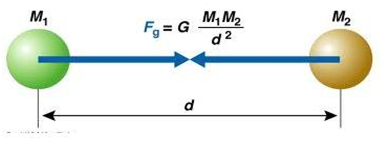
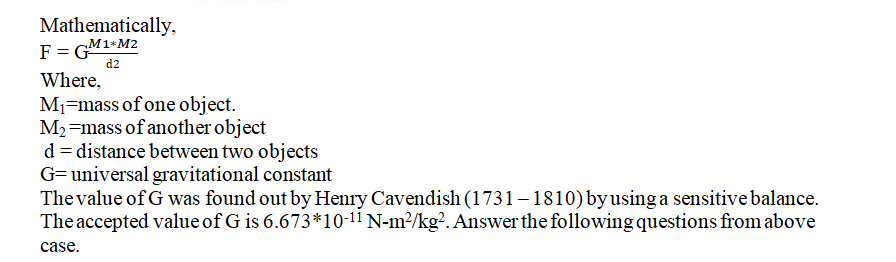
(i)Gravitational force does not depend on
$(a)$ Masses of objects
$(b)$ Separation between objects
$(c)$ Charges on objects
$(d)$ None of these
(ii) Force of gravitation varies with masses of object as
$(a)$ Product of masses
$(b)$ Sum of masses
$(c)$ Difference of masses
$(d)$ None of these
(iii) When mass of one body is doubled then force of gravitation will become
$(a)$ Force will remain same
$(b)$ Force will become double
$(c)$ Force will become halved
$(d)$ None of these
(iv)What is universal gravitational constant? What is its SI unit?
(v) Two objects of masses 10kg and 20kg separated by distance 10m. What is gravitational force between them? View full solution →