Questions · Page 2 of 3

3 Marks Question

Question 513 Marks
Shabana's age 10 years hence, will be twice juhi's present age. 6 years back shabana's age was $\frac{5}{3}$ times Juhi's at that time find their present ages.
Answer
26 years, 18 years
View full question & answer
Question 563 Marks
Places A and B are 30 km apart and they are on a straight road. Hamid travels from A to B on bike. At the same time Joseph starts from B on bike, travels towards A. They meet each other after 20 minutes. If Joseph would have started from B at the same time but in the opposite direction (instead of towards A) Hamid would have caught him after 3 hours. Find the speed of Hamid and Joseph.
Answer
Let the speed of $Joseph = x km / h$
Let the speed of Hamid be $=y km / h$
When approaching each other, combined speed $=(x+y) km / h$
Time taken to meet $=\frac{30}{x+y}=\frac{1}{3}(20 mins )$
$\therefore x + y =90 \ldots I$
When moving away from each other, combined speed $=(x-y) km / h$
Time taken for Hamid to catch up $=\frac{30}{x-y}=3$
$\therefore x - y =10 \ldots II$
Equating I and II,
$\begin{aligned}
& x+y=90 \\
& x-y=10 \\
& 2 x=100 \\
& x=\frac{100}{2}=50
\end{aligned}$
Substituting $x=50$ in eq. I
$50+y=90$
$\begin{aligned}
& y=90-50 \\
& y=40
\end{aligned}$
Hamid's speed $50 km / hr$.
Joseph's speed $40 km / hr$.
View full question & answer
Question 573 Marks
In a factory the ratio of salary of skilled and unskilled workers is 5 : 3. Total salary of one day of both of them is ₹ 720. Find daily wages of skilled and unskilled workers.
Answer
Ratio of skilled and unskilled worker's salary $=5: 3$
Let it be $5 x$ and $3 x$
Total of one day's salary $=₹ 720$
$\begin{aligned}
& \text { So, } 5 x+3 x=720 \\
& 8 x=720 \\
& x=\frac{720}{8} \\
& x=90
\end{aligned}$
Skilled worker's wages $=5 x =5 \times 90=₹ 450$.
unskilled worker's wages $3 x =3 \times 90=₹ 270$
View full question & answer
Question 583 Marks
View full question & answer
Question 593 Marks
Answer
Let $\frac{1}{3 x+4 y}=m$ and $\frac{1}{2 x-3 y}=n$
$\begin{aligned}
& \frac{1}{2} m+\frac{1}{5} n=\frac{1}{4} \Rightarrow 5 m+2 n=\frac{10}{4} \Rightarrow 20 m+8 n=10 \Rightarrow 10 m+4 n=5 \ldots (1) \\
& 5 m-2 n=-\frac{3}{2} \Rightarrow 10 m-4 n=-3 \ldots (2)
\end{aligned}$
Equating Eq. I and II
$\begin{aligned}
& 10 m+4 n=5 \\
& 10 m-4 n=-3 \\
& 20 m=2
\end{aligned}$
$\begin{aligned}
& m =\frac{2}{20} \\
& m =\frac{1}{10}
\end{aligned}$
Substituting $m =\frac{1}{10}$ in Eq. I
$\begin{aligned}
& 10 \times \frac{1}{10}+4 n=5 \\
& 1+4 n=5 \\
& 4 n=5-1
\end{aligned}$
4n=4
$\begin{aligned}
& n =\frac{4}{4} \\
& n =1 \\
& \quad \frac{1}{3 x +4 y }= m \Rightarrow \frac{1}{3 x +4 y }=\frac{1}{10} \Rightarrow 3 x +4 y =10 \ldots (3) \\
& \therefore \frac{1}{2 x -3 y }= n \Rightarrow \frac{1}{2 x -3 y }=1 \Rightarrow 2 x -3 y =1 \ldots (4)
\end{aligned}$
Multiply Eq. III by 3 and Eq. IV by 4 and Equate
$\begin{aligned}
& 9 x+12 y=30 \\
& 8 x-12 y=4 \\
& 17 x=34 \\
& x=\frac{34}{17} \\
& x=2
\end{aligned}$
Substituting $x=2$ in Eq. $V$
$\begin{aligned}
& 9 \times 2+12 y=30 \\
& 18+12 y=30 \\
& 12 y=30-18
\end{aligned}$
$\begin{aligned}
& 12 y=12 \\
& y=\frac{12}{12} \\
& y=1
\end{aligned}$
Hence, $(x, y)=(2,1)$
View full question & answer
Question 603 Marks
Solve the following simultaneous equations.
$\frac{7 x-2 y}{x y}=5 ; \frac{8 x+7 y}{x y}=15$
Answer

$\begin{aligned} & \frac{7 x-2 y}{x y}=5 \Rightarrow \frac{7 x}{x y}-\frac{2 y}{x y}=5 \Rightarrow \frac{7}{y}-\frac{2}{x}=5 \ldots \text { (I) } \\ & \frac{8 x+7 y}{x y}=15 \Rightarrow \frac{8 x}{x y}+\frac{7 y}{x y}=15 \Rightarrow \frac{8}{y}+\frac{7}{x}=15 \ldots \text { (II) } \\ & \text { Let } \frac{1}{x}=m \text { and } \frac{1}{y}=n \\ & 7 n-2 m=5 \ldots \text { (III) } \\ & 8 n+7 m=15 \ldots \text { (IV) } \\ & \text { Multiply Eq. } 1 \text { by } 7 \text { and Eq.II by } 2 \\ & 49 n-14 m=35 \ldots \text { (V) } \\ & 16 n+14 m=30 \ldots \text { (VI) } \\ & 65 n=65 \\ & n=\frac{65}{65} \\ & n=1 \text { Substituting value in Eq.VI } \\ & 16 \times 1+14 m=30 \\ & 14 m=30-16 \\ & 14 m=14\end{aligned}$
$\begin{aligned}
& m =\frac{14}{14} \\
& m =1 \\
& \therefore \frac{1}{ x }= m \Rightarrow \frac{1}{ x }=1 \Rightarrow x =1 \\
& \quad \frac{1}{ y }= n \Rightarrow \frac{1}{ y }=1 \Rightarrow y =1
\end{aligned}$
View full question & answer
Question 613 Marks
Solve the following simultaneous equations.
$\frac{148}{x}+\frac{231}{y}=\frac{527}{x y} ; \frac{231}{x}+\frac{148}{y}=\frac{610}{x y}$
Answer

$\begin{aligned}
& \frac{148}{x}+\frac{231}{y}=\frac{527}{x y} \Rightarrow \frac{148 y+231 x}{x y}=\frac{527}{x y} \Rightarrow 231 x+148 y=527 \ldots(1) \\
& \frac{231}{x}+\frac{148}{y}=\frac{610}{x y} \Rightarrow \frac{231 y+148 x}{x y}=\frac{610}{x y} \Rightarrow 148 x+231 y=610 \ldots(2)
\end{aligned}$
Adding Eq. I and II
$\begin{aligned}
& 379 x+379 y=1137 \\
& x+y=3 \ldots \text { (III) }
\end{aligned}$
Subtracting Eq. I and II
$\begin{aligned}
& 83 x-83 y=-83 \\
& x-y=-1 \ldots \text { (IV) }
\end{aligned}$
Equating I and II
$\begin{aligned}
& x+y=3 \\
& x-y=-1 \\
& 2 x=2 \\
& x=\frac{2}{2} \\
& x=1
\end{aligned}$
Substituting $x =1$ in Eq. I
$\begin{aligned}
& 1+y=3 \\
& y=3-1 \\
& y=2
\end{aligned}$
Hence, $(x, y)=(1,2)$
View full question & answer
Question 623 Marks
Solve the following simultaneous equations.
$\frac{7}{2 x +1}+\frac{13}{ y +2}=27 ; \frac{13}{2 x +1}+\frac{7}{ y +2}=33$
Answer

$\begin{aligned}
& \text { Let } \frac{1}{2 x+1}=m \text { and } \frac{1}{y+2}=n \\
& 7 m+13 n=27 \ldots \text { (I) } \\
& 13 m+7 n=33 \ldots \text { (II) }
\end{aligned}$Adding Eq. I and II
$20 m +20 n =60 \Rightarrow m + n =3 \ldots(III)$
Subtract Eq. I and II
$-6 m+6 n=-6 \Rightarrow-m+n=-1 \ldots(IV)$
Equating Eq. III and IV
$\begin{aligned}
& m+n=3 \\
& -m+n=-1 \\
& \hline 2 n=2 \\
& n=1
\end{aligned}$
Substituting $n=1$ in Eq. III
$\begin{aligned}
& m+1=3 \\
& m=3-1 \\
& m=2
\end{aligned}$
$\begin{aligned}
& \therefore \frac{1}{2 x +1}= m \Rightarrow \frac{1}{2 x +1}=2 \Rightarrow 2(2 x +1)=1 \Rightarrow 4 x +2=1 \Rightarrow 4 x =1-2 \\
& \Rightarrow 4 x =-1 \Rightarrow x =-\frac{1}{4} \\
& \therefore \frac{1}{ y +2}= n \Rightarrow \frac{1}{ y +2}=1 \Rightarrow y +2=1 \Rightarrow y =1-2 \Rightarrow y =-1
\end{aligned}$
Hence, $(x, y)=\left(-\frac{1}{4},-1\right)$
View full question & answer
Question 633 Marks
Solve the following simultaneous equations.
$\frac{2}{x}+\frac{2}{3 y}=\frac{1}{6} ; \frac{3}{x}+\frac{2}{y}=0$
Answer

Let $\frac{1}{x}=m$ and $\frac{1}{y}=n$
$2 m+\frac{2}{3} n=\frac{1}{6} \Rightarrow 12 m+\frac{12}{3 n}=1 \Rightarrow 12 m+4 n=1 \ldots(1)$
$3 m+2 n=0 \ldots(2)$
Multiply Eq. II by 2
$6 n+4 n=0 \ldots(3)$
Subtract Eq.III from Eq. I
$\begin{aligned}
& 12 m+4 n=1 \\
& -6 m-4 n=0 \\
& \hline 6 m=1 \\
& m=\frac{1}{6}
\end{aligned}$
Substitute $m=1 / 6$ in Eq. I
$\begin{aligned}
& 12 \times \frac{1}{6}+4 n=1 \\
& 2+4 n=1 \\
& 4 n=1-2
\end{aligned}$
$\begin{aligned}
& 4 n =-1 \\
& n =-\frac{1}{4} \\
& \therefore m =\frac{1}{ x } \Rightarrow \frac{1}{6}=\frac{1}{ x } \Rightarrow x =6 \\
& \therefore n =\frac{1}{ y } \Rightarrow-\frac{1}{4}=\frac{1}{ y } \Rightarrow y =-4
\end{aligned}$
Hence, $(x, y)=(6,-4)$
View full question & answer
Question 643 Marks
Solve the following equations by Cramer’s method.
$\frac{x+y-8}{2}=\frac{x+2 y-14}{3}=\frac{3 x-y}{4}$
Answer
Let,
$\begin{aligned}
& \frac{x+y-8}{2}=\frac{x+2 y-14}{3} \\
& \Rightarrow 3 x+3 y-24=2 x+4 y-28 \\
& \Rightarrow x-y=-4 \ldots \text { (1) }
\end{aligned}$
Also,
$\begin{aligned}
& \text { Let } \frac{x+2 y-14}{3}=\frac{3 x-y}{4} \\
& \Rightarrow 4 x+8 y-56=9 x-3 y \\
& \Rightarrow 5 x-11 y=-56 \ldots \text { (2) }
\end{aligned}$
Hence the two equations are:
$\begin{aligned}
& x-y=-4 \ldots(1) \\
& 5 x-11 y=-56
\end{aligned}$
Now,
$\begin{aligned}
& D=\left|\begin{array}{cc}
1 & -1 \\
5 & -11
\end{array}\right| \\
& \Rightarrow D=(-11-(-5))=-6
\end{aligned}$
Also, $D _{ x }=\left|\begin{array}{cc}-4 & -1 \\ -56 & -11\end{array}\right|$
$D_x=44-56=-12$
And,
$\begin{aligned}
& D_y=\left|\begin{array}{cc}
1 & -4 \\
5 & -56
\end{array}\right| \\
& \Rightarrow D_y=-56+20=-36
\end{aligned}$
Now,
$x=\frac{D_x}{D}=\frac{-12}{-6}=2$
And,
$y=\frac{D_y}{D}=\frac{-36}{-6}=6$
Hence, $(2,6)$ is the solution
View full question & answer
Question 653 Marks
Solve the following equations by Cramer’s method.
7x + 3y = 15; 12y – 5x = 39
Answer

$\begin{aligned} & D =\left[\begin{array}{cc}7 & 3 \\ -5 & 12\end{array}\right]=(7 \times 12)-(3 \times-5)=84+15=99 \\ & D _{ x }=\left[\begin{array}{cc}15 & 3 \\ 39 & 12\end{array}\right]=(15 \times 12)-(3 \times 39)=180-117=63 \\ & D _{ y }=\left[\begin{array}{cc}7 & 15 \\ -5 & 39\end{array}\right]=(7 \times 39)-(15 \times-5)=273+75=348 \\ & x =\frac{ D _{ x }}{ D }=\frac{63}{99}=\frac{7}{11} y =\frac{ D _{ y }}{ D }=\frac{348}{99}=\frac{116}{33} \\ & \therefore( x , y )=\left(\frac{7}{11}, \frac{116}{33}\right)\end{aligned}$
View full question & answer
Question 663 Marks
Solve the following equations by Cramer’s method.
$3 x-2 y=\frac{5}{2} ; \frac{1}{3} x+3 y=-\frac{4}{3}$
Answer

$\begin{aligned} & 3 x -2 y =\frac{5}{2} \Rightarrow 6 x -4 y =5 \\ & \frac{1}{3} x +3 y =-\frac{4}{3} \Rightarrow \frac{ x +9 y }{3}=-\frac{4}{3} \Rightarrow x +9 y =-4 \\ & D =\left[\begin{array}{cc}6 & -4 \\ 1 & 9\end{array}\right]=(6 \times 9)-(-4 \times 1)=54+4=58 \\ & D _{ x }=\left[\begin{array}{cc}5 & -4 \\ -4 & 9\end{array}\right]=(5 \times 9)-(-4 \times-4)=45-16=29 \\ & D _{ y }=\left[\begin{array}{cc}6 & 5 \\ 1 & -4\end{array}\right]=(6 \times-4)-(5 \times 1)=-24-5=-29 \\ & x=\frac{D_x}{D}=\frac{1}{2}, y=\frac{D_y}{D}=\frac{(-29)}{58}=\frac{(-1)}{2} \\ & \therefore( x , y )=(1 / 2,-1 / 2)\end{aligned}$
View full question & answer
Question 673 Marks
Solve the following equations by Cramer’s method.
4m – 2n = –4; 4m + 3n = 16
Answer

$\begin{aligned} & D =\left[\begin{array}{cc}4 & -2 \\ 4 & 3\end{array}\right]=(4 \times 3)-(-2 \times 4)=12+8=20 \\ & D_x=\left[\begin{array}{cc}-4 & -2 \\ 16 & 3\end{array}\right]=(-4 \times 3)-(-2 \times 16)=-12+32=20 \\ & D_y=\left[\begin{array}{cc}4 & -4 \\ 4 & 16\end{array}\right]=(4 \times 16)-(-4 \times 4)=64+16=80 \\ & x=\frac{D_x}{D}=\frac{20}{20}=1 y=\frac{D_y}{D}=\frac{80}{20}=4 \\ & \therefore(x, y)=(1,4)\end{aligned}$
View full question & answer
Question 683 Marks
Solve the following equations by Cramer’s method.
6x – 3y = –10; 3x + 5y – 8 = 0
Answer

$\begin{aligned} & 6 x-3 y=-10 \\ & 3 x+5 y=8 \\ & D=\left[\begin{array}{cc}6 & -3 \\ 3 & 5\end{array}\right]=(6 \times 5)-(-3 \times 3)=30+9=39 \\ & D_x=\left[\begin{array}{cc}-10 & -3 \\ 8 & 5\end{array}\right]=(-10 \times 5)-3 \times 8=-50+24=-26 \\ & D_y=\left[\begin{array}{cc}6 & -10 \\ 3 & 8\end{array}\right]=(6 \times 8)-(-10 \times 3)=48+30=78 \\ & x=\frac{D_x}{D}=\frac{-26}{39}=\frac{-2}{3} y=\frac{D_y}{D}=\frac{78}{39}=2 \\ & \therefore(x, y)=\left(-\frac{2}{3}, 2\right)\end{aligned}$
View full question & answer
Question 693 Marks
Find the values of each of the following determinants.
(1) $\left|\begin{array}{ll}4 & 3 \\ 2 & 7\end{array}\right|$
(2) $\left|\begin{array}{cc}5 & -2 \\ -3 & 1\end{array}\right|$
(3) $\left|\begin{array}{cc}3 & -1 \\ 1 & 4\end{array}\right|$
Answer
(1) $D =\left[\begin{array}{ll}4 & 3 \\ 2 & 7\end{array}\right]=(4 \times 7)-(3 \times 2)=28-6=22$
(2) $D=\left[\begin{array}{cc}5 & -2 \\ -3 & 1\end{array}\right]=(5 \times 1)-2 \times-3=5-6=-1$
(3) $D =\left[\begin{array}{cc}3 & -1 \\ 1 & 4\end{array}\right]=(3 \times 4)-(-1 \times 1)=12+1=13$
View full question & answer
Question 723 Marks
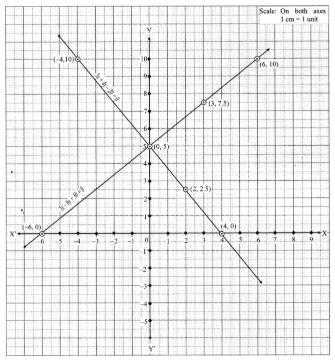
Solve the following simultaneous equation graphically.
5x – 6y + 30 = 0; 5x + 4y – 20 = 0
View full question & answer
Question 733 Marks
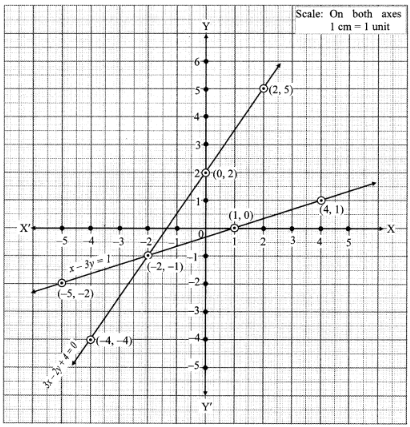
Solve the following simultaneous equation graphically.
x – 3y = 1; 3x – 2y + 4 = 0
Answer
The given simultaneous equations are
$x-3 y=1$
$\therefore \quad 3 y=x-1$
$\therefore \quad y=\frac{x-1}{3}$
x4-2-51
y1-1-20
(x, y)(4, 1)(-2, -1)(-5, -2)(1, 0)
$3 x-2 y+4=0$
$\therefore \quad 2 y=3 x+4$
$\therefore \quad y=\frac{3 x+4}{2}$
x0-22-4
y2-15-4
(x, y)(0, 2)(-2, -1)(2, 5)(-4, -4)
Image
The two lines intersect at point (-2, -1).
∴ x = -2 and y = -1 is the solution of the simultaneous equations x – 3y = 1 and 3x – 2p + 4 = 0.
 
View full question & answer
Question 753 Marks
Sum of the present ages of Manish and Savita is 31. Manish’s age 3 years ago was 4 times the age of Savita. Find their present ages.
Answer
Let Manish's present age be $x$
Let Savita's present age be y
According to $1^{\text {st }}$ situation,
$x+y=31 \dots (1)$
According to second situation,
$\begin{aligned}
& x-3=4(y-3) \\
& x-3=4 y-12 \\
& x-4 y=-12+3 \\
& x-4 y=-9 \ldots (2)
\end{aligned}$
Subtracting Eq. II from I
$\begin{aligned}
& x+y=31 \\
& -x+4 y=9 \\
& 5 y=40 \\
& y=\frac{40}{5} \\
& y=8
\end{aligned}$
Substitute $y=8$ in eq. I
$\begin{aligned}
& x+8=31 \\
& x=31-8 \\
& x=23
\end{aligned}$
Manisha's age 23 years
Savita's age 8 years.
View full question & answer
Question 763 Marks
Out of 1900 km, Vishal travelled some distance by bus and some by aeroplane. Bus travels with average speed 60 km/hr and the average speed of aeroplane is 700 km/hr. It takes 5 hours to complete the journey. Find the distance, Vishal travelled by bus.
View full question & answer
Question 773 Marks
Two types of boxes A, B are to be placed in a truck having capacity of 10 tons. When 150 boxes of type A and 100 boxes of type B are loaded in the truck, it weighes 10 tons. But when 260 boxes of type A are loaded in the truck, it can still accommodate 40 boxes of type B, so that it is fully loaded. Find the weight of each type of box.
View full question & answer
Question 783 Marks
The denominator of a fraction is 4 more than twice its numerator. Denominator becomes 12 times the numerator, if both the numerator and the denominator are reduced by 6. Find the fraction.
Answer
Let the numerator and denominator of the fraction be $x$ and $y$ respectively.
Fraction $=\frac{\bar{x}}{ y }$
Given,
Denominator $=2$ (Numerator $)+4$
$\begin{aligned}
& \Rightarrow y =2 x +4 \\
& \Rightarrow 2 x - y =(-4) \ldots I
\end{aligned}$
According to the given condition, we have
$\begin{aligned}
& y-6=12(x-6) \\
& \Rightarrow y-6=12 x-72 \\
& \Rightarrow 12 x-y=66 \ldots II
\end{aligned}$
Equating Eq. I and II,
$\begin{aligned}
& 2 x-y=-4 \\
& -12 x+y=-66 \\
& -10 x=-70 \\
& x=\frac{70}{10}
\end{aligned}$
$x=7$
Putting $x=7$ in equation $I$, we get
$\begin{aligned}
& \Rightarrow 2 \times 7-y=-4 \\
& \Rightarrow 14-y=-4 \\
& \Rightarrow y=14+4 \\
& \Rightarrow y=18
\end{aligned}$
Hence, required fraction $=\frac{7}{18}$
View full question & answer
Question 793 Marks
The sum of father’s age and twice the age of his son is 70. If we double the age of the father and add it to the age of his son the sum is 95. Find their present ages.
Answer
Suppose father's age(in years) be $x$ and that son's age be $y$.
Then,
$\begin{aligned}
& x+2 y=70 \dots(1) \\
& 2 x+y=95 \dots(2)
\end{aligned}$
Multiply Eq.I by 2 and equate
$\begin{gathered}
2 x+4 y=140 \\
-2 x-y=-95 \\
\hline 3 y=45
\end{gathered}$
$\begin{aligned}
& y=\frac{45}{3} \\
& y=15
\end{aligned}$
Substituting $y=15$ in Eq.II
$\begin{aligned}
& 2 x+15=95 \\
& 2 x=95-15 \\
& 2 x=80 \\
& x=\frac{80}{2} \\
& x=40
\end{aligned}$
∴ Son’s age is 15 years, father’s age is 40 years.
View full question & answer
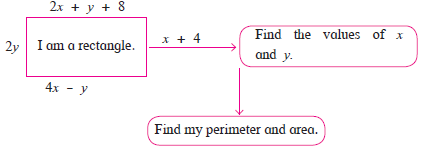
Question 803 Marks
Answer

$\begin{aligned} & \text { Length of rectangle } \Rightarrow 2 x+y+8=4 x-y \\
& \Rightarrow 2 x-4 x+y+y=-8 \\
& \Rightarrow-2 x+2 y=-8 \\
& \Rightarrow-x+y=-4 \ldots \ldots(I)
\end{aligned}$
$\begin{aligned}
& \text { Breadth of the rectangle }=2 y=x+4 \\
& \Rightarrow-x+2 y=4 \ldots . . \text { (II) }
\end{aligned}$
Equating Eq. I and II and change sign of Eq. II
$\begin{gathered}
-x+y=-4 \\
x-2 y=-4 \\
\hline -y=-8 \\
y=8
\end{gathered}$
Substituting $y=8$ in Eq.I
$\begin{aligned}
& -x+8=-4 \\
& -x=-4-8 \\
& -x=-12 \\
& x=12
\end{aligned}$
$\begin{aligned} & \text { Length }=2 \times 12+8+8=40 \\ & \text { Breadth }=2 \times 8=16 \\ & \text { Area }=\text { Length } \times \text { breadth }=40 \times 16=640 \text { sq. unit } \\ & \text { Perimeter }=2 \text { (Length }+ \text { Breadth) }=2(40+16)=2(56)=112 \text { unit. }\end{aligned}$
View full question & answer
Question 813 Marks
Two numbers differ by 3. The sum of twice the smaller number and thrice the greater number is 19. Find the numbers.
Answer
Let the greater no. be $x$ and smaller no. be $x-3$
As per given situation,
$\begin{aligned}
& 2(x-3)+3(x)=19 \\
& \Rightarrow 2 x-6+3 x=19 \\
& \Rightarrow 5 x-6=19 \\
& \Rightarrow 5 x=19+6 \\
& \Rightarrow 5 x=25 \\
& \Rightarrow x=\frac{25}{5}=5
\end{aligned}$
$\therefore$ smaller no is $x-3 \Rightarrow 5-3=2$
Hence, The numbers are 5 and 2.
View full question & answer
Question 823 Marks
Solve the following simultaneous equation.
$\begin{aligned} & \frac{1}{3 x+y}+\frac{1}{3 x-y}=\frac{3}{4} \\ & \frac{1}{2(3 x+y)}-\frac{1}{2(3 x-y)}=\frac{1}{8}\end{aligned}$
Answer

$\begin{aligned}& \frac{1}{3 x+y}+\frac{1}{3 x-y}=\frac{3}{4} \\
& \frac{1}{[2(3 x+y)]}-\frac{1}{[2(3 x-y)]}=\frac{1}{8} \\
& \text { Let } \frac{1}{3 x+y}=m \text { and } \frac{1}{3 x-y}=n \\
& m+n=\frac{3}{4} \Rightarrow 4(m+n)=3 \Rightarrow 4 m+4 n=3 \ldots \text { (I) } \\
& \frac{1}{2} m-\frac{1}{2} n=\frac{1}{8} \Rightarrow 8(m-n)=1 \times 2 \Rightarrow 8 m-8 n=2 \ldots (II)
\end{aligned}$
Multiply Eq. I by 2
$8 m+8 n=6$ $\dots$ (a)
$8 m-8 n=2$ $\dots$ (b)Add (a) and (b) to get,
$8 m+8 n+8 m-8 n=8$
$\Rightarrow 16 m =8$
$m =\frac{8}{16}$
$m =\frac{1}{2}$
Substituting $m =\frac{1}{2}$ in Eq. II
$8 \times \frac{1}{2}-8 n=2$
⇒ 4 - 8n = 2
⇒ - 8n = 2 - 4
⇒ - 8n = -2
⇒ 8n = 2
$\begin{aligned}
\Rightarrow & n=\frac{2}{8} \\
\Rightarrow & n=\frac{1}{4} \\
& \therefore m=\frac{1}{2(3 x+y)} \\
& \frac{1}{2(3 x+y)}=\frac{1}{2} \\
\Rightarrow & 2=2(3 x+y) \\
\Rightarrow & 2=6 x+2 y \ldots \ldots . \text { III } \\
& n=\frac{1}{2(3 x-y)} \\
\Rightarrow & \frac{1}{2(3 x-y)}=\frac{1}{4} \\
\Rightarrow & 4=2(3 x-y) \\
\Rightarrow & 4=6 x-2 y \ldots . I V
\end{aligned}$
Add Eq. III and IV
$\begin{aligned}
& 6 x+2 y=2 \\
& \frac{6 x-2 y=4}{12 x=6} \\
& x=\frac{6}{12} \\
& x=\frac{1}{2}
\end{aligned}$
Substituting $x =\frac{1}{2}$ in Eq. III
$\begin{aligned}
& 6 \times \frac{1}{2}+2 y=2 \\
& \Rightarrow 3+2 y=2 \\
& \Rightarrow 2 y=2-3 \\
& \Rightarrow 2 y=-1 \\
& y=-\frac{1}{2}
\end{aligned}$
Hence $(x, y)=\left(\frac{1}{2},-\frac{1}{2}\right)$
View full question & answer
Question 833 Marks
Solve the following simultaneous equation.
$\frac{27}{x-2}+\frac{31}{y+3}=85 ; \frac{31}{x-2}+\frac{27}{y+3}=89$
Answer

$\begin{aligned}& \frac{27}{x-2}+\frac{31}{y+3}=85 \\
& \frac{31}{x-2}+\frac{27}{y+3}=89
\end{aligned}$
Let $\frac{1}{x-2}=m$ and $\frac{1}{y+3}=n$
$27 m+31 n=85 \dots (1)$
$31 m+27 n=89 \dots (2)$
Adding both equations
$58 m+58 n=174$
Dividing both sides by 58
$m + n =3 \dots (3)$
Subtracting Eq. I and II
$\begin{aligned}
& 27 m+31 n=85 \\
& -31 m-27 n=-89 \\
& -4 m+4 n=-4
\end{aligned}$
Dividing both sides by 4
$-m+n=-1 \dots (4)$
Equating Eq. III and IV
$\begin{gathered}
m+n=3 \\
-m+n=-1 \\
\hline 2 n=2
\end{gathered}$
$\begin{aligned}
& n =\frac{2}{2} \\
& n =1
\end{aligned}$
Subsituting $n=1$ in Eq. III
$\begin{aligned}
& m+1=3 \\
& m=3-1 \\
& m=2
\end{aligned}$
$\begin{aligned}
& \therefore m =\frac{1}{ x -2} \\
& \Rightarrow \frac{1}{ x -2}=2 \Rightarrow 2( x -2)=1 \\
& \Rightarrow 2 x -4=1 \Rightarrow 2 x =4+1 \\
& \Rightarrow 2 x =5 \Rightarrow x =\frac{5}{2} \\
& \therefore n =\frac{1}{ y +3} \\
& \Rightarrow \frac{1}{ y +3}=1 \\
& \Rightarrow y +3=1 \\
& \Rightarrow y =1-3 \\
& \Rightarrow y =-2 \\
& y =2
\end{aligned}$
Hence $(x, y)=\left(\frac{5}{2},-2\right)$
View full question & answer
Question 843 Marks
Solve the following simultaneous equation.
$\frac{10}{x+y}+\frac{2}{x-y}=4 ; \frac{15}{x+y}-\frac{5}{x-y}=-2$
Answer

$\begin{aligned} & \frac{10}{x+y}+\frac{2}{x-y}=4 \\
& \frac{15}{x+y}-\frac{5}{x-y}=-2 \\
& \text { Let } \frac{1}{x+y}=m \text { and } \frac{1}{x-y}=n \\
& 10 m+2 n=4 \ldots \text { (I) } \\
& 15 m-5 n=-2 \ldots \text { (II) }
\end{aligned}$
Multiply Eq. I by 5 and Eq.II by 2
$\begin{gathered}
50 m+10 n=20 \\
\frac{30 m-10 n=-4}{80 m=16}
\end{gathered}$
$\begin{aligned}
m & =\frac{16}{80} \\
m & =\frac{1}{5}
\end{aligned}$
$\begin{aligned}
& \text { Substituting } m=\frac{1}{5} \text { in Eq. I } \\
& 10 \times \frac{1}{5}+2 n=4 \\
& 2+2 n=4 \\
& 2 n=4-2 \\
& 2 n=2 \\
& n=\frac{2}{2} \\
& n=1
\end{aligned}$
$\begin{aligned}
\therefore & m =\frac{1}{ x + y } \Rightarrow \frac{1}{ x + y }=\frac{1}{5} \Rightarrow x + y =5 \dots (3)\\
& n =\frac{1}{ x - y } \Rightarrow \frac{1}{x-y}=1 \Rightarrow x - y =1 \dots (4)
\end{aligned}$
Now, equating Eq. III and IV
$\begin{gathered}
x+y=5 \\
x-y=1 \\
\hline 2 x=6 \\
x=\frac{6}{2} \\
x=3
\end{gathered}$
Subsituting value of $x=3$ in Eq. III
$\begin{aligned}
& 3+y=5 \\
& y=5-3 \\
& y=2
\end{aligned}$
Hence $(x, y)=(3,2)$
View full question & answer
Question 853 Marks
Solve the following simultaneous equation.
$\frac{2}{x}-\frac{3}{y}=15 ; \frac{8}{x}+\frac{5}{y}=77$
Answer

$\begin{aligned} & \frac{2}{x}-\frac{3}{y}=15 \\
& \frac{8}{x}+\frac{5}{y}=77 \\
& \text { Let } \frac{1}{x}=m \text { and } \frac{1}{y}=n \\
& 2 m-3 n=15 \ldots \text { (I) } \\
& 8 m+5 n=77 \ldots \text { (II) }
\end{aligned}$
Multiply Eq. I by 4
$8 m-12 n=60 \ldots \text { (III) }$
Equating Eq. II and III. Change the signs of Eq. III
$\begin{gathered}
8 m+5 n=77 \\
-8 m+12 n=-60 \\
\hline 17 n=17
\end{gathered}$
$\begin{aligned}
& n =\frac{17}{17} \\
& n =1
\end{aligned}$
Substituting $n =1$ in Eq. II
$\begin{aligned}
& 8 m+5 \times 1=77 \\
& 8 m+5=77 \\
& 8 m=77-5 \\
& 8 m=72 \\
& m=\frac{72}{8} \\
& m=9
\end{aligned}$
$\begin{aligned} & \therefore m =\frac{1}{ x } \Rightarrow \frac{1}{ x }=9 \Rightarrow x =\frac{1}{9} \\ & \therefore n =\frac{1}{ y } \Rightarrow \frac{1}{ y }=1 \Rightarrow y =1 \\ & \text { Hence }( x , y )=\left(\frac{1}{9}, 1\right)\end{aligned}$
View full question & answer
Question 863 Marks
Solve the following simultaneous equations using Cramer’s rule.
$2 x+3 y=2 ; x-\frac{y}{2}=\frac{1}{2}$
Answer

$\begin{aligned} & 2 x+3 y=2 \\ & x-\frac{y}{2}=\frac{1}{2} \Rightarrow 2 x-y=1 \\ & D=\left[\begin{array}{cc}2 & 3 \\ 2 & -1\end{array}\right]=(2 \times-1)-(3 \times 2)=-2-6=-8 \\ & D_x=\left[\begin{array}{cc}2 & 3 \\ 1 & -1\end{array}\right]=(2 \times-1)-(3 \times 1)=-2-3=-5 \\ & D_y=\left[\begin{array}{ll}2 & 2 \\ 2 & 1\end{array}\right]=(2 \times 1)-(2 \times 2)=2-4=(-2) \\ & x=\frac{D_x}{D}=\frac{-5}{-8}=\frac{5}{8} y=\frac{D_y}{D}=\frac{-2}{-8}=\frac{1}{4} \\ & \therefore(x, y)=\left(\frac{5}{8}, \frac{1}{4}\right) \text { is solution. }\end{aligned}$
View full question & answer
Question 873 Marks
Solve the following simultaneous equations using Cramer’s rule.
4m + 6n = 54; 3m + 2n = 28
Answer

$\begin{aligned} & 4 m+6 n=54 \\
& 3 m+2 n=28 \\
& D=\left[\begin{array}{ll}
4 & 6 \\
3 & 2
\end{array}\right]=(4 \times 2)-(6 \times 3)=8-18=10 \\
& D_x=\left[\begin{array}{ll}
54 & 6 \\
28 & 2
\end{array}\right]=(54 \times 2)-(6 \times 28)=108-168=60 \\
& D_y=\left[\begin{array}{ll}
4 & 54 \\
3 & 28
\end{array}\right]=(4 \times 28)-(54 \times 3)=112-162=50 \\
& x=\frac{D_x}{D}=\frac{60}{10}=6 y=\frac{D_y}{D}=\frac{50}{10}=5
\end{aligned}$
$\therefore(x, y)=(6,5)$ is solution.
View full question & answer
Question 883 Marks
Solve the following simultaneous equations using Cramer’s rule.
6x – 4y = –12; 8x – 3y = –2
Answer

$\begin{aligned} & 6 x-4 y=-12 \\
& 8 x-3 y=-2 \\
& D=\left[\begin{array}{ll}
6 & -4 \\
8 & -3
\end{array}\right]=(6 \times-3)-(-4 \times 8)=-18+32=14 \\
& D_x=\left[\begin{array}{cc}
-12 & -4 \\
-2 & -3
\end{array}\right]=(-12 \times-3)-(-4 \times-2)=36-8=28 \\
& D_y=\left[\begin{array}{cc}
6 & -12 \\
8 & -2
\end{array}\right]=(6 \times-2)-12 \times 8=12+96=108 \\
& x=\frac{D_x}{D}=\frac{28}{14}=2 y=\frac{D_y}{D}=\frac{108}{14}=6
\end{aligned}$
$\therefore(x, y)=(2,6)$ is solution.
View full question & answer
Question 893 Marks
Solve the following simultaneous equations using Cramer’s rule.
x + 2y = –1; 2x – 3y = 12
Answer

$\begin{aligned} & x+2 y=-1 \\ & 2 x-3 y=12 \\ & D=\left[\begin{array}{cc}1 & 2 \\ 2 & -3\end{array}\right]=(1 \times-3)-(2 \times 2)=-3-4=-7 \\ & D_x=\left[\begin{array}{cc}-1 & 2 \\ 12 & -3\end{array}\right]=(-1 \times-3)-(2 \times 12)=3-24=-21 \\ & D_y=\left[\begin{array}{cc}1 & -1 \\ 2 & 12\end{array}\right]=(1 \times 12)-(-1 \times 2)=12+2=14 \\ & x=\frac{D_x}{D}=-\frac{21}{-7}=3 y=\frac{D_y}{D}=\frac{14}{-7}=-2 \\ & \therefore(x, y)=(3,-2) \text { is solution. }\end{aligned}$
View full question & answer
Question 903 Marks
Solve the following simultaneous equations using Cramer’s rule.
4x + 3y – 4 = 0; 6x = 8 – 5y
Answer

$\begin{aligned}
& 4 x+3 y=4 \\
& 6 x+5 y=8 \\
& D=\left[\begin{array}{ll}
4 & 3 \\
6 & 5
\end{array}\right]=(4 \times 5)-(3 \times 6)=20-18=2 \\
& D_x=\left[\begin{array}{ll}
4 & 3 \\
8 & 5
\end{array}\right]=(4 \times 5)-(3 \times 8)=20-24=-4 \\
& D_y=\left[\begin{array}{ll}
4 & 4 \\
6 & 8
\end{array}\right]=(4 \times 8)-(4 \times 6)=32-24=8 \\
& x=\frac{D_x}{D}=-\frac{4}{2}=-2 y=\frac{D_y}{D}=\frac{8}{2}=4
\end{aligned}$
$\therefore( x , y )=(-2,4)$ is the solution.
View full question & answer
Question 913 Marks
Solve the following simultaneous equations using Cramer’s rule.
3x – 4y = 10; 4x + 3y = 5
Answer

$\begin{aligned}
& 3 x-4 y=10 \\
& 4 x+3 y=5 \\
& D=\left|\begin{array}{cc}
3 & -4 \\
4 & 3
\end{array}\right|=(3 \times 3)-(-4 \times 4)=9+16=25 \\
& D_x=\left[\begin{array}{cc}
10 & -4 \\
5 & 3
\end{array}\right]=(10 \times 3)-(-4 \times 5)=30+20=50 \\
& D_y=\left[\begin{array}{cc}
3 & 10 \\
4 & 5
\end{array}\right]=(3 \times 5)-(10 \times 4)=15-40=-25 \\
& x=\frac{D_x}{D}=\frac{50}{25}=2 \\
& x=\frac{D_y}{D}=-\frac{25}{25}=-1
\end{aligned}$
$\therefore(x, y)=(2,-1)$ is the solution
View full question & answer
Question 923 Marks
Find the values of following determinants.
(1) $\left|\begin{array}{cc}-1 & 7 \\ 2 & 4\end{array}\right|$
(2) $\left|\begin{array}{cc}5 & 3 \\ -7 & 0\end{array}\right|$
(3) $\left|\begin{array}{ll}\frac{7}{3} & \frac{5}{3} \\ \frac{3}{2} & \frac{1}{2}\end{array}\right|$
Answer
we know, determinant of a $2 \times 2$ matrix
$\left|\begin{array}{ll}
a & b \\
c & d
\end{array}\right|$
(1) $(-1 \times 4)-(7 \times 2)=-4-14=-18$
(2) $(5 \times 0)-(3 \times-7)=0-(-21)=21$
$\begin{aligned}
& \text { (3) } \frac{7}{3} \times \frac{1}{2}-\frac{5}{3} \times \frac{3}{2}=\frac{7}{6}-\frac{15}{6} \\
& =-\frac{8}{6} \\
& =-\frac{4}{3}
\end{aligned}$
View full question & answer
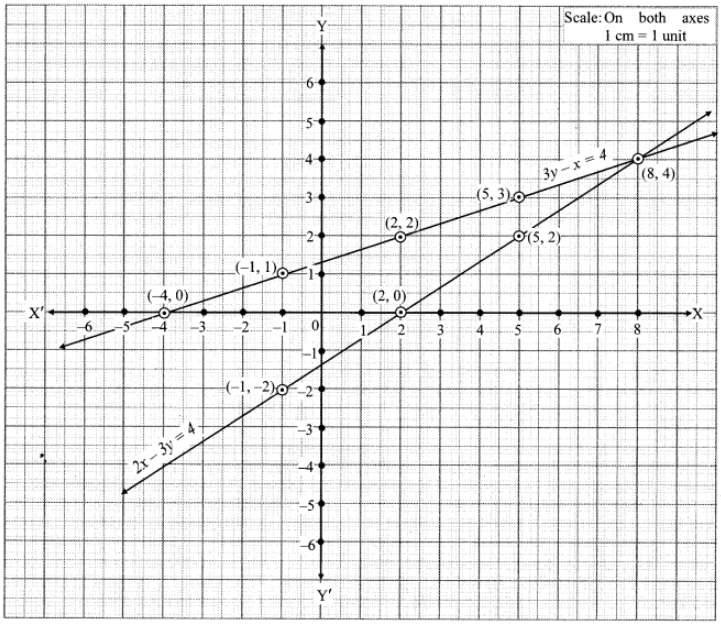
Question 933 Marks
Solve the following simultaneous equation graphically.
2x – 3y = 4 ; 3y – x = 4
Answer
The given simultaneous equations are
$2 x-3 y=4$
$\therefore \quad 3 y=2 x-4$
$\therefore \quad y=\frac{2 x-4}{3}$
x2-158
y0-224
(x. y)(2, 0)(-1, -2)(-5, 2)(8, 4)
$3 y-x=4$
$\therefore \quad 3 y=x+4$
$\therefore \quad y=\frac{x+4}{3}$
x2-45-1
y2031
(x. y)(2, 2)(-4, -0)(5, 3)(-1, 1)

Image
The two lines intersect at point (8, 4).
∴ x = 8 and y = 4 is the solution of the simultaneous equations 2x – 3y = 4 and 3y – x = 4.
View full question & answer
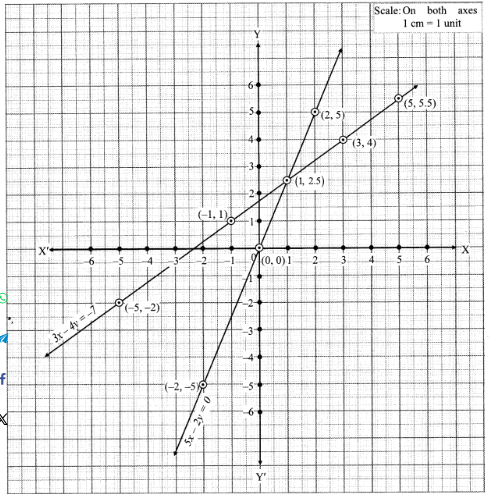
Question 943 Marks
Solve the following simultaneous equation graphically.
3x – 4y = –7; 5x – 2y = 0
View full question & answer
Question 1003 Marks
A certain amount is equally distributed among certain number of students. Each would get ₹ 2 less if 10 students were more and each would get ₹ 6 more if 15 students were less. Find the number of students and the amount distributed.
View full question & answer