Question 14 Marks
In a circle with centre $P ,$ chord $AB$ is parallel to a tangent and intersects the radius drawn from the point of contact to its midpoint. If $AB = 16\sqrt3$ then find the radius of the circle
Answer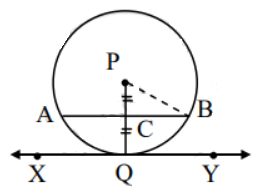
Given: Chord $A B||$ tangent $X Y$
$A B=16 \sqrt{3}$ units
$PQ$ is radius of the circle.
$P C=C Q$
To find: Radius of the circle, $i.e.,I(PQ)$
Construction: Draw seg $PB.$
In given figure, $ \angle P Q Y=90^{\circ}..(i) [$Tangent theorem$]$
Chord $A B \|$ line $X Y$
$\therefore \angle PCB \cong \angle PQY$
$\therefore \angle PCB =90^{\circ}(ii) ...[$From $(i)]$
Now $C B=\frac{1}{2} A B$
$ \begin{array}{l} \therefore C B=\frac{1}{2} \times 16 \sqrt{3} \ldots . .\left[\begin{array}{c} \text { A perpendicular drawn from the } \\ \text { centre of a circle on its chord } \\ \text { bisects the chord } \end{array}\right] \\\end{array}$
$C B=8 \sqrt{3}....(iii) $
Let the radius of the circle be $x$ units
$\therefore PQ = x$
$\therefore PC =\frac{1}{2} PQ \ldots \ldots . .[ PC = CQ , P - C - Q ]$
$\therefore PC =\frac{1}{2} x \ldots \ldots . (v)$
$\text { In } \triangle PCB ,$
$\angle PCB =90^{\circ} \ldots . .[$From $(ii)] $
$\therefore PB P ^2= PC ^2+ CB ^2 \ldots . .[$ Pythagoras theorem $]$
$\therefore x ^2=\left(\frac{1}{2} x\right)^2+(8 \sqrt{3})^2 \ldots . . .[$ From $(iii), (iv)$ and $( v )]$
$\therefore x ^2=\frac{x^2}{4}+64 \times 3$
$\therefore 4 x^2=x^2+192$
$\therefore 4 x ^2- x ^2=192$
$\therefore 3 x^2=192$
$\therefore x ^2=\frac{192}{3}$
$\therefore x^2=64$
$\therefore x =8$ units $[$Taking square root of both sides$]$
$\therefore$ The radius of the circle is $8$ units. View full question & answer→Question 24 Marks
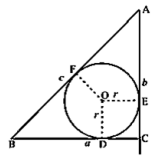
Given : A circle inscribed in a right angled $\triangle ABC.$ If $\angle ACB = 90^\circ$ and the radius of the circle is $r.$
To prove $: 2 r = ? + b – c$
AnswerProof: In given figure,
$\left.\begin{array}{l} A F=A E \\ F B=B D \\ E C=D C \end{array}\right\}.....(i) [$Tangent Segment theorem$]$
In $\square \ce{ODCE},$
$\angle E C D=90^{\circ} \ldots \ldots \ldots\left[\angle A C B=90^{\circ}, A-E-C, B-D-C\right]$
$\left.\begin{array}{l}\angle O D C=90^{\circ} \\ \angle O E C=90^{\circ}\end{array}\right\} \ldots \ldots .[$ Tangent theorem $]$
$\therefore \angle E O D=90^{\circ} \ldots[$ Ramining angle of $\square \ce{ODCE}]$
$\therefore \square \ce{ODCE}$ is a rectangle.
Also, $\ce{OEOD}=r [$Radii of the same circle$]$
$\therefore \square \ce{ODCE}$ is a square $ \ldots \ldots .\left[\begin{array}{c}A \\ \text { Rectangle is square if it's } \\ \text { adjent sides are congruent }\end{array}\right]$
$ \therefore O E=O D=C D=C E=r \ldots \ldots (ii) [ $sides of the square $] $
Consider $\text{R.H.S. }=a+b-c$
$ =B C+A C-A B$
$ =(B D+D C)+(A E+E C)-(A F+F B) \ldots \ldots[B-D-C, A-E-C, A-F-B]$
$ =(F B+r)+(A F+r)-(A F+F B) \ldots \ldots[$ From $(i)$ and $(ii)]$
$ =F B+r+A F+r-A F-F B$
$ =2 r$
$ =\text { L.H.S }$
$ \therefore 2 r=a+b-c$
View full question & answer→Question 34 Marks
In the figure quadrilateral ABCD is cyclic, If m(arc BC) = 90° and ∠DBC = 55°. Then find the measure of ∠BCD .
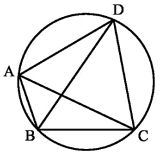
AnswerGiven: $m (\operatorname{arc} BC )=90^{\circ}, \angle DBC =55^{\circ}$
To find: $\angle B C D$
Solution:
$\angle B D C=\frac{1}{2} m(\operatorname{arc~BC}) \quad$......[Inscribed angle theorem $]$
$\therefore \angle BDC =\frac{1}{2} \times 90^{\circ} \quad$.......[Given]
$\therefore \angle BDC =45^{\circ} \quad \ldots . .$. (i)
In $\triangle B C D$,
$\angle BDC +\angle DBC +\angle BCD =180^{\circ}$ [Sum of the measures of all angles of a triangle is $180^{\circ}$ ]
$\therefore 45^{\circ}+55^{\circ}+\angle B C D=180^{\circ} [From (i) and given]$
$ \therefore 100^{\circ}+\angle B C D=180^{\circ}$
$\therefore \angle B C D=180^{\circ}-100^{\circ}$
$\therefore \angle B C D=80^{\circ} $
$\therefore$ The measure of $\angle B C D$ is $80^{\circ}$.
View full question & answer→Question 44 Marks
In the figure ∆ABC is an equilateral triangle.The angle bisector of ∠? will intersect the circumcircle ∆ABC at point P. Then prove that : CQ = CA.
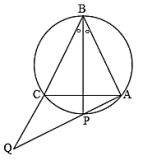
Answer$\triangle ABC$ is an equilateral triangle.
$\therefore \angle ABC =\angle ACB =\angle BAC =60^{\circ} ....(i) [Angles of an equilateral triangle]$
$\angle CBP =\frac{1}{2} \angle ABC$
$\therefore \angle CBP =\frac{1}{2} \times 60^{\circ}$
$\therefore \angle CBP =30^{\circ}$
$\angle C B P=\angle C A P=30^{\circ} ....[Angles inscribed in the same arc]$
$\therefore \angle CAQ =30^{\circ}$
In $\triangle ABQ$,
$\angle B A Q=\angle B A C+\angle C A Q ....[Angle addition property]$
$\therefore \angle BAQ =60^{\circ}+30^{\circ}$
In $\triangle A B Q$,
$ \angle BAQ =\angle BAC +\angle CAQ \quad \ldots . .[\text { Angle addition property }]$
$\therefore \angle BAQ =60^{\circ}+30^{\circ} \quad \ldots . .[\text { From (i) and (ii) }]$
$\therefore \angle BAQ =90^{\circ} $
Also, $\angle A B Q=60^{\circ}$ [From (i) and B-C-Q]
$\therefore \angle BQA =30^{\circ}$
$\therefore \angle C Q A=30^{\circ}$
In $\triangle CQA$,
$\angle C A Q=\angle C Q A [From (ii) and (iii)]$
$\therefore CQ = CA [Converse of isosceles triangle theorem]$
View full question & answer→Question 54 Marks
The figure $\triangle ABC$ is an isosceles triangle with a perimeter of $44 \ cm.$ The sides $AB$ and $BC$ are congruent and the length of the base $AC$ is $12\ cm.$ If a circle touches all three sides as shown in the figure, then find the length of the tangent segment drawn to the circle from the point $B$
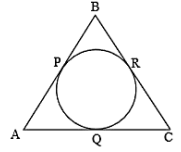
AnswerGiven: $A B+B C+A C=44 \ \mathrm{cm}$
$A C=12 \ \mathrm{cm}$
To find: $I(B P), I(B R)$
Solution:
$\left.\begin{array}{l}\operatorname{seg} A P \cong \operatorname{seg} A Q \\ \operatorname{seg} Q C \cong \operatorname{seg} R C \\ \operatorname{seg} B P \cong \operatorname{seg} B R\end{array}\right\} \ldots . .[$ Tangent Segment theorem $]$
$\left.\begin{array}{c}\text { Let } l(A P)=l(A Q)=x, \\ l(Q C)=l(R C)=y, \\ l(B P)=l(B R)=z\end{array}\right\}$
$ A C=A Q+Q C \ldots \ldots[A-Q-C]$
$ \therefore A C=x+y$
$ \therefore x+y=12 \ldots(\text { ii })[$ Given $]$
$ A B+B C+A C=44 \ldots \ldots[$ Given $]$
$ \therefore(A P+P B)+(B R+R C)+(A Q+Q C)=44 \ldots \ldots[A-P-B, B-R-C, A-Q-C]$
$ \therefore x+z+z+y+x+y=44 \ldots \ldots[$ From $(i) ]$
$ \therefore 2 x+2 y+2 z=44$
$ \therefore 2(x+y)+2 z=44$
$ \therefore 2(12)+2 z=44 \ldots \ldots[$ From $(ii) ]$
$ \therefore 24+2 z=44$
$ \therefore 2 z=44-24$
$ \therefore 2 z=20$
$ \therefore z=10 \ldots \ldots(\text { iiii })$
$ \therefore I(B P)=1(B R)=10 \mathrm{~cm} \ldots . .[$ From $(i)$ and $(iii)]$
View full question & answer→Question 64 Marks
In the figure $\square ABCD$ is a cyclic quadrilateral. If $m($arc $ABC) = 230^\circ.$ then find $\angle ABC ,\angle CDA ,\angle CBE$
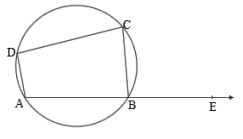
Answer$ m (\operatorname{arc} ABC )=230^{\circ} \quad \ldots . .( i )[\text { Given }]$
$\left.\therefore m (\operatorname{arc} ADC )+ m (\operatorname{arc} ABC )=360^{\circ} \quad \text {.......[Degree measure of a circle is } 360^{\circ}\right]$
$\therefore m (\operatorname{arc} ADC )=360^{\circ}- m (\operatorname{arc~ABC})$
$\therefore m (\operatorname{arc~} ADC )=360^{\circ}-230^{\circ} \quad \ldots . . .[\text { From }( i )]$
$\therefore m (\operatorname{arc} ADC )=130^{\circ}$
$\angle ABC =\frac{1}{2} m (\operatorname{arc} ADC ) \quad \ldots . .[\text { Inscribed angle theorem }]$
$=\frac{1}{2} \times 130^{\circ}$
$=65^{\circ} $
Now, $\angle C D A=\frac{1}{2} m(\operatorname{arc} A B C)$ [Inscribed angle theorem]
$\therefore \angle CDA =\frac{1}{2} \times 230^{\circ}$
$\therefore \angle CDA =115^{\circ}$
$\angle C B E=\angle C D A$ .....(iiii) [The exterior angle of a cyclic quadrilateral is equal to the interior opposite angle]
$\therefore \angle C B E=115^{\circ} \quad \ldots . . .[\text { From (ii) and (iii) }]$
$\therefore \angle A B C=65^{\circ}, \angle C D A=115^{\circ}, \angle C B E=115^{\circ} .$
View full question & answer→Question 74 Marks
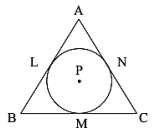
A circle with centre $P$ is inscribed in the $\triangle ABC.$ Side $AB,$ side $BC$ and side $AC$ touches the circle at points $L, M$ and $N$ respectively. Radius of the circle is $r$
Prove that : $A (\triangle ABC )=\frac{1}{2}(A B+B C+A C) \times r$
Answer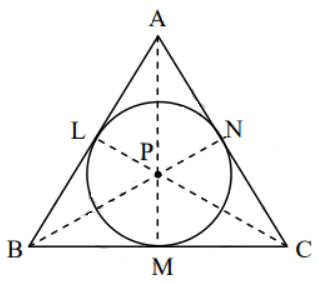
Given: Side $A B$, side $B C$, and side $A C$ are tangents to circle at $L, M$, and $N$ respectively. Radius $=r$
To prove: $A(\triangle A B C)=\frac{1}{2}(A B+B C+A C) \times r$
Construction: Join seg $P M$, seg $P N$, seg $P L$, seg $A P$, seg $B P$ and seg $C P$.
Proof: seg $B C$ is a tangent to circle at $M$.
$ \therefore \text { seg } PL \perp \text { side } AB$
$\text { seg } PM \perp \text { side } BC $
seg $PN \perp$ side $AC$ (By the theorem, the tangent is perpendicular to the radius)
We know,
$\text { Area of triangle }=\frac{1}{2} \times \text { base } \times \text { height }$
$\therefore$ seg $PM \perp \operatorname{seg} BC \quad \ldots . . .[$ Tangent is perpendicular to radius]
$ A (\triangle BPC )=\frac{1}{2} \times BC \times PM$
$\therefore A (\triangle BPC )=\frac{1}{2} \times BC \times r \quad \text {......(i) }[ PM =\text { radius }=r] $
Similarly,
$A(\triangle A P B)=\frac{1}{2} \times A B \times " r "$
$A (\triangle APC )=\frac{1}{2} \times AC \times " r "$
Now,
$ A (\triangle ABC )= A (\triangle APB )+ A (\triangle BPC )+ A (\triangle APC ) \quad \ldots . . .[\text { Area addition property] }$
$=\frac{1}{2} \times AB \times r +\frac{1}{2} \times BC \times r +\frac{1}{2} \times AC \times r \quad \ldots \ldots . .[\text { From (i), (ii), and (iii)] }$
$=\frac{1}{2} \times r ( AB + BC + AC )$
$\therefore A (\triangle ABC )=\frac{1}{2}( AB + BC + AC ) \times r $ View full question & answer→Question 84 Marks
The chords $AB$ and $CD$ of the circle intersect at point $M$ in the interior of the same circle then prove that $CM \times BD = BM \times AC.$
AnswerGiven: Chords $A B$ and $C D$ intersect at point $M$.
To prove: $CM \times BD = BM \times AC$
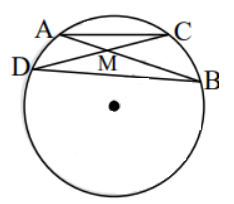
Proof: In $\triangle AMC$ and $\triangle DMB$,
$ \angle AMC \cong \angle DMB \quad \ldots . . . .[\text { Vertically opposite angles] }$
$\angle ACD \cong \angle ABD \quad \ldots . . .[\text { Angles inscribed in the same } arc ]$
$\therefore \triangle AMC \sim \triangle DMB \quad \ldots . . .[ AA \text { test of similarity }]$
$\therefore \frac{ CM }{ BM }=\frac{ AC }{ BD } \quad \ldots . . .[\text { Corresponding sides of similar triangles] }]$
$\therefore CM \times BD = BM \times AC $ View full question & answer→Question 94 Marks
In the figure segment PQ is the diameter of the circle with center O. The tangent to the tangent circle drawn from point C on it , intersects the tangents drawn from points P and Q at points A and B respectively ,
prove that ∠AOC = 90°
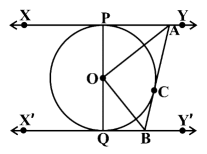
AnswerGiven: $P Q$ is the diameter of the circle.
Point P, Q, C are points of contact of the respective tangents.
To prove: $\angle A O B=90^{\circ}$
Construction: Draw seg OC
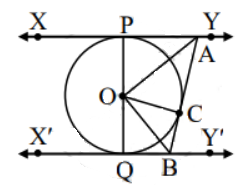
Proof:
In $\triangle OPA$ and $\triangle OCA$,
side $O P \cong$ side $O C$ [Radii of the same circle]
side $O A \cong$ side $O A$ [Common side]
side $PA \cong$ side $CA$ [Tangent segment theorem]
$\therefore \triangle OPA \cong \angle OCA$ [[SSS test of congruency]
$\therefore \angle AOP \cong \angle AOC$ [C.A.C.T.]
Let $m \angle A O P= m \angle A O C= x$ .....(i)
Similarly, we can prove that $\angle B O C \cong \angle B O Q$.
Let $m \angle BOC = m \angle BOQ = y$ ......(ii)
$m \angle AOP + m \angle AOC + m \angle B O C+ m \angle B O Q=180^{\circ}$ [Linear angles]
$\therefore x + x + y + y =180^{\circ}$ [From (i) and (ii)]
$\therefore 2 x +2 y =180^{\circ}$
$\therefore 2(x+y)=180^{\circ}$
$\therefore x + y =90^{\circ} \ldots . . . \text { (iii) }$
$\text { Now } \angle AOB =\angle AOC +\angle BOC$
$= x + y \quad \ldots . . .[\text { From (i) and (ii)]}$
$\therefore \angle AOB =\angle AOC +\angle BOC$
$= x + y$
$\therefore \angle AOB =90^{\circ} \quad \ldots . . .[\text { From (iii)] }$ View full question & answer→Question 104 Marks
In the figure, O is the center of the circle. Line AQ is a tangent. If OP = 3 m(arc PM) = 120° then find the length of AP?
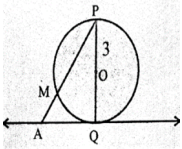
AnswerGiven: line $A Q$ is a tangent.
$OP =3, m (\operatorname{arc} PM )=120^{\circ}$
To find: AP
In the given figure, arc PMQ is a semicircle.
$\therefore m (\operatorname{arc} PMQ )=180^{\circ}$
$\therefore m (\operatorname{arc} P M)+ m (\operatorname{arc} M Q)=180^{\circ}$.....[Arc addition property]
$\therefore 120^{\circ}+ m (\operatorname{arc} M Q)=180^{\circ}$
$\therefore m (\operatorname{arc} M Q)=180^{\circ}-120^{\circ}$
$\therefore m (\operatorname{arc} MQ )=60^{\circ}$
$\angle MPQ =\frac{1}{2} m (\operatorname{arc} MQ ).....[Inscribed angle theorem]$
$ \therefore \angle MPQ =\frac{1}{2} \times 60^{\circ} \quad \ldots . . .[\text { From (i)] }$
$\therefore \angle MPQ =30^{\circ} $
$\text { i.e., } \angle APQ =30^{\circ}$
In $\triangle PQA , \angle PQA =90^{\circ}$ [Tangent theorem]
$\angle APQ =30^{\circ}$
$\therefore \angle PAQ =60^{\circ}$ [Remaning angle of $\triangle PQA ]$
$\therefore \triangle PAQ$ is $30^{\circ}-60^{\circ}-90^{\circ}$ triangle.
$\therefore PQ =\frac{\sqrt{3}}{2} AP$ ..[Side opposite to $60^{\circ}$ ]
$\therefore( PO + OQ )=\frac{\sqrt{3}}{2} AP \quad \ldots \ldots .[ P - O - Q ]$
$\therefore(3+3)=\frac{\sqrt{3}}{2} \text { AP } \quad \ldots . . .[\text { Radii of same circle and op }=3]$
$\therefore AP =\frac{6 \times 2}{\sqrt{3}}$
$\therefore AP =\frac{6 \times 2 \times \sqrt{3}}{\sqrt{3} \times \sqrt{3}} \ldots . . .[\text { Multiply and divide by } \sqrt{3}]$
$\therefore AP =\frac{6 \times 2 \times \sqrt{3}}{3}$
$\therefore AP =2 \times 2 \sqrt{3}$
$\therefore AP =4 \sqrt{3} \text { units }$
View full question & answer→Question 114 Marks
Prove that $2\left(\sin ^6 A +\cos ^6 A \right)-3\left(\sin ^4 A +\cos ^4 A \right)+1=0$.
Answer$\sin ^6 A+\cos ^6 A=\left(\sin ^2 A\right)^3+\left(\cos ^2 A\right)^3$
$=\left(1-\cos ^2 A\right)^3+\left(\cos ^2 A\right)^3 \quad \ldots \ldots\left[\begin{array}{l}\because \sin ^2 A+\cos ^2 A=1 \\ \therefore 1-\cos ^2 A=\sin ^2 A\end{array}\right]$
$ =1-3 \cos ^2 A+3\left(\cos ^2 A\right)^2-\left(\cos ^2 A\right)^3+\cos ^6 A$
$ =1-3 \cos ^2 A\left(1-\cos ^2 A\right)-\cos ^6 A+\cos ^6 A$
$ =1-3 \cos ^2 A \sin ^2 A$
$ \sin ^4 A+\cos ^4 A=\left(\sin ^2 A\right)^2+\left(\cos ^2 A\right)^2$
$ =\left(1-\cos ^2 A\right)^2+\left(\cos ^2 A\right)^2$
$ =1-2 \cos ^2 A+\left(\cos ^2 A\right)^2+\left(\cos ^2 A\right)^2 \ldots \ldots\left[\because(a-b)^2=a^2-2 a b+b^2\right]$
$ =1-2 \cos ^2 A+2 \cos ^4 A$
$ =1-2 \cos ^2 A\left(1-\cos ^2 A\right)$
$ =1-2 \cos ^2 A \sin ^2 A$
$ \text { L.H.S }=2\left(\sin ^6 A+\cos ^6 A\right)-3\left(\sin ^4 A+\cos ^4 A\right)+1$
$ =2\left(1-3 \cos ^2 A \sin ^2 A\right)-3\left(1-2 \cos ^2 A \sin ^2 A\right)+1$
$ =2-6 \cos ^2 A \sin ^2 A-3+6 \cos ^2 A \sin ^2 A+1$
$ =0$
$ =\text{R.H.S}$
$ \therefore 2\left(\sin ^6 A+\cos ^6 A\right)-3\left(\sin ^4 A+\cos ^4 A\right)+1=0$
View full question & answer→Question 124 Marks
Prove that $\sin ^6 A+\cos ^6 A=1-3 \sin ^2 A \cdot \cos ^2 A$
Answer$ \text { L.H.S }=\sin ^6 A+\cos ^6 A$
$ =\left(\sin ^2 A\right)^3+\left(\cos ^2 A\right)^3$
$=\left(1-\cos ^2 A\right)^3+\left(\cos ^2 A\right)^3 \ldots \ldots\left[\begin{array}{l}\because \sin ^2 A+\cos ^2 A=1 \\ \therefore 1-\cos ^2 A=\sin ^2 A\end{array}\right]$
$ =1-3 \cos ^2 A+3\left(\cos ^2 A\right)^2-\left(\cos ^2 A\right)^3+\cos ^6 A \ldots \ldots\left[\because(a-b)^3=a^3-3 a^2 b+3 a b^2-b^3\right]$
$ =1-3 \cos ^2 A\left(1-\cos ^2 A\right)-\cos ^6 A+\cos ^6 A$
$ =1-3 \cos ^2 A \sin ^2 A$
$ =\text { R.H.S }$
$ \therefore \sin ^6 A+\cos ^6 A=1-3 \sin ^2 A \cdot \cos ^2 A$
View full question & answer→Question 134 Marks
In $\triangle ABC , \sqrt{2} AC = BC , \sin A =1, \sin ^2 A +\sin ^2 B +\sin ^2 C =2$ then $\angle A =? \angle B =$ ? $\angle C =$ ?
Answer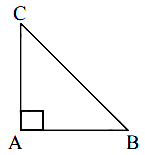
$\sin A=1$
But, $\sin 90^{\circ}=1$
$\therefore \sin A=\sin 90^{\circ}$
$\therefore A=90^{\circ}$
$\sqrt{2} AC = BC \ldots$....[Given]
$\therefore \frac{ AC }{ BC }=\frac{1}{\sqrt{2}}$
$\therefore \sin B=\frac{A C}{B C}$
(ii) [By definition]
$\therefore \sin B=\frac{1}{\sqrt{2}}$
But, $\sin 45^{\circ}=\frac{1}{\sqrt{2}}$
$\therefore \sin B=\sin 45^{\circ}$
$\therefore B=45^{\circ}$
$\sin ^2 A +\sin ^2 B +\sin ^2 C =2$
$ \therefore(1)^2+\left(\frac{1}{\sqrt{2}}\right)^2+\sin ^2 C =2$
$\therefore 1+\frac{1}{2}+\sin ^2 C =2$
$\therefore \sin ^2 C =2-\frac{3}{2} $
$\therefore \sin ^2 C =\frac{1}{2}$
$\therefore \sin C=\frac{1}{\sqrt{2}}$
But, $\sin 45^{\circ}=\frac{1}{\sqrt{2}}$
$\therefore \sin C=\sin 45^{\circ}$
$\therefore C =45^{\circ}$
$\therefore \angle A=90^{\circ}, \angle B=45^{\circ}, \angle C=45^{\circ}$ View full question & answer→Question 144 Marks
If $\sec A = ? + \frac{1}{4 x}$ then show that $\sec A + \tan A = 2?$ or $\frac{1}{2 x}$.
Answer$\sec A =x+\frac{1}{4 x} \quad \ldots . . .[\text { Given] }$
$\text { We know that, }$
$1+\tan ^2 A =\sec ^2 A$
$\therefore \tan ^2 A=\sec ^2 A-1$
$=\left(x+\frac{1}{4 x}\right)^2-1$
$=x^2+2 \times x \times \frac{1}{4 x}+\left(\frac{1}{4 x}\right)^2-1 \ldots \ldots\left[\because(a+b)^2=a^2+2 a b+b^2\right]$
$=x^2+\frac{1}{2}+\frac{1}{16 x^2}-1$
$=x^2-\frac{1}{2}+\frac{1}{16 x^2}$
$\therefore \tan ^2 A=\left(x-\frac{1}{4 x}\right)^2 \quad \ldots \ldots\left[\because a^2-2 a b+b^2=(a-b)^2\right]$
$\therefore \tan A =x-\frac{1}{4 x} \text { or } \tan A =-\left(x-\frac{1}{4 x}\right)$
$\text { When } \tan A =x-\frac{1}{4 x} \text {, }$
$\sec A+\tan A$
$=x+\frac{1}{4 x}+x-\frac{1}{4 x}$
$=2 x$
$\text { When } \tan A =-\left(x-\frac{1}{4 x}\right)$
$\sec A +\tan A$
$=x+\frac{1}{4 x}-\left(x-\frac{1}{4 x}\right)$
$=x+\frac{1}{4 x}-x+\frac{1}{4 x}$
$=\frac{2}{4 x}$
$=\frac{1}{2 x}$
View full question & answer→Question 154 Marks
Draw a circle with center O and radius 3 cm. Take the point P and the point Q at a distance of 7 cm from the center of the circle on the opposite side of the circle at the intersection passing through the center of the circle Draw a tangent to the circle from the point P and the point Q.
Answer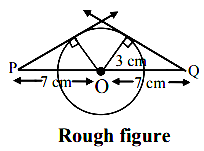
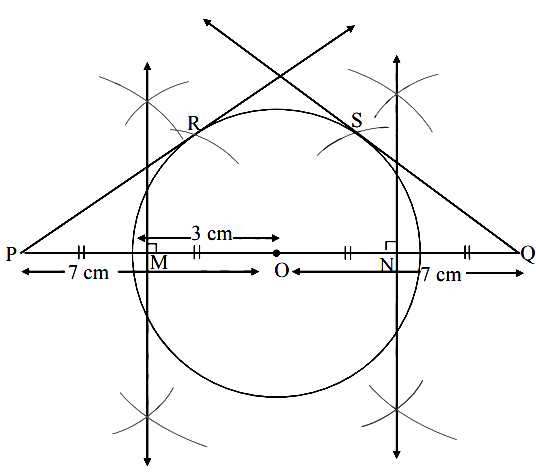 Steps of construction:
- With centre O, draw a circle of radius 3 cm.
- Take point P and Q such that OP = 7 cm and OQ = 7 cm.
- Draw the perpendicular bisector of seg OP. It intersects OP in point M.
- Also, draw the perpendicular bisector of seg OQ. It intersects OQ in point N.
- With M as centre and radius equal to PM, draw an arc intersecting the circle in points R and with N as centre and radius equal to NQ, draw an arc intersecting the circle in points S.
- Draw rays PR and QS.
Rays PR and QS are the required tangents to the circle.
View full question & answer→Question 164 Marks
If cos $A =\frac{2 \sqrt{m}}{m+1}$ then Prove that cosec A = $\frac{m+1}{m-1}$
Answer$\cos A =\frac{2 \sqrt{ m }}{ m +1} \quad$.......[Given]
We know that,
$\sin ^2 A +\cos ^2 A =1$
$ \therefore \sin ^2 A+\left(\frac{2 \sqrt{m}}{m+1}\right)^2=1$
$\therefore \sin ^2 A+\frac{4 m}{(m+1)^2}=1 $
$\therefore \sin ^2 A=1-\frac{4 m}{(m+1)^2}$
$=\frac{( m +1)^2-4 m }{( m +1)^2}$
$=\frac{ m ^2+2 m +1-4 m }{( m +1)^2} \ldots \ldots . .\left[\because( a + b )^2= a ^2+2 ab + b ^2\right]$
$=\frac{ m ^2-2 m +1}{( m +1)^2}$
$\therefore \sin ^2 A=\frac{(m-1)^2}{(m+1)^2} \quad \ldots \ldots . .\left[\because a^2-2 a b+b^2=(a-b)^2\right]$
$\therefore \sin A=\frac{m-1}{m+1} \quad \ldots .$. [Taking square root of both sides]
Now, $\operatorname{cosec} A=\frac{1}{\sin A}$
$=\frac{1}{\frac{m-1}{m+1}}$
$\therefore \operatorname{cosec} A=\frac{m+1}{m-1}$
View full question & answer→Question 174 Marks
Show that $A (1, 2) , (1, 6), C (1+2 \sqrt{3}, 4)$ are vertices of an equilateral triangle.
AnswerDistance between two points $=\sqrt{\left(x_2-x_1\right)^2+\left(y_2-y_1\right)^2}$
By distance formula,
$ A B=\sqrt{(1-1)^2+(6-2)^2}$
$=\sqrt{0^2+4^2}$
$=\sqrt{4^2}$
$=4 \quad \ldots \ldots(i)$
$B C=\sqrt{(1+2 \sqrt{3}-1)^2+(4-6)^2}$
$=\sqrt{(2 \sqrt{3})^2+(-2)^2}$
$=\sqrt{12+4}$
$=\sqrt{16} $
$=4$
$ AC =\sqrt{(1+2 \sqrt{3}-1)^2+(4-2)^2}$
$=\sqrt{(2 \sqrt{3})^2+2^2}$
$=\sqrt{12+4}$
$=\sqrt{16} $
$=4$
$\therefore A B=B C=A C \quad \ldots \ldots[$ From (i), (ii) and (iii)]
$\therefore A B=B C=A C \quad \ldots . . .[$ From (i), (ii) and (iii)]
$\therefore \triangle ABC$ is an equilateral triangle.
$\therefore$ Points $A, B$ and C are the vertices of an equilateral triangle.
View full question & answer→Question 184 Marks
Draw a circle with radius 3.3cm. Draw a chord PQ of length 6.6cm . Draw tangents to the circle at points P and Q. Write your observation about the tangents.
Answer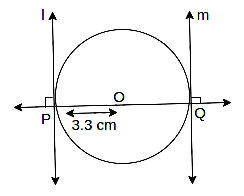 Rough Figure
Analysis:
Rough Figure
Analysis: 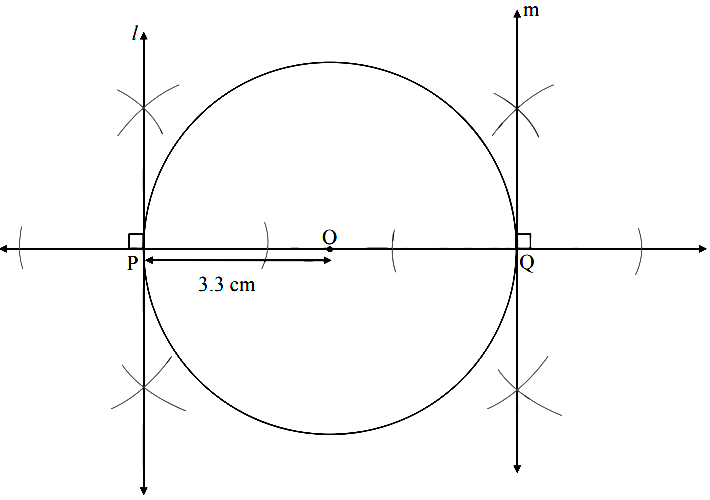 Steps of construction:
- With center O, draw a circle of radius 3.3 cm
- Draw a chord PQ of length 6.6 cm
- Draw rays OP and OQ
- Draw line l ⊥ ray OP at point P
- Draw line m ⊥ ray OQ at point Q.
Lines l and m are the required tangents to the circle.
Radius = 3.3 cm
∴ Diameter = 2 × 3.3 = 6.6 cm
∴ Chord PQ is the diameter of the circle.
∴ The tangents through points P and Q (endpoints of diameter) are parallel to each other.
View full question & answer→Question 194 Marks
Prove that $\sin \theta ( 1 – \tan \theta ) − \cos \theta ( 1 − \cot \theta ) = cosec \theta − \sec \theta$
Answer$\text { L.H.S }=\sin \theta(1-\tan \theta)-\cos \theta(1-\cot \theta)$
$=\sin \theta\left(1-\frac{\sin \theta}{\cos \theta}\right)-\cos \theta\left(1-\frac{\cos \theta}{\sin \theta}\right)$
$=\sin \theta-\frac{\sin ^2 \theta}{\cos \theta}-\cos \theta+\frac{\cos ^2 \theta}{\sin \theta}$
$=\sin \theta+\frac{\cos ^2 \theta}{\sin \theta}-\frac{\sin ^2 \theta}{\cos \theta}-\cos \theta$
$=\frac{\sin ^2 \theta+\cos ^2 \theta}{\sin \theta}-\left(\frac{\sin ^2 \theta+\cos ^2 \theta}{\cos \theta}\right)$
$=\frac{1}{\sin \theta}-\frac{1}{\cos \theta} \quad \ldots \ldots\left[\because \sin ^2 \theta+\cos ^2 \theta=1\right]$
$=\operatorname{cosec} \theta-\sec \theta$
$=\text { R.H.S }$
$\therefore \sin \theta(1-\tan \theta)-\cos \theta(1-\cot \theta)=\operatorname{cosec} \theta-\sec \theta$
View full question & answer→Question 204 Marks
If A(5,4 ) , B (-3 , -2) and C (1 -8) are the vertices of a ∆ ??? . Segment AD is median. Find the length of seg AD:
Answer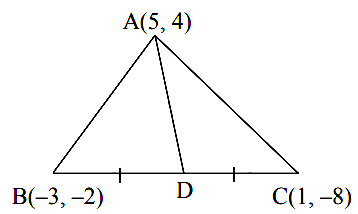
Since segment $A D$ is median, Point $D$ is the midpoint of side $B C$.
By midpoint formula,
$ \text { Co-ordinates of } D =\left(\frac{x_1+x_2}{2}, \frac{y_1+y_2}{2}\right)$
$=\left(\frac{-3+1}{2}, \frac{-2-8}{2}\right)$
$=\left(\frac{-2}{2}, \frac{-10}{2}\right) $
Co-ordinates of $D=(-1,-5)$
Distance between two points $=\sqrt{\left(x_2-x_1\right)^2+\left(y_2-y_1\right)^2}$
By distance formula,
$ d(A, D)=\sqrt{[5-(-1)]^2+[4-(-5)]^2}$
$=\sqrt{(5+1)^2+(4+5)^2}$
$=\sqrt{6^2+9^2}$
$=\sqrt{36+81}$
$=\sqrt{117} $
$\therefore$ The length of segment AD is $\sqrt{117}$ units. View full question & answer→Question 214 Marks
∆AMT. ~∆AHE, ?? ∆AMT AM=6.3 cm, ∠TAM=50°, AT=5.6cm, $\frac{A M}{A H}=\frac{7}{5}$ , then
construct △AMT and ∆AHE.
Answer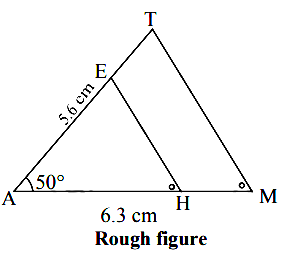
As shown in the figure,
Let $A - H - M$ as well as points $A - E - T$ be collinear.
$\triangle AMT \sim \triangle AHE$
$\therefore \angle TAM \cong \angle EAH \ldots$..(Corresponding angles of similar triangles)
$\frac{ AM }{ AH }=\frac{ MT }{ HE }=\frac{ AT }{ AE } \ldots$ (i)(Corresponding sides of similar triangles)
$\therefore \frac{ AM }{ AH }=\frac{7}{5} \quad$ (..(ii) (Given)
$\frac{ AM }{ AH }=\frac{ MT }{ HE }=\frac{ AT }{ AE }=\frac{7}{5} \quad \ldots[$ From (i) and (ii) $]$
$\therefore$ sides of $\triangle AHE$ are smaller than sides of $\triangle AMT$.
$\therefore$ If seg AH will be equal to 5 parts out of 7 equal parts of side AM.
So, if we construct $\triangle AMT$, point $H$ will be on side $AM$, at a distance equal to 5 parts from $A$.
Now, point E is the point of intersection of ray AT and a line through $H$, parallel to MT.
$\triangle AHE$ is the required triangle similar to $\triangle AMT$.
Steps of Construction:
1. Draw $\triangle AMT$ such that $AM =6.3 cm , \angle TAM =50^{\circ}, AT =5.6 cm$.
2. Draw ray $AB$ making an acute angle with side $AM$.
3. Taking convenient distance on the compass, mark 7 points $A_1, A_2, A_3, A_4, A_5, A_6$ and $A_7$, such that $A_1 A_1$ $=A_1 A_2=A_2 A_3=A_3 A_4=A_4 A_5=A_5 A_6=A_6 A_7$.
4. Join $A_7 M$. Draw line parallel to $A_7 M$ through $A_5$ to intersects seg $A M$ at $H$.
5. Draw a line parallel to side TM through $H$. Name the point of intersection of this line and seg AT as $E$. $\triangle AHE$ is the required triangle similar to $\triangle AMT$.
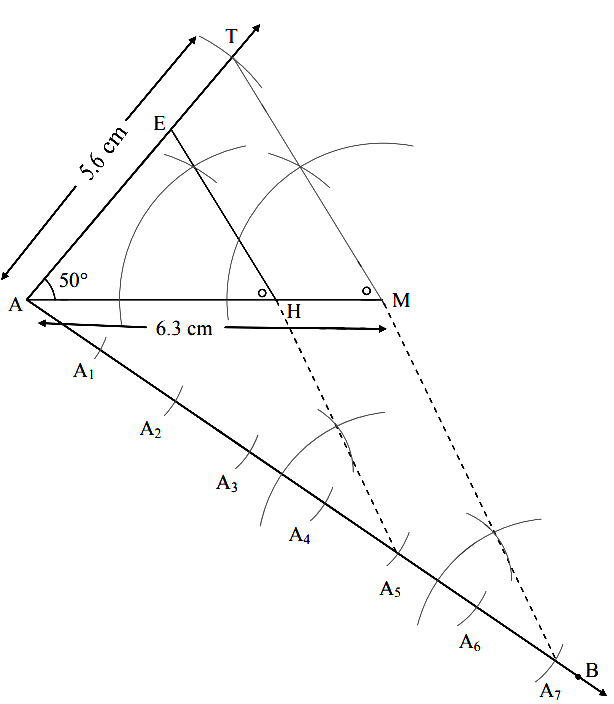
Here, ∆AMT ~ ∆AHE. View full question & answer→Question 224 Marks
Prove that $\frac{\cot A+\operatorname{cosec} A-1}{\cot A-\operatorname{cosec} A+1}=\frac{1+\cos A}{\sin A}$.
Answer$\text { L.H.S }=\frac{\cot A+\operatorname{cosec} A-1}{\cot A-\operatorname{cosec} A+1}$
$=\frac{\cot A+\operatorname{cosec} A-\left(\operatorname{cosec}^2 A-\cot ^2 A\right)}{\cot A-\operatorname{cosec} A+1} \ldots\left[\begin{array}{l}\because 1+\cot ^2 A=\operatorname{cosec}^2 A \\ \therefore \operatorname{cosec}^2 A-\cot ^2 A=1\end{array}\right]$
$ =\frac{\cot A+\operatorname{cosec} A-(\operatorname{cosec} A+\cot A)(\operatorname{cosec} A-\cot A)}{\cot A-\operatorname{cosec} A+1} \ldots .\left[\because a^2-b^2=(a+b)(a-b)\right]$
$ =\frac{(\cot A+\operatorname{cosec} A)(1-\operatorname{cosec} A+\cot A)}{\cot A-\operatorname{cosec} A+1}$
$ =\cot A+\operatorname{cosec} A$
$ =\frac{\cos A}{\sin A}+\frac{1}{\sin A}$
$ =\frac{\cos A+1}{\sin A}$
$ =\text { R.H.S }$
$ \therefore \frac{\cot A+\operatorname{cosec} A-1}{\cot A-\operatorname{cosec} A+1}=\frac{1+\cos A}{\sin A}$
View full question & answer→Question 234 Marks
Show that the points $(2, 0 ), (-2 , 0)$ and $(0, 2 )$ are vertices of a triangle. State the type of triangle with reason.
AnswerLet the points be $P(2,0), Q(-2,0)$ and $R(0,2)$
Distance between two points $=\sqrt{\left(x_2-x_1\right)^2+\left(y_2-y_1\right)^2}$
By distance formula,
$ d(P, Q)=\sqrt{[(-2)-2]^2+(0-0)^2}$
$=\sqrt{(-4)^2+(0)^2}$
$=\sqrt{16+0}$
$=4 \quad \ldots \text { (i) } $
$d(Q, R)=\sqrt{[0-(-2)]^2+(2-0)^2}$
$ =\sqrt{(2)^2+(2)^2}$
$=\sqrt{4+4}$
$=\sqrt{8} \ldots \ldots \text { (ii) } $
$ d(P, R)=\sqrt{(0-2)^2+(2-0)^2}$
$=\sqrt{(-2)^2+(2)^2}$
$=\sqrt{4+4}$
$=\sqrt{8} \ldots \text { (iii) } $
$ d(P, R)=\sqrt{(0-2)^2+(2-0)^2}$
$=\sqrt{(-2)^2+(2)^2}$
$=\sqrt{4+4}$
$=\sqrt{8} $
On adding (ii) and (iii),
$ d(P, Q)+d(Q, R)=4+\sqrt{8}$
$4+\sqrt{8}>\sqrt{8}$
$\therefore d(P, Q)+d(Q, R)>d(P, R) $
$\therefore$ Points $P, Q, R$ are non colinear points.
We can construct a triangle through $3$ non collinear points.
$\therefore$ The segment joining the given points form a triangle.
Since $P(Q, R)=P(P, R)$
$\therefore \triangle PQR$ is an isosceles triangle.
$\therefore$ The segment joining the points $(2,0),(-2,0)$ and $(0,2)$ will form an isosceles triangle.
View full question & answer→Question 244 Marks
∆ABC. ~∆PBR, BC=8 cm, AC=10 cm , ∠B=90°,
$\frac{B C}{B R}=\frac{5}{4}$ then construct △ABC and ∆PBR
Answer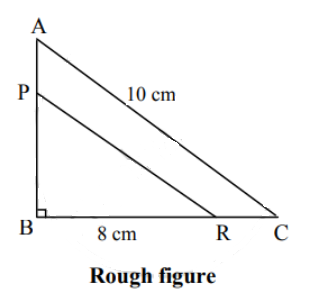
Analysis: In $\triangle A B C, \angle B=90^{\circ}$ ...[Given]
$ \therefore A C^2=A B^2+B C^2$
$\therefore 10^2=A B^2+8^2$
$\therefore A B^2=100-64$
$\therefore A B^2=36$
$\therefore A B=6 cm $
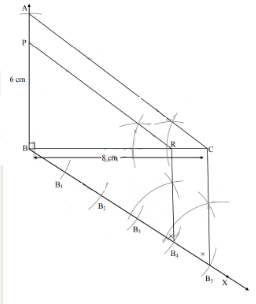
Steps of construction:
1. Draw seg $B C$ of length $8 cm$.
2. Take $\angle B$ as $90^{\circ}$ and draw an arc of $6 cm$ on it. Name the point as $A$.
3. Join seg $A C$ to obtain $\triangle A B C$.
4. Draw ray $B X$ such that $\angle C B X$ is an acute angle.
5. Locate points $B_1, B_2, B_3, B_4, B_5$ on ray $B X$ such that, $B B_1=B_1 B_2=B_2 B_3=B_3 B_4$ $= B _4 B _5$.
6. Join point $C$ and $B _5$.
7. Through point $B_4$ draw a line parallel to seg $C B_5$ which intersects seg $B C$ at point R.
8. Draw a line parallel to $A C$ through $R$ to intersect line $A B$ at point $P$. $\triangle PBR$ is the required triangle similar to $\triangle ABC$. View full question & answer→Question 254 Marks
Two triangles are similar .Smaller triangle sides are $4\ cm ,5\ cm,6\ cm$ perimter of larger triangle is $90\ cm$ then find the sides of larger triangle.
AnswerGiven: $\triangle ABC \sim \triangle PQR$
In $\triangle A B C, A B=4 cm , B C=5 cm , A C=6 cm$
In $\triangle P Q R, P Q+Q R+P R=90 cm$
To find: $P Q, Q R$ and $P R$
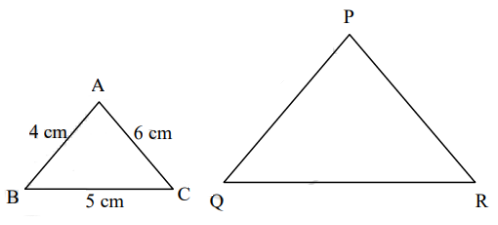
$\triangle ABC \sim \triangle PQR$
$\therefore \frac{ AB }{ PQ }=\frac{ BC }{ QR }=\frac{ AC }{ PR } ....\text{[Corresponding sides of similar triangles]}$
Let $\frac{A B}{P Q}=\frac{B C}{Q R}=\frac{A C}{P R}=k$
$\therefore \frac{4}{ PQ }=\frac{5}{ QR }=\frac{6}{ PR }= k$
$\therefore \frac{4}{ PQ }= k , \frac{5}{ QR }= k \text { and } \frac{6}{ PR }= k$
$\therefore P Q=\frac{4}{k}, Q R=\frac{5}{k} \text { and } P R=\frac{6}{k}$
$\therefore P Q+Q R+P R=\frac{4}{k}+\frac{5}{k}+\frac{6}{k}$
$\therefore 90=\frac{15}{k}$
$\therefore k =\frac{15}{90}$
$=\frac{1}{6}$
$ \therefore P Q=\frac{4}{\left(\frac{1}{6}\right)}=4 \times 6=24 cm \quad \ldots[\text { From (i) }]$
$QR =\frac{5}{\left(\frac{1}{6}\right)}=5 \times 6=30 cm \quad \ldots[\text { From (i) }]$
$PR =\frac{6}{\left(\frac{1}{6}\right)}=6 \times 6=36 cm \quad \ldots[\text { From (i) }]$
$\therefore$ The sides of the larger triangle are $24 cm , 30 cm$ and $36 cm$. View full question & answer→Question 264 Marks
Prove that $\sec ^2 A-\operatorname{cosec}^2 A=\frac{2 \sin ^2 A-1}{\sin ^2 A \cdot \cos ^2 A}$
Answer$ \text { L.H.S }=\sec ^2 A-\operatorname{cosec}^2 A$
$ =\frac{1}{\cos ^2 A}-\frac{1}{\sin ^2 A}$
$ =\frac{\sin ^2 A-\cos ^2 A}{\cos ^2 A \cdot \sin ^2 A}$
$=\frac{\sin ^2 A-\left(1-\sin ^2 A\right)}{\sin ^2 A \cdot \cos ^2 A} \ldots\left[\begin{array}{l}\because \sin ^2 A+\cos ^2 A=1 \\ \therefore 1-\sin ^2 A=\cos ^2 A\end{array}\right]$
$=\frac{\sin ^2 A-1+\sin ^2 A}{\sin ^2 A \cdot \cos ^2 A}$
$ =\frac{2 \sin ^2 A-1}{\sin ^2 A \cdot \cos ^2 A}$
$ =\text { R.H.S }$
$\therefore \sec ^2 A-\operatorname{cosec}^2 A=\frac{2 \sin ^2 A-1}{\sin ^2 A \cdot \cos ^2 A}$
View full question & answer→Question 274 Marks
Show that the points $(0 , -1), (8, 3) , (6 , 7)$ and $(-2 , 3)$ are vertices of a rectangle.
AnswerLet the points be $P(0,-1), Q(8,3), R(6,7), S(-2,3)$
Distance between two points $=\sqrt{\left(x_2-x_1\right)^2+\left(y_2-y_1\right)^2}$
$\therefore$ By distance formula,
$ d(P, Q)=\sqrt{(8-0)^2+[3-(-1)]^2}$
$=\sqrt{(8-0)^2+(3+1)^2}$
$=\sqrt{8^2+4^2}$
$=\sqrt{64+16}$
$=\sqrt{80}$
$d(Q, R)=\sqrt{(6-8)^2+(7-3)^2}$
$=\sqrt{(-2)^2+(4)^2}$
$=\sqrt{4+16}$
$=\sqrt{20}$
$d(R, S)=\sqrt{[(-2)-6]^2+(3-7)^2}$
$=\sqrt{(-8)^2+(-4)^2}$
$=\sqrt{64+16}$
$=\sqrt{80}$
$d(Q, R)=\sqrt{(6-8)^2+(7-3)^2}$
$=\sqrt{(-2)^2+(4)^2}$
$=\sqrt{4+16}$
$=\sqrt{20}$
$d(R, S)=\sqrt{[(-2)-6]^2+(3-7)^2}$
$ =\sqrt{(-8)^2+(-4)^2}$
$=\sqrt{64+16} $
$=\sqrt{80}$
$d(P, S)=\sqrt{[(-2)-0]^2+\left[3-(-1)^2\right]}$
$=\sqrt{(-2)^2+(3+1)^2}$
$=\sqrt{(-2)^2+4^2}$
$=\sqrt{4+16}$
$=\sqrt{20}$
In $\square P Q R S$,
In $\square P Q R S$,
$\therefore$ side $P Q=$ side $R S$ [From (i) and (iii)]
side $Q R=$ side $P S$ [From (ii) and (iv)]
$\therefore \square P Q R S$ is a parallelogram [A quadrilateral is a parallelogram, if both the pairs of its opposite sides are congruent]
$d(P, R)=\sqrt{(6-0)^2+[7-(-1)]^2}$
$=\sqrt{(6-0)^2}$ $=\sqrt{6^2+8^2}$
$=\sqrt{36+64}$
$=\sqrt{100}$
$=10$
$d(Q, S)=\sqrt{[(-2)-8]^2+[3-3]^2}$
$=\sqrt{(-10)^2+(0)^2}$
$=\sqrt{100+0}$
$=\sqrt{100}$
$=10$
In parallelogram $PQRS$,
$P R=Q S$
[From (v) and (vi)]
$\therefore \square P Q R S$ is a rectangle. [A parallelogram is a rectangle if its diagrands are equal]
View full question & answer→Question 284 Marks
∆RHP~∆NED, In ∆NED, NE=7 cm. ∠D=30°, ∠N=20° $\frac{H P}{E D}=\frac{4}{5}$ then construct
∆RHP and △NED .
Answer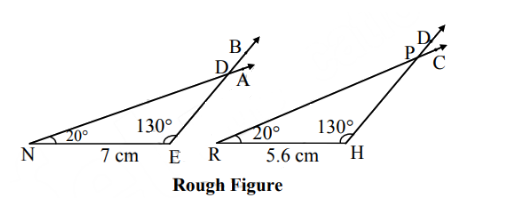
Analysis:
In $\triangle NED , \angle D =30^{\circ}$ and $\angle N =20^{\circ}$ [Given]
$\therefore \angle E =130^{\circ}$
(ii) [Remaining angle of a triangle]
$\triangle RHP \sim \triangle NED$
$\therefore \frac{ RH }{ NE }=\frac{ HP }{ ED }=\frac{ PR }{ DN }$
[Corresponding sides of similar triangles]
$\therefore \frac{ RH }{7}=\frac{4}{5}$
[Given]
$\therefore RH =\frac{4 \times 7}{5}=5.6 cm$
Also, $\angle R =\angle N , \angle H =\angle E , \angle P =\angle D$ (iiii) [Corresponding angles of similar triangles]
$\therefore \angle R =20^{\circ}, \angle H =130^{\circ}, \angle P =30^{\circ}$ [From (i), (ii) and (iii)]
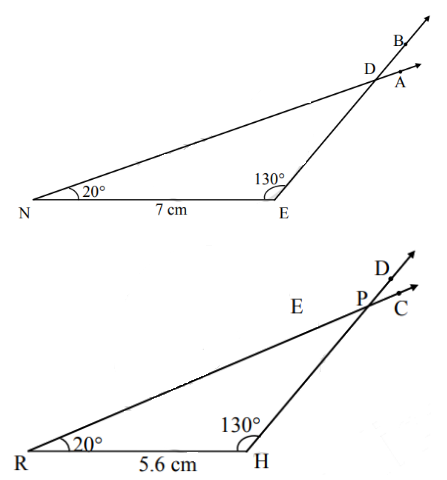
Steps of construction:
| |
$\triangle NED$ |
$\Delta R H P$ |
| (i) |
Draw seg NE of 7 cm |
Draw seg RH of 5.6 cm |
| (ii) |
Draw a ray $N A$ and $E B$ such that $\angle A N E=$ $20^{\circ}$ and $\angle B E N=130^{\circ}$. |
Draw a ray $R C$ and $H D$ such that $\angle C R H=$ $20^{\circ}$ and $\angle DHR =130^{\circ}$. |
| (iii) |
Name the point of intersection of rays D. |
Name the point of intersection of rays P. |
View full question & answer→Question 294 Marks
Areas of two similar triangle are equal then prove that triangles are congruent
AnswerGiven: $\triangle ABC \sim \triangle PQR$ and $A (\triangle ABC )= A (\triangle PQR )$
To prove: $\triangle ABC \cong \triangle PQR$
Proof:
$\frac{A(\triangle A B C)}{A(\triangle P Q R)}=1$
Also, $\frac{ A (\triangle ABC )}{ A (\triangle PQR )}=\frac{ AB ^2}{ PQ ^2}=\frac{ BC ^2}{ QR ^2}=\frac{ AC ^2}{ PR ^2}$ [Theorem of areas of similar triangles]
$ \therefore 1=\frac{A B^2}{P Q^2}=\frac{B^2}{Q^2}=\frac{A C^2}{P R^2} \quad \ldots . .[\text { From (i) }]$
$\therefore 1=\frac{A B^2}{P Q^2}$
$\therefore A B^2=P Q^2 $
$\therefore AB = PQ ....[Taking square root of both sides]$
$\text { i.e., } \operatorname{seg} A B \cong \operatorname{seg} P Q$
Similarly, seg $B C \cong \operatorname{seg} Q R$ and seg $A C \cong \operatorname{seg} P R$
$\therefore \triangle ABC \cong \triangle PQR .....[SSS test of congruency]$
View full question & answer→Question 304 Marks
Prove that $\sin ^2 A \cdot \tan A +\cos ^2 A \cdot \cot A +2 \sin A \cdot \cos A =\tan A +\cot A$
Answer$\text { L.H.S }=\sin ^2 A \cdot \tan A+\cos ^2 A \cdot \cot A+2 \sin A \cdot \cos A$
$=\sin ^2 A \cdot \frac{\sin A }{\cos A }+\cos ^2 A \cdot \frac{\cos A }{\sin A }+2 \sin A \cdot \cos A$
$=\frac{\sin ^3 A }{\cos A }+\frac{\cos ^3 A }{\sin A }+2 \sin A \cdot \cos A$
$=\frac{\sin ^4 A +\cos ^4 A +2 \sin ^2 A \cos ^2 A }{\sin A \cos A }$
$=\frac{\left(\sin ^2 A+\cos ^2 A\right)^2}{\sin A \cos A} \ldots . .\left[\because a^2+b^2+2 a b=(a+b)^2\right]$
$=\frac{1^2}{\sin A \cos A} \quad \ldots \ldots\left[\because \sin ^2 A+\cos ^2 A=1\right]$
$=\frac{1}{\sin A \cos A }$
$=\frac{\sin ^2 A +\cos ^2 A }{\sin A \cos A } \quad \ldots \ldots\left[\because 1=\sin ^2 A +\cos ^2 A \right]$
$=\frac{\sin ^2 A}{\sin A \cos A}+\frac{\cos ^2 A}{\sin A \cos A}$
$=\frac{\sin A}{\cos A}+\frac{\cos A}{\sin A}$
$=\tan A +\cot A$
$=\text { R.H.S }$
$\therefore \sin ^2 A \cdot \tan A +\cos ^2 A \cdot \cot A +2 \sin A \cdot \cos A =\tan A +\cot A$
View full question & answer→Question 314 Marks
Show that points $A(-4 , -7), B(-1,2 ), C (8, 5)$ and $D (5 , -4)$ are the vertices of a parallelogram $ABCD.$
AnswerWe know that, slope of line $=\frac{y_2-y_1}{x_2-x_1}$
Slope of side $A B=\frac{2-(-7)}{-1-(-4)}$
$ =\frac{2+7}{-1+4}$
$=\frac{9}{3}$
$=3 \quad \ldots \ldots . .( i ) $
Slope of side $B C=\frac{5-2}{8-(-1)}$
$ =\frac{3}{8+1}$
$=\frac{3}{9}$
$=\frac{1}{3} \ldots \ldots $
Slope of side $C D=\frac{-4-5}{5-8}$
$ =\frac{-9}{-3}$
$=3 $
Slope of side $A D=\frac{-4-(-7)}{5-(-4)}$
$=\frac{-4+7}{5+4}$
$=\frac{3}{9}$
$=\frac{1}{3}$
$\therefore$ Slope of side $A B=$ Slope of side $C D$ [From (i) and (iii)]
$\therefore$ Side $A B \|$ side $C D$
$\therefore$ Slope of side BC = Slope of side AD [From (ii) and (iv)]
$\therefore$ Side $B C \|$ side AD
Both the pairs of opposite sides of $A B C D$ are parallel
$\therefore \square ABCD$ is a parallelogram.
$\therefore$ Points $A (-4,-7), B (-1,2), C (8,5)$ and $D (5,-4)$ are the vertices of a parallelogram.
View full question & answer→Question 324 Marks
∆AMT ~∆AHE, In ∆AMT, AM =6.3 cm
∠MAT= 120° , AT = 4.9 cm, $\frac{ AM }{ HA }=\frac{7}{5}$ then construct ∆AMT and ∆AHE .
Answer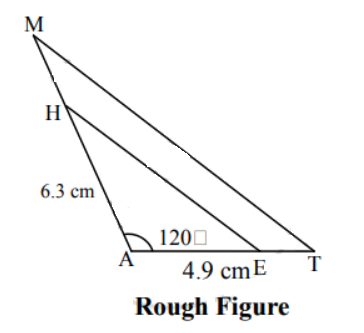
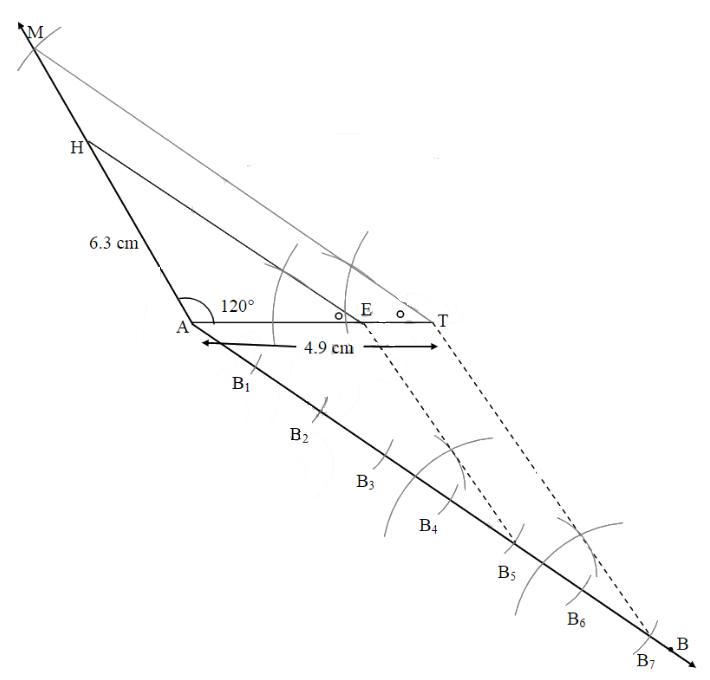
Steps of construction:
1. Draw seg AT of length $4.9 cm$
2. Take $\angle A$ as $120^{\circ}$ and draw an arc of $6.3 cm$ on it. Name the point as $M$.
3. Join seg $M T$ to obtain $\triangle A M T$.
4. Draw ray $A B$ such that $\angle T A B$ is an acute angle.
5. Locate points $B_1, B_2, B_3, B_4, B_5, B_6$, $B_7$ on ray $A B$ such that,
$
AB _1= B _1 B _2= B _2 B _3= B _3 B _4= B _4 B _5= B _5 B _6= B _6 B _7
$
6. Join point $T$ and $B _7$.
7. Through point, $B_5$ draw a line parallel to seg $T B_7$ which intersects seg $A T$ at point $E$.
8. Draw a line parallel to $M T$ through $E$ to intersect line $A M$ at point $H$.
$\triangle AHE$ is the required triangle similar to $\triangle AMT$. View full question & answer→Question 334 Marks
Side of eqilateral triangle $PQR$ is $8\ cm$ then find the area of triangle whose side is half of side of triangle $PQR$
AnswerGiven: $\triangle P Q R$ is an equilateral triangle with $P Q=Q R=P R=8 cm$ and $\triangle A B C$ is an equilateral triangle with $A B=B C=A C=4 cm$
To find: $A(\triangle A B C)$
Construction: Draw seg $A D \perp B C, B-D-C$
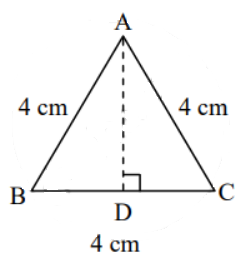
In $\triangle A B D$,
$ \angle ADB =90^{\circ} \quad \ldots[\text { Construction }]$
$\angle ABD =60^{\circ} \quad \ldots[\text { Angle of an equilateral triangle }]$
$\angle BAD =30^{\circ} \quad \ldots[\text { Remaining angle of a triangle }] $
$\therefore \triangle ABD$ is a $30^{\circ}-60^{\circ}-90^{\circ}$ triangle.
$ \therefore AD =\frac{\sqrt{3}}{2} AB$
$\therefore AD =\frac{\sqrt{3}}{2} \times 4$
$\therefore AD =2 \sqrt{3} $
Area of triangle $=\frac{1}{2} \times$ height $\times$ base
$\therefore$ Area of $\triangle A B C=\frac{1}{2} \times A D \times B C$
$=\frac{1}{2} \times 2 \sqrt{3} \times 4$
$ =2 \times 2 \sqrt{3}$
$=4 \sqrt{3} \quad \ldots \ldots .[\text { From (i)] } $
$\therefore$ Area of the triangle whose side is half of the side of $\triangle P Q R$ is $4 \sqrt{3}$ sq.cm View full question & answer→Question 344 Marks
Prove that $\frac{\cot A }{1-\tan A }+\frac{\tan A }{1-\cot A }=1+\tan A +\cot A =\sec A \cdot \operatorname{cosec} A$ $+1$
Answer$\frac{\cot A}{1-\tan A}+\frac{\tan A}{1-\cot A}$
$=\frac{\frac{\cos A}{\sin A}}{1-\frac{\sin A}{\cos A}}+\frac{\frac{\sin A}{\cos A}}{1-\frac{\cos A}{\sin A}}$
$=\frac{\frac{\cos A}{\sin A}}{\frac{\cos A-\sin A}{\cos A}}+\frac{\frac{\sin A}{\cos A}}{\frac{\sin A-\cos A}{\sin A}}$
$=\frac{\cos A}{\sin A} \times \frac{\cos A}{\cos A-\sin A}+\frac{\sin A}{\cos A} \times \frac{\sin A}{\sin A-\cos A}$
$=\frac{\cos ^2 A }{\sin A (\cos A -\sin A )}+\frac{\sin ^2 A }{\cos A (\sin A -\cos A )}$
$=\frac{1}{\sin A -\cos A }\left(\frac{-\cos ^3 A +\sin ^3 A }{\sin A \cos A }\right)$
$=\frac{1}{\sin A -\cos A }\left(\frac{\sin ^3 A -\cos ^3 A }{\sin A \cos A }\right)$
$=\frac{1}{\sin A-\cos A} \times \frac{(\sin A-\cos A)\left(\sin ^2 A+\sin A \cos A+\cos ^2 A\right)}{\sin A \cos A} \ldots \ldots\left[\because a^3-b^3=(a-b)\left(a^2+a b\right.\right.\left.\left.+b^2\right)\right]$
$=\frac{\sin ^2 A +\sin A \cos A +\cos ^2 A }{\sin A \cos A }$
$=\frac{1+\sin A \cos A}{\sin A \cos A} \quad \ldots \ldots\left[\because \sin ^2 A+\cos ^2 A=1\right]$
$=\frac{1}{\sin A \cos A}+\frac{\sin A \cos A}{\sin A \cos A}$
$=\operatorname{cosec} A \sec A+1 \ldots \text { (ii) }$
$ \frac{\cot A }{1-\tan A }+\frac{\tan A }{1-\cot A }$
$=\frac{\sin ^2 A +\sin A \cos A +\cos ^2 A }{\sin A \cos A } \quad \ldots \ldots . .[\text { From (i)] }$
$=\frac{\sin ^2 A }{\sin A \cos A }+\frac{\sin A \cos A }{\sin A \cos A }+\frac{\cos ^2 A }{\sin A \cos A }$
$=\frac{\sin A }{\cos A }+1+\frac{\cos A }{\sin A }$
$=\tan A +1+\cot A \quad \ldots . . . \text { (iii) }$
From (ii) and (iii), we get
$\frac{\cot A}{1-\tan A}+\frac{\tan A}{1-\cot A}=1+\tan A+\cot A=\sec A \cdot \operatorname{cosec} A+1$
View full question & answer→Question 354 Marks
How many coins 1.75 cm in diameter and 2 mm thick must be melted to form a cuboid 11 cm ✖ 10 cm ✖ 7 cm?
Question 364 Marks
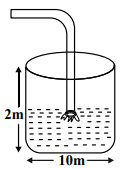
A farmer connects a pipe of internal diameter 20 cm from the canal into a cylindrical tank in his field, which is 10 m in diameter and 2 m deep. If water flows through the rate of 3 km/h, in how much time will the tank be filled.
Question 374 Marks
A toy is in the form of a cone mounted on a hemisphere. The diameter of the base of the cone and that of a hemisphere is 18 cm and the height of cone is 12 cm. Find the total surface area of toy. $(\pi=3.14)$
View full question & answer→Question 384 Marks
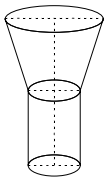
An oil funnel made of tin sheet consists of a cylindrical portion 10 cm long attached to a frustum of a cone. If the total height is 22 cm, diameter of the cylindrical portion is 8 cm and the diameter of the top of funnel is 18 cm. Find the area of tin required to make the funnel.