Question types

Question Bank - P2 question types

295 questions across 7 question groups — pick any mix to generate a Maths paper with step-by-step answer keys.

295
Questions
7
Question groups
5
Question types
Sample Questions

Question Bank - P2 questions

One sample from each question group in this chapter. Select any group above to see the full set with answer keys.

Find the diagonal of a rectangle whose length is 16 cm and area is 192 sq.cm. Complete the following activity.
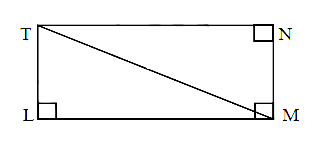
Activity: As shown in figure GLMNT is a reactangle.
$\therefore$ Area of rectangle $=$ length $\times$ breadth
$\therefore$ Area of rectangle $=\square \times$ breadth
$\therefore 192=\square \times$ breadth
$\therefore$ Breadth $=12 cm$
Also,
$\angle TLM =90^{\circ}$ [Each angle of reactangle is right angle]
In $\triangle T L M$,
By Pythagoras theorem
$\therefore TM ^2= TL ^2+\square$
$\therefore TM ^2=12^2+\square$
$\therefore TM ^2=144+\square$
$\therefore TM ^2=400$
$\therefore TM =20$
 
View full solution
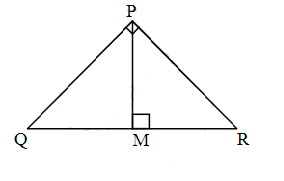
From given figure, in $\triangle P Q R$, if $\angle Q P R=90^{\circ}, P M \perp Q R, P M=10, Q M=8$, then for finding the value of $Q R$, complete the following activity.
Image
Activity: In $\triangle P Q R$, if $\angle Q P R=90^{\circ}, P M \perp Q R$,
[Given]
In $\triangle P M Q^1$ by Pythagoras Theorem,
$\therefore PM ^2+\square= PQ ^2$
$\therefore P Q^2=10^2+8^2$
$\therefore P Q^2=\square+64$
$\therefore P Q^2=\square$
$\therefore P Q=\sqrt{164}$
Here, $\triangle QPR \sim \triangle QMP \sim \triangle PMR$
$\therefore \triangle QMP \sim \triangle PMR$
$\therefore \frac{ PM }{ RM }=\frac{ QM }{ PM }$
$\therefore PM ^2= RM \times QM$
$\therefore 10^2= RM \times 8$
$RM =\frac{100}{8}=\square$
And,
$Q R=Q M+M R$
$QR =\square+\frac{25}{2}=\frac{41}{2}$
View full solution
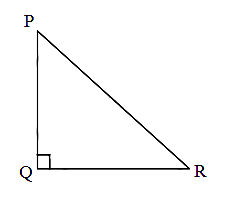
Complete the following activity to find the length of hypotenuse of right angled triangle, if sides of right angle are $9 cm$ and $12 cm$.
Activity: In $\triangle P Q R, m \angle P Q R=90^{\circ}$


By Pythagoras Theorem,
$P Q^2+\square=P R^2$
$\therefore P R^2=9^2+12^2$
$\therefore P R^2=\square+144$
$\therefore P R^2=\square$
$\therefore P R=15$
$\therefore$ Length of hypotenuse of triangle PQR is $\square cm$.
View full solution
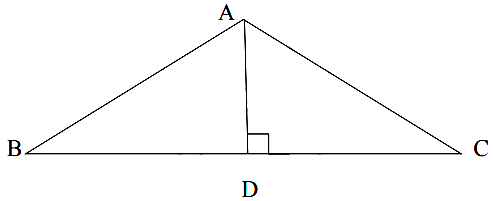
From the given figure, in $\triangle A B C$, if $A D \perp B C, \angle C=45^{\circ}, A C=8 \sqrt{2}, B D=5$, then for finding value of $A D$ and $BC$, complete the following activity.

Activity: In $\triangle ADC$, if $\angle ADC =90^{\circ}, \angle C =45^{\circ}$ [Given]
$\therefore \angle DAC =\square \quad$..... [Remaining angle of $\triangle ADC ]$
By theorem of $45^{\circ}-45^{\circ}-90^{\circ}$ triangle,
$ \therefore \square=\frac{1}{\sqrt{2}} AC \text { and } \square=\frac{1}{\sqrt{2}} AC$
$\therefore AD =\frac{1}{\sqrt{2}} \times \square \text { and } DC =\frac{1}{\sqrt{2}} \times 8 \sqrt{2}$
$\therefore AD =8 \text { and } DC =8$
$\therefore BC = BD + DC$
$=5+8$
$=13 $
View full solution
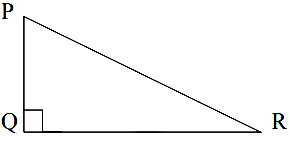
A ladder $10\ m$ long reaches a window $8\ m$ above the ground. Find the distance of the foot of the ladder from the base of wall. Complete the given activity.
Activity: As shown in figure suppose

PR is the length of ladder $=10 m$
At P - window, At Q - base of wall, At R - foot of ladder
$\therefore PQ =8 m$
$\therefore Q R=?$
In $\triangle P Q R, m \angle P Q R=90^{\circ}$
By Pythagoras Theorem,
$\therefore PQ ^2+\square= PR ^2$
Here, $P R=10, P Q=\square$
From equation (l)
$ 8^2+Q^2=10^2$
$Q R^2=10^2-8^2$
$Q R^2=100-64$
$Q R^2=\square$
$Q R=6 $
$\therefore$ The distance of foot of the ladder from the base of wall is $6 m$.
View full solution
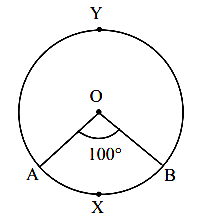
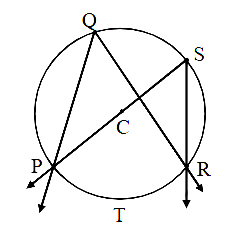
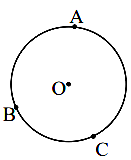
If O is the center of the circle in the figure alongside, then complete the table from the given information.

The type of arc
Type of circular arc Name of circular arc Measure of circular arc
Minor arc
Major arc
View full solution
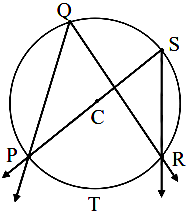
Prove that angles inscribed in the same arc are congruent.

Given: In a circle with center $C, \angle P Q R$ and $\angle P S R$ are inscribed in same arc PQR. Arc PTR is intercepted by the angles.
To prove: $\angle P Q R \cong \angle P S R$.
Proof:
$ m \angle PQR =\frac{1}{2} \times[ m (\operatorname{arc} PTR )]$
$m \angle \square=\frac{1}{2} \times[ m (\operatorname{arc} PTR )] \ldots . . . \text { (ii) } \square$
$m \angle \square= m \angle PSR \quad \ldots . . .[ By \text { (i) and (ii) }]$
$\therefore \angle PQR \cong \angle PSR $
View full solution
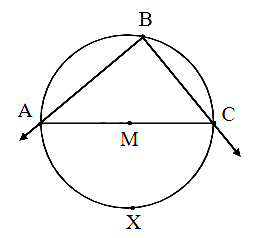
The angle inscribed in the semicircle is a right angle. Prove the result by completing the following activity.

Given: $\angle A B C$ is inscribed angle in a semicircle with center $M$
To prove: $\angle A B C$ is a right angle.
Proof: Segment AC is a diameter of the circle.
$
\therefore m(\operatorname{arc} A X C)=\square
$
Arc $A X C$ is intercepted by the inscribed angle $\angle A B C$
$\angle ABC =\square$ [Inscribed angle theorem]
$
=\frac{1}{2} \times \square
$
$\therefore m \angle ABC =\square$
$\therefore \angle ABC$ is a right angle.
View full solution
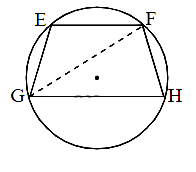
In figure, chord EF || chord GH. Prove that, chord EG ≅ chord FH. Fill in the blanks and write the proof.
Proof: Draw seg GF.

$\angle EFG =\angle FGH \quad \ldots . . . \square \quad \ldots . . .( I )$
$\angle EFG =\square \quad \ldots . .[\text { [inscribed angle theorem] (II) }$
$\angle FGH =\square \quad \ldots . .[\text { inscribed angle theorem] (III) }$
$\therefore m (\operatorname{arc} EG )=\square \quad \ldots \ldots[ By ( I ),( II ), \text { and (III)] }$
chord $EG \cong$ chord $FH \quad$.........[corresponding chords of congruent arcs]
View full solution
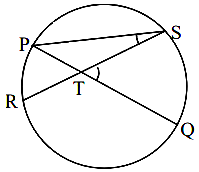
In the figure, if the chord $P Q$ and chord $R S$ intersect at point $T$, prove that: $m \angle S T Q=\frac{1}{2}[m(\operatorname{arc} P R)+$ $m (\operatorname{arc} S Q)]$ for any measure of $\angle S T Q$ by filling out the boxes

Proof: $m \angle STQ = m \angle SPQ +\square \ldots$....[Theorem of the external angle of a triangle $]$ $=\frac{1}{2} m (\operatorname{arc~SQ})+\square \quad \ldots . . .[$ Inscribed angle theorem $]$
$=\frac{1}{2}[\square+\square]$
View full solution
To prove $\cot \theta+\tan \theta=\operatorname{cosec} \theta \times \sec \theta$, complete the activity given below.
Activity:
L.H.S = $\square$
$ =\frac{\square}{\sin \theta}+\frac{\sin \theta}{\cos \theta}$
$=\frac{\cos ^2 \theta+\sin ^2 \theta}{\square}$
$=\frac{1}{\sin \theta \cdot \cos \theta} \quad \ldots \ldots . .\left[\cos ^2 \theta+\sin ^2 \theta=\square\right]$
$=\frac{1}{\sin \theta} \times \frac{1}{\square}$
$=\square$
$=\text { R.H.S } $
View full solution
If $\tan \theta=\frac{7}{24}$, then to find value of $\cos \theta \operatorname{complete}$ the activity given below.
Activity:
$ \sec ^2 \theta=1+\square \quad \ldots . . .[\text { Fundamental tri. identity] }$
$\sec ^2 \theta=1+\square^2$
$\sec ^2 \theta=1+\frac{\square}{576}$
$\sec ^2 \theta=\frac{\square}{576}$
$\sec \theta=\square$
$\cos \theta=\square \quad \ldots \ldots . .\left[\cos \theta=\frac{1}{\sec \theta}\right] $
View full solution
Do the following activity to draw tangents to the circle without using the center of the circle.
  1. Draw a circle with radius 3.5 cm and take any point C on it.
  2. Draw chord CB and an inscribed angle CAB.
  3. With the center A and any convenient radius, draw an arc intersecting the sides of angle BAC in points M and N.
  4. Using the same radius, draw an arc intersecting the chord CB at point R.
  5. Taking the radius equal to d(MN) and center R, draw an arc intersecting the arc drawn in the previous step. Let D be the point of intersection of these arcs. Draw line CD. Line CD is the required tangent to the circle.
View full solution
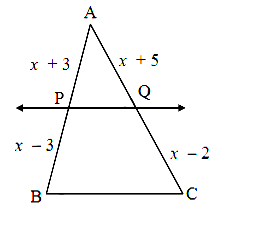
From fig., seg $PQ ||$ side $BC, AP = x + 3, PB = x – 3, AQ = x + 5, QC = x – 2,$ then complete the activity to find the value of $x.$

$\text { In } \triangle P Q B, P Q|| \text { side } B C$
$\frac{ AP }{ PB }=\frac{ AQ }{[} \quad \ldots[\ldots]$
$\frac{x+3}{x-3}=\frac{x+5}{[}$
$(x+3)[\quad]=(x+5)(x-3)$
$x^2+x-[\quad]=x^2+2 x-15$
$x=[$
View full solution
$\tan ^2 \theta-\sin ^2 \theta=\tan ^2 \theta \times \sin ^2 \theta$. For proof of this complete the activity given below.
Activity:
L.H.S = $\square$
$ =\square\left(1-\frac{\sin ^2 \theta}{\tan ^2 \theta}\right)$
$=\tan ^2 \theta\left(1-\frac{\square}{\frac{\sin ^2 \theta}{\cos ^2 \theta}}\right)$
$=\tan ^2 \theta\left(1-\frac{\sin ^2 \theta}{1} \times \frac{\cos ^2 \theta}{\square}\right)$
$=\tan ^2 \theta(1-\square)$
$=\tan ^2 \theta \times \square \quad \ldots . .\left[1-\cos ^2 \theta=\sin ^2 \theta\right]$
$=\text { R.H.S } $
View full solution
Q 193 Marks Question3 Marks
Draw a circle with a radius of 3.5 cm. Take the point K anywhere on the circle. Draw a tangent to the circle from K (without using the center of the circle)
View full solution
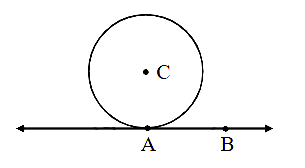
In a circle with centre $P ,$ chord $AB$ is parallel to a tangent and intersects the radius drawn from the point of contact to its midpoint. If $AB = 16\sqrt3$ then find the radius of the circle
View full solution
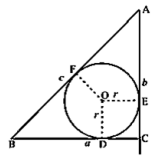
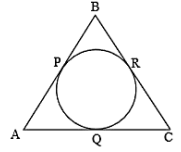
Given : A circle inscribed in a right angled $\triangle ABC.$ If $\angle ACB = 90^\circ$ and the radius of the circle is $r.$
To prove $: 2 r = ? + b – c$
Image
View full solution
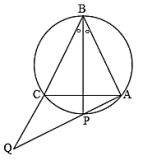
In the figure ∆ABC is an equilateral triangle.The angle bisector of ∠? will intersect the circumcircle ∆ABC at point P. Then prove that : CQ = CA.
Image
View full solution
The figure $\triangle ABC$ is an isosceles triangle with a perimeter of $44 \ cm.$ The sides $AB$ and $BC$ are congruent and the length of the base $AC$ is $12\ cm.$ If a circle touches all three sides as shown in the figure, then find the length of the tangent segment drawn to the circle from the point $B$
Image
View full solution
Points A, B, C are on a circle, such that m(arc AB) = m(arc BC) = 120°. No point, except point B, is common to the arcs. Which is the type of ∆ ABC?
  • Equilateral triangle
  • B
    Scalene triangle
  • C
    Right angled triangle
  • D
    Isosceles triangle

Answer: A.

View full solution
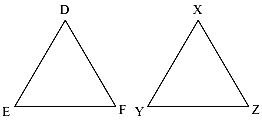
In $\triangle DEF$ and $\triangle XYZ , \frac{ DE }{ XY }=\frac{ FE }{ YZ }$ and $\angle E \cong \angle Y$.___ __ test gives similarity between $\triangle DEF$ and $\triangle XYZ$
.
  • A
    AAA
  • SAS
  • C
    SAA
  • D
    SSS

Answer: B.

View full solution

Generate a Question Bank - P2 paper free

Pick question groups from the list above, set marks and difficulty, and export a branded PDF with step-by-step answer keys. First 3 chapters free — no signup.

Download App