Questions

Answer the following questions.

Take a timed test

29 questions · self-marked practice — reveal the answer and mark yourself.

Question 14 Marks

Image
Answer
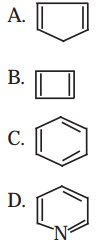
A.
Image

Compound is non-aromatic since it has 4π electrons and hence, does not obey Huckel rule of aromaticity.

B.

Image

Compound is non-aromatic since it has 4π electrons and hence, does not obey Huckel rule of aromaticity.

C.

Image

Compound is aromatic since it has 6π electrons and hence, obeys Huckel rule of aromaticity.

D.

Image

Compound is aromatic since it has 6n electrons and hence, obeys Huckel rule of aromaticity.
View full question & answer
Question 24 Marks
Write short note about hydrocarbon.
Answer
  • In organic chemistry, a hydrocarbon is an organic compound consisting of carbon and hydrogen as the only elements.
  • They are examples of group 14 hydrides.
  • Alkanes, cycloalkanes, aromatic hydrocarbons are different types of hydrocarbons.
  • Most of the hydrocarbons found on earth occur naturally in crude oil.
  • They mainly undergo substitution, addition or combustion reactions.
  • Most hydrocarbons are flammable and toxic.
  • They are the primary energy source in the form of combustible fuel source.

[Note: Students are expected to collect additional information on their own]

View full question & answer
Question 34 Marks
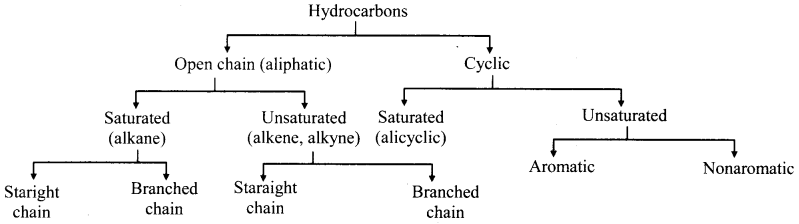
Prepare chart of hydrocarbons and note down the characteristics.
Answer

Image

Characteristics of hydrocarbons:

  • They are chemical compounds that are formed from only hydrogen and carbon atoms.
  • Both ‘C’ and ‘H’ share an electron pair forming covalent bonds.
  • One of the special properties of carbon is its ability to form double and triple bonds (unsaturation). Saturated hydrocarbons are alkanes and cycloalkanes while the unsaturated hydrocarbons are the aromatics, alkenes and alkynes.
  • All hydrocarbons are insoluble in water, their boiling point increases as the size of alkane increases.
  • All hydrocarbons can reach complete oxidation.
  • Hydrocarbons are mainly used as fuel for transport and industry.

[Note: Students are expected to collect additional information on hydrocarbons on their own.]

View full question & answer
Question 54 Marks
Write a short note on aromaticity.
Answer
$i.$ All aromatic compounds undergoes substitution reactions rather than addition reactions and this property is referred to as aromaticity or aromatic character.
$ii.$ The aromatic character of benzene is correlated to its structure.
$iii.$ Aromaticity is due to extensive cyclic delocalization of $p$ electrons in the planar ring structure.
$iv.$ Three rules of aromaticity that is used for predicting whether a particular compound is aromatic or non$-$aromatic are as follows:
Aromatic compounds are cyclic and planar $($all atoms in ring are $sp^2$ hybridized$).$
Each atom in aromatic ring has a $p$ orbital. The $p$ orbitals must be parallel so that continuous overlap is possible around the ring.
Huckel rule: The cyclic $\pi$ molecular orbital formed by overlap of $p$ orbitals must contain $(4n + 2) p$ electrons, where $n =$ integer $0, 1, 2, 3, …$ etc.
View full question & answer
Question 64 Marks
Explain the directive influence of nitro group in nitrobenzene. Explain why nitro group is a meta$-$directing group.
Answer
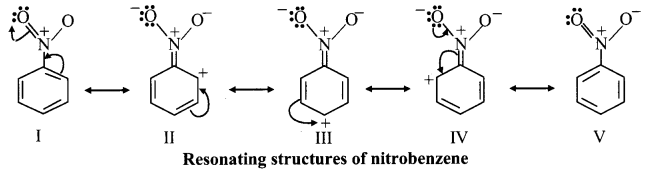
$i.$ Meta directing group withdraws electrons from the aromatic ring by resonance, making the ring electron$-$deficient. Therefore, meta groups are ring deactivating groups.
$ii.$ Due to $-I$ effect, $-NO_2$ group reduces electron density in benzene ring on ortho and para positions. So, the attack of incoming group becomes difficult at ortho and para positions. The incoming group can attack on meta positions more easily.
$iii.$ The various resonance structures of nitrobenzene are as shown below:Image
$iv.$ It is clear from the above resonance structures that the ortho and para positions have comparatively less electron density than at meta positions. Hence, the incoming group/electrophile attacks on meta positions.
View full question & answer
Question 74 Marks
Explain why halide group is an ortho and para directing group.
Answer
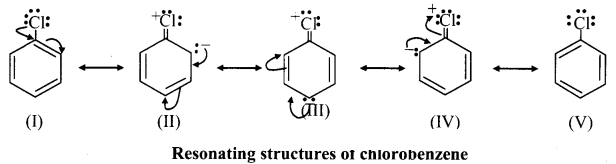
i. In aryl halides, halogens are moderately deactivating. Because of their strong -I effect, overall electron density on the benzene ring decreases, which makes the electrophilic substitution difficult.
ii. However, halogens are ortho and para directing. This can be explained by considering resonance structures.
iii. e.g. Chlorobenzene has the following resonating structures:
Image
iv. Due to resonance, the electron density on ortho and para positions is greater than meta positions and hence, -Cl is ortho and para directing.
View full question & answer
Question 84 Marks
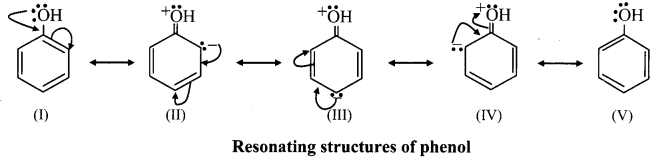
Explain the directive influence of ortho, para directing groups in monosubstituted benzene using suitable example. ### Explain the directive influence of -OH group in benzene.
View full question & answer
Question 104 Marks
How does Huckel rule help in determining the aromaticity of pyridine?
Answer
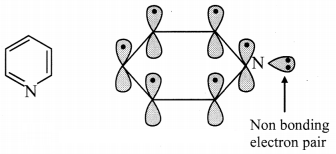
$i.$ Pyridine has three double bonds and $6 \pi$ electrons.
$ii.$ The six $p$ orbitals containing six electrons form delocalized $\pi$ molecular orbital.
$iii.$ The unused $sp^2$ hybrid orbital of nitrogen containing two non$-$bonding electrons is as it is.
Image
$iv.$ According to Huckel rule, this compound is aromatic if, $4n + 2 =$ Number of $\pi$ electrons
$4n + 2 = 6,$
$\therefore 4n = 6 – 2 = 4$
$n = 4/4 = 1,$ here $‘n \ ’$ comes out to be an integer. Hence, pyridine is aromatic.
View full question & answer
Question 114 Marks
State and explain the Huckel rule of aromaticity.
View full question & answer
Question 124 Marks
Explain the structure of benzene with respect to molecular orbital theory.
Answer
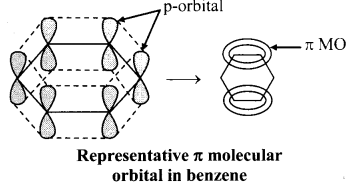
i. According to molecular orbital (MO) theory, the six p orbitals of six carbons give rise to six molecular orbitals of benzene.
ii. Shape of the most stable MO is as show in the figure below. Three of these π molecular orbitals lie above and the other below those of free carbon atom energies.Image
iii. The six electrons of the p orbitals cover all the six carbon atoms and are said to be delocalized. Delocalization of π electrons results in stability of benzene molecule.
View full question & answer
Question 134 Marks
Explain the resonance phenomenon with respect to benzene. ### Explain the resonance hybrid structure of benzene.
Answer
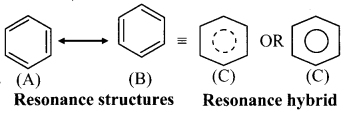
  • Benzene is a hybrid of various resonance structures. The two structures, (A) and (B) given by Kekule are the main contributing structures.
  • The resonance hybrid is represented by inserting a circle or a dotted circle inscribed in the hexagon as shown in (C).
  • The circle represents six electrons delocalized over the six carbon atoms of benzene ring.
  • A double headed arrow between the resonance structures is used to represent the resonance phenomenon.

Image
View full question & answer
Question 144 Marks
Give the evidence for the cyclic structure of benzene.
Answer
Evidence for the cyclic structure of benzene:
$i.$ Benzene yields only one and no isomeric monosubstituted bromobenzene $(C_6H_5Br)$ when treated with equimolar bromine in $FeBr_3.$ This indicates that all six hydrogen atoms in benzene are identical.
$\underset{\text { Benzene }}{ C _6 H _6}+ Br _2 \xrightarrow[\text { Bromobenzene }]{ Fe _6} C _6 H _5 Br + HBr$
$ii.$ This is possible only if benzene has cyclic structure of six carbons bound to one hydrogen atom each.
$iii.$ Benzene on catalytic hydrogenation gives cyclohexane.
$\underset{\text { Benzene }}{ C _6 H _6}+3 H _2 \xrightarrow{ Ni } \underset{\text { Cyclohexane }}{ C _6 H _{12}}$
This confirms the cyclic structure of benzene and three $C = C$ in it.
View full question & answer
Question 154 Marks
Explain: Ozonolysis
Answer
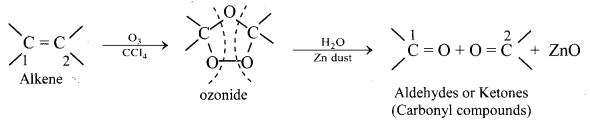
i. The C = C double bond in alkenes, gets cleaved on reaction with ozone followed by reduction.
ii. The overall process of formation of ozonide by reaction of ozone with alkene in the first step and then decomposing it to the carbonyl compounds by reduction in the second step is called ozonolysis.
iii. When ozone gas is passed into solution of the alkene in an inert solvent like carbon tetrachloride, unstable alkene ozonide is obtained.
iv. This is subsequently treated with water in the presence of a reducing agent zinc dust to form carbonyl compounds, namely, aldehydes and/or ketones.
Image
View full question & answer
Question 164 Marks
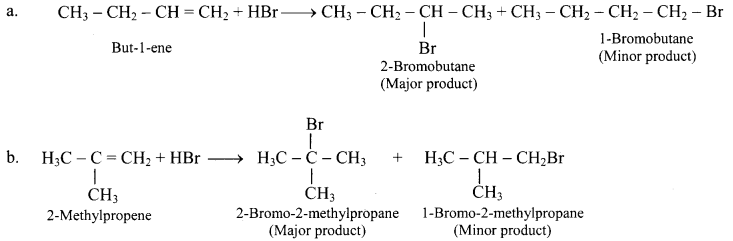
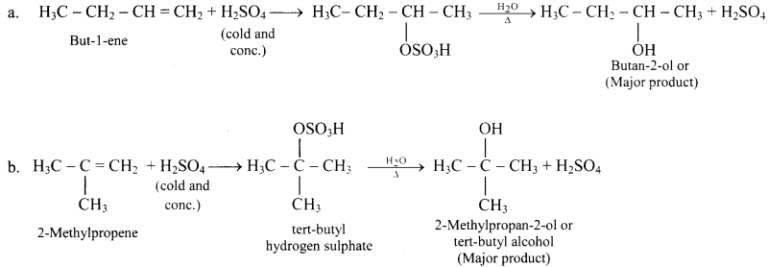
But$-1-$ene and $2-$methylpropene are separately treated with following reagents. Predict the product/products. Indicate major/minor product,
$i. HBr$
$ii. H_2SO_4 / H_2O$
Answer
$i. HBr:$
Image

$ii. H_2SO_4 / H_2O:$​​​​​​​​​​​​​​
Image
View full question & answer
Question 174 Marks
State Markovnikov’s rule and explain it with the help of an example.
Answer
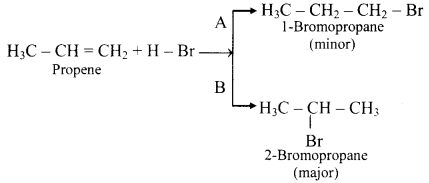
i. Markovnikov’s rule: When an unsymmetrical reagent is added to an unsymmetrical alkene, the negative part (X-) of the reagent gets attached to the carbon atom which carries less number of hydrogen atoms.
ii. For example, addition of HBr to unsymmetrical alkenes yield two isomeric products.
Image
iii. Experimentally it has been found that 2-Bromopropane is the major product.
View full question & answer
Question 184 Marks
Explain the formation of alkyl halides from alkenes.
Answer
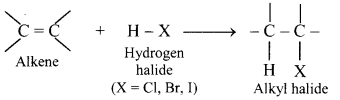
i. Alkenes react with hydrogen halides (HX) like hydrogen chloride, hydrogen bromide and hydrogen iodide to give corresponding alkyl halides (haloalkanes). This reaction is known as hydrohalogenation of alkenes.
Image
Image
ii. The order of reactivity of halogen acids is HI > HBr > HCl.
View full question & answer
Question 194 Marks
How are geometrical isomers of alkenes obtained from alkynes?
Answer
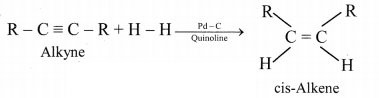
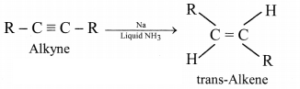
Alkenes are obtained by partial reduction of alkynes wherein C = C triple bond of alkynes is reduced to a C = C double bond by:
i. using calculated quantity of dihydrogen in presence of Lindlar’s catalyst (palladised charcoal deactivated partially with quinoline or sulphur compound) to give the cis-isomer of alkene.
Image
ii. using sodium in liquid ammonia to give trans-isomer of alkene.
Image
View full question & answer
Question 204 Marks
Explain dehydration reaction of alcohols.
Answer
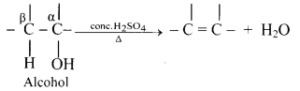
i. Alcohols on heating with sulphuric acid form alkenes with elimination of water molecule. The reaction is known as catalysed dehydration of alcohols.
ii. The exact conditions of dehydration depend upon the alcohol.
iii. Dehydration of alcohol is an example of β-elimination since -OH group from α-carbon along with H-atom from β-carbon is removed.
Image
The ease of dehydration of alcohol is in the order 3° > 2° > 1°.
View full question & answer
Question 214 Marks
i. What is dehydrohalogenation reaction?
ii. How is it carried out. Explain with an example.
Answer
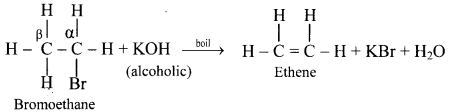
i. a. The reactions in which there is removal of hydrogen (H) atom and halogen (X) atom from adjacent carbon atoms are known as dehydrohalogenation reactions.
b. The carbon carrying X is called α-carbon atom. The hydrogen atom from adjacent carbon called β-carbon atom, is removed and hence, the reaction is known as β-elimination.

ii. When an alkyl halide is boiled with a hot concentrated alcoholic solution of a strong base like KOH or NaOH, alkene is formed with removal of water molecule.
Image
View full question & answer
Question 224 Marks
What is $\beta-$elimination reaction? Explain in brief.
Answer
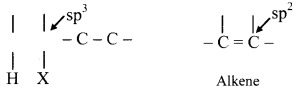
The reactions in which two atoms or groups are eliminated from adjacent carbon atoms are called $1,2-$elimination reactions. Since the atom/group is removed from $\beta-$carbon atom $(\beta$ to the leaving group$)$ it is called as $\beta-$elimination reaction.
Image
The hybridization of each $C$ in the reactant is $sp^3$ while that in the product is $sp^2.$ This means elimination reactions cause change in hybridization state while forming multiple bonds from single bond.
View full question & answer
Question 244 Marks
Collect the information on CNG and LPG with reference to the constituents and the advantages of CNG over LPG.
Answer
Constituents of CNG (Compressed Natural Gas):
It mainly consists of methane compressed at a pressure of 200-248 bar.
Constituents of LPG (Liquefied Petroleum Gas):
It contains a mixture of propane and butane liquefied at 15°C and a pressure of 1.7 – 7.5 bar.
Advantages of CNG over LPG:
  • CNG is cheaper and cleaner than LPG.
  • CNG produces less pollutants than LPG.
  • It does not evolve gases containing sulphur and nitrogen.
  • Octane rating of CNG is high, hence thermal efficiency is more.
  • Vehicles powered by CNG produces less carbon monoxide and hydrocarbon emission.
View full question & answer
Question 254 Marks
State physical properties of alkanes.
Answer
  • Alkanes are colourless and odourless.
  • At room temperature, the first four alkanes are gases, alkanes having 5 to 17 carbon atoms are liquids while the rest all are solids.
  • Alkanes are readily soluble in organic solvents such as chloroform, ether or ethanol while they are insoluble in water.
  • Alkanes have low melting and boiling points which increases with an increase in the number of carbon atoms for straight chain molecules. But for branched chain molecules, more the number of branches, lower is the boiling/melting point.
View full question & answer
Question 264 Marks
Straight chain alkanes have higher melting and boiling points as compared to branched isomeric alkanes. Give reason.
Answer
i. The electronegativity of carbon and hydrogen is nearly the same. Therefore, C-H and C-C bonds are nonpolar covalent bonds and hence, alkanes are nonpolar.
ii. Alkane molecules are held together by weak intermolecular van der Waals forces.
iii. Larger the surface area of molecules, stronger are such intermolecular van der Waals forces.
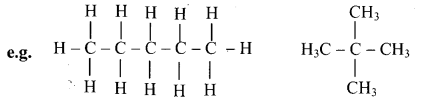
iv. In straight chain alkane molecules, surface area is relatively larger as compared to branched chain alkanes and as a result, the intermolecular forces are relatively stronger in straight chain alkanes than in branched chain alkanes.
Image
Hence, straight chain alkanes have higher melting and boiling points as compared to branched alkanes.
View full question & answer
Question 274 Marks
How are alkanes obtained from alkenes and alkynes? ### How are alkanes obtained from catalytic hydrogenation of alkenes and alkynes?
Answer
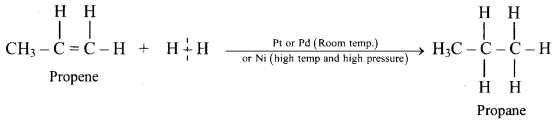
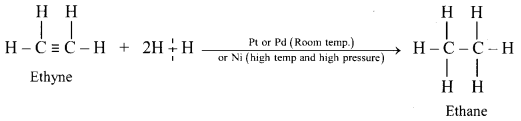
i. Catalytic hydrogenation of alkenes or alkynes with dihydrogen gas gives corresponding alkanes.
ii. Finely divided powder of platinum (Pt) or palladium (Pd) catalyse the hydrogenation of alkenes and alkynes at room temperature.
iii. Relatively high temperature and pressure are required with finely divided nickel as the catalyst.
e.g. a. Propene to propane:
Image
b. Ethyne to ethane:Image
View full question & answer
Question 284 Marks
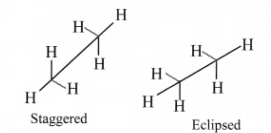
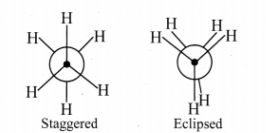
Draw structures representing staggered and eclipsed conformations of ethane using:
i. Sawhorse projection
ii. Newman projection
Answer
i. Sawhorse projection of ethane:
Image
ii. Newman projection of ethane:
Image
View full question & answer
Question 294 Marks
i. Why do C – C bonds in alkanes undergo rotation?
ii. What are conformations?
Answer
i. a. Alkanes have single covalent bonds (sigma bonds) formed by the coaxial overlap of orbitals.
b. As a direct consequence of coaxial overlap of orbitals, a sigma bond is cylindrically symmetrical and the extent of orbital overlap is unaffected by rotation about the single bond and therefore, C – C bonds undergo rotation.
ii. a. In alkanes, the atoms bonded to one carbon of a C – C single bond change their relative position with reference to the atoms on the other carbon of that bond on rotation of that C – C single bond.
b. The resulting arrangements of the atoms in space about the C – C single bond are called conformations or conformational isomers. Innumerable conformations result on complete rotation of a C – C single bond through 360°.
View full question & answer