Question 12 Marks
Prove the following : $2(\sin^6 \theta + \cos^6 \theta ) – 3(\sin^4 \theta + \cos^4 \theta ) + 1 = 0$
AnswerL.H.S =
$2(\sin^6 \theta + \cos^6 \theta ) – 3(\sin^4 \theta + \cos^4 \theta ) + 1=0$
$= \sin^6 \theta + \cos^6 \theta $
$= (\sin^2 \theta )^3 + (\cos^2 \theta )^3 = (\sin^2 \theta + \cos^2 \theta )^3$
$– 3 \sin^2 \theta \cos^2 \theta (sin2 0 + cos2 0)$
$…[••• a^3 + b^3 = (a + b)^3 – 3ab(a + b)]$
$= (1)^3 – 3 \sin^2 \theta \cos^2 \theta (1)$
$= 1-3 \sin^2 \theta \cos^2 \theta \sin^4 \theta + \cos^4 \theta $
$= (\sin^2 \theta )^2 + (\cos^2 \theta )^2 = (\sin^2 \theta + \cos^2 \theta )^2 – 2 \sin^2 \theta \cos^2 \theta $
$…[Y a^2 + b^2 = (a + b)^2 – 2ab]$
$= 1-2 \sin^2 \theta \cos^2 \theta $
L.H.S.=$ 2(\sin^6 \theta + \cos^6 \theta ) – 3(\sin^4 \theta + \cos^4 \theta ) + 1$
$= 2(1-3 \sin^2 \theta \cos^2 \theta ) -3(1 – 2 \sin^2 \theta \cos^2 \theta ) + 1$
$= 2-6 \sin^2 \theta \cos^2 \theta – 3 + 6 \sin^2 \theta \cos^2 \theta + 1 = c$
= R.H.S.
View full question & answer→Question 22 Marks
Prove the following : $\sec^2\theta –\sec^4\theta –2cosec^2\theta +cosec^4\theta =\cot^4\theta –\tan^4\theta $
AnswerLHS.
$= 2.sec2 \theta – sec4 \theta – 2.cosec2 \theta + cosec4 \theta = = 2 sec2 \theta – (sec2 \theta )2 – 2cosec2 \theta + (cosec2 \theta )2$
$= 2(1+ tan2 \theta ) – (1+ tan2 \theta )2 – 2(1+ cot2 \theta )$
$+ (1+ cot2 \theta )2$
$= 2 + 2tan2 \theta – (1 + 2tan2 \theta + tan4 \theta )$
$– 2 – 2cot2 \theta + 1 + 2cot2 \theta + cot4 \theta $
$= 2 + 2.tan2 \theta – 1 – 2 tan2 \theta – tan4 \theta – 2$
$– 2 cot2 \theta + 1 + 2 cot2 \theta + cot4 \theta $
$= cot4 \theta – tan4 \theta $ = R.H.S.
View full question & answer→Question 32 Marks
Prove the following : $\frac{\operatorname{cosec} \theta+\cot \theta+1}{\cot \theta+\operatorname{cosec} \theta-1}=\frac{\cot \theta}{\operatorname{cosec} \theta-1}$
AnswerWe know that,
$\cot ^2 \theta=\operatorname{cosec}^2 \theta-1$
$\therefore \cot \theta \cdot \cot \theta=(\operatorname{cosec} \theta+1)(\operatorname{cosec} \theta-1)$
$\therefore \quad \frac{\cot \theta}{\operatorname{cosec} \theta-1}=\frac{\operatorname{cosec} \theta+1}{\cot \theta}$
By the theorem on equal ratios, we get
$\begin{aligned}
& \frac{\cot \theta}{\operatorname{cosec} \theta-1}=\frac{\operatorname{cosec} \theta+1}{\cot \theta}=\frac{\cot \theta+\operatorname{cosec} \theta+1}{\operatorname{cosec} \theta-1+\cot \theta} \\
\therefore \quad & \frac{\operatorname{cosec} \theta+\cot \theta+1}{\cot \theta+\operatorname{cosec} \theta-1}=\frac{\cot \theta}{\operatorname{cosec} \theta-1}
\end{aligned}$
View full question & answer→Question 42 Marks
Show that $\tan^2 \theta + \cot^2 \theta \geq 2$ for all $\theta \in R$.
Answer$ \tan ^2 \theta+ \cot ^2 \theta=\tan ^2 \theta+\frac{1}{\tan ^2 \theta}$
$=(\tan \theta)^2+\left(\frac{1}{\tan \theta}\right)^2$
$=\left(\tan \theta-\frac{1}{\tan \theta}\right)^2+2 \tan \theta \cdot \frac{1}{\tan \theta}$
$\quad \ldots\left[\because a^2+b^2=(a-b)^2+2 a b\right]$
$=\left(\tan \theta-\frac{1}{\tan \theta}\right)^2+2 \geq 2 \text { for all } \theta \in R .$
View full question & answer→Question 52 Marks
Which of the following is positive?
sin(-310°) or sin(310°)
Answer
Since 270° <310° <360°,
310° lies in the 4th quadrant.
∴ sin (310°) < 0
-310° = -360°+ 50°
∴ 50° and – 310° are co-terminal angles.
Since 0° < 50° < 90°, 50° lies in the 1st quadrant.
∴ – 310° lies in the 1st quadrant.
∴ sin (- 310°) > 0
∴ sin (- 310°) is positive.
View full question & answer→Question 62 Marks
Which is greater?
sin (1856°) or sin (2006°)
Answer1856° = 5 x 360° + 56°
∴ 1856° and 56° are co-terminal angles.
Since 0° < 56° < 90°, 56° lies in the 1st quadrant.
∴ 1856° lies in the 1st quadrant,
∴ sin 1856° >0 …(i)
2006° = 5 x 360° + 206°
∴ 2006° and 206° are co-terminal angles.
Since 180° < 206° < 270°,
206° lies in the 3rd quadrant.
∴ 2006° lies in the 3rd quadrant,
∴ sin 2006° <0 …(ii)
From (i) and (ii),
sin 1856° is greater.
View full question & answer→Question 72 Marks
Find the trigonometric functions of : 270°
Answer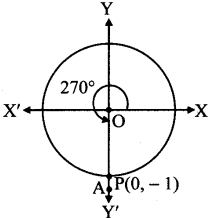
Angle of measure $270^{\circ}$ :
Let $m \angle X O A=270^{\circ}$
Its terminal arm (ray $O A)$ intersects the standard unit circle at $P(0,-1)$.
$ x=0 \text { and } y=-1$
$\sin 270^{\circ}=y=-1$
$\cos 270^{\circ}=x=0$
$\tan 270^{\circ}=\frac{y}{x} $
$=-\frac{1}{0}$, which is not defined
$\operatorname{cosec} 270^{\circ}=\frac{1}{y}$
$=\frac{1}{-1}=-1$
$\sec 270^{\circ}=\frac{1}{x}$
$=\frac{1}{0}$, which is not defined
$\cot 270^{\circ}=\frac{x}{y}=\frac{0}{-1}=0$ View full question & answer→Question 82 Marks
Find the trigonometric functions of : 90°
Answer
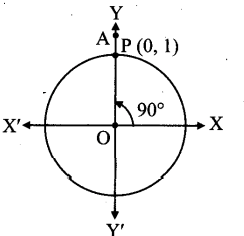
Angle of measure 90° :
Let m∠XOA = 90°
Its terminal arm (ray OA)
intersects the standard, unit circle at P(0, 1).
$\therefore x=0 \text { and } y=1$
$\sin 90^{\circ}=y=1$
$\cos 90^{\circ}=x=0$
$\tan 90^{\circ}=\frac{y}{x}=\frac{1}{0}, \text { which is not defined }$
$\operatorname{cosec} 90^{\circ}=\frac{1}{y}=\frac{1}{1}=1$
$\sec 90^{\circ}=\frac{1}{x}=\frac{1}{0}, \text { which is not defined }$
$\cot 90^{\circ}=\frac{x}{y}=\frac{0}{1}=0$ View full question & answer→Question 92 Marks
Prove the following : $\frac{\operatorname{cosec} \theta+\cot \theta-1}{\operatorname{cosec} \theta+\cot \theta+1}=\frac{1-\sin \theta}{\cos \theta}$
AnswerWe know that,
$ \cot ^2 \theta=\operatorname{cosec}^2 \theta-1$
$\therefore \cot \theta \cdot \cot \theta=(\operatorname{cosec} \theta+1)(\operatorname{cosec} \theta-1)$
$\therefore \quad \frac{\tan \theta}{\sec \theta+1}=\frac{\sec \theta-1}{\tan \theta}$
By the theorem on equal ratios, we get
$ \frac{\tan \theta}{\sec \theta+1}=\frac{\sec \theta-1}{\tan \theta}=\frac{\tan \theta+\sec \theta-1}{\sec \theta+1+\tan \theta}$
$\therefore \quad \frac{\tan \theta+\sec \theta-1}{\tan \theta+\sec \theta+1}=\frac{\tan \theta}{\sec \theta+1} $
View full question & answer→Question 102 Marks
Prove the following : $\frac{\tan \theta+\sec \theta-1}{\tan \theta+\sec \theta+1}=\frac{\tan \theta}{\sec \theta+1}$
AnswerWe know that
$ \tan ^2 \theta=\sec ^2 \theta-1$
$\therefore \tan \theta \cdot \tan \theta=(\sec \theta+1)(\sec \theta-1)$
$\therefore \quad \frac{\operatorname{cosec} \theta+\cot \theta}{1}=\frac{1}{\operatorname{cosec} \theta-\cot \theta} $
By componendo-dividendo, we get
$ \frac{\operatorname{cosec} \theta+\cot \theta+1}{\operatorname{cosec} \theta+\cot \theta-1}=\frac{1+\operatorname{cosec} \theta-\cot \theta}{1-(\operatorname{cosec} \theta-\cot \theta)}$
$\therefore \frac{\operatorname{cosec} \theta+\cot \theta+1}{\operatorname{cosec} \theta+\cot \theta-1}=\frac{1+\operatorname{cosec} \theta-\cot \theta}{1-\operatorname{cosec} \theta+\cot \theta}$
$\therefore \frac{\operatorname{cosec} \theta+\cot \theta+1}{1+\operatorname{cosec} \theta-\cot \theta}=\frac{\operatorname{cosec} \theta+\cot \theta-1}{\cot \theta-\operatorname{cosec} \theta+1} $
View full question & answer→Question 112 Marks
Prove the following $: \frac{1+\cot \theta+\operatorname{cosec} \theta}{1-\cot \theta+\operatorname{cosec} \theta}=\frac{\operatorname{cosec} \theta+\cot \theta-1}{\cot \theta-\operatorname{cosec} \theta+1}$
AnswerWe know that $\operatorname{cosec}^2 \theta-\cot ^2 \theta=1$
$\therefore(\operatorname{cosec} \theta-\cot \theta)(\operatorname{cosec} \theta+\cot \theta)=1 $
$\text { L.H.S. }=\frac{\sin ^3 \theta+\cos ^3 \theta}{\sin \theta+\cos \theta}+\frac{\sin ^3 \theta-\cos ^3 \theta}{\sin \theta-\cos \theta} $
$=\frac{(\sin \theta+\cos \theta)\left(\sin ^2 \theta+\cos ^2 \theta-\sin \theta \cos \theta\right)}{\sin \theta+\cos \theta} +\frac{(\sin \theta-\cos \theta)\left(\sin ^2 \theta+\cos ^2 \theta+\sin \theta \cos \theta\right)}{\sin \theta-\cos \theta}$
$......\left[\begin{array}{l} a^3+b^3=(a+b)\left(a^2-a b+b^2\right) \\ a^3-b^3=(a-b)\left(a^2+a b+b^2\right) \end{array}\right] $
View full question & answer→Question 122 Marks
Prove the following : $(1 + tanA tanB)^2 + (tanA – tanB)^2 = \sec ^2A \sec^2B$
AnswerL.H.S. $= (1 + tanA tanB)^2 + (tanA – tanB)^2$
$= 1 + 2tanA tanB + \tan^2A \tan^2 + \tan^2 A- 2tanA tanB + \tan^2B$
$= 1 + \tan^2A + \tan^2 B + \tan^2A \tan^2B$
$= 1(1+ \tan^2A) + \tan^2 B(1 + \tan^2A)$
$= (1 + \tan^2A) (1 + \tan^2B)$
$= \sec^2A \sec^2B$ = R.H.S.
View full question & answer→Question 132 Marks
Prove the following : $\sin^6A + \cos^6A = 1 – 3 \sin^2A + 3sin^4A$
AnswerL.H.S. $= \sin^6A + \cos^6A$
$= (\sin^2 A)^3 + (\cos^2 A)^3$
$= (\sin^2 A + \cos^2 A)^3$
$– 3sin^2A \cos^2A(\sin^2 A + \cos^2 A)$
$…[ a^3 + b^3 = (a + b)^3 – 3ab(a + b)]$
$= 1^3 – 3sin^2A \cos^2A (1)$
$= 1 – 3sin^2A \cos^2A$
$= 1 – 3 \sin^2A (1 – \sin^2A)$
$= 1 – 3 \sin^2A + 3sin^4A$
= R.H.S.
View full question & answer→Question 142 Marks
Prove the following : $\sin^8\theta – \cos^8\theta = (\sin^2 \theta – \cos^2 \theta ) (1 – 2sin^2 \theta \cos^2 \theta )$
AnswerL.H.S. $= \sin^8\theta – \cos^8\theta $
$= (\sin^4\theta )^2 – (\cos^4\theta )^2$
$= (\sin^4\theta – \cos^4\theta ) (\sin^4\theta + \cos^4\theta )$
$= [(\sin^2 \theta )^2 – (\cos^2 \theta )^2 ]$
$. [(\sin^2 \theta )^2 + (\cos^2 \theta )^2 ]$
$= (\sin^2 \theta + \cos^2 \theta ) (\sin^2 \theta – \cos^2 \theta ). [(\sin^2 \theta + \cos^2 \theta )^2 – 2sin^2 \theta .\cos^2 \theta ] …[Y a^2 + b^2 = (a + b)^2 – 2ab]$
$= (1) (\sin^2 \theta – \cos^2 \theta ) (1^2 – 2sin^2 \theta \cos^2 \theta )$
$= (\sin^2 \theta – \cos^2 \theta ) (1 – 2sin^2 \theta \cos^2 \theta )$
= R.H.S.
View full question & answer→Question 152 Marks
Prove the following : $(\sin\theta + cosec\theta )^2 + (\cos \theta + see \theta )^2= \tan^2 \theta + \cot^2 \theta + 7$
AnswerL.H.S.$= (\sin\theta + cosec\theta )2 + (\cos \theta + see \theta )2$
$= \sin 2 \theta + cosec2 \theta + 2sin\theta cosec \theta $
$+ cos2 \theta + sec2 \theta + 2sec0 cos0$
$= (sin2 \theta + cos2 \theta ) + cosec2 \theta + 2 + sec2 \theta + 2$
$= 1 + (1 + cot2 \theta ) + 2 + (1 + tan2 \theta ) + 2 = tan2 \theta + cot2 \theta + 7$
$= R.H.S.$
View full question & answer→Question 162 Marks
Prove the following : $\frac{\sin ^3 \theta+\cos ^3 \theta}{\sin \theta+\cos \theta}+\frac{\sin ^3 \theta-\cos ^3 \theta}{\sin \theta-\cos \theta}=2$
Answer$=2\left(\frac{\sin ^2 \theta}{\cos ^2 \theta}+\frac{1}{\cos ^2 \theta}\right)$
$=2\left(\frac{\sin ^2 \theta+1}{\cos ^2 \theta}\right)$
$=2\left(\frac{1+\sin ^2 \theta}{1-\sin ^2 \theta}\right)$
$=\text { R.H.S. }$
$=\left(\sin ^2 \theta+\cos ^2 \theta-\sin \theta \cos \theta\right)+\left(\sin ^2 \theta+\cos ^2 \theta+\sin \theta \cos \theta\right)$
$=2\left(\sin ^2 \theta+\cos ^2 \theta\right)$
$=2(1)$
$=2=\text { R.H.S. }$
View full question & answer→Question 172 Marks
Find the polar co-ordinates of the point whose Cartesian coordinates are (3,3).
Question 182 Marks
If tan θ + sec θ = 1.5 then find tanθ, sinθ and secθ.
Question 192 Marks
If $\sin \theta=-\frac{3}{5}$ and $180^{\circ}<\theta<270^{\circ}$ then find all trigonometric functions of $\theta$.
View full question & answer→Question 202 Marks
If $2 \sin ^2 \theta+7 \cos \theta=5$ then find the permissible values of $\cos \theta$.
View full question & answer→Question 212 Marks
If $\sec \theta=\sqrt{2}, \frac{3 \pi}{2}<\theta<2 \pi$ then find the value of $\frac{1+\tan \theta+\operatorname{cosec} \theta}{1+\cot \theta-\operatorname{cosec} \theta}$.
View full question & answer→Question 222 Marks
If $\sec x=\frac{13}{5}, x$ lies in the fourth quadrant, find the values of other trigonometric functions.
View full question & answer→Question 232 Marks
If $\tan \theta=\frac{1}{\sqrt{7}}$ then evaluate $\frac{\operatorname{cosec}^2 \theta-\sec ^2 \theta}{\operatorname{cosec}^2 \theta+\sec ^2 \theta}$
View full question & answer→Question 242 Marks
$\sec \theta=-3$ and $\pi<\theta<\frac{3 \pi}{2}$ then find the values of other trigonometric functions.
View full question & answer→Question 252 Marks
Find all trigonometric functions of the angle made by OP with X-axis where P is (−5, 12).
Question 262 Marks
If $\tan \theta+\frac{1}{\tan \theta}=2$ then find the value of $\tan ^2 \theta+\frac{1}{\tan ^2 \theta}$
View full question & answer→Question 272 Marks
Prove that $(\sec A-\tan A)^2=\frac{1-\sin A}{1+\sin A}$
View full question & answer→Question 282 Marks
Prove that $\frac{\sec \theta-\tan \theta}{\sec \theta+\tan \theta}=1-2 \sec \theta \tan \theta+2 \tan ^2 \theta$
View full question & answer→Question 292 Marks
Find the acute angle $\theta $ such $2cos^2 \theta = 3sin θ$.
Answer$2 \cos ^2 0=3 \sin \theta$
$\therefore 2\left(1-\sin ^2 \theta\right)=3 \sin \theta$
$\therefore 2-2 \sin ^2 \theta=3 \sin \theta$
$\therefore 2 \sin ^2 \theta+3 \sin 9-2=\theta$
$\therefore 2 \sin ^2 \theta+4 \sin \theta-\sin \theta-2=\theta$
$\therefore 2 \sin \theta(\sin \theta+2)-1(\sin \theta+2)=\theta$
$\therefore(\sin \theta+2)(2 \sin \theta-1)=0$
$\therefore \sin \theta+2=0 \text { or } 2 \sin \theta-1=0$
$\therefore \sin \theta=-2 \text { or } \sin \theta=1 / 2$
$\text { Since, }-1 \leq \sin \theta \leq 1$
$\therefore \sin \theta=1 / 2$
$\therefore \theta=30^{\circ} \ldots[\because \sin 30=1 / 2]$
View full question & answer→Question 302 Marks
If $2cos^2 \theta – 11 \cos \theta + 5 = 0$, then find the possible values of $\cos \theta $.
Answer$2 \cos ^2 \theta-11 \cos \theta+5=0$
$\therefore 2 \cos ^2 \theta-10 \cos \theta-\cos \theta+5=0$
$\therefore 2 \cos \theta(\cos \theta-5)-1(\cos \theta-5)=0$
$\therefore(\cos \theta-5)(2 \cos \theta-1)=0$
$\cos \theta-5=0 \text { or } 2 \cos \theta-1=0$
$\therefore \cos \theta=5 \text { or } \cos \theta=1 / 2$
$\text { Since, }-1 \leq \cos \theta \leq 1$
$\therefore \cos \theta=1 / 2$
View full question & answer→Question 312 Marks
If $2\sin^2 \theta + 3sin \theta = 0$, find the permissible values of cosθ.
Answer$2 \sin { }^2 \theta+3 \sin \theta=0$
$\therefore \sin \theta(2 \sin \theta+3)=0$
$\therefore \sin \theta=0 \text { or } \sin \theta=\frac{-3}{2}$
$\text { Since }-1 \leq \sin \theta \leq 1,$
$\sin \theta=0$
$\sqrt{1-\cos ^2 \theta}=0 \ldots\left[\because \sin ^2 \theta=1-\cos ^2 \theta\right]$
$\therefore 1-\cos ^2 \theta=0$
$\therefore \cos ^2 \theta=1$
$\therefore \cos \theta= \pm 1 \ldots[\because-1 \leq \cos \theta \leq 1]$
View full question & answer→Question 322 Marks
If and A, B are angles in the second quadran, then prove that 4cosA + 3 cos B = -5
AnswerGiven, $\frac{\sin \mathrm{A}}{3}=\frac{\sin \mathrm{B}}{4}=\frac{1}{5}$
$\therefore \sin A=\frac{3}{5}$ and $\sin B=\frac{4}{5}$
We know that,
$ \cos ^2 \mathrm{~A}=1-\sin ^2=1-\left(\frac{3}{5}\right)^2=1-\frac{9}{25}=\frac{16}{25}$
$\therefore \operatorname{Cos} A= \pm[45 $ Since A lies in the second quadrant, $ \cos A<0$
$\therefore \cos A=-\frac{4}{5}$
$\sin B=4 / 5 $
We know that,
$ \cos ^2 B=1-\sin ^2 B=1-\left(\frac{4}{5}\right)^2=1-\frac{16}{25}=\frac{9}{25}$
$\therefore \cos B= \pm \frac{4}{5} $
Since $B$ lies in the second quadrant, $\cos B<0$
$ \therefore \quad \cos \mathrm{B}=-\frac{3}{5}$
$\therefore \quad 4 \cos \mathrm{A}+3 \cos \mathrm{B}=4\left(-\frac{4}{5}\right)+3\left(-\frac{3}{5}\right)$
$=-\frac{16}{5}-\frac{9}{5}=-\frac{25}{5}=-5 $
$=-\frac{16}{5}-\frac{9}{5}=-\frac{25}{5}=-5$
View full question & answer→Question 332 Marks
Find the other trigonometric functions if : $\tan x=\frac{-5}{12} x$ lies in the fourth quadrant.
AnswerGiven, $\tan x=-\frac{5}{12}$
We know that,
$\sec ^2 x=1+\tan ^2 x$
$=1+\left(-\frac{5}{12}\right)^2$
$=1+\frac{25}{144}$
$=\frac{169}{144}$
$\therefore \sec x= \pm \frac{13}{12} $
Since $x$ lies in the $4^{\text {th }}$ quadrant,
$\sec x>0$
$\therefore \sec x=\frac{13}{12}$
$\therefore \cos x=\frac{1}{\sec x}=\frac{1}{\frac{13}{12}}=\frac{12}{13}$
$\tan x=\frac{\sin x}{\cos x}$
$\therefore \sin x=\tan x \cos x=-\frac{5}{12} \times \frac{12}{13}=-\frac{5}{13}$
$\operatorname{cosec} x=\frac{1}{\sin x}=\frac{1}{\left(-\frac{5}{13}\right)}=-\frac{13}{5}$
$\cot x=\frac{1}{\tan x} \frac{1}{\left(-\frac{5}{12}\right)}=-\frac{12}{5} $
View full question & answer→Question 342 Marks
Find the other trigonometric functions if : $\cot x=\frac{3}{4}$, $x$ lies in the third quadrant.
Answer$ \text { We have } \cot x=\frac{3}{4}$
$\therefore \operatorname{cosec}^2 x=1+\cot ^2 x$
$=1+\left(\frac{3}{4}\right)^2$
$=1+\frac{9}{16}$
$=\frac{25}{16}$
$\therefore \operatorname{cosec} x= \pm \frac{5}{4}$
But $x$ lies in the third quadrant $\therefore \operatorname{cosec} \mathrm{x}$ is negative
$ \therefore \operatorname{cosec} x=-\frac{5}{4}$
$\therefore \sin \mathrm{x}=\frac{1}{\operatorname{cosec} x}=\frac{1}{\left(-\frac{5}{4}\right)}=-\frac{4}{5}$
Now, $\cot x=\frac{\cos x}{\sin x}=\frac{3}{4}$
$\therefore \cos x=\frac{3}{4} \sin x=\frac{3}{4}\left(-\frac{4}{5}\right)=-\frac{3}{5}$
$\sec x=\frac{1}{\cos x}=\frac{1}{\left(-\frac{3}{5}\right)}=-\frac{5}{3} $
$\tan x=\frac{1}{\cot x}=\frac{1}{\frac{3}{4}}=\frac{4}{3}$
View full question & answer→Question 352 Marks
Find the other trigonometric functions if : Sec $A=-\frac{25}{7}$ and $A$ lies in the second quadrant.
AnswerGiven, sec $A=-\frac{25}{7}$
We know that,
$ \tan ^2 A=\sec ^2 A-1$
$=\left(-\frac{25}{7}\right)^2-1=\frac{625}{49}-1=\frac{576}{49}$
$\therefore \tan A= \pm \frac{24}{7} $
Since A lies in the $2^{\text {nd }}$ quadrant,
$ \tan A<0$
$\therefore \tan A=-\frac{24}{7}$
$\therefore \cot A=\frac{1}{\tan A}=\frac{1}{\left(-\frac{24}{7}\right)}=-\frac{7}{24}$
$\cos A=\frac{1}{\sec A}=\frac{1}{\left(-\frac{25}{7}\right)}=-\frac{7}{25}$
$\tan A=\frac{\sin A}{\cos A}$
$\therefore \sin A=\tan A \cos A=-\frac{24}{7} \times-\frac{7}{25}=\frac{24}{25}$
$\therefore \operatorname{cosec} A=\frac{1}{\sin A}=\frac{1}{\frac{24}{25}}=\frac{25}{24} $
View full question & answer→Question 362 Marks
Find the other trigonometric functions if : $\cot \theta=-\frac{3}{5}$, and $180<\theta<270$
AnswerSince $180^{\circ}<\theta<270^{\circ}$, $\theta$ lies in the third quadrant.
We have $\cos \theta=-\frac{3}{5}$
Now, $\sin ^2 \theta+\cos ^2 \theta=1$
$ \therefore \sin ^2 \theta=1-\cos ^2 \theta=1-\left(-\frac{3}{5}\right)^2$
$=1-\frac{9}{25}$
$=\frac{16}{25}$
$\therefore \sin \theta= \pm \frac{4}{5}$
But $\theta$ lies in the third quadrant.
$\therefore \sin \theta$ is negative.
$ \therefore \sin \theta=-\frac{4}{5}$
$\therefore \operatorname{cosec} \theta=\frac{1}{\sin \theta}=\frac{1}{\left(-\frac{4}{5}\right)}=-\frac{5}{4}$
$\sec \theta=\frac{1}{\cos \theta}=\frac{1}{\left(-\frac{3}{5}\right)}=-\frac{5}{3}$
$\tan \theta=\frac{\sin \theta}{\cos \theta}=\frac{\left(-\frac{4}{5}\right)}{\left(-\frac{3}{5}\right)}=\frac{4}{3}$
$\cot \theta=\frac{1}{\tan \theta}=\frac{1}{\left(\frac{4}{3}\right)}=\frac{3}{4} $
View full question & answer→Question 372 Marks
Find all trigonometric functions of angle in standard position whose terminal arm passes through point $(3, – 4).$
AnswerLet $\theta$ be the measure of the angle in standard position whose terminal arm passes through $P(3, -4).$
$\therefore x = 3$ and $y = -4$
$r = OP$
$=\sqrt{3^2+(-4)^2}$
$\quad=\sqrt{9+16}$
$=5$
$\sin \theta=\frac{y}{r}=-\frac{4}{5}$
$\cos \theta=\frac{x}{r}=\frac{3}{5}$
$\tan \theta=\frac{y}{x}=-\frac{4}{3}$
$\operatorname{cosec} \theta=\frac{r}{y}=-\frac{5}{4}$
$\sec \theta=\frac{r}{x}=\frac{5}{3}$
$\cot \theta=\frac{x}{y}=-\frac{3}{4}$
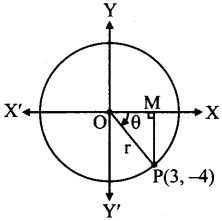
View full question & answer→Question 382 Marks
Find the trigonometric functions of $: – 270^\circ$
Answer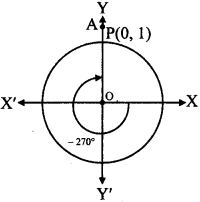
Angle of measure $\left(-270^{\circ}\right)$ :
Let $\mathrm{m} \angle \mathrm{XOA}=-270^{\circ}$
Its terminal arm (ray $\mathrm{OA}$ ) intersects the standard unit, circle at $P(0,1)$.
$ \therefore x=0 \text { and } y=1$
$\sin \left(-270^{\circ}\right)=y=1$
$\cos \left(-270^{\circ}\right)=x=0$
$\tan \left(-270^{\circ}\right)=\frac{y}{x}=\frac{1}{0} $
which is not defined.
$\operatorname{cosec}\left(-270^{\circ}\right)=\frac{1}{y}=\frac{1}{1}=1$
$\sec \left(-270^{\circ}\right)=\frac{1}{x}=\frac{1}{0}$,
which is not defined.
$\cot \left(-270^{\circ}\right)=\frac{x}{y}=\frac{0}{1}=0$ View full question & answer→Question 392 Marks
Find the trigonometric functions of $: – 90^\circ$
Answer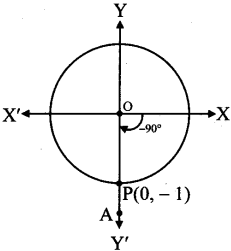
Angle of measure $\left(-90^{\circ}\right)$ :
Let $m \angle X O A=-90^{\circ}$
It terminal arm (ray $O A$ ) intersects the standard unit circle at $P(0,-1)$
$ \therefore x=0 \text { and } y=-1$
$\sin \left(-90^{\circ}\right)=y=-1$
$\cos \left(-90^{\circ}\right)=s=0$
$\tan \left(-90^{\circ}\right)=\frac{y}{x}$
$=\frac{-1}{0},$
which is not defined.
$\operatorname{cosec}\left(-90^{\circ}\right)=\frac{1}{y}$
$=\frac{1}{-1}=-1$
$\sec \left(-90^{\circ}\right)=\frac{1}{x}=\frac{1}{0}$
which is not defined.
$\cot \left(-90^{\circ}\right)=\frac{x}{y}=\frac{0}{-1}=0$ View full question & answer→Question 402 Marks
Find the trigonometric functions of : – 60°
Answer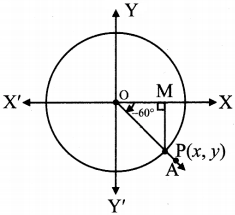
Angle of measure $\left(-60^{\circ}\right)$ :
Let $m_{\angle} X O A=-60^{\circ}$
Its terminal arm (ray $O A$ ) intersects the standard unit circle at $P(x, y)$.
Draw seg PM perpendicular to the $X$-axis. $\triangle O M P$ is a $30^{\circ}-60^{\circ}-90^{\circ}$ triangle. $O P=1$,
$-\frac{\sqrt{3}}{2}$
$=\frac{\sqrt{3}}{2}$
Since point $P$ lies in the 4 quadrant,
$ x>0, y<0$
$x=O M=\frac{1}{2} \text { and } y=-P M=-\frac{\sqrt{7}}{2}$
$\therefore \quad \mathbf{P}=\left(\frac{1}{2},-\frac{\sqrt{3}}{2}\right)$
$\sin \left(-60^{\circ}\right)-y=-\frac{\sqrt{3}}{2}$
$\cos \left(-60^{\circ}\right)-x=\frac{1}{2}$
$\tan \left(-60^{\circ}\right)=\frac{y}{x}=\frac{-\frac{\sqrt{3}}{2}}{\frac{1}{2}}$
$=-\sqrt{3}$
$\operatorname{cosec}\left(-60^{\circ}\right)-\frac{1}{y}=\frac{1}{\left(-\frac{\sqrt{3}}{2}\right)}$
$\sec \left(-60^{\circ}\right)=\frac{1}{x} =\frac{1}{\left(\frac{1}{2}\right)}=2$
$\cot \left(-60^{\circ}\right)=\frac{x}{\sqrt{3}} =\frac{\frac{1}{2}}{\frac{\sqrt{3}}{2}}$
$ =-\frac{1}{\sqrt{3}}$ View full question & answer→Question 412 Marks
Find the trigonometric functions of : 180°
Answer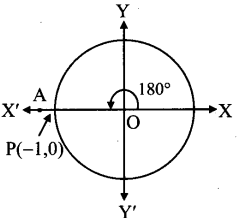
Angle of measure $180^{\circ}$ :
Let $\mathrm{m} \angle \mathrm{XOA}=180^{\circ}$
Its terminal arm (ray $O A)$ intersects the standard unit circle at $P(-1,0)$.
$\therefore \mathrm{x}=-1 \text { and } \mathrm{y}=0$
$\sin 180^{\circ}=y=0$
$\cos 180^{\circ}=x=-1$
$ \tan 180^{\circ}=\frac{y}{x}$
$=\frac{0}{-1}=0$
$\operatorname{Cosec} 180^{\circ}=\frac{1}{y}$
$=\frac{1}{0} $
which is not defined.
$\sec 180^{\circ}=\frac{1}{x}=\frac{1}{-1}=-1$
$\cot 180^{\circ}=\frac{x}{y}=\frac{-1}{0}$, which is not defined. View full question & answer→Question 422 Marks
Find the trigonometric functions of : 0°
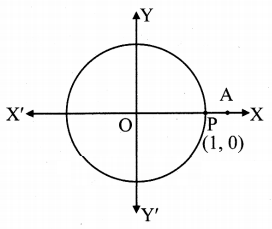
AnswerAngle of measure $0^{\circ}$ :
Let $\mathrm{m} \angle \mathrm{XOA}=0^{\circ}=0^c$
Its terminal arm (ray $O A)$ intersects the standard unit circle in $\mathrm{P}(1,0)$.
Hence, $\mathrm{x}=1$ and $\mathrm{y}=0$
$\sin 0^{\circ}=y=0$,
$\cos 0^{\circ}=x=1$,
$\tan 0^{\circ}=\frac{y}{x}=\frac{0}{1}=0$
$\cot 0^{\circ}=\frac{x}{y}=\frac{1}{0}$ which is not defined
$\sec 0^{\circ}=\frac{1}{x}=\frac{1}{1}=1$
$\cot 0^{\circ}=\frac{1}{y}=\frac{1}{0}$ which is not defined
View full question & answer→