Question 12 Marks
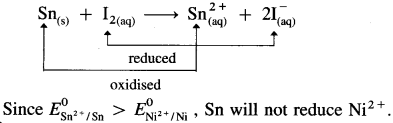
From $E^\circ$ values predict whether Sn can reduce $I_2$ or $Ni^{2+}$.
AnswerFrom the electrochemical series,
$E_{ I _2 / I ^{-}}^0=+0.535 V , E_{ N ^{2+} / Ni }^0=-0.257 V \text { and }$
$E_{ Sn ^{2+} / Sn }=-0.136 V $
View full question & answer→Question 22 Marks
Write electrode reactions and overall cell reaction for Daniel cell you learnt in standard XI.
AnswerReactions for Daniell cell:Oxidation at $Zn$ anode :
$
Zn _{( s )} \rightarrow Zn _{( qq )}^{2+}+2 e ^{-} (Oxidation half reaction)
$
Reduction at Cu cathode :
$
\frac{ Cu _{( aq )}^{2+}+2 e ^{-} \rightarrow Cu _{( s )} \text {( Reduction half reaction ) }}{ Zn _{( s )}+{(1 M )}{ Cu _{( aq )}^{2+}} \rightarrow {(1 M )}{ Zn _{( aq )}^{2+}}+ Cu _{( s )}}
$
View full question & answer→Question 32 Marks
Why is alternating current used in the measurement of conductivity of the solution ?
AnswerIf direct current (D.C.) by battery is used, there will be electrolysis and the concentration of the solution is changed. Hence alternating current (A.C.) with high frequency is used.
View full question & answer→Question 42 Marks
Define resistivity. What are its units ?
AnswerResistivity (or specific resistance) : It is the resistance of a conductor that is 1 m in length and 1 m2 in cross section area in SI units. (In C.G.S. units, it is the resistance of a conductor that is 1 cm in length and 1 cm2 in cross section area.) Hence, the resistivity is the resistance of a conductor of unit volume. (In case of electrolytic solution, ρ is the resistivity i.e., resistance of a solution of unit volume.)
It has SI units, ohm m and C.G.S. units, ohm cm.
View full question & answer→Question 52 Marks
What is the significance of the single vertical line and double vertical line in the formulation galvanic cell.
Answer(i) Consider representation of Daniell cell,
$
Zn _{( s )}\left| Zn ^{2+} 1 M \right|\left| Cu ^{2+} 1 M \right| Cu _{( s )}
$
Single vertical line represents separation of two phases, solid $Zn _{( s )}$ and solution of ions.
(ii) Double vertical lines represent a salt bridge.
View full question & answer→Question 62 Marks
How many electrons would have a total charge of 1 coulomb ?
AnswerGiven: 1 Faraday $=$ charge on 1 mol of electrons \
$=6.022 \times 10^{23}$ electrons and 1 Faraday $=96500 C$
$\because 96500 C =6.022 \times 10^{23}$ electrons $6022 \times 10^{23}$
$\therefore 1 C \equiv \frac{6.022 \times 10^{23}}{96500}=6.24 \times 10^{18}$ electrons
Ans. Number of electrons $=6.24 \times 10^{18}$
View full question & answer→Question 72 Marks
Formulate a cell from the following electrode reactions :
$ A u _{( aq )}^{3+}+ 3 e ^{-} \longrightarrow A u _{( s )}$
$M g _{( s )} \longrightarrow M g _{( aq )}^{2+}+2 e ^{-}$
AnswerAn electrochemical cell from above electrode reactions is,
$ Au _{( aq )}^{3+}+3 e ^{-} \longrightarrow Au _{( s )}$
$\text { (Cathode reduction reaction) }$
$Mg _{( s )} \longrightarrow Mg _{\text {(aq) }}^{2+}+2 e ^{-}$
$\text { (Anode oxidation reaction) }$
$Mg _{( s )}\left| Mg _{( aq )}^{2+} 1 M \right|\left| Au _{\text {(aq) }}^{3+} 1 M \right| Au$
View full question & answer→Question 82 Marks
Under what conditions the cell potential is called standard cell potential ?
AnswerIn the standard cell, the active masses of the substances taking part in the electrochemical reaction have unit value, i.e., 1 M solution or ions and 1 atm gas.
View full question & answer→Question 92 Marks
Write Nerst equation. What part of it represents the correction factor for nonstandard state conditions ?
Answer(1) Nernst equation for cell potential is,
$
E_{\text {cell }}=E_{\text {cell }}^0-\frac{2.303 R T}{n F} \log _{10} \frac{[\text { Products }]}{[\text { Reactants }]}
$
(2) The part of equation namely,
$
\frac{2.303 RT }{ nF } \log _{10}\frac{[\text { Products }]}{[\text { Reactants }]}
$
represents the correction factor for nonstandard state conditions.
View full question & answer→Question 102 Marks
What is standard cell potential for the reaction
$ 3 Ni _{( s )}+2 Al ^{3+}(1 M ) \rightarrow 3 Nl ^{2+}(1 M )+2 Al _{( s )}$
$\text { if } E _{ Ni }^0=-0.25 V \text { and } E _{ Al }^0=-1.66 V ? $
AnswerGiven: $E _{ Ni ^{2-} / Ni }=-0.25 V$
$E _{ Al ^{3+} / Al }=-1.66 V ; E _{\text {cell }}^0=?$
Since $Ni$ is oxidised and $Al ^{3+}$ is reduced,
$ E_{\text {cell }}^0=E_{ Al ^{3+} / Al }^0-E_{ Ni ^{2+} / Ni }^0$
$=-1.66-(-0.25)$
$=-1.41\ V $
Ans. $E_{\text {cell }}^0=-1.41\ V$
[Note : Since $E_{\text {cell }}^0$ is negative, the given reaction is not possible but reverse reaction is possible.]
View full question & answer→Question 112 Marks
Write any two functions of salt bridge.
AnswerThe functions of a salt bridge are :
- It maintains the electrical contact between the two electrode solutions of the half cells.
- It prevents the mixing of electrode solutions.
- It maintains the electrical neutrality in both the solutions of two half cells by a flow of ions.
- It eliminates the liquid junction potential.
View full question & answer→Question 122 Marks
Write the electrode reactions during electrolysis of molten $KCl.$
Answer$KCl _{(\text {molten })} \rightarrow K _{( l )}^{+}+ Cl _{( ij }^{+}$
Reaction at cathode :
$2 K _{( l )}^{+}+2 e ^{-} \rightarrow 2 K _{( s )} \text { Reduction }$
Reaction at anode :
$ 2 Cl _{( l )}^{-} \rightarrow 2 Cl _{( g )}+2 e ^{-}$
$2 Cl _{ g )} \rightarrow Cl _{2( g )} $
Overall reaction : $2 K _{( l )}^{+}+2 Cl _{( l )}^{-} \rightarrow 2 K _{( s )}+ Cl _{2( g )}$
View full question & answer→Question 132 Marks
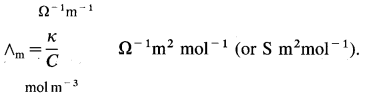
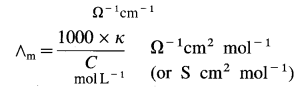
Write the relationship between conductivity and molar conductivity and hence unit of molar conductivity.
AnswerIf $k$ is conductivity and $\wedge_m$ is molar conductivity then, $\wedge_m=\frac{\kappa \times 1000}{C}$ Unit of molar conductivity is, $\Omega^{-1} cm ^2 mol ^{-1}$ or $S cm ^2 mol ^{-1}$.
View full question & answer→Question 142 Marks
What is a cell constant ?
AnswerCell constant of a conductivity cell is defined as the ratio of the distance between the electrodes divided by the area of cross section of the electrodes. In SI units it is expressed as m-1.
View full question & answer→Question 152 Marks
Write any four applications of electrochemical series.
AnswerThe applications of electrochemical series are as follows :- Predicting relative strength of oxidising agents.
- Predicting relative strength of reducting agents.
- Identifying the spontaneous direction of a reaction.
- To calculate the standard cell potential $E ^{\circ}$cell.
View full question & answer→Question 162 Marks
Define electrochemical series or electromotive series.
AnswerElectrochemical series (Electromotive series) : It is defined as the arrangement in a series of electrodes of elements (metal or non-metal in contact with their ions) with the electrode half reactions in the decreasing order of their standard reduction potentials.
View full question & answer→Question 172 Marks
In what way fuel cell differs from ordinary galvanic cells ?
Answer- Fuel cell is a modified galvanic cell in which the thermal energy of combustion reactions is directly converted into electrical energy.
- In the fuel cell, the reactants are not placed within the cell like ordinary galvanic cells, but they are continuously supplied to the electrodes from outside reservoir.
- They cannot be recharged unlike ordinary galvanic cell.
View full question & answer→Question 182 Marks
Write net charging and discharging reactions for lead storage battery.
AnswerFor lead storage battery :
Net charging reaction:
$2 PbSO _{4( s )}+2 H _2 O _{( l )} \rightarrow Pb ( s )+ PbO _{2( s )}+2 H _2 SO _{4( aq )}$
Net discharging reaction:
$Pb _{( s )}+ PbO _{2( s )}+2 H _2 SO _{4( aq )} \rightarrow 2 PbSO _{4( s )}+2 H _2 O _{( l )}$
View full question & answer→Question 192 Marks
If the standard cell potential of Daniell cell is $1.1 V$, calculate standard free energy change for the cell reaction.
AnswerGiven : Daniell cell :
$\begin{aligned}
& Zn _{( s )} \mid Zn _{\text {(aq) }}^{2+}(1 M )\left\| Cu _{\text {(aq) }}^{2+}(1 M )\right\| Cu _{( s )} \\
& E_{\text {cell }}^0=1.1 V \\
& \Delta G^0=?
\end{aligned}$
The cell reaction : $Zn _{( s )}+ Cu _{( aq )}^{2+} \longrightarrow Zn _{( aq )}^{2+}+ Cu$
$\begin{aligned}
& \therefore n =2 \\
& \Delta G^0=-n F E_{\text {cell }}^0 \\
& =-2 \times 96500 \times 1.1 \\
& =-212300 J \\
& =-212.3 kJ
\end{aligned}$
Standard free energy change $=\Delta G^0$
$=-212.3 kJ$
View full question & answer→Question 202 Marks
Write a reaction and calculate the potential of the electrode, $Cl _{( aq )}^{-}(0.05 M )\left| Cl _2( g , 1 atm )\right| Pt$ $E ^0 Cl _2 / Cl ^{-}=1.36 V$.
AnswerGiven : Reduction reaction :
$\begin{aligned}
& \frac{1}{2} Cl _{2( g )}+ e ^{-} \longrightarrow Cl _{\text {(aq) }}^{-} \quad \therefore n =1 \\
& E_{ Cl _2 / Cl ^{-}}=E_{ Cl _2 / Cl ^{-}}^0-\frac{0.0592}{n} \log _{10} \frac{\left[ Cl ^{-}\right]}{\left[ Cl _2\right]^{\frac{1}{2}_g}} \\
& =1.36-\frac{0.0592}{1} \log _{10} \frac{0.05}{1^{\frac{1}{2}}} \\
& =1.36-0.0592(\overline{2} .6990) \\
& =1.36-0.0592(-2+0.6990) \\
& =1.36-0.0592(-1.3010) \\
& =1.36+0.077 \\
& =1.437 V \\\end{aligned}$
Potential of the electrode $=1.437 V$
View full question & answer→Question 212 Marks
Write the reaction and calculate the potential of the half cell,
$Z n _{( a q )}^{2+}(0.2 M ) \mid Zn . (E_{Z n^{2+} / Zn}^0 = -0.76 V)$
AnswerGiven : $E ^0 Zn ^{2+} / Zn =-0.76 V$
Concentration of $Zn ^{2+}=\left[ Zn ^{2+}\right]=0.2 M$
$E _{ Zn }{ }^{2+} / Zn =$ ?
Reduction reaction for the half cell,
$\begin{aligned}
& Zn _{( aq )}^{2+}+2 e ^{-} \longrightarrow Zn _{( s )} \quad \therefore n=2 \\
& E_{ Zn ^{2+} / Zn }=E_{ Zn ^{2+} / Zn }^0+\frac{0.0592}{n} \log _{10}\left[ Zn ^{2+}\right] \\
& =-0.76+\frac{0.0592}{2} \log _{10} 0.2 \text {} \\
& =-0.76+0.0296(\overline{1} .3010) \\
& =-0.76+0.0296(-0.6990) \\
& =-0.76-0.02069 \\
& =-0.78069 V \\
\end{aligned}$
$E ^0 Zn ^{2+} / Zn =-0.78069 V$
View full question & answer→Question 222 Marks
Obtain a relation between cell potential and Gibbs energy for the cell reaction.
AnswerConsider a galvanic cell which involves $n$ number of electrons in the overall cell reaction. Since one mole of electrons involve the electric charge equal to one Faraday (F) which is equal to 96500 C, the total charge involved in the reaction is,
Electric charge $= n \times F$
If Ecell is the cell potential, then Electrical work $= n \times F \times E _{\text {cell }}$
According to thermodynamics, electric work is equal to decrease in Gibbs energy, $-\Delta G$, we can write,
Electric work $=n \times F \times E_{\text {cell }}=-\Delta G$
$\therefore \Delta G=-n F E_{\text {cell }}$
Under standard conditions, we can write
$\therefore \Delta G^0=-n F E_{\text {cell }}^0$
where $E_{\text {cell }}^0$ is the standard cell potential and $\Delta G^0$ is the standard Gibbs free energy change.
View full question & answer→Question 232 Marks
Obtain Nernst equation for the electrode potential for the electrode, $Zn _{( aq )}^{2+} \mid Zn _{( s )}$.
AnswerFor the electrode, $Zn _{( aq )}^{2+} \mid Zn _{( s )}$,
the reduction reaction is,
$Zn _{\text {(aq) }}^{2+}+2 e ^{-} \longrightarrow Zn _{( s )} \therefore n =2$
By Nernst equation, the reduction electrode potential is given by,
$\begin{aligned}
& E_{ Zn ^{2+} / Zn }=E^0_{ Zn ^{2+} / Zn }-\frac{0.0592}{2} \log _{10} \frac{1}{\left[ Zn ^{2+}\right]} \\
=& E_{ Zn ^{2+} / Zn }+\frac{0.0592}{2} \log _{10}\left[ Zn ^{2+}\right] \\
&
\end{aligned}$
where $E ^0 zn ^{2+} / zn$ is the standard electrode potential of zinc electrode.
View full question & answer→Question 242 Marks
State (or write) Nernst equation for the electrode potential and explain the terms involved.
AnswerThe Nernst equation for the single electrode reduction potential for a given ionic concentration in the solution in the case, $M_{(a q)}^{n+}+ ne ^{-} \rightarrow M _{( s )}$ is given by
$\begin{aligned}
& E_{ M ^{n+} / M }=E_{ M ^{ n } / M }^0-\frac{2.303 R T}{n F} \log _{10} \frac{[ M ]}{\left[ M ^{ n +}\right]} OR \\
& E_{ M ^{ n } / M }=E_{ M ^{n^{+} / M }}^0-\frac{2.303 R T}{n F} \log _{10} \frac{[1]}{\left[ M ^{ n +}\right]}
\end{aligned}$
$E _{ M ^{ n +} / M }$ is the single electrode potential,
$E_{ M ^{n+} / M }^0$ is the standard reduction electrode potential,
$R$ is the gas constant $=8.314 JK ^{-1} mol ^{-1}$
$T$ is the absolute temperature,
$n$ is the number of electrons involved in the reaction,
F is Faraday ( 96500 C)
$\left[ Mn ^{+}\right]$is the molar concentration of ions.
View full question & answer→Question 252 Marks
What is the standard potential of an electrode according to IUPAC convention?
AnswerStandard reduction potential : According to IUPAC convention, the standard potential of an electrode due to reduction reaction at $298 K$ is taken as the standard reduction potential. In this active mass of the substance has unit value.
View full question & answer→Question 262 Marks
What is a standard state of a substance ?
AnswerThe standard state of a substance is that state in which the substance has unit activity or concentration at $25^{\circ} C$. i.e., For solution having concentration 1 molar, gas at $1 atm$, pure liquids or solids are said to be in their standard states.
View full question & answer→Question 272 Marks
Define :
(1) Oxidation potential,
(2) Reduction potential.
Answer(1) Oxidation potential : It is defined as the difference of electrical potential between metal electrode and the solution around it at equilibrium developed due to oxidation reaction at anode and at constant temperature.
(2) Reduction potential : It is defined as the difference of electrical potential between metal electrode and the solution around it at equilibrium developed due to reduction reaction at cathode and at constant temperature.
View full question & answer→Question 282 Marks
Formulate a cell from the following electrode reactions :
(a) $Cl _{2( g )}+2 e ^{-} \rightarrow 2Cl ^{-}$(aq)
(b) $2I ^{-}( aq ) \rightarrow I _{2( s )}+2 e ^{-}$
Answer(a) $Cl _{2( g )}+2 e ^{-} \rightarrow 2 Cl ^{-}$(aq) (Reduction half reaction)
(b) $2 I _{\text {(aq) }}^{-} \rightarrow I _{2( s )}+2 e ^{-}$(Oxidation half reaction)
The galvanic cell is,
$Pt \left\|_{2( s )}\right\|^{-}{ }_{( aq )}(1 M )\left| Cl ^{-}( aq )(1 M )\right| Cl _2\left( g , P _{ Cl _2}\right) \mid Pt$
View full question & answer→Question 292 Marks
$Ni _{( s )}\left| Ni ^{2+}(1 M ) \| Al ^{3+}(1 M )\right| Al _{( s )}$
View full question & answer→Question 302 Marks
$Pt , H _{2(g)}\left| H _{( aq )}^{+}\right|\left| Cl _{( aq )}^{-}\right| Cl _{2(g)}, Pt$
Question 312 Marks
View full question & answer→Question 322 Marks
Give the cell reactions in the case of the following cells :
$A l ( s )\left| A l ^{3+}{ }_{( aq )} \| C u ^{2+}{ }_{( aq )}\right| C u ( s )$
View full question & answer→Question 332 Marks
Why is cathode in a galvanic cell considered to be positive electrode?
Answer(1) According to IUPAC conventions, the electrode of the galvanic cell where electronation or reduction takes place is called cathode. In this, the electrons from the metal electrode are removed by cations required for their reduction.
$Cu _{( aq )}^{2+}+2 e ^{-} \rightarrow Cu _{( s )}$
(2) Since the electrons are lost, the metal electrode acquires a positive charge. Hence cathode in the galvanic cell is considered to be positive.
View full question & answer→Question 342 Marks
Why is anode in a galvanic cell considered to be negative?
Answer- According to IUPAC conventions, the electrode of a galvanic cell where de-electronation or oxidation takes place releasing electrons is called anode. $Zn _{( s )} \rightarrow Zn _{( aq )}^{2+}+2 e ^{-}$
- The electrons released due to oxidation reaction are accumulated on the metal electrode surface charging it negatively.
Hence anode in the galvanic cell is considered to be negative. View full question & answer→Question 352 Marks
What are the functions of a salt bridge ?
AnswerThe functions of a salt bridge are :
- It maintains the electrical contact between the two electrode solutions of the half cells.
- It prevents the mixing of electrode solutions.
- It maintains the electrical neutrality in both the solutions of two half cells by a flow of ions.
- It eliminates the liquid junction potential.
View full question & answer→Question 362 Marks
Define : Half cell or Electrode.
AnswerHalf cell or Electrode : It is a metal electrode dipped in the electrolytic solution and capable of establishing oxidation reduction equilibrium with one of the ions of electrolyte solution and develop electrode potential. E.g. $Zn$ in $ZnSO _4$ solution.
View full question & answer→Question 372 Marks
Define : Galvanic cell or voltaic cell.
AnswerGalvanic or voltaic cell : An electrochemical cell which is used to produce electrical energy by a spontaneous chemical reaction inside it is called an electrochemical cell. In this chemical energy is converted into electrical energy.
Example : Daniell cell.
View full question & answer→Question 382 Marks
How many electrons will have a total charge of 1 Coulomb ?
AnswerGiven : Charge $=1$ Coulomb
Number of electrons $=$ ?
1 Faraday $=96500 C$ per mol electrons
$\because 96500$ C electric charge is present on 1 mol electrons
$\therefore 1 C$ charge is present on $\frac{1}{96500}$ mol electrons
$\therefore$ Number of electrons $=\frac{1}{96500} \times 6.022 \times 10^{23}$
$=6.24 \times 10^{18}$ electrons
1 Coulomb charge is present on $6.24 \times 10^{18}$ electrons.
View full question & answer→Question 392 Marks
How much quantity of electricity in coulomb is required to deposit $1.346 \times 10^{-3} kg$ of $Ag$ in 3.5 minutes from $AgNO _3$ solution?
(Given : Molar mass of $Ag$ is $108 \times 10^{-3} kg mol ^{-1}$ )
AnswerGiven : Mass of Ag deposited $=1.346 \times 10^{-3} kg$
Molar mass of $Ag =108 \times 10^{-3} kg mol ^{-1}$
$\begin{aligned}
\text { Time } & = t =3.5 \times 60 s \\
Ag _{( aq )}^{+} & +1 e ^{-} \longrightarrow Ag _{( s )} \\
& 1 \text { mol electrons } 108 \times 10^{-3} kg \\
& =1 \text { Faraday }
\end{aligned}$
$\because 108 \times 10^{-3} kg Ag$ requires 1 Faraday
$1.346 \times 10^{-3} kg$ Ag will require,
$\begin{aligned}
& \frac{1.346 \times 10^{-3}}{108 \times 10^{-3}}=0.01246 F \\
& \because \text { If }=96500 C \\
& \therefore 0.01246 F =96500 \times 0.01246=1202 C
\end{aligned}$
Amount of electricity required $=1202 C$
View full question & answer→Question 402 Marks
What mass of aluminium is produced at the cathode during the passage of 4 ampere current through $Al _2\left( SO _4\right)_3$ solution for 100 minutes? Molar mass of aluminium is $27 g mol ^{-1}$.
Answer$\begin{aligned}
& \text { Given: } I=4 A ; t=100 \times 60=600 s \\
& F =96500 C mol ^{-1}, M =27 g mol ^{-1}, W _{ Al }=\text { ? } \\
& Al _{\text {(aq) }}^{3+}+3 e ^{-} \longrightarrow Al _{( s )} \\
& \therefore \text { Mole ratio }=\frac{1 mol Al }{3 mol e ^{-}}=\frac{1}{3} \\
& \therefore W_{ Al }=\frac{I \times t}{96500} \times \text { mole ratio } \times \text { molar mass of } Al \\
& =\frac{4 \times 600}{96500} \times \frac{1}{3} \times 27 \\
& =0.2238 g \text {} \\
&
\end{aligned}$
Mass of Al produced $= 0 . 2 2 3 8 g$
View full question & answer→Question 412 Marks
How much electricity in terms of Faraday is required to produce:
(a) $20 g$ of $Ca$ from molten $CaCl _2$
(b) $40 g$ of $Al$ from molten $Al _2 O _3$
(Given: Molar mass of Calcium and Aluminium are $40 g mol ^{-1}$ and $27 g mol ^{-1}$ respectively.)
Answer(a) For $CaCl _2$ :
$\begin{aligned}
& Ca _{( aqq )}^{2+}+2 e ^{-} \longrightarrow Ca _{( s )} \\
& \because 1 \text { mole of Ca i.e. } 40 g \text { Ca require }=2 \text { mole }^{-} \\
& =2 F \\
\end{aligned}$
$\begin{aligned} & (b) { For } Al _2 O _3: \\ & Al _{\text {(aq) }}^{+}+3 e ^{-} \longrightarrow Al _{( s )} \\ & \because 1 \text { mol Al i.e. } 27 g Al \text { require }=3 \text { mole }^{-}=3 F \\ & \therefore 40 g Al \text { requires } \frac{3 \times 40}{27}=4.44 F\end{aligned}$
(a) $2 F$ (b) $4.44 F$
View full question & answer→Question 422 Marks
An electric current of 100 mA is passed through an electrolyte for 2 hours, 20 minutes and 20 seconds. Find the quantity of electricity passed.
Question 432 Marks
Obtain a charge on one electron from Faraday’s value.
Answer- One Faraday is the electric charge on one mole of electrons (6.022 $\times 10^{23}$ electrons).
- 1 Faraday = 96500 (per mol of electrons).
- Hence the charge on one electron is, change on one electron $=965006.022 \times 1023$
$=1.602 \times 10^{-9} C$.
View full question & answer→Question 442 Marks
AnswerElectrolysis : The process of a non-spontaneous chemical decomposition of an electrolyte by the passage of an electric current through its aqueous solution or fused mass and in which electrical energy is converted into chemical energy is called electrolysis. E.g. Electrolysis of fused NaCl.
View full question & answer→Question 452 Marks
Define : (1) Electrolytic cell (2) Voltaic or galvanic cell.
Answer(1) Electrolytic cell : An electrochemical cell in which a non-spontaneous chemical reaction is forced to occur by passing direct electric current into the solution from the external source and where electrical energy is converted into chemical energy is called an electrolytic cell. E.g. voltameter, electrolytic cell for deposition of a metal.
(2) Voltaic or galvanic cell : An electrochemical cell in which a spontaneous chemical reaction occurs producing electricity and where a chemical energy is converted into an electrical energy is called voltaic cell or galvanic cell. E.g. Daniell cell, dry cell, lead storage battery, fuel cells, etc.
View full question & answer→Question 462 Marks
What are the types of electrochemical cells ?
AnswerThere are two types of electrochemical cells as follows :
- Electrolytic cells
- Voltaic or galvanic cells.
View full question & answer→Question 472 Marks
Define : (a) Anode (b) Cathode.
Answer(a) Anode : An electrode of an electrochemical cell, at which oxidation half reaction occurs due to the loss of electrons from some species is called an anode.
(b) Cathode : An electrode of an electrochemical cell at which reduction half reaction occurs due to gain of electrons by some species is called a cathode.
View full question & answer→Question 482 Marks
AnswerElectrode : The arrangement consisting of a metal rod dipping in an aqueous solution or molten electrolyte containing ions and conduct electric current due to oxidation or reduction half reactions occurring on its surface is called an electrode.
The electrodes which take part in the reactions are called active electrodes while those which do not take part in the reactions are called inert electrodes.
View full question & answer→Question 492 Marks
What is an electrochemical cell? What does it consist of?
AnswerElectrochemical cell : It consists of two electronic conductors such as metal plates dipping into an electrolytic or ionic conductor which is an aqueous electrolytic solution or a pure liquid of a molten electrolyte.
View full question & answer→Question 502 Marks
The molar conductivity of $0.1 M CH _3 COOH$ at $25^{\circ} C$ is $15.9 \Omega^{-1} cm ^2 mol ^{-1}$. If the molar conductivities of $CH 3 COO ^{-}$and $H ^{+}$ions in $\Omega^{-1} cm ^2 mol ^{-1}$ at zero concentration are 40.8 and 349.6 respectively, calculate degree of dissociation of $0.1 M CH _3 COOH$.
Answer$\begin{aligned}
& \text { Given : Concentration }= C =0.1 M CH _3 COOH \\
& \text { Molar conductivity }=\wedge_{ m }=15.9 \Omega^{-1} cm ^2 mol ^{-1} \\
& \lambda_{ CH _3 COO ^{-}}^0=40.8 \Omega-1 cm ^2 mol ^{-1} \\
& \lambda_{ H ^{+}}^0=349.6 \Omega^{-1} cm ^2 mol ^{-1}
\end{aligned}$
Degree of dissociation $=\alpha=$ ?
By Kohlrausch's law,
$\begin{aligned}
& \wedge_{0\left( CH _3 COOH \right)}=\lambda_{ CH _3 COO ^{-}}^0+\lambda_{ H ^{+}}^0 \\
& =40.8+349.6 \\
& =390.4 \Omega^{-1} cm ^2 mol ^{-1} \\
& \alpha=\wedge_{ m / \wedge 0} \\
& =\frac{15.9}{390.4}=0.0407
\end{aligned}$
The degree of dissociation of $CH _3 COOH =0.0407$
View full question & answer→Question 512 Marks
Molar conductivities at infinite dilution of $Mg ^{2+}$ and $Br ^{-}$are $105.8 \Omega^{-1} cm ^2 mol ^{-1}$ and $78.2 \Omega^{-1}$ $cm ^2 mol ^{-1}$ respectively. Calculate molar conductivity at zero concentration of $MgBr _2$.
Answer$\begin{aligned}
& \text { Given: } \lambda_{ Mg ^{2+}}^0=105.8 \Omega^{-1} cm ^2 mol ^{-1} \\
& \lambda_{ Br ^{-}}^0=78.2 \Omega^{-1} cm ^2 mol ^{-1} \\
& \wedge_{0\left( MgBr _2\right)}=?
\end{aligned}$
By Kohlrausch's law,
$\begin{aligned}
& \wedge_{0\left( MgBr _2\right)}=\lambda_{ Mg ^{2+}}^0+2 \lambda_{ Br ^{-}}^0 \\
& =105.8+2 \times 78.2=105.8+156.4 \\
& =262.2 \Omega^{-1} cm ^2 mol ^{-1}
\end{aligned}$
Ans. Molar conductivity of $MgBr _2$ at zero concentration $=\Lambda_{0\left( MgBr _2\right)}=262.2 \Omega^{-1} cm ^2 mol ^{-1}$
View full question & answer→Question 522 Marks
Molar conductivity of $KCl$ at infinite dilution is $150.3 S cm ^2 mol ^{-1}$. If the molar conductivity of $K ^{+}$is 73.4 , calculate that of $Cl ^{-}$.
AnswerGiven : Molar conductivity at infinite dilution
$=\wedge_{(K C l)}=150.3 S cm ^2 mol ^{-1}$
Molar conductivity of $K ^{+}$
$=\lambda_{ K ^{+}}^0=73.4 S cm ^2 mol ^{-1}$
Molar conductivity of $Cl ^{-}=\lambda_{ Cl ^{-}}^0=$ ?
By Kohlrausch's law,
$\begin{aligned}
\wedge_{0( KCl )} & =\lambda_{ K ^{+}}^0+\lambda_{ Cl ^{-}}^0 \\
\therefore \lambda_{ Cl ^{-}}^0 & =\wedge_{0( KCl )}-\lambda_{ K ^{+}}^0=150.3-73.4 \\
& =76.9 S cm ^2 mol ^{-1} \text {}
\end{aligned}$
$\lambda_{ Cl ^{-}}^0=76.9 S cm ^2 mol ^{-1}\left(\Omega^{-1} cm ^2 mol ^{-1}\right)$
View full question & answer→Question 532 Marks
A conductivity cell filled with $0.02 M H _2 SO _4$ gives at $25^{\circ} C$ resistance of 122 ohms. If the molar conductivity of $0.02 H _2 SO _4$ is $618 \Omega^{-1} cm ^2 mol ^{-1}$, what is the cell constant?
Answer$\begin{aligned}
& \text { Given : Concentration }= C =0.02 M H _2 SO _4 \\
& \text { Resistance of } H _2 SO _4 \text { solution }= R _{\text {soln }}=122 \Omega \\
& \text { Molar conductivity }=\Lambda_{ m }=618 \Omega^{-1} cm ^2 mol ^{-1} \\
& \text { Cell constant }= b =\text { ? } \\
& \because \wedge_{ m }=\frac{\kappa \times 1000}{C} \\
& \therefore \kappa=\frac{\Lambda_{ m } \times C}{1000}=\frac{618 \times 0.02}{1000}=0.01236 \Omega^{-1} cm ^{-1} \\
& \text { Now, } \kappa=\frac{\text { cell constant }}{R_{\text {soln }}}=\frac{b}{R_{\text {soln }}} \text { MaharashtraBoardSolutions.in } \\
& \therefore b=\kappa \times R_{\text {soln }}=0.01236 \times 122=1.51 cm ^{-1}
\end{aligned}$
Ans. Cell constant $=b=1.51 cm ^{-1}$
View full question & answer→Question 542 Marks
AnswerGiven : Resistance of $KCl$ solution $=1500 \Omega$, conductivity of $KCl$ solution $= k =1.46 \times 10^{-4} S . cm ^{-1}$,
Cell constant $=b=$ ?
Cell constant $=$ Conductivity $( k ) \times$ Resistance
$\begin{aligned}
& =1.46 \times 10^{-4} \times 1500 \\
& =0.219 cm ^{-1}
\end{aligned}$
Cell constant $=0.219 cm ^{-1}$
View full question & answer→Question 552 Marks
Conductivity of a solution is $6.23 \times 10^{-5} \Omega^{-1} cm ^{-1}$ and its resistance is $13710 \Omega$. If the electrodes are $0.7 cm$ apart, calculate the cross-sectional area of electrode.
AnswerGiven : $k =6.23 \times 10^{-5} \Omega^{-1} cm ^{-1}$
$\begin{aligned}
& R=13710 \Omega \\
& I =0.7 cm \\
& a=\text { ? } \\
& \kappa=\frac{1}{R} \times \frac{l}{ a } \\
& \therefore a=\frac{1}{R} \times \frac{1}{\kappa} \\
& =\frac{1}{13710} \times \frac{0.7}{6.23 \times 10^{-5}} \\
& =0.8195 cm ^2 \quad \\
\end{aligned}$
Cross sectional area of electrode $=0.8195 cm ^2$
View full question & answer→Question 562 Marks
The molar conductivity of $0.05 M BaCl _2$ solution at $25^{\circ} C$ is $223 \Omega^{-1} cm ^2 mol ^{-1}$. What is its conductivity?
Answer$\begin{aligned}
& \text { Given : Molar conductivity }=\wedge_{ m } \\
& =223 \Omega^{-1} cm ^2 mol ^{-1} \\
& \text { Concentration }= C =0.05 M BaCl _2 \\
& \text { Conductivity }=\kappa=\text { ? } \\
& \wedge_{ m }=\frac{\kappa \times 1000}{C} \quad \quad \\
& \therefore \kappa=\frac{\wedge_{ m } \times C}{1000}=\frac{223 \times 0.05}{1000}=0.01115 \Omega^{-1} cm ^{-1}
\end{aligned}$
Ans. Conductivity $= k =0.01115 \Omega^{-1} cm ^{-1}$
View full question & answer→Question 572 Marks
$0.05M\ NaOH$ solution offered a resistance of $31.6$ in a conductivity cell at $298 K$. If the cell constant of the cell is $0.367 \ cm ^{-1}$, calculate the molar conductivity of $NaOH$ solution.
AnswerGiven : Concentration $= C =0.05 M\ NaOH$
Resistance $= R =31.6 \Omega$
Cell constant $= b =0.367 \ cm^{-1}$
$ \Lambda_{ m ( NaOH )}=?$
$\kappa_{( NaOH )}=\frac{ b }{R_{ NaOH }}=\frac{0.367}{31.6}=0.01161 \Omega^{-1} \ cm^{-1}$
$ \Lambda_{ m ( NaOH )} =\frac{\kappa \times 1000}{ C }$
$= \frac{0.01161 \times 1000}{0.05}$
$=232.2 \Omega^{-1} \ cm ^2 mol ^{-1}$
Molar conductivity $=\wedge_{ m }=232.2 \Omega^{-1} \ cm ^2 mol ^{-1}$
View full question & answer→Question 582 Marks
The conductivity of $0.02 M AgNO _3$ at $25^{\circ} C$ is $2.428 \times 10^{-3} \Omega^{-1} cm ^{-1}$. What is its molar conductivity?
AnswerGiven : Concentration of solution $= C =0.02 M AgNO _3$
Temperature $= T =273+25=298 K$
Conductivity $= K =2.428 \times 10^{-3} \Omega^{-1} \ cm^{-1}\left(\text { or } \ cm ^{-1}\right)$
Molar conductivity $=\wedge_{ m }=?$
$\wedge_{ m }=\frac{\kappa \times 1000}{C}$
$=\frac{2.428 \times 10^{-3} \times 1000}{0.02}$
$=121.4 \Omega^{-1} \ cm^2 mol^{-1}\left(\text { or } 121.4 S \ cm ^2 mol^{-1}\right)$
Ans. Molar conductivity $=\wedge_{ m }$
$=121.4 \Omega^{-1} \ cm^2 mol^{-1}$
View full question & answer→Question 592 Marks
A conductivity cell has two electrodes $20 mm$ apart and of cross section area $1.8 cm ^2$. Find the cell constant.
AnswerGiven: Distance between two electrodes $=1$
$\begin{aligned}
& =20 mm \\
& =2 cm
\end{aligned}$
Cross section area $= a =1.8 cm$
Cell constant $= b =$ ?
$b =\frac{l}{a}=\frac{2}{1.8}=1.111 cm ^{-1}$
Cell constant $=1.111 cm ^{-1}$
View full question & answer→Question 602 Marks
The resistance of a solution is $2.5 \times 10^3$ ohm. Find the conductance of the solution.
AnswerGiven : Resistance of solution $=R=2.5 \times 10^3 \Omega$
Conductance of solution $=G=$ ?
$\begin{aligned}
& G =\frac{1}{R} \\
& =\frac{1}{2.5 \times 10^3} \text { ohm }^{-1} \text { ( } \Omega^{-1} \text { or } S \text { ) } \\
& =4 \times 10^{-3} \Omega^{-1} \text { (or } S \text { ) }
\end{aligned}$
Conductance $=G=4 \times 10^{-3} \Omega^{-1}$
View full question & answer→Question 612 Marks
Write the relation between molar conductivity and molar ionic conductivities for the following electrolytes:
(a) $KBr$, (b) $Na _2 SO _4$ (c) $AlCl _3$.
Answer(a) If $\wedge_0$ is molar conductivity of an electrolyte at infinite dilution and $\lambda_{+}^0$ and $\lambda_{-}^0$ are molar ionic conductivities then,
$\wedge_{ 0KBr }=\lambda_{ K +}^0+\lambda_{ Br ^{-}}^0$
(b) $\wedge_{ 0Na _2 SO _4}=2 \lambda_{ Na +}^0+\lambda_{ SO _4{ }^{2+}}^0$
(c) $\wedge_{ AlCl _3}=\lambda_{ Al _{3+}}^0+3 \lambda_{ Cl ^{-}}^0$
View full question & answer→Question 622 Marks
State Kohlrausch’s law and write mathematical expression of molar conductivity of the given solution at infinite dilution.
AnswerStatement of Kohlrausch's law : This states that at infinite dilution of the solution, each ion of an electrolyte migrates independently of its co-ions and contributes independently to the total molar conductivity of the electrolyte, irrespective of the nature of other ions present in the solution.
This law of independent migration of ions is represented as
$\wedge_0=\lambda_{+}^0+\lambda_{-}^0$.
where $\wedge_0$ is the molar conductivity of the electrolyte at infinite dilution or zero concentration while $\lambda_{+}^0$ and $\lambda_{-}^0$ are the molar ionic conductivities of cation and anion respectively at infinite dilution.
View full question & answer→Question 632 Marks
Why has the molar conductance of an electrolyte the maximum value at infinite dilution ?
Answer- As the dilution of an electrolytic solution increases or concentration decreases, the dissociation of an electrolyte increases.
- At infinite dilution, the dissociation of an electrolyte is complete (100% dissociation). Hence all the ions from one mole of an electrolyte are available to carry electricity.
Therefore the molar conductance at infinite dilute$\left(\wedge_0\right)$ for a given electrolyte has the highest or limiting value. It is always constant for the given electrolyte at constant temperature. View full question & answer→Question 642 Marks
What are the units of molar conductivity, $\Lambda_{ m }$ ?
View full question & answer→Question 652 Marks
Define molar conductivity. What is the significance of it ?
AnswerMolar conductivity: It is defined as a conductance of a volume of the solution containing ions from one mole of an electrolyte when placed between two parallel plate electrodes $1 cm$ apart and of large area, sufficient to accommodate the whole solution between them, at constant temperature. It is denoted by $\wedge_{ m }$.
Thus, the significance of molar conductivity is the conductance due to ions from one mole of an electrolyte.
View full question & answer→Question 662 Marks
What are the units of specific conductance or conductivity?
Question 672 Marks
What is specific conductance or conductivity?
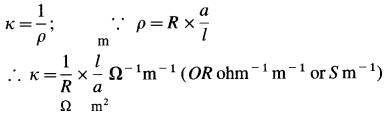
AnswerThe reciprocal of specific resistance or resistivity is called specific conductance or conductivity.
If $\rho$ is the resistivity then,
$\text { conductivity }=\frac{1}{\text { resistivity }}=\frac{1}{\rho}$
Conductivity is denoted by $k$ (kappa), where $k =\frac{1}{\rho}$
It is the conductance of a conductor that is $1 m$ in length and $1 m ^2$ in cross section area in SI units.
(In C.G.S. units, it is the resistance of a conductor that is $1 cm$ in length and $1 cm ^2$ in cross section
area.) It is the conductance of a conductor of volume $1 m ^3$ (or in C.G.S. units, the volume of $1 cm ^3$ ).
View full question & answer→Question 682 Marks
What is electrical conductance? What are its units ?
Question 692 Marks
How is electrical conductance of a solution denoted ? What are its units ?
AnswerThe electrical conductance of a solution is denoted by $G$ and it is the reciprocal of resistance, $R$.
/(G=\frac{1}{R}$
The unit of $G$ is siemens denoted by $S$ or $\Omega^{-1}$.
Hence we can write, $S =\Omega^{-1}= AV ^{-1}= CV ^{-1} S ^{-1}$ where $A$ is ampere and $C$ is coulomb.
View full question & answer→Question 702 Marks
What are SI units of
(a) electrical resistance
(b) potential and
(c) electric current?
Answer(a) The SI unit of electrical resistance is Ohm denoted by $\Omega$ (omega).
(b) The SI unit of potential is volt denoted by V.
(c) The SI unit of electric current is ampere denoted by A.
View full question & answer→Question 712 Marks
AnswerOhm's law : According to Ohm's law, the electrical resistance $R$ of a conductor is equal to the electric potential difference, $V$ divided by the electric current, I.
$R =\frac{V}{I} \text { ohm }$
View full question & answer→Question 722 Marks
What are the types of electric conductors? On what basis are they classified ?
AnswerThe electric conductors are classified according to the mechanism of the transfer of electrons or charge. There are two types of conductors as follows :
(i) Electrons (or metallic) conductors : The electric conductors through which the conduction of electricity takes place by a direct flow of electrons under the influence of applied potential are called electronic conductors.
In this case, there is no transfer of matter like atoms or ions. For example, solid and molten metals such as Al, Cu, etc.
(ii) Electrolytic conductors : The conductors in which the conduction of electricity takes place by the migration of positive ions (cations) and negative ions (anions) of the electrolyte are called electrolytic conductors. In this, the conduction involves the transfer of matter and it is accompanied with chemical changes. For example, solutions of electrolytes (strong and weak), molten salts.
View full question & answer→Question 732 Marks
What is a flow of electricity or a transfer of electric charge?
AnswerThe flow of electricity or a transfer of electric charge through a conductor involves the transfer of electrons from one point to the other point. This takes place under the influence of applied electric potential.
View full question & answer→Question 742 Marks
What is electrochemistry ?
AnswerElectrochemistry : It is the branch of physical chemistry which involves the study of the inter-relation between chemical changes and electrical energy and also concerned with the electrical properties of electrolytic solutions such as resistance and conductance.
View full question & answer→