Questions

Answer the following in Detail

🎯

Test yourself on this topic

16 questions · timed · auto-graded

Question 14 Marks
White Light LEDs or White LED Lamps:
Shuji Nakamura, a Japanese – born American electronic engineer invented the blue LED. He was awarded the Nobel prize for physics for 2014. He was also awarded the global energy prize in the year 2015. His invention of blue LED made the fabrication of white LED possible.
LED lamps, bulbs, street lighting are becoming very popular these days because of the very high efficiency of LEDs in terms of light output per unit input power(in milliWatts), as compared to the incandescent bulbs. So for general purpose lightings, white light is preferred.
Commercially available white LEDs are normally manufactured by using the technique of wavelength conversion. It is a process which partly or completely converts the radiation of a LED into white light. There are many ways of wavelength conversion. One of these methods uses blue LED and yellow phosphor. In this method of wavelength conversion, a LED which emits blue colour is used to excite a yellow colour phosphor. This results in the emission of yellow and blue light and this mixture of blue and yellow light gives the appearance of white light. This method is the least expensive method for producing white light.
Answer
The all important blue LEDs
The development of LEDs has made more efficient light sources possible. Creating white light that can be used for lighting requires a combination of red, green and blue light. Blue LEDs proved to be much more difficult to create than red and green LEDs. During the 1980s and 1990s Isamu Akasaki, Hiroshi Amano, and Shuji Nakamura successfully used the difficult-to-handle semiconductor gallium nitride to create efficient blue LEDs. Isamu Akasaki is known for invent ing the bright gallium nitride (CaN) pn-junction blue LED in 1989 and subsequently the high-brightness CaN blue LED.

Using blue LEDs, highly efficient white light sources. became possible by converting part of the blue light emitted from an LED to yellow using a phosphor. To the human eye, the combination of blue and yellow light is perceived as white. A white LED can be created by embedding phosphors in the plastic cap which surrounds a blue LED. Higher quality white light can also be created by mixing blue light with other colors as well, including red and green

Isamu Akasaki, together with Shuji Nakamura and Hiroshi Amano, received the 2014 Nobel Prize in Physics for the invention of efficient blue light-emitting diodes which has enabled bright and energy saving white light sources.
View full question & answer
Question 24 Marks
Why is a resistance connected in series with a Zener diode when used in a circuit?
Answer
The I-V characteristics in the breakdown region of a Zener diode is almost vertical.
That is, the current $I _{ z }$ can rapidly increase at constant $V _{ Z }$.
To prevent damage due to excessive heating, the Zener current should not exceed the rated maximum current, $I _{ ZM }$. Hence, a current-limiting resistor $R_S$ is connected in series with the diode.
$I _{ Z }$ and the power dissipated in the Zener diode will be large for $I _{ L }=0$ (no-load condition) or when $I _{ L }$ is less than the rated maximum (when $R_S$ is small and $R_L$ is large).
The current-limiting resistor $R_s$ is so chosen that the Zener current does not exceed the rated maximum reverse current, $I _{\text {ZM }}$ when there is no load or when the load is very high.
The rated maximum power of a Zener diode is
$P_{ZM}=I_{ZM}=V_{Z}$
At n -load condition, the current through R is $I = I _{ ZM }$ and the voltage drop across it is $V - V _{ Z }$, where V is the unregulated source voltage.
The diode current will be maximum when V is maxi mum at $V _{\max }$ and $I = I _{ ZM }$.
Then, the minimum value of the series resistance should be
$R_{s, \min }=\frac{V_{\max }-V_Z}{I_{Z M}}$
View full question & answer
Question 34 Marks
How does a cell phone charger produce a voltage of 5.0 V form the line voltage of 230V?
Answer
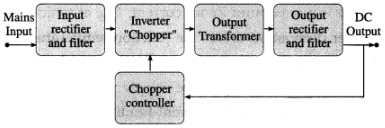
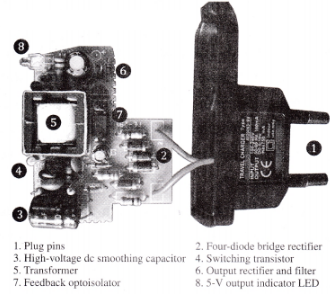
A phone charger is usually a 5 V power supply. A 4-diode bridge input rectifier rectifies the ac mains voltage a provide a high voltage dc. A transistor chopper switches this on and off at high frequency. This stage is required because this high frequency allows the transformer to be smaller, lighter and much lower in cost.

Image
A small transformer steps this down to a low voltage high-frequency ac. An output rectifier and filter convert this to low-voltage (5 V) dc and smooths out the ripple. A chopper controller provides a feedback to the chopper through an optoisohitor and adjusts the chopping cycle to maintain the output voltage at 5 V.

Image

View full question & answer
Question 44 Marks
Define $\alpha $ and $\beta$. Derive the relation between then.
Answer
The dc common-base current ratio or current gain $(\alpha _{dc})$ is defined as the ratio of the collector current to emitter current.
$\alpha_{ dc }=\frac{I_C}{I_{ E }}$
The dc common-emitter current ratio or current gain $\left(\beta_{ dc }\right)$ is defined as the ratio of the collector current to base current.
$\beta_{ dc }=\frac{I_C}{I_B}$
Since the emitter current $I _E= I _B+ I _C$
$ \frac{I_{ E }}{I_C}=\frac{I_{ B }}{I_{ C }}+1$
$\therefore \frac{1}{\alpha_{ dc }}=\frac{1}{\beta_{ dc }}+1 $
Therefore, the common-base current gain in terms of the common-emitter current gain is $\alpha_{ dc }=\frac{\beta_{ dc }}{1+\beta_{ dc }}$
and the common-emitter current gain in terms of the common-base current gain is
$\beta_{ dc }=\frac{\alpha_{ dc }}{1-\alpha_{ dc }}$
For a transistor, $\alpha_{ dc }$ is close to but always less than $1$ (about $0.92$ to $0.98$ ) and $\beta_{ dc }$ ranges from $20$ to $200$ for most general purpose transistors.
View full question & answer
Question 54 Marks
Why is the emitter, the base and the collector of a BJT doped differently?
Answer
A BJT being a bipolar device, both electrons and holes participate in the conduction process. Under the forward-biased condition, the majority carriers injected from the emitter into the base constitute the largest current component in a BJT. For these carriers to diffuse across the base region with t negligible recombination and reach the collector junction, these must overwhelm the majority carriers of opposite charge in the base. The total emitter current has two components, that due to majority carriers in the emitter and that due to minority carriers diffused from base into emitter. The ratio of the current component due to the injected majority carriers from the emitter to the total emitter current is a measure of the emitter efficiency. To improve the emitter efficiency and the common-base current gain (a), it can be shown that’ the emitter should be much heavily doped than the base.

Also, the base width is a function of the base- collector voltage. A low doping level of the collector increases the size of the depletion region. This increases the maximum collector-base voltage and reduces the base width. Further, the large depletion region at the collector-base junction-extending mainly into the collector-corresponds to a smaller electric field and avoids avalanche breakdown of the reverse-biased collector-base junction.
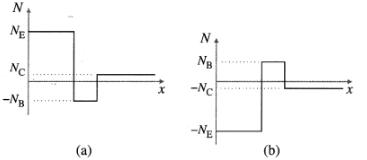
[Note : Effective dopant concentrations of (a) npn transistor (b) pnp transistor are shown below.

Image
The base doping is less than the emitter doping but greater than the collector doping. Contrary to the impression stressed in the Board’s and NCERT textbooks, collector doping is typically an order of magnitude lower than base doping. {Ref. : Semiconductor Devices Physics and Technology (3rd Edition), Simon M. Sze and M. K. Lee, p. 125}]

View full question & answer
Question 64 Marks
Write the Boolean expression for (i) OR gate, (ii) AND gate, and (iii) NAND Gate.
Answer
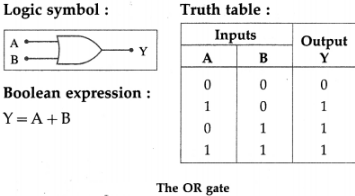
(i) The OR gate : It is a circuit with two or more inputs and one output in which the output signal is HIGH if any one or more of the inputs is HIGH.
The OR operation represents a logical addition.
Below figure shows the 2-input OR gate logic sym-bol, and the Boolean expression and the truth table for the OR function.

Image

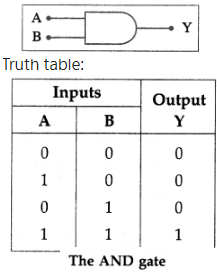
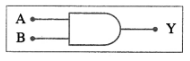
(ii) The AND gate : It is a circuit with two or more inputs and one output in which the output signal is HIGH if and only if all the inputs are HIGH simultaneously.

The AND operation represents a logical multiplication.

Below figure shows the 2-input AND gate logic symbol and the Boolean expression and the truth table for the AND function.
Logic symbol:

Image

Boolean expression:
Y = A ∙ B

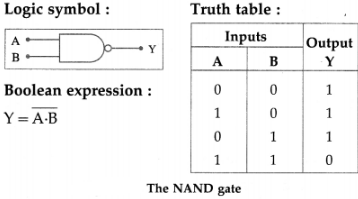
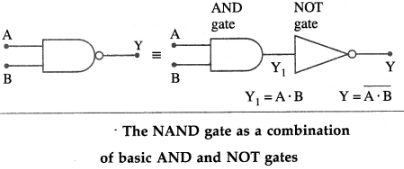
(iii) The NAND gate : It is a circuit with two or more inputs and one output, whose output is HIGH if any one or more of the inputs is LOW; the output is LOW if all the inputs are HIGH.

Image
The NAND gate is a combination of an AND gate followed by a NOT gate so that the truth table of the NAND function is obtained by inverting the outputs of the AND gate.

Image

View full question & answer
Question 74 Marks
What are the uses of logic gates? Why is a NOT gate known as an inverter?
Answer
Explanation/Uses :
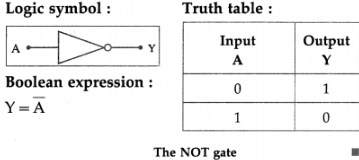
Any digital computation process consists in performing a sequence of arithmetical operations on the data of the problem. At each stage in the computation, the nature of the operation to be performed is decided partly by the pre-determined program and partly by the outcome of earlier stages in the process. We therefore need switches with multiple inputs to perform logical operations, i.e., the outputs of these switches are determined in specified ways by the condition (binary state) of their inputs. These arrangements are known as logic gates, and mostly they are extension of a simple transistor switch.The NOT gate or INVERTER : It is a circuit with one input whose output is HIGH if the input is LOW and vice versa.
The NOT operation outputs an inverted version of the input. Hence, a NOT gate is also known as an INVERTER.
The small invert bubble on the output side of the inverter logic symbol, below figure and the over bar $(^–)$ in the Boolean expression represent the invert function.


Image
View full question & answer
Question 84 Marks
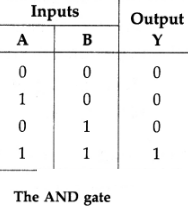
What is logic gate? Write down the truth table and Boolean expression for ‘AND’ gate.
Answer
A logic gate is a basic switching circuit used in digital circuits that determines when an input pulse can pass through to the output. It generates a single output from one or more inputs.

The AND gate : It is a circuit with two or more inputs and one output in which the output signal is HIGH if and only if all the inputs are HIGH simultaneously.

The AND operation represents a logical multiplication.

Below figure shows the 2-input AND gate logic symbol and the Boolean expression and the truth table for the AND function.
Logic symbol:

Image
Truth table:

Image
Boolean expression:
Y = A ∙ B

View full question & answer
Question 94 Marks
What do you mean by a logic gate, a truth table and a Boolean expression?
Answer
A logic gate is a basic switching circuit used in digital circuits that determines when an input pulse can pass through to the output. It generates a single output from one or more inputs.

Explanation/Uses :
Any digital computation process consists in performing a sequence of arithmetical operations on the data of the problem. At each stage in the computation, the nature of the operation to be performed is decided partly by the pre-determined program and partly by the outcome of earlier stages in the process. We therefore need switches with multiple inputs to perform logical operations, i.e., the outputs of these switches are determined in specified ways by the condition (binary state) of their inputs. These arrangements are known as logic gates, and mostly they are extension of a simple transistor switch.

(1) Boolean expression : An equation expressing a logical compound statement in Boolean algebra is called a Boolean expression. A Boolean expression for a logic gate expresses the relation between input(s) and output of a logic gate.

(2) Truth table : The table which shows the truth values of a Boolean expression for a logic gate for all possible combinations of its inputs is called the truth table of logic gate.

The truth table contains one row for each input combination. Since a logical variable can assume only two possible values, 0 and 1, there are 2N combinations of N inputs so that the table has 2N rows.
[Note : Boolean algebra is a form of symbolic logic developed in 1847 by George Boole (1815-64) British mathematician.]

View full question & answer
Question 104 Marks
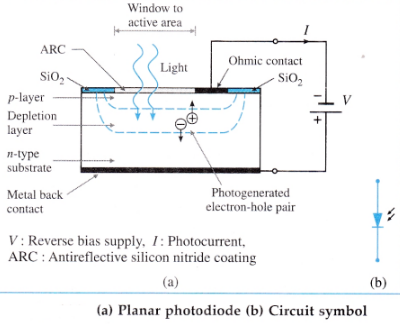
Explain the principle of operation of a photodiode.
Answer
Construction:
A photodiode consists of an n-type silicon substrate with a metal electrode back contact. A thin p-type layer is grown over the n-type substrate by diffusing a suitable acceptor dopant.The area of the p-layer defines the photodiode active area. An ohmic contact pad is deposited on the active area. The rest of the active area is left open with a protective antireflective coating of silicon nitride to minimize the loss of photons. The nonactive area is covered with an insulating opaque $SiO_2$​​​​​​​ coating.


Image
photodiode materials are silicon, germanium, indium gallium arsenide phosphide ( InGaAsP ) and indium gallium arsenide ( InGaAs ), of which silicon is the cheapest while the last two are expensive.
Working : The band gap energy of silicon is $E _G=1.12 eV$ at room temperature. Thus, photons or particles with energies greater than or equal to $1.12\ eV$ , which corresponds to $110\ nm$ , can transfer electrons from the valence band into the conduction band.
A photodiode is operated in the reverse bias mode which results in a wider depletion region. When operated in the dark (zero illumination), there is a reverse saturation current due solely to the thermally generated minority charge carriers. This is called the dark current. Depending on the minority carrier concentrations, the dark current in an Si photodiode may range from $5\ pA $ to $10\ nA$ .
When exposed to radiation of energy $h v \geq E _{ G }$ (in the range near-UV to near-IR), electron-hole pairs are created in the depletion region. The electric field in the depletion layer accelerates these photogenerated electrons and holes towards the n side and p side, respectively, constituting a photocurrent I in the external circuit from the p side to the n side. Due to the photogeneration, more charge carriers are available for conduction and the reverse current is increased. The photocurrent is directly propor-tional to the intensity of the incident light. It is independent of the reverse bias voltage.
[Notes: Typical photodiode materials are:
(1) silicon (Si) : low dark current, high speed, good sensitivity between $\sim 400 nm$ and $1000\ run$ (best around $800\ nm 900\ nm$ )
(2) germanium (Ge) : high dark current, slow speed, good sensitivity between $\sim 900 nm$ and 1600 nm (best around $1400\ nm-1500\ nm$ )
(3) indium gallium arsenide phosphide (InGaAsP) : expensive, low dark current, high speed, good sensitivity between $\sim 1000\ nm$ and $1350\ nm$ (best around $1100 nm-1300 nm$ )
(4) indium gallium arsenide (InGaAs): expensive, low dark current, high speed, good sensitivity between $\sim 900 nm$ and $1700\ nm$ (best around $1300 nm-1600 nm$ ],
View full question & answer
Question 114 Marks
Explain the construction and working of solar cell.
Answer
Construction :
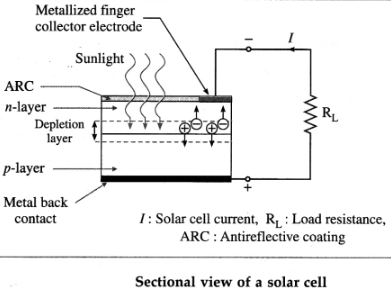
A simple pn-junction solar cell con-sists of a p-type semiconductor substrate backed with a metal electrode back contact. A thin n-layer (less than 2.5 pm, for silicon) is grown over the p-type substrate by doping with suitable donor impurity. Metal finger electrodes are prepared on top of the n-layer so that there is enough space between the fingers for sunlight to reach the n-layer and, subsequently, the underlying pn-junction.

Image

Working : When exposed to sunlight, the absorption of incident radiation (in the range near-UV to infrared) creates electron-hole pairs in and near the depletion layer.

Consider light of frequency v incident on the pn-junction such that the incident photon energy hv is greater than the band gap energy EG of the semiconductor. The photons excite electrons from the valence band to the conduction band, leaving vacancies or holes in the valence band, thus generating electron-hole pairs.

The photogenerated electrons and holes move towards the n side and p side, respectively. If no external load is connected, these photogenerated charges get collected at the two sides of the junction and give rise to a forward photovoltage. In a closed- circuit, a current I passes through the external load as long as the solar cell is exposed to sunlight.

A solar cell module consists of several solar cells connected in series for a higher voltage output. For outdoor use with higher power output, these modules are connected in different series and parallel combinations to form a solar cell array.

[Note : Currently most of the crystalline solar cells are p-type as described above. This is because of a lower cost of production of p-type. But performance wise, n-type solar cells (a thin p-layer over an n-type substrate by doping with suitable acceptor impurity) can give much better efficiency compared to p-type solar cells.]

View full question & answer
Question 124 Marks
Explain the working of a LED.
Answer
Working :
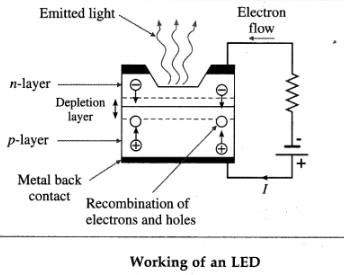
An LED is forward-biased with about $1.2\ V$ to $3.6\ V$ at $12\ mA$ to $20\ mA$ . Majority carriers electrons from n-type layer and holes from p-type layer are injected into the active layer. Electrons cross the junction into the p-layer. In the active p -layer, some of these excess minority carriers electrons, recombine radiatively with majority carriers, holes, thereby emitting photons. The resulting photon has an energy approximately equal to the bandgap of the active layer material. Modifying the bandgap of the active layer creates photons of diferent energies.
Image
In the energy band diagram this recombination is equivalent to a transition of the electron from a higher energy state in the conduction band to a lower energy state in the valence band. The energy difference is emitted as a photon of energy hv.
[Note : The photons originate primarily in the p-side of the junction which has a bandgap $E _{ Gp }$ narrower than that of the $n$-side, $E _{ Gn }$. Thus, with hv < $E _{ Gn }$, the photons are emitted through the wide-bandgap n-region with essentially no absorption.]
View full question & answer
Question 134 Marks
Explain the forward and the reverse characteristic of a Zener diode.
Answer
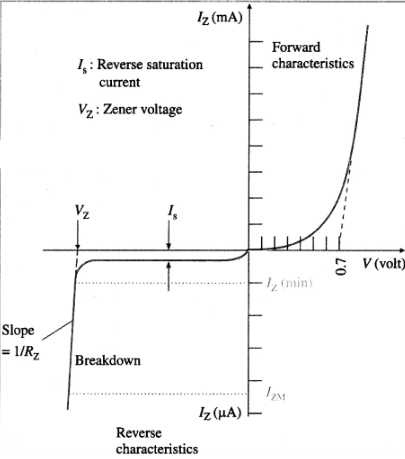
The forward bias region of a Zener diode is identical to that of a regular diode. There is forward current only after the barrier potential of the pn- junction is overcome.
Beyond this threshold or cut in voltage, there is an exponential upward swing.
The typical forward voltage at room temperature with a current of around $1\ mA $is around $0.6\ V$ . In the reverse bias condition the Zener diode is an open circuit and only a small reverse saturation current flows as shown with change of scale.
At the reverse breakdown voltage there is an abrupt rapid increase in the current-the knee is very sharp, followed by an almost vertical increase in current.
The voltage across the Zener diode in the breakdown region is very nearly constant with only a small increase in voltage with increasing current.
There is a minimum Zener current, $I _{ Z }( min )$, that places the operating point in the desired breakdown region.
At some high current level, $I _{ ZM }$, the power dissipation of the diode becomes excessive beyond which the diode can be damaged.

Image

Zener diode characteristics
The $I-V$ characteristics of a Zener diode is not totally vertical in the breakdown region. This means that for slight changes in current, there will be a small change in the voltage across the diode. The voltage change for a given change in current is the resistance $Rz$ of the Zener diode.
View full question & answer
Question 144 Marks
Explain how a Zener diode maintains constant voltage across a load.
Answer
Principle : In the breakdown region of a Zener diode, for widely changing Zener current, the voltage across the Zener diode remains almost constant.

Image
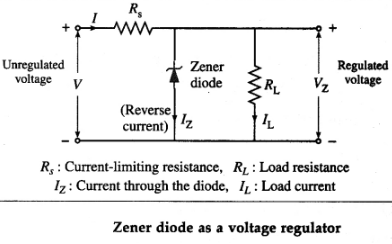
Electric circuit : The circuit for regulating or stabilizing the voltage across a load resistance RL against change in load current and supply voltage is shown in above figure. The Zener diode is connected parallel to load Rh such that the current through the Zener diode is from the n to p region. The series resistance Rs limits the current through the diode below the maximum rated value.
From the circuit,
$I = I_Z + I_L$ and $V = IR_s + V_Z$
$= (I_Z + I_L)R_s + V_Z$
Working: When the input unregulated dc voltage $V$ across the Zener diode is greater than the Zener voltage $V_Z$ in magnitude, the diode works in the Zener breakdown region. The voltage across the diode and load Rh is then $V _{ Z }$. The corresponding current in the diode is $I _{ Z }$. As the load current $( I )$ or supply voltage $( V )$ changes, the diode current $( 7 Z )$ adjusts itself at constant $V _{ Z }$. The excess voltage $V - V _{ Z }$ appears across the series resistance Rs .
For constant supply voltage, the supply current I and the voltage drop across $R _5$ remain constant. If the diode is within its regulating range, an increase in load current is accompanied by a decrease in Iz at constant $V _{ Z }$.
Since the voltage across $R_L$ remains constant at $V_Z$, the Zener diode acts as a voltage stabilizer or voltage regulator.
View full question & answer
Question 154 Marks
Draw a neat diagram of a full wave rectifier and explain it’s working.
Answer
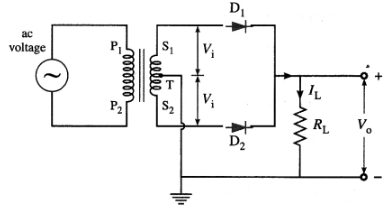
A device or a circuit which rectifies both halves of each cycle of an alternating voltage is called a full-wave rectifier. Electric circuit : The alternating voltage to be rectified is applied across the primary coil ( $P _1 P _2$ ) of a transformer with a centre-tapped secondary coil ( $S _1 S_2$ ). The terminals and S 2 of the secondary are connected to the two p-regions of two junction diodes $D_1$ and $D_2$, respectively. The centre-tap $T$ is connected to the ground. The load resistance RL is connected across the common $n$-regions and the
Image
$P _1 P _2, S_1 S_2$ : Primary and secondary of transformer,
$T$ : Centre-tap on secondary; $D _1 D _2$ : Junction diodes,
$R _{ L }$ : Load resistance, $I _{ L }$ : Load current,
$V _{ i }$ : AC input voltage, $V _0$ : DC output voltage
Above Figure : Full-wave rectifier circuit
Working : During one half cycle of the input, terminal $S _1$ of the secondary is positive while $S _2$ is negative with respect to the ground (the centre-tap $T$ ). During this half cycle, diode $D _1$ is forward biased and conducts, while diode $D _2$ is reverse biased and does not conduct. The direction of current $Z_L$ through $R_L$ is in the sense shown.


Image
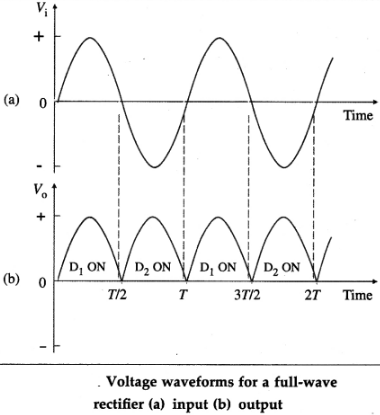
During the next half cycle of the input voltage, S2 becomes positive while $S$, is negative with respect to $T$. Diode D2 now conducts sending a current IL through RL in the same sense as before. Dt now does not conduct. Thus, the current through RL flows in the same direction, i.e., it is unidirectional, for both halves or the full-wave of the input.
This is called full-wave rectification.
The output voltage has a fixed polarity but varies periodically with time between zero and a maximum value. Above figure shows the input and output voltage waveforms. The pulsating dc output voltage of a full-wave rectifier has twice frequency of the input.
View full question & answer
Question 164 Marks
Draw the circuit diagram of a half wave rectifier. Explain its working. What is the frequency of ripple in its output?
Answer
A device or a circuit which rectifies only one-half of each. cycle of an alternating voltage is called a half-wave rectifier.
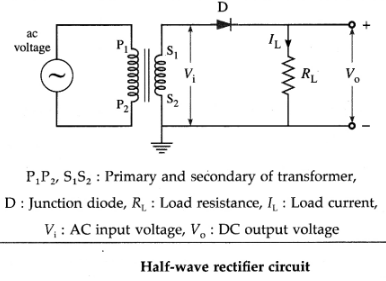
Electric circuit : The alternating voltage to be rectified is applied across the primary coil $\left( P _1 P _2\right)$ of a transformer. The secondary coil $\left(S_1 S_2\right)$ of the transformer is connected in series with the junction diode and a load resistance $R_{ L }$, as shown in below figure. The alternating voltage across the secondary coil is the ac input voltage $V _{ i }$. The dc voltage across the load resistance is called the output voltage $V _0$.

Image
Working : Due to the alternating voltage $V_i,$ the p-region of the diode becomes alternatively positive and negative with respect to the n-region.
During the half-cycle when the p-region is positive, the diode is forward biased and conducts. A current $I_L$ passes through the load resistance RL in the direction shown.


Image
During the next half cycle, when the p-region is negative, the diode is reverse biased and the forward current drops to zero.
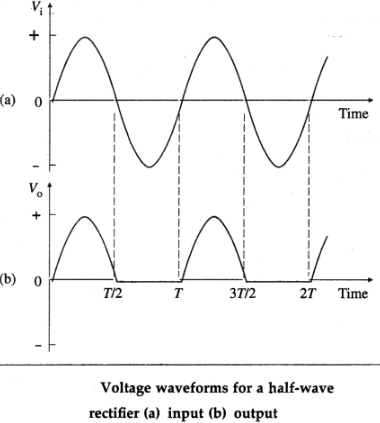
Thus, the diode conducts only during one-half of the input cycle and thus acts as a half-wave rectifier. The intermittent output voltage $V_0$ has a fixed polarity but changes periodically with time between zero and a maximum value. $I_L$ is unidirectional. Above figure shows the input and output voltage waveforms.
The pulsating dc output voltage of a half-wave rectifier has the same frequency as the input.
View full question & answer