Question 13 Marks
For the interference pattern to be clearly visible on the screen, the distance (D) between the slits and the screen should be much larger than the distance (d) between the two slits (S1 and S2), i.e., D » d.
AnswerThe condition for constructive interference at $P$ is,
$\Delta l = y _{ n } \frac{d}{D}= n \lambda$
$y_n$ being the position (y-coordinate) of $n$th bright fringe ( $\left.n=0, \pm 1, \pm 2, \ldots\right)$.
$\therefore y _{ n }= n \lambda \frac{D}{d} \ldots . .(2)$
Similarly, the position of $m$ th $(m=+1, \pm 2, \ldots)$ dark fringe (destructive interference) is given by,
$ \Delta 1=y_m \frac{d}{D}=(2 m -1) \lambda \text { giving }$
$y_m=(2 m -1) \lambda \frac{D}{d} \ldots(3) $
The distance between any two consecutive bright or dark fringes, i.e., the fringe width $= W =\Delta y=y_{n+1}-y_n=\lambda \frac{D}{d}$
Conditions given by Eqs. (1) to (4) and hence the location of the fringes are derived assuming that the two sources $S_1$ and $S_2$ are in phase. If there is a non-zero phase difference between them it should be added appropriately. This will shift the entire fringe pattern but will not change the fringe width.
View full question & answer→Question 23 Marks
Why does the sky appear to be blue while the clouds appear white ?
AnswerThe blue colour of the sky is because of the scattering of light by air molecules and dust particles in the atmosphere. As the wavelength of blue light is less than that of red light, the blue light is preferentially scattered than the light corresponding to other colours in the visible region. Clouds are seen due to scattering of light from lower parts of the atmosphere. The clouds contain the dust particles and water droplets which are sometimes large enough to scatter light of all the wavelengths such that the combined effect makes the clouds appear white.
View full question & answer→Question 33 Marks
In Young’s double slit experiment what will we observe on the screen when white light is incident on the slits but one slit is covered with a red filter and the other with a violet filter? Give reasons for your answer.
AnswerIn Young’s double-slit experiment, when white light is incident on the slits and one of the slit is covered with a red filter, the light passing through this slit will emerge as the light having red colour. The other slit which is covered with a violet filter, will give light having violet colour as emergent light. The interference fringes will involve mixing of red and violet colours. At some points, fringes will be red if constructive interference occurs for red colour and destructive interference occurs for violet colour. At some points, fringes will be violet if constructive interference occurs for violet colour and destructive interference occurs for red colour. The central fringe will be bright with mixing of red and violet colours.
View full question & answer→Question 43 Marks
Why are multiple colours observed over a thin film of oil floating on water? Explain with the help of a diagram.
AnswerSeveral phenomena that we come across in our day to day life are caused by interference and diffraction of light. These are the vigorous colours of soap bubbles as well as those seen in a thin oil film on the surface of water, the bright colours of butterflies and peacocks etc. Most of these colours are not due to pigments which absorb specific colours but are due to interference of light waves that are reflected by different layers.
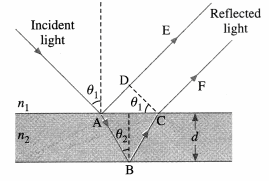
Interference due to a thin film:
The brilliant colours of soap bubbles and thin films on the surface of water are due to the interference of light waves reflected from the upper and lower surfaces of the film. The two rays have a path difference which depends on the point on the film that is being viewed. This is shown in above figure.
The incident wave gets partially reflected from upper surface as shown by ray AE. The rest of the light gets refracted and travels along $A B$. At $B$ it again gets partially reflected and travels along $B C$. At $C$ it refracts into air and travels along CF. The parallel rays $A E$ and CF have a phase difference due to their different path lengths in different media. As can be seen from the figure, the phase difference depends on the angle of incidence $\theta_1$, i.e., the angle of incidence at the top surface which is the angle of viewing, and also on the wavelength of the light as the refractive index of the material of the thin film depends on it. The two waves propagating along $A E$ and CF interfere producing maxima and minima for different colours at different angles of viewing. One sees different colours when the film is viewed at different angles.
As the reflection is from the denser boundary, there is an additional phase difference of $\pi$ radians (or an additional path difference $\lambda$ ). This should be taken into account for mathematical analysis. View full question & answer→Question 53 Marks
What is a wavefront? How is it related to rays of light? What is the shape of the wavefront at a point far away from the source of light?
AnswerWavefront or wave surface : The locus of all points where waves starting simultaneously from a source reach at the same instant of time and hence the particles at the points oscillate with the same phase, is called a wavefront or wave surface.

Consider a point source of light O in a homogeneous isotropic medium in which the speed of light is v. The source emits light in all directions. In time t, the disturbance (light energy) from the source, covers a distance vt in all directions, i.e., it reaches out to all points which are at a distance vt from the point source. The locus of these points which are in the same phase is the surface of a sphere with the centre O and radius vt. It is a spherical wavefront.
In a given medium, a set of straight lines can be drawn which are perpendicular to the wavefront. According to Huygens, these straight lines are the rays of light. Thus, rays are always normal to the wavefront. In the case of a spherical wavefront, the rays are radial.
If a wavefront has travelled a large distance away from the source, a small portion of this wavefront appears to be plane. This part is a plane wavefront.
View full question & answer→Question 63 Marks
What are primary and secondary sources of light?
Answer(1) Primary sources of light: The sources that emit light on their own are called primary sources. This emission of light may be due to
(a) the high temperature of the source, e.g., the Sun, the stars, objects heated to high temperature, a flame, etc.
(b) the effect of current being passed through the source, e.g., tubelight, TV, etc.
(c) chemical or nuclear reactions taking place in the source, e.g., firecrackers, nuclear energy generators, etc.
(2) Secondary sources of light: Some sources are not self luminous, i.e., they do not emit light on their own, but reflect or scatter the light incident on them. Such sources of light are called secondary sources, e.g. the moon, the planets, objects such as humans, animals, plants, etc. These objects are visible due to reflected light.
Many of the sources that we see around are secondary sources and most of them are extended sources.
View full question & answer→Question 73 Marks
Estimate the smallest angular separation of two stars which can be just resolved by the telescope having objective of diameter $25 cm$. The mean wavelength of light is $555 nm$.
AnswerData : $\lambda=555 nm 555 \times 10^9 m$
$D=25 cm =25 \times 10^2 m$
$\theta=\frac{1.22 \lambda}{D}=\frac{1.22 \times 555 \times 10^{-7}}{25 \times 10^{-2}}$
$=2.708 \times 10^6 rad$
This is the required angular separation.
View full question & answer→Question 83 Marks
The minimum angular separation between two stars is $4 \times 10^6 rad$ when a telescope is used to observe them with an objective of aperture $16 cm$. Find the wavelength of the light.
AnswerData : $\theta=4 \times 10^{-6} rad , D=16 cm =0.16 m$
$\theta=\frac{1.22 x}{D}$
$\therefore$ The wavelength of the light used.
$
\lambda=\frac{D \theta}{1.22}-\frac{0.16 \times 4 \times 10^{-6}}{1.22}-5.246 \times 10^{-7} m
$
View full question & answer→Question 93 Marks
The two headlights of an approaching automobile are $1.22 m$ apart. At what maximum distance will eye resolve them? Assume a pupil diameter of $5.0 mm$ and $\lambda=5500 A$. Assume also that this distance is determined only by the diffraction effect at the circular aperture.
AnswerData $: y =1.22 m$, diameter $D =5 \times 10^{-3} m$,
$
\lambda=5500 Å=5.5 \times 10^{-7} m
$
In this case, $\frac{y}{L}=1.22 \frac{\lambda}{D} \begin{array}{c}\text { (Luminous sources) } \\ \text {}\end{array}$
$
\begin{aligned}
\therefore L & =\frac{y D}{1.22 \lambda}=\frac{1.22 \times 5 \times 10^{-3}}{1.22 \times 5.5 \times 10^{-7}} \\
& =9090 m = 9 . 0 9 0 km
\end{aligned}
$
This is the required distance.
View full question & answer→Question 103 Marks
What is the minimum distance between two objects which can be resolved by a microscope having the visual angle of $30^{\circ}$ when light of wavelength $600 \ nm$ is used?
Answer$\text { Data : } \theta=30^{\circ}, \lambda=600 \ mm =6 \times 10^{-7} m$
$d_{\text {min }} =\frac{0.61 \lambda}{\tan \theta} $
$=\frac{0.61 \times 6.0 \times 10^{-7}}{\tan 30^{\circ}} m $
$=\frac{3.66 \times 10^{-4}}{0.5774} m$
$ =6.339 \times 10^{-7} m$
View full question & answer→Question 113 Marks
The semi vertical angle of the cone of the rays incident on the objective of a microscope is $20 *$. If the wavelength of incident light is $6600 A$, calculate the smallest distance between two points which can be just resolved.
Answer$
\text { Data : } \alpha=20^{\circ}, \lambda=6600 A =6.6 \times 10^{-7} m , n =1 \text { (air) }
$
The numerical aperture, $N A=n \sin \alpha$
$
=1 \times \sin 20^{\circ}=0.3420
$
The limit of resolution for an illuminated object,
$
\begin{aligned}
a & =\frac{\lambda}{2 NA }-\frac{6.6 \times 10^{-7}}{2 \times 0.3420} \\
& =9.649 \times 10^{-7} m -9649 Å
\end{aligned}
$
The limit of resplution for self-luminous vbjects,
$
\begin{aligned}
A & =\frac{1.227}{2 NA } \quad \\
& =1.22 \times 9.649 \times 10^{-7} \\
& =1.177 \times 10^{-6} m =11770 A
\end{aligned}
$
View full question & answer→Question 123 Marks
Light of wavelength $650 \ nm$ falls on the objective of a microscope having total angle of angular separation as $60^{\circ}$. Calculate the resolving power of the microscope. $[$Refractive index of air $=1 ]$
Answer$\text { Data : } \lambda=650 \ nm =6.5 \times 10^{-7} m , n =1,2 \alpha=60^{\circ}$
$\therefore a=30^{\circ}$
$\text { Resolving power of the microscope }=\frac{2 m \times \operatorname{lin} a }{\lambda}$
$=\frac{2 \times 1 \times \sin .30^{\circ}}{6.5 \times 10^{-7}}$
$=\frac{10}{6.5} \times 10^{\circ}$
$=1.538 \times 10^6 m ^{-1}$
View full question & answer→Question 133 Marks
What is the resolving power of a telescope if the diameter of the objective of the telescope is $1.22 m$ and the wavelength of light is $5000 \mathring A $ ? .
AnswerResolving power of the telescope $=\frac{D}{1.22 \lambda}$
$=\frac{1.22}{1.22 \times 5 \times 10^{-7}}$
$=\frac{10 \times 10^6}{5}$
$=2 \times 10^6 rad ^{-1}$
View full question & answer→Question 143 Marks
Light of wavelength $650 nm$ falls on the objective of a microscope having total angle of angular w separation as $60^{\circ}$. Calculate the resolving power of the microscope. [Refractive index of air =1]
AnswerData : $\lambda=650 nm =6.5 \times 10^{-7} m , n =1$,
$2 \alpha=60^{\circ}$
$\therefore \alpha=30^{\circ}$
Resolving power of the microscope $=\frac{2 \pi \sin \alpha}{\lambda}$ $=\frac{2 \times 1 \times \sin 30^p}{6.5 \times 10^{-7}}=\frac{10}{6.5} \times 10^6$
View full question & answer→Question 153 Marks
Determine the angular spread between the central maximum and first order maximum of the diffraction pattern due to a single slit of width $0.25 mm$, when light of $6650 A$ is incident on it normally.
Answer$
\text { Data } \begin{aligned}
\lambda & =6650 Å=6650 \times 10^{-10} m , a =0.25 mm \\
a \sin \theta & =(2 m+1) \frac{\lambda}{2} \\
& =(2 \times 1+1) \frac{\lambda}{2}=\frac{3 \lambda}{2} \quad(\text { for } m=1)
\end{aligned}
$
When $\theta$ is small and expressed in radian, $\sin \theta \simeq \theta$
$
\begin{aligned}
\therefore a \theta & =\frac{3 \lambda}{2} \text {} \\
\therefore \theta & =\frac{3 \lambda}{2 a}=\frac{3 \times 6650 \times 10^{-10}}{2 \times 0.25 \times 10^{-3}} \\
& =3.99 \times 10^{-3} rad
\end{aligned}
$
This is the required angular spread.
View full question & answer→Question 163 Marks
In a single$-$slit diffraction pattern, the distance between the first minimum on the right and the first minimum on the left of the central maximum is $4\ mm$. The screen is $2 m$ from the slit and the wavelength of light used is $6000 \mathring A$ . Calculate the width of the slit and the width of the central maximum.
AnswerData $: y _1 \ ($minimum, right$) + y _1\ ($minimum, left$)$
$=4 mm =4 \times 10^{-3} m , D =2 m , \lambda=6 \times 10^{-7} m$
$y_m=\frac{m \lambda D}{a}\ ($for minima$)$
$\therefore$ The width of the central maximum,
$W_{ c }=y_1(\min , \text { right })+y_1(\min , \text { left })=4\ mm$
Also, $W_{ c }=\frac{\lambda D}{a}+\frac{\lambda D}{a}=\frac{2 \lambda D}{a}$
$\therefore$ The slit width$, a=\frac{2 \lambda D}{W_c}$
$=\frac{2\left(6 \times 10^{-7}\right)(2)}{4 \times 10^{-3}}=6 \times 10^{-4} m$
View full question & answer→Question 173 Marks
In a single-slit diffraction pattern, the distance between the first minimum on the right and the first minimum on the left is $5.2 \ mm$. The screen on which the pattern is displayed is $80 \ cm$ from the slit and the wavelength of light is $5460 \mathring A $. Calculate the slit width.
Answer$\text { Data }: y _1 \text { (minimum, right) }+ y _1 \text { (minimum, left) }$
$\text { Data }: y_1 \text { (minimum, right) }+y_1 \text { (minimum, left) }$
$=5.2 mm =5.2 \times 10^{-3} m , D=80 \ cm =0.8 m ,$
$\lambda=5460 \mathring A =5.460 \times 10^{-7} m$
$ y_m=\frac{m \lambda D}{a}$
$\text { (for minima) }$
$\therefore y_1 \text { (right) }+y_1(\text { left })=\frac{\lambda D}{a}+\frac{\lambda D}{a}=\frac{2 \lambda D}{a}$
$\therefore 5.2 \times 10^{-3}=\frac{2 \times 5.460 \times 10^{-7} \times 0.8}{a}$
$\therefore \text { The slit width, } a=\frac{2 \times 5.46 \times 0.8 \times 10^{-4}}{5.2}$
$\quad=1.68 \times 10^{-4} m = 0 . 1 6 8 \ m m $
View full question & answer→Question 183 Marks
Light of wavelength 6000 Å is incident on a slit of width $0.3 mm$. A screen is placed parallel to the slit $2 m$ away from the slit. Find the position of the first dark fringe from the centre of the central maximum. Also, find the width of the central maximum.
Answer Data : $\lambda=6 \times 10^{-7} m, a =0.3 mm =3 \times 10^{-4} m$,
$D=2 m$
The distance $y_m$ of the $m$ th minimum from the centre of the central maximum is
$
y_x=\frac{m D \lambda}{\text { d }} \quad \text { where } m=1,2,3, \ldots .
$
$\therefore$ For the first dark fringe,
$
y_1=\frac{D \lambda}{a}=\frac{2 \times 6 \times 10^{-7}}{3 \times 10^{-4}}=4 \times 10^{-3} m =4 mm
$
The first dark fringe is $4 mm$ from the centre of the central fringe.
$\therefore$ Half-width of the central maximum $=4 mm$
$\therefore$ The width of the central maximum $=2 \times 4 mm =8 mm$
View full question & answer→Question 193 Marks
The diffraction pattern of a single slit of width $0.5 cm$ is formed by a lens of focal length 40 $cm$. Calculate the distance between the first dark and the next bright fringe from the axis. The wavelength of light used is 4890 Å.
AnswerData : $a=0.5 cm =0.5 \times 10^{-2} m$,
$D \simeq f=40 cm =0.4 m , \lambda=4890 Å=4.890 \times 10^{-7} m$
The distance between the first dark fringe and the next bright fringe $=\frac{\lambda D}{2 a }$
$=\frac{4.890 \times 10^{-7} \times 0.4}{2 \times 0.5 \times 10^{-2}}=1.956 \times 10^{-5} m
$
View full question & answer→Question 203 Marks
Explain briefly the double-slit diffraction pattern.
Question 213 Marks
State the characteristics of a single-slit diffraction pattern.
AnswerCharacteristics of a single-slit diffraction pattern :
1. The image cast by a single-slit is not the expected purely geometrical image.
2. For a given wavelength, the width of the diffraction pattern is inversely proportional to the slit width.
3. For a given slit width $a$, the width of the diffraction pattern is proportional to the wavelength.
4. The intensities of the non-central, i.e., secondary, maxima are much less than the intensity of the central maximum.
5. The minima and the non-central maxima are of the same width, $D \lambda / a$.
6. The width of the central maximum is $2 D \lambda / a$. It is twice the width of the non-central maxima or minima.
View full question & answer→Question 223 Marks
In a biprism experiment, the slit is illuminated by red light of wavelength $6400 \mathring A$ and the cross wire of the eyepiece is adjusted at the centre of the $3^{rd}$ bright band. On using blue light, it is found that the $4^{th}$ bright band is on the cross wire. Find the wavelength of blue light.
Answer$\lambda_r=6400 \mathring A _, y_3 ($red, bright$)$
$=y_4 ($blue, bright$)$
For a bright band, $y_n=\frac{n \lambda D}{d}$
$\therefore y_3(\text { red })=\frac{3 \lambda_{ r } D}{d}$ and $y_4 \text { (blue) }=\frac{4 \lambda_{ b } D}{d}$
Now, $y_3 ($red$) =y_4 ($blue$)$
$\therefore 3 \lambda_{ T }=4 \lambda_{ b }.$
$\therefore \lambda_{ b }$
$=\frac{3}{4} \lambda_{ T }$
$=\frac{3}{4} \times 6400$
$=4800 \mathring A $
This is the wavelength of blue light.
View full question & answer→Question 233 Marks
In a biprism experiment, light of wavelength $5200 A$ is used to get an interference pattern on the screen. The fringe width changes by $1.3\ mm$ when the screen is moved towards the biprism by $50 \ cm$. Find the distance between the two virtual images of the slit.
Answer$\lambda=5200 \mathring A =5.2 \times 10^{-7} m ,$
$ W_1-W_2=1.3\ mm =1.3 \times 10^{-3} m$
$D_1-D_2=50 \ cm =0.5 m$
$W=\frac{\lambda D}{d} \text {}$
$\therefore W_1=\frac{\lambda D_1}{d}$ and $W_2=\frac{\lambda D_2}{d}$
$\therefore W_1-W_2=\frac{\lambda}{d}\left(D_1-D_2\right)$
$\therefore d=\frac{\lambda\left(D_1-D_2\right)}{W_1-W_2}$
$=\frac{\left(5.2 \times 10^{-7}\right)(0.5)}{1.3 \times 10^{-3}}$
$=4 \times 0.5 \times 10^{-4}$
$= 2 \times 1 0 -4$
$= 0 . 2\ mm$ This is the distance between the two virtual sources.
View full question & answer→Question 243 Marks
In a biprism experiment, a source of light having wavelength $6500 A$ is replaced by a source of light having wavelength $5500 A$. Calculate the change in the fringe width, if the screen is at a distance of $1 m$ from the sources which are $1\ mm$ apart.
AnswerData : $\lambda_1=6500 \mathring A =6.5 \times 10^{-7} m$,
$\lambda_2=5500 \mathring A =5.5 \times 10^{-7} m ,$
$D=1 m ,$
$d=1\ mm =1 \times 10^{-3} m$
Fringe width, $W=\frac{\lambda D}{d}$
$\therefore W_1=\frac{\lambda_1 D}{d}$ and $W_2=\frac{\lambda_2 D}{d}$
Since $\lambda_1>\lambda_2, W_1>W_2$.
$\therefore W_1-W_2 =\left(\lambda_1-\lambda_2\right) \frac{D}{d}$
$ =(6.5-5.5) \times 10^{-7} \times \frac{1}{1 \times 10^{-3}}$
$ =1 \times 10^{-4} m =0.1\ mm$
The fringe width decreases by $1 \times 10^{-4} m =0.1\ mm$.
View full question & answer→Question 253 Marks
In a biprism experiment, the distance of the 20 th bright band from the centre of the interference pattern is $8 mm$. Calculate the distance of the 30 th bright band from the centre.
AnswerData $: y _{20}=8 mm$ (bright band)
The distance of the nth bright band from the centre of the interference pattern,
$
\begin{aligned}
y_n & =\frac{n \lambda D}{d} \\
\therefore y_{20} & =\frac{20 \lambda D}{d} \text { and } y_{30}=\frac{30 \lambda D}{d} \\
\therefore \frac{y_{30}}{y_{20}} & =\frac{30}{20} \text {} \\
\therefore y_{30} & =\frac{3}{2} y_{20}=\frac{3}{2} \times 8 mm =3 \times 4 mm =12 mm
\end{aligned}
$
The distance of the 30th bright band from the centre of the interference pattern is $12 mm$.
View full question & answer→Question 263 Marks
A biprism is placed $5 \ cm$ from the slit illuminated by sodium light of wavelangth $5890 \mathring A $. The width of the fringes obtained on a screen $75 \ cm$ from the biprism is $9.424 \times 10^{-2} \ cm$. What is the distance between the two coherent sources?
AnswerData : $D =5 \ cm +75 \ cm =80 \ cm =0.8 m$,
$\lambda=5890 \mathring A =5.890 \times 10^{-7} m ,$
$W=9.424 \times 10^{-2} \ cm =9.424 \times 10^{-4} m$
Fringe width, $W =\frac{\lambda D}{d}$
$\therefore$ The distance between the two coherent sources,
$d=\frac{\lambda D}{W}=\frac{5.890 \times 10^{-7} \times 0.8}{9.424 \times 10^{-4}}$
$=5 \times 10^{-4} m =0.5\ mm$
View full question & answer→Question 273 Marks
In a biprism experiment, the eyepiece is placed at a distance of $1.2$ metres from the source. The distance between the virtual sources was found to be $7.5 \times 10^4 m$. Find the wavelength of light if the eyepiece is to be moved transversely through a distance of $1.888 \ cm$ for $20$ fringes.
Answer$D =1.2 m , d =7.5 \times 10^{-4} m ,$
$20 W =1.888 \ cm =1.888 \times 10^{-2} m$
$\therefore W=\frac{1.888}{20} \times 10^{-2} m =0.944 \times 10^{-3} m$
The wavelength of light,
$\lambda =\frac{W d}{D}$
$=\frac{0.944 \times 10^{-3} \times 7.5 \times 10^{-4}}{1.2}$
$ = 5.9 \times 10^{-7}$
$= 5 9 0 0 \mathring A$
View full question & answer→Question 283 Marks
In Young's double-slit experiment, the separation between the slits is $3 mm$ and the distance between the slits and the screen is $1 m$. If the wavelength of light used is $6000 A$. calculate the fringe width. What will be the change in the fringe width if the entire apparatus is immersed in a liquid of refractive index $\frac{4}{3}$ ?
AnswerData : $d =3 \times 10^{-3} m , D =1 m , \lambda=6 \times 10^{-7} m , n =\frac{4}{3}$
(i) The fringe width,
$
W=\frac{\lambda . D}{d}=\frac{6 \times 10^{-7} \times 1}{3 \times 10^{-3}}= 2 \times 10^{-4} m
$
(ii) Refractive index, $n=\frac{\lambda}{\lambda^{\prime}} \quad \therefore \lambda^{\prime}=\frac{\lambda}{n}$
The fringe width in this case is
$
\begin{aligned}
W^{\prime} & =\frac{\lambda^{\prime} D}{d}=\frac{\lambda D}{n d}=\frac{W}{n} \text {} \\
& =\frac{2 \times 10^{-4}}{4 / 3}=1.5 \times 10^{-4} m
\end{aligned}
$
$\therefore$ The change in fringe width
$
=W-W^{\prime}=(2-1.5) \times 10^{-4}= 5 \times 10^{-5} ~ m
$
View full question & answer→Question 293 Marks
In Young's double$-$slit experiment, the two slits separated by $4\ mm$ are illuminated by light of wavelength $6400 A$. Interference fringes are obtained on a screen placed at a distance of $60\ cm$ from the slits. Find the change in the fringe width if the separation between the slits is $(i)$ increased by $1\ mm\ (ii)$ decreased by $1\ mm$.
AnswerData : $d =4 mm =4 \times 10^{-3} m , \lambda=6.4 \times 10^{-7} m , $
$D =0.6 m , d ^{\prime}=5 mm = 5 \times 10^{-3} m , $
$d ^{\prime \prime}=3 mm =3 \times 10^{-3} m$
Fringe width, $W =\frac{\lambda D}{d} \therefore W \propto \frac{1}{d}\ ........(i)$
Since $d^{\prime}>d, W^{\prime} W,$ i.e., the fringe width increases.
Increase in the fringe width $=W^{\prime \prime}-W$
$ =\frac{\lambda D}{d^{\prime \prime}}-\frac{\lambda D}{d}=\lambda D\left(\frac{1}{d^{\prime \prime}}-\frac{1}{d}\right)$
$=6.4 \times 10^{-7} \times 0.6\left(\frac{1}{3 \times 10^{-3}}-\frac{1}{4 \times 10^{-3}}\right) $
$ =\frac{3.84}{12} \times 10^{-4}$
$=3.2 \times 10^{-5} m $
View full question & answer→Question 303 Marks
In Young's double$-$slit experiment the slits are $2\ mm$ apart and interference is observed on a screen placed at a distance of $100\ cm$ from the slits. It is found that the ninth bright fringe is at a distance of $2.208\ mm$ from the second dark fringe from the centre of the fringe pattern. Find the wavelength of light used.
Answer$d =2\ mm=2 \times 10^{-3} m$,
$D=100 \ cm=1 m$,
$y_9-y_2^{\prime}=2.208\ mm=2.208 \times 10^{-3} m ($on the same side of the centre of the fringe pattern$)$
$y_n=\frac{n \lambda D}{d} ... ($bright fringe$)$
$y_m^{\prime}=\frac{(2 m-1) \lambda D}{2 d} ... ($dark fringe$)$
$\therefore y_9-y_2^{\prime}=\frac{9 \lambda D}{d}-\frac{3 \lambda D}{2 d}=\frac{15 \lambda D}{2 d}$
$\therefore$ The wavelength of light,
$\lambda=\frac{2 d\left(y_9-y_2^{\prime}\right)}{15 D}$
$=\frac{2 \times 2 \times 10^{-3} \times 2.208 \times 10^{-3}}{15 \times 1}$
$=5.888 \times 10^{-7} m$
$=5888 \mathring A $
View full question & answer→Question 313 Marks
In Young's double$-$slit experiment, the distance between two consecutive bright fringes on a screen placed at $1.5 m$ from the two slits is $0.6\ mm$. What would be the fringe width, if the screen is brought towards the slits by $50\ cm$, keeping rest of the setting the same?
AnswerLet $\lambda$ be the wavelengths of light used and $d$ the distance between the two sources $($i.e., slits$)$,
if $D$ is the distance between the sources and the screen, the fringe width is
$w =\frac{\lambda D}{d}$
For the same $\lambda$ and $d, W \propto D$.
$\therefore \frac{W_2}{W_1}=\frac{D_2}{D_1}$
Data: $W_1=0.6\ mm =6 \times 10^{-4} m ,$
$D_1=1.5 m , D_2=1 m$
$\therefore W_2=\frac{W_1 D_2}{D_1}$
$=\frac{6 \times 10^{-4} \times 1}{1.5}$
$= 4 \times 1 0 ^{- 4 }m~$
This is the required fringe width.
View full question & answer→Question 323 Marks
In Young's double$-$slit experiment, the two slits are $2\ mm$ apart. The interference fringes for light of wavelength $6000 \mathring A$ are formed on a screen $80 \ cm$ away from them.
$(i)$ How far is the second bright fringe from the central bright point?
$(ii)$ How far is the second dark fringe from the central bright point?
AnswerData: $D =80 \ cm =0.8 m$,
$d =2 mm =2 \times 10^{-3} m , \lambda=6000 \mathring A =6 \times 10^{-7} m$
$(i)$ For the second bright fringe from the central bright point, $n =2$
$\therefore y=n \lambda \frac{D}{d}=\frac{2 \times 6 \times 10^{-7} \times 0.8}{2 \times 10^{-3}}=4.8 \times 10^{-4} m$
This is the required distance.
$(ii)$ For the second dark fringe from the central bright point, $m =2$
$\therefore y=(2 m -1) \frac{\lambda}{2} \frac{D}{d}=\frac{3 \times 6 \times 10^{-7} \times 0.8}{2 \times 2 \times 10^{-3}}$
$=3.6 \times 10^{-4} m$
This is the required distance.
View full question & answer→Question 333 Marks
Green light of wavelength $5100 \mathring A$ from a narrow slit is incident on a double-slit. If the overall separation of $10$ fringes on a screen $200 \ cm$ away from it is $2 \ cm$, find the slit-separation.
Answer
Data $: \lambda = 5100 \mathring A =5.1 \times 10^{-7} m$
$W =\frac{2}{10} \ cm=2 \times 10^{-3} m,$
$D=200 \ cm=2 m$
$W =\frac{\lambda D}{d}$
$\therefore d =\frac{\lambda D}{W}=\frac{5.1 \times 10^{-7} \times 2}{2 \times 10^{-3}}$
$=5.1 \times 10^{-4} m$
This is the slit$-$separation.
View full question & answer→Question 343 Marks
Two coherent sources are $1.8\ mm$ apart and the fringes are observed on a screen $80 \ cm$ away from them. It is found that with a certain source of light, the fourth bright fringe is situated at: a distance of $1.08\ mm$ from the central fringe. Calculate the wavelength of light.
Answer$d=1.8\ mm =1.8 \times 10^3 m$
$D =80 \ cm =0.8 m$
For fourth bright fringe, $n=4$
$y=1.08\ mm =1.08 \times 10^{-3} m$
For bright fringes, $y-n \lambda \frac{D}{d}$
$\therefore \lambda=\frac{y d}{n D}$
$=\frac{1.08 \times 10^{-3} \times 1.8 \times 10^{-3}}{4 \times 0.8}$
$=0.6075 \times 10^{-6} m$
$\lambda=6075 A$
This is the wavelength of light.
View full question & answer→Question 353 Marks
In Young's double-slit experiment, light waves of wavelength $5.2 \times 10^{-7} m$ and $6.5 \times 10^7 m$ are used in tum keeping the same geometry. Compare the fringe widths in the two cases.
AnswerData : $\lambda_1=5.2 \times 10^{-7} m , \lambda_2=6.5 \times 10^{-7} m$
As, $W =\frac{\lambda D}{d}$ and the geometry is the same, i.e., $D$ and $d$ remain the same,
$
\frac{W_1}{W_2}=\frac{\lambda_1}{\lambda_2}=\frac{5.2 \times 10^{-7}}{6.5 \times 10^{-7}}=0.8
$
View full question & answer→Question 363 Marks
A plane wavefront of light of wavelength $5000 A$ is incident on two slits in a screen perpendicular to the direction of light rays. If the total separation of 10 bright fringes on a screen $2 m$ away is $4 mm$, find the distance between the slits.
AnswerGiven : $\lambda=5000 \hat{A}=5 \times 10^7 m$,
$D=2 m$ and the total separation of 10 fringes $=4 mm =4 \times 10^3 m$
$\therefore$ The fringe width, $W=\frac{4 \times 10^{-3} m }{10}=4 \times 10^{-4} m$
Now, $W=\frac{\lambda D}{d}$
$
\begin{aligned}
\therefore d & =\frac{1 D}{W} \\
& -\frac{\left(5 \times 10^{-7} m \right)(2 m )}{\left.4 \times 10^{-4} m \right)} \\
& =2.5 \times 10^{-3} m \\
& =2.5 mm
\end{aligned}
$
View full question & answer→Question 373 Marks
Two slits $1.25\ mm$ apart are illuminated by light of wavelength $4500 A.$ The screen is $1 m$ away from the plane of the slits. Find the separation between the $2^{nd}$ bright fringe on one side and the $2^{nd}$ bright fringe on the other side of the central maximum.
AnswerData: $D=1 m , d =1.25\ mm =1.25 \times 10^3 m$,
$\lambda=4500 A =4500 \times 10^{10} m =4.5 \times 10^7 m$
Since, it is a second bright fringe, $n=2$.
If $s$ is the distance between the $2^{nd}$ bright fringe on one side and the $2^{nd}$ bright fringe on the other side of the central maximum,
then $s =2 y =2 n \lambda \frac{ D }{d}$
$=\frac{2 \times 2 \times 4.5 \times 10^{-7} \times 1}{1.25 \times 10^3}$
$=14.4 \times 10^4 m$
$W=1.44\ mm$
View full question & answer→Question 383 Marks
In Young's double$-$slit experiment, interference fringes are observed on a screen $1 m$ away from the two slits which are $2\ mm$ apart. A point $P$ on the screen is $1.8\ mm$ from the central bright fringe,
$(i)$ Find the path difference at $P$.
$(ii)$ If the wavelength of the light used in $4800 A$, what can you say about the illumination at $p?$
Answer$D =1 m ,$
$d =2\ mm =2 \times 10^3 m ,$
$y =1.8 mm =1.8 \times 10^3 m ,$
$\lambda=4800 A =4.8 \times 10^7$ m
$(i)$ Path differenne $-\frac{z_1^{\prime}}{D}-\frac{\left(1.8 \times 10^{-5}\right)\left(2 \times 10^{-3}\right)}{1}$
$-3.6 \times 10^{-7}$ in
$(ii) \frac{\text { Path difference }}{2}=\frac{3.5 \times 10^{-6}}{4.8 \times 10^{-7}}-\frac{15}{2}$
$\therefore$ Path differenoe $-15 \frac{2}{2}$
$\therefore$ Path difference $=15 \frac{\lambda}{2}$
As the path difference is an odd integral multiple of $\frac{\lambda}{2}$,
point $P$ is a dark point with minimum intensity.
View full question & answer→Question 393 Marks
The two slits in an interference experiment are illuminated by light of wavelength $5600 A$. Deter-mine the path difference and phase difference between the waves arriving at the centre of the eighth dark fringe on the screen.
AnswerData : $\lambda=5600 A =5.6 \times 10^7 m$
Order of the dark fringe is $8, \therefore m =8$
For the fringe to be dark, path difference
$
=(2 m-1) \frac{\lambda}{2}
$
$\therefore$ Path difference, $\Delta l=(2 \times 8-1) \frac{\lambda}{2}=7.5 \lambda$
$=7.5 \times 5.6 \times 10^7 m$
$=4.2 \times 10^6 m$
Phase difference, $\varphi=\frac{2 \pi}{\lambda} \times \Delta l$
$=\frac{2 \pi}{5.6 \times 10^{-7}} \times 4.2 \times 10^6=15 \pi$
View full question & answer→Question 403 Marks
The optical path difference between identical waves from two coherent sources and arriving at a point is 172 . What can you say about the resultant intensity at the point? If the path difference is $9.18 \mu m$, calculate the wavelength of light.
AnswerData: Path difference $=17 \lambda=9.18 \mu m$
(i) Path difference $=17 \lambda=n \lambda$, where $n=17$
As the path difference is an integral multiple of the wavelength $\lambda$ the point where the waves interfere is a bright point with maximum intensity.
(ii) $17 \lambda=9.18 \mu m =9.18 \times 10^6 m$
$
\therefore \lambda=\frac{9.18 \times 10^{-6}}{17}=5.4 \times 10^{-7} m =5400 Å
$
View full question & answer→Question 413 Marks
The optical path difference between identical waves from two coherent sources and arriving at a point is $87 \lambda$. What can you say about the resultant intensity at the point? If the path difference is $49.19 \mu m$, calculate the wavelength of light.
AnswerData : Path difference $=87 \lambda=49.19 / rm$.
(i) Path difference $=87 \lambda=n \lambda$, where $n=87$. As the path difference is an integral multiple of the wavelength $\lambda$, the point where the waves interfere is a bright point with maximum intensity-
(ii) $87 \lambda=49.19 \mu n =49.19 \times 10^{6 f } m$.
$
\therefore \lambda=\frac{49.19 \times 10^{-4}}{87}=5.654 \times 10^7 m =5654 A
$
View full question & answer→Question 423 Marks
Two monochromatic light waves of equal intensities produce an interference pattern. At a point in the pattern, the phase difference between the interfering waves is $\pi / 3 rad$. Express the intensity at this point as a fraction of the maximum intensity in the pattern.
AnswerData $: I_1=I_2=I_{\square}, \varphi=\pi / 3 rad$
The resultant intensity at the point in the pattern is
$
\begin{aligned}
I & =I_{\max } \cos ^2 \frac{\phi}{2} \text { } \\
& =I_{\max }\left(\cos \frac{\pi}{6}\right)^2=I_{\max }\left(\frac{\sqrt{3}}{2}\right)^2 \\
\therefore I & =\frac{3}{4} I_{\max }
\end{aligned}
$
View full question & answer→Question 433 Marks
Two slits in Young's double$-$slit experiment have widths in the ratio $81 : 1.$ What is the ratio of the amplitudes of light waves coming from them?
Answer$w_1: w_2=81: 1$
Since the intensity of a wave is directly proportional to the square of its amplitude.
$\frac{I_1}{I_1}=\left(\frac{E_{00}}{E_{00}}\right) \ldots \text {... (1) }$
Also, the intensity of a wave coming out of a slit is directly propotional to the slit width.
$\therefore \frac{I_1}{I_1}=\frac{w_1}{w_1} \ldots . .(2)$
From Eqs. $(1)$ and $(2).$
$\left(\frac{E_{10}}{E_{20}}\right)^2=\frac{w_1}{w_2}$
$\therefore \frac{E_{30}}{E_{20}}=\sqrt{\frac{E_1}{w_1}}-\sqrt{31}-9$
The ratio of the amplitudes of light waves from the slits is $9: 1$.
View full question & answer→Question 443 Marks
In Young's double$-$slit experiment, the ratio of the intensities of the maxima and minima in an interference pattern is $36: 9$. What is the ratio of the intensities of the two interfering waves?
Answer$\frac{l_{\max }}{I_{\min }}-\frac{36}{9}$
$\frac{I_{\text {max }}}{I_{\min }}=\left(\frac{E_{20}}{E_{20}-E_{20}}\right)^2$
$\therefore\left(\frac{E_{10}+E_{20}}{E_{10}-E_{20}}\right)^2=\frac{36}{9}$
$\therefore \frac{E_{10}+E_{20}}{E_{10}-E_{20}}-\frac{6}{3}=\frac{2}{1}$
$\therefore \frac{E_{10}}{E_{20}}=\frac{2+1}{2-1}=\frac{3}{1}$
$\therefore \frac{I_1}{I_2}-\left(\frac{E_{10}}{E_{20}}\right)^2-\left(\frac{3}{1}\right)^2-\frac{9}{1}$
$\therefore$ The ratio of the intensities of the two interfering waves is $9: 1$.
View full question & answer→Question 453 Marks
Two coherent sources, whose intensity ratio is $81: 1$, produce interference fringes. Calculate the ratio of the intensities of maxima and minima in the fringe system.
AnswerData $: l_1: l_2=81: 1$
If $E_{10}$ and $E_{20}$ are the amplitudes of the interfering waves.
the ratio of the maximum intensity to the minimum intensity in the fringe system is
$\therefore r =\sqrt{\frac{l_4}{l_2}}=\sqrt{81}=9$
$\therefore \frac{l_{\max }}{l_{\min }}-\left(\frac{9+1}{9-1}\right)^2-\left(\frac{10}{8}\right)^2-\left(\frac{5}{4}\right)^2-\frac{25}{16}$
View full question & answer→Question 463 Marks
Find the ratio of intensities at two points $X$ and $Y$ on a screen in Young's double-slit experiment where waves from the slits $S_1$, and $S_2$ have path difference of 0 and $\frac{\lambda}{4}$ respectively.
AnswerData : $\Delta l_1=0, \Delta l_2=\frac{\lambda}{4}$
Phase difference $(\phi)=\frac{2 \pi}{\lambda} \times$ path difference $(\Delta l)$
$\therefore \phi_1=\frac{2 \pi}{\lambda} \times \Delta l_1=0$ and
$\phi_2=\frac{2 \pi}{\lambda} \times \Delta l_2=\frac{2 \pi}{\lambda} \times \frac{\lambda}{4}=\frac{\pi}{2} rad$
Assuming equal intensities $I_0$ of the two interfering waves, the intensity at a point on the screen is
$I=4 I_0 \cos ^2 \frac{\phi}{2} \quad$
$
\therefore \frac{I_x}{I_y}=\left[\frac{\cos \frac{\phi_1}{2}}{\cos \frac{\phi_2}{2}}\right]^2=\left[\frac{\cos 0}{\cos \frac{\pi}{4}}\right]^2=\left(\frac{1}{1 / \sqrt{2}}\right)^2=2
$
View full question & answer→Question 473 Marks
In Young's double-slit experiment, the second minimum in the interference pattern is exactly in front of one slit. The distance between the two slits is $d$ and that between the source and screen is $D$. What is the wavelength of the light used?
AnswerThe distance of the mth minimum from the central fringe is,
$
y_n=(2 m-1) \frac{\lambda D}{2} d
$
Given, $y_{2 a}=\frac{d}{2}$ for $m=2$
$
(4-1) \frac{\lambda}{2} \frac{D}{d}=\frac{d}{2} \quad \therefore 2=\frac{d^2}{3 D}
$
This is the wavelength of the light used.
View full question & answer→Question 483 Marks
What is the nature of the interference pattern obtained using white light?
AnswerWith white light, one gets a white central fringe at the point of zero path difference along with a few coloured fringes on both the sides, the colours soon fade off to white.
The central fringe is white because waves of all wavelengths constructively interfere here. For a path difference of $\frac{1}{2} \lambda_{\text {walst }}$ complete destructive interference occurs only for the violet colour, for waves of other wavelengths, there is only partial destructive interference.
Consequently, we have a line devoid of violet colour and thus reddish in appearance. A point for which the path difference $=\frac{1}{2} \lambda_{\text {rad }}$ is similarly devoid of red colour, and appears violettish. Thus, following the white central fringe we have coloured fringes, from redolish to violettish. Beyond this, the fringes disappear because there are so many wavelengths in the visible region which constructively interfere that we observe practically uniform white illumination.
View full question & answer→Question 493 Marks
What are coherent sources? Is it possible to observe interference pattern with light from any two different sources? Why?
AnswerCoherent sources : Two sources of light are said to be coherent if the phase difference between the emitted waves remains constant.
It is not possible to observe interference pattern with light from any two different sources. This is because, no observable interference phenomenon occurs by' superposing light from two different sources. This happens due to the fact that different sources emit waves of different frequencies. Even if the two sources emit light of the same frequency, the phase difference between the wave trains from them fluctuates randomly and rapidly, i.e, they are not coherent.
Consequently, the interference pattern will change randomly and rapidly, and steady interference pattern would not be observed.
View full question & answer→Question 503 Marks
Explain what you understand by interference of light.
AnswerThe phenomenon in which the superposition of two or more light waves produces a resultant disturbance of redistributed light intensity or energy is called the interference of light.
Light waves are transverse in nature. If two monochromatic light waves of the same frequency arrive in phase at a point, the crest of one wave coincides with the crest of the other and the trough of one wave coincides with the trough of the other. Therefore, the resultant amplitude and hence the resultant intensity of light at that point is maximum and the point is bright. This phenomenon is called constructive interference. If two light waves having the same amplitude are in opposite phase, the crest of one wave coincides with the trough of the other. Therefore, the resultant amplitude, and hence the intensity, at that point is minimum (zero) and the point is dark. This phenomenon is called destructive interference. If the amplitudes are unequal, the resultant amplitude is minimum, but not zero. At other points, the intensity of light lies between the maximum and zero.
View full question & answer→Question 513 Marks
A ray of light is incident on a glass slab at the polarizing angle of $58^{\circ}$. Calculate the change in the wavelength of light in glass.
AnswerData : $\theta_8=56^{\circ}$
$n=\frac{\lambda_3}{\lambda_k}=\tan s_8$
$=\tan 58^{\circ}=1.6003$
$\therefore \frac{\lambda_3}{\lambda_a}=\frac{1}{1.6003}$
$\therefore \frac{\lambda_2-\lambda_3}{\lambda_a}-\frac{1.6003-1}{1.6003}=\frac{0.6003}{1.6003}=0.3751$
$\therefore$ The change in the wavelength of the light in glass, $\lambda_2-\lambda_b=0.37514 \lambda_2$, i.e., $37.51 \%$ of its wavelength in air.
View full question & answer→Question 523 Marks
The wavelengths of a certain blue light in air and in water are $4800 \mathring A$ and $3600 \mathring A ,$ respectively. Find the corresponding Brewster angle.
Answer$\text { Data : } \lambda_2=4800 \hat{A}, \lambda_\alpha=3600 \hat{A}$
$n=\frac{\lambda_2}{\lambda_w} \text { and } n=\tan \theta_3$
$\therefore \tan \theta_8=\frac{\lambda_2}{\lambda_2}=\frac{4800}{3600}=\frac{1}{3}=1.333$
$\therefore \theta_8-\tan ^{-1}(1.333)=53^{\circ} c$
This is the Brewster angle for the given light incident on water surface.
View full question & answer→Question 533 Marks
For a certain unpolarized monochromatic light incident on glass and water, the polarizing angles are $59^{\circ} 32^{\prime}$ and $53^{\circ} 4^{\prime}$, respectively. What would be the polarizing angle for the light if it is incident from water on to the glass?
Answer$\begin{aligned} \text { Data } & : \theta_{ B }, a \rightarrow g =59^{\circ} 32^{\prime}, \theta_{ B , a \rightarrow w }=53^{\circ} 4^{\prime} \\ n_{ g } & =\tan \theta_{ B , a \rightarrow g } \\ & =\tan 59^{\circ} 32^{\prime}=1.70\end{aligned}$
$\begin{aligned} n_{ w } & =\tan \theta_{ B } a ^{ a \rightarrow w } \\ & =\tan 53^{\circ} 4^{\prime}=1.333 \\ _{ w } n_{ g } & =\frac{n_{ g }}{n_{ w }}=\frac{1.70}{1.333}=1.275\end{aligned}$
$\therefore$ The required polarizing angle,
$
\begin{aligned}
\theta_{ B } ; w \rightarrow g & =\tan ^{-1}{ }_{ w } n_{ g } \\
& =\tan ^{-1} 1.275= 5 1 ^{\circ} 5 4 ^ { \prime }
\end{aligned}
$
View full question & answer→Question 543 Marks
If a glass plate of refractive index $1.732$ is to be used as a polarizer, what would be the
$(i)$ polarizing angle and
$(ii)$ angle of refraction?
Answer$n_g=1.732$
$n _g=\tan \theta_{ B }$
$O B=\tan ^{-1}(1.732)=60^{\circ}$
This is the polarizing angle,
$n_{ g }=\frac{\sin \theta_{ B }}{\sin r_{ p }}$
$\therefore \sin \theta_{ r }=\frac{\sin \theta_{ B }}{n_{ g }}$
$\therefore \sin \theta_{ r }=\frac{\sin 60^{\circ}}{1.732}=\frac{0.8660}{1.732}$
$\therefore \theta_{ r }=\sin ^{-1}\left(\frac{0.8660}{1.732}\right)$
$=\sin ^{-1}(0.5)=30^{\circ}$
This is the angle of refraction.
View full question & answer→Question 553 Marks
For a given medium, the polarizing angle is $60^{\circ}$. What is the critical angle for this medium ?
AnswerData : $\theta_{ B }=60^{\circ}$
$n-\tan \theta_{ b }-\tan 60^{\circ}=\sqrt{3}$
$\sin \theta_c-\frac{1}{n}=\frac{1}{\sqrt{3}}=0.5773$
$\therefore \theta_e=\sin ^{-1}(0.5773)-35^{\circ} 16^{\prime}$
This is the critical angle for the medium.
View full question & answer→Question 563 Marks
The refractive index of a medium is $\sqrt{3}$. What is the angle of refraction, if the unpolarized light is incident on it at the polarizing angle of the medium?
Answer$\text { Data : } n=\sqrt{3}$
$\tan \theta_{ B }=n=\sqrt{3}$
$\therefore \theta_{ B }=\tan ^{-1}(\sqrt{3})=60^*$
Also, $\theta_{ r }=90^{\circ}-\theta_{ B }$
$\therefore \theta_{ e }=90^{\circ}-60^2-30^{\circ}$
This is the angle of refraction.
View full question & answer→Question 573 Marks
The critical angle for a glass-air interface is $\sin 1 \frac{5}{8}$. A ray of unpolarized monochromatic light in air is incident on the glass. What is the polarizing angle?
AnswerData: $\theta_c=\sin ^1 \frac{5}{8}$
$\therefore \sin \theta_c=\frac{5}{8}$
$\therefore n =\frac{1}{\sin \theta_{ r }}=\frac{8}{5}=1.6$
Also, $n=\tan \theta_8$
$\therefore \theta_{ B }=\tan ^{-1} n$
$\therefore$ The polarizing angle, $\theta_{ B }=\tan ^1 1.6=58^{\circ}$
View full question & answer→Question 583 Marks
The angle between the transmission axes of two polarizers is $45^{\circ}.$ What will be the ratio of the intensities of the original light and the transmitted light after passing through the second polarizer?
AnswerData : $\theta=45^{\circ}$
According to Malus' law,
$I_2=I_2 \cos ^2 \theta$
$\therefore \frac{I_1}{I_2}=\frac{1}{\cos ^2 \theta}=\frac{1}{\left(\cos 45^{\circ}\right)^2}=\frac{1}{(1 / \sqrt{2})^2}=\frac{1}{1 / 2}$
$=2$
This is the required ratio.
View full question & answer→Question 593 Marks
State any four uses of a Polaroid.
Answer1. A Polaroid lens filter makes use of polarization by reflection. This filter is used in photography to reduce or eliminate glare from reflective nonmetallic surfaces like glass, rock faces, water and foliage. It can also deepen the colour of the skies.
2. Polaroid sunglasses reduce the transmitted intensity by a factor of one half and also reduce or eliminate glare from nonmetallic surfaces such as asphalt roadways and snow fields.
3. Polaroid filters are used in liquid crystal display (LCD) screens.
4. Polaroids are used to produce and show 3-D movies to give the viewer a perception of depth.
[Note :Three-dimensional movies are filmed from two slightly different camera locations and shown at the same time through two projectors fitted with polarizers having different transmission axes. The audience wear glasses which have two Polaroid filters whose transmission axes are the same as those on the projectors.]
View full question & answer→Question 603 Marks
If $75 \%$ of incident light is transmitted by the second polarizer, what is the angle made by the transmission axis of the second polarizer to the transmission axis of the first polarizer?
Answer$I_2=I_1 \cos ^2 \theta$
$=I_1\left(\frac{3}{4}\right) \text { gives } \cos ^2 \theta=\frac{3}{4}$
$\therefore \cos \theta=\frac{\sqrt{3}}{2} \text {}$
$\therefore \theta=\cos ^{-1}\left(\frac{\sqrt{3}}{2}\right)=60^{\circ}$
gives the required angle.
View full question & answer→Question 613 Marks
A ray of light travelling through air falls on the surface of a glass slab at an angle $i.$ It is found that the angle between the reflected and the refracted rays is $90^{\circ}$. If the speed of light in glass is $2 \times 10^8\ m / s$, find the angle of incidence.
Answer$c =3 \times 10^8\ m / s , v _{ g }=2 \times 10^8\ m / s$, angle between the reflected ray and the refracted ray $=90^{\circ}$
$n _{ g }=\frac{c}{v_g}=\frac{3 \times 10^8}{2 \times 10^8}=1.5$
The angle between the reflected and refracted rays
$=\left(90^{\circ}-i\right)+\left(90^{\circ}-r\right)$
$=180^{\circ}-(i+r)$
$=90^{\circ} ($by the data$)$
$i + r =90^{\circ} \therefore r =90^{\circ}- i$
$\therefore \sin r =\sin \left(90^{\circ}- i \right)=\cos i$
$n _{ g }=\frac{\sin i}{\sin r}=\frac{\sin i}{\cos i}=\tan i$
$\therefore$ The angle of incidence,
$i =\tan ^{-1} ng$
$=\tan ^{-1} 1.5$
$=56^{\circ} 19^{\prime}$
View full question & answer→Question 623 Marks
A light beam of wavelength $6400 \mathring A$ is incident normally on the surface of a glass slab of thickness $5 \ cm$. Its wavelength in glass is $4000 A.$ The beam of light takes the same time to travel from the source to the surface as it takes to travel through the glass slab. Calculate the distance of the source from the surface.
Answer$\lambda_a=6400 \mathring A , s_g=$ thickness of the glass slab $=5 \ cm , \lambda_g=4000 \mathring A $
The speeds of light in glass and air are,
respectively, $v_g=\lambda_g v$ and $v_a=\lambda_a v$ where the frequency of the light $v$ remains un$-$changed with the change of medium.
The time taken to travel through the glass slab,
$t _g=\frac{ Sg }{v_{ B }}=\frac{S_g}{\lambda_g v}$
The time taken to travel through air,
$t _{ a }=\frac{S_{ a }}{v_{ a }}=\frac{d}{\lambda_{ a } v}$
where $s_a=d$ is the distance of the glass surface from the source.
Since $t_a=t_9$
$\frac{d}{\lambda_{ a } v}=\frac{s_g}{\lambda_g v}$
$\therefore d =\frac{\lambda_{ a }}{\lambda_{ g }} S _{ g } S _{ g }=\frac{6400}{4000} \times 5=1.6 \times 5=8 \ cm$
View full question & answer→Question 633 Marks
Determine the change in wavelength of light during its passage from air to glass, if the refractive index of glass with respect to air is $1.5$ and the frequency of light is $5 \times 10^{14}\ Hz. [$Speed of light in air $=( c )=3 \times 10^8 m / s ]$
AnswerLet $v$ be the frequency of the electromagnetic radiation and $c$ its speed in air.
Let $\lambda_a$ and $\lambda_b$ be the wavelengths of the radiation in air and glass, respectively.
Data : $c=3 \times 10^8 m / s ,$
$v=3.5 \times 10^{14} Hz ,$
${ }_{ a } n_{ g }=1.5$
$\lambda_{ a }=\frac{c}{v}$
$\therefore \lambda_{ a }=\frac{3 \times 10^{ g }}{3.5 \times 10^{14}}=8.571 \times 10^{-7} m =8571 \mathring A $
${ }_{ a } n_{ g }=\frac{\lambda_{ a }}{\lambda_{ g }} \quad$
$\therefore \lambda_{ g }=\frac{\lambda_{ a }}{{ }_{ a } n_{ g }}=\frac{8571}{1.5}=5714 \mathring A $
$\therefore$ The change in wavelength $=\lambda_{ a }-\lambda_{ g }$
$=8571-5714$
$=2857 \mathring A $
$\lambda_{ a }=6000 \mathring A , _{ } \lambda_{ g }=4000 \mathring A$
$\therefore \lambda_{ a }-\lambda_{ g }=2000 \mathring A$
View full question & answer→Question 643 Marks
Determine the change in wavelength of electro$-$magnetic radiation as it passes from air to glass, if the refractive index of glass with respect to air for the radiation under consideration is $1.5$ and the frequency of the radiation is $3.5 \times 10^{14} Hz. [$Speed of the radiation in air $( c )=3 \left.\times 10^8\ m / s \right]$
AnswerLet $v$ be the frequency of the electromagnetic radiation and $c$ its speed in air.
Let $\lambda_a$ and $\lambda_b$ be the wavelengths of the radiation in air and glass, respectively.
Data : $c=3 \times 10^8 m / s , v=3.5 \times 10^{14} Hz ,{ }_{ a } n_{ g }=1.5$
$\lambda_{ a }=\frac{c}{v}$
$\therefore \lambda_{ a }=\frac{3 \times 10^8}{3.5 \times 10^{14}}=8.571 \times 10^{-7} m =8571 \mathring A $
$a ^n g =\frac{\lambda_{ a }}{\lambda_{ g }}$
$\therefore \lambda_{ g }=\frac{\lambda_{ a }}{{ }_{ a } n_{ g }}$
$=\frac{8571}{1.5}$
$=5714 \mathring A $
$=8571-5714$
$=2857 \mathring A $
$\therefore$ The change in wavelength $=\lambda_{ a }-i_{ g }$
$=8571-5714$
View full question & answer→Question 653 Marks
White light consists of wavelengths from $400 \ nm$ to $700 \ nm$. What will be the wavelength range seen when white light is passed through glass of refractive index $1.55$ ?
AnswerLet $\lambda_1$ and $\lambda_2$ be the wavelengths of light in water for $400 \ nm$ and $700 \ nm ($wavelengths in vacuum$)$ respectively.
Let $\lambda_{ a }$ be the wavelength of light in vacuum.
$\lambda_1=\frac{\lambda_{ a }}{n}=\frac{400 \times 10^{-9} m }{1.55}=258.06 \times 10^{-9} m$
$\lambda_2=\frac{\lambda_{ a }}{n}=\frac{700 \times 10^{-9} m }{1.55}=451.61 \times 10^{-9} m$
The wavelength range seen when white light is passed through the glass would be $258.06 \ nm$ to $451.61 \ nm$.
View full question & answer→Question 663 Marks
The wavelength of blue light in air is $4500 A$. What is its frequency? If the refractive index of glass for blue light is $1.55 ,$ what will be the wavelength of blue light in glass?
Answer$\lambda_a=4500 \mathring A =4.5 \times 10^{-7} m ,$
$ n _{ g }=1.55,$
$v _{ a }=3 \times 10^8 m / s$
$v _{ a }= v _{ a } \lambda_{ a }$
$\therefore v_{ a } =\frac{v_a}{\lambda_{ a }}=\frac{3 \times 10^8}{4.5 \times 10^{-7}}$
$ =6.667 \times 10^{14} Hz$
This is the frequency of light.
$n_{ g }=\frac{\lambda_{ a }}{\lambda_{ g }}$
$\therefore \lambda_{ g }=\frac{\lambda_{ a }}{n_{ g }}=\frac{4500 \mathring A }{1.55}$
$\lambda_{ g }=2903 \mathring A$
This is the wavelength of blue light in glass.
View full question & answer→Question 673 Marks
A ray of light travelling in air is incident on a glass slab making an angle of $30^{\circ}$ with the surface. Calculate the angle by which the refracted ray in glass is deviated from its original path and the speed of light in glass [Refractive index of glass $=1.5$ ].
AnswerSolve for the speed (ug) of light in glass and the angle of refraction ( $r$ ) in glass as in Solved Problem (14).ug $=2 \times 10^8 m / s$ and $r =35^{\circ} 16^{\prime}$
The angle of incidence $(z)$, i.e., the angle between the incident ray and the normal to the glass surface, is $i=90^{\circ}-30^{\circ}=60^{\circ}$.
Hence, the angle by which the refracted ray is deviated from the original path is $\delta=i-r=60^{\circ}-35^{\circ} 16^{\prime}=24^{\circ} 44^{\prime}$
View full question & answer→Question 683 Marks
A ray of light is incident on a water surface of refractive index $\frac{4}{3}$ making an angle of $40^{\circ}$ with the surface. Find the angle of refraction.
AnswerData : $n=\frac{4}{3}, i=90^{\circ}-40^{\circ}=50^{\circ}$
$n=\frac{\sin i}{\sin r}$
$\therefore \sin r=\frac{\sin i}{n}=\frac{\sin 50^{\circ}}{4 / 3}=\frac{0.7660}{4 / 3}$
$\therefore \text { The angle of refraction, } r=\sin ^{-1}(0.5745)=35^{\circ} 4^{\prime}$
View full question & answer→Question 693 Marks
Red light of wavelength 6400 Å in air has wavelength 4000 Å in glass. If the wavelength of violet light in air is 4400 Å, what is its wavelength in glass? Assume that the glass has the same refractive index for red and violet colours.
Answer$
\text { Data : } \lambda_{\text {r(air) }}=6400 Å, \lambda_{\text {r(glas })}=4000 Å, \lambda_{\text {v(air) }}=4400 Å$
Let $n$ be the refractive index of glass for both red and violet colours.
$\therefore n=\frac{\lambda_{ r (\text { air ) }}}{\lambda_{ r \text { (glass) }}}=\frac{\lambda_{ V \text { (air) }}}{\lambda_{ V \text { (glass) }}}$
$\therefore \lambda_{\text {v(glass) }}=\frac{\lambda_{ r \text { (glass) }}}{\lambda_{ r \text { (air) }}} \times \lambda_{ v \text { (air) }}=\frac{4000}{6400} \times 4400=2750 Å$
(Note : This problem was asked in Board examination in October 2014. The assumption $n_{ r (g l a s s)}=n_{ v (g l a s s)}$ is manifestly gross. No glass can have the same refractive index for red and violet colours.)
View full question & answer→Question 703 Marks
If the difference in speeds of light in glass and water is $0.25 \times 10^8\ m / s$, find the speed of light in air. $\left[n_g=1.5\right.$ and $\left.n_w=\frac{4}{3}\right]$
Answer$v_{ w }-v_{ g }=0.25 \times 10^8\ m / s ,$
$n_{ g }=1.5,$
$n_{ w }=\frac{4}{3}$
$ v_{ w }=\frac{c}{n_{ w }}=\frac{c}{4 / 3}=\frac{3 c}{4}$ and $v_{ g }=\frac{c}{n_{ g }}=\frac{c}{1.5}=\frac{2 c}{3}$
$\therefore v_{ w }-v_{ g }=c\left(\frac{3}{4}-\frac{2}{3}\right)=\frac{c}{12}$
$\therefore$ The speed of light in air,
$c =12\left( n _{ w }-v_{ g }\right)$
$=12 \times 0.25 \times 10^8$
$=3 \times 10^8\ m / s$
View full question & answer→Question 713 Marks
If the difference in speeds of light in glass and water is $2.505 \times 10^7\ m / s$, find the speed of light in air. $[$Refractive index of glass $=1.5$, refractive index of water $=1.333$ ]
Answer$n_{ g }=1.5, n_w=1.333$
$n_g =\frac{c}{v_g}, n_w=\frac{c}{v_w}$
Since, $n_{ g }>n_{ w }, v_{ g }$
$\therefore v_{ W }-v_{ g }=2.505 \times 10^7 m / s ($ Given $)$
From Eq. $(1), v_{ w }-v_{ g }=\frac{c}{n_{ w }}-\frac{c}{n_g}$
$\therefore c\left(\frac{1}{n_w}-\frac{1}{n_g}\right)=2.505 \times 10^7$
$\therefore c\left(\frac{1}{1.333}-\frac{1}{1.5}\right)=2.505 \times 10^7$
$\therefore c\left(\frac{1.5-1.333}{1.333 \times 1.5}\right)=2.505 \times 10^7$
$\therefore c=\frac{2.505 \times 10^7 \times 1.333 \times 1.5}{0.167}$
$=30 \times 10^7=3 \times 10^8 m / s$
This is the speed of light in air.
View full question & answer→Question 723 Marks
The refractive indices of water for red and violet colours are $1.325$ and $1.334$ , respectively. Find the difference between the speeds of the rays of these two colours in water. $\left[c=3 \times 10^8\right. m / s ]$
Answer$n _{ r }=1.325,$
$n _{ v }=1.334,$
$c =3 \times 10^8\ m / s$
$ n_{ r }=\frac{c}{v_{ r }}$ and $n_{ v }=\frac{c}{v_{ v }}$
$\therefore v_{ r }=\frac{c}{n_{ r }}$ and $v_{ v }=\frac{c}{n_{ v }}$
Since $n_{ r }v_{ v }$
$\therefore$ The speed difference,
$v_{ r }-v_{ v } =c\left(\frac{1}{n_{ r }}-\frac{1}{n_{ v }}\right)$
$ =\left(3 \times 10^8\right)\left(\frac{1}{1.325}-\frac{1}{1.334}\right)$
$ =\frac{3 \times 10^8 \times 0.009}{1.325 \times 1.334}$
$= 1 . 5 2 8 \times 10^6 m / s$
View full question & answer→Question 733 Marks
The wavelengths of a certain light in air and in a medium are $4560 \mathring A$ and $3648 \mathring A ,$ respectively. Compare the speed of light in air with its speed in the medium.
AnswerLet $v_a$ and $v_m$ be the speeds of light in air and in the medium respectively and let $\lambda_a$ and $\lambda_m$ be the wavelengths of light in air and in the medium respectively.
Let $v$ be the frequency of light in air.
When light passes from one medium to another, its frequency remains unchanged.
$\therefore v_{ a }=v \lambda_{ a }$ and $v_{ m }=v \lambda_{ m }$
$\therefore \frac{v_{ a }}{v_{ m }}=\frac{\lambda_{ a }}{\lambda_{ m }}$
$\lambda_{ a }=4560 \ \mathring A ,$
$\lambda_{ m }=3648 \ \mathring A $
$\therefore \frac{v_{ a }}{v_{ m }}$
$=\frac{4560}{3648}$
$=1.25$
View full question & answer→Question 743 Marks
The refractive indices of glass and water with respect to air are $\frac{3}{2}$ and $\frac{4}{3}$, respectively. Determine the refractive index of glass with respect to water.
Answer$\text { Data : } n_{ g }=\frac{3}{2}, n_{ w }=\frac{4}{3}$
$n_{ g }=\frac{v_{ a }}{v_{ g }}, n_{ w }=\frac{v_{ a }}{v_{ w }}$
${ }_{ w } n_{ g }=\frac{v_{ w }}{v_{ g }} \quad$
$\therefore{ }_w n_{ g }=\frac{v_{ a } / v_{ g }}{v_{ a } / v_{ w }}=\frac{n_{ g }}{n_{ w }}=\frac{3 / 2}{4 / 3}=\frac{9}{8}=1.125$
This is the refractive index of glass with respect to water.
View full question & answer→Question 753 Marks
If the refractive index of glass is $3 / 2$ and that of water is $4 / 3$ respectively, find the speed of light in glass and in water.
AnswerLet $n_g$ and $n_w$ be the refractive indices of glass and water respectively. Also let $v_a v_g$ and $v_W$ be the speeds of light in air, glass and water, respectively.
Data : $v_{ a }=3 \times 10^8 m / s , n_{ g }=3 / 2, n_{ w }=4 / 3$
(i) $n_{ g }=\frac{v_{ a }}{v_{ g }} \quad$
$
\therefore v_{ g }=\frac{v_{ a }}{n_{ g }}=\frac{3 \times 10^8}{3 / 2}= 2 \times 10^8 m / s
$
(ii) $n_{ w }=\frac{v_{ a }}{v_{ w }}$
$\therefore v_{ w }=\frac{v_{ a }}{n_{ w }}=\frac{3 \times 10^8}{4 / 3}= 2 . 2 5 \times 10^8 m / s$
View full question & answer→Question 763 Marks
Draw a neat labelled diagram illustrating spherical wavefronts corresponding to a diverging beam of light.
Question 773 Marks
What is a plane wavefront? Draw the corresponding diagram.
Question 783 Marks
What is a cylindrical wavefront? Draw the corresponding diagram.
Question 793 Marks
Define absolute refractive index of a medium.
AnswerThe absolute refractive index of a medium is defined as the ratio of the speed of light in vacuum to the speed of light in the medium.
[Note: Absolute refractive index of a medium $(n)=$ $\frac{\text { speed of light in wacuum (c) }}{\text { spoed of light in the medium (o) }}$
The absolute refractive index of vacuum is 1 (by definition) and that of air is greater than 1 . but very nearly equal to 1.$]$
View full question & answer→Question 803 Marks
Give a brief account of the wave nature of light.
Answer1. Light is a transverse, electromagnetic wave.
2. A light wave consists of oscillating electric and magnetic fields that are perpendicular to each other and also perpendicular to the direction of propagation of the wave.
3. Like all other electromagnetic waves, light waves do not require any material medium as they can travel even through vacuum.
4. In a material medium, the speed of light depends on the refractive index of the medium, which, in turn depends on the permeability and permittivity of the medium.
View full question & answer→Question 813 Marks
What is the photon model or quantum hypothesis of light?
AnswerTo explain the interaction of light and matter (as in the emission or absorption of radiation), Max Planck, in 1900, and Einstein, in 1905, hypothesized light as concentrated or localized packets of energy. Such an energy packet is called a quantum of energy, which was given the name photon much later, in 1926, by Frithiof Wolfers and Gilbert Newton Lewis. For a radiation of frequency $v$, a quantum of energy is $h$, where $h$ is a universal constant, now called Planck's constant.
[Note : 'Localisation' of energy in a region gives light its particle nature while frequency is a wave characteristic. The complementary properties of particle and wave of light quanta are reconciled as follows : light propagates as wave but interacts with matter as particle]
View full question & answer→Question 823 Marks
What was Maxwell's concept of light?
AnswerIn 1865, James Clerk Maxwell developed a mathematical theory on the intimate relationship between electricity and magnetism. His theory predicted light to be a high-frequency transverse electromagnetic wave in ether. Electric and magnetic fields in the wave vary periodically in space and time at right angles to each other and to the direction of propagation of the wave.
The speed of the electromagnetic waves in a medium, as calculated on the basis of Maxwell's theory, was experimentally found to be equal to the measured speed of light in that medium. Maxwell's electromagnetic theory of light, with addition by others till 1896, could account for all the known phenomena regarding the propagation (or transmission) of light through space and through matter.
View full question & answer→Question 833 Marks
State the drawbacks of Newton's corpuscular theory of light.
AnswerDrawbacks of Newton's corpuscular theory of light :
1. The theory predicted that the speed of light in a denser medium should be greater than that in air. This was disproved when experiment showed that the speed of light in water is less than that in air (carried out: in 1850 by French physicist Jean Bernard Leon Foucault).
2. The theory could not satisfactorily explain the phenomenon of polarization and the simultaneousness of reflection and refraction.
3. The corpuscular theory failed to explain the phenomena of diffraction and interference.
4. There was no basis for the hypothesis that the constituent colours of white light are due to different sized corpuscles.
View full question & answer→