Questions

5 Mark Question

🎯

Test yourself on this topic

29 questions · timed · auto-graded

Question 15 Marks
PQRS is a rectangle inscribed in a quadrant of a circle of radius 13cm. A is any point on PQ. If PS = 5cm, then
find $\text{ar}(\triangle\text{RAS}).$
Answer
Given: Here from the given figure we get
  1. PQRS is a rectangle inscribed in a quadrant of a circle with radius 10cm,
  2. PS = 5cm
  3. PR = 13cm (radius of the quadrant)
To find: Area of $\triangle\text{RAS}.$
Calculation: In right $\triangle\text{PSR},$
(Using Pythagoras Theorem)$ PR^2$
$= PS^2 + SR^2 13^2$
$= 5^2 + SR^2 SR^2$
$= 13^2 - 5^2 SR^2$
$= 169 - 25 SR^{2}$
$ = 144 SR = 12cm$​​​​​​​


Area of Rectangle $\triangle=\frac{1}{2}\times\text{base}\times\text{height}$$\text{Area of }\triangle\text{RAS}=\frac{1}{2}\times\text{base}\times\text{height}$
$=\frac{1}{2}\times\text{RS}\times\text{SP}$
$=\frac{1}{2}\times12\times5$
$=\frac{1}{2}\times60$
$\text{Area of }\triangle\text{RAS}=30\text{cm}^2$
Hence we get the Area of $\triangle\text{RAS}=30\text{cm}^2$
View full question & answer
Question 25 Marks
In figure, ABCD and AEFD are two parallelograms. Prove that:
  1. $\text{PE}=\text{FQ}$
  2. $\text{ar}(\triangle\text{APE}) : \text{ar}(\triangle\text{PFA})\\=\text{ar}(\triangle\text{QFD}): \text{ar}(\triangle\text{PFD})$
  3. $\text{ar}(\triangle\text{PEA})=\text{ar}(\triangle\text{QFD})$
Answer
Given that, ABCD and AEFD are two parallelograms
  1. In triangles, EPA and FQD
$\angle\text{PEA}=\angle\text{QFD}$ [corresponding angles]

$\angle\text{EPA}=\angle\text{FQD}$ [corresponding angles]

PA = QD [opposite sides of parallelogram]

Then, $\triangle\text{EPA}\cong\triangle\text{FQD}$ [By AAS condition]

Therefore, EP = FQ [C.P.C.T]
  1. Since triangles, PEA and QFD stand on equal bases PE and FQ lies between the same parallels EQ and AD
Therefore, $\text{ar}(\triangle\text{PEA})=\text{ar}(\triangle\text{QFD})\ ...(1)$

Since, triangles PEA and PFD stand on the same base PF and between same parallels PF and AD

Therefore, $\text{ar}(\triangle\text{PFA})=\text{ar}(\triangle\text{PFD})\ ...(2)$

Divide the equation 1 by equation 2

$\text{ar}(\triangle\text{PEA})\text{ ar}(\triangle\text{PFA})=\text{ar}(\triangle\text{QFD})\text{ ar}(\triangle\text{PFD})$
  1. From part (i),
$\triangle\text{EPA}\cong\triangle\text{FQD}$

Then, $\text{ar}(\triangle\text{PEA})=\text{ar}(\triangle\text{QFD}).$.
View full question & answer
Question 35 Marks
In figure, find the area of $\triangle\text{GEF}.$
Answer
Given:
  1. ABCD is a rectangle.
  2. CD = 6cm
  3. AD = 8cm
To find: Area of rectangle $\triangle\text{GEF}.$ Calculation: We know that, Area of parallelogram = base × height If a triangle and a parallelogram are on the same base and between the same parallels , the area of the triangle is equal to half of the parallelogram Here we can see that rectangle ABCD and Parallelogram GEF are between the same base and same parallels. Hence, Area of Rectangle $\triangle\text{GEF}=\frac{1}{2}\text{Area of parallelogram ABCD}$$=\frac{1}{2}\times\text{AD}\times\text{CD}$
$=\frac{1}{2}\times8\times6$
$=24\text{cm}^2$
Hence we get the result as Area of $\triangle\text{GEF}=24\text{cm}^2$
View full question & answer
Question 45 Marks
In figure, ABC and ABD are two triangles on the base AB. If line segment CD is bisected by AB at O, show that $\text{ar}(\triangle\text{ABC})=\text{ar}(\triangle\text{ABD}).$
Answer
Given that CD is bisected by AB at O To prove: $\text{ar}(\triangle\text{ABC})=\text{ar}(\triangle\text{ABD}).$ Construction: Draw $\text{CP}\perp\text{AB}$ and $\text{DQ}\perp\text{AB}.$ Proof:$\text{ar}(\triangle\text{ABC})=\frac{1}{2}\times\text{AB}\times\text{CP}\ ⋅⋅⋅⋅⋅ (1)$
$\text{ar}(\triangle\text{ABD})=\frac{1}{2}\times\text{AB}\times\text{DQ}\ ⋅⋅⋅⋅⋅ (2)$
In $\triangle\text{CPO}$ and $\triangle\text{DQO}$$\angle\text{CPO}=\angle\text{DQO}$ [Each 90°]
Given that, CO = OD$\angle\text{CPO}=\angle\text{DQO}$ [Vertically opposite angles are equal]
Then, $\triangle\text{CPO}\cong\text{DQO}$ [By AAS condition]$\therefore$ CP = DQ (3) [C.P.C.T]
Compare equation (1), (2) and (3)$\therefore\text{ar}(\triangle\text{ABC})=\text{ar}(\triangle\text{ABD}).$
View full question & answer
Question 55 Marks
In figure, ABCD is a trapezium in which $AB = 7cm, AD = BC = 5cm, DC = x cm$, and distance between AB and DC is $4cm$. Find the value of x and area of trapezium ABCD.
Answer
Draw $\text{AL}\perp\text{DC},\ \text{BM}\perp\text{DC}$ then, $AL = BM = 4cm$ and $LM = 7cm$. In
$\triangle\text{ADL},$ we have $AD^2 = AL^2 + DL^{2}$
$ \Rightarrow 25 = 16 + DL^2$
$\Rightarrow DL = 3cm$ Similarly,
$\text{MC}=\sqrt{\text{BC}^2-\text{BM}^2}=\sqrt{25-16}=3\text{cm}$
$\therefore$ $X = CD = CM + ML + LD = (3 + 7 + 3)cm = 13cm$
ar(trap. ABCD) $=\frac{1}{2}(\text{AB}+\text{CD})\times\text{AL}\\ =\frac{1}{2}(7+3)\times4\text{cm}^2=40\text{cm}^2$
View full question & answer
Question 65 Marks
In a triangle ABC, if L and M are points on AB and AC respectively such that LM || BC. Prove that:
  1. $\text{ar}(\triangle\text{LCM})=\text{ar}(\triangle\text{LBM})$
  2. $\text{ar}(\triangle\text{LBC})=\text{ar}(\triangle\text{MBC})$
  3. $\text{ar}(\triangle\text{ABM})=\text{ar}(\triangle\text{ACL})$
  4. $\text{ar}(\triangle\text{LOB})=\text{ar}(\triangle\text{MOC})$
Answer
Clearly triangles LMB and LMC are on the same base LM and between the same parallels LM and BC.$\therefore\text{ar}(\triangle\text{LMB})=\text{ar}(\triangle\text{LMC})\ ...(1)$
We observe that triangles LBC and MBC are on the same base BC and between same parallels LM and BC.$\therefore\text{ar}(\triangle\text{LBC})=\text{ar}(\triangle\text{MBC})\ ...(2)$
We have,$\text{ar}(\triangle\text{LMB})=\text{ar}(\triangle\text{LMC})$ [From 1]
$\Rightarrow\text{ar}(\triangle\text{ALM})+\text{ar}(\triangle\text{LMB})\\=\text{ar}(\triangle\text{ALM})+\text{ar}(\triangle\text{LMC})$.
$\Rightarrow\text{ar}(\triangle\text{ABM})=\text{ar}(\triangle\text{ACL})$
We have,$\text{ar}(\triangle\text{LBC})=\text{ar}(\triangle\text{MBC})$ [From 1]
$\Rightarrow\text{ar}(\triangle\text{LBC})-\text{ar}(\triangle\text{BOC})\\=\text{ar}(\triangle\text{MBC})-\text{ar}(\triangle\text{BOC})$
$\Rightarrow\text{ar}(\triangle\text{LOB})=\text{ar}(\triangle\text{MOC}).$
View full question & answer
Question 75 Marks
In figure, $\angle\text{AOB}=90^\circ,$ $AC = BC, OA = 12cm$ and $OC = 6.5cm$.
Find the area of $\triangle\text{AOB}.$
Answer
Since, the midpoint of the hypotenuse of a right triangle is equidistant from the vertices
$\therefore$ $CA = CB = OC$
$\Rightarrow CA = CB = 6.5cm$
$\Rightarrow AB = 13cm$ In right angled triangle OAB,
we have $AB^2 = OB^2 + OA^2$
$\Rightarrow 13^2 = OB^2 + 12^{2} $
$\Rightarrow OB^2 = 13^2 - 12^2= 169 - 144 = 25$
$\Rightarrow OB $= $5$
​​​​​​​$\therefore\text{ar}(\triangle\text{AOB})=\Big(\frac{1}{2}\Big)(12\times5)=30\text{cm}^2$
View full question & answer
Question 85 Marks
ABCD is a parallelogram. G is a point on AB such that AG = 2GB and E is point on DC such that CE = 2DE and F is the point of BC such that BF = 2FC. Prove that:
  1. $\text{ar}(\text{ADEG})=\text{ar}(\text{GBCE})$
  2. $\text{ar}{(\triangle\text{EGB}})=\frac{1}{6}\text{ar}(\text{ABCD})$
  3. $\text{ar}(\triangle\text{EFC})=\frac{1}{2}\text{ar}(\triangle\text{EBF})$
  4. $\text{ar}(\triangle\text{EBG})=\text{ar}(\triangle\text{EFC})$
  5. Find what portion of the parallelogram is the area of $\triangle\text{EFG}.$
Answer
ABCD is a parallelogram AG = 2GB, CE = 2DE, BF = 2FC To prove: ABCD is ||gm ar(EBG) = ar(EFC) AB || CD (AB = CD)$\text{BG}=\frac{1}{3}\text{AB},\ \text{DE}=\frac{1}{3}\text{CD}$
$\therefore\ \text{BG}=\text{DE}$
$\therefore\ \text{ADEH}$ is ||gm
ar(||gm ADEH) = ar(||gm BCIG) ...(i) ar$(\triangle\text{HEG})$ = ar$(\triangle\text{EGI})$ ..(ii) ($\because$ diagonal of ||gm divided into 2 equal areas) (i) and (ii)$\therefore\text{ar}(||\text{gm}\text{ ADEG})=\text{ar}(||\text{gm}\text{ GBCE})$
Height, h of ||gm ABCD and $\triangle\text{EGB}$ is Its same Base of $\triangle\text{EGB}=\frac{1}{3}\text{AB}$ area of ABCD = h × AB$\text{ar}(\triangle\text{EGB})=\frac{1}{6}\times\text{h}\times\frac{1}{3}\text{AB}=\frac{1}{6}\text{h}\times\text{AB}$
$\text{ar}(\text{EGB})=\frac{1}{6}\text{Area}(\text{ABCD})$
let dislaver between EH and CB = x$\text{ar}(\text{EBF})=\frac{1}{2}\times\text{BF}\times\text{x}=\frac{1}{2}\times\frac{2}{3}\text{BC}\times\text{x}=\frac{1}{3}\times\text{BC}\times\text{x}$
$\text{ar}(\text{EFC})=\frac{1}{2}\times\text{CF}\times\text{x}=\frac{1}{2}\times\frac{1}{3}\text{BC}\times\text{x}=\frac{1}{2}\times\text{ar}\times(\text{EBF})$
$\Rightarrow\text{ar}(\text{EFC})=\frac{1}{2}\times\text{area of EBF}$
If g = altitute from AD to BC$\text{ar}(\text{EFC})=\frac{1}{2}\times\frac{2}{3}\text{g}\times\frac{1}{3}\text{BC}=\frac{1}{9}\text{ar}(\text{ABCD})$
$\Rightarrow\text{ar}(\text{EFC})=\frac{2}{3}\text{ar}\text{ EBG}$
$\text{ar}(\text{EFG})=\text{ar}(\text{EGB})+\text{ar}(\text{FBF})+\text{ar}(\text{EFC})$
$=\frac{1}{6}\text{ABCD}+2\text{ar}(\text{EFC})+\text{ar}(\text{EFC})$
$=\frac{1}{6}\text{ABCD}+3\text{ar}(\text{EFC})$
$=\frac{1}{6}\text{ABCD}+\not3\times\frac{1}{\not9}\times\text{ABCD}$
$=\Big(\frac{1}{6}+\frac{1}{3}\Big)\text{ABCD}$
$=\Big(\frac{1+2}{6}\Big)\text{ABCD}$
$=\frac{1}{2}\text{ABCD}$
View full question & answer
Question 95 Marks
If ABC and BDE are two equilateral triangles such that D is the mid-point of BC, then find $\text{ar}(\triangle\text{ABC}) : \text{ar}(\triangle\text{BDE}).$
Answer
Given:$\triangle\text{ABC}$ is equilateral triangle.
$\triangle\text{BDE}$ is equilateral triangle.
D is the midpoint of BC. To find: $\text{ar}(\triangle\text{ABC}):\text{ar}(\triangle\text{BDE})$ Proof: Let us draw the figure as per the instruction given in the question.
We know that area of equilateral triangle $=\frac{\sqrt3}{4}\times\text{a}^2,$ where a is the side of the triangle. Let us assume that length of BC is a cm. This means that length of BD is $\frac{\text{a}}{2}\text{cm},$ Since D is the midpoint of BC.$\therefore$ Area of equilateral $\triangle\text{ABC}=\frac{\sqrt3}{4}\times\text{a}^2\ ...(1)$
Area of equilateral $\triangle\text{BDE}=\frac{\sqrt3}{4}\times\Big(\frac{\text{a}^2}{2}\Big)\ ...(2)$ Now, $\triangle\text{ABC}:\triangle\text{BDE}=\frac{\sqrt3}{4}\times\text{a}^2:\frac{\sqrt3}{4}\times\Big(\frac{\text{a}^2}{2}\Big)$ [From 1 and 2]$=4:1$
Hence we get the result $\text{ar}(\triangle\text{ABC}):\text{ar}(\triangle\text{BDE})=4:1$
View full question & answer
Question 105 Marks
In figure, ABCD is a rectangle in which CD = 6cm, AD = 8cm. Find the area of parallelogram CDEF.
Answer
Given:
  1. ABCD is a rectangle.
  2. CD = 6cm
  3. AD = 8cm
To find: Area of rectangle CDEF.
Calculation: We know that,
Area of parallelogram = $base \times height$
The Area of parallelogram and a rectangle on the same base and between the same parallels are equal in area.

Here we can see that rectangle ABCD and Parallelogram CDEF are between the same base and same parallels.
Hence,
Area of Rectangle CDEF = Area of parallelogram ABCD
$= AD \times CD$
$= 8 \times 6$
$= 48cm^2$
Hence we get the result as Area of Rectangle CDEF $= 48cm^2$​​​​​​​
View full question & answer
Question 115 Marks
A point D is taken on the side BC of a $\triangle\text{ABC},$ such that BD = 2DC. Prove that $\text{ar}(\triangle\text{ABD})=2\text{ar}(\triangle\text{ADC}).$
Answer
Given that, In $\triangle\text{ABC},$ BD = 2DC To prove: $\text{ar}(\triangle\text{ADB})=2\text{ar}(\triangle\text{ADC}).$ Construction: Take a point E on BD such that BE = ED Proof: Since, BE = ED and BD = 2 DC Then, BE = ED = DC We know that median of triangle divides it into two equal triangles.$\therefore$ In $\triangle\text{ABD},$ AE is the median.
Then, $\text{ar}(\triangle\text{ABD})=2\text{ar}(\triangle\text{AED})\ ...(1)$ In $\triangle\text{AEC},$ AD is the median. Then, $\text{ar}(\triangle\text{ADE})=2\text{ar}(\triangle\text{ADC})\ ...(2)$ Compare equation 1 and 2$\text{ar}(\triangle\text{ABD})=2\text{ar}(\triangle\text{ADC}).$
View full question & answer
Question 125 Marks
In the given figure, ABCD is a rectangle with sides AB = 10cm and AD = 5cm. Find the area of $\triangle\text{EFG}.$
Answer
Given:
  1. ABCD is a rectangle.
  2. AB = 10cm
  3. AD = 5cm
To find: Area of rectangle $\triangle\text{EGF}.$ Calculation: We know that, Area of Rectangle = base × height If a triangle and a parallelogram are on the same base and between the same parallels , the area of the triangle is equal to half of the parallelogram Here we can see that Rectangle ABCD and triangle GEF are between the same base and same parallels. Hence, Area of Rectangle $\triangle\text{GEF}=\frac{1}{2}$ Area of parallelogram ABCD$=\frac{1}{2}\times\text{AD}\times\text{CD}$
$=\frac{1}{2}\times10\times5$
$=25\text{cm}^2$
Hence we get the result as Area of $\triangle\text{GEF}=25\text{cm}^2$
View full question & answer
Question 135 Marks
In square ABCD, P and Q are mid-point of AB and CD respectively. If AB = 8cm and PQand BD intersect at O, then find area of $(\triangle\text{OPB}).$
Answer
Given: Here from the given question we get
  1. ABCD is a square,
  2. P is the midpoint of AB
  3. Q is the midpoint of CD
  4. PQ and BD intersect at O.
  5. AB = 8cm
To find: Area of $\triangle\text{OPB}.$ Calculation: Since P is the midpoint of AB,$\text{BP}=\frac{1}{2}(\text{AB})$
$=\frac{1}{2}(8)$
$=4\text{cm}$
$\text{BP}=4\text{cm}\ ...(1)$
Area of triangle $=\frac{1}{2}\times\text{base}\times\text{height}$$\text{Area of }\triangle\text{OPB}=\frac{1}{2}\times\text{BP}\times\text{PO}$ [From 1]
$=\frac{1}{2}\times4\times4$ $\Big(\text{PO}=\frac{1}{2}\text{AD},\text{APQD}$ is a rectangle$\Big)$
$=\frac{1}{2}\times16$
$\text{Area of }\triangle\text{OBP}=8\text{cm}^2$
Hence we get the Area of $\triangle\text{OBP}=8\text{cm}^2$
View full question & answer
Question 145 Marks
$A B C D$ is a parallelogram. $E$ is a point on $B A$ such that $B E=2 E A$ and $F$ is point on $D C$ such that $D F=2 F C$. Prove that AECF is a parallelogram whose area is one third of the area of parallelogram $A B C D$.
Answer
Draw $FG \perp AB$
We have, $B E=2 E A$ and $D F=2 F C$
$\Rightarrow A B-A E=2 A E$ and $D C-F C=2 F C$
$\Rightarrow A B=3 A E$ and $D C=3 F C$
$\Rightarrow AE=\left(\frac{1}{3}\right) AB \text { and } FC=\left(\frac{1}{3}\right) DC \ldots$
But $A B=D C$ Then, $A E=F C$ [opposite sides of $\left.\|^{g m}\right]$ Thus, $A E=F C$ and $A E \| F C$ Then, $A E C F$ is a parallelogram Now, area of parallelogram $AECF = AE \times FG \Rightarrow \operatorname{ar}\left(| |^{ gm } AECF \right)=\frac{1}{3} AB \times FG$ from (1)
$\Rightarrow 3 a r\left(\|{ }^{g m} A E C F\right)=A B \times F G \ldots$...(2) And $\operatorname{ar}(\| g gm A B C D)=A B \times F G \cdots(3)$
Compare equation 2 and 3
$\Rightarrow 3 \operatorname{ar}\left(\|^{gm} AECF\right)=\operatorname{ar}\left(\| \|^{gm} ABCD\right)$
$\Rightarrow \operatorname{ar}\left(\|^{gm} AECF\right)=\frac{1}{3} \operatorname{ar}\left(\|^{gm} ABCD\right)$
View full question & answer
Question 155 Marks
In figure, ABCD is a parallelogram. O is any point on AC. PQ || AB and LM || AD. Prove that: $\text{ar}(||^{\text{gm}}\text{ DLOP})=\text{ar}(||^{\text{gm}}\text{ BMOQ}).​​​$
Answer
Since a diagonal of a parallelogram divides it into two triangles of equal area Therefore, $\text{ar}(\triangle\text{ADC})=\text{ar}(\triangle\text{ABC})$$\Rightarrow\text{ar}(\triangle\text{APO})+\text{ar}(||^{\text{gm}}\text{ DLOP})+\text{ar}(\triangle\text{OLC})$
$\Rightarrow\text{ar}(\triangle\text{AOM})+\text{ar}(||^{\text{gm}}\text{ BMOQ})+\text{ar}(\triangle\text{OQC})\ ...(1)$
Since AO and Oc are diagonals of parallelograms AMOP and OQCL respectively.$\therefore\text{ar}(\triangle\text{APO})=\text{ar}(\triangle\text{AMO})\ ...(2)$
And $\text{ar}(\triangle\text{OLC})=\text{ar}(\triangle\text{OQC})\ ...(3)$ Subtracting 2 and 3 from 1, we get$\text{ar}(||^{\text{gm}}\text{ DLOP})=\text{ar}(||^{\text{gm}}\text{ BMOQ}).$
View full question & answer
Question 165 Marks
In figure, PSDA is a parallelogram in which PQ = QR = RS and AP || BQ || CR. Prove that $\text{ar}(\triangle\text{PQE})=\text{ar}(\triangle\text{CFD}).$
Answer
Given that PADA is a parallelogram Since, AP || BQ || CR || DS and AD || PS Therefore, PQ = CD (equ. 1) In triangle BED, C is the midpoint of BD and CF || BE Therefore, F is the midpoint of ED ⇒ EF = PE Similarly, EF = PE Therefore, PE = FD (equ. 2) In triangle PQE and CFD, we have PE = FD THerefore, $\angle\text{EPQ}=\angle\text{FDC}$ [Alternate angles] So, by SAS criterion, we have$\triangle\text{PQE}\cong\triangle\text{DCF}$
$\Rightarrow\text{ar}(\triangle\text{PQE})=\text{ar}(\triangle\text{DCF})$
View full question & answer
Question 175 Marks
Compute the area of trapezium PQRS in figure.
Answer
We have, $ar(trap. PQRS)$= $ar(rect. PSRT)$ + $\text{ar}(\triangle\text{QRT})$
$\Rightarrow$ ar(trap. PQRS) $=\text{PT}×\text{RT}+\frac{1}{2}(\text{QT}\times\text{RT})$
$=8\times\text{RT}+\frac{1}{2}(8\times\text{RT})=12\times\text{RT}$
In $\triangle\text{QRT},$ we have$\text{QR}^2=\text{QT}^2+\text{RT}^2$
$\Rightarrow\text{RT}^2=\text{QR}^2-\text{QT}^2$
$\Rightarrow\text{RT}^2=17^2-8^2=225$
$\Rightarrow\text{RT}=15$
Hence, Area of trapezium =$12 \times 15cm^2 = 180cm^2$
View full question & answer
Question 185 Marks
ABC is a triangle in which D is the mid-point of BC. E and F are mid-points of DC and AE respectively. IF area of $\triangle\text{ABC}$ is $16cm^2,$ find the area of $\triangle\text{DEF}.$
Answer
Given: Here from the given question we get
  1. ABC is a triangle
  2. D is the midpoint of BC
  3. E is the midpoint of CD
  4. F is the midpoint of A
Area of $\triangle\text{ABC}=16\text{cm}^2$ To find:
Area of $\triangle\text{DEF}$ Calculation:
We know that , The median divides a triangle in two triangles of equal area.

For $\triangle\text{ABC},$ AD is the median$\text{Area of }\triangle\text{ADC}=\frac{1}{2}(\text{Area of }\triangle\text{ABC})$
$=\frac{1}{2}(16)$
$=8\text{cm}^2$
$\text{Area of }\triangle\text{ADE}=8\text{cm}^2$
For $\triangle\text{ADC},$ AE is the median.$\text{Area of }\triangle\text{AED}=\frac{1}{2}(\text{Area of }\triangle\text{ABC})$
$=\frac{1}{2}(8)$
$=4\text{cm}^2$
$\text{Area of }\triangle\text{AED}=4\text{cm}^2$
Similarly, For $\triangle\text{AED},$ DF is the median.$\text{Area of }\triangle\text{DEF}=\frac{1}{2}(\text{Area of }\triangle\text{AED})$
$=\frac{1}{2}(4)$
$=2\text{cm}^2$
$\text{Area of }\triangle\text{DEF}=2\text{cm}^2$
Hence we get Area of $\triangle\text{DEF}=2\text{cm}^2$
View full question & answer
Question 195 Marks
If AD is a median of a triangle ABC, then prove that triangles ADB and ADC are equal in area. If G is the mid-point of median AD, prove that $\text{ar}(\triangle\text{BGC})=\text{ar}(\triangle\text{AGC}).$
Answer
Draw $\text{AM}\perp\text{BC}$ Since, AD is the median of $\triangle\text{ABC}$$\therefore$ BD = DC
⇒ BD = AM = DC × AM$\Rightarrow\Big(\frac{1}{2}\Big)(\text{BD}\times\text{AM})=\Big(\frac{1}{2}\Big)(\text{DC}\times\text{AM)}$
$\Rightarrow\text{ar}(\triangle\text{ABD})=\text{ar}(\triangle\text{ACD})\ ⋅⋅⋅ (1)$
In $\triangle\text{BGC},$ GD is the median$\Rightarrow\text{ar}(\triangle\text{BGD})=\text{ar}(\triangle\text{CGD})\ ⋅⋅⋅ (2)$
In $\triangle\text{ACD},$ CG is the median$\Rightarrow\text{ar}(\triangle\text{AGC})=\text{ar}(\triangle\text{CGD})\ ⋅⋅⋅ (3)$
From (2) and (3) we have,$\text{ar}(\triangle\text{BGD})=\text{ar}(\triangle\text{AGC}).$
But, $\text{ar}(\triangle\text{BGC})=\text{ar}(\triangle\text{AGD}).$$\text{ar}(\triangle\text{BGC})=\text{ar}(\triangle\text{AGC}).$
View full question & answer
Question 205 Marks
In figure, compute the area of quadrilateral ABCD.
Answer
Given that: $DC =17 cm A D=9 cm$ and $B C=8 cm$ In
$\triangle BCD$
we have $C D^2=B D^2+B C^2$
$\Rightarrow(17)^2=B D^2+(8)^2$
$\Rightarrow B D^2=289-64$
$\Rightarrow B D=15 \ln$
$\triangle ABD$,
we have $A B^2+A D^2=B D^2$
$\Rightarrow(15)^2=A B^2+(9)^2$
$\Rightarrow A B^2=225-81$
$\Rightarrow A B=123 \operatorname{ar}(\text { quad, } A B C D)$
$=\operatorname{ar}(\triangle ABD)+(\triangle BCD)$
$\Rightarrow \operatorname{ar}(\text { quad, } A B C D)=\frac{1}{2}(12 \times 9)+\frac{1}{2}(8 \times 17)=54+68$
$=112 cm^2$
$\Rightarrow \operatorname{ar}(\text { quad, } A B C D)=\frac{1}{2}(12 \times 9)+\frac{1}{2}(8 \times 17)$
$=54+60 cm^2$
$=114 cm^2$
View full question & answer
Question 215 Marks
ABCD is a parallelogram in which BC is produced to E such that CE = BC. AE intersects CD at F.
  1. Prove that $\text{ar}(\triangle\text{ADF})=\text{ar}(\triangle\text{ECF}).$
  2. If the area of $\triangle\text{DFB}=3\text{cm}^2,$ find the area of $||^{gm}ABCD$.
Answer
In triangles ADF and ECF, we have$\angle\text{ADF}=\angle\text{ECF}$ [Alternate interior angles, Since AD || BE]
AD = EC [since AD = BC = CE] And $\angle\text{DFA}=\angle\text{CFA}$ [Vertically opposite angles] So, by AAS congruence criterion, we have$\triangle\text{ADF}\cong\triangle\text{ECF}$
$\Rightarrow\text{ar}(\triangle\text{ADF})=\text{ar}(\triangle\text{ECF})$ and DF = CF.
Now, DF = CF ⇒ BF is a median in $\triangle\text{BCD}.$
$\Rightarrow\text{ar}(\triangle\text{BCD})=2\text{ar}(\triangle\text{BDF})$
$\Rightarrow\text{ar}(\triangle\text{BCD})=2\times3\text{cm}^2=6\text{cm}^2$
Hence, area of a parallelogram $=2\text{ar}(\triangle\text{BCD})=2\times6\text{cm}^2=12\text{cm}$
View full question & answer
Question 225 Marks
P is any point on base BC of $\triangle\text{ABC}$ and D is the mid-point of BC. DE is drawn parallel to PA to meet AC at E. If $\text{ar}(\triangle\text{ABC})=12\text{cm}^2,$ then find area of $\triangle\text{EPC}.$
Answer
Given: $A r e a(A B C)=12 cm^2, D$ is midpoint of $B C$ and $A P$ is parallel to $E D$.
We need to find area of the triangle EPC.
 
Since, AP || ED, and we know that the area of triangles between the same parallel and on the same base are equal.
$\text { So, Area(APE) }=\text { Area(APD) }$
$\Rightarrow \text { Area(APM) }+ \text { Area(AME })=\text { Area(APM })+ \text { Area(PMD) }$
$\Rightarrow \text { Area(AME })=\text { Area(PMD) } \ldots . .(1) \text { Since, median divide triangles into two equal parts. }$
$\text { So,Area }(ADC)=\frac{1}{2} \text { Area }(ABC)=\frac{12}{2}=6 cm^2$
$\Rightarrow \text { Area(ADC) }=\text { Area(MDCE })+ \text { Area(AME })$
$\Rightarrow \text { Area(ADC) }=\text { Area(MDCE })+ \text { Area(PMD) (from equation (1)) }$
$\Rightarrow \text { Area(ADC) }=\text { Area(PEC) Therefore, Area(PEC) }=6 cm^2 .$
View full question & answer
Question 235 Marks
In a $\triangle\text{ABC},$ P and Q are respectively the mid points of AB and BC and R is the midpoint of AP. Prove that:
  1. $\text{ar}(\triangle\text{PBQ})=\text{ar}(\triangle\text{ARC}).$
  2. $\text{ar}(\triangle\text{PRQ})=\frac{1}{2}\text{ar}(\triangle\text{ARC}).$
  3. $\text{ar}(\triangle\text{EQC})=\frac{3}{8}\text{ar}(\triangle\text{ABC}).$
Answer
We know that each median of a triangle divides it into two triangles of equal area.
  1. Since CR is the median of $\triangle\text{CAP}$
$\therefore\text{ar}(\triangle\text{CRA})=\Big(\frac{1}{2}\Big)\text{ar}(\triangle\text{CAP})\ ...(1)$

Also, CP is the median of a $\triangle\text{CAB}$

$\therefore\text{ar}(\triangle\text{CAP})=\text{ar}(\triangle\text{CPB})\ ...(2)$

From 1 and 2, we get

$\therefore\text{ar}(\triangle\text{ARC})=\Big(\frac{1}{2}\Big)\text{ar}(\triangle\text{CPB})\ ...(3)$

PQ is the median of a $\triangle\text{PBC}$

$\therefore\text{ar}(\triangle\text{CPB})=2\text{ar}(\triangle\text{PBQ})\ ...(4)$

From 3 and 4, we get

$\therefore\text{ar}(\triangle\text{ARC})=\text{ar}(\triangle\text{PBQ})\ ...(5)$
  1. Since QP and QR medians of triangles QAB and QAP respectively
$\therefore\text{ar}(\triangle\text{QAP})=\text{ar}(\triangle\text{QBP})\ ...(6)$

And $\therefore\text{ar}(\triangle\text{QAP})=2\text{ar}(\triangle\text{QRP})\ ...(7)$

From 6 and 7, we get

$\therefore\text{ar}(\triangle\text{PRQ})=\Big(\frac{1}{2}\Big)\text{ar}(\triangle\text{PBQ})\ ...(8)$

From 5 and 8, we get

$\therefore\text{ar}(\triangle\text{PRQ})=\Big(\frac{1}{2}\Big)\text{ar}(\triangle\text{ARC})$
  1. Since, LR is a median of $\triangle\text{CAP}$
$\therefore\text{ar}(\triangle\text{ARC})=\Big(\frac{1}{2}\Big)\text{ar}(\triangle\text{CAD})$

$=\frac{1}{2}\times\Big(\frac{1}{2}\Big)\text{ar}(\triangle\text{ABC})$

$=\Big(\frac{1}{4}\Big)\text{ar}(\triangle\text{ABC})$

Since RQ is the median of $\triangle\text{RBC}.$

$\therefore\text{ar}(\triangle\text{RQC})=\Big(\frac{1}{2}\Big)\text{ar}(\triangle\text{RBC})$

$=\Big(\frac{1}{2}\Big)\{\text{ar}(\triangle\text{ABC})−\text{ar}(\triangle\text{ARC})\}$

$=\Big(\frac{1}{2}\Big)\Big\{\text{ar}(\triangle\text{ABC})–\Big(\frac{1}{4}\Big)\text{ar}(\triangle\text{ABC)}\Big\}$

$=\Big(\frac{3}{8}\Big)\text{ar}(\triangle\text{ABC})$
View full question & answer
Question 245 Marks
In Q.No. 1, if AD = 6cm, CF = 10cm, and AE = 8cm, find AB.
Answer

Area of parallelogram ABCD = AD × CF ...(1)
Again area of parallelogram ABCD = DC × AE ...(2)
Compare equation (1) and equation (2)
AD × CF = DC × AE
⇒ 6 × 10 = DC × 8
$\Rightarrow\text{DC}=\frac{6\times10}{8}=7.5\text{cm}$
$\therefore$ AB = DC = 7.5cm [Opposite sides of || gm]
View full question & answer
Question 255 Marks
D is the midpoint of side BC of $\triangle\text{ABC}$ and E is the midpoint of BD. If O is the midpoint of AE, Prove that $\text{ar}(\triangle\text{BOE})=\frac{1}{8}\text{ar}(\triangle\text{ABC}).$
Answer
Given that D is the midpoint of sides BC of triangle ABC E is the midpoint of BD and O is the midpoint of AE Since AD and AE are the medians of triangles, ABC and ABD respectively$\therefore\text{ar}(\triangle\text{ABD})=\Big(\frac{1}{2}\Big)\text{ar}(\triangle\text{ABC})\ ...(1)$
$\therefore\text{ar}(\triangle\text{ABE})=\Big(\frac{1}{2}\Big)\text{ar}(\triangle\text{ABD})\ ...(2)$
OB is the median of triangle ABE Therefore,$\therefore\text{ar}(\triangle\text{BOE})=\Big(\frac{1}{2}\Big)\text{ar}(\triangle\text{ABE})$
From 1, 2 and 3, we have$\therefore\text{ar}(\triangle\text{BOE})=\Big(\frac{1}{8}\Big)\text{ar}(\triangle\text{ABC})$
View full question & answer
Question 265 Marks
PQRS is a trapezium having PS and QR as parallel sides. A is any point on PQ and B is a point on SR such that AB || QR. If area of $\triangle\text{PBQ}$ is $17cm^2$,
find the area of $\triangle\text{ASR}.$
Answer
Here from the given figure we get
  1. PQRS is a trapezium having PS || QR
  2. A is any point on PQ
  3. B is any point on SR
  4. AB || QR
  5. Area of $\triangle\text{BPQ}=17\text{cm}^2$
To find : Area of $\triangle\text{ASR}.$
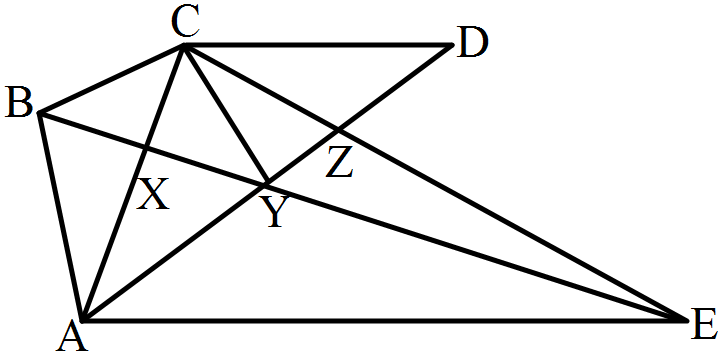
Calculation: We know that ‘If a triangle and a parallelogram are on the same base and the same parallels,
the area of the triangle is equal to half the area of the parallelogram’
Here we can see that:$\text{Area}(\triangle\text{APB})=\text{Area}(\triangle\text{ABS})\ ...(1)$
And, $\text{Area}(\triangle\text{AQR})=\text{Area}(\triangle\text{ABR})\ ...(2)$
Therefore,$\text{Area}(\triangle\text{ASR})=\text{Area}(\triangle\text{ABS})+\text{Area}(\triangle\text{ABR})$
From equation (1) and (2),
we have,$\text{Area}(\triangle\text{ASR})=\text{Area}(\triangle\text{APB})+\text{Area}(\triangle\text{AQR})$
$\Rightarrow\text{Area}(\triangle\text{ASR})=\text{Area}(\triangle\text{BPQ})=17\text{cm}^2$
Hence, the area of the triangle $\triangle\text{ASR}\text{ is }17\text{cm}^2.$
View full question & answer
Question 275 Marks
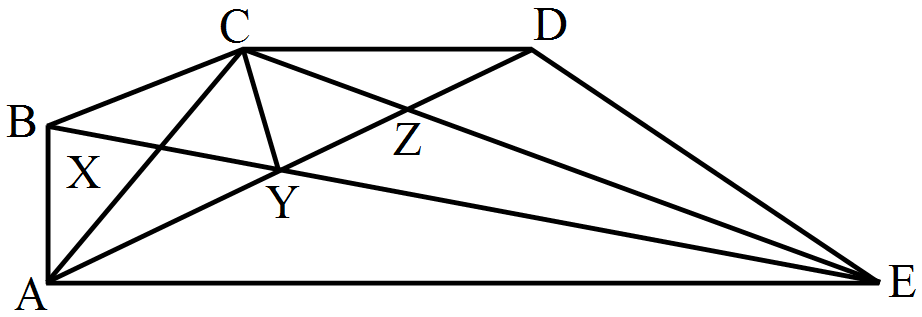
In the given figure, CD || AE and CY || BA.
  1. Name a triangle equal in area of $\triangle\text{CBX}$
  2. Prove that $\text{ar}(\triangle\text{ZDE})=\text{ar}(\triangle\text{CZA})$
  3. Prove that $\text{ar}(\text{BCZY})=\text{ar}(\triangle\text{EDZ}).$
Answer
Given: CD || AE. CY || BA. To find: Name a triangle equal in area of $\triangle\text{CBX}.$$\text{ar}(\triangle\text{ZDE})=\text{ar}(\triangle\text{CZA}).$
$\text{ar}(\text{BCZY})=\text{ar}(\triangle\text{EDZ}).$
Proof:
  1. Since triangle BCY and triangle YCA are on the same base and between same parallel, so their area should be equal.
Therefore
$\text{ar}(\triangle\text{BCY})=\text{ar}(\triangle\text{YCA})$
$\Rightarrow\text{ar}(\triangle\text{CBX})+\text{ar}(\triangle\text{XYC})\\=\text{ar}(\triangle\text{XYC})+\text{ar}(\triangle\text{AXY})$
$\Rightarrow\text{ar}(\triangle\text{CBX})=\text{ar}(\triangle\text{AXY})$
Therefore area of triangle CBX is equal to area of triangle AXY
  1. Triangle ADE and triangle ACE are on the same base AE and between the same parallel AE and CD.
$\Rightarrow\text{ar}(\triangle\text{ADE})=\text{ar}(\triangle\text{ACE})$
$\Rightarrow\text{ar}(\triangle\text{ADE})-\text{ar}(\triangle\text{AZE})\\=\text{ar}(\triangle\text{ACE})-\text{ar}(\triangle\text{AZE})$
$\Rightarrow\text{ar}(\triangle\text{ZDE})=\text{ar}(\triangle\text{ACZ})$
  1. Triangle ACY and BCY are on the same base CY and between same parallels CY and BA. So we have $\text{ar}(\triangle\text{ACY})=\text{ar}(\triangle\text{BCY})$
Now we know that
$\text{ar}(\triangle\text{ACZ})=\text{ar}(\triangle\text{ZDE})$
$\Rightarrow\text{ar}(\triangle\text{ACY})+\text{ar}(\triangle\text{CYZ})=\text{ar}(\triangle\text{EDZ})$
$\Rightarrow\text{ar}(\triangle\text{BCY})+\text{ar}(\triangle\text{CYZ})=\text{ar}(\triangle\text{EDZ})$
$\Rightarrow\text{ar}(\triangle\text{BCY})=\text{ar}(\triangle\text{EDZ})$
View full question & answer
Question 285 Marks
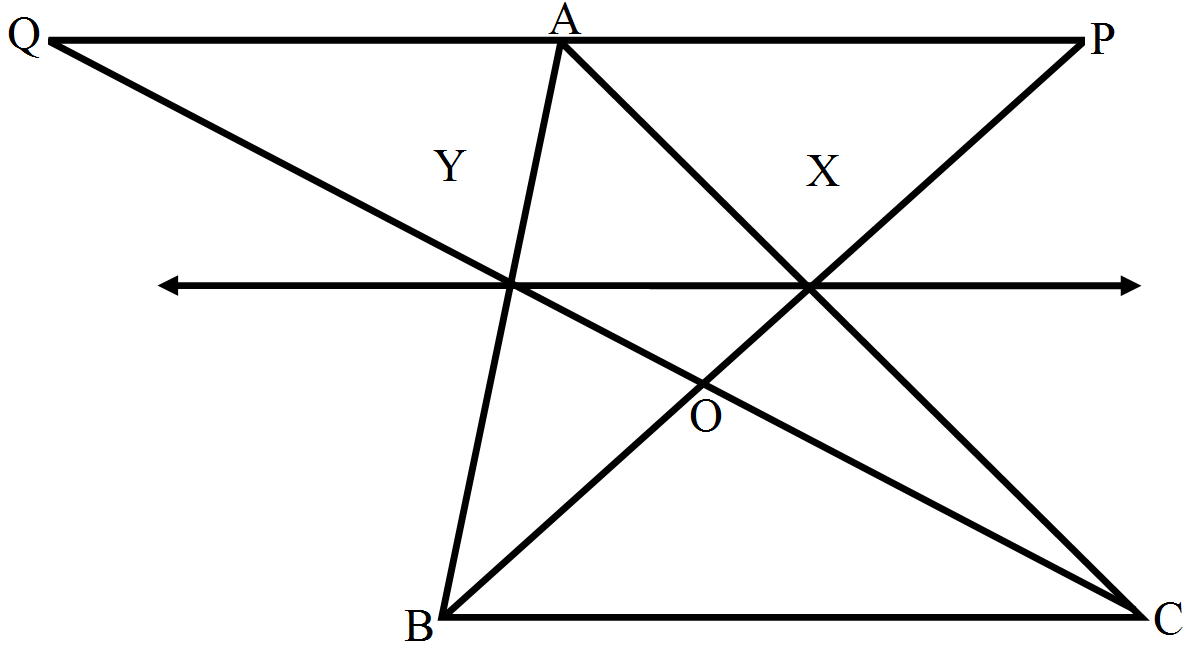
In figure, X and Y are the mid points of AC and AB respectively, QP || BC and CYQ and BXP are straight lines. Prove that $\text{ar}(\triangle\text{ABP})=\text{ar}(\triangle\text{ACQ}).$
Answer
Since X and Y are the mid points of AC and AB respectively. Therefore, XY || BC Clearly, triangles BYC and BXC are on the same base BC and between the same parallels XY and BC$\therefore\text{ar}(\triangle\text{BYC})=\text{ar}(\triangle\text{BXC})$
$\Rightarrow\text{ar}(\triangle\text{BYC})-\text{ar}(\triangle\text{BOC})\\ \ =\text{ar}(\triangle\text{BXC})-\text{ar}(\triangle\text{BOC})$
$\Rightarrow\text{ar}(\triangle\text{BOY})=\text{ar}(\triangle\text{COX})$
$\Rightarrow\text{ar}(\triangle\text{BOY})+\text{ar}(\triangle\text{XOY})\\ \ =\text{ar}(\triangle\text{COX})+\text{ar}(\triangle\text{XOY})$
$\Rightarrow\text{ar}(\triangle\text{BXY})=\text{ar}(\triangle\text{CXY})\ ...(1)$
We observed that the quadrilaterals XYAP and XYAQ are on the same base XY and between same parallels XY and PQ.$\therefore\text{ar}(\text{quad}.\ \text{XYAP})=\text{ar}(\text{quad}\text{ XYQA})\ ...(2)$
Adding 1 and 2, we get$\therefore\text{ar}(\triangle\text{BXY})+\text{ar}(\text{quad}.\text{ XYAP})\\ \ =\text{ar}(\triangle\text{CXY})+\text{ar}(\text{quad}\text{ XYQA})$
$\Rightarrow\text{ar}(\triangle\text{ABP})=\text{ar}(\triangle\text{ACQ})$
View full question & answer
Question 295 Marks
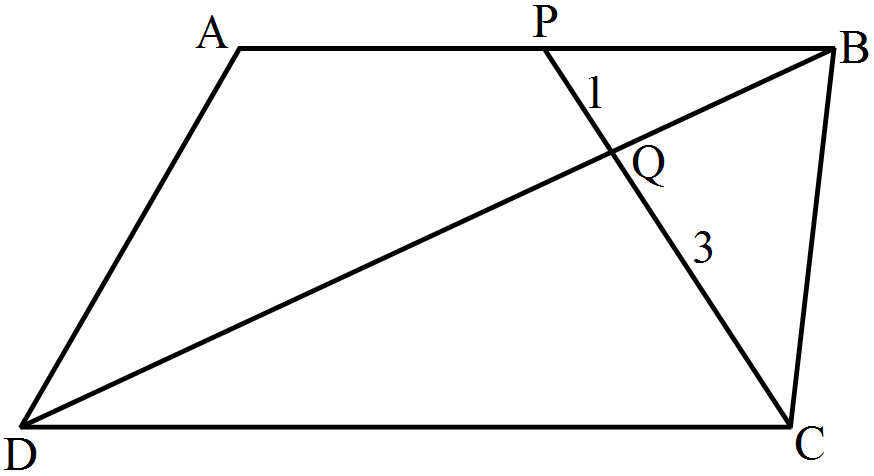
$ABCD$ is a parallelogram. $P$ is the mid-point of $AB. BD$ and $CP$ intersect at $Q$ such that $CQ : QP = 3 : 1.$
If$\text{ar}(\triangle\text{PBQ})=10\text{cm}^2,$ find the area of parallelogram $ABCD.$
Answer


Given: $A B C D$ is a parallelogram. $P$ is a mid point of $A B, B D$ and $C P$ intersect at $Q$ such that $C Q: Q P=3: 1$
To find: the area of parallelogram $A B C D$.
As we know
$CQ: QP=3: 1$
$\text { or } \frac{CQ}{QP}=\frac{3}{1}$
$\text { Or } 3 Q P=C Q \ldots \text { Eq } 1$
and also
$\Rightarrow \frac{1}{2} \times PB \times QP=10 cm^2$
$\Rightarrow \frac{1}{2} \times PB \times \frac{CQ}{3}=10 cm^2[\text { From eq 1] }$
$\Rightarrow \frac{1}{2} \times PB \times CQ=3 \times 10 cm^2$
$\Rightarrow \frac{1}{2} \times PB \times CQ=30 cm^2$
but Area(triangle $P B Q$ ) + Area(triangle $C B Q$ ) $=$ Area(triangle $P B C$ )
$\Rightarrow 10 cm^2+30 cm^2=40 cm^2$
therefore Area(triangle $P B C$ ) $=40 cm^2$
Since $P$ is the mid point of $A B$
therefore $C P$ is the median of triangle $A B C$
thus Area(triangle PBC ) = Area(triangle APC )
Or Area(triangle APC ) $=40 cm^2$
thus area of triangle $A B C=40+40=80 cm^2$
Area of parallelogram $A B C D=160 cm^2$
View full question & answer
5 Mark Question - Maths STD 9 Questions - Vidyadip