Question types

Areas Of Parallelograms And Triangles question types

73 questions across 5 question groups — pick any mix to generate a Maths paper with step-by-step answer keys.

73
Questions
5
Question groups
5
Question types
Sample Questions

Areas Of Parallelograms And Triangles questions

One sample from each question group in this chapter. Select any group above to see the full set with answer keys.

Q 1MCQ(1M)1 Mark
The figure obtained by joining the mid-points of the adjacent sides of a rectangle of sides $8cm$ and $6cm$ is:
  • A
    $A rhombus of area 24cm^2$
     
  • B
    $A rectangle of area 24cm^2$
     
  • C
    $A square of area 26cm^2$
     
  • D
    $A trapezium of area 14cm^2$
View full solution
Q 2MCQ(1M)1 Mark
If $AD$ is median of $\triangle\text{ABC}$ and $P$ is a point on $AC$ such that $\text{ar}(\triangle\text{ADP}):\text{ar}(\triangle\text{ABD})=2:3,$ then $\text{ar}(\triangle\text{PDC}):\text{ar}(\triangle\text{ABC})$ is:
  • A
    $1 : 4$
  • B
    $1 : 5$
  • $1 : 6$
  • D
    $3 : 5$

Answer: C.

View full solution
Q 3MCQ(1M)1 Mark
The median of a triangle divides it into two:
  • A
    Congruent triangle.
  • B
    Isosceles triangles.
  • C
    Right triangles.
  • Triangles of equal areas.

Answer: D.

View full solution
Q 4MCQ(1M)1 Mark
$A, B, C, D$ are mid $-$ points of sides of parallelogram $\text{PQRS}$. If $ar\text{(PQRS)} = 36\ cm^2$, then $ar\text{(ABCD)}=$
  • A
    $24\ cm^2$
  • $18\ cm^2$
  • C
    $30\ cm^2$
  • D
    $36\ cm^2$

Answer: B.

View full solution
Q 5MCQ(1M)1 Mark
In figure, $\text{ABCD}$ and $\text{FECG}$ are parallelograms equal in area. If $\text{ar} (\triangle\text{AQE})=12\text{cm}^2,$ then $\text{ar}(||^{\text{gm}}\text{FGBQ}) =$
  • A
    $12\ cm^2$
  • B
    $20\ cm^2$
  • $24\ cm^2$
  • D
    $36\ cm^2$

Answer: C.

View full solution
Q 62 Mark Question2 Marks
Which of the following figures lie on the same base and between the same parallels. In such a case, write the common base and two parallels:
View full solution
Q 72 Mark Question2 Marks
Which of the following figures lie on the same base and between the same parallels. In such a case, write the common base and two parallels:
View full solution
Q 82 Mark Question2 Marks
Which of the following figures lie on the same base and between the same parallels. In such a case, write the common base and two parallels:
View full solution
Q 92 Mark Question2 Marks
Which of the following figures lie on the same base and between the same parallels. In such a case, write the common base and two parallels:
View full solution
Q 102 Mark Question2 Marks
Which of the following figures lie on the same base and between the same parallels. In such a case, write the common base and two parallels:
View full solution
Q 123 Mark Question3 Marks
In figure, ABC is a right angled triangle at A, BCED, ACFG and ABMN are squares on the sides BC, CA and AB respectively. Line segment $\text{AX}\perp\text{DE}$ meets BC at Y. Show that: $\text{ar}(\text{BYXD})=\text{ar}(\text{ABMN})$
View full solution
Q 133 Mark Question3 Marks
In figure, ABC is a right angled triangle at A, BCED, ACFG and ABMN are squares on the sides BC, CA and AB respectively. Line segment $\text{AX}\perp\text{DE}$ meets BC at Y. Show that: $\text{ar}(\text{CYXE})=\text{ar}(\text{ACFG})$
View full solution
Q 143 Mark Question3 Marks
In figure, PQRS is a square and T and U are, respectively, the mid-points of PS and QR. Find the area of $\triangle\text{OTS}$ if PQ = 8cm.
View full solution
Q 165 Mark Question5 Marks
PQRS is a rectangle inscribed in a quadrant of a circle of radius 13cm. A is any point on PQ. If PS = 5cm, then
find $\text{ar}(\triangle\text{RAS}).$
View full solution
Q 175 Mark Question5 Marks
In figure, ABCD and AEFD are two parallelograms. Prove that:
  1. $\text{PE}=\text{FQ}$
  2. $\text{ar}(\triangle\text{APE}) : \text{ar}(\triangle\text{PFA})\\=\text{ar}(\triangle\text{QFD}): \text{ar}(\triangle\text{PFD})$
  3. $\text{ar}(\triangle\text{PEA})=\text{ar}(\triangle\text{QFD})$
View full solution
Q 195 Mark Question5 Marks
In figure, ABC and ABD are two triangles on the base AB. If line segment CD is bisected by AB at O, show that $\text{ar}(\triangle\text{ABC})=\text{ar}(\triangle\text{ABD}).$
View full solution
Q 205 Mark Question5 Marks
In figure, ABCD is a trapezium in which $AB = 7cm, AD = BC = 5cm, DC = x cm$, and distance between AB and DC is $4cm$. Find the value of x and area of trapezium ABCD.
View full solution
If ABCD is a parallelogram, then prove that$\text{ar}(\triangle\text{ABD})=\text{ar}(\triangle\text{BCD})\\ \ =\text{ar}(\triangle\text{ABC})=\text{ar}(\triangle\text{ACD})=\frac{1}{2}\text{ar}$ $(||^{gm} ABCD)$
View full solution
ABCD is a parallelogram whose diagonals intersect at O .If P is any point on BO, prove that:
  1. $\text{ar}(\triangle\text{ADO})=\text{ar}(\triangle\text{CDO})$
  2. $\text{ar}(\triangle\text{ABP})=\text{ar}(\triangle\text{CBP})$
View full solution
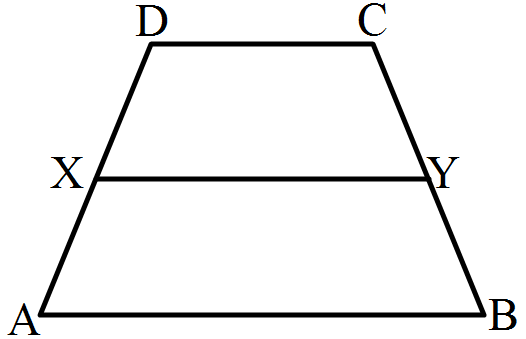
In figure, ABCD is a trapezium in which AB || DC and DC = 40cm and AB = 60cm. If X and Y are, respectively, the mid-points of AD and BC, prove that:
  1. XY = 50cm
  2. DCYX is a trapezium
  3. $\text{ar}(\text{trap}.\ \text{DCYX})=\Big(\frac{9}{11}\Big)\text{ar}(\text{XYBA}).$
View full solution

Generate a Areas Of Parallelograms And Triangles paper free

Pick question groups from the list above, set marks and difficulty, and export a branded PDF with step-by-step answer keys. First 3 chapters free — no signup.

Download App