Questions · Page 2 of 5

M.C.Q (1 Marks)

MCQ 511 Mark
Which of the following states of matter has the maximum value of mean free path?
  • Gas
  • B
    Solid
  • C
    Liquid
  • D
    Plasma
Answer
Correct option: A.
Gas
The atoms of gas have the most interatomic space and can therefore travel freely. This is why they travel longer distances without colliding and are therefore said to have the maximum mean free path.
View full question & answer
MCQ 521 Mark
The energy of a given sample of an ideal gas depends only on its:
  • A
    Volume.
  • B
    Pressure.
  • Temperature.
  • D
    Mass.
Answer
Correct option: C.
Temperature.
The energy of a given sample of an ideal gas depends only on temperature as average energy/ molecule/ degree of freedom $=\frac{1}{2}\text{k}_{\text{B}}\text{T}$
View full question & answer
MCQ 531 Mark
The number of molecules per unit volume in the sample is $20.$ The mass of each molecule is $10-20\ kg.$ The mean of speed squared is $4\ m^2/s^2$. What is the value of internal energy of the gas? Assume volume of container is $0.02m^3$.
  • $0.8 \times 10^{-20} \mathrm{~J}$
  • B
    $0.53 \times 10^{-20} \mathrm{~J}$
  • C
    $0.01 \times 10^{-20} \mathrm{~J}$
  • D
    $0.45 \times 10^{-20} \mathrm{~J}$
Answer
Correct option: A.
$0.8 \times 10^{-20} \mathrm{~J}$
Internal energy is given by: $E = \Big(\frac{1}{2}\Big)Nmv^2$,
where $N$ is the total number of molecules $= nV.$
$E =0.5 \times 20 \times 0.02 \times 10^{-20} \times 4$
$= 0.8 \times 10^{-20} \mathrm{~J}$.
View full question & answer
MCQ 541 Mark
In a mixture of gases at a fixed temperature:
  • Heavier molecule has lower average speed
  • B
    Lighter molecule has lower average speed
  • C
    Heavier molecule has higher average speed
  • D
    None of these
Answer
Correct option: A.
Heavier molecule has lower average speed
View full question & answer
MCQ 551 Mark
Consider a mixture of oxygen and hydrogen kept at room temperature. $AB$ compared to a hydrogen molecule an oxygen molecule hits the wall:
  • A
    With greater average speed.
  • With smaller average speed.
  • C
    With greater average kinetic energy.
  • D
    With smaller average kinetic energy.
Answer
Correct option: B.
With smaller average speed.
The average speed of molecules is given by $\sqrt{\frac{8\text{kT}}{\pi\text{m}}}.$
We observe that greater the mass, lesser is the average speed of the molecule. Since an oxygen molecule is heavier than a hydrogen molecule, the oxygen molecule will hit the wall with smaller average speed.
View full question & answer
MCQ 561 Mark
For Boyle’s law to hold, the gas should be:
  • Perfect and of constant mass and temperature.
  • B
    Real and of constant mass and temperature.
  • C
    Perfect and constant temperature but variable mass.
  • D
    Real and constant temperature but variable mass.
Answer
Correct option: A.
Perfect and of constant mass and temperature.
View full question & answer
MCQ 571 Mark
Inter atomic forces are:
  • A
    Attractive in long range.
  • B
    Repulsive in short range.
  • C
    Negligible in gases.
  • All $(a), (b)$ and $(c).$
Answer
Correct option: D.
All $(a), (b)$ and $(c).$
Interatomic forces are attractive in long range and repulsive in short range and negligible in gases.
View full question & answer
MCQ 581 Mark
The temperature at which the $\text{r.m.s.}$ velocity of $H^2$ becomes escape velocity from the earth is,
  • A
    $10059^\circ C$
  • $10059K$
  • C
    $10332^\circ C$
  • D
    $10332K$
Answer
Correct option: B.
$10059K$
View full question & answer
MCQ 591 Mark
The total energy for one mole of solid is:
  • A
    $2RT$
  • $3RT$
  • C
    $4RT$
  • D
    $\frac{3}{2}\text{RT}$
Answer
Correct option: B.
$3RT$
View full question & answer
MCQ 601 Mark
Latent heat of ice is:
  • A
    Less than external latent heat of fusion.
  • B
    More than external latent heat of fusion.
  • C
    Twice the external latent heat of fusion.
  • Equal to external latent heat of fusion.
Answer
Correct option: D.
Equal to external latent heat of fusion.
Latent heat of ice is more than external latent heat of fusion.
View full question & answer
MCQ 611 Mark
The behavior of real gases approaches that of ideal gas in which of these following conditions?
  • A
    Low pressure $\&$ low temperature
  • B
    High Pressure $\&$ high temperature
  • Low pressure $\&$ high temperature
  • D
    High pressure $\&$ low temperature
Answer
Correct option: C.
Low pressure $\&$ high temperature
Ideal gas is based on the assumptions of kinetic theory of gases$\text{(KTG).}$
At low pressure and high temperature the intermolecular forces become less significant and the size of molecules becomes less as compared to separation between them.
These are two postulates of $\text{KTG}$ and hence in these conditions real gas behavior is similar to that of ideal gases.
View full question & answer
MCQ 621 Mark
Boyls law is applicable in:
  • A
    Isochoric process
  • Isothermal process
  • C
    Isobaric process
  • D
    Isotonic process
Answer
Correct option: B.
Isothermal process
View full question & answer
MCQ 631 Mark
What is the ratio of specific heats for a monatomic gas?
  • $\frac{5}{3}$
  • B
    $\frac{5}{2}$
  • C
    $\frac{7}{5}$
  • D
    $\frac{9}{5}$
Answer
Correct option: A.
$\frac{5}{3}$
The value of $Cv$ for a monatomic gas is $\frac{3}{2} R$ and
$C_P$ is $\frac{5}{2} R.$
Thus the value of $γ$ is:
$\frac{\text{C}_\text{p}}{\text{C}_\text{V}}=\frac{5}{3}$
View full question & answer
MCQ 641 Mark
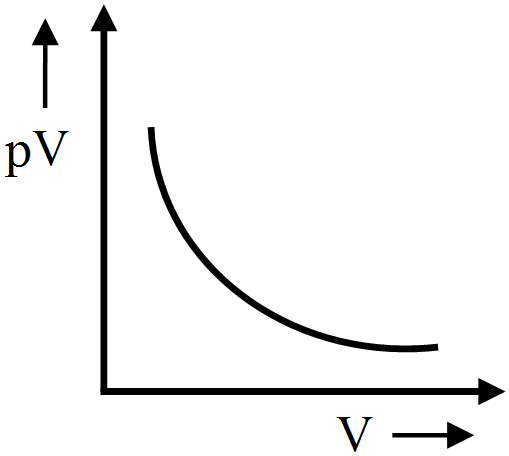
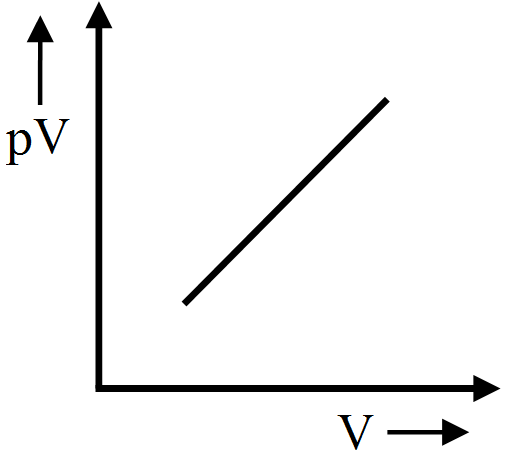
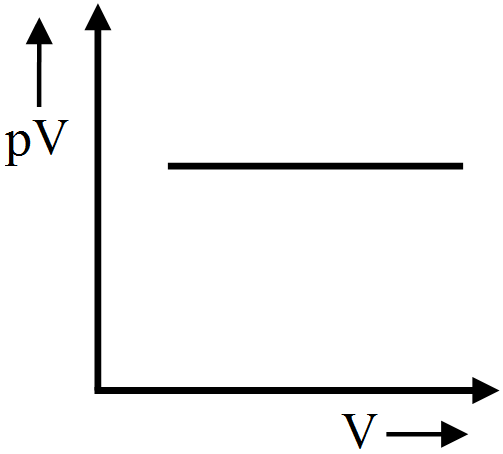
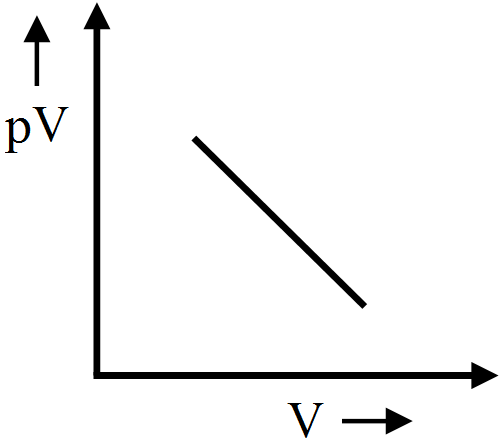
Which one of the following graphs represents the behavior of an ideal gas?
  • A
  • B
  • C
Answer
Correct option: D.
View full question & answer
MCQ 651 Mark
Why are liquids and gases termed as fluids? Because:
  • A
    They have irregular shape
  • B
    They have randomly moving particles
  • C
    They are compressible
  • They can flow
Answer
Correct option: D.
They can flow
View full question & answer
MCQ 661 Mark
A gas behaves more closely as an ideal gas at:
  • A
    Low pressure and low temperature.
  • Low pressure and high temperature.
  • C
    High pressure and low temperature.
  • D
    High pressure and high temperature.
Answer
Correct option: B.
Low pressure and high temperature.
At low pressure, the concentration of gas molecules is very low. Hence, the kinetic assumption that the size of the molecules can be neglected compared to the volume of the container applies. At high temperature, molecules move very fast. So, they tend to collide elastically and forces of interaction between the molecules minimise. This is the required idea condition.
View full question & answer
MCQ 671 Mark
If $\text{r.m.s.}$ speed of a gas increases, then its pressure:
  • Increases
  • B
    Decreases
  • C
    Remains same
  • D
    May increase or decrease
Answer
Correct option: A.
Increases
View full question & answer
MCQ 681 Mark
In equilibrium, the total energy is equally distributed in all possible energy modes having an energy equal to $\text{1/2KB T,}$ this is called as:
  • A
    Boyle’s law
  • B
    Charle’s law
  • Law of equipartition of energy
  • D
    None
Answer
Correct option: C.
Law of equipartition of energy
View full question & answer
MCQ 691 Mark
When we cool a gas below its condensation point, the $K.E.$ of its molecules:
  • A
    Increases
  • Decreases
  • C
    Remains the same
  • D
    First decreases then increases
Answer
Correct option: B.
Decreases
As we know kinetic energy of molecules of a gas is a function of Temperature
So, As we decrease its temperature or say cool it, its kinetic energy gradually decrease.
At a certain point which decreasing kinetic energy it starts bonding up whit molecules and thus condensation starts.
View full question & answer
MCQ 701 Mark
Cooking gas containers are kept in a lorry moving with uniform speed. The temperature of the gas molecules inside will.
  • Remains the same
  • B
    Decrease for some and increase for others
  • C
    Decrease
  • D
    Increase
Answer
Correct option: A.
Remains the same
View full question & answer
MCQ 711 Mark
At constant pressure, the volume of the gas is proportional to the absolute temperature is called as:
  • A
    Boyle’s law
  • B
    Charle’s law
  • Zeroth law of thermodynamics
  • D
    Second law of thermodynamics
Answer
Correct option: C.
Zeroth law of thermodynamics
View full question & answer
MCQ 721 Mark
The diatomic gas molecule has total $............$ degrees of freedom.
  • A
    $4$
  • B
    $3$
  • C
    $2$
  • $5$
Answer
Correct option: D.
$5$
View full question & answer
MCQ 731 Mark
Which of the following quantities is zero on an average for the molecules of an ideal gas in equilibrium?
  • A
    Kinetic energy.
  • Momentum.
  • C
    Density.
  • D
    Speed.
Answer
Correct option: B.
Momentum.
The molecules move in all possible directions in an ideal gas at equilibrium.
Since momentum is a vector quantity for every direction of motion of the molecules, there exists an opposite direction of motion of the other.
Hence, the average momentum is zero for an ideal gas at equilibrium.
View full question & answer
MCQ 741 Mark
An inflated rubber balloon contains one mole of an ideal gas, has a pressure $P.$ volume $V$ and temperature $T.$ If the temperature rises to $1.1 T,$ and the volume is increased to $1.05V,$ the final pressure will be:
  • A
    $1.1 P$
  • B
    $P$
  • C
    Less than $P$
  • Between $P$ and $1.1$
Answer
Correct option: D.
Between $P$ and $1.1$
$\text{PV = nRT n}$ and $R$ are constant for the system here
$\frac{\text{PV}}{\text{T}} =$ constant
or
$\frac{\text{P}_1\text{V}_1}{\text{T}_1}=\frac{\text{P}_2\text{V}_2}{\text{T}_2}$
$\text{P}_2=\frac{\text{P}_1\text{V}_1}{\text{T}_1}\times\frac{\text{T}_2}{\text{V}_2}$
$=\frac{\text{p}\text{V1.1T}}{\text{T1.05V}}=\frac{1.1}{1.05}\text{p}$
$=(1.0476)\text{p}$
i.e. $P_2$ is between $P$ and $1.1p.$
So option $(d)$ verifies.
View full question & answer
MCQ 751 Mark
Which of the following quantities is the same for all ideal gases at the same temperature?
  • A
    The kinetic energy of $1$ mole.
  • B
    The kinetic energy of $1g.$
  • C
    The number of molecules in $1$ mole.
  • Both $A$ and $C$
Answer
Correct option: D.
Both $A$ and $C$
Kinetic energy per mole of an ideal gas is directly proportional to $T.$
So, it will be the same for all ideal gases.
Number of molecules in $1$ mole of an ideal is the same for all ideal gases because ideal gases obey Avogadro's law.
View full question & answer
MCQ 761 Mark
The temperature to which a gas must be cooled before it can't be liquefied by pressure alone is called its:
  • Critical temperature
  • B
    Saturation point
  • C
    Boiling point
  • D
    Freezing point
Answer
Correct option: A.
Critical temperature
In this $P-V$ curve the isotherm having $T_c$ is that critical temperature and corresponding to that there is critical pressure $P_c$.
Critical temperature is the temperature of a gas in its critical state, above which it cannot be liquefied by pressure alone.
Critical pressure is the pressure of a gas or vapour in its critical state.
Critical temperature amd pressure $-$ Thermodynamics $-$ Engineering Reference with Worked Examples
View full question & answer
MCQ 771 Mark
The internal energy of one mole of an ideal gas depend upon:
  • A
    Volume of gas
  • Temperature of gas
  • C
    Nature of gas
  • D
    Density of gas
Answer
Correct option: B.
Temperature of gas
View full question & answer
MCQ 781 Mark
The volume of $5$ moles of a gas at $\text{N.T.P.}$ in litres is:
  • $112$
  • B
    $11.2$
  • C
    $1.12$
  • D
    $1120$
Answer
Correct option: A.
$112$
View full question & answer
MCQ 791 Mark
What is number of degrees of freedom of an ideal diatomic molecule at ordinary temperature?
  • A
    $7$
  • B
    $6$
  • $5$
  • D
    $3$
Answer
Correct option: C.
$5$
The degrees of freedom of an ideal diatomic molecule at ordinary temperature is $5.$
View full question & answer
MCQ 801 Mark
On a particular day, the relative humidity is $100\%$ and the room temperature is $30^\circ C,$ then the dew point is:
  • A
    $70^\circ C$
  • $30^\circ C$
  • C
    $100^\circ C$
  • D
    $0^\circ C$
Answer
Correct option: B.
$30^\circ C$
View full question & answer
MCQ 811 Mark
The average kinetic energy of the molecules of a gas at $27^\circ C$ is $9 10-20J.$ what is its average $K.E.$ at $227^\circ C\ ?$
  • A
    $5 10-20J$
  • B
    $10 10-20J$
  • $15 10-20J$
  • D
    $20 10-20J$
Answer
Correct option: C.
$15 10-20J$
View full question & answer
MCQ 821 Mark
According to kinetic theory of gases the $\text{r.m.s}.$ velocity of the gas molecules is directly proportional to:
  • A
    $\sqrt{\text{T}}$
  • B
    $T^4$
  • $T$
  • D
    $T^2$
Answer
Correct option: C.
$T$
View full question & answer
MCQ 831 Mark
Pressure exerted by a gas is:
  • Directly proportional to the density of the gas.
  • B
    Directly proportional to the square of the density of the gas.
  • C
    Inversely proportional to the density of the gas.
  • D
    Independent of density of the gas.
Answer
Correct option: A.
Directly proportional to the density of the gas.
View full question & answer
MCQ 841 Mark
At a given temperature the force between molecules of a gas as a function of intermolecular distance is:
  • First decreases and then increases
  • B
    Always increases
  • C
    Always decreases
  • D
    Always constant
Answer
Correct option: A.
First decreases and then increases
View full question & answer
MCQ 851 Mark
If masses of all molecule of a gas are halved and their speed doubled then the ratio of initial and final pressure will be:
  • A
    $2 : 1$
  • $1 : 2$
  • C
    $4 : 1$
  • D
    $1 : 4$
Answer
Correct option: B.
$1 : 2$
View full question & answer
MCQ 861 Mark
The $\text{r.m.s}$ velocity of oxygen molecules at $27^\circ C$ is $318\ m/ s.$ the $\text{r.m.s}$ velocity of hydrogen molecules at $127^\circ C$ is:
  • $1470\ m/ s$
  • B
    $1603\ m/ s$
  • C
    $1869\ m/ s$
  • D
    $2240\ m/ s$
Answer
Correct option: A.
$1470\ m/ s$
View full question & answer
MCQ 871 Mark
The average kinetic energy of gas molecules depends upon which of the following factor?
  • Temperature of the gas
  • B
    Nature of the gas
  • C
    Volume of the gas
  • D
    None of these
Answer
Correct option: A.
Temperature of the gas
View full question & answer
MCQ 881 Mark
At change of state the kinetic energy of the molecules of a substances increases greatly.
  • A
    True
  • False
  • C
    Either
  • D
    Neither
Answer
Correct option: B.
False
If heat is coming into a substance during a phase change, then this energy is used to break the bonds between the molecules of the substance.
An example we will use here is ice melting into water.
View full question & answer
MCQ 891 Mark
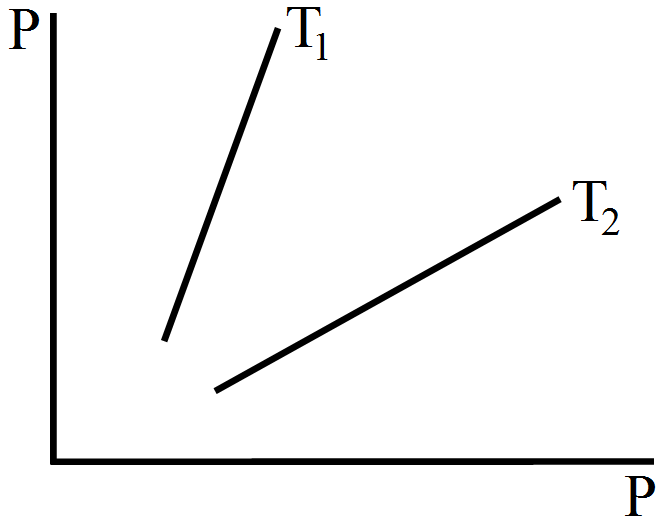
Figure. shows graphs of pressure vs density for an ideal gas at two temperatures $T_1$ and $T_2$.
  • $T_1>T_2$
  • B
    $T_1=T_2$
  • C
    $T_1 < T_2$
  • D
    Any of the three is possible. 
Answer
Correct option: A.
$T_1>T_2$
The straight line $T_1$ has greater slope than $T_2$. This means $\frac{\text{P}}{\rho}$ ratio is greater for $T_1$ than $T_2$. Now, rms velocity of a gas is given by $\sqrt{\frac{3\text{P}}{\rho}}.$ This means rms velocity of gas with $T_1$ molecules is greater than $T_2$ molecules. Again, gas with higher temperature has higher rms velocity.
View full question & answer
MCQ 901 Mark
Two bodies at different temperatures are mixed in a calorimeter. Which of the following quantities remains conserved?
  • A
    Sum of the temperatures of the two bodies.
  • B
    Total heat of the two bodies.
  • Total internal energy of the two bodies.
  • D
    Internal energy of each body.
Answer
Correct option: C.
Total internal energy of the two bodies.
When two bodies at different temperatures are mixed in the calorimeter, heat flows from one body to the other due to the temperature difference. This results in change in the internal energy of the individual bodies. There is no exchange of heat with the surrounding in the calorimeter. Thus, the total internal energy of the bodies remain conserved as no external work is done on them.
View full question & answer
MCQ 911 Mark
A product from a chemical industry passes through three states $-$ gas, liquid, solid. The product is initially formed in gaseous state which is then liquefied and finally solidified. For same mass $($say $5g)$ which state has maximum internal energy?
  • A
    Solid
  • B
    Liquid
  • Gas
  • D
    All have equal internal energy
Answer
Correct option: C.
Gas
Internal energy is dependent on the freedom of movement of particles.
Since in gaseous state, particles are most free to move, this state has maximum internal energy.
View full question & answer
MCQ 921 Mark
Oxygen and hydrogen gases are at same temperature and pressure. And the oxygen molecule has 16 times the mass of hydrogen molecule. Then the ratio of their r.m.s. speed is:
  • A
    $2$
  • $\frac{1}{4}$
  • C
    $4$
  • D
    $16$
Answer
Correct option: B.
$\frac{1}{4}$
$\frac{\text{C}_{\text{oxy}}}{\text{C}_{\text{H}}}=\sqrt{\frac{\text{m}_{\text{H}}}{\text{m}_{\text{oxy}}}}=\sqrt{\frac{1}{16}}=\frac{1}{4}$
View full question & answer
MCQ 931 Mark
According to kinetic theory of gases, at absolute zero temperature:
  • Molecular motion stops
  • B
    Liquid hydrogen freezes
  • C
    Liquid helium freezes
  • D
    Water freezes
Answer
Correct option: A.
Molecular motion stops
View full question & answer
MCQ 941 Mark
Real gases show markable deviation from that of ideal gas behavior at:
  • High temperature and low pressure.
  • B
    Low temperature and high pressure.
  • C
    High temperature and high pressure.
  • D
    Low temperature and low pressure.
Answer
Correct option: A.
High temperature and low pressure.
Real gases approach ideal gas behaviour at high temperature and low pressure because at high pressures and low temperature, molecules of gases are very close to each other.
View full question & answer
MCQ 951 Mark
The internal energy of $2$ moles of a mono atomic gas is:
  • A
    $\frac{3}{2}\text{RT}$
  • $3\text{RT}$
  • C
    $2\text{RT}$
  • D
    $5\text{RT}$
Answer
Correct option: B.
$3\text{RT}$
lnternal energy, $\text{U}=\Big(\frac{3}{2}\text{k}_{\text{B}}\text{T}\Big)2\text{N}_{\text{A}}$
$=3(\text{k}_{\text{B}}\times\text{N}_{\text{A}})\text{T = 3RT}$
View full question & answer
MCQ 961 Mark
Equal volumes of two gases at the same temperature and pressure have the same:
  • Number of molecules.
  • B
    $\text{r.m.s.}$ velocity.
  • C
    No. of molecules with $\text{r.m.s}.$ velocities.
  • D
    None of the above.
Answer
Correct option: A.
Number of molecules.
View full question & answer
MCQ 971 Mark
When a gas is in thermal equilibrium, its molecules:
  • Have the same average kinetic energy of molecules.
  • B
    Have different energies which remain constant.
  • C
    Have a certain constant energy.
  • D
    Do not collide with one another.
Answer
Correct option: A.
Have the same average kinetic energy of molecules.
View full question & answer
MCQ 981 Mark
The number of degrees of freedom for translatory motion are:
  • A
    Dependent on the nature of translatory motion.
  • Same for all types of molecules.
  • C
    Less for multiatomic molecules.
  • D
    More for multiatomic molecules.
Answer
Correct option: B.
Same for all types of molecules.
View full question & answer
MCQ 991 Mark
A molecule moving along a straight line possess $............$ degree of freedom.
  • one.
  • B
    two.
  • C
    three.
  • D
    four.
Answer
Correct option: A.
one.
View full question & answer
MCQ 1001 Mark
Energy supplied to convert unit of substance from solid to liquid state at its melting point is called:
  • Latent heat of fusion
  • B
    Solidification
  • C
    Latent heat of fission
  • D
    Evaporation
Answer
Correct option: A.
Latent heat of fusion
The heat energy supplied per unit mass of a substance at its melting point to convert the state of the substance from solid to liquid is known as Latent heat of Fusion.
View full question & answer
M.C.Q (1 Marks) - Page 2 - Physics STD 11 Science Questions - Vidyadip