MCQ 1011 Mark
The pressure of a gas kept in an isothermal container is $200\ \text{kPa.}$ If half the gas is removed from it, the pressure will be:
- ✓
$100\ \text{kPa.}$
- B
$200\ \text{kPa.}$
- C
$400\ \text{kPa.}$
- D
$800\ \text{kPa.}$
AnswerCorrect option: A. $100\ \text{kPa.}$
Let the number of moles in the gas be $n.$
Applying equation of state, we get,
$\text{PV}=\text{nRT}$
$\Rightarrow\text{P}=\frac{\text{nRT}}{\text{V}}$
$\Rightarrow2\times10^5=\frac{\text{nRT}}{\text{V}}\ ...(1)$
When half of the gas is removed, number of moles left behind $=\frac{\text{n}}{2}$
Let the pressure be $P'.$
$\text{P}'=\frac{\text{n}}{2}\frac{\text{RT}}{\text{V}}$
Now,
$\text{P}'=\frac{1}{2}\times2\times10^5=10^5 [$From eq. $(1)]$
$=100\text{kPa}$
View full question & answer→MCQ 1021 Mark
Gases deviate from perfect gas behaviour because their molecules:
- A
- B
- C
Don’t attract each other.
- ✓
Interact with each other through intermolecular forces.
AnswerCorrect option: D. Interact with each other through intermolecular forces.
View full question & answer→MCQ 1031 Mark
The absolute zero is that temperature at which:
- ✓
All molecular linear velocities are zero.
- B
Most of the molecular linear velocities are zero.
- C
Most of the molecular linear velocities are not zero.
- D
The weight of the gas is zero.
AnswerCorrect option: A. All molecular linear velocities are zero.
View full question & answer→MCQ 1041 Mark
Oxygen and hydrogen gases are at the same temperature $T.$ The kinetic energy of an oxygen molecule will be equal to:
- A
$16$ times the kinetic energy of a hydrogen molecule.
- B
$5$ times the kinetic energy of a hydrogen molecule.
- ✓
The kinetic energy of a hydrogen molecule.
- D
One$-$fourth the kinetic energy of a hydrogen molecule.
AnswerCorrect option: C. The kinetic energy of a hydrogen molecule.
View full question & answer→MCQ 1051 Mark
The pressure $P$ of a gas and its mean $K.E.$ per unit volume are related as:
- A
$\text{P}=\frac{1}{2}\text{E}$
- B
$\text{P = E}$
- C
$\text{P}=\frac{3}{2}\text{E}$
- ✓
$\text{P}=\frac{2}{3}\text{E}$
AnswerCorrect option: D. $\text{P}=\frac{2}{3}\text{E}$
$\text{P}=\frac{1}{3}\rho\text{C}^2$
Mean $K.E$./ volume $=\text{E}=\frac{1}{2}\rho\text{C}^2$
$\therefore\text{P}=\frac{1}{3}\rho\text{C}^2=\frac{2}{3}\Big(\frac{1}{2}\rho\text{C}^2\Big)=\frac{2}{3}\text{E}$
View full question & answer→MCQ 1061 Mark
The molar specific heat at constant pressure for monoatomic gas molecule is given by:
- A
$\frac{3}{2}\text{R}$
- B
$\frac{1}{2}\text{R}$
- ✓
$\frac{5}{2}\text{R}$
- D
$\text{R}$
AnswerCorrect option: C. $\frac{5}{2}\text{R}$
View full question & answer→MCQ 1071 Mark
Which of the following can be the basis of sesparating a mixture of gases?
- ✓
Graham’s law of diffusion
- B
- C
- D
AnswerCorrect option: A. Graham’s law of diffusion
View full question & answer→MCQ 1081 Mark
The phenomenon of Browninan movement may be taken as evidence of:
- ✓
- B
Electromagnetic theory of radiation
- C
Corpuscular theory of light
- D
View full question & answer→MCQ 1091 Mark
What is the ratio of specific heats for a diatomic gas?
- ✓
$\frac{7}{5}$
- B
$\frac{5}{3}$
- C
$\frac{9}{7}$
- D
$\frac{7}{2}$
AnswerCorrect option: A. $\frac{7}{5}$
The value of $CV$ for a diatomic gas is $\frac{7}{2} R$ and
CP is$\frac{9}{2} R.$
Thus the value of $γ$ is:
$\frac{\text{C}_\text{P}}{\text{C}_\text{V}}=\frac{7}{5}$
View full question & answer→MCQ 1101 Mark
Diatomic molecules like hydrogen have energies due to both translational as well as rotational motion. From the equation in kinetic theory $\text{PV} = \frac{2}{3} E,E$ is:
- A
The total energy per unit volume.
- B
Only the translational part of energy because rotational energy is very small compared to the translational energy.
- ✓
Only the translational part of the energy because during collisions with the wall pressure relates to change in linear momentum.
- D
The translational part of the energy because rotational energies of molecules can be of either sign and its average over all the molecules is zero.
AnswerCorrect option: C. Only the translational part of the energy because during collisions with the wall pressure relates to change in linear momentum.
According to kinetic theory equation, $\text{PV} = \frac{2}{3} E [$where $P=$ Pressure $V =$ volume$]$
$E$ is representing only translational part of energy.
Internal energy contains all types of energies like translational, rotational, vibrational etc.
But the molecules of an ideal gas is treated as point masses in kinetic theory, so its kinetic energy is only due to translational motion.
Point mass does not have rotational or vibrational motion.
Here, we assumed that the walls only exert perpendicular forces on molecules.
They do not exert any parallel force, hence there will not be any type of rotation present.
The wall produces only change in translational motion.
View full question & answer→MCQ 1111 Mark
According to kinetic theory of gases, at absolute zero of temperature:
AnswerThis model is described for an ideal gas and assumes that the particles does not interact in any other way.
It is known that the root mean square velocity of a particle is proportional to the absolute temperature Also for zero absolute temperature, the velocity is also zero.
View full question & answer→MCQ 1121 Mark
The ratio of principal molar heat capacities of a gas is maximum for:
MCQ 1131 Mark
Which of the following quantities is zero on an average for the molecules of an ideal gas in equilibrium?
AnswerIn case of ideal gases the average velocity is always zero. Hence the average momentum is zero.
Whereas average speed is non$-$zero so the kinetic energy also non$-$zero, as these two are scalar quantities.
View full question & answer→MCQ 1141 Mark
The process on an ideal gas, shown in figure. is:
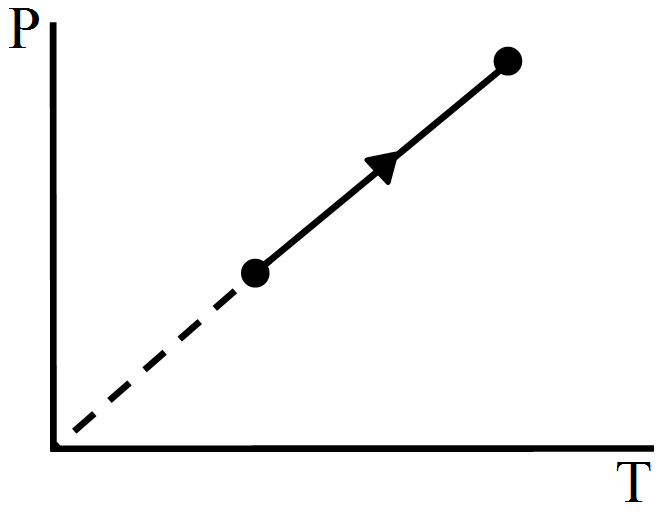
AnswerAccording to the graph, $P$ is directly proportional to $T.$
Applying the equation of state, we get,
$\text{PV = nRT}$
$=\frac{\text{nR}}{\text{V}}\text{T}$
Given: $\text{P}\propto\text{T}$
This means $\frac{\text{nR}}{\text{V}}$ is a constant.
So, $V$ is also a constant.
Constant $V$ implies the process is isochoric.
View full question & answer→MCQ 1151 Mark
Which of the following is not a postulate of kinetic theory of gases:
- ✓
The molecules of a gas are always at rest.
- B
The molecules of a gas are point masses.
- C
The molecules of a gas are perfectly elastic spheres.
- D
The molecules of a gas are identical.
AnswerCorrect option: A. The molecules of a gas are always at rest.
View full question & answer→MCQ 1161 Mark
When do real gases approach the ideal gas behaviour?
- ✓
At low pressure and high temperature
- B
At high pressure and high temperature
- C
At high pressure and low temperature
- D
At low pressure and low temperature
AnswerCorrect option: A. At low pressure and high temperature
View full question & answer→MCQ 1171 Mark
Keeping the number of moles, volume and temperature the same, which of the following are the same for all ideal gases?
AnswerPressure of an ideal gas is given by $\text{PV}=\frac{1}{3}\text{mnu}^2.$
We know that pressure depends on volume, number of molecules and root mean square velocity.
Also, root mean square velocity depends on the temperature of the gas.
Since the number of molecules, volume and temperature are constant, pressure of the gas will not change.
View full question & answer→MCQ 1181 Mark
Which of the following options is correct about the flow of a liquid?
- ✓
In liquids the atoms are not as rigidly fixed as in solid.
- B
In liquids the atoms are more rigidly fixed as in gas.
- C
In liquid the separation between atoms are spaced about.
- D
AnswerCorrect option: A. In liquids the atoms are not as rigidly fixed as in solid.
View full question & answer→MCQ 1191 Mark
A cubic vessel $($with face horizontal $+$ vertical$)$ contains an ideal gas at $\text{NTP.}$ The vessel is being carried by a rocket which is moving at a speed of $500\ ms^{-1}$ in vertical direction. The pressure of the gas inside the vessel as observed by us on the ground:
- A
Remains the same because $500\ ms^{-1}$ is very much smaller than $v_{rms}$ of the gas.
- ✓
Remains the same because motion of the vessel as a whole does not affect the relative motion of the gas molecules and the walls.
- C
Will increase by a factor equal to $\left(\mathrm{v}_{\mathrm{rms}}^2+(500)^2\right) / \mathrm{v}^2_{rms}$ where $v_{rms}$ was the original mean square velocity of the gas.
- D
Will be different on the top wall and bottom wall of the vessel.
AnswerCorrect option: B. Remains the same because motion of the vessel as a whole does not affect the relative motion of the gas molecules and the walls.
As the relative velocity of molecules with respect to the walls of container does not change in rocket, due to the mass of a molecule is negligible with respect to the mass of whole system and system of gas moves as a whole and $g = 0$ on molecule everywhere. The acceleration of rocket is also zero because rocket is moving with constant speed. Hence the pressure inside the vessel of gas as observed by us on the ground remains same.
View full question & answer→MCQ 1201 Mark
What is the number of molecules in $3$ cubic metre of a gas at $3\ \text{atm}\ 27^\circ C?$
- ✓
$2.17\times 10^{-20}$
- B
$6.38\times 10^{-20}$
- C
$3.86\times 10^{-20}$
- D
$4.58\times 10^{-20}$
AnswerCorrect option: A. $2.17\times 10^{-20}$
Using, $\text{PV = NkT}$
we get : $\text{N}=\frac{\text{PV}}{\text{KT}}$
$= \frac{(3\times3\times105)}{(1.38\times10^{-23}\times300)}$
$= 2.17\times 10^{-20}$
View full question & answer→MCQ 1211 Mark
For a gas, $\frac{\text{R}}{\text{C}_{\text{V}}}=0.67$ The gas is made up of molecules, which are:
Answer$\frac{\text{R}}{\text{C}_{\text{V}}}=0.67=\frac{2}{3}$
$\text{C}_{\text{V}}=\frac{3}{2}\text{R}$
View full question & answer→MCQ 1221 Mark
A vessel of volume $V$ contains a mixture of $1$ mole of hydrogen and $1$ mole of oxygen $($both considered as ideal$).$ Let $f_1\text{(v)dv}$ denotes the fraction of molecules with speed between $v$ and $(v + dv)$ with $f_2\text{(v)dv}$, similarly for oxygen. Then,
- A
$f_1(v) + f_2(v) = f (v)$ obeys the Maxwell’s distribution law.
- ✓
$f_1(v), f_2(v)$ will obey the Maxwell’s distribution law separately.
- C
Neither $f_1(v)$ nor $f_2(v)$ will obey the Maxwell’s distribution law.
- D
$f_2(v)$ and $f_1(v)$ will be the same.
AnswerCorrect option: B. $f_1(v), f_2(v)$ will obey the Maxwell’s distribution law separately.
Key concept: Maxwell’s Law $($or the Distribution of Molecular Speeds$):$
- The $v_{rms}$ gives us a general idea of molecular speeds in a gas at a given temperature.
This doesn’t mean that the speed of each molecule is $v_{rms}$. Many of the molecules have speed less than $v_{rms}$ and many have speeds greater than $v_{rms}$.
- Maxwell derived equation gives the distribution of molecules in different speeds as follows:
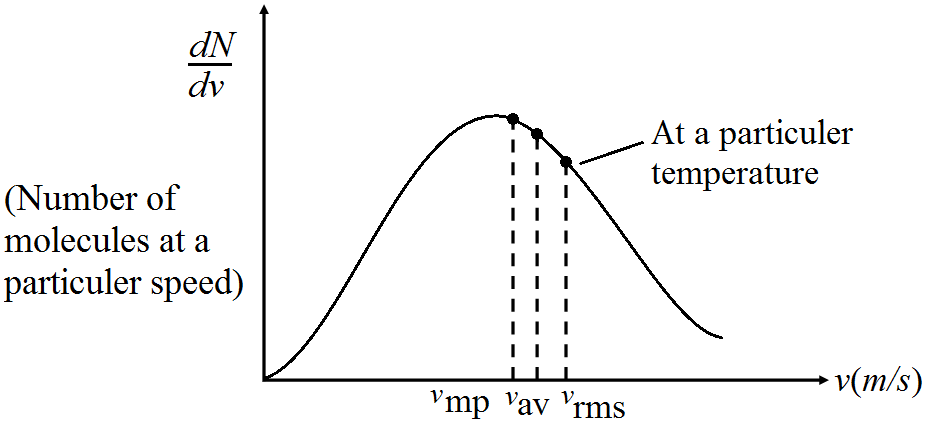
The masses of hydrogen and oxygen molecules are different.
For a function $f(v),$ the number of molecules $dn = f[v),$ which are having speeds between $v$ and $v + dv.$ The Maxwell$-$Boltzmann speed distribution function $(N_v = dn/ dv)$ depends on the mass of the gas molecules.
For each function $f_1(v)$ and $f_2(v), n$ will be different, hence each function $f_1(v)$ and $f_2(v)$ will obey the Maxwell’s distribution law separately. View full question & answer→MCQ 1231 Mark
Specific heat capacity of water is given by:
MCQ 1241 Mark
The state of greatest potential energy is:
MCQ 1251 Mark
The internal energy of a gram-molecule of an ideal gas depends on:
- A
- B
- ✓
- D
Both on pressure as well as temperature
View full question & answer→MCQ 1261 Mark
The pressure of an ideal gas is written as $\text{p}=\frac{2\text{E}}{3\text{v}}.$ Here $E$ refers to:
- ✓
Translational kinetic energy.
- B
Rotational kinetic energy.
- C
Vibrational kinetic energy.
- D
AnswerCorrect option: A. Translational kinetic energy.
According to the kinetic theory, molecules show straight line in motion $($translational$)$. So, the kinetic energy is essentially transitional.
View full question & answer→MCQ 1271 Mark
According to the kinetic theory of gases, the pressure exerted by a gas on the wall of the container is measured as:
- ✓
Rate of change of momentum imparted to the walls per second per unit area.
- B
Momentum imparted to the walls per unit area.
- C
Change of momentum imparted to the walls per unit area.
- D
Change in momentum per unit volume.
AnswerCorrect option: A. Rate of change of momentum imparted to the walls per second per unit area.
View full question & answer→MCQ 1281 Mark
Molecules of a ideal gas behave like:
AnswerCorrect option: A. Perfectly elastic rigid sphere
View full question & answer→MCQ 1291 Mark
Following gases are kept at the same temperature. Which gas possesses maximum r.m.s. speed?
AnswerOut of all gases, hydrogen gas has the minimum molecular mass, therefore hydrogen gas will have the highest $\text{r.m.s}$ speed.
View full question & answer→MCQ 1301 Mark
At what temperature the kinetic energy of gas molecule is half of the value at $27^\circ C\ ?$
- A
$13.5^\circ C$
- B
$150^\circ C$
- C
$75K$
- ✓
$-123^\circ C$
AnswerCorrect option: D. $-123^\circ C$
View full question & answer→MCQ 1311 Mark
At constant volume temperature is increased then:
- A
Collision on walls will be less
- ✓
Collision frequency will be increases
- C
Collision will be in straight line
- D
Collision will not change
AnswerCorrect option: B. Collision frequency will be increases
View full question & answer→MCQ 1321 Mark
The two gases with the ratio $3 : 2$ of their masses in a container are at a temperature $T.$ The ratio of the kinetic energies of the molecule of two gases is:
- A
$3 : 2$
- B
$9 : 4$
- ✓
$1 : 1$
- D
$4 : 9$
AnswerCorrect option: C. $1 : 1$
View full question & answer→MCQ 1331 Mark
During an adiabatic process, the pressure of a gas is proportional to the cube of its absolute temperature. The value of $\frac{\text{C}_{\text{p}}}{\text{C}_\text{v}}$ for that gas is:
- A
$\frac{3}{5}$
- ✓
$\frac{4}{3}$
- C
$\frac{5}{3}$
- D
$\frac{3}{2}$
AnswerCorrect option: B. $\frac{4}{3}$
View full question & answer→MCQ 1341 Mark
For hydrogen gas, $C_p-C_v=b$. The relation between $a$ and $b$ is:
- A
$a = 16b$
- B
$b = 16$
- ✓
$a = b$
- D
$a = 4b$
AnswerCorrect option: C. $a = b$
For any gas $C_P - C_V = R$
$\therefore a = b$
View full question & answer→MCQ 1351 Mark
According to law of equipartition of energy, in equilibrium the tot energy is equally distributed in all possible energy modes having an energy equal to:
- A
$\frac{3}{2}\text{KBT}$
- ✓
$\frac{1}{2}\text{KBT}$
- C
$\text{KBT}$
- D
$\frac{5}{2}\text{KBT}$
AnswerCorrect option: B. $\frac{1}{2}\text{KBT}$
View full question & answer→MCQ 1361 Mark
A room temperature the $\text{r.m.s.}$ velocity of the molecules of a certain diatomic gas is found to be $1930\ m/\sec$. the gas is:
- ✓
$H^2$
- B
$F^2$
- C
$O^2$
- D
$Cl^2$
View full question & answer→MCQ 1371 Mark
Consider the quantity $\frac{\text{MkT}}{\text{pV}}$ of an ideal gas where $M$ is the mass of the gas. It depends on the,
AnswerIn an ideal gas, the equation of state is given by
$\text{PV}=\text{nRT}$
$\Rightarrow\text{PV}=\text{nN}_\text{A}\frac{\text{R}}{\text{N}_\text{A}}\text{T}$
$\Rightarrow\text{PV}=\text{nN}_\text{A}\text{kT}$
$\Rightarrow\frac{1}{\text{nN}_\text{A}}=\frac{\text{kT}}{\text{PV}}$
Multiplying both sides by mass of the gas $M,$ we get
$\frac{\text{M}}{\text{nN}_\text{A}}=\frac{\text{MkT}}{\text{PV}}$
Now, $nN_A$ gives the total number of molecules of the gas.
Also, $\frac{\text{M}}{\text{nN}_\text{A}}$ gives the mass of a single molecule.
Hence, $\frac{\text{MkT}}{\text{PV}}$ is the mass of a single molecule of the gas,
Molecular mass is a property of the gas.
View full question & answer→MCQ 1381 Mark
A vessel $A$ volume $V$ and a vessel $B$ has volume $2V.$ Both contain some water which has a constant volume. The pressure in the space above water is $p_a$ for veesel $A$ and $p_b$ for vessel $B.$
- ✓
$\mathrm{p}_{\mathrm{a}}=\mathrm{p}_{\mathrm{b}}$
- B
$\mathrm{p}_{\mathrm{a}}=2\mathrm{p}_{\mathrm{b}}$
- C
$\mathrm{p}_{\mathrm{b}}=2 \mathrm{p}_{\mathrm{a}}$
- D
$\mathrm{p}_{\mathrm{b}}=4 \mathrm{p}_{\mathrm{a}}$
AnswerCorrect option: A. $\mathrm{p}_{\mathrm{a}}=\mathrm{p}_{\mathrm{b}}$
The maximum pressure attainable above the water will be saturated vapour pressure at that temperature. Since saturated vapour pressure does not depend upon volume, both the vessels will have same pressure.
View full question & answer→MCQ 1391 Mark
A container has $3$ gases whose mass ratio is $1:3:5.$ What is the ratio of mean square speed of the molecules of two gases? Their atomic masses are $20u, 30u\ \&\ 40u$ corresponding to the order in which the ratios are given.
- A
$2:3:4$
- ✓
$4:3:2$
- C
$2:\sqrt{3}:\sqrt{2}$
- D
$\sqrt{2}:\sqrt{3}:2$
AnswerCorrect option: B. $4:3:2$
Their average kinetic energies will be the same.
Thus, $\frac{1}{2}mv^2$ will be the same.
$\text{v}_1^2:\text{v}_2^2:\text{v}_3^2$
$= m_3:m_2:m_1$
$= 40:30:20$
$= 4:3:2.$
View full question & answer→MCQ 1401 Mark
Real gases obey ideal gas laws more closely at:
- A
Low pressure and low temperature.
- ✓
Low pressure and high temperature.
- C
High pressure and low temperature.
- D
High pressure and high temperature.
AnswerCorrect option: B. Low pressure and high temperature.
Real gases obey ideal gas laws at low pressure and high temperature because at low pressure the number of molecules per unit volume is less so attractive force between them is negligible.
At high temperature the speed of the molecules is very high so collisions becomes elastic.
View full question & answer→MCQ 1411 Mark
A sealed container with negligible thermal coefficient of expansion contains helium $($a monoatomic gas$).$ When it is heated from $300$ to $600K,$ the average kinetic energy of the helium atom is:
View full question & answer→MCQ 1421 Mark
The molecule of monoatomic gas has:
- A
Three rotational degrees of freedom.
- ✓
Three translational degrees of freedom.
- C
Two rotational degrees of freedom.
- D
Both $a$ and $b.$
AnswerCorrect option: B. Three translational degrees of freedom.
View full question & answer→MCQ 1431 Mark
Kinetic theory of gases provide a base for:
- ✓
Both Charle’s law and Boyle’s law
- B
- C
- D
AnswerCorrect option: A. Both Charle’s law and Boyle’s law
View full question & answer→MCQ 1441 Mark
In the gas equation $\text{PV = RT, V}$ is the volume of:
- ✓
$1$ mol of gas
- B
$1g$ of gas
- C
- D
$1$ litre of gas
AnswerCorrect option: A. $1$ mol of gas
For an Ideal Gas, $\text{PV = nRT}$
Here $V$ is the volume of $n$ moles of gas.
Thus for $\text{PV = (1)RT, V}$ is the volume of $1$ mol of gas.
View full question & answer→MCQ 1451 Mark
The specific heat capacity of solids is given by:
MCQ 1461 Mark
A perfect gas at $27^\circ C$ is heated at constant pressure so as to double its volume. The temperature of the gas will be:
- A
$300^\circ C$
- B
$54^\circ C$
- C
$600^\circ C$
- ✓
$327^\circ C$
AnswerCorrect option: D. $327^\circ C$
According to Charle's law, when $P$ is constant, $\text{T}\propto\text{V}$ As $V$ is doubled, $T$ becomes twice i.e.,
$T = 2 \times (17 + 273)K$
$= 600K$
$= 600 - 273$
$= 327^\circ C$
View full question & answer→MCQ 1471 Mark
Diatomic molecule $($rigid rotator$)$ has:
AnswerCorrect option: C. Both $(a)$ and $(b).$
The diatomic molecules $($without vibration mode$)$ like $O_2$ and $N_2$ has three translational degrees of freedom and two rotational degrees of freedom.
View full question & answer→MCQ 1481 Mark
The molecular kinetic energy of a liquid is:
- ✓
More than molecular kinetic energy of solids.
- B
More than molecular kinetic energy of gases.
- C
Less than molecular kinetic energy of solids.
- D
AnswerCorrect option: A. More than molecular kinetic energy of solids.
The inter$-$molecular attractions in liquids are lesser compared to solids. As, liquids can move freely due to less inter molecular attraction they have more molecular kinetic energy compared to solids.
View full question & answer→MCQ 1491 Mark
As temperature tends to zero i.e., $T \rightarrow 0$
- ✓
Specific heat of all substances approaches zero.
- B
Specific heat of all substances approaches infinity.
- C
Specific heat of all substances may be zero or infinity.
- D
AnswerCorrect option: A. Specific heat of all substances approaches zero.
View full question & answer→MCQ 1501 Mark
The gas which satisfies the equation $\text{PV = nRT}$ at all pressure and temperature is called as:
View full question & answer→