Questions · Page 1 of 2

2 Marks Questions

🎯

Test yourself on this topic

50 questions · timed · auto-graded

Question 12 Marks
Give the magnitude and direction of the net force acting on a stone of mass 0.1 kg , (Neglect air resistance throughout.) Just after it is dropped from the window of a train accelerating with $1 \mathrm{~ms}^{-2}$.
Answer
1 N ; vertically downward It is given that the train is accelerating at the rate of $1 \mathrm{~m} / \mathrm{s}^2$. Therefore, the net force acting on the stone, $\mathrm{F}^{\prime}=\mathrm{ma}=0.1 \times 1=0.1 \mathrm{~N}$ This force is acting in the horizontal direction. Now, when the stone is dropped, the horizontal force F', stops acting on the stone. This is because of the fact that the force acting on a body at an instant depends on the situation at that instant and not on earlier situations. Therefore, the net force acting on the stone is given only by acceleration due to gravity. $\mathrm{F}=\mathrm{mg}=1 \mathrm{~N}$ This force acts vertically downward.
View full question & answer
Question 22 Marks
Give the magnitude and direction of the net force acting on a stone of mass 0.1kg, (Neglect air resistance throughout.) Just after it is dropped from the window of a train running at a constant velocity of 36km/h.
Answer
1N; vertically downward The train is moving with a constant velocity. Hence, its acceleration is zero in the direction of its motion, i.e., in the horizontal direction. Hence, no force is acting on the stone in the horizontal direction. The net force acting on the stone is because of acceleration due to gravity and it always acts vertically downward. The magnitude of this force is 1N.
View full question & answer
Question 32 Marks
Give the magnitude and direction of the net force acting on a stone of mass 0.1 kg , (Neglect air resistance throughout.) Lying on the floor of a train which is accelerating with $1 \mathrm{~ms}^{-2}$, the stone being at rest relative to the train.
Answer
0.1 N ; in the direction of motion of the train, The weight of the stone is balanced by the normal reaction of the floor. The only acceleration is provided by the horizontal motion of the train. Acceleration of the train, $a=0.1 \mathrm{~m} / \mathrm{s}^2$ The net force acting on the stone will be in the direction of motion of the train. Its magnitude is given by: $\mathrm{F}=\mathrm{ma}=0.1 \times 1=$ 0.1 N
View full question & answer
Question 42 Marks
Give the magnitude and direction of the net force acting on a stone of mass 0.1kg, (Neglect air resistance throughout.) Just after it is dropped from the window of a stationary train.
Answer
1 N ; vertically downward Mass of the stone, $m=0.1 \mathrm{~kg}$ Acceleration of the stone, $a=g=10 \mathrm{~m} / \mathrm{s}^2$ As per Newton's second law of motion, the net force acting on the stone, $\mathrm{F}=\mathrm{ma}=\mathrm{mg}=0.1 \times 10=1 \mathrm{~N}$ Acceleration due to gravity always acts in the downward direction.
View full question & answer
Question 52 Marks
Is a 'single isolated force' possible in nature?
Answer
A single isolated force is not possible. This follows from Newton's third law of motion, according to which to every action, there is an equal and opposite reaction. So, the forces must always exist in pairs. When we talk of a single force, we are considering only one aspect of mutual interaction.
View full question & answer
Question 62 Marks
A tennis ball of mass 'm' strikes a massive wall with a velocity V and traces back the same path. Calculate the change in momentum of the ball due to the wall.
Answer
Let $\mathrm{m}_1=$ mass of ball $\mathrm{v}_1=$ velocity of ball $=v \mathrm{~m}_2=$ mass of wall $\mathrm{v}_2=$ velocity of wall $=0 \mathrm{~m}_2 \gg m_1$ ( $\mathrm{m}_1$ can be neglected) $\therefore$ Change in momentum of ball $=$ final momentum - initial momentum $=\mathrm{m}[\mathrm{v}-(-\mathrm{v})]=2 \mathrm{mv}$.
View full question & answer
Question 72 Marks
A monkey is ascending a branch with constant acceleration. If the breaking strength is 160% of the monkey's weight, what is the maximum acceleration permitted for the monkey?
Answer
Breaking strength $=\frac{160}{100}\text{mg},$ where m is the mass of the monkey. While ascending the apparent weight w = m(g + a).For safety, $\text{m(g + a)}\leq\frac{160}{100}\text{mg}$
$\therefore\ \text{a}\leq\Big(\frac{160}{100}-1\Big)\text{g,}$
$\text{i.e., a}\leq0.6\text{m/ s}^2.$
View full question & answer
Question 82 Marks
It is easier to pull a lawn roller than to push it. Why?
Answer
When we pull the lawn roller, the vertical component of the applied pull acts opposite to the weight of the roller and it reduces its effective weight. On the other hand, when the lawn roller is pushed, the vertical component of the applied push adds to the weight of the roller and therefore its effective weight increases. As the effective weight is lesser, when the lawn roller is pulled, it is easier to pull the lawn roller than to push it.
View full question & answer
Question 92 Marks
A woman throws an object of mass 500g with a speed of $25m s^1$. What is the impulse imparted to the object?
Answer
Mass of object m = 500 g = 0.5kg u = 0, v = 25m/ s Impulse $\vec{\text{F}}.\text{dt}=\frac{\text{d}\vec{\text{p}}}{\text{dt}}=\text{d}\vec{\text{p}}=\text{m}\vec{\text{v}}-\text{m}\vec{\text{u}}$ $\text{I}=\Delta\vec{\text{p}}=\text{m}(\vec{\text{v}}-\vec{\text{u}})=0.5(25.5)\text{N}-\text{s}$
View full question & answer
Question 102 Marks
A person of mass 50 kg stands on a weighing scale on a lift. If the lift is descending with a downward acceleration of $9 \mathrm{~m} \mathrm{~s}^{-2}$, what would be the reading of the weighing scale? $\left(\mathrm{g}=10 \mathrm{~m} \mathrm{~s}^{-2}\right)$
Answer
When lift is descending with acceleration a, the apparent weight decreases on weighing scale $\therefore\text{W}'=\text{R}=(\text{mg}-\text{ma})=\text{m}(\text{g}-\text{a})$ Apparent weight due to reaction force by the lift on weighing scale. $\therefore\text{W}'=50(10-9)=50\text{N}$ Reading of weighing scale $=\frac{\text{R}}{\text{g}}=\frac{50}{10}=5\text{kg}$
View full question & answer
Question 112 Marks
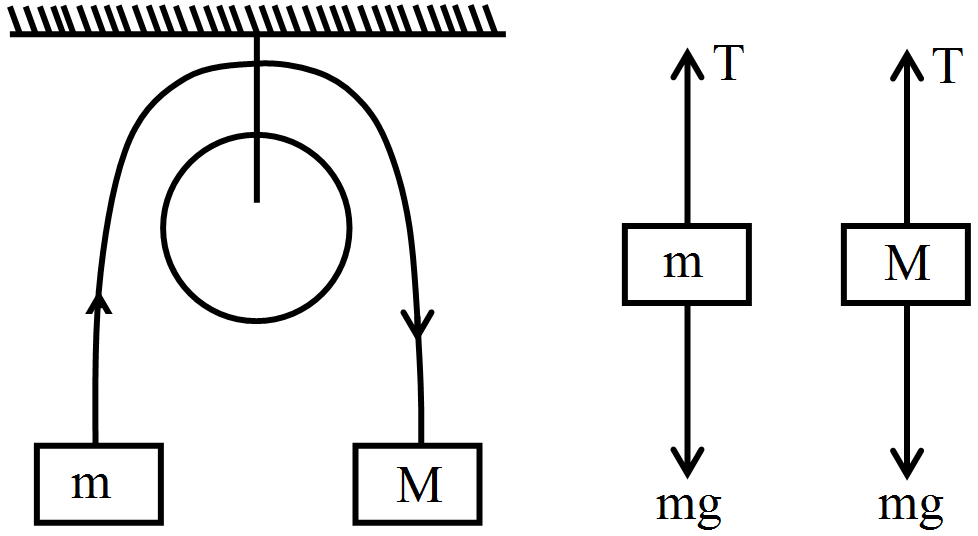
Two masses M and m are connected at the two ends of an inextensible, light string. The string passes over a smooth frictionless pulley. Calculate the acceleration of the masses and the tension in the string. M is heavier than m.
Answer
The pulley is frictionless, massless and fixed. The free body diagram for the two masses are shown along with the equation. Mg - T = Ma T - mg = ma Solving the equation, we get $\text{a}=\frac{(\text{M}-\text{m})\text{g}}{\text{M}+\text{m}}$ and $\text{T}=\frac{(2\text{Mm})\text{g}}{\text{M}+\text{m}}$
View full question & answer
Question 122 Marks
Write the three laws of motion.
Answer
  1. A body at rest or uniform motion will continue to maintain the status, till an unbalanced force acts on it.
  2. The rate of change of momentum is a measure of the force acting on the body.
Alternate Answer
The total unbalanced external force acting on a body is the product of its mass and acceleration.
  1. For every action there exists an equal and opposite reaction.
View full question & answer
Question 132 Marks
Is friction a necessary evil? Justify.
Answer
Friction opposes the motion and brings wear and tear. But without friction one cannot stop any body.
View full question & answer
Question 142 Marks
A aircraft executes horizontal loop of radius 1.00km with a steady speed of 900km/ h. Compare its centripetal acceleration with the acceleration due to gravity (g).
Answer
Radius of the loop, $\mathrm{r}=1 \mathrm{~km}=1000 \mathrm{~m}$ Speed of the aircraft, $\mathrm{v}=900 \mathrm{~km} / \mathrm{h}=900 \times \frac{5}{18} \mathrm{~m} / \mathrm{s}=250 \mathrm{~m} / \mathrm{s}$ Centripetal acceleration, $\mathrm{a}_{\mathrm{c}}=\frac{\mathrm{v}^2}{\mathrm{r}}=\frac{62500}{1000}=62.5 \mathrm{~m} /$ sAcceleration due to gravity, $\mathrm{g}=9.8 \mathrm{~m} / \mathrm{s}^2$
$\therefore \frac{a_c}{g}=\frac{62.5}{9.8}=6.38 \mathrm{~g} \simeq 6.4 \mathrm{~g}$
View full question & answer
Question 152 Marks
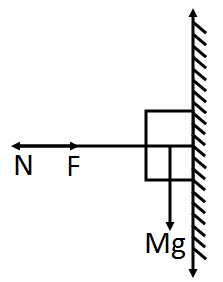
A block of mass M is held against a rough vertical wall by pressing it with a finger. If the coefficient of friction between the block and the wall is $\mu$ and the acceleration due to gravity is g, calculate the minimum force required to be applied by the finger to hold the block against the wall?
Answer
Let F force is applied by the finger on a body of mass M to hold rest against the wall. Under the balanced condition $\text{F}=\text{N} $ and $\text{f}=\text{Mg}$$\Rightarrow\mu\text{F}=\text{Mg}$ or $\text{F}=\frac{\text{Mg}}{\mu}$ is the minimum force to hold the block against the wall at rest.
View full question & answer
Question 162 Marks
A person driving a car suddenly applies the brakes on seeing a child on the road ahead. If he is not wearing seat belt, he falls forward and hits his head against the steering wheel. Why?
Answer
When a person applies breaks suddenly, the lower part of person slows rapidly with the car, but the upper part of driver continue to move with same speed in the same direction due to the inertia of motion and his head car hit with steering.
View full question & answer
Question 172 Marks
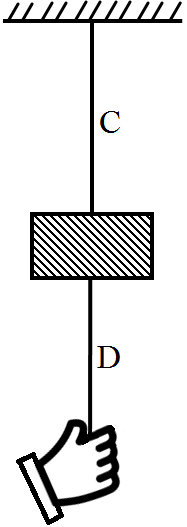
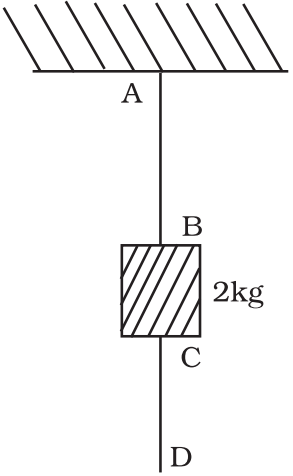
A mass of 2kg is suspended with thread AB Thread CD of the same type is attached to the other end of 2kg mass. Lower thread is pulled gradually, harder and harder in the downward directon so as to apply force on AB. Which of the threads will break and why?
Answer
Thread AB will break. Force on CD is equal to the force (f) applied at D downward, but the force on thread AB is equal to the force F along with force due to mass 2kg downward. so the force on AB is 2kg more than applied force at D.Hence the thread AB will break up.
View full question & answer
Question 182 Marks
What are the three Newtons Laws of Motion.
Answer
Newton's First Law of Motion : Every body continues to be at rest or in motion until or unless it is compelled by an external force. Newton's Second Law of Motion : The rate of change of momentum of a body is directly proportional to the force applied and in the same direction as the force is applied. Newton's Third Law of Motion : To every action there is equal and opposite reaction.
View full question & answer
Question 192 Marks
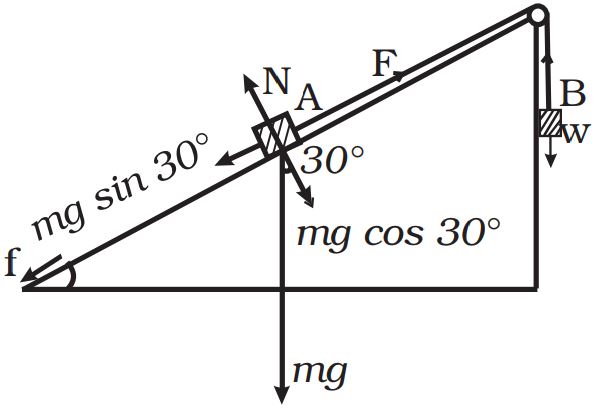
Block A of weight 100N rests on a frictionless inclined plane of slope angle 30° A flexible cord attached to A passes over a frictonless pulley and is connected to block B of weight W. Find the weight W for which the system is in equilibrium.
Answer
Main concept used: On balanced condition i.e., no motion then no frictional force or f = 0 Explanation: During equilibrium of A or B $\text{mg}\sin30^\circ=\text{f}$ $\frac{1}{2}\text{mg}=\text{F}\ [\because\text{mg}=100\ \text{N}]$ $\therefore\text{F}=\frac{1}{2}\times100=100=50$ For B is at rest W = F =50N.
View full question & answer
Question 202 Marks
A nucleus is at rest. All of a sudden it splits into two small nuclei. What is the angle at which these two nuclei fly apart?
Answer
Let $M=$ mass of nucleus at rest, $\therefore$ Momentum of the nucleus before disintegration $=M \times 0=0$, Let $m_1$ and $m_2$ be the mass of the two smaller nuclei and $v_1$ and $v_2$ be their velocities. $\therefore$ Momentum of the nucleus after disintegration $=m_1 v_1+m_2 v_2$. According to the law of conservation of linear momentum $m_1 v_1+m_2 v_2=0 m_1 v_1=-m_2 v_2 \cdot \mathbf{O R}$ The -ve sign shows that the velocities $\mathrm{v}_1$ and $\mathrm{v}_2$ must be opposite sign i.e., the two products must be emitted in opposite direction. Thus, the angle between two nuclei is $180^{\circ}$.
View full question & answer
Question 212 Marks
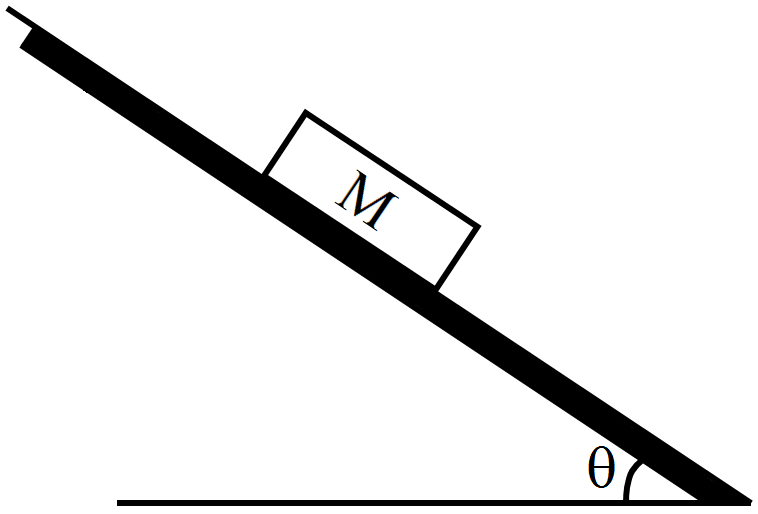
A block of mass M is placed on a frictionless, inclined plane of angle $\theta,$ as shown in the figure. Determine the acceleration of the block after it is released. What is force exerted by the incline on the block?
Answer
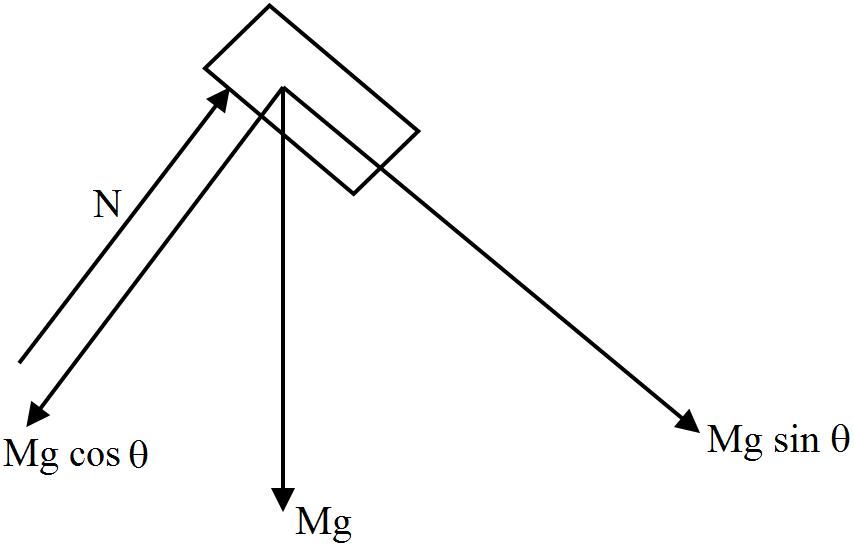
When the block is released, it will move down the incline. Let its acceleration be a. As the surface is frictionless, so the contact force will be normal to the plane. Let it be N. Here, for the block we can apply equation for motion along the plane and equation for equilibrium perpendicular to the plane. i.e., $\text{Mg}\sin\theta=\text{Ma}\Rightarrow\text{a}=\text{g}\sin\theta$ Also, $\text{Mg}\cos\theta-\text{N}=0$ $\Rightarrow\text{N}=\text{Mg}\cos\theta.$

View full question & answer
Question 222 Marks
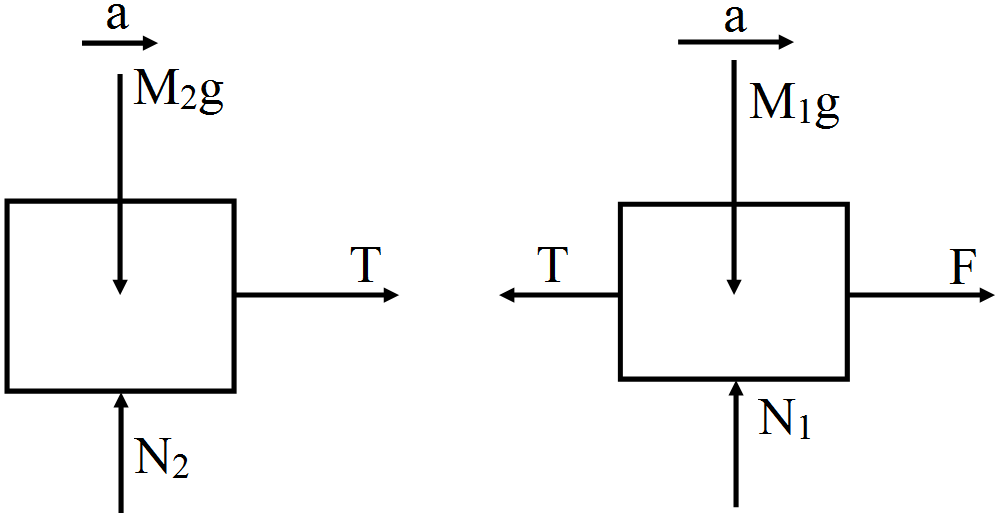
A light, inextensible string as shown in figure connects two blocks of mass $M_1$ and $M_2$. A force F as shown acts upon $M_1$. Find acceleration of the system and tension in string.
Answer
Here as the string is inextensible, acceleration of two blocks will be same. Also, string is massless so tension throughout the string will be same. Contact force will be normal force only. Let acceleration of each block is a, tension in string is T and contact force between $M_1$ and surface is $N_1$ and contact force between $M_2$ and surface is $N_2$. Applying Newton's second law for the blocks; For $M_1, F - T = M_1a$ ...(i) $m_1g - N_1 = 0$ ...(ii) For $M_2, T = M_2a$ ...(iii) $M_2g - N_2 = 0$ ...(iv) Solving equations (i) and (iii) $\text{a}=\frac{\text{F}}{\text{M}_1\text{M}_2}$ and $\text{T}=\frac{\text{M}_2\text{F}}{\text{M}_1+\text{M}_2}$
View full question & answer
Question 232 Marks
Why does a gun recoil? Derive the recoil velocity of a gun.
Answer
Since no external force acts on gun, the momentum has to be conserved. So the gun recoils. If $m_g$ and $m_b$ are the mass of gun and bullet with velocity of bullet being $\mathrm{V}_{\mathrm{b}}$ then $\mathrm{m}_{\mathrm{g}} \mathrm{v}_{\mathrm{g}}+\mathrm{m}_{\mathrm{b}} \mathrm{v}_{\mathrm{b}}=0, \therefore \mathrm{v}_{\mathrm{g}}=-\frac{\mathrm{m}_{\mathrm{b}} \mathrm{v}_{\mathrm{b}}}{\mathrm{m}_{\mathrm{g}}}$-ve sign means that the gun moves opposite to the direction of the bullet.
View full question & answer
Question 242 Marks
A hammer of mass 1kg strikes on the head of a nail with a velocity of $10m s^{-1}7$.It drives the nail 1cm into a wooden block. Calculate the force applied by the hammer and the time of impact.
Answer
Here mass of hammer $M=1 \mathrm{~kg}$, when hammer strikes the nail with a velocity of $10 \mathrm{~ms}^{-1}$ and as mass of nail is extremely small, hence nail also starts moving with same velocity. Thus, for nail $\mathrm{u}=10 \mathrm{~ms}^{-1}, \mathrm{v}=0$ and $\mathrm{s}=1 \mathrm{~cm}=$ 0.01 m . Using the relation $\mathrm{v}^2-\mathrm{u}^2=2$ as, we get $(0)^2-(10)^2=2 \times \mathrm{a} \times(0.01) \Rightarrow \mathrm{a}=-\frac{10 \times 10}{2 \times 0.01}=-5 \times 10^3 \mathrm{~ms}^{-2}$ and using relation $\mathrm{v}=\mathrm{u}+$ at, we have $0=10-5 \times 10^{-3} \cdot \mathrm{t} \Rightarrow \mathrm{t}=\frac{10}{5 \times 10^3}=2 \times 10^{-3} \mathrm{~s}$ or $2 \mathrm{~ms} . \therefore$ Force exerted by the hammer on the nail $\frac{\Delta \mathrm{p}}{\Delta \mathrm{t}}=\frac{\mathrm{Mu}-0}{\Delta \mathrm{t}}=\frac{1 \times 10}{2 \times 10^{-3}}=5 \times 10^3 \mathrm{~N}$.
View full question & answer
Question 252 Marks
Name the fundamental forces of nature.
Answer
Gravitational force, Nuclear force, Electro-magnetic force and weak forces.
View full question & answer
Question 262 Marks
A block is supported by a cord C from a rigid support, and another cord D is attached to the bottom of the block. If you give a sudden jerk to D, it will break. But if you pull on D steadily, C will break. Why?
Answer
String C breaks because C is stretched more than D. This is because C was already in stretched state due to large weight. When D is given a jerk, the load will receive only a small acceleration due to its large mass. Thus, C will not be further stretched but D will exceed the safe limit and break.
View full question & answer
Question 272 Marks
Derive the law of conservation of liner momentum from Newton's third law of motion.
Answer
According to third law, for every action there is an equal and opposite reaction. So, if $\mathrm{dP}_1$ and $\mathrm{dP}_2$ are change in momentum of two masses $\mathrm{m}_1$ and $\mathrm{m}_2$ then $\frac{\mathrm{dP}_1}{\mathrm{dt}}=-\frac{\mathrm{dP}_2}{\mathrm{dt}}$ Since, $\mathrm{F}_1=-\mathrm{F}_2 \therefore-\frac{\mathrm{d}}{\mathrm{dt}}\left(\mathrm{P}_1+\mathrm{P}_2\right)=0$ i.e., $\mathrm{P}_1+\mathrm{P}_2=$ constant.
View full question & answer
Question 282 Marks
Is earth an inertial frame of reference?
Answer
Since earth rotates about its own axis and also revolve round the sun, there will be acceleration associated. So earth cannot be taken as an inertial frame of reference (strictly).
View full question & answer
Question 292 Marks
Give the magnitude and direction of the net force acting on a stone of mass 0.1 kg , (Neglect air resistance throughout.) Just after it is dropped from the window of a train accelerating with $1 \mathrm{~ms}^{-2}$.
Answer
1 N ; vertically downward It is given that the train is accelerating at the rate of $1 \mathrm{~m} / \mathrm{s}^2$. Therefore, the net force acting on the stone, $\mathrm{F}^{\prime}=\mathrm{ma}=0.1 \times 1=0.1 \mathrm{~N}$ This force is acting in the horizontal direction. Now, when the stone is dropped, the horizontal force $\mathrm{F}^{\prime}$, stops acting on the stone. This is because of the fact that the force acting on a body at an instant depends on the situation at that instant and not on earlier situations. Therefore, the net force acting on the stone is given only by acceleration due to gravity. $\mathrm{F}=\mathrm{mg}=1 \mathrm{~N}$ This force acts vertically downward.
View full question & answer
Question 302 Marks
A particle of mass 200g is whirled into a vertical circle of radius 80cm using a massless string. The speed of particle when the string makes an angle $60^\circ$ with the vertical line is $1.5ms^{-1}$ What is the tension in the string is this position?
Answer
Here, m = 200g = 0.2kg r = 80cm = 0.8m $\text{v}=1.5\text{ms}^{-1}$ $\theta=60^\circ$ $\therefore$ Required tensionin the string $\text{T}=\frac{\text{mV}^2}{\text{r}}+\text{mg}\cos\theta$ $=\frac{0.2\times(1.5)^2}{0.8}+0.2\times10\times\cos60^\circ$ $\frac{2.25}{4}+0.2\times10\times\frac{1}{2}$ $=0.56+1=1.56\text{N}$
View full question & answer
Question 312 Marks
A body of mass 500 g tied to a string of length 1 m is revolved in the vertical circle with a constant speed. Find the minimum speed at which there will not be any slack on the string. Take $\mathrm{g}=10 \mathrm{~m} \mathrm{~s}^{-2}$.
Answer
The tension T in the string will provide the necessary centripetal force $\frac{\text{mv}^2}{\text{r}}$ i.e., $\text{T}=\frac{\text{mv}^2}{\text{r}}$ Here, $\text{m}=500\text{g}=\frac{1}{2}\text{kg};\text{ r}=1\text{m}$ $\therefore\text{T}=\frac{1}{2}\text{v}^2\text{ N}$ There will not be slack if $\text{T}\geq$ Weight of the body. i.e., $\text{T}\geq\text{mg}$ or $\frac{1}{2}\text{v}^2\geq\frac{1}{2}\times10$ So, the minimum speed $=\sqrt{10}\text{m s}^{-1}=3.162\text{m }\text{s}^{-1}.$
View full question & answer
Question 322 Marks
Give some ways by which the friction can be reduced.
Answer
  1. Polishing the surfaces.
  2. Lubricating the surfaces.
  3. Streamlining of bodies.
  4. Use of ball bearings.
View full question & answer
Question 332 Marks
Find the minimum force required to pull a body up a rough inclined plane $(\theta,\mu).$
Answer
As the mass has to be pulled up, the component of force of gravity and the force of friction act downward. Therefore, the minimum force required is, $(\text{mg}\sin\theta+\mu\text{ mg}\cos\theta).$
View full question & answer
Question 342 Marks
A car of mass 1000 kg moving with a speed of $30 \mathrm{~ms}^{-1}$ collides with the back of a stationary lorry of mass 9000 kg . (Fig.).Calculate the speed of the vehicles immediately after the collision if they remain jammed together.
Answer
Using conservation of momentum, $(1000+9000)\text{v}=1000\times30+9000\times0$ or $\text{V}=\frac{1000\times30}{10000}\text{m/s}^{-1}=\text{3ms}^{-1}.$
View full question & answer
Question 352 Marks
Give the magnitude and direction of the net force acting on a stone of mass 0.1kg, (Neglect air resistance throughout.) Just after it is dropped from the window of a train running at a constant velocity of 36km/h.
Answer
1N; vertically downward The train is moving with a constant velocity. Hence, its acceleration is zero in the direction of its motion, i.e., in the horizontal direction. Hence, no force is acting on the stone in the horizontal direction. The net force acting on the stone is because of acceleration due to gravity and it always acts vertically downward. The magnitude of this force is 1N.
View full question & answer
Question 362 Marks
Give the magnitude and direction of the net force acting on a stone of mass 0.1 kg , (Neglect air resistance throughout.) Lying on the floor of a train which is accelerating with $1 \mathrm{~ms}^{-2}$, the stone being at rest relative to the train.
Answer
0.1 N ; in the direction of motion of the train, The weight of the stone is balanced by the normal reaction of the floor. The only acceleration is provided by the horizontal motion of the train. Acceleration of the train, $a=0.1 \mathrm{~m} / \mathrm{s}^2$ The net force acting on the stone will be in the direction of motion of the train. Its magnitude is given by: $\mathrm{F}=\mathrm{ma}=0.1 \times 1=$ 0.1 N
View full question & answer
Question 372 Marks
Give one argument in favour of the fact that frictional force is a non conservative force.
Answer
The direction of the frictional force is opposite to the direction of motion. When a body is moved, say from A to B and then back to A, work is required to be done both during forward and backward motion. So, the net work done in a round trip is not zero. Hence, the frictional force is a non-conservative force.
View full question & answer
Question 382 Marks
What is the apparent weight felt by a person in an elevator, when it is accelerating $(i)$ upward by $'a\ '\  (ii)$ downward by $'a\ '\ ?$
Answer
  1. Apparent weight $= m(g + a).$
  2. Apparent weight $= m(g - a).$
View full question & answer
Question 392 Marks
Define centripetal force. A cyclist speeding at 18km/ hr on a level road takes a sharp circular turn of radius 3m without reducing the speed. The coefficient of static friction is 0.1. Will the cyclist slip while taking the turn?
Answer
The force on the body towards the centre while it is moving is a circular path. The condition for the cyclist not to slip is $\text{V}^2\leq\mu_\text{s}\times\text{R}\times\text{g}$ $\text{V}^2\leq0.1\times3\times9.8$ $\text{V}^2=2.94\text{m}^2/\text{s}^2$ But the speed of the cyclist is $18\text{km}/\text{hr}=5\text{m}/\text{s}$ $\therefore\text{V}^2=25\text{m}^2/\text{s}^2$ $\therefore$ The condition is not obeyed $\therefore$ The cyclist will slip.
View full question & answer
Question 402 Marks
Two bodies of mass M and m (M > m) are allowed to fall freely from the same height. If air resistance for each body be same which one reach the ground first?
Answer
The heavier body will reach the ground earlier. Net downward force on mass, M = mg - F$\Rightarrow\ \text{a}'=\frac{\text{Mg}-\text{F}}{\text{M}}$
Similarly for mass (m),$ \text{a}'=\frac{\text{Mg}-\text{F}}{\text{m}}$
F is same on both as M > m ⇒ a > a'
View full question & answer
Question 412 Marks
A bird is sitting on the floor of a closed glass cage and the cage is in the hand of a girl. Will the girl experience any change in the weight of the cage when the bird
  1. Starts flying in the cage with a constant velocity;
  2. Flies upwards with acceleration.
  3. Flies downwards with acceleration?
Answer
In a closed glass cage, air inside is bound with the cage. Therefore,
  1. There would be no change in weight of the cage if the bird flies with a constant velocity.
  2. The cage becomes heavier, when bird flies upwards with an acceleration.
  3. The cage appears lighter, when bird flies downwards with an acceleration.
View full question & answer
Question 422 Marks
A passenger of mass $72.2\ kg$ is riding in an elevator while standing on a platform scale. What does the scale read when the elevator cab is:
  1. Descending with constant velocity,
  2. Ascending with constant acceleration, $3.5\ m/ s$?
Answer
Given, mass, $\mathrm{m}=72.2 \mathrm{~kg}$
Gravity acceleration, $\mathrm{g}=9.8 \mathrm{~m} / \mathrm{s}^2$
Scale reading $=$ apparent weight $=\mathrm{R}= ?$
i. While descending with constant velocity, $\mathrm{a}=0$
$R=m g$
$R=72.2 \times 9.8$
$R=707.56 \mathrm{~N}$
ii. While ascending with $a=3.2 \mathrm{~m} / \mathrm{s}$
$R=m(g+a)$
$R=72.2(9.8+3.2)$
$=938.6 \mathrm{~N}$
View full question & answer
Question 432 Marks
A cyclist speeding at 18km/ h on a level road takes a sharp circular turn of radius 3m without reducing the speed. The co-efficient of static friction between the tyres and road is 0.1. Will the cyclist slip while taking the turn? Explain.
Answer
The maximum velocity with which a vehicle can go round a level curve, without skidding is, Given radius r = 3m, $\mu_\text{s}=0.1$ and $\mathrm{v}=18 \mathrm{kmh}^{-1} \text{V}_\text{max}=\sqrt{\mu_\text{s}\text{rg}}=\sqrt{0.1\times3\times10}$
= 1.732m/ s This is the maximum velocity with which cyclist can take turn. But, the velocity of the cyclist = 18km/ h $=18\times\frac{5}{18}\text{m/ s}=5\text{m/ s}$ Hence cyclists will slip.
View full question & answer
Question 442 Marks
Why is it necessary to keep the rate of fuel consumption in a rocket constant?
Answer
If the rate of fuel consumption is not kept the same, the energy produced every moment will be different and may lead to problem of controlling large energy or accelerating the rocket.
View full question & answer
Question 452 Marks
Give the magnitude and direction of the net force acting on a stone of mass 0.1kg, (Neglect air resistance throughout.) Just after it is dropped from the window of a stationary train.
Answer
1 N ; vertically downward Mass of the stone, $m=0.1 \mathrm{~kg}$ Acceleration of the stone, $a=g=10 \mathrm{~m} / \mathrm{s}^2$ As per Newton's second law of motion, the net force acting on the stone, $F=m a=m g=0.1 \times 10=1 \mathrm{~N}$ Acceleration due to gravity always acts in the downward direction.
View full question & answer
Question 462 Marks
To what angle a cyclist has to bend to negotiate a curved path? Derive an expression.
Answer
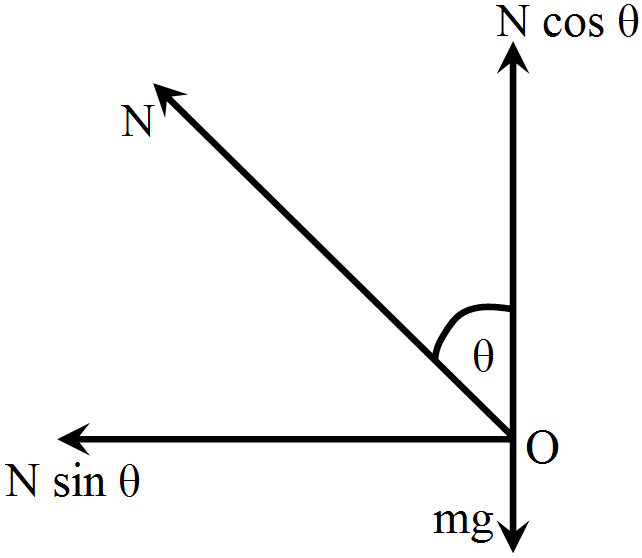
As the cyclist leans by an angle $\theta$ with the vertical, the normal can be acting as shown. If v is the speed of the cyclist, the necessary centripetal force is provided by the component $\text{N}\sin\theta$ of normal reaction and $\text{N}\cos\theta$ provides balancing for weight. $\therefore\ \text{N}\sin\theta=\frac{\text{mv}^2}{\text{r}},$ $\text{N}\cos\theta=\text{mg}$ Dividing, $\tan\theta=\frac{\text{v}^2}{\text{rg}}$ $\Rightarrow\ \theta=\tan^{-1}\Big(\frac{\text{v}^2}{\text{rg}}\Big)$
View full question & answer
Question 472 Marks
Find the acceleration with a mass sliding down an inclined plane $(\theta)$ with coefficient of friction $\mu.$
Answer
As the mass slides down, the force of friction, will act in the upward direction along the plane. The net force acting will be, $(\text{mg}\sin\theta-\mu\text{ mg}\cos\theta).$ Therefore, the acceleration is $\text{g}(\sin\theta-\mu\cos\theta).$
View full question & answer
Question 482 Marks
What is the principle behind the launch of rockets?
Answer
The principle behind the launch of rockets is the law of conservation of momentum. The change in momentum with the burnt fuel provides momentum to the rocket.
View full question & answer
Question 492 Marks
Air is thrown on a sail attached to a boat from an electric fan placed on the boat. Will the boat start moving?
Answer
No, when the fan pushes the sail by air, then air also pushes the fan in the opposite direction. Since fan is placed on the boat, the vector sum of linear moments of fan and the boat is zero. The boat can move only under the force of reaction from some external agency.
View full question & answer
Question 502 Marks
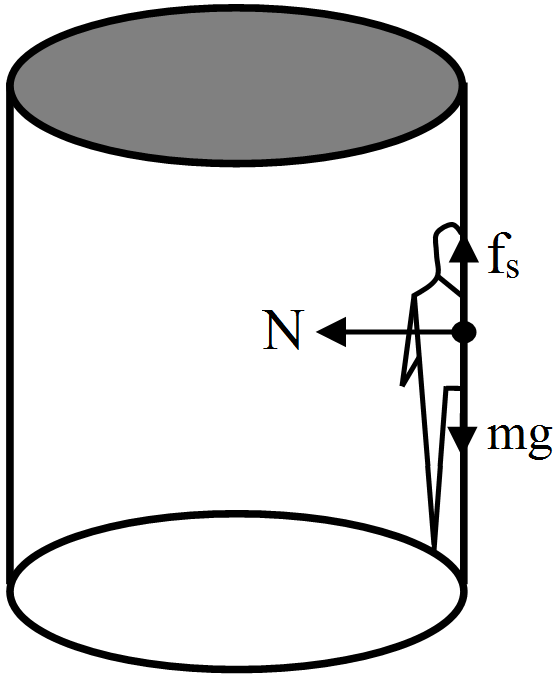
In a rotor, a hollow vertical cylinder rotates about its axis and a person rests against the inner wall. At a particular speed of the rotor, the floor below the person is removed and the person hangs resting against the wall without any floor. If the radius of the rotor is $2m$ and the coefficient of static friction between the wall and the person is $0.2.$
  1. Find the minimum speed at which the floor may be removed.
  2. What type of speciality is associated with this question? $[$take, $g = 10m/ s^2]$
Answer
The situation is shown in figure below:
  1. When the floor is removed, the forces on the person are:
  • Weight mg downward.
  • Normal force $N$ due to the wall towards the centre.
  • Frictional force $f$, parallel to the wall, upwards.
The person is moving in a circle with a uniform speed, so its acceleration is $v?$ Ir towards the centre.
Newton's law for the horizontal direction $($second law$)$ and for the vertical direction $($first law$)$ give
$N = mv^{2/ r}$ and,
$f_s = mg$
For the minimum speed, when the floor may be removed, the friction is limiting one and, so equals $\mu_\text{s}\text{N}.$
This given $\mu_\text{s}\text{N}=\text{mg}$
or $\frac{\mu_\text{s}\text{mv}^2}{\text{r}}=\text{mg} [$using Eq. $(i)]$
or $\text{v}=\sqrt{\frac{\text{rg}}{\mu_\text{s}}}=\sqrt{\frac{2\text{m}\times10\text{ms}^2}{0.2}}=10\text{ms}.$
  1. Speciality is that without the floor an object a body may be $0$ align with a vertical wall provided, it is set to be in circular motion $($horizontal$)$ with properly required speed.
View full question & answer
2 Marks Questions - Physics STD 11 Science Questions - Vidyadip